B2B AEPS Platform: Features, Benefits & Complete Guide
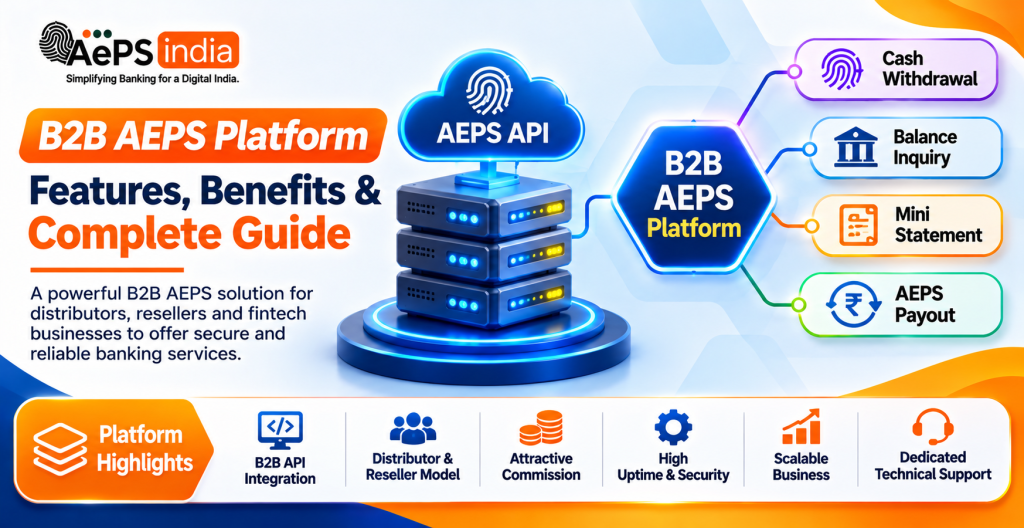
The digital banking industry in India is growing rapidly, creating new opportunities for fintech companies, payment service providers, distributors, and retailers. A B2B AEPS Platform is an essential technology solution for businesses looking to offer Aadhaar Enabled Payment System (AEPS) services and expand their digital banking network across India.
With a reliable B2B AEPS Platform, businesses can provide essential banking services such as Aadhaar-based cash withdrawal, balance enquiry, mini statement, and Aadhaar Pay through an integrated digital Aeps platform. It enables fintech businesses to connect with retailers, distributors, and banking service networks while managing transactions through a centralized system.
A B2B AePS (Aadhaar Enabled Payment System) Platform is a white label or API-driven digital banking solution that allows businesses, fintech startups, distributors, and micro-entrepreneurs to offer basic banking services through their own retail or agent networks.
AEPS India provides information and solutions for businesses looking to establish or expand their AEPS operations with a structured B2B banking platform. Whether you are a fintech entrepreneur, master distributor, distributor, retailer, or payment service provider, choosing the right AEPS infrastructure is an important step towards building a scalable digital banking business.
A professional B2B AEPS software solution should offer more than basic transaction processing. It should include a user-friendly retailer panel, distributor management system, master admin dashboard, wallet management, commission configuration, transaction monitoring, automated reporting, and Aeps API integration capabilities.
Businesses can also explore white label AEPS platforms to operate under their own brand identity, manage their distribution networks, and offer digital banking services through their own business ecosystem.
In this guide, we will explain everything about a B2B AEPS Platform, including how it works, its essential features, AEPS API integrate, white label Aeps solution, distributor and retailer management, business opportunities, and the important factors to consider before selecting an AEPS platform in India.
What Is a B2B AEPS Platform?
A B2B AEPS platform is business software that lets companies, distributors, and retail agents offer Aadhaar Enabled Payment System (AEPS) banking services to customers using biometric authentication. Built on India’s NPCI-led AEPS framework, it provides a centralized system to manage agent networks, transactions, commissions, and settlements.
B2B AEPS Platform Work
A B2B AEPS (Aadhaar Enabled Payment System) platformlets a business act as a micro-banking service provider or run a white-label fintech network. It allows local retail stores and customer service points (CSPs) to offer basic banking services using biometric authentication.
How a B2B AEPS Platform Works
- Hierarchy & Network Management: The Aeps system operates on a multi-layer structure (Admin, White-Label, Super Distributor, Distributor, and Retailer/CSP). Admins or white-label owners control the Aeps platform, commission slabs, and wallet balances.
- Customer Request: A walk-in customer visits a local retailer and provides their 12-digit Aadhaar number, selects their bank name, and specifies the transaction type (e.g., cash withdrawal or balance inquiry).
- Biometric Authentication: The customer places their finger on a connected biometric scanner (such as a Mantra device).
- NPCI & Bank Routing: The B2B Aeps platform securely encrypts and routes the transaction through the National Payments Corporation of India (NPCI) network to UIDAI and the customer’s bank for verification.
- Settlement & Commission: Upon approval, the cash is dispensed or transferred, and commissions are automatically credited through a multi-wallet or automated settlement system.
Why Is a B2B AEPS Platform Important for Fintech Businesses?
A B2B AePS (Aadhaar Enabled Payment System) platform is essential for fintech businesses because it transforms local retailers and Business Correspondents (BCs) into assisted banking touchpoints, driving revenue, scale, and financial inclusion.
Key Reasons Why a B2B AePS Platform is Important
- Network and Multi-Level Management: A robust B2B Aeps platform allows fintechs to efficiently manage a multi-tiered hierarchy including master distributors, distributors, and local retailers from a centralized Aeps admin dashboard. Learn more about setting up these structures through a specialized B2B AEPS Software platform.
- Financial Inclusion in Underserved Areas: It bridges the gap between traditional banking infrastructure and remote or rural communities where physical bank branches and ATMs are scarce. Retailers act as mini-banks offering basic cash withdrawals, balance inquiries, and mini-statements. Explore how these networks operate via AEPS B2B Portal.
- Seamless Scalability and Automation: Managing thousands of agents manually is impossible as a fintech grows. A centralized B2B architecture automates retailer onboarding, commission calculations, wallet settlements, and ledger management. Review solutions for building scalable systems at AEPS B2B Software.
- Fast and Secure Biometric Authentication: Transactions rely on UIDAI-certified Aeps fingerprint or Aeps iris scans, eliminating physical cards, PINs, and the fraud risks associated with paper-based or cash-heavy methods.
- New Revenue Streams and Cross-Selling: For a fintech startup or aggregator, AePS acts as an entry-level service that draws foot traffic to retail outlets. Once retailers are Aeps onboarded, fintechs can cross-sell additional financial services like BBPS (Bill Payment System), domestic money transfers (DMT), and mobile recharges.
- Real-Time Reconciliation and Compliance: The Aeps platform provides transparent tracking of live transaction statuses, automated failed-transaction management, and adherence to National Payments Corporation of India (NPCI) and UIDAI guidelines.
Key Features of a B2B AEPS Platform
A Business-to-Business (B2B) Aadhaar Enabled Payment System (AePS) platform empowers fintech companies, master distributors, and service providers to manage rural and digital banking networks.
Network & Hierarchical Management
- Multi-Level Hierarchy: Manages administrative tiers including Admins, Master White Label Aeps, White Labels, Super Distributors, Distributors, and Retailers/CSPs (Customer Service Points).
- Digital Onboarding & KYC: Automated agent and Aeps merchant onboarding with integrated electronic Know Your Customer (e-KYC) tools.
- Commission & Margin Management: Configurable commission slabs, payout rules, and automated profit-sharing structures for each tier in the network.
Security & Compliance
- Biometric Authentication: Mandatory fingerprint or iris scanning via certified devices to authorize transactions and prevent identity fraud.
- NPCI & RBI Compliance: Built to adhere strictly to National Payments Corporation of India guidelines with encrypted (e.g., 256-bit) data transmission.
- Data Encryption & Security: Implements multi-layer security protocols (such as 256-bit encryption) to safeguard sensitive financial data.
- Auto-Settlement & Reconciliation: Automates daily ledger reconciliations, wallet management, and fund settlements to bank accounts.
- Role-Based Access Controls (RBAC): Restricts panel permissions so staff and distributors can only access authorized operational data.
Technology & Customization
- Auto-Settlement & Wallets: Manages internal ledger wallets, instant payouts, and automated bank settlements.
- API & White-Label Customization: Aeps india offers white label Aeps software branding (custom domains, logos) and Aeps API developer to integrate AePS services into existing mobile or web apps.
- API Integration: Provides developer-friendly B2B and AEPS API to plug banking services into existing b2b Aeps software suites.
- Real-Time Tracking & Reconciliation: Live transaction logs, automated tracking for failed or pending transactions, and dispute-resolution tools.
- Multi-Banking Connectivity: Interoperable links across major public and private sector banks in India.
AEPS Services Available on a B2B Platform
An Aadhaar Enabled Payment System B2B platform provides core biometric-based banking and financial services that allow local retailers, micro-merchants, and business correspondents to act as mini-bank touchpoints.
Core AePS Banking Services
- Cash Withdrawal: Customers can withdraw money from their bank accounts using only their Aadhaar number, bank name, and fingerprint or iris scan.
- Cash Deposit: Customers can deposit cash directly into their linked bank accounts at a local retail or agent point.
- Balance Enquiry: Customers can check their real-time bank account balance through biometric authentication.
- Mini Statement: Customers can view recent transaction history (such as the last 9 transactions) alongside their updated account balance.
- Aadhaar Pay: Allows small businesses and merchants to accept digital payments directly from a customer’s Aadhaar-linked bank account.
- Fund Transfers: Supports Aadhaar-to-Aadhaar or interbank money transfers through agent assistance.
B2B AEPS Platform Business Model in India
A B2B AePS platform in India is a multi-layered, bank-backed micro-banking distribution model that enables local retail shops and neighborhood agents to offer basic financial services using biometric authentication.
Core Architecture & Hierarchy
The B2B AePS ecosystem operates on a tiered structure managed through a centralized Aeps software platform:
- Platform / Fintech Provider (Admin): Manages Aeps banking API, National Payments Corporation of India (NPCI) routing, multi-bank settlements, compliance, and core infrastructure.
- Master Distributors / Distributors: Supervise regional agent networks, handle local Aeps onboarding, and earn an overriding Aeps commission split on transactions processed by their downline.
- Retailers / Business Correspondents (CSPs): Local kirana stores, CSCs, or small business owners who interact directly with customers using a biometric fingerprint scanner and smartphone/POS device.
- End Customers: Rural or semi-urban citizens who access cash and banking services without visiting a physical bank branch.
How Do Master Distributors, Distributors & Retailers Earn Through AEPS?
In a B2B Aadhaar Enabled Payment System (AePS) platform, the ecosystem operates on a hierarchical multi-tier commission and distribution model. Each tier Retailer, Distributor, and Master Distributor earns through a combination of direct transaction commissions, volume overrides, and value-added service (VAS) cross-selling.
1. How Retailers Earn (The Grassroots Layer)
Retailers (such as local kirana stores, micro ATM, or Common Service Centers) interact directly with end customers, turning physical shops into micro-banking touchpoints.
- Per-Transaction Commission (AePS): Retailers earn a fixed fee or slab-based commission for every successful transaction using biometric authentication including Aeps cash withdrawal, Aeps balance inquiry, and Aeps mini statement.
- Aadhaar Pay Commissions: When merchants accept digital payments directly from a customer’s Aadhaar-linked bank account, the retailer earns a percentage-based or flat merchant discount/commission.
- Ancillary & Cross-Selling Services: Retailers maximize daily footfall by bundling AePS with:
- Domestic Money Transfer (DMT): Earning a commission on transferring money to bank accounts via IMPS/NEFT.
- BBPS & Utility Bills: Earning small cuts on electricity, water, gas, and DTH recharges.
- Micro-ATM, PAN Card & e-Governance: Extra per-task earnings for issuing PAN cards or processing micro-ATM card swipes.
- Customer Retention & Volume: More services on a single wallet/ledger mean higher daily transactions per outlet.
2. How Distributors Earn (The Regional Layer)
Distributors manage a specific cluster or local network of retailers (typically 15 to 50+ active shops).
- Tiered Slabs & Overrides: Distributors earn a micro-override or “spread” (a fraction of a rupee to a few rupees) on every single transaction executed by the retailers in their downline. If a retailer does cash withdrawals, the distributor gets a small percentage/flat pass-through override.
- Onboarding & ID Creation Fees: Distributors generate income by selling or registering retailer IDs and charging active/renewal franchise fees.
- Wallet Funding & Float Management: Distributors buy wallet balance from the Master Distributor or Aeps admin platform and transfer it down to retailers in real time, often managing liquidity and local support.
- Self-Transactions: Distributors can also run a retail counter themselves, earning direct retail commissions alongside network overrides.
3. How Master Distributors Earn (The Multi-District / State Layer)
Master Distributors sit at the top of the regional B2B hierarchy, overseeing multiple distributors and hundreds (or thousands) of retailers across zones or states.
- Network-Wide Overrides: They earn a high-tier override commission or volume spread on every transaction passing through their entire network across all downstream distributors and retailers. Even a fraction of a rupee adds up significantly when multiplied across thousands of daily cash withdrawals and bill payments.
- Master Franchise & White-Label Fees: They earn revenue by appointing regional distributors, selling white label B2B Aeps portal setups, or structuring active-tier licensing fees.
- Hardware & Device Margins: Master Distributors often control regional supply chains for biometric fingerprint scanners (Mantra, Morpho), Micro-ATM terminals, and SoundBox units, buying at wholesale bulk rates and supplying their downline network at retail-wholesale margins.
- Passive/Volume Scale: Because lower tiers (distributors and retailers) handle the day-to-day customer-facing work, the Master Distributor’s income behaves much closer to true volume-based passive income.
White Label B2B AEPS Platform vs Ready-Made AEPS Software
A White Label B2B AEPS Platform and a Ready-Made AEPS Software largely refer to the same functional model a pre-built, turnkey Aadhaar Enabled Payment System solution that a business licenses, rebrands, and deploys to its own agent or retailer network.
Comparison at a Glance
| Feature / Dimension | White Label B2B AEPS Platform | Ready-Made AEPS Software |
|---|---|---|
| Core Definition | A multi-tier B2B micro-banking ecosystem with admin, distributor, and retailer panels branded as your own. | A packaged digital banking/payment script or portal focused specifically on AEPS transaction flows. |
| Branding & Identity | Complete rebranding (logo, custom domain, mobile app name, UI color scheme, and SSL). | Standardized portal branding, sometimes limited to logo/banner insertion depending on the tier. |
| Hierarchy & Network | Built-in Multi-Level Hierarchy (Admin → Master Distributor → Distributor → Retailer/CSP). | Often simpler structures (Admin → Retailer) or requires add-on modules for distributor chains. |
| Ecosystem & Bundling | Usually bundled with DMT (Domestic Money Transfer), BBPS (Bharat Connect), mATM, UPI, and recharges. | Can range from a single-service AEPS-only window to modular add-ons. |
| Time-to-Market | Fast (days to 2–3 weeks) via configuration rather than custom coding. | Instant to a few days for basic script installation. |
| Cost Range (India) | ₹7,999 to ₹1,20,000+ one-time setup (depending on tier/app) + ₹3,500–₹5,500/month server costs. | Varies widely based on whether it is a shared SaaS license or open-source/source-code purchase. |
Key Differences in Practice
Scope of the Business Model (B2B Multi-Layer vs. Single Portal):
- A White Label B2B Platform emphasizes channel management letting you create sub-distributors, set individual commission slabs for different tiers, and track massive agent networks.
- A Ready-Made AEPS Software is sometimes marketed as a generic descriptor for the software package itself, which might be bare-bones (just cash withdrawal and balance check) or a full suite.
App and API Access:
- Higher-tier white-label solutions include dedicated Android mobile apps with your package name, Aeps API integrating access for third-party tie-ins, and automated wallet-to-bank payout modules.
- Basic ready-made Aeps software packages may restrict you to a responsive web portal or a shared-name Aeps mobile commisison app rather than a custom-branded APK.
Benefits B2B AEPS Platform
A B2B Aadhaar Enabled Payment System (AEPS) platform allows fintech companies, white label Aeps APP, and Aeps india to deliver interoperable banking and micro ATM services through a networked hierarchy of distributors and retailers.
Core Benefits of a B2B AEPS Platform
- Recurring Commission & Revenue Streams: Aeps Platform owners and channel partners earn fixed or percentage-based commissions on every transaction (cash withdrawals, balance inquiries, mini statements, and Aadhaar Pay) processed across their network.
- Multi-Tier Network Management: Built-in Aeps administrative dashboards let you create and manage multi-level hierarchies including Admin, Master Distributors, Distributors, and Retailers with role-based access and customized commission slabs.
- Turnkey Infrastructure & No Direct NPCI Overhead: White label Aeps and fast Aeps API-driven AEPS solutions eliminate the need for independent National Payments Corporation of India (NPCI) licensing, heavy capital setup, or direct core-banking integrations.
- Cardless & Smartphone-Free Customer Access: End-users need only their Aadhaar number and biometric fingerprint or iris scan to perform banking transactions, removing barriers in rural and semi-urban markets.
- Automated Reconciliation & Real-Time Settlements: Centralized ledgers, automated Aeps wallet management, and real-time transaction reports minimize manual accounting errors and settlement delays.
- Brand Customization: Aeps B2B platforms offer white-label capabilities, allowing businesses to launch Aeps portal under their own brand name, logo, and domain.
- Expanded Service Cross-Selling: Most B2B Aeps portal bundle additional digital services such as Best BBPS, DTH/mobile recharges, Micro ATMs, and money transfers into a single login to boost retailer earnings.
B2B AEPS Platform Development Process
The B2B AEPS platform development process follows a structured 7-stage lifecycle to connect retail merchant networks with national banking rails. Because direct integration with the National Payments Corporation of India (NPCI) switch is restricted to licensed banks, the process centers on partner onboarding, strict regulatory compliance, core ledger engineering, and biometric hardware integration.
1. Partner Selection and Legal Onboarding
Before writing code, you must establish a legal and technical bridge to the banking ecosystem.
- Choose a Banking Partner or Aggregator. Partner with an NPCI-member acquiring Aeps india. Your choice determines whether you build a custom Aeps API-driven portal or launch a white label Aeps platform.
- Complete Corporate KYC and Due Diligence. Submit your Certificate of Incorporation, MOA/AOA, GST registration, PAN card, cancelled cheque, and director KYC documents.
- Sign Service Level Agreements (SLAs). Finalize commercial terms, per-transaction commission structures, dispute resolution workflows, and technical support timelines.
2. Compliance and Regulatory Architecture
AEPS platforms must adhere strictly to Reserve Bank of India (RBI) and UIDAI security directives.
- Enforce “One Operator, One Bank” Rules. Build Aeps onboarding checks that prevent a retail agent from linking to multiple acquiring banks simultaneously, per RBI touchpoint due diligence mandates.
- Implement Biometric Security Controls. Ensure best Aeps system never stores, logs, or caches raw biometric data or Aadhaar numbers in plain text.
- Integrate Step-Up Authentication. Build workflows supporting dual-factor or Aadhaar OTP step-up authentication for high-value cash withdrawals and Aadhaar Pay transactions as mandated by recent NPCI AePS circulars.
3. System Architecture and Core Module Design
A B2B AEPS platform requires a multi-tiered architecture covering front-end portals, b2b mobile Aeps app and a double-entry financial backend.
- Multi-Level Hierarchy Management. B2B AEPS platform Design role-based access control (RBAC) for Super Admins, Master Distributors, Distributors, and Retailers.
- Automated Ledger and Wallet Engine. Build an immutable double-entry ledger to track wallet top-ups, real-time transaction debits/credits, and automated commission splits across distributor tiers.
- Agent Onboarding and e-KYC Module. Develop digital Aeps onboarding flows with Aadhaar e-KYC, PAN verification, geo-tagging, and inactivity monitoring (requiring re-KYC if an agent is inactive for six months).
4. API and Biometric RD Service Integration
During B2B AEPS platform development, engineers connect the frontend interfaces to the Aeps bank API and physical scanner hardware.
- Integrate Core AEPS APIs. Connect endpoints for Cash Withdrawal, Balance Enquiry, Mini Statement, Cash Deposit, and Aadhaar Pay. Use robust backend languages like Java, Python, or .NET to manage encrypted payloads and IP whitelisting.
- Configure L1 Registered Device (RD) Services. Integrate SDKs for STQC-certified L1 Aeps fingerprint and Aeps iris scanner device (such as Mantra) so biometric data is encrypted directly at the hardware level before transmission.
- Build Asynchronous Status Checks. Implement idempotent webhook callbacks and automated cron jobs to verify “pending” or timed-out banking transactions without double-crediting wallets.
5. Settlement and Reconciliation Engine
Handling high-volume retail cash-outs requires automated financial tracking.
- Payout and Settlement Module. Integrate IMPS/NEFT payout APIs so retailers can move their AEPS wallet earnings to their linked bank accounts on a T+0 or instant basis.
- Automated Daily Reconciliation. Build reporting tools that match internal ledger entries against the acquiring bank’s Management Information System (MIS) files to flag discrepancies or failed chargebacks.
6. Sandbox Testing and UAT Certification
Before going live, the trusted Aeps platform undergoes rigorous testing in a staging environment.
- Simulate Transaction Edge Cases. Test successful transactions, biometric mismatches, bank server timeouts, and insufficient fund errors using dummy Aadhaar credentials.
- Pass Partner UAT Sign-Off. Submit transaction logs, UI flows, and security checklists to your acquiring bank or aggregator to receive User Acceptance Testing (UAT) approval and production Aeps API keys.
7. Production Deployment and Ongoing Monitoring
Once certified, the Aeps service platform moves to live servers with continuous risk oversight.
- Server Hardening and IP Whitelisting. Deploy the application on high-availability cloud servers with SSL certificates and whitelist static production IPs with your banking partner.
- Real-Time Fraud and Risk Monitoring. Configure automated alerts for unusual transaction spikes, off-location agent activity, and high failure rates to remain compliant with RBI risk management rules.
Documents & Requirements to B2B AEPS Platform
Setting up or onboarding onto a B2B Aadhaar Enabled Payment System (AEPS) platform requires personal and business KYC documents, UIDAI/STQC-certified biometric hardware, and a licensed Aeps india. Because AEPS operates as a bank-led model governed by the National Payments Corporation of India (NPCI) and the Reserve Bank of India (RBI), businesses must partner with an authorized Aeps india rather than connecting directly.
1. Personal & Identity KYC Documents
Individual retailers, proprietors, partners, or company directors must submit personal identity proofs for fast Aeps onboarding and daily two-factor authentication:
- Aadhaar Card. Mandatory for identity verification and biometric authentication, and it must be linked to an active mobile number for OTP verification.
- PAN Card. Required for tax compliance, TDS deductions on commissions, and financial verification.
- Passport-Sized Photographs. Recent photographs of the applicant, proprietor, or company directors.
- Active Contact Details. A working mobile number (linked to Aadhaar) and an active email address for registration alerts and credential delivery.
2. Business & Banking Documents
To operate as a B2B admin, distributor, or Aeps API partner, you must verify your legal entity and settlement account:
- Business Registration Proof. Official documents such as a GST Registration Certificate, MSME/Udyam Registration, Shop & Establishment Act License, or Certificate of Incorporation (for Pvt. Ltd./LLP companies).
- Bank Account Proof. A cancelled cheque, active bank passbook copy, or recent bank statement in the name of the individual or business entity for wallet settlements and commission payouts.
- Business Address Proof. A recent utility bill (electricity, water, or landline bill not older than 2–3 months) or a registered rent agreement matching the operational office or shop address.
3. Hardware & Technical Requirements
Aeps india businesses and their retail agents must maintain specific physical and digital infrastructure:
- Certified Biometric Scanner. A UIDAI and STQC-certified Level 1 (L1) fingerprint or iris scanner (such as Mantra devices) capable of encrypting biometric data at the device level.
- Registered Device (RD) Service. An active RD service software subscription and driver installed on the operating computer or mobile phone to capture encrypted biometric payloads.
- Computing & Internet Setup. A Windows PC/laptop or Android smartphone/tablet (with USB OTG support) paired with a stable broadband or mobile data connection.
- Server & Security Infrastructure (For API Integration). If integrating AEPS API into your own custom Aeps software, you need a secure HTTPS/SSL server environment, Indian IP whitelisting, and Merchant ID (MID) credentials provided by Aeps india.
4. Regulatory & Compliance Prerequisites
- Authorized Partner Agreement. You must sign an agreement with an NPCI-authorized bank, corporate Business Correspondent, or licensed Aeps india. Refer to the NPCI AePS Circulars and Notifications for the latest operational mandates.
- Single-Operator Mapping & Daily 2FA. Under updated NPCI AePS Guidelines, retail agents must adhere to single-acquiring-bank mapping rules and complete mandatory daily biometric authentication before processing customer cash withdrawals.
How Much Does a B2B AEPS Platform Cost in India?
A B2B AePS platform cost structure involves a combination of Aeps platform setup fees, Aeps software licensing models, infrastructure/maintenance, and per-transaction routing charges or commissions.
1. Platform & Software Deployment Models
White-Label AEPS Software / Portal:
- Cost: ₹15,000 to ₹1,20,000 (one-time or initial deployment)
- What it includes: Pre-built admin, master distributor, distributor, and retailer/agent panel hierarchies, customizable branding, and integration with a parent banking/AePS service API.
Direct Bank API Integration (Custom FinTech / Banking Partnership):
- Cost: ₹2,50,000 to ₹4,50,000+
- What it includes: Direct tie-up and technical integration with partner banks (such as ICICI or Yes Bank), dedicated sandbox, compliance modules, and high-volume routing.
Recurring / Maintenance Fees:
- Cost: ₹10,000 to ₹1,00,000+ per year or month depending on the vendor tier and support level (e.g., Noble Web Studio).
2. Per-Transaction API & Routing Costs (B2B Level)
When transactions (Cash Withdrawal, Balance Enquiry, Mini Statement, Aadhaar Pay) pass through the B2B switch or Aeps mini statement API, Aeps platform operators typically encounter per-hit charges or pay-as-you-grow slab fees:
- Cash Withdrawal: ₹0.50 to ₹1.50 per transaction (or ₹10–₹20 in bank/NPCI routing overhead depending on the tier).
- Balance Enquiry: ₹0.10 to ₹0.25 per query.
- Mini Statement: ₹0.15 to ₹0.30 per request.
- Aadhaar Pay: ₹0.40 to ₹1.00 per transaction.
- eKYC via AePS: ₹1.00 to ₹2.00 per verification.
3. Commission & Margin Structure (Multi-Tier Hierarchy)
B2B AePS platforms operate on a multi-tier distribution network: Admin/Super Admin → Master Distributor → Distributor → Retailer/Agent.
- Retailer Commission: Retail agents typically earn ₹2.00 to ₹15.00+ per cash withdrawal transaction slab.
- Platform/Distributor Margins: The parent B2B Aeps platform carves out a micro-margin or override commission on every downline transaction across the network chain.
- Settlement: Real-time or batch-based fund settlement via Aeps API integrated.
4. Ancillary & Operational Costs
- Hardware: Biometric fingerprint scanners (Morpho devices certified by UIDAI) for agents (~₹2,000 to ₹4,500 per device).
- Infrastructure & Hosting: Cloud servers, SMS/OTP gateways, SSL, and database management.
- Taxes & Compliance: GST on Aeps software licenses, Aeps API setup, and mandatory audit/reporting setups.
Common Challenges in Managing a B2B AEPS Platform
Managing a B2B Aadhaar Enabled Payment System (AePS) platform involves overcoming a mix of technical, operational, and regulatory hurdles as you coordinate between central banking rails, network distributors, retail agents, and end customers.
Core Challenges in Managing a B2B AePS Platform
- Biometric Authentication Failures & Device Issues: High rates of fingerprint or iris mismatch occur due to worn-out fingerprints, dust, poor sensor quality, or low-cost biometric hardware. Platforms must continuously certify devices (Morpho, Mantra, etc.) and handle frequent SDK/L0-L1 device compliance updates.
- Network & Bank Server Downtimes: AePS relies on a multi-tier pipeline (Agent Device -> B2B Switch/API -> NPCI -> Issuer Bank Server). Intermittent rural connectivity or sudden outages at major public/private sector bank servers lead to high transaction failure and timeout rates.
- Fraud, Security, and Biometric Cloning: B2B Aeps platforms face severe risks from rogue agents or bad actors using cloned/silicon fingerprints, unauthorized device whitelisting bypasses, and account hijacking. Real-time anomaly detection and strict KYC for onboarding sub-agents are constant operational burdens.
- Cash Liquidity & Float Management: Rural and semi-urban AePS agents depend heavily on physical cash availability to fulfill cash-withdrawal demands. Managing merchant float, rebalancing cash, and handling delayed settlement or transaction reversals strain Aeps service platform liquidity and support teams.
- Multi-Tier Dispute & Reconciliation Management: When an AePS transaction fails (e.g., account debited but cash not dispensed or Aeps API timeout), automated and manual T+0 / T+1 dispute resolution loops become complex. Managing customer expectations and chargeback claims across thousands of downstream B2B distributors and retailers requires heavy operational overhead.
- Compliance & Regulatory Pressure: Platforms must strictly adhere to NPCI guidelines, UIDAI data-privacy/biometric capture norms, RBI escrow/payout rules, and ongoing KYC/AML audits, which change frequently and require rapid technical updates.
Future Trends B2B AEPS Platform
B2B Aadhaar Enabled Payment System platforms are shifting from simple cash-out portals into regulated, AI-secured, multi-service financial hubs. Driven by steady rural transaction growth which reached over 6.28 billion transactions worth ₹3.28 lakh crore in FY 2025–26 Aadhaar Enabled Payment System platform are evolving around stricter regulatory compliance, advanced biometrics, and embedded financial products.
1. Stricter Regulatory Compliance & Agent Due Diligence
- Customer-Grade Operator KYC. Following the Reserve Bank of India (RBI) Guidelines effective January 2026, acquiring banks and B2B Aeps platforms must enforce strict due diligence on every AEPS Touchpoint Operator (ATO). Platforms are automating digital KYC, geolocation tagging, and mandatory re-KYC workflows for agents inactive for three months. \
- Dedicated API Isolation. Regulations now require high speed Aeps API allocated to AEPS touchpoints to be strictly restricted to core AEPS functions. Modern B2B Aeps architectures are modularizing their Aeps API gateways to isolate AEPS traffic from non-AEPS services.
- Step-Up Authentication. Per NPCI AEPS Circulars, Aeps platform integrating step-up authentication protocols for high-risk cash withdrawals and Aadhaar Pay transactions to curb credential compromise.
2. Next-Generation Biometrics & AI Fraud Prevention
- Multi-Modal Biometrics. To reduce authentication failures among rural laborers with worn fingerprints, Top Aeps platforms are moving beyond single-finger scanners to support iris scanners and facial authentication.
- AI Liveness & Spoof Detection. Aeps Platforms are embedding AI-driven liveness checks into UIDAI-certified Registered Device (RD) services to block silicone fingerprint spoofing and deepfakes.
- Real-Time Behavioral Risk Scoring. B2B Aeps backends now use machine learning to monitor transaction velocity, odd-hour activity, and abnormal withdrawal patterns, automatically freezing suspicious agent wallets before settlement.
3. Evolution into “Super-Agent” Financial Ecosystems
- Beyond Cash-In/Cash-Out (CICO). Thin margins on basic withdrawals are pushing B2B Aeps platforms to transform local retailers into full-service micro-branches. High speed Aeps Platform are bundling AEPS with Bharat Connect (BBPS) bill payments, Domestic Money Transfer (DMT), micro-ATMs, and best Aadhaar Pay merchant collections.
- 3-Party Cash Deposits & Interoperability. Updated NPCI frameworks like AEPS 3-Party Cash Deposit allow customers to deposit cash at any interoperable Business Correspondent (BC) point into any bank account, turning retail shops into true deposit-taking touchpoints.
- Alternative Credit & Micro-Lending. By analyzing an agent’s consistent AEPS transaction ledger and cash-flow volume, B2B platforms are partnering with NBFCs to offer instant working-capital loans and overdrafts directly to retailers.
4. Enterprise-Grade Architecture & White-Label Scalability
- Automated Reconciliation & T+0 Settlements. Modern B2B Aeps portal feature real-time ledger management, automated multi-level commission splits (Super Distributor, Distributor, Retailer), and instant wallet-to-bank settlements.
- Embedded Finance & Developer Sandboxes. Aeps india offer plug-and-play SDKs and sandbox environments. This allows non-fintech businesses such as e-commerce logistics firms, agri-tech apps, and FMCG distributors to embed AEPS cash-out features directly into their existing field apps.
Aeps india One of The Best B2B AEPS Platform Provider in India?
Aeps india one of the right B2B AEPS platform provider requires balancing high transaction success rates, regulatory compliance, and competitive commission structures. Because BEST AEPS handles sensitive biometric and banking data, reliability and security directly impact your brand reputation and retailer retention.
1. Regulatory Compliance & Security
Before looking at pricing, verify that the Aeps india adheres to strict financial governance.
- NPCI & RBI Certification: Aeps india is officially authorized by the National Payments Corporation of India (NPCI) or operates as a certified Business Correspondent (BC) partner with a scheduled commercial bank.
- UIDAI Biometric Standards: The Reliable Aeps platform must support L1-registered biometric devices (fingerprint and iris scanners) to meet updated UIDAI security mandates and prevent spoofing.
- Two-Factor Authentication (2FA): Confirm the best Aeps system enforces mandatory daily 2FA for retailers and merchants as required by RBI guidelines to prevent unauthorized access.
2. Technical Reliability & Uptime
A high commission means nothing if transactions fail during peak hours.
- Transaction Success Rate: Look for a Aeps earning platform with a documented success rate above 95%, supported by direct bank integrations rather than multiple third-party hops.
- Multi-Bank Switching: Aeps india with automated bank-switching technology that reroutes traffic if a primary acquiring bank server goes down.
- API & White-Label Flexibility: If you are building your own brand, check for clean, well-documented APIs, customizable white-label portals, and dedicated Android SDKs for biometric capture.
3. Financial Terms & Settlement Speed
Your cash flow depends on how fast funds move from the customer’s bank to your retailer’s wallet.
- Instant Settlement (T+0): Aeps india offering 24/7 instant IMPS/NEFT settlement to bank accounts so retailers do not run out of working capital.
- Transparent Commission Structure: Compare payout slabs across transaction tiers (e.g., ₹500–₹999 vs. ₹3,000+) and check for hidden monthly maintenance fees or settlement charges.
- Chargeback & Dispute Handling: Aeps india SLA for resolving “amount debited but not credited” (deemed approved) disputes, which are common in rural banking.
4. Support & Onboarding Experience
- Dedicated Account Management: B2B partners need direct access to technical support via WhatsApp or phone rather than slow email ticketing systems.
- Fast Retailer KYC: Look for digital e-KYC onboarding that activates new agents within a few hours instead of days.
- Value-Added Services (VAS): Aeps india that bundle AEPS APP with Micro ATM Software, Domestic Money Transfer (DMT), BBPS (bill payments), and PAN card services help maximize revenue per retailer.
Why Choose AEPS India for a B2B AEPS Platform?
Aeps india one of the B2B Aadhaar Enabled Payment System (AePS) platform solution is critical for fintech companies, distributors, and micro-banking networks.
Partnering with a Aeps india allows businesses to offer banking services without building complex systems from scratch.
Core Reasons to Choose a Specialized B2B AePS Provider
1. Avoid Heavy Compliance & Licensing Hurdles
- No Independent NPCI / UIDAI Certification Needed: Building an AePS stack independently requires direct, time-consuming certifications with the National Payments Corporation of India (NPCI) and UIDAI, alongside massive capital. Aeps india handles backend banking integrations and compliance out of the box.
- Regulatory Adherence: Aeps india ensure strict adherence to safety guidelines, data privacy, and biometric authentication standards.
2. High Transaction Success Rates & Uptime
- Multi-Bank Routing: Aeps india use intelligent multi-bank routing to bypass server downtimes, ensuring high transaction success rates (typically 99%+) for cash withdrawals, balance inquiries, and mini statements.
- Low Latency / Speed: Fast biometric processing prevents customer drop-offs at rural or semi-urban retail touchpoints.
3. White-Label & Custom Branding Support
- Own-Branded Fintech Ecosystem: Aeps india developers offer white label Aeps panel or reseller models, letting you launch your own branded Aeps portal, mobile app, and admin/Aeps distributor panel with your logo and domain.
- Multi-Service Integration: Beyond basic AePS, good Aeps platform bundle complementary services like Micro ATMs, Aadhaar Pay API, Domestic Money Transfer (DMT), BBPS (bill payments), and mobile recharges into a single wallet.
4. Instant Settlements & Commission Margins
- Automated Liquidity: Real-time or 24/7 wallet settlements ensure that working capital flows smoothly for retailers, distributors, and B2B agents.
- Recurring Revenue: A solid commission structure per transaction helps build a sustainable micro-banking business model.
5. Developer-Friendly APIs & Scalability
- Easy Integration: Ready-to-use smooth Aeps API, webhooks, and sandbox environments allow quick deployment into existing websites, best Aeps apps, or B2B distributor portals via Aeps india.
- Scalable Infrastructure: Built to handle high transaction volumes as your retailer or agent network grows.
Conclusion
Choosing the right B2B AEPS Platform is an important step for businesses looking to enter or expand in India’s digital banking and fintech industry. A reliable AEPS solution should offer more than basic Aadhaar-enabled transactions. It should provide a complete business management system that helps fintech companies, distributors, retailers, CSPs, and entrepreneurs manage their operations efficiently.
With a professional B2B AEPS Platform from Aeps India, businesses can explore essential functionalities such as Aadhaar Enabled Payment System (AEPS) transactions, cash withdrawal, balance enquiry, mini statements, retailer management, distributor management, commission management, wallet management, transaction monitoring, and detailed business reports, depending on the available integrations and service arrangements.
A B2B AePS (Aadhaar Enabled Payment System) Platform is a white-label or Aadhaar Enabled Payment System API-driven digital banking infrastructure that allows businesses, fintech startups, and banks to empower a network of agents, retailers, and Customer Service Points (CSPs) to offer basic banking services using Aadhaar biometric authentication.
Whether you are starting a new AEPS business, expanding your existing retailer network, or building your own fintech brand, selecting scalable and well-supported B2B AEPS Software can help simplify daily operations and create opportunities for business growth. Before choosing a Aeps india, always evaluate Aeps API reliability, transaction success rates, security controls, transparent commission structures, settlement processes, technical support, and applicable regulatory requirements.
Aeps India aims to provide businesses with AEPS technology solutions designed to support their digital banking operations and business expansion goals. If you are searching for a dependable B2B AEPS Platform in India, explore the available fast AEPS software, Aeps API integration, white label Aeps software solution, and business management features to identify the right solution for your requirements.
Ready to grow your fintech business with a B2B AEPS Platform? Connect with Aeps India to explore the available solutions and take the next step towards building and managing your digital financial services business.
B2B AEPS Platform with Aeps India
Looking for a reliable B2B AEPS Platform for your fintech business? Aeps India offers AEPS platform solutions for managing distributors, retailers and Aadhaar-enabled banking services through a centralized system. Discuss biometric device integration, cash withdrawal, balance enquiry, mini statement, API connectivity and white-label options with our team. Contact us for platform features, pricing and business setup details.
Frequently Asked Questions (FAQs) About B2B AEPS Platforms
A B2B AEPS Platform is a digital banking technology solution that enables fintech companies, payment service providers, distributors, and retailers to offer Aadhaar Enabled Payment System (AEPS) services. It provides a centralized Aeps commisison platform for managing AEPS transactions, retailer accounts, distributor networks, commissions, wallets, and transaction reports. Businesses can use an AEPS platform to expand their digital banking services through an organized distribution network.
A B2B AEPS Platform connects an authorized AEPS service infrastructure with businesses, distributors, retailers, and customers. After completing the required onboarding and verification, retailers can use supported biometric devices to provide services such as cash withdrawal, balance enquiry, and mini statement. The Reliable Aeps platform processes transaction requests through its connected banking infrastructure and provides transaction status, reports, and applicable commission information.
Businesses evaluating AEPS India can explore its B2B AEPS platform solutions for managing digital banking operations. Important factors to consider include Aeps platform functionality, AEPS integration, retailer and distributor management, commission configuration, transaction reporting, technical support, security practices, and applicable service arrangements. The right solution should match your business model and operational requirements.
A professional B2B AEPS Software solution may include:
Super Admin and Master Distributor Panel
Distributor and Retailer Management
AEPS API Integration
Retailer Wallet Management
Commission and Margin Management
Transaction History and Reports
Settlement and Reconciliation Management
Biometric Device Compatibility
User Role and Permission Management
Customer Support and Transaction Monitoring
These features help businesses manage their AEPS distribution network through a centralized system.
Yes. A B2B AEPS Platform can help eligible fintech entrepreneurs and businesses establish an best AEPS service network. Depending on the business arrangement, you can manage distributors and retailers, provide supported banking services, monitor transactions, and configure applicable commission structures. You must also meet the relevant onboarding, banking partner, authentication, and regulatory requirements.
A White Label B2B AEPS Platform is a customizable technology solution that allows businesses to offer top AEPS services using their own brand identity. Depending on the Aeps india, it may include a custom domain, branded web portal, Android application, Aeps admin dashboard, retailer panel, distributor panel, and AEPS Cash Withdrawal API integration. It helps businesses establish their own branded fintech service without developing the complete software infrastructure from the beginning.
Yes. A B2B AEPS Platform can provide separate dashboards for administrators, master distributors, distributors, and retailers. Administrators can manage user accounts, Aeps onboard, transaction activity, commission structures, wallet balances, reports, and other permitted operations. This hierarchical management system helps businesses organize and expand their retailer network.
Depending on the connected banking partner and enabled services, an AEPS platform can support:
Aadhaar-based Cash Withdrawal
Bank Balance Enquiry
Mini Statement
Aadhaar Pay, where supported
The availability of individual services depends on the applicable Aeps india company.
A B2B AEPS API is an application programming interface that enables businesses to integrate AEPS functionality into their existing website, mobile Aeps application, or fintech software. It allows compatible systems to communicate with the connected AEPS service infrastructure and process supported banking requests. Businesses should evaluate Aeps API documentation, authentication, transaction callbacks, error handling, security, and technical support before integration.
Yes. An AEPS API can be integrated into an existing fintech application if the application meets the technical requirements and the business has the necessary Aeps india. Integration may include authentication, transaction requests, biometric device support, status callbacks, reporting, and reconciliation functionality.
Commission management allows platform administrators to configure applicable transaction-based commissions or margins for different levels of the business network. Depending on the commercial arrangement, master distributors, distributors, and retailers may receive their respective shares. A good Aeps commission management system should provide transparent transaction-wise records, commission calculations, and downloadable reports.
A compatible AEPS platform can support approved biometric devices and their required Registered Device (RD) services for eligible transactions. Before choosing a High volume Aeps platform, businesses should confirm supported device models, operating systems, RD service compatibility, authentication requirements, and the applicable banking partner’s device policy.
Security depends on the Aeps platform architecture, service-provider arrangements, banking integration, and operational controls. Businesses should evaluate encrypted communication, secure authentication, role-based access, transaction monitoring, audit logs, vulnerability management, and appropriate biometric data handling. AEPS operations must follow applicable UIDAI, NPCI, and banking partner requirements. Businesses should never store customer biometric information in an unauthorized manner.
Yes. A B2B AEPS Portal can allow administrators and distributors to manage multiple retailers through a centralized dashboard. Depending on the available features, users can monitor retailer activity, account status, transaction history, wallet balances, commissions, and business reports from one management system.
A B2B AEPS Platform is primarily designed for businesses that manage a network of distributors, sub-distributors, and retailers. It focuses on administrative controls, user management, commissions, wallet operations, reporting, and fast Aeps API integrating. A Retailer AEPS App designed for individual agents who directly provide supported AEPS services to customers.
The cost of a B2B AEPS Platform varies according to the software features, API integration, white-label branding, mobile application, customization, hosting, maintenance, technical support, and commercial agreement. Businesses should request a detailed quotation and compare one-time setup costs, recurring charges, transaction fees, and support terms before making a decision.
Before selecting a B2B AEPS Platform, evaluate these important factors:
Availability of a suitable banking or authorized Aeps india arrangement
AEPS API integration and technical documentation
Admin, distributor, and retailer panels
Transparent commission and commercial terms
Wallet, settlement, and reconciliation features
Biometric device and RD service compatibility
Transaction monitoring and reporting
Security and applicable regulatory compliance
Customer support and issue resolution
Scalability for future business expansion
A detailed evaluation helps businesses select a platform that fits their long-term operational requirements.
To explore a B2B AEPS Platform with AEPS India, visit the official website and review the available Aeps platform solutions. Discuss your business model, required user panels, Aeps API integrate, white-label requirements, banking arrangements, pricing, and technical support with the Aeps india. Complete the applicable onboarding and verification procedures before launching AEPS services.
B2B AEPS Software is a complete business management solution that can include user dashboards, retailer management, distributor panels, Aeps wallets, Aeps commissions and reporting. An reliable AEPS API integration interface that allows an existing application or Aeps software system to connect with supported AEPS services. The right option depends on whether a business needs a ready made Aeps platform or an reputed Aeps API for its existing technology.
Yes. A B2B AEPS Platform can help fintech businesses organize their distribution network by providing user onboarding, retailer management, distributor dashboards, transaction monitoring, commission configuration, and business reports. These tools can make it easier to manage operations across multiple locations.
A well-designed AEPS B2B Portal can provide transaction reports containing relevant information such as transaction references, dates, amounts, statuses, user details, and applicable charges or commissions. Reporting features help administrators monitor operations and reconcile transactions.
Yes. A B2B AEPS Platform can be suitable for eligible fintech startups that want to enter the digital banking services market. A suitable solution can provide the technology infrastructure, user management tools, and integration capabilities needed to establish and manage an AEPS distribution network, subject to the required business and banking arrangements.
A scalable B2B AEPS Platform can support businesses operating across multiple regions by providing centralized administration, distributor management, retailer onboarding, transaction reporting, and configurable business operations. Actual geographic coverage depends on the connected banking partners, service availability, and applicable onboarding requirements.
What Is a B2B AePS Portal? Features, Benefits & Business Opportunities
AEPS Technology: Complete Guide to Aadhaar Enabled Payment System in India

AEPS App Provider in India – The Best AEPS App & Platform for Retailers
About Author

