Aadhaar Pay API Development: Features, Cost & Complete Guide
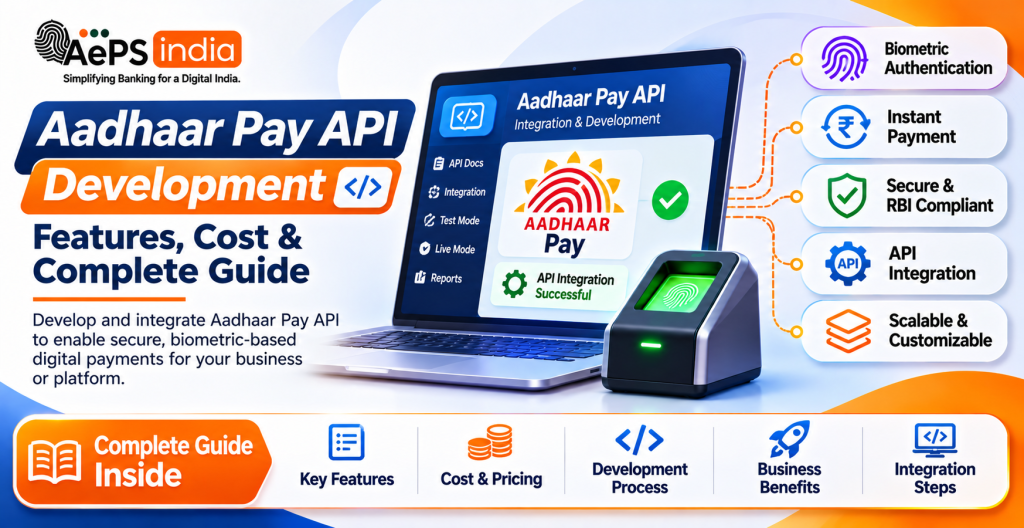
Aadhaar Pay API Development is becoming an important technology requirement for fintech companies, banking service providers, payment businesses, and digital banking platforms looking to enable Aadhaar-based merchant payments in India. By integrating Aadhaar Pay API into a web application or mobile platform, businesses can build payment solutions that support biometric authentication, secure transaction processing, merchant payment acceptance, and real-time transaction status management through authorized banking and payment service partners.
Aadhaar Pay API development involves integrating biometric payment interfaces into merchant applications using the National Payments Corporation of India (NPCI) AePS framework. It allows merchants to accept digital payments directly from a customer’s Aadhaar-linked bank account via fingerprint or iris authentication.
Developing an Aadhaar Pay API solution involves much more than connecting a payment endpoint. It requires a well-structured API architecture, secure backend development, biometric device compatibility, transaction request and response handling, authentication mechanisms, payment status verification, settlement reconciliation, and regulatory compliance. A properly developed solution can help businesses create a reliable digital payment infrastructure while providing merchants with a convenient way to accept Aadhaar-enabled payments.
With professional Aadhaar Pay API Development in India, fintech startups, payment aggregators, technology companies, and established financial service providers can integrate Aadhaar Pay functionality into their existing applications or develop a customized payment platform from the ground up. The development process can include Aadhaar Pay API integration, Android application development, web-based merchant dashboards, admin panels, transaction management systems, reporting tools, and scalable backend infrastructure.
Whether you want to develop a new Aadhaar Pay application, integrate Aadhaar Pay API into an existing Aeps platform, or expand your digital payment services, choosing the right development architecture and authorized Aadhaar Pay API integrate partner is essential for building a secure, efficient, and scalable solution.
In this guide, we will explore what Aadhaar Pay API Development is, how Aadhaar Pay API integration works, essential development features, technical requirements, biometric authentication, security considerations, integration processes, business benefits, and how to develop an Aadhaar Pay solution for the Indian fintech market.
What is a Aadhaar Pay API Development?
Aadhaar Pay API development is the process of building and integrating software interfaces that let merchants and apps accept cardless, PIN-less payments from a customer’s bank account using their 12-digit Aadhaar number and biometric authentication (fingerprint or iris). Built on the Aadhaar Enabled Payment System (AePS) framework by the National Payments Corporation of India (NPCI), it connects platforms to banks and biometric scanners so users can pay without a debit card, smartphone, or PIN.
Aadhaar Pay API Work
An Aadhaar Pay API is a software interface that connects a merchant’s application or point-of-sale system to the Aadhaar Enabled Payment System (AePS) network managed by the National Payments Corporation of India (NPCI). It allows businesses to accept cashless payments directly from a customer’s Aadhaar-linked bank account using only their Aadhaar number and biometric authentication (fingerprint or iris scan).
How the Transaction Flow Works
When a customer pays at a store or service point, the Aadhaar Pay API handles the communication between the merchant, the payment network, and the banks in real time:
- Initiate the payment. The merchant enters the customer’s 12-digit Aadhaar number, selects the customer’s bank name, and inputs the transaction amount into their app or terminal.
- Capture biometrics. The customer places their finger or scans their iris on a UIDAI-certified biometric scanner connected to the merchant’s device. The device’s Registered Device (RD) service immediately encrypts the biometric data so it cannot be stored or misused.
- Route through the API gateway. The Aeps merchant software sends the encrypted payload via the AePS API to the acquiring bank and the NPCI switch.
- Verify identity with UIDAI. NPCI routes the encrypted biometric data to the Unique Identification Authority of India (UIDAI) servers to verify the customer’s identity against their Aadhaar record.
- Settle the funds. Once UIDAI confirms a match, NPCI instructs the customer’s issuing bank to debit the amount and credits the merchant’s bank account.
- Confirm the receipt. The Best Aeps API returns a real-time success or failure response to the merchant’s interface, generating a digital receipt or SMS confirmation for the customer.
Industries That Can Use Aadhaar Pay API Solutions
Aadhaar Enabled Payment System (AePS) and Aadhaar Pay API solutions are widely used across multiple sectors to enable biometric authentication, cash withdrawals, balance inquiries, and last-mile financial services.
Key Industries Using Aadhaar Pay / AePS API Solutions
- Banking Correspondents (BC) & Rural Banking Networks: Empower local agents and micro ATM to provide cash withdrawal, cash deposit, mini statements, and doorstep banking in unbanked or rural areas.
- Fintech & Neobanks: Integrate biometric authentication and cardless/PIN-less banking capabilities directly into digital banking platforms or mobile apps.
- Retail Networks & Kirana Stores: Transform local retail outlets into mini-banking or cash-out points where customers can pay or withdraw cash using their Aadhaar number and fingerprint.
- Telecom Industry: Streamline mobile recharges, utility bill payments, and subscriber authentication through fast, secure Aadhaar-based verification and payment flows.
- Government & Welfare Platforms: Facilitate direct benefit transfers (DBT), pension distributions, and subsidy payouts with verified biometric authentication.
- Microfinance Institutions (MFIs): Enable microfinance borrowers to make loan repayments, check balances, or disburse funds locally through agent networks.
Difference Between Aadhaar Pay Api and AEPS API
AEPS API (Aadhaar Enabled Payment System API) is a bank-led infrastructure interface designed primarily for basic banking and cash-out services like cash withdrawals and balance inquiries, whereas Aadhaar Pay API is a merchant-focused payment (P2M) solution built specifically for shopkeepers and businesses to accept digital payments directly from a customer’s bank account using biometrics.
Key Comparison Summary
| Feature | AEPS API | Aadhaar Pay API |
|---|---|---|
| Primary Focus | General Banking / Cash Withdrawal / Financial Inclusion | Merchant Payment / Retail Sale (P2M) |
| Target User | Individuals needing cash or account info | Customers paying merchants for products/services |
| Supported Operations | Withdrawal, Deposit, Balance, Mini-Statement, Transfer | Direct payment from customer account to merchant account |
| Commissions | Agent earns a commission per transaction | Merchant may incur gateway/processing service fees |
AEPS API (Aadhaar Enabled Payment System)
- Primary Purpose: Functions as an assisted-banking and cash-in/cash-out channel for unbanked or rural populations through micro-ATMs.
- Core Transactions: Supports cash withdrawals, cash deposits, balance inquiries, mini-statements, and Aadhaar-to-Aadhaar fund transfers.
- Cash Limit: Typically capped at ₹10,000 per single transaction, subject to individual bank daily cumulative caps.
- Merchant/Agent Economics: Generally provides a commission or revenue-sharing incentive to the agent or operator per transaction.
- Use Case: Working as a mini-bank or micro-ATM at a local Kirana store to let villagers withdraw cash.
Aadhaar Pay API
- Primary Purpose: Operates as a point-of-sale (P2M) merchant payment system allowing customers to pay for goods and services cardlessly.
- Core Transactions: Strictly restricted to receiving payments from a customer’s bank account into a merchant’s bank account.
- Cash Limit: Designed for higher or flexible merchant transaction workflows (often bypassing standard ₹10,000 single-withdrawal limits depending on the merchant bank setup).
- Merchant/Agent Economics: Often involves merchant-side processing or service charges rather than cash-out commissions.
- Use Case: A retail shop owner using an integrated Aeps biometric scanner and smartphone app to let a customer pay their bill with a thumbprint.
Why Businesses Need Aadhaar Pay API Development
Businesses need Aadhaar Pay API development to accept cardless, smartphone-free digital payments and offer basic banking services using only a customer’s Aadhaar number and biometric authentication. Integrating this interface via the National Payments Corporation of India (NPCI) network turns standard retail storefronts, mobile Aeps apps, or web portals into interoperable payment and micro-banking touchpoints.
Core Business Drivers & Revenue Benefits
Integrating Aadhaar Pay API unlocks immediate commercial advantages for fintech platforms, retailers, and enterprises.
- Expanded Customer Reach. Businesses can serve rural, elderly, and underbanked demographics who do not own smartphones, debit cards, or UPI apps.
- New Commission Streams. Retailers and fintech aggregators earn tiered commissions on every processed banking transaction, turning local shops into profitable mini-ATMs.
- Increased Store Footfall. Aeps india offering essential services like cash withdrawals and balance inquiries draws more walk-in customers, which naturally boosts sales of primary retail goods.
- Multi-Bank Interoperability. A single Aadhaar API integration lets merchants accept payments from customers holding an Aadhaar-linked account at any participating bank across India.
Operational Efficiency & Cost Reduction
Custom API development streamlines how payments are accepted and settled without heavy hardware investments.
- Low Infrastructure Costs. Merchants avoid expensive Point-of-Sale (POS) terminals and physical bank branch setups, requiring only a standard smartphone or PC paired with a certified Aeps biometric scanner.
- Higher Transaction Limits. Unlike standard AEPS cash withdrawals capped at ₹10,000, Aadhaar Pay enables merchants to accept higher-value customer payments up to ₹50,000 per day.
- Instant Settlements. Funds are debited directly from the customer’s bank account and routed to the merchant’s account in real time, improving daily working capital.
Security & Regulatory Compliance
Modern Aadhaar Pay API architectures enforce strict authentication layers to prevent financial fraud and align with UIDAI standards.
- Biometric Fraud Prevention. Transactions require live fingerprint or iris verification matched against central records, eliminating risks tied to stolen cards, skimmed magnetic stripes, or forgotten PINs.
- Step-Up Authentication. High-value merchant payments exceeding ₹5,000 automatically trigger an additional One-Time Password (OTP) sent to the customer’s Aadhaar-linked mobile number.
- Mandatory Security Standards. Up-to-date Aadhaar Pay API integrating support STQC-certified L1 Aeps biometric devices, AI liveness detection, daily merchant biometric login, and end-to-end data encryption.
Key Features of Aadhaar Pay API Development
Aadhaar Pay API development enables merchants and fintech platforms to accept cashless payments directly from a customer’s bank account using their Aadhaar number and biometric authentication. Built on the National Payments Corporation of India (NPCI) Aadhaar Enabled Payment System (AePS) framework, it eliminates the need for physical debit cards, PINs, or smartphones on the customer’s end.
Core Functional Features
- Merchant Payment Acceptance. Customers pay for goods and services at a retail point-of-sale by providing their Aadhaar number, selecting their bank, and scanning their fingerprint or iris.
- Multi-Bank Interoperability. The Best Aadhaar Pay API connects to the central NPCI switch, allowing a single merchant terminal to accept payments from any bank account linked to Aadhaar.
- Instant Settlement and Receipts. Transactions are processed in real time with immediate confirmation webhooks and digital receipt generation.
- Extended AePS Banking Suite. Most Aadhaar Pay API integration bundle Aadhaar Pay alongside cash withdrawals, cash deposits, balance inquiries, mini statements, and Aadhaar-to-Aadhaar fund transfers.
Security and Regulatory Compliance
- UIDAI Biometric Integration. The system captures encrypted biometric data via UIDAI-certified Registered Devices (L1 RD services) from manufacturers like Mantra.
- Liveness and Anti-Spoofing. Built-in biometric validation prevents fake fingerprints or replay attacks during authentication.
- Data Vault and Tokenization. To meet strict UIDAI compliance, platforms cannot store raw Aadhaar numbers and must use encrypted reference keys or an Aadhaar Data Vault.
- End-to-End Encryption. Payloads use TLS 1.3 encryption, digital signatures, and IP whitelisting to secure communication between the Aeps india servers.
Developer and Integration Features
- RESTful Architecture and SDKs. Aeps india offer clean JSON-based REST Aadhaar Pay APIs paired with mobile SDKs (Android/iOS) to handle hardware communication with external biometric scanners.
- Sandbox Environment. A dedicated testing environment simulates NPCI response codes, biometric captures, and failure scenarios before going live.
- Agent Onboarding and eKYC. Automated workflows let platforms onboard retail merchants digitally using PAN, Aadhaar eKYC, and geo-tagging.
- Reconciliation and Reporting Dashboards. Real-time administrative Aeps portal track transaction statuses, Reference Retrieval Numbers (RRN), dispute handling, and commission splits.
Aadhaar Pay API Development Process: Step-by-Step
Developing and integrating an Aadhaar Pay API (built on the NPCI Aadhaar Enabled Payment System (AePS) framework) requires partnering with an Aeps india, completing regulatory KYC, integrating UIDAI-compliant biometric capture, and building secure backend payment endpoints.
1. Partner Selection and Regulatory Onboarding
Because only licensed Aeps india connect directly to the NPCI switch, businesses must onboard through an authorized Aeps india.
- Aeps india Selection. Choose an certified Aeps india offers direct switch connectivity, high transaction success rates, and clear developer documentation.
- Merchant and Agent KYC. Submit mandatory Know Your Customer (KYC) documents including Aadhaar, PAN card, GST certificate or business registration, and settlement bank details for regulatory verification.
- Credential Generation. Obtain your sandbox and production Aadhaar Pay API keys, merchant IDs, secret tokens, and IP whitelisting access from the Aeps developer console.
2. Biometric Hardware and RD Service Setup
Aadhaar Pay relies on real-time biometric authentication, which requires strict hardware and encryption compliance with the Unique Identification Authority of India (UIDAI).
- L1-Certified Scanners. Acquire UIDAI-approved, L1 Aeps certified fingerprint or Aeps iris biometric devices from manufacturers such as Mantra.
- Registered Device (RD) Service Integration. Integrate Aeps device manufacturer’s RD Service SDK into your Android, iOS, or web frontend so biometric data is encrypted at the hardware level before touching your Aeps application.
- PID XML Generation. Configure your frontend to trigger the RD Service during checkout, capturing the customer’s scan and returning an encrypted Personal Identity Data (PID) XML block.
3. Backend API Architecture and Integration
Your backend acts as a secure bridge between your merchant application and the AePS payment gateway.
- Authentication Layer. Implement header-based authentication using OAuth tokens, Aadhaar Pay API key, or HMAC-SHA256 request signatures over TLS 1.3 encryption.
- Transaction Request Endpoints. Build backend services to send required payload parameters including the customer’s 12-digit Aadhaar number, Bank Issuer Identification Number (IIN), transaction amount, unique reference ID, and the encrypted PID data.
- Status and Reconciliation APIs. Integrate transaction status check endpoints and webhook listeners to handle network timeouts, pending states, and automated settlement reconciliation.
4. Sandbox Testing and Error Handling
Before handling live funds, validate every payment flow and edge case in the Aeps india staging environment.
- Simulated Biometric Flows. Test successful payments, insufficient balance responses, and invalid Aadhaar or bank IIN errors using sandbox test credentials.
- UIDAI and NPCI Error Mapping. Map standard error codes such as biometric mismatch, daily limit exceeded, or bank server downtime—to clear, actionable messages for the merchant interface.
- Idempotency Controls. Enforce unique transaction IDs on every top Aadhaar Pay API call to prevent duplicate debits if a merchant retries a timed-out request.
5. Security Audit and Production Go-Live
Once sandbox testing passes, complete final compliance checks to switch to live banking rails.
- Data Privacy Compliance. Ensure your servers never store raw biometric data or full Aadhaar numbers in plain text, adhering to UIDAI data vault and masking rules.
- Production Whitelisting. Whitelist your live server IP addresses with your Aeps india and swap sandbox keys for production credentials.
- Live Penny-Drop Verification. Execute low-value live transactions using an L1 device to verify real-time NPCI routing, bank debit, and merchant Aeps wallet settlement.
Aadhaar Pay API Development Cost in India
Developing or integrating an Aadhaar Pay API (the merchant payment module under NPCI’s Aadhaar Enabled Payment System) in India typically costs between ₹7,500 and ₹4.5+ Lakhs for initial setup and software, plus ongoing per-transaction charges. Because businesses cannot connect directly to NPCI without bank sponsorship, the total cost depends heavily on whether you integrate an existing reliable Aadhaar Pay API, launch a white label Aeps platform, or build custom fintech middleware.
1. Cost Structure by Deployment Model
Your development and licensing expenses vary significantly based on how you deploy the system:
| Deployment Model | Estimated Initial Cost | Best For | What Is Included |
|---|---|---|---|
| Basic API Integration | ₹7,500 – ₹35,000 | Existing apps or websites adding Aadhaar Pay | Aadhaar Pay API keys, sandbox access, documentation, and basic developer onboarding from a Aeps india. |
| White-Label Portal / App | ₹25,000 – ₹1.5 Lakhs | Startups launching a branded B2B agent network | Pre-built web and Android Aeps apps with custom branding, Aadhaar Pay admin panel, and distributor/retailer hierarchies. |
| Custom Middleware & Direct Bank Switch | ₹1.5 Lakhs – ₹4.5+ Lakhs | Large fintechs and enterprise aggregators | Custom UI/UX, multi-bank routing, reconciliation engines, and high-volume switch integration. |
2. Core Development & Infrastructure Components
When budgeting for custom development or third-party integration, expenses break down into four primary buckets:
- API Onboarding & Licensing Fees. Aggregators charge a one-time Aeps setup fee to provision credentials, verify your business KYC, and whitelist your server IPs.
- Biometric RD Service Integration. Developers must integrate UIDAI-certified Registered Device (RD) SDKs (such as Mantra) to capture encrypted fingerprint or iris scans.
- Backend & Settlement Engineering. Custom builds require database architecture for real-time ledgering, wallet management, automated T+0/T+1 merchant settlements, and webhook handling for failed or timed-out transactions.
- Security & Compliance Audits. Aadhaar Pay Systems must implement TLS 1.3 encryption, Aadhaar data masking/vaulting per UIDAI guidelines, and periodic VAPT (Vulnerability Assessment and Penetration Testing) certifications.
3. Ongoing Operational & Transaction Costs
Beyond initial development, operating an Aadhaar Pay API involves recurring expenses:
- Aadhaar Pay Transaction Charges. Unlike standard AEPS cash withdrawal (where operators earn a commission), Aadhaar Pay is a merchant payment service. Aeps india typically charge a flat fee of ₹0.40 to ₹1.00 per transaction or a merchant discount rate (MDR) of 0.25% to 1% (often capped around ₹15 per transaction).
- Ancillary Verification Calls. Aeps onboarding merchants and validating accounts incurs minor per-call fees, such as ₹1.00 to ₹2.00 for Aadhaar eKYC and ₹1.00 to ₹3.00 for bank account penny-drop verification.
- Server, AMC, and Taxes. You will need cloud hosting (₹3,000–₹15,000/month depending on traffic), Annual Maintenance Contracts (typically 15%–20% of software cost), and 18% GST on all setup and API fees.
- Biometric Hardware (If Supplied). If you bundle hardware for your merchants, L1 Aeps certified fingerprint scanners cost roughly ₹2,000 to ₹3,500 per unit.
Aadhaar Pay API Integration with Android, Web and Mobile Applications
Integrating Aadhaar Pay (BHIM Aadhaar Pay) requires connecting your application to an NPCI-certified acquiring licensed Aeps india alongside UIDAI-certified biometric hardware. Because direct access to the NPCI BHIM Aadhaar Pay switch is restricted to member banks, third-party developers integrate via REST Aadhaar Pay API and native SDKs provided by Aeps india.
Core Architecture & Transaction Flow
Every Aadhaar Pay integration whether web, Android, or cross-platform mobile relies on a strict client-device-server pipeline to comply with UIDAI and RBI security rules:
- Client Interface. Your app collects the customer’s 12-digit Aadhaar number, selects their bank from an Issuer Identification Number (IIN) list, and enters the payment amount.
- Registered Device (RD) Service. Best Aeps application invokes a locally installed UIDAI-certified RD Service app (such as Mantra) to capture an encrypted biometric PID (Personal Identity Data) XML block. Raw biometric data is never exposed to your app.
- Backend API Call. Your server sends the encrypted PID block, Aadhaar number, bank IIN, and merchant credentials to Aeps india over HTTPS/TLS 1.3.
- NPCI & UIDAI Settlement. The Aeps india routes the payload to the acquiring bank and NPCI, which verifies the biometrics with UIDAI and settles funds directly into the merchant’s account.
Platform-Specific Integration Approaches
| Platform | Hardware Connection | Recommended Integration Method | Key Implementation Notes |
|---|---|---|---|
| Android (Native) | USB OTG / Type-C | Native Android SDK (.aar) or Intent-based RD Service calls | Most widely supported platform; Aeps india offer drop-in UI SDKs that handle RD Service discovery automatically. |
| Web Applications | USB Port (Windows/Linux) | JavaScript / REST API communicating with local RD Service over localhost ports | Browser calls the local RD Service daemon (typically on ports 11100–11120) via AJAX/HTTP to fetch the PID XML before posting to your backend. |
| Cross-Platform Mobile (Flutter / React Native) | USB OTG (Android) | Native Android Bridge / MethodChannel wrapping the vendor’s .aar SDK | Must bridge to Android native intents to trigger the external RD Service app; iOS lacks standard USB OTG RD Service support for consumer fingerprint scanners. |
Aadhaar Pay API Security and Data Protection
Aadhaar Pay API security and data protection rely on strict regulatory mandates from the Unique Identification Authority of India (UIDAI), National Payments Corporation of India (NPCI), and the Reserve Bank of India (RBI). These frameworks enforce hardware-level encryption, strict data storage bans, and multi-factor authentication to protect biometric and financial data during merchant transactions.
1. Biometric and Hardware Security
- Registered Devices (L1 Standard). Merchants must use STQC-certified Level 1 (L1) biometric scanners integrated with UIDAI Registered Device (RD) services. Unlike older devices, L1 scanners perform cryptographic signing and encryption directly inside a secure hardware environment.
- Encrypted PID Blocks. Biometric data (fingerprint or iris) is captured and immediately encrypted into a Personal Identity Data (PID) block at the hardware level. Raw biometric templates are never exposed to the merchant application, host device, or intermediate servers.
- Liveness Detection. Aeps Scanners and modern Aadhaar Pay API must enforce anti-spoofing and liveness checks to prevent fraudsters from using silicone molds, lifted prints, or fake biometrics.
2. API and Transmission Security
- End-to-End Encryption. All Aadhaar Pay API payloads moving between the merchant terminal, Aeps india, NPCI switch, and UIDAI’s Central Identities Data Repository (CIDR) must travel over encrypted channels using TLS 1.3 or higher.
- Digital Signatures and Dedicated APIs. Every smooth Aadhaar Pay API request must be digitally signed using the authorized agency’s cryptographic keys. Under RBI AePS guidelines, Aeps india must isolate AePS and Aadhaar Pay traffic using dedicated Aadhaar Pay API rather than sharing endpoints with non-AePS services.
- Strict Access Controls. Aadhaar Pay API access is restricted to registered, whitelisted IP addresses and authorized Authentication User Agencies (AUAs) or Sub-AUAs.
3. Authentication Rules and Fraud Controls
- Step-Up Two-Factor Authentication. Under NPCI circular OC 096, Aadhaar Pay transactions exceeding ₹5,000 require step-up authentication. Merchants must capture and transmit an Aadhaar-registered OTP inside the encrypted PID block alongside the customer’s biometrics.
- Transaction Caps and Monitoring. Single transactions are capped at ₹10,000, and acquiring banks must run real-time fraud monitoring based on operator location, transaction velocity, and risk parameters.
- Operator Due Diligence. Banks must perform full KYC before onboarding an top Aadhaar Pay touchpoint operator. Operators are mapped to a single acquiring bank and must undergo mandatory re-KYC if their terminal remains inactive for three consecutive months.
4. Data Protection and Storage Mandates
- Zero Biometric Storage. Storing, caching, or logging biometric data or PID blocks anywhere in the application stack is strictly prohibited under the Aadhaar Act.
- Aadhaar Data Vault (ADV). Regulated entities permitted to retain Aadhaar numbers for audit or compliance must store them inside an isolated, encrypted Aadhaar Data Vault backed by FIPS 140-2 compliant Hardware Security Modules (HSMs). Applications must interact using tokenized reference keys rather than actual Aadhaar numbers.
- Mandatory Masking and Consent. Any display, receipt, or log containing an Aadhaar number must mask the first eight digits (showing only the last four). Explicit customer consent must also be captured before initiating every Aadhaar Pay AP call, aligning with UIDAI rules and the Digital Personal Data Protection (DPDP) Act.
Aadhaar Pay API Testing and Sandbox Environment
An Aadhaar Pay API sandbox is a simulated staging environment that allows developers and businesses to test biometric payment workflows without using real customer money or live bank networks. Because Aadhaar Pay operates as a merchant-initiated payment layer on top of NPCI’s Aadhaar Enabled Payment System (AePS), testing requires both mock financial endpoints and biometric capture simulation.
1. Where to Access Sandbox Environments
Direct access to live Aadhaar Pay rails requires authorization as an Authentication User Agency (AUA) or a direct banking partnership. Depending on your organization’s status, you can access testing environments through two main channels:
- UIDAI Developer Portal. The official UIDAI Developer Section provides a staging environment with a mock Central Identities Data Repository (CIDR). It allows you to test underlying Aadhaar authentication, e-KYC, and the Aadhaar Face Authentication SDK using dummy 9999-series Aadhaar numbers over the public internet.
- Licensed AePS & Fintech Aggregators. Aeps india offer immediate sandbox access upon signup. These sandboxes simulate the complete NPCI payment leg alongside biometric authentication.
2. Core Components of an Aadhaar Pay Sandbox
Testing an Aadhaar Pay integrate goes beyond standard RESTFULL Aadhaar Pay API calls because it relies on hardware-level encryption and webhook confirmations.
- Mock Biometric & RD Service Simulation. Live transactions require a UIDAI-certified Registered Device (RD) like Mantra to capture and encrypt biometrics into a PID (Personal Identity Data) block. In the sandbox, you can use RD Service simulation modes or pre-generated mock XML PID blocks to test Aadhaar Pay API payloads without physical scanner hardware.
- Test Credentials & Dummy Data. Aeps india supply test Aadhaar numbers, mock bank IINs (Issuer Identification Numbers), and dummy merchant/agent onboarding IDs so you can simulate different customer profiles.
- Staging Certificates. You will use UIDAI staging public keys (
.cerfiles) to encrypt session keys and validate digital signatures in your request headers. - Webhook & Callback Simulators. Because interbank settlements can be asynchronous, sandboxes allow you to configure a secure callback URL to test real-time transaction status updates.
3. Essential Test Cases to Validate
Before requesting production credentials, ensure your integration passes these standard sandbox scenarios:
- Agent & Merchant Daily Login. Verify the two-factor authentication flow required for merchants to activate their daily Aadhaar Pay terminal session.
- Successful Merchant Payment. Simulate a customer paying a merchant by entering a dummy Aadhaar number, selecting a bank IIN, inputting a transaction amount, and passing a valid mock PID block.
- Error & Exception Handling. Trigger specific sandbox error codes to verify how your app handles insufficient funds, biometric mismatch, invalid bank IINs, daily transaction limit breaches, and timeout responses.
- Reconciliation & Status Check. Test the transaction status inquiry Aadhaar Pay API Service to confirm your system accurately resolves pending transactions when a webhook is delayed.
4. Typical Integration Workflow
- Register on a Portal. Sign up on your chosen Aadhaar Enabled Payment System developer dashboard or the UIDAI Developer Portal to generate your sandbox Aadhaar Pay API keys and download Postman collections.
- Configure Local RD Service. Install the staging RD Service driver on your test Android device or Windows machine, or load the mock PID generator provided in the SDK.
- Execute API Flows. Run end-to-end tests covering merchant e-KYC, payment initiation, and webhook receipt.
- Compliance & Go-Live. Complete security audits, IP whitelisting, and merchant KYC verification to swap your sandbox endpoints and certificates for live production credentials.
Aadhaar Pay API Compliance: RBI, NPCI, and UIDAI Guidelines and Requirements
Aadhaar Pay and Aadhaar Enabled Payment System integration are strictly governed by a multi-layered compliance framework enforced by the Reserve Bank of India (RBI), the National Payments Corporation of India (NPCI), and the Unique Identification Authority of India (UIDAI).
1. Reserve Bank of India (RBI) Guidelines & Directives
Under the RBI’s updated operational resilience and risk-management directives (effective January 1, 2026), acquiring Aeps india must enforce stringent controls:
- Touchpoint Operator (ATO) KYC: Acquiring banks must conduct mandatory full KYC-based due diligence and periodic KYC updates for all AePS Touchpoint Operators before Aeps onboard.
- Re-KYC for Inactivity: If a touchpoint operator or terminal remains inactive for three consecutive months, mandatory re-verification via KYC is required before re-activating Aadhaar Pay API or terminal access.
- API Access & Security: Restrict Aadhaar Pay Service API access strictly to authorized, whitelisted systems. Banks must integrate with Enterprise Fraud Risk Management Systems (EFRMS) and Security Information and Event Management (SIEM) tools, alongside real-time transaction monitoring and automated fraud blocking.
- Mapping Limits: Each touchpoint operator must be strictly mapped to a single acquiring bank to prevent rogue or multi-bank misuse.
2. National Payments Corporation of India (NPCI) Rules
NPCI governs the interoperable switch, transaction limits, and authentication workflows:
- Two-Factor Step-Up Authentication: Cash withdrawals or Aadhaar Pay transactions above ₹5,000 require two-factor step-up authentication using an Aadhaar-registered OTP alongside biometrics. Transactions up to ₹5,000 rely on biometrics alone. (Face authentication for cash-outs has been discontinued).
- Transaction Caps: Individual transaction caps are strictly enforced at a maximum of ₹10,000 (subject to issuer bank limits).
- Hardware Compliance: All biometric capture devices deployed at terminals must be STQC-certified L1 (Level 1) live biometric devices featuring anti-spoofing capabilities.
- Technical Architecture: Integration must utilize NPCI-certified direct switch connectivity, supporting encrypted payloads (such as TLS 1.3), JSON/RESTful standards, and sandbox testing environments.
3. UIDAI Guidelines & Data Privacy Norms
The Unique Identification Authority of India mandates strict data lifecycle and authentication safeguards:
- No Raw Aadhaar Storage: Aeps System integrated with Aadhaar/eKYC APIs must not store raw Aadhaar numbers or biometric templates locally in unencrypted or unnecessary databases.
- Encrypted Transmission: All biometric and demographic data packets must be encrypted at the terminal/SDK level using UIDAI-compliant public-key encryption before hitting the switch.
- Explicit Consent & Audit Trails: Operators and merchants must capture and retain verifiable user consent records for every authentication event and adhere to periodic security/compliance audits.
- Co-operative Bank Framework: Under recent frameworks (such as UIDAI Circular 10 of 2025), State Co-operative Banks (StCBs) onboard as master AUA/KUAs, while District Central Co-operative Banks (DCCBs) operate under strict parent-bank mapping and joint compliance.
Core Compliance Checklist for API Integration
| Regulatory Body | Key Compliance Focus | Mandatory Requirement |
|---|---|---|
| RBI | Operator Due Diligence | Full KYC for ATOs + Re-KYC after 3 months of inactivity |
| RBI | Fraud & API Defense | Integration with EFRMS/SIEM + restricted API whitelisting |
| NPCI | Authentication Tier | 2FA (Biometric + OTP) for transactions > ₹5,000 |
| NPCI | Terminal Hardware | STQC-certified L1 anti-spoofing fingerprint scanners |
| UIDAI | Data Protection | Zero raw-Aadhaar local storage + end-to-end packet encryption |
Aadhaar Pay API Transaction Reconciliation and Reporting
Aadhaar Pay and AePS (Aadhaar Enabled Payment System) transaction reconciliation and reporting ensure that merchant accounts, Aadhaar Pay API gateways, and bank settlement systems remain balanced, error-free, and compliant with NPCI (National Payments Corporation of India) guidelines.
Core Components of Aadhaar Pay API Reconciliation
Transaction Status Inquiry (API / Query):
- Real-time or batch-wise query fast Aadhaar Pay API allow platforms to verify the terminal/merchant-side status against the NPCI / issuer switch (e.g., checking if a transaction is Success, Failed, or Pending/Ambiguous). Best Aeps Platform often use an best AEPS API Transaction Status Check mechanism to resolve intermediate states.
Multi-File & Any-to-Any Matching:
- Reconciliation engines match API log files from the merchant/aggregator platform against switch files (NPCI logs) and core banking settlement (CBS) files.
Automated Exception Handling & Force Matching:
- System flags mismatches such as “debited from customer, not credited to merchant” or “dropped at gateway.”
- Automated dispute and chargeback management workflows handle UDIR (Unified Dispute and Issue Resolution) and ODR (Online Dispute Resolution) guidelines.
Key Reporting Capabilities
Real-Time Settlement & Dashboard Analytics:
- Track live transaction volume, success/failure rates, merchant-wise earnings, and commission splits.
- Monitor active biometric devices, agent IDs, and terminal-level liquidity.
Operational & Audit Reports:
- Daily Summary Reports: Total count and value of Aadhaar Pay collections, refunds, and chargebacks.
- Settlement Reports: T+1 or same-day liquidity movement linked to merchant payout accounts via Reconciliation & Settlement for Business workflows.
- Dispute Logs: Detailed audit trails tracking open, under-review, and closed dispute tickets under NPCI norms.
Aeps india One of The Best Aadhaar Pay API Development Company in India
Aeps india one of the best Aadhaar Pay / AEPS (Aadhaar Enabled Payment System) API development company requires evaluating strict security standards, transaction reliability, and technical architecture.
Key Factors to Consider
Security & Regulatory Compliance:
- Aeps india is registered or compliant with NPCI (National Payments Corporation of India) guidelines and RBI norms.
- Check that biometric data is encrypted end-to-end and not stored on their local servers (UIDAI-compliant data handling).
- Look for multi-factor authentication (MFA) and built-in fraud detection/monitoring systems.
Core API Features & Functionality:
- Support for essential banking services: Aadhaar Pay, cash withdrawal, balance inquiry, mini statements, and fund transfers.
- Compatibility with various biometric fingerprint/iris scanner devices (Mantra, etc.).
- Multi-bank connectivity for higher transaction uptime and fallback routing.
Transaction Performance & Settlement:
- High transaction success rates and minimal latency.
- Fast payout and settlement cycles to protect merchant/retailer liquidity and cash flow.
- Clear commission structures, High Speed Aadhaar Pay API usage charges, and transparent pricing models.
Developer Experience & Integration:
- Clean, well-structured Aadhaar Pay API documentation.
- Availability of a sandbox environment for testing before going Aadhaar Pay API live.
- Support for webhooks, real-time reporting dashboards, and wallet/ledger reconciliation tools.
Scalability & Support:
- Ability to scale up your fintech operations as transaction volumes grow.
- Reliable, 24/7 technical and customer support to handle live transaction failures or downtime.
- Check Aeps india comparisons and white label Aeps options via resources like Aeps india.
Why Choose Aeps india for Aadhaar Pay API Development Solution
Choosing a Aeps india for an Aadhaar Pay / AePS (Aadhaar Enabled Payment System) API development solution is critical for ensuring smooth, compliant, and profitable financial operations.
Key Reasons to Choose a Aeps india
- Security & Regulatory Compliance: Aeps india ensure compliance with NPCI guidelines, UIDAI regulations, and strict end-to-end encryption for biometric data.
- High Uptime & Reliability: A live Aadhaar Pay API offers 99%+ transaction success rates, low failure rates, and fast real-time processing to prevent user drop-offs.
- Cardless & PIN-less Convenience: It allows end-users to make payments or withdraw cash using just their Aadhaar number and biometric scan (fingerprint or iris), expanding access in semi-urban and rural areas.
- New Revenue Streams & Commissions: Businesses and retailers can earn competitive per-transaction commissions while turning local shops into mini-banking touchpoints.
- White-Label & Scalable Solutions: Aeps india offer white label Aadhaar Pay API capabilities (custom branding, logos, and domains) along with the infrastructure to scale high transaction volumes smoothly.
- Developer Support & Documentation: Clear real time Aadhaar Pay API, sandbox environments for testing, and 24/7 technical assistance help reduce time-to-market during integration.
Conclusion: Choosing the Right Aadhaar Pay API Development Solution
Aadhaar Pay API Development is an important step for fintech companies, payment service providers, banking correspondents, and businesses looking to expand their digital payment infrastructure in India. With secure biometric authentication and seamless banking integration, Aadhaar Pay enables merchants to accept Aadhaar-based payments while helping businesses deliver convenient and accessible digital banking services.
Aadhaar Pay API development enables merchants to accept cardless, cashless digital payments directly from a customer’s Aadhaar-linked bank account using only their biometric authentication. Managed by the National Payments Corporation of India (NPCI), it operates as a core component of the Aadhaar Enabled Payment System (AePS) infrastructure.
Choosing the right Aadhaar Pay API Development Company in India is essential for building a reliable, scalable, and business-ready payment platform. A well-developed Aadhaar Pay API should offer seamless integration, secure transaction processing, compatible biometric devices, real-time transaction status updates, automated reconciliation, detailed reporting, and dependable technical support.
Whether you are planning to launch a new fintech platform, integrate Aadhaar Pay into an existing application, or expand your retailer and distributor network, the right Aadhaar Pay API infrastructure can help simplify operations and improve the customer payment experience.
Before selecting an Aeps india, evaluate its banking partnerships, best Aadhaar Pay API documentation, integration process, security architecture, regulatory compliance, transaction success monitoring, settlement procedures, and post-integration support. Ensure that the service operates through the appropriate authorized banking and payment ecosystem and follows applicable RBI, NPCI, UIDAI, and data protection requirements.
At Aeps india, our focus is on helping businesses build and integrate reliable Aadhaar Pay API designed around their operational requirements. From Aadhaar Pay API integrated and biometric device compatibility to transaction management and business scalability, the right technology can help create a strong foundation for your digital payment business.
If you are looking for Aadhaar Pay API Development in India, choose a solution that combines technical reliability, security, scalability, transparent operations, and professional integration support.
Start building your Aadhaar Pay payment infrastructure today and take your fintech business towards a more connected, accessible, and digitally empowered future.
Aadhaar Pay API Development Solution with Aeps India
Looking to integrate Aadhaar Pay services into your fintech or digital banking platform? Aeps India offers Aadhaar Pay API development solutions to help businesses explore biometric authentication, transaction processing, API integration and platform connectivity. Contact our team to discuss API features, integration requirements, pricing and development options for your business.
Top 10 Frequently Asked Questions About Aadhaar Pay API Development in India
Aadhaar Pay API Development is the process of integrating Aadhaar-based biometric payment functionality into a fintech application, merchant platform, or digital banking system. It enables merchants to accept payments from customers using their Aadhaar number and biometric authentication without requiring a debit card, credit card, or UPI application.
The transaction generally involves the merchant entering the payment amount, the customer providing their Aadhaar number and selecting their Aadhaar-linked bank, and biometric authentication being performed through an approved device and authorised payment infrastructure. Once the transaction is successfully authenticated and processed, the customer’s bank account is debited and the merchant receives the payment confirmation.
Businesses can use Aadhaar Pay API integration to develop merchant payment applications, retail payment solutions, and digital Aeps service platform.
A reliable Aadhaar Pay API should provide the essential functionality required to process Aadhaar-based merchant payments securely and efficiently.
The important features include:
Aadhaar-based biometric payment processing.
Registered biometric device integration.
Merchant registration and authentication.
Bank selection and payment processing.
Real-time transaction status and confirmation.
Transaction history and reporting.
Payment failure handling and status verification.
Secure API communication and access control.
Settlement and reconciliation support.
The availability of individual features depends on the Aeps india.
Aadhaar Pay API and top AEPS API both use Aadhaar-based biometric authentication, but they serve different banking and payment requirements.
Aadhaar Pay is primarily designed for merchant payments. Customers can pay merchants using their Aadhaar-linked bank accounts after biometric authentication.
AEPS (Aadhaar Enabled Payment System) provides assisted banking services through authorised banking correspondents and service points.
The main AEPS services include cash withdrawal, balance enquiry, mini statement, and other services supported by the participating banking infrastructure.
Businesses should select the appropriate Aadhaar Pay API according to whether they want to develop a merchant payment platform or an Aadhaar-enabled banking service application.
Businesses can integrate an Aadhaar Pay API by working with an eligible and authorised Aeps india.
The typical integration process includes:
Select an Aeps india with suitable banking and payment infrastructure.
Complete the required business verification and onboarding.
Obtain API documentation, credentials, and sandbox access.
Configure the development environment.
Integrate merchant authentication and payment initiation endpoints.
Connect compatible registered biometric devices through the approved application workflow.
Implement transaction status checks, error handling, and reconciliation.
Complete testing and required compliance checks before production deployment.
A well-planned integration helps businesses launch Aadhaar-based payment services while maintaining reliable transaction management.
Aadhaar Pay applications require compatible biometric authentication devices that meet applicable UIDAI registration and certification requirements.
Depending on the authorised infrastructure and supported application, fingerprint authentication devices may be used to capture biometric information securely.
Before selecting a biometric device, businesses should verify:
UIDAI Registered Device (RD) compliance.
Device certification and compatibility.
Supported operating systems.
RD service availability and updates.
Secure biometric capture and encryption.
Compatibility with the selected payment application.
Popular device manufacturers may include Mantra but compatibility must be confirmed with the relevant authorised Aeps india.
To start an Aadhaar Pay API-based business in India, an organisation generally needs an eligible business structure, appropriate banking or payment partnerships, technical infrastructure, and compliance arrangements.
Important requirements may include:
Business registration and applicable KYC documents.
PAN and business bank account details.
Agreement with an eligible banking or payment partner.
Required approvals and authorisations for the proposed operating model.
Merchant onboarding and verification procedures.
Compatible biometric devices and application infrastructure.
Secure API integration and transaction monitoring.
Customer consent, privacy, and data protection procedures.
The exact requirements depend on the business model and the organisation’s role in the Aadhaar payment ecosystem. Simply purchasing an API does not automatically authorise a company to perform Aadhaar authentication or operate regulated payment services.
Aadhaar Pay API integration must follow applicable UIDAI, NPCI, banking partner, and information security requirements.
A secure implementation should use encrypted communication, authorised authentication infrastructure, registered biometric devices, controlled Aadhaar Pay API access, and proper transaction monitoring.
Businesses must also ensure that biometric information and Personal Identity Data (PID) are handled according to applicable UIDAI requirements. Core biometric information must not be stored or shared, and encrypted authentication data must only be processed in accordance with the prescribed specifications.
Customer consent, access control, secure credential management, audit logs, and data protection are important parts of a secure Aadhaar Pay implementation.
The cost of Aadhaar Pay API Development in India depends on the required features, application complexity, Aeps india partnership, infrastructure, and integration requirements.
The overall investment may include:
API integration and onboarding charges.
Software and application development costs.
Biometric device procurement.
Server and infrastructure expenses.
Testing and security implementation.
Maintenance and technical support.
Applicable transaction or service charges.
There is no universal fixed development price for every Aadhaar Pay project. Businesses should request a detailed quotation from their selected Aeps india based on their technical and operational requirements.
Choosing the Aeps india is an important decision because it affects transaction reliability, compliance, application performance, and long-term business operations.
Before selecting a Aeps india, developers and fintech businesses should evaluate:
Verified banking and payment partnerships.
Appropriate authorisations for the proposed service.
Complete and updated Aadhaar Pay API documentation.
Sandbox and testing facilities.
Biometric device compatibility.
Transaction status and reconciliation mechanisms.
Security and data protection practices.
Transparent pricing and commercial terms.
Technical support and issue resolution.
Scalability and infrastructure reliability.
Businesses should independently verify the claims, credentials, and regulatory position before signing an agreement or launching services.
Aadhaar Pay API Development offers fintech businesses an opportunity to build biometric-based merchant payment solutions and expand their digital payment services.
It can help businesses create merchant applications, support Aadhaar-based payment acceptance, simplify customer payment experiences, and serve merchants who want an alternative to conventional card-based payment methods.
With suitable banking partnerships, authorised infrastructure, and secure Aadhaar Pay API integration, businesses can develop scalable payment applications for retail stores, service providers, and merchant networks.
The success of an Aadhaar Pay platform depends on regulatory compliance, transaction reliability, customer trust, and a smooth merchant experience.

AEPS Banking Portal in India: Complete Guide to Aadhaar-Enabled Banking

Best AEPS API Provider in India: Features, Pricing, Integration & Benefits

What is AEPS? Full Form, Meaning, Services & How AEPS Works in India
About Author

