AEPS Integration for Businesses: Features, Benefits & Setup Guide
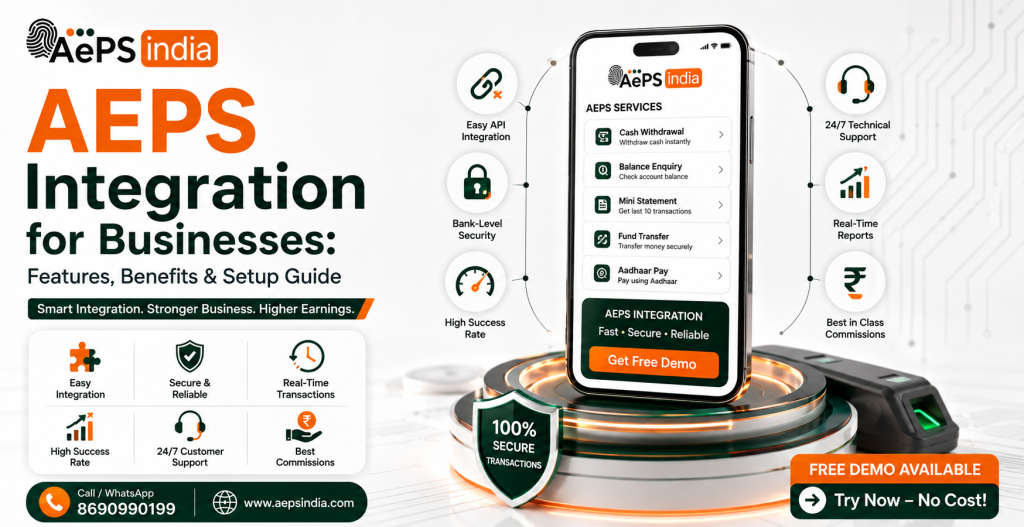
As digital banking continues to grow across India, AEPS Integration has become an essential solution for fintech companies, retailers, distributors, CSPs, payment service providers, and banking agents looking to offer secure Aadhaar-based banking services. By integrating a reliable AEPS API, businesses can enable customers to perform cash withdrawal, balance enquiry, mini statement, Aadhaar Pay, and other supported AEPS transactions through biometric authentication, helping deliver convenient banking services closer to customers.
A professional AEPS Integration allows businesses to connect their website, mobile application, or Aeps B2B portal with a secure AEPS platform. This helps automate banking transactions, improve transaction success rates, reduce manual work, and provide a smooth customer experience. With real-time processing, secure Aeps API connectivity, and easy Aeps API integration, businesses can expand their digital banking services while creating new revenue opportunities.
AEPS integration is the process of connecting a Aeps software application to the Aeps india, enabling cardless and PIN-less transactions using a 12-digit Aadhaar number and biometric data. The core steps involve partner selection, KYC verification, and technical configuration.
AEPS India offers advanced AEPS Integration Solution built for businesses that need reliable performance, secure technology, and scalable infrastructure. Our Aeps platform supports fast Aeps API integration, a user-friendly Aeps admin panel, retailer and distributor management, transaction monitoring, reporting, and dedicated technical support, making it easier to launch and manage Aadhaar-enabled banking services.
Whether you are starting a new fintech platform or upgrading an existing digital banking solution, Aeps india one of the right AEPS Integration Provider is important for long-term success. A secure and feature-rich integration helps improve operational efficiency, strengthen customer trust, and support business growth in India’s rapidly expanding digital payments ecosystem.
In this blog, you will learn everything about AEPS Integration, including how it works, its key features, business benefits, API integration process, security considerations, and why it is a valuable solution for retailers, fintech companies, and digital banking businesses.
What Is AEPS Integration?
AEPS Integration is the technical process of connecting a best Aeps software application, website, or Aeps business platform to the Aadhaar Enabled Payment System infrastructure via an best Aeps API. It allows merchants and retailers to turn everyday digital devices into micro-ATMs, letting customers complete cardless, PIN-free banking transactions using only their Aadhaar number and fingerprint.
How Does AEPS Integration Work?
AePS (Aadhaar Enabled Payment System) integration work connects your top Aeps software application to the National Payments Corporation of India (NPCI) network via an Aeps india. This allows users to perform cardless, PIN-free banking transactions such as cash withdrawals, balance checks, and mini-statements using an Aadhaar number and a certified biometric fingerprint scanner.
Step-by-Step Transaction Flow
- Data Input: The merchant or agent enters the customer’s 12-digit Aadhaar number, selects their bank name, and chooses the transaction type on your app.
- Biometric Capture: The customer scans their fingerprint or iris using a certified Aeps biometric device attached to the terminal.
- Encryption: The Aeps application securely encrypts the biometric and Aadhaar data to maintain strict security.
- Validation & Settlement: The data routes through NPCI to the customer’s bank for verification. Once approved, the bank debits the user and credits the agent’s wallet instantly.
Services Supported by AEPS Integration
Aadhaar Enabled Payment System integration empowers Aeps software platform, fintechs, and micro ATM to offer cardless, PIN-less interoperable banking transactions using biometric authentication (fingerprint or iris scan) via the NPCI network.
Core Financial Services
- Cash Withdrawal: Allows customers to extract money cardlessly from their Aadhaar-linked bank accounts through authorized agents.
- Cash Deposit: Enables users to deposit cash directly into participating Aadhaar-linked accounts.
- Balance Enquiry: Provides instant, real-time checking of available account balances.
- Mini Statement: Retrieves a short summary of recent ledger transactions and history logs.
Advanced & Merchant Services
- Aadhaar-to-Aadhaar Fund Transfer: Supports peer-to-peer or account-to-account money transfers across compatible systems.
- Aadhaar Pay (BHIM Aadhaar): Allows merchants to accept cashless retail payments directly through biometric verification.
- Direct Benefit Transfers (DBT): Facilitates lookup and tracking or routing of government pensions, subsidies, and welfare funds.
- Electronic KYC (e-KYC): Executes rapid, paperless customer identity verifications via UIDAI-approved Aeps scanners.
Documents Required for AEPS Integration
To integrate AEPS API, you must submit personal KYC, business registration proof, and bank settlement details. You also need an active mobile number linked to Aadhaar and an STQC Aeps certified biometric scanner (such as a fingerprint or iris device) for transaction authentication.
Identity & Personal KYC Proof
- PAN Card: Mandatory for individual and business financial tracking and tax compliance.
- Aadhaar Card: Essential for biometric e-KYC; must be linked to an active, functional mobile number for OTP verification.
- Passport-Sized Photographs: Recent colored photos of the business owner or directors.
Business & Address Proof
- Registration Document: GST Certificate, Udyam MSME Registration, or Shop & Establishment Act license.
- Address Verification: Recent utility bill (electricity or water bill) or rent/lease agreement for the business location.
Settlement Bank Proof
- Bank Account Details: A cancelled cheque, the first page of the bank passbook, or a recent verified bank statement for processing commissions and fund settlements.
Mandatory Hardware Requirements
- Biometric Scanner: A UIDAI/STQC-Aeps certified fingerprint or certified Aeps iris scanner (e.g., Mantra MFS100).
- Active Device: A computer or smartphone with a reliable internet connection.
Who Can Use AEPS Integration
Fast AEPS integration can be used by fintech companies, banks, Business Correspondents (BCs), local retailers like Kirana shops, and Common Service Centers (CSCs) to offer cardless, biometric-based banking services like cash withdrawals and balance checks via the NPCI network.
Eligible Entities for AEPS Integration
- Fintech Startups & Developers: Build or embed Aeps banking API into custom mobile Aeps apps, web Aeps dashboard or white label Aeps platform.
- Retailers & Local Merchants: Grocery stores (Kirana shops), pharmacies, and mobile recharge outlets can turn their shops into functional “micro ATM device“.
- Business Correspondents (BCs) & Agents: Authorized grassroots agents deployed by banks to deliver doorstep or rural banking.
- Common Service Centers (CSCs) & E-Mitra: Centers providing government-to-citizen (G2C) and financial inclusion services.
- Banks & NBFCs: Commercial and payment banks scaling interoperable financial services in remote areas.
Why Use AEPS Integration
AEPS integration allows businesses and fintech apps to offer cardless, PIN-free banking services like Aeps cash withdrawal API, AEPS balance check API and Aeps mini statement API using only a customer’s Aadhaar number and Aeps biometric fingerprint. It turns local retail shops into active mini-ATMs and drives safe, inclusive digital financial access.
Key Benefits for Businesses
- New Revenue Streams: Retailers and store owners earn direct commissions on every cash withdrawal or balance inquiry they process.
- Increased Foot Traffic: Turning a shop into a best micro ATM brings more local customers through the door.
- Real-Time Settlement: Transactions process instantly over the National Payments Corporation of India network, with quick wallet credits for agents.
Key Benefits for Customers
- No Cards or PINs Needed: Users do not need to carry debit cards or remember secret numbers.
- High Security: Biometric fingerprint or iris authentication makes fraud very hard to commit.
- Universal Access: The system works across different banks, letting anyone use any enabled local agent.
- Easy Subsidies: People can easily withdraw government pensions and direct benefit transfers close to home.
Industries Use AEPS Integration
Best AEPS integration is used by various industries including fintech, retail, microfinance, and banking to enable cardless, secure, biometric-based financial transactions like cash withdrawals and balance checks using just an Aadhaar number and a fingerprint.
Key Industries Using AEPS Integration
- Fintech & Digital Banking: Companies integrate biometric authentication into mobile wallets and best Aeps apps to offer cardless, secure Aeps banking api services.
- Retail & Kirana Stores: Local grocery shops and pharmacies turn their storefronts into mini ATM to help customers withdraw cash and check balances.
- Microfinance (MFIs) & NBFCs: Organizations use best AEPS to smoothly disburse loans and collect local EMI payments in remote areas.
- Banking & Business Correspondents (BCs): Authorized agents act as mobile or rural branches to bring essential banking to unbanked populations.
- Government & E-Governance: Centers process Direct Benefit Transfers (DBT) for welfare funds, pensions, and subsidies.
AEPS Integration Use Cases
AEPS integration allows best Aeps application and micro ATM software to process cardless, PIN-free banking and payment transactions using a customer’s Aadhaar number and biometric fingerprint. It drives financial inclusion by turning local retail shops into accessible banking touchpoints.
Rural & Micro Banking Services
- Cash Withdrawals & Deposits: Local grocery shops and pharmacies function as top micro ATM software, letting users withdraw or deposit money without visiting a bank.
- Balance Inquiries & Mini-Statements: Customers instantly check account balances and view recent transaction history using fingerprint validation.
- Aadhaar-to-Aadhaar Transfers: Direct inter-bank or intra-bank money transfers between two people via their Aadhaar numbers.
Government & Welfare Disbursements
- Direct Benefit Transfers (DBT): Secure distribution of government subsidies, NREGA wages, and social security pensions directly to beneficiary accounts.
- Doorstep Delivery: Facilitates last-mile cashouts for rural citizens who cannot travel far to standard bank branches.
Retail & Merchant Payments
- Aadhaar Pay: Allows small merchants to accept digital payments directly from a customer’s bank account via biometrics, avoiding card network fees.
- Micro-Insurance Collections: Insurance agents collect regular policy premium payments at the customer’s doorstep.
Business & Fintech Operations
- Paperless e-KYC: Rapid customer identity verification and onboarding for financial apps or services.
- Agent Network Monetization: Aeps platform build B2B reseller channels where local shop owners earn Aeps commissions per transaction.
Key Aspects of AEPS Integration
Reliable AEPS integration lets businesses offer cardless, PIN-less banking services like cash withdrawals and balance checks using Aadhaar numbers and biometric scans. Key aspects include:
Core Services & Functions
- Cash transactions: Withdraw or deposit cash directly from an Aadhaar-linked bank account.
- Account insights: Check live balances and generate mini-statements.
- Fund transfers: Move money securely between Aadhaar-linked accounts.
- Aadhaar Pay: Allow merchants to accept instant digital payments via biometrics.
Security & Compliance
Biometric verification: Use fingerprint or iris scans matched via UIDAI.
Certified hardware: Require STQC-certified L1 Aeps biometric scanning devices.
Data encryption: Protect sensitive data in transit and at rest using SSL/TLS protocols.
Technical Integration Steps
- API credentials: Obtain Aeps API keys, secret tokens, and endpoint URLs from an Aeps india.
- RD service setup: Integrate Registered Device (RD) services on web or mobile Aeps apps to capture fingerprint data.
- Sandbox testing: Test success, failure, and invalid biometric scenarios before going live.
- Real-time settlement: Handle instant wallet updates and commission tracking through NPCI routing.
Why Businesses Need AEPS Integration
Trusted AEPS integration allows local shops, fintech firms, and retail businesses to function as mini-banks. By using a biometric scanner and an Aadhaar number, businesses can offer cash withdrawals, balance checks, and fund transfers, driving financial inclusion while creating new revenue through transaction commissions.
Key Benefits for Businesses
- New Revenue Streams: Earn attractive Aeps commission margins on every cash withdrawal, balance inquiry, or mini-statement processed.
- Increased Customer Footfall: Serving as a local banking point brings more people through your doors, boosting sales of your primary retail or service products.
- Cardless and Pinless Simplicity: Customers do not need debit cards, credit cards, or remembered PINs only their Aadhaar number and a quick fingerprint scan.
- High Security and Trust: Backed by UIDAI and NPCI guidelines, biometric verification drastically reduces chargeback frauds and unauthorized payments.
- Instant Wallet Settlements: Real time Aeps API connections ensure fast processing and same-day (T+0) or instant wallet credits to maintain smooth business cash flow.
AEPS Integration Flow Diagram
User initiates transaction
Secure entry
Control center
Connectivity layer
Core processing
Deterministic response
Money accounting
Compliance + reporting
Operational transparency
- Idempotency keys for duplicate requests
- Encryption in transit + secrets management
- Audit trail for every request/decision
- Observability (logs/metrics/traces) for faster debugging
Benefits AEPS Integration
AEPS service integration allows b2b Aeps apps, websites, or trusted Aeps software to offer cardless, PIN-free banking services like cash withdrawals, balance checks, and mini-statements using only an Aadhaar number and a Aeps fingerprint scan. It benefits businesses by boosting store footfall, generating Aeps commission revenue, and expanding financial access.
Key Advantages for Businesses and Platforms
- New Revenue Stream: Retailers and fintech agents earn attractive Aeps commissions on every cash withdrawal, deposit, or balance inquiry.
- More Store Visitors: Offering local banking services brings community members to your shop, increasing sales on your primary goods.
- Low Setup Cost: You only need a basic smartphone or computer paired with an affordable biometric fingerprint scanner.
- Instant Cash Flow: Modern Aeps API support real-time settlements (T+0), crediting funds instantly to your agent or business wallet.
Customer and User Advantages
- No Cards or PINs: Users do not need to carry debit cards or remember secret numbers; a fingerprint is enough.
- High Security: Biometric verification matches unique fingerprints through encrypted channels, reducing fraud risk.
- Universal Access: Customers can use any domestic bank account at any enabled best micro ATM device or retail shop.
- Government Subsidies: Helps people easily withdraw direct benefit transfers and rural welfare funds close to home.
Features AEPS Integration
AePS integrate allows Aeps admin apps and websites to process cardless, PIN-less banking transactions using a 12-digit Aadhaar number and biometric fingerprint or iris authentication via Aeps india. It turns standard smartphones or PCs into functional micro ATM APP.
Security and Compliance
- Biometric Authentication: Uses UIDAI-approved L0/L1 Aeps STQC-certified fingerprint or L1 Aeps iris scanners to secure validation.
- Zero-Storage Policy: Ensures sensitive biometric data is never saved locally; payloads are encrypted and passed directly to UIDAI servers.
- Regulatory Framework: Complies strictly with National Payments Corporation of India (NPCI) and Reserve Bank of India (RBI) protocols.
Technical Integration Features
- Interoperability: Connects seamlessly with all major participating banks across India under a unified switch.
- Instant Settlement: Supports real-time T+0 or T+1 wallet credits and commission disbursements for agents and retailers.
- Developer APIs & Dashboards: Provides webhook triggers, multi-tier admin control panels, and simple Aeps software development kits for Android and web apps.
AEPS API Integration Requirements
To integrated AePS API, you must partner with an NPCI-approved and RBI-licensed Aeps india. Essential requirements include completing business and agent KYC, using a UIDAI/STQC certified Aeps biometric device with Registered Device (RD) services, and setting up a secure HTTPS server environment.
Business Documentation & KYC
- Identity & Address Proof: PAN card and Aadhaar card (linked to an active mobile number) of the business owner or agent.
- Business Registration: GST certificate, Udyam registration, or Shop & Establishment Act license.
- Settlement Proof: Cancelled cheque or bank statement for your settlement account.
Hardware Requirements
- Biometric Scanner: UIDAI/STQC-certified Level-1 (L1) Buy Aeps fingerprint or Buy Aeps iris scanner (such as Mantra).
- RD Service: The device must run Registered Device (RD) service software to encrypt biometric PID blocks securely at the hardware level.
Technical Prerequisites
- Secure Server: A cloud or local hosting environment supporting SSL/TLS and secure HTTPS endpoints.
- API Framework: Capability to handle JSON/XML requests, parse bank IIN (Issuer Identification Number) directories, and process encrypted biometric payloads.
- Sandbox Testing: Test environment provided by Aeps india to debug request flows before production launch.
Regulatory & Security Compliance
- 2-Factor Authentication (2FA): Daily biometric authentication for the agent/merchant before processing customer transactions.
- No Data Storage: Raw biometric data or PID blocks must never be stored on your servers.
- One Operator, One Bank: Compliance with current NPCI settlement mandates.
Step-by-Step AEPS Integration Process
To integrating Aeps API into a website or mobile Aeps application, you must choose an NPCI-certified Aeps india complete business KYC, register an STQC-certified Aeps biometric device, write frontend/backend code, and pass sandbox testing before deployment.
1. Vendor Selection and Onboarding
- Choose a Aeps india: Select an Aeps india.
- Submit KYC Documents: Provide your PAN card, Aadhaar card, business registration proof, and bank settlement details.
- Receive Credentials: Get Aeps Merchant ID (MID), best Aeps API keys, and technical Aeps API documentation.
2. Hardware and Device Integration
- Procure Biometric Scanner: Purchase Aeps certified fingerprint or Purchase Aeps iris scanner (e.g.Mantra).
- Install RD Service: Install the Registered Device (RD) service drivers for Android or Windows.
- Map Device: Register the device serial number with Aeps india ecosystem.
3. Technical Development
- Frontend UI: Build data inputs to capture the 12-digit Aadhaar number, bank Issuer Identification Number (IIN), transaction type (cash withdrawal, balance check, or mini-statement), and trigger the RD service for biometric capture.
- Backend Integration: Securely handle SOAP/ REST Aeps API to encrypt sensitive Aadhaar and biometric data blocks before sending them to the central bank switch.
- Callback URL: Set up an HTTPS callback URL to handle real-time transaction responses, status logs, and error alerts.
4. Testing and Deployment
- Get Credentials: Receive Aeps API keys, Merchant ID (MID), and technical documentation from Aeps india.
- Build Interface: Create frontend UI fields for the customer’s Aadhaar number, bank IIN (Issuer Identification Number), and transaction type (cash withdrawal, balance check, or mini-statement).
- Sandbox Testing: Test mock transactions in a staging environment to ensure success, failure, and error handling (such as invalid biometrics or bank offline responses).
- Go Live: Switch to the production environment using live Aeps API credentials to begin processing real-time transactions.
AEPS Integration Timeline
A complete AePS API integration typically takes 2 to 4 weeks from initial paperwork to going Aeps API live. The precise duration depends on compliance checks, biometric device registration, and your technical readiness.
Integration Phases and Timeline
Day 1–2: Vendor Selection & KYC
- Choose an Aeps india.
- Submit corporate credentials, PAN, business registration, and complete merchant KYC.
Day 3–5: Credential Issuance & Hardware Procurement
- Receive your Aeps Merchant ID (MID) and best Aeps API documentation.
- Acquire STQC-certified L1 biometric fingerprint/iris scanners and register their Registered Device (RD) Aeps service software.
Day 6–15: Technical Development
- Build frontend user interface components for entering Aadhaar numbers and selecting bank IINs.
- Implement backend REST/JSON Aeps API endpoints, encryption structures and secure callback URLs.
Day 16–21: Sandbox Testing
- Connect to the Aeps india test environment.
- Run test loops for balance inquiries, mini statements, and cash withdrawals.
Day 22–28: Security Audit & Go-Live
- Validate internal data handling policies (ensuring no raw biometric or PIN caching).
- Whitelist production IP addresses and switch to live Aeps API production credentials.
AEPS Integration Architecture
AEPS Integration Architecture Overview
A high-level integration flow for AEPS: channel → API gateway → AEPS orchestration → Aadhaar/Fingerprint verification → account/transaction ledger → notifications & audit.
1) User Channels
Banking apps, BC/AEPS agent app, Web portal, APIs for merchants
Entry points2) API Gateway
AuthN/AuthZ, request validation, throttling, routing
Traffic control3) AEPS Orchestrator
Transaction workflow manager: fetch → validate → verify → post → status
Workflow brain4) Aadhaar/Fingerprint Verification
Verification service integration (as required by your scheme/provider)
Biometric auth5) Bank/Acquirer Switch Connectors
Routed requests to participating bank/switch/aggregator endpoints
Upstream connectivity6) Transaction Engine
Idempotency, retries, compensation, state machine, settlement posting
Reliable execution7) Ledger, Audit & Reporting
Transaction DB, audit logs, reconciliation reports, admin dashboards
Traceability8) Notifications
SMS/Email/Push, status updates, error alerts to agent/admin
User communication9) Security, Compliance & Monitoring
Encryption, secrets vault, RBAC, audit events, SIEM alerts, monitoring
Governance & opsAEPS Integration Cost Structure
AEPS API integration cost in India generally involve a one-time Aeps API setup fee of ₹12,000 to ₹35,000, recurring annual maintenance charges (AMC) of ₹10,000 to ₹40,000, and per-transaction pricing or commission sharing models ranging from ₹0.25 to ₹15 depending on transaction type.
Setup and Integration Models
- Standard API Setup: ₹12,000 to ₹35,000 one-time fee to connect via developer Aeps API documentation and SDKs.
- White-Label Portals: ₹15,000 to ₹1,20,000 for ready-made, pre-branded web and mobile Aeps app.
- Direct Bank Integration: ₹2,50,000 to ₹4,50,000 for custom enterprise setups connected directly with partner banking partners.
Ongoing and Recurring Costs
- Annual Maintenance (AMC): ₹10,000 to ₹40,000 billed yearly for server uptime, security patches, and technical support.
- Per-Transaction Charges / Commissions: Vary by volume and activity type, typically structured as:
- Cash Withdrawal: ₹0.50 to ₹1.50 per hit (or retailer commissions yielding up to ₹15 for higher slab values).
- Balance Enquiry: ₹0.10 to ₹0.25 per query.
- Mini Statement: ₹0.15 to ₹0.30 per request.
- Aadhaar Pay: ₹0.40 to ₹1.00 per transaction.
Hardware Requirements
- Biometric Scanners: L1 Aeps certified fingerprint/Aeps iris scanners cost approximately ₹1,500 to ₹3,000 per unit for agent endpoints.
Aeps Commission Structure
The Aadhaar Enabled Payment System (AePS) commission structure relies on a tiered, slab-based model where retailer earnings scale with transaction sizes, ranging from ₹2 to ₹15+ per cash withdrawal. Maximum payouts apply to higher withdrawal amounts, usually between ₹3,000 and ₹10,000.
Cash Withdrawal Slab Rates
- ₹100 – ₹999: ₹2.00 per transaction.
- ₹1,000 – ₹1,499: ₹3.00 per transaction.
- ₹1,500 – ₹1,999: ₹4.50 per transaction.
- ₹2,000 – ₹2,499: ₹5.50 per transaction.
- ₹2,500 – ₹2,999: ₹5.00 to ₹7.00 per transaction.
- ₹3,000 – ₹10,000: ₹13.00 to ₹15.00+ per transaction.
Additional Services and Bonuses
- Balance Inquiry & Mini-Statements: ₹0.50 to ₹3.00 per query.
- Aadhaar Pay: Up to 1% commission on high-value merchant transactions (capped by specific portal policies).
- Monthly Volume Bonuses: Extra incentives up to ₹2,000 for high-volume agents crossing specified monthly transaction thresholds.
How Retailers and Businesses Earn AEPS Commission
Retailers and businesses earn AEPS (Aadhaar Enabled Payment System) commission by acting as micro-ATMs, processing customer cash withdrawals, balance inquiries, and mini-statements using biometric fingerprint verification. Agents receive a direct, instant commission in their digital wallet for every successful transaction, with earnings scaled by transaction value and volume bonuses.
How the Process Works
- Setup Requirements: Retailers need a smartphone or computer, an internet connection, an STQC-certified L1 biometric fingerprint scanner, and a registered AEPS merchant account.
- Customer Verification: The customer provides their Aadhaar number, bank name, and scans their fingerprint on the retailer’s device for real-time UIDAI and NPCI authentication.
- Wallet Settlement: Funds are deducted from the customer’s bank and instantly credited (T+0 or T+1 settlement) to the retailer’s business wallet along with the earned commission.
Transaction Commission Breakdown
- Cash Withdrawals (₹3,000–₹10,000): Highest payouts, typically ranging from ₹13 to ₹15+ per successful transaction.
- Lower-Value Withdrawals (₹1,000–₹2,999): Smaller slab rates, generally yielding between ₹3 and ₹6 per transaction.
- Balance Inquiries & Mini-Statements: Smaller fees or auxiliary bonuses, usually paying ₹1 to ₹7 based on the Aeps india.
- Aadhaar Pay: Higher-limit merchant transactions (up to ₹50,000) that give roughly a 1% return.
AEPS Transaction Flow Explained
An AePS transaction allows a customer to perform basic banking services like cash withdrawals, balance inquiries, or mini-statements at a micro-ATM or point-of-sale terminal handled by a Business Correspondent (BC). The process uses the customer’s 12-digit Aadhaar number and biometric data (fingerprint or iris scan) instead of a physical debit card and PIN.
Step-by-Step Transaction Flow
- Initiation: The customer visits a local banking agent or top micro ATM touchpoint and provides their 12-digit Aadhaar number along with the name of their bank.
- Service Selection: The agent chooses the required service type on the terminal device, such as cash withdrawal, balance check, or mini-statement.
- Biometric Capture: The customer places their finger on the attached biometric scanner to capture their fingerprint.
- UIDAI Authentication: The Aeps device encrypts the biometric data and sends it securely to the Unique Identification Authority of India (UIDAI) via the NPCI switch to verify the user’s identity.
- Bank Authorization: Once UIDAI confirms the identity match, the request routes to the customer’s specific issuer bank to authorize and process the financial transaction.
- Confirmation & Settlement: The bank debits or credits the account in real-time, the agent hands over cash (if it is a withdrawal), and a transaction receipt or SMS confirmation is generated.
AEPS API Transaction Flow Diagram
AEPS API Transaction Flow (Request → Response)
A high-level flow for AEPS API integrations: authenticate → validate → KYC/ledger checks → controller routing → biometric verification → transaction processing → settlement & audit.
AEPS Integration Security Best Practices
Secure AEPS integration requires strict compliance with NPCI and UIDAI guidelines, focusing on device-level biometric encryption, zero-storage of sensitive personal data, HTTPS/TLS transit protection, and multi-factor agent authentication to prevent data theft or spoofing.
Hardware and Biometric Security
- Use L1 Certified Devices: Deploy STQC-certified L1 Registered Devices (RD Service) that lock and encrypt biometric data directly inside the hardware before transmission.
- Liveness Detection: Enable real-time AI liveness checks on scanners to block spoofed or rubber/silicone fingerprints.
- No Biometric Caching: Never store, log, or temporarily cache raw fingerprint images, iris scans, or Aadhaar numbers on local application servers.
Network and API Transmission
- End-to-End Encryption: Transmit all data payloads (especially the PID block) via secure HTTPS using robust AES-256 or RSA asymmetric encryption algorithms.
- IP Whitelisting: Restrict Aeps API access to designated static server IP addresses registered with your banking partner or network aggregator.
- HMAC Signatures: Secure JSON/XML Aeps API requests and webhook callbacks using HMAC-SHA256 message authentication hashing to verify data integrity.
Access Control and Governance
- Two-Factor Authentication (2FA): Require merchant or business correspondent (BC) operators to complete daily biometric logins before accessing the transaction portal.
- Role-Based Access Control (RBAC): Limit backend administrative dashboard permissions to authorized personnel only to prevent internal data tampering.
- Audit Logs: Maintain immutable, real-time audit trails of all system requests, response codes, and administrative changes for compliance reviews.
AEPS Integration Challenges and Solutions
Advanced AePS integration connects applications to UIDAI and NPCI networks for biometric banking. Major challenges include high transaction failure rates, biometric spoofing risks, and poor rural internet connectivity. Solutions rely on robust STQC-certified hardware, 2-factor authentication, and fallback routing.
Technical & Infrastructure Challenges
- Network Latency & Drops: Poor rural connectivity causes timeout errors during real-time NPCI switches.
- Device Incompatibility: Variations in biometric scanner drivers (RD services) fail to sync with best mobile Aeps apps.
- Low Success Rates: Poor fingerprint quality or worn-out ridges lead to repeated authentication mismatches.
Technical & Infrastructure Solutions
- Smart Routing: Use multi bank Aeps payment API switches with automatic fallback logic to retry dropped packets.
- Liveness Detection: Implement AI/ML-driven liveness checks within the SDK to filter out fake or cloned rubber fingerprints.
- Optimized SDKs: Deploy lightweight, updated STQC-compliant Registered Device (RD) service layers.
Security & Compliance Challenges
- Biometric Data Theft: Intercepted data packets during transmission risk exposing user identities.
- Unauthorized Agent Onboarding: Rogue merchants exploit loopholes to perform illegal or silent cash withdrawals.
- Strict Regulatory Audits: Failing UIDAI or NPCI encryption standards leads to immediate smooth Aeps API suspension.
Security & Compliance Solutions
- End-to-End Encryption: Encrypt biometric templates at the hardware capture stage before routing through the trusted Aeps software.
- Mandatory Agent KYC: Enforce strict video-based or physical verification before activating merchant profiles.
- Transaction Caps: Set dynamic velocity limits and alert triggers for unusual withdrawal frequencies.
How to Choose the Best AEPS Integration Provider
Aeps india one of the best AEPS integration provider, look for NPCI and UIDAI compliance, 99%+ transaction uptime, instant T+0 settlements, Buy L1 Aeps biometric device compatibility, and High Aeps commission structures.
Security and Compliance
- Official Authorization: Verify the partner works under an RBI-authorized bank or payment bank.
- Data Standards: Ensure strict adherence to NPCI guidelines, UIDAI biometric capture rules, and PCI-DSS data safety.
- L1 Device Support: Confirm the low budget Aeps API handles mandatory Level-1 certified fingerprint or iris scanners to prevent rejections.
Performance and Reliability
- High Success Rate: Choose a Aeps india with a proven track record of 98% to 99%+ success rates to avoid customer drop-offs.
- Low Latency APIs: Look for fast, RESTful developer endpoints with clear documentation and a sandbox environment for testing.
- Real-time Settlement (T+0): Ensure funds are credited instantly or on the same day to maintain retail working capital.
Commercials and Usability
- Competitive Payouts: Compare per-transaction commission slabs and mini-statement incentives without hidden deduction fees.
- Dashboard Quality: Demand an intuitive merchant/agent portal with live transaction tracking, analytical reporting, and automated dispute resolution.
- Technical Support: Opt for 24/7 developer and operational support to handle sudden banking downtime or biometric errors.
Why Choose AEPS India for AEPS Integration
Aeps india is an AEPS API provider, you must evaluate platform reliability, transaction success rates, security compliance, and settlement speed to ensure smooth operations and user trust.
Security and Compliance
- NPCI & UIDAI Guidelines: Ensure the Aeps india strictly adheres to NPCI and Unique Identification Authority of India (UIDAI) regulations.
- Biometric Security: Look for support for L0/L1 certified Registered Devices (RD) for safe fingerprint and iris authentication.
- Data Encryption: End-to-end encryption is mandatory to secure sensitive customer data.
Performance and Reliability
- Uptime & Success Rate: Opt for Aeps india maintaining at least 99.9% uptime and high transaction success rates (>98%) to minimize failures.
- Speed: Fast processing speeds prevent long queues and frustrated customers at retail touchpoints.
Financials and Payouts
- Commission Structure: Compare per-transaction earnings and check for hidden fees.
- Settlement Speed: Choose a Aeps india offering instant or same-day (T+0) settlements to keep working capital fluid for agents and retailers.
Developer Experience and Support
- API Documentation: Clean documentation, sample code, and a reliable sandbox testing environment make integration much easier.
- Customer Support: 24/7 technical assistance is crucial to resolve transaction errors or downtime immediately.
- Additional Services: Look for bundled support for Reliable Micro ATM Software and BBPS Software to scale your ecosystem.
Conclusion
AEPS Integration is an important step for businesses that want to offer secure Aadhaar-based banking services and expand their digital financial offerings. By integrating a seamless AEPS API, businesses can provide essential services such as cash withdrawal, balance enquiry, mini statement, Aadhaar Pay API, and other supported AEPS transactions through a single, seamless Aeps platform. This helps improve customer convenience while creating new business opportunities for retailers, distributors, CSPs, and fintech companies.
A professional AEPS Integration Solution helps businesses automate banking transactions, improve operational efficiency, reduce manual processes, and deliver a faster customer experience. Features such as real-time transaction processing, secure Aeps API integrated, high transaction success rates, retailer management, Aeps commission management, settlement tracking, and detailed reporting make AEPS an ideal solution for building a scalable digital banking business.
Low Budget AePS integration is a bank-led digital process enabling cardless, PIN-less financial transactions using partner onboarding, biometric hardware, and Aeps API development. Key steps include choosing an Aeps india, completing merchant KYC, and executing technical code integration.
AEPS India provides secure and advanced AEPS API Integration solutions designed for modern fintech businesses. With easy integration, scalable infrastructure, a user-friendly dashboard, reliable technical support, and high performance Aeps API, businesses can launch and manage top AEPS services with confidence while serving customers across urban and rural India.
As India’s digital banking ecosystem continues to grow, investing in a trusted AEPS Integration solution can help businesses strengthen their service portfolio, increase customer engagement, and build sustainable long-term growth. Selecting the right technology partner ensures that your platform is ready to support future business expansion while delivering a secure and reliable banking experience.
Contact AEPS India today to integrate a secure and scalable AEPS solution and start offering reliable Aadhaar-enabled banking services through your own digital platform.
AEPS Integration for Seamless Banking Services
Empower your customers with Aadhaar-based financial transactions. Integrate AEPS into your recharge platform and offer cash withdrawal, balance enquiry, and fund transfer services across India.

Why Add AEPS to Your Business?
AEPS (Aadhaar Enabled Payment System) is a secure, biometric-based payment solution that allows customers to perform banking transactions using just their Aadhaar number and fingerprint. By integrating AEPS into your recharge software, you unlock a powerful revenue stream and serve millions of unbanked customers across India.
- Aadhaar Cash Withdrawal & Balance Enquiry
- Secure Biometric Authentication (Fingerprint)
- Mini Statement & Fund Transfer Support
- NPCI Compliant & Bank-Grade Security
- Seamless Integration with Your Existing Recharge Platform
- Real-Time Transaction Settlement
FAQs – AEPS Integration
AEPS Integration is the process of connecting an Aadhaar Enabled Payment System API with your website, mobile app, or B2B Aeps FinTech platform. It enables retailers and Business Correspondents (BCs) to offer Aadhaar-based banking services such as cash withdrawal, balance enquiry, mini statement, and other supported services using biometric authentication. The exact transaction flow and supported services depend on the Aeps API implementation and applicable banking integrations.
AEPS API integration is suitable for:
FinTech startups
B2B recharge companies
Digital banking platforms
BC networks
CSP operators
White Label Aeps software provider
Payment solution companies
Multi-service portals
Businesses that want to expand assisted banking services can integrate AEPS into their existing b2b Aeps platform.
Depending on the implementation and partner network, an AEPS integration may support services such as:
Cash Withdrawal
Balance Enquiry
Mini Statement
Cash Deposit (where supported)
Fund Transfer (where supported)
Aadhaar Authentication
BHIM Aadhaar Pay (where supported)
Availability varies by Aeps india.
Most AEPS integrations require:
Secure REST Aeps API
Aeps API Authentication
Aadhaar data encryption
Biometric device integration
Merchant onboarding
Retailer activation
Callback URL support
Transaction status APIs
Production IP whitelisting (where applicable)
Specific requirements depend on the Aeps india.
Support depends on the Aeps india, but commonly supported certified biometric devices include:
Mantra
Morpho
Startek
TMF20
Always verify the supported RD Service devices with Aeps india is an AEPS provider before deployment.
Yes. Most AEPS API designed to integrate with existing FinTech platforms such as:
B2B Recharge Software
BBPS Platforms
Wallet Applications
Payout Platforms
White Label Aeps Portal
This allows businesses to offer multiple digital financial services from a single dashboard.
The timeline depends on high speed Aeps API readiness, onboarding, testing, merchant activation, and compliance checks. Ready-made integrations are generally faster than fully custom implementations. Merchant activation itself may require additional processing time based on the Aeps india workflow.
Professional AEPS integration typically use:
Aadhaar encryption
Secure Aeps API authentication
Encrypted communication
Biometric verification
Access controls
Audit logs
Server-side transaction verification
These measures help improve transaction security and reduce fraud risks.
Yes. A properly designed AEPS platform can be scaled to support growing retailer networks and higher transaction volumes, provided the underlying infrastructure, banking partnerships, and operational capacity are designed for that scale.
Requirements vary by Aeps india, but commonly requested documents include:
Business registration documents
PAN
GST (if applicable)
Bank account details
KYC documents
Merchant onboarding information
Additional compliance requirements may apply depending on the Aeps india ecosystem.
Yes. Aeps india offer White Label AEPS Integration, allowing businesses to use their own:
Logo
Domain
Brand Name
Mobile App
Admin Panel
Distributor Panel
Retailer Portal
Customization options vary by Aeps india.
Before selecting an Aeps india, evaluate:
API stability
Platform uptime
Security standards
Technical support
Documentation quality
Integration assistance
Reporting features
Scalability
Dashboard usability
Experience with FinTech deployments
Some common implementation challenges include:
Incomplete onboarding
Biometric device configuration
API authentication issues
Network connectivity
Callback handling
Merchant activation delays
Error response management
Compliance validation
Proper testing and documentation help reduce these issues.
Yes. Many FinTech businesses combine AEPS with:
BBPS
Domestic Money Transfer (DMT)
Mobile Recharge
FASTag Recharge
Wallet Services
PAN Services
Verification APIs
This creates a unified multi-service FinTech platform.
AEPS Integration enables businesses to expand assisted digital banking services, strengthen retailer engagement, add complementary financial services, and support a scalable FinTech platform. For businesses serving semi-urban and rural markets, it can become an important part of a broader digital banking offering alongside recharge, bill payments, and money transfer services.
AEPS Business with Biometric & Face Authentication: Earn More Commission

AEPS Software Free Demo — Try It Now

AEPS App Provider in India – The Best AEPS App & Platform for Retailers
About Author

