AEPS Features: Complete Guide to Services, Benefits & Functions
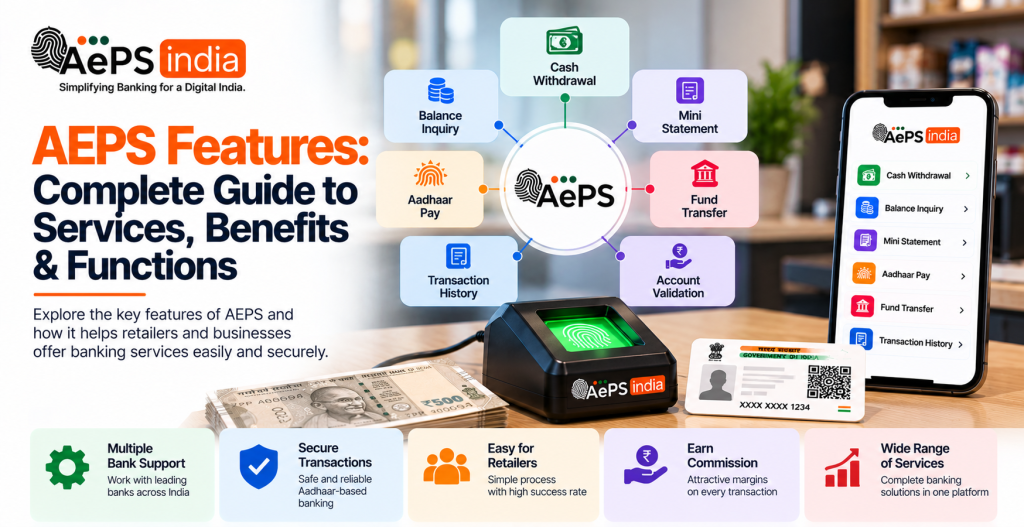
AEPS features make it possible for customers to access supported basic banking services through Aadhaar-based authentication at participating banking outlets. The Aadhaar Enabled Payment System (AEPS) helps extend banking access to areas where visiting a traditional bank branch may be difficult. Depending on the Aeps india, customers may be able to use services such as cash withdrawal, balance enquiry, and mini statements through an authorised AEPS app.
Understanding AEPS features is important for retailers, banking agents, distributors, and fintech businesses planning to offer Aadhaar-enabled banking services. Key functions can include biometric authentication, supported bank transactions, transaction status tracking, receipt generation, and retailer transaction management. The available services, limits, and requirements depend on the participating bank, acquiring institution, and AEPS service provider.
Aadhaar Enabled Payment System (AePS) is a bank-led model developed by the National Payments Corporation of India (NPCI) that lets users perform basic banking services using their Aadhaar number and biometric authentication.
AEPS India focuses on AEPS-related services and solutions for businesses exploring Aadhaar-enabled banking. Before selecting an AEPS platform, it is important to evaluate its supported transactions, retailer tools, security controls, transaction reporting, settlement process, and customer support.
In this guide, you will learn about the main AEPS features, how transactions work, the benefits for customers and retailers, and the points to check when choosing an AEPS solution. This will help you understand which features matter for your business and how to evaluate a platform against your operational needs.
What Are AEPS Features?
The Aadhaar Enabled Payment System (AePS) is a bank-led model built by the National Payments Corporation of India (NPCI) that allows online financial and non-financial transactions at micro-ATMs, kiosks, or authorized operator devices using Aadhaar authentication.
How AEPS Works
The Aadhaar Enabled Payment System (AePS) is a bank-led model developed by the National Payments Corporation of India (NPCI) that allows users to perform basic banking transactions using just their Aadhaar number and biometric authentication, without needing a debit card, credit card, or ATM PIN.
How an AePS Transaction Works
- Visit a Touchpoint: The customer goes to an authorized Aeps india website.
- Provide Details: The customer gives their Aadhaar number, names their bank, and selects the type of transaction (e.g., cash withdrawal, balance inquiry, mini-statement, or fund transfer).
- Biometric Authentication: The customer places their finger on a Aeps biometric scanner (Aeps fingerprint or Aeps iris scan) connected to the micro-ATM or POS device.
- UIDAI Verification: The biometric data is sent in real-time to the Unique Identification Authority of India (UIDAI) database to verify the customer’s identity.
- NPCI Switching & Bank Processing: Once verified, the request routes through the NPCI network to the user’s linked bank account to debit or credit the funds.
- Completion: The transaction finishes in a few seconds, and the touchpoint prints or displays a confirmation receipt.
Top 15 AEPS Features in India
The Aadhaar Enabled Payment System (AePS) developed by the Aeps india is a bank-led model that allows online interoperable financial transactions using an Aadhaar number and biometric authentication.
Top 15 AEPS Features and Explanations
Cash Withdrawal
- Explanation: Allows account holders to withdraw money from their Aadhaar-linked bank account at a local Business Correspondent (BC) or micro ATM without needing a debit card or ATM PIN.
Cash Deposit
- Explanation: Enables users to deposit cash directly into their Aadhaar-linked bank account through authorized agent touchpoints.
Balance Enquiry
- Explanation: Provides real-time information regarding the available balance in a customer’s linked bank account.
Mini Statement
- Explanation: Generates a quick, truncated record showing recent transactions (typically the last 5 to 10 entries) of the bank account.
Aadhaar-to-Aadhaar Fund Transfer
- Explanation: Facilitates direct peer-to-peer or account-to-account money transfers using the recipient’s and sender’s Aadhaar numbers.
Biometric Authentication
- Explanation: Replaces traditional passwords or PINs with secure biometric verification such as fingerprint or iris scans via UIDAI-compliant devices.
Interoperability
- Explanation: Connects multiple participating banks into a single platform, allowing a customer of one bank to use an agent/micro-ATM belonging to another bank.
Aadhaar Pay
- Explanation: A merchant-specific payment solution that allows shopkeepers to accept digital payments from customers using their Aadhaar number and biometrics, often with extended withdrawal/payment limits.
Micro Merchant Payments
- Explanation: Empowers small rural vendors and micro-businesses to accept digital retail payments without investing in expensive Point-of-Sale (POS) card machine hardware.
Micro Insurance Premium Collections
- Explanation: Allows insurance agents and rural service providers to collect regular policy premium payments at a customer’s doorstep using biometric verification.
Doorstep / Last-Mile Banking
- Explanation: Brings formal banking infrastructure to unbanked, remote, and rural villages via local bank mitras, eliminating the need to travel to distant bank branches.
Electronic KYC (e-KYC)
- Explanation: Uses demographic and biometric data from the UIDAI database to instantly and securely verify identity for opening new bank accounts.
Cardless and PIN-less Convenience
- Explanation: Removes the barrier of remembering complex ATM PINs or carrying physical debit/credit cards, making the system accessible to first-time or illiterate users.
End-to-End Security & Encryption
- Explanation: Protects data during transmission and storage using high-grade encryption standards mandated by the RBI and NPCI, minimizing fraud risks.
Agent Commission & Business Opportunities
- Explanation: Enables local shopkeepers and entrepreneurs to operate as authorized banking correspondents, earning service commissions on every successful financial transaction.
Benefits of AEPS for Customers and Retailers
The Aadhaar Enabled Payment System (AePS) is a bank-led model developed by the Aeps india that allows online interoperable financial transactions using Aadhaar authentication through a Business Correspondent (BC) or retailer touchpoint.
Benefits for Customers
- Cardless and PINless Banking: Customers do not need to carry a physical debit/credit card or remember a PIN. Transactions require only their Aadhaar number and biometric authentication (fingerprint or iris scan).
- High Security: Biometric verification prevents identity theft and unauthorized access, minimizing fraud risks compared to traditional paper or card methods.
- Local and Rural Accessibility: Users can access essential banking services at a nearby neighborhood retailer or BC outlet instead of traveling long distances to a bank branch or ATM.
- Access to Multiple Core Services: Customers can perform various transactions, including cash withdrawals, cash deposits, balance enquiries, mini statements, and fund transfers.
- Government Benefit Transfers: Makes it easy to receive and withdraw Direct Benefit Transfer (DBT) funds, pensions, and government subsidies directly.
- Assisted Banking Support: Ideal for elderly, unbanked, or illiterate individuals who may not be comfortable using smartphones or independent mobile banking apps.
Benefits for Retailers and Shopkeepers
- Additional Business and Revenue Opportunities: Retailers can transform a traditional shop into a local digital banking touchpoint, earning commissions on each AePS transaction.
- Increased Customer Footfall: Offering banking services brings more people into the store, which can directly boost regular product sales.
- Low-Space and Minimal Setup: Retailers do not need heavy or expensive ATM infrastructure; they can operate services using a compatible smartphone, micro-ATM, or a single Aeps biometric scanner device on their counter.
- Multi-Service Business Model: AePS can be bundled with other digital and utility services (such as bill payments, mobile recharges, or micro-insurance) to build an all-in-one assisted service business.
- Interoperable Operations: Retailers can serve customers from any bank connected to the Aadhaar network, expanding their potential client base beyond a single bank’s account holders.
AEPS Transaction Limits, Charges and Eligibility
The Aadhaar Enabled Payment System (AePS) allows customers to perform cardless, PIN-free financial transactions using their Aadhaar number and biometric authentication through a Business Correspondent (BC) or micro-ATM.
AEPS Transaction Limits
- Per-Transaction Limit: National Payments Corporation of India (NPCI) sets the maximum cash withdrawal limit at ₹10,000 per transaction.
- Daily / Cumulative Limit: Most issuing banks cap cumulative daily transactions at ₹50,000, though specific banks may enforce lower or distinct limits (e.g., Utkarsh Small Finance Bank caps limits at 10 transactions or ₹1,00,000 per month, whichever is reached first).
- Available Services: Cash withdrawal, cash deposit, balance enquiry, mini statement, and Aadhaar-to-Aadhaar or interbank fund transfers.
AEPS Charges
- Customer Fees: For basic services like balance checks, mini statements, and standard cash withdrawals at authorized bank or BC touchpoints, transactions are typically free or carry minimal fees depending on the bank.
- Bank/Operator Charges: Some banks or micro ATM operators may charge small fees (ranging from ₹5 to ₹25 per transaction) for cash withdrawals exceeding free monthly quotas set by individual institutions. For instance, SBI allows a set number of free transactions at BC/FI channels before applying standard charges of ₹15 + GST per extra transaction.
AEPS Security Features and Fraud Prevention
The Aadhaar Enabled Payment System (AePS) managed by the National Payments Corporation of India (NPCI)allows bank customers to perform basic banking transactions using their Aadhaar number and biometric data (fingerprint or face) without needing a debit card or OTP.
Core Security Features of AePS
- Biometric Authentication: Transactions require unique physical verification (fingerprint, iris, or face authentication via UIDAI) instead of standard passwords or PINs.
- End-to-End Encryption: All sensitive data is encrypted during transmission and storage across the central switching network.
- Interoperability & Compliance: Built on standards set by the Reserve Bank of India (RBI) to ensure safe interbank routing.
- Virtual ID (VID) Support: Users can generate a temporary 16-digit Virtual ID via the UIDAI portal instead of sharing their actual 12-digit Aadhaar number.
Common AePS Fraud Methods
- Cloned Fingerprints: Fraudsters steal biometric impressions from physical documents, land registries, or surface smears to create silicon/rubber fingerprint replicas.
- Misuse of Unmasked Documents: Publicly sharing or handing out unmasked Aadhaar photocopies at hotels, shops, or telecom counters exposes sensitive details.
- Fake Demos and Scams: Tricking users into scanning their thumbs or faces on unknown or handheld micro-ATM/POS devices under the guise of a “verification” or “subsidy demo”.
- AI-Assisted Spoofing: Using digital or AI-generated visual/biometric data to bypass weak agent-side validation.
Fraud Prevention & Best Practices
For Customers
- Lock Biometrics: Use the UIDAI Official Website or the mAadhaar app to lock your biometric data when not performing a genuine transaction unlocking it only right before you need to use it.
- Use Masked Aadhaar: Always share masked Aadhaar copies (where the first 8 digits are hidden) instead of full copies.
- Never Scan on Unknown Devices: Avoid placing your thumb or face on unverified handheld scanners or micro-ATMs at small or unverified retail outlets.
- Monitor Alerts: Watch for SMS or email debit notifications immediately; even a small ₹1 unauthorized test debit can precede a larger attack.
- Disable Unused AePS: Contact your bank to disable AePS services on your account if you do not actively use micro-ATMs or banking correspondents.
For Banks & Business Correspondents (BCs)
- AI-Driven Monitoring: Implement real-time anomaly detection to flag unusual withdrawal patterns or multi-attempt failures.
- Device & Location Binding: Lock BC agent logins to specific registered hardware devices and GPS footprints.
- Two-Factor Authentication (2FA): Enforce strict 2FA for all merchant/agent Aeps portal access.
How to Report AePS Fraud
If you notice an unauthorized withdrawal, act immediately because AePS transactions are difficult to reverse once cash is disbursed:
- National Cybercrime Helpline: Call 1930 or log a complaint on the National Cybercrime Reporting Portal.
- NPCI Dispute Portal: Register a grievance via the NPCI Complaint Portal.
- Bank Branch: Notify your bank’s fraud desk immediately with transaction details, time stamps, and your account statement.
Conclusion
Understanding AEPS features helps retailers, banking agents, and fintech businesses choose a solution that meets their daily banking service requirements. Features such as cash withdrawal, balance enquiry, mini statements, Aadhaar-based biometric authentication, transaction history, and status tracking can support basic banking operations, depending on the services enabled by the participating Aeps india.
Before selecting an best AEPS platform, check its supported banking services, transaction limits, authentication process, retailer management tools, reporting facilities, settlement procedures, security measures, and technical support. These factors can help you assess whether the solution fits your business model and provides the tools needed to manage transactions efficiently.
Aadhaar Enabled Payment System (AEPS) is a bank-led model developed by the National Payments Corporation of India (NPCI) that lets users perform financial transactions using only their Aadhaar number and biometric authentication through an authorized Aeps india.
AEPS India is a relevant starting point for businesses exploring AEPS-related services and solutions. Review the available features and service conditions carefully, and confirm the supported functionality before Aeps onboarding retailers or launching operations.
Whether you are starting an AEPS business or improving an existing banking service network, choosing the right features can help you plan a more efficient and customer-focused operation. Understand your requirements, compare available solutions, and select an top AEPS platform that supports your long-term business goals.
AEPS Features with Aeps India
Looking for AEPS software with useful banking and transaction features? Contact Aeps India to learn more about AEPS cash withdrawal, balance enquiry, mini statement, biometric authentication, transaction tracking, and software integration options for your business.
Frequently Asked Questions About AEPS Features
The main AEPS features may include cash withdrawal, balance enquiry, mini statement, Aadhaar-based biometric authentication, and transaction confirmation. Available services depend on the participating Aeps india.
AEPS allows eligible customers to access supported banking services using Aadhaar-based authentication at an authorised banking outlet. The transaction is processed through the participating institutions, Aeps india to authentication and service availability.
Yes. Cash withdrawal is one of the primary AEPS services. Customers must meet the participating bank’s requirements, complete the required authentication, and stay within the applicable transaction limits.
Yes. Balance enquiry is a commonly supported top AEPS service that allows customers to check their available bank balance after successful authentication, where the service is enabled.
Some AEPS services support mini statements, which show recent account transactions. Availability and the number of transactions displayed depend on the participating Aeps india.
Biometric authentication helps verify a customer’s identity during an AEPS transaction. The process uses an approved authentication mechanism and compatible device, subject to the applicable technical and regulatory requirements.
AEPS supports transactions through participating banks and enabled services. Customers should confirm whether their bank and the required transaction type are supported before using an best AEPS Software.
Retailers should evaluate supported banking services, transaction status tracking, receipts, transaction history, balance visibility, reporting tools, settlement procedures, device compatibility, and customer support.
AEPS platform provide transaction status and history features. These help retailers review transaction outcomes and identify pending or failed transactions. The available tracking options depend on the trusted Aeps platform.
A failed or pending transaction should be checked using its transaction reference and the Aeps india prescribed process. Retailers should follow the relevant Aeps india guidance for status verification, reversals, and customer communication.
Yes. AEPS transactions may be subject to limits set by participating banks, service providers, and applicable rules. Limits can vary by transaction type and other conditions, so confirm the current limit before processing a transaction.
AEPS uses Aadhaar-based authentication and defined transaction processes. Safety also depends on authorised access, secure devices, correct handling of customer information, and compliance with applicable requirements. Customers should use authorised Aeps application and never share their banking PINs or OTPs with agents.
AEPS can help eligible retailers offer supported basic banking services locally. Depending on their Aeps india agreement, retailers may also receive transaction records, operational reports, and tools to manage customer transactions.
AEPS features are the functions offered by the best Aeps system, such as cash withdrawal, balance enquiry, biometric authentication, and transaction tracking. AEPS benefits are the practical advantages these functions may provide, such as easier access to basic banking services and more convenient local transactions.
Businesses should review supported services, bank coverage, Aeps onboard requirements, transaction limits, device compatibility, security measures, settlement processes, support availability, and commercial terms. They should also verify the Aeps india authorisations and applicable compliance requirements.
Businesses can explore the AEPS-related services and Aeps API solutions available through AEPS India based on their operational requirements. Confirm the current service list, supported features, eligibility conditions, pricing, and Aeps onboarded process directly before making a decision.
Start by identifying the services you want to offer, your retailer or distributor model, expected transaction needs, and required Aeps software features. Contact AEPS India to confirm eligibility, onboarding requirements, supported services, commercial terms, and the next steps.

6 Essential Steps To Ensure That Your AEPS Portal Is Profitable
AEPS Service Company in India 2026 – Best AEPS Service Provider

Top AEPS Company in India: Complete Guide for Retailers & Businesses
About Author

