AEPS Portal Developer: Features, Cost & Complete Guide
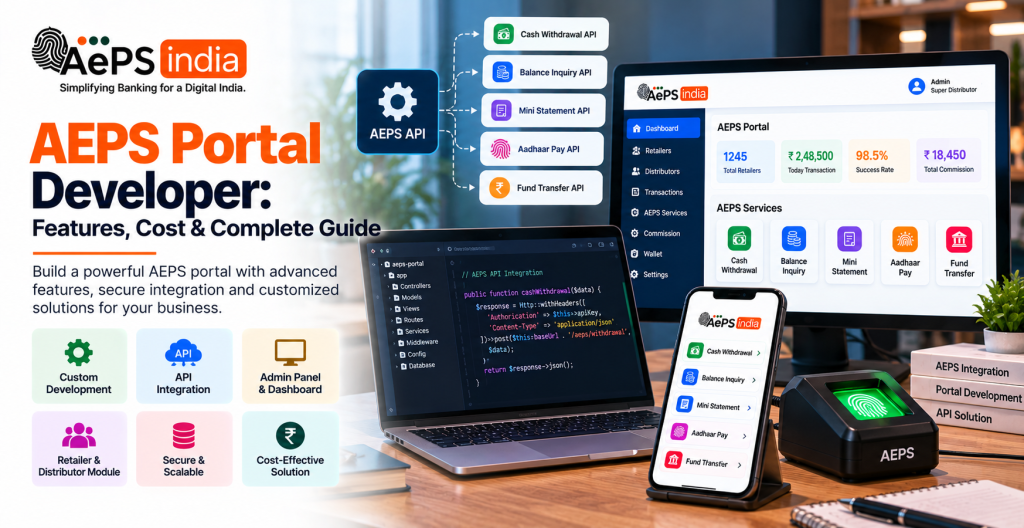
An AEPS Portal Developer helps businesses build a portal for managing Aadhaar Enabled Payment System (AEPS) services through supported banking integrations and authorized service providers. For fintech startups, retailers, distributors, and digital banking businesses, Aeps india is the right AEPS portal development company is essential for managing transactions, monitoring business activity, and delivering supported banking services to eligible customers.
An AEPS portal developer creates or integrates software that connects a Aeps business platform with the required AEPS service provider like Aeps india. Depending on the business requirements and available integrations, the portal may support cash withdrawal, balance enquiry, mini statements, retailer account management, transaction reports, and commission tracking.
An AEPS (Aadhaar Enabled Payment System) Portal Developer builds custom, NPCI-compliant Aeps software solutions that let businesses offer cardless, pinless banking services using Aadhaar numbers and biometric authentication (fingerprint or iris scan).
A well-planned AEPS portal can also include an administrative dashboard, retailer and distributor management, transaction-status monitoring, role-based access, reporting tools, and Aeps API integration. The exact features depend on the selected Aeps india. Biometric device compatibility, secure authentication, and clear processes for handling pending or failed transactions should also be considered during development.
Before selecting a Aeps india, evaluate their technical capabilities, integration documentation, customization options, security controls, Aeps onboarding requirements, maintenance support, and project costs. Confirm which banks and best AEPS services are supported, whether the proposed transaction workflow meets your requirements, and what authorizations and compliance obligations apply to your business model.
It is also important to understand the difference between a ready made AEPS portal, a customized Aeps portal, and an Aeps API-based integration. A ready-made Aeps solution may suit businesses that want to launch using existing features, while a customized portal may be appropriate when specific workflows or business requirements need additional development.
Aeps India provides a contact point for businesses exploring best AEPS software, Aeps portal solutions, and Aeps API integrated requirements. Whether you want to establish a new digital banking service, expand a retailer network, or integrate AEPS functionality into an existing Aeps fintech platform, start by identifying your required services, user roles, reporting needs, and expected transaction volume.
In this guide, we cover AEPS portal development, essential features, integration requirements, business benefits, security considerations, and the key questions to ask before choosing an AEPS Portal Developer. This information can help you compare solutions and make a more informed decision for your business.
What Is an AEPS Portal Developer?
An AEPS portal developer is a software engineer or a development company that builds digital platforms for the Aadhaar Enabled Payment System (AePS).
AEPS Portal Developer Work?
An AEPS Portal Developer builds, customizes, and integrates digital banking software that allows businesses, fintechs, and agents to provide Aadhaar-enabled banking services to customers.
Core Responsibilities and Work
- Platform & Panel Development: Building multi-tiered web and mobile Aeps panel including Aeps Admin Panel (for tracking system revenue, settlements, and compliance), Distributor Panels, and Retailer/Aeps Agent Panels.
- AEPS & Banking API Integration: Integrating AEPS API for core transactions like cash withdrawals, balance inquiries, mini-statements, and Aadhaar Pay API.
- Biometric & Hardware Support: Integrating Registered Device (RD) service drivers for Aeps fingerprint scanners and micro-ATM/PoS hardware (such as Mantra devices).
- White-Label Solutions: Providing ready-to-launch or custom-branded white label AEPS software so entrepreneurs can run their own branded fintech networks.
- Wallet & Commission Management: Aeps portal Developing automated ledger systems, multi-wallet structures, real-time settlement engines, and agent commission payout rules.
- Security & Regulatory Compliance: Implementing end-to-end encryption, multi-factor authentication, and sandbox testing to meet strict NPCI and UIDAI data security mandates.
AEPS Portal Developer Services
AEPS portal development services build cardless, PIN-less digital Aeps banking platform that connect retail agents, distributors, and fintech brands to NPCI and UIDAI infrastructure.
Core Services Offered by AEPS Developers
- White-Label AEPS Portals: Pre-built, customizable Aeps admin, distributor, and retailer web and mobile panels.
- AEPS API Integration: Live transaction bridges for cash withdrawals, balance inquiries, mini-statements, Aadhaar-to-Aadhaar fund transfers, and Aadhaar Pay.
- Biometric Authentication: SDK integration for STQC-certified Aeps fingerprint and Aeps iris scanners device (such as Mantra).
- Multi-Service Add-ons: Integration of DTH, mobile recharges, utility bill payments (BBPS), and micro-ATM/POS solutions.
Types of AEPS Portals a Developer Can Build
A developer can build several types of Aadhaar Enabled Payment System portals depending on the target audience, business model, and depth of integration.
1. White-Label AePS Portals
- Overview: A ready-made, customizable turn-key Aeps platform branded with the developer’s or client’s own company name, logo, and custom domain.
- Features: Built-in multi-bank switching, agent/retailer wallet management, live commission settings, and transaction reporting dashboards.
- Cost / Setup: Typically ranges from ₹15,000 to ₹1,20,000+ depending on the Aeps india and bundled services.
2. B2B / Admin & Distributor Portals
- Overview: A hierarchical control Aeps portal designed for master distributors, distributors, and network managers.
- Features: Sub-agent Aeps onboarded, KYC verification workflows, hierarchical commission-sharing trees (distributor-to-retailer cuts), and real-time ledger monitoring.
- Target Audience: Aeps india scaling a field agent network.
3. Custom AePS API Integration Solutions
- Overview: Backend-focused developer code layers that embed cardless, biometric banking functions directly inside an existing larger fintech application or enterprise Aeps app.
- Features: RESTful Aeps API for cash withdrawals, cash deposits, balance inquiries, mini statements, and Aadhaar Pay API, decoupled from a specific front-end UI.
- Target Audience: Established fintech startups or enterprise software companies wanting full control over the user experience.
4. Retailer / Agent Micro-ATM Portals (Web & Mobile Apps)
- Overview: A front-end interface built specifically for local Kirana store owners, service points, and business correspondents.
- Features: Customer Aadhaar entry, bank selector, L1 Aeps biometric fingerprint scan integration (via USB/OTG or Bluetooth), and instant wallet settlement.
- Platforms: Web browser dashboards (requiring RD-service desktop drivers) or Android mobile/tablet applications.
5. Direct Bank / Enterprise Integration Portals
- Overview: A high-tier, direct-switching infrastructure built in compliance with sponsor banks (such as ICICI Bank or Yes Bank) and NPCI routing specifications.
- Features: High-throughput transaction engines, custom cryptographic modules, and direct settlement pipelines.
- Cost / Setup: High barrier to entry, ranging from ₹2,50,000 to ₹4,50,000+ in compliance and Aeps setup overhead.
Who Can Use AEPS Portal Developer
An Aadhaar Enabled Payment System (AePS) portal and its developer/admin systems can be used by various business entities, service providers, and individual operators:
Key Users of an AePS Portal & Developer Solution
- Fintech Startups and Software Developers: Build, customize, and maintain white-label AePS platforms, integrate APIs, and manage software architecture.
- Admin / Central Authorities: Monitor multi-level hierarchies, including master distributors, distributors, and transaction ledgers.
- Distributors and Master Distributors: Onboard regional agents, manage merchant networks, and handle commission structures.
- Retailers and Local Shop Owners (Kirana Stores, Pharmacies): Turn local shops into micro-ATMs to provide cash withdrawals, deposits, and balance inquiries.
- Business Correspondents (BCs) and Field Agents: Authorized bank agents offering doorstep or rural banking services using UIDAI-certified biometric devices.
- Micro-Merchants: Accept cardless and PIN-less biometric payments directly from customers.
- Bank Customers and Citizens (End-Users): Any resident of India with an active, Aadhaar-seeded bank account who uses the touchpoints for basic banking.
Why Use AEPS Portal Developer
Using an AEPS (Aadhaar Enabled Payment System) portal developer allows businesses, fintech startups, and retail networks to build custom, cardless, and PIN-less banking platforms.
Key Reasons to Work with an AEPS Portal Developer
- Custom API Integration: Developers integrate core AEPS APIs such as cash withdrawals, cash deposits, balance inquiries, and mini-statements directly into your existing mobile app or website.
- Turn Shops into Micro-ATMs: Software solutions let local retailers and Business Correspondents (BCs) use biometric scanners to serve rural and underbanked communities without physical bank branches.
- NPCI & UIDAI Compliance: Developers ensure the platform securely routes transaction requests through the National Payments Corporation of India (NPCI) gateway and matches fingerprints via UIDAI.
- Admin & Merchant Dashboards: They build multi-tiered management systems including AEPS admin software (to oversee agents, commissions, and ledgers) and merchant/retailer software (to process customer transactions and track earnings).
- Financial Inclusion & Direct Benefit Transfer (DBT): Your portal can support government subsidy disbursements and micro-insurance collections, expanding your service reach.
Essential Modules of an AEPS Portal
An Aadhaar Enabled Payment System Portal is a complex financial inclusion Aeps platform developed in accordance with NPCI guidelines. To function efficiently, secure high transaction success rates, and manage an extensive agent network, an best AEPS portal must be built around several essential core modules:
1. Core AEPS Transaction Processing Module
This is the foundational engine of the entire top Aeps portal that routes and processes financial and non-financial transactions. It communicates directly with bank servers through the NPCI gateway.
- Cash Withdrawal Module: Enables cardless cash withdrawals up to the ₹10,000 NPCI-mandated limit per transaction.
- Aadhaar Pay Module: Allows merchants to accept digital payments from customers over and above the regular daily AEPS withdrawal limits.
- Balance Enquiry & Mini-Statement: Fetches real-time bank balances and lists the last few transactions for the consumer.
- Fund Transfer: Facilitates Aadhaar-to-Aadhaar financial transfers between accounts.
2. User Administration & Hierarchy Management Module
AEPS operates on a B2B2C chain (Fintech/Bank → Distributor → Retailer/Agent). This module manages various system access tiers:
- Admin Panel: The central backend dashboard used by the primary b2b Aeps platform owner to view master analytics, tweak commissions, and manage global settings.
- Distributor Management: Allows master distributors to onboard, track, and manage retail agents under their geographical banner.
- Retailer/Agent Portal: The front-facing point-of-sale interface used by local shopkeepers to interact with walk-in customers.
3. Onboarding & KYC Compliance Module
Because AEPS handles direct banking infrastructure, rigorous regulatory compliance is necessary.
- Agent eKYC / Onboarding: Collects and safely archives government-mandated documents (Aadhaar, PAN, and business address proofs) to approve agent profiles before issuing functional credentials.
- Biometric Device Registration: Registers, whitelists, and pairs certified biometric Aeps fingerprint system or Aeps iris scanner system (Registered Devices – RD services) with the b2b Aeps software to secure authentication workflows.
4. Dual-Wallet & Real-Time Settlement Module
Handling daily liquid cash requires an automated and transparent ledger architecture.
- Agent Digital Wallet: Reflects the digital cash equivalence balances of the agent. Every successful cash withdrawal debits the consumer’s bank and immediately credits this digital wallet.
- Real-Time Payout (Settlement): An integrated IMPS/NEFT payout module allowing agents to transfer their accumulated digital wallet balances directly into their registered personal bank accounts 24/7/365 to maintain physical cash liquidity.
5. Automated Commission Distribution Module
Aeps platforms grow by motivating distributors and retailers through small, immediate margins on every single transaction.
- Commission Matrix Planner: Allows administrators to establish customized flat or percentage-based commission slabs based on transaction volume brackets.
- Instant Credit Ledger: Automatically splits and credits commissions into the Aeps wallet of both the working agent and their supervising distributor the exact second a customer’s transaction closes successfully.
6. Security, Risk, & Fraud Monitoring Module
Best AEPS manages sensitive financial payload routing and biometric checks, requiring heavy protective infrastructure.
- Biometric & Two-Factor Authentication (2FA): Enforces mandatory merchant 2FA daily logins alongside biometric customer scans to prevent system unauthorized usage.
- Velocity Checks & Fraud Management: Automatically flags and blocks suspicious high-frequency transactions from identical biometric indicators or isolated IP endpoints to eliminate looping threats.
- Unique 12-digit RRN Tracking: Generates and maintains a unique Retrieval Reference Number (RRN) for every transaction to simplify transaction audits and dispute resolution.
7. Reporting & Business Analytics Module
Provides transactional clarity and system oversight for agents and administrators alike.
- Transaction Status Ledgers: Offers real-time tabular data specifying “Success,” “Failed,” or “Pending” transaction loops.
- Dispute & Chargeback Loggers: Automatically captures and addresses network timeout failures, initiating auto-reversal procedures for accounts when bank networks disconnect unexpectedly.
What Does an AEPS Portal Developer Do?
An AEPS portal developer builds secure digital platforms that let retail agents and businesses offer cardless, PIN-less banking services using Aadhaar numbers and biometric verification (fingerprints or iris scans).
Key Responsibilities
- API and Bank Integration: Connects the Aeps service portal to the National Payments Corporation of India (NPCI) switch, UIDAI authentication servers, and banking partner networks for real-time transaction processing.
- Biometric Device Integration: Integrates Aeps software development kits (SDKs) for Aeps fingerprint scanners device and biometric devices to capture and encrypt customer identities safely.
- Core Banking Workflow Design: Builds modules for basic financial services including cash withdrawals, cash deposits, balance inquiries, and mini-statements.
- Multi-Tier User Management: Develop Aeps administrative dashboards to manage different user hierarchies, such as white label Aeps, distributors, retailers, and customer service points (CSPs).
- Commission and Wallet Tracking: Implements automated calculation and tracking systems for agent commissions, transaction ledgers, and live wallet balances.
- Data Security and Compliance: Ensures compliance with UIDAI, RBI, and NPCI regulations by building end-to-end data encryption, audit logs, and secure cloud architectures.
AEPS Portal Developers Technology and Requirements
An AEPS (Aadhaar Enabled Payment System) portal lets businesses offer cardless, biometric banking services like Aeps cash withdrawal, Aeps balance inquiry, and Aeps mini statement through Aeps service platforms such as AEPS India.
Key Technology Stack & Architecture
- Interface & Client Layer: Web portals, mobile Aeps application (Android/iOS), or embedded web SDKs like Aeps india SDK supporting iframe rendering.
- Biometric Device Integration: Certified Registered Devices (RD Service drivers) for fingerprint scanners from brands like Mantra.
- API & Authentication Layer: REST Aeps API, asymmetric encryption, and single-use token systems to protect transaction data.
- Switching & Routing: Integration with the National Payments Corporation of India (NPCI) Central Switch and Bank Switches for real-time settlement.
- Backend & Core Systems: Direct connectivity to UIDAI (Aadhaar Authentication) and CBS (Core Banking Systems).
Core Requirements & Compliance
- Regulatory Approvals: Authorization from NPCI and adherence to Reserve Bank of India (RBI) guidelines.
- UIDAI Compliance: Strict data protection, strong encryption, and certified biometric capture protocols.
- KYC & Onboarding: Paperless/digital KYC verification for administrators, distributors, and retail business correspondents (BC).
- Operational & Admin Controls: Multi-tier dashboards for managing wallets, tracking transaction history, configuring commissions, and generating audit logs.
AEPS Developers for Retailer and Distributor Panel Development
AePS development for retailer and distributor panels involves building a multi-tier, white-label B2B2C fintech infrastructure.
Key Panel Hierarchy & Structure
- Admin Panel: Controls system-wide configurations, Aeps bank API routing, global commission slabs, wallet loads, KYC approvals, and dispute management.
- Distributor / Super Distributor Panel: Manages regional onboarding of sub-distributors and retail agent stores, tracks network transaction volume, and manages commission overrides.
- Retailer / Merchant Panel & App: Enables cardless micro ATM operations including cash withdrawals, balance inquiries, mini-statements, and Aadhaar Pay via STQC-certified Aeps biometric devices.
Core Features Included by Developers
- Multi-Tier Commission Engine: Automated slab-based commission distribution and instant credit for retailers, distributors, and Aeps admins.
- Digital KYC & Onboarding: Paperless merchant verification integrated with Aadhaar validation API/PAN validation APIs.
- Double Wallet & Settlement System: Real-time wallet loading, auto-debits/credits, and instant or IMPS/NEFT bank settlement.
- Biometric Device Integration: Plug-and-play support for major finger/iris scanners (such as Mantra) on Android and Web.
- Value-Added Services (VAS): Often bundled with Domestic Money Transfer (DMT), BBPS/Bharat Connect bill payments, mobile/DTH recharges, and PAN card services.
Features AEPS Portal Developer
An AEPS portal developer builds digital financial platforms that allow merchants and agents to process cardless, PIN-free banking transactions using Aadhaar and biometric verification.
Core Features Built by AEPS Portal Developers
- Cardless & Biometric Authentication: Integrates UIDAI-certified Registered Device (RD) services for fingerprint and Aeps iris scanning.
- Essential Banking Services: Enables cash withdrawals, balance inquiries, mini statements, and fund transfers.
- Multi-Bank & API Integration: Connects the modern Aeps platform to NPCI, central switches, and multiple sponsor bank gateways via REST Aeps Cash Withdrawal API.
- Multi-Tier User Hierarchy: Provides separate dashboards and permission levels for Administrators, Distributors, Retailers (Micro-ATM / CSP agents), and Support teams.
- Wallet & Commission Management: Includes automated wallet top-ups, virtual wallet creation, real-time balance tracking, and configurable commission structures.
- Auto Reconciliation & Settlements: Automates transaction matching with Core Banking Systems (CBS) and handles direct merchant settlements.
- White-Label Solution: Aeps india offers customizable, branded web portals and Android/iOS mobile apps under your own company name.
- Security & Fraud Prevention: Incorporates AES-256 data encryption, AI-driven liveness/spoof checks, session controls, and detailed audit trails.
Benifits AEPS Portal Developer
Working with specialized AEPS Portal Developers allows businesses to launch cardless, biometric-based banking services under their own brand.
Key Benefits of Hiring AEPS Portal Developers
- New Revenue Streams: Earn tiered commissions and transaction fees on every cash withdrawal, balance inquiry, mini-statement, and fund transfer.
- White-Label Customization: Receive a fully branded platform featuring your own company logo, custom domain, and tailored user interface (UI).
- High Uptime & Multi-Bank Routing: Integrate smart backend routing across multiple nationalized and private banking partners to maintain over 98% system reliability and fewer failed transactions.
- Instant Payout Settlements: Utilize automated real-time transaction processing and T+0 or T+1 cash settlements to maintain smooth store liquidity.
- Centralized Admin Dashboards: Control multi-tiered channel hierarchies (master distributors, distributors, and retailers), adjust commission splits dynamically, and monitor live audit logs from a single panel.
- Regulatory Compliance & Security: Ensure end-to-end encryption, OWASP guidelines, and strict adherence to National Payments Corporation of India (NPCI) and UIDAI mandates.
- Biometric Hardware Compatibility: Integrate seamlessly with UIDAI-certified L1 fingerprint and iris scanners (such as Mantra) and micro-ATM peripherals.
- Value-Added Services (VAS): Bundle extra financial offerings into your portal, such as domestic money transfer (DMT), Bharat Bill Payment System (BBPS), mobile recharges, and PAN card creation.
How to Hire AEPS Portal Developer
To hire AEPS portal developer, you must evaluate technical fintech experience, choose between a white label Aeps solution or custom-built Aeps earning software, and ensure compliance with AEPS Developer in India | Custom AEPS Software & Aeps mini statement API guidelines.
1. Define Project Requirements
- Core Services: Cash withdrawals, balance inquiries, mini statements, and Aadhaar-to-Aadhaar fund transfers.
- Hierarchy Support: Multi-level administrator, master distributor, distributor, and Aeps retailer panel.
- Additional Utilities: Integration for BBPS bill payments, domestic money transfer (DMT), micro ATMs, and mobile recharges.
2. Choose a Hiring Model
- White-Label Portal Provider: Fast deployment and cost-effective (setup ranging from ₹34,999 to ₹50,000+) using pre-built, branded Aeps platform with integrated Aeps Fund Transfer API.
- Custom Full-Stack Development: Aeps india offers complete ownership and custom logic for ₹50,000 to ₹1.2 Lakhs+.
- In-House Team: Ideal for long-term product scaling and data control.
3. Identify Essential Technical Skills
- Tech Stack & APIs: Backend languages like Node.js or PHP, frontend frameworks like React, and experience with RESTful Aeps banking API and NPCI switches.
- Biometric & Security: Knowledge of UIDAI-compliant RD services, fingerprint device SDKs (Mantra), data encryption, and PCI-DSS standards.
4. Screen and Interview Candidates
- Review portfolios for live B2B Aeps platform, question them on error handling and automatic failure reversals, and mandate sandbox environments for testing.
5. Legal and Onboarding Steps
- Secure business logic with an NDA and clarify direct Aeps india agreements along with post-launch support terms.
Hiring AEPS Portal Developer Cost in India
Hiring an Aadhaar Enabled Payment System (AePS) portal developer or setting up a white label Aeps pltaform/custom AePS platform in India typically costs ₹7,500 to ₹4,50,000+, depending on the integration model, architecture, and whether you need custom code or a pre-built white label Aeps software pack.
Cost Breakdown by Development & Integration Model
White-Label / Basic AePS API:₹7,500 – ₹35,000
- Best for startups wanting quick branding using an existing parent banking/Aeps API license via AEPS India.
AePS Software & Portal Pack (with Device Support):₹20,000 – ₹1,00,000+
- Includes admin, distributor, and retailer panels, Aeps biometric device integration (such as Mantra), wallet architecture, and basic reporting.
Direct Bank / Enterprise AePS API Integration:₹1,50,000 – ₹4,50,000+
- Built for established fintechs connecting directly with partner banks (like ICICI or Yes Bank) requiring high-security NPCI/UIDAI compliance.
- Freelance API / Custom Script Integration: ₹600 – ₹1,500+ per task or project-based (though custom full-stack custom engineering runs significantly higher).
Ongoing & Hidden Cost Factors
- Per-Transaction & Routing Fees: Banks and NPCI routing incur per-transaction charges (or yield agent/platform commission slabs ranging up to ₹13–₹20 per withdrawal).
- Recurring Maintenance & Hosting: Monthly or annual server hosting, security patches, and technical support fees charged by the software provider.
- Compliance & Security: Mandatory adherence to UIDAI and NPCI encryption, KYC modules, and biometric signature verifications.
AEPS KYC and User Onboarding Module Development
An AePS KYC and User Onboarding Module automates the registration, verification, and compliance of Business Correspondents (BCs)/merchants and end-customers through the National Payments Corporation of India (NPCI) and UIDAI infrastructure.
Core Components of an AePS Onboarding & KYC Module
1. Merchant / Agent Onboarding Flow (Business Correspondent)
Because agents act as last-mile banking touchpoints, strict regulatory due diligence (aligned with RBI and PMLA guidelines) is mandatory:
- Mobile & OTP Verification: Initial signup via mobile number with a one-time password (OTP) check.
- Personal & Business Info Entry: Collection of legal name, PAN card, residential address, and business/shop details (e.g., Shop & Establishment Act license, Udyam registration).
- Biometric eKYC: Live fingerprint, iris, or compliant face authentication via an STQC-certified Registered Device (RD) service.
- Document Uploads: Digital submission of PAN, Aadhaar, bank account proof (cancelled cheque or passbook), and a live selfie/photo.
- Centralized KYC (C-KYCR) Integration: Optional or mandatory lookup via central registries to reduce repeat checks and drop-off errors.
- Bank & NPCI Mapping: Allocation of a unique Aeps Merchant ID (MID), multi-bank routing configuration, and status tracking dashboards to monitor where an agent’s verification stands.
2. Customer / End-User Authentication Flow
End-users do not require a heavy advance registration module they only need an Aadhaar-linked bank account (AEBA):
- Aadhaar Number & Bank Selection: The agent inputs the customer’s 12-digit Aadhaar number and selects their target bank from the multi-bank gateway.
- Transaction & Service Selection: Choosing between cash withdrawal, balance inquiry, mini-statement, Aadhaar Pay software, or cash deposit.
- Biometric or OTP Check:
- Fingerprint or iris scan via the RD service device.
- Step-up OTP verification for high-value transactions (e.g., above ₹5,000) sent to the customer’s Aadhaar-linked mobile number.
- Daily merchant self-authentication (biometric check required once a day before processing customer requests).
AEPS Admin Panel Development
An AEPS (Aadhaar Enabled Payment System) Admin Panel is a centralized backend dashboard that fintech companies, banks, and master distributors use to manage cardless, biometric-based banking networks.
Core Features
- Agent & Hierarchy Management: Aeps Onboard, approve, or reject retailers, distributors, and super-distributors with multi-level permissions and KYC verification.
- Real-Time Transaction Tracking: Monitor live cash withdrawals, balance inquiries, mini-statements, and fund transfers using unique Retrieval Reference Numbers (RRN).
- Automated Commission Engine: Configure slab-wise Aeps commission structures that split and credit earnings across the hierarchy in real time.
- Dual-Wallet & Settlement System: Maintain separate main liquidity and AEPS commission wallets with automated bank settlement processing.
- White-Label Branding: Customized Aeps portal, web app, and mobile interface with your own company logo, domain name, and brand identity.
- Security & Fraud Control: Implement multi-layer encryption, AI fraud detection, and compliance with NPCI and UIDAI guidelines.
AEPS Wallet and Commission Module Development
An Aadhaar Enabled Payment System wallet and commission module powers cardless, biometric-based banking transactions (such as cash withdrawals, balance inquiries, and mini-statements) while automatically handling multi-tier payouts, liquidity, and ledger settlements.
Core Architecture of an AePS Wallet Module
- Working Balance & Liquidity Control: Manages main merchant/agent working balances so micro ATM operators or retail outlets have immediate liquidity to disburse cash.
- Real-Time Settlement (T+0 / 24/7): Handles instant wallet-to-bank and bank-to-wallet fund movements, payout requests, and operational cash flow.
- Escrow & Pooled Account Security: Segregates and protects pooled merchant funds in compliance with banking and NPCI guidelines.
- Ledger & Account Statements: Generates date-wise ledgers, service-wise summaries, and export-ready reconciliation reports.
Core Architecture of a Commission Module
- Slab-Based Commission Engine: Configures automated per-transaction margins and surcharges based on transaction volume tiers (e.g., higher margins or percentage/flat splits for different cash withdrawal slabs).
- Multi-Tier Distribution Hierarchy: Supports profit-sharing across multi-level networks, including:
- Admin / Fintech Provider (central authority)
- Master Distributors
- Distributors
- Retailers / Agents / Business Correspondents (BC)
- Instant Sub-Wallet Credit: Credits agent and distributor commissions directly into respective sub-wallets immediately upon transaction confirmation.
- Dynamic Commission Control: Allows admins to customize, adjust, or override commission structures per distributor or retailer profile.
AEPS Transaction Management Module Development
An Aadhaar Enabled Payment System (AePS) Transaction Management Module is the core operational and backend control center of a digital banking or trusted Aeps platform. It handles cardless, PIN-less financial transactions routed through the National Payments Corporation of India (NPCI) switch.
Core Components of an AEPS Transaction Module
1. Transaction Processing & Routing Engine
- Multi-Bank Routing: Automatically switches transaction loads across 15+ participating banking partners to ensure high uptime and failure fallback.
- Supported Operations:
- Cash Withdrawals
- Cash Deposits
- Balance Enquiries
- Mini-Statements
- Aadhaar-to-Aadhaar Fund Transfers
- Aadhaar Pay
- Real-Time Status Tracking: Uses unique Retrieval Reference Numbers (RRN) to track and reconcile live status updates or troubleshoot failed/pending transactions.
2. Biometric Authentication & Security Layer
- UIDAI / RD Service Integration: Connects to STQC-certified L1 Aeps biometric devices (such as fingerprint or iris scanners) to capture, encrypt, and validate user biometrics.
- Aadhaar Seeding & Lookup: Verifies the customer’s 12-digit Aadhaar number and mapped bank account via bank-led routing switches.
- Fraud Prevention: Implements double-encryption, anti-spoofing checks, and device-binding protocols to block unauthorized or duplicate transactions.
3. Agent & Retailer (BC) Hierarchy Management
- Business Correspondent (BC) Onboarding: Manages KYC, document verification, and activation statuses for local merchants, retailers, and distributors.
- Tiered Access Control: Assigns role-based permissions for Admins, Distributors, Master Franchisees, and Retailers.
- Device & Terminal Mapping: Associates specific micro ATM hardware or mobile Aeps commission app logins with authorized agent locations.
4. Commission & Payout Engine
- Configurable Slabs: Sets tiered commission structures based on transaction volume, ticket size, or agent performance levels.
- Ledger & TDS Management: Automatically calculates agent earnings, deductions (such as TDS), and net payouts.
- Wallet & Settlement Engine: Controls automated or manual fund flows between the top AEPS nodal bank account, platform wallets, and individual agent bank accounts (
T+0or real-time settlements).
AEPS Portal UI/UX Design and Customisation
An Aadhaar Enabled Payment System portal interface balances strict regulatory security (UIDAI and NPCI guidelines) with high-speed, low-friction workflows for rural banking agents, retailers, and distributors.
Core UI/UX Components of an AePS Portal
1. Retailer / Agent Dashboard
- Service Quick-Launch Bar: Large, high-contrast action cards for primary services: Cash Withdrawal, Balance Enquiry, Mini Statement, and Aadhaar Pay service.
- Live Wallet & Settlement Status: Real-time visibility into floating cash balances, instant credit commissions, and payout schedules.
- Biometric Device Status Indicator: Clear visual feedback (green/red signal) showing whether the Morpheus, Mantra, or Secugen fingerprint/iris scanner is plugged in and ready.
- Customer Lookup Flow (Step-by-Step Wizard):
- Input 12-digit Aadhaar Number (with automatic grouping/validation).
- Select Bank Name via searchable IIN (Issuer Identification Number) dropdown with bank logos.
- Enter Transaction Amount (for withdrawals).
- Prompt biometric scan with clear voice/visual countdown timers.
2. Admin & Distributor Panel UI
- Multi-Tier Hierarchy Views: Separate, role-based dashboards for Super Admin, Distributors, and Retailers so each tier views only relevant commission ledgers and downline activity.
- Transaction Ledger & Dispute Management: Real-time transaction status (Success, Pending, Failed) with one-click chargeback or ticket-raising hooks linked to NPCI/bank switch responses.
- Commission Slab Configurator: Drag-and-drop or matrix UI to set custom flat-fee or percentage-based commission slabs per bank or volume tier.
Key UI/UX Customisation Options
- White-Label Branding: Custom corporate logo, favicon, color schemes (primary/secondary hex codes), and white-label mobile app APKs (Android/iOS) matching your brand identity.
- Dashboard Modular Layout: Ability to enable or disable cross-sell services on the dashboard such as BBPS bill payments, Domestic Money Transfer (DMT), Micro ATM, or PAN card services.
- Receipt & Invoice Generator: Custom thermal-printer-friendly receipt templates (2-inch or 3-inch layouts) featuring your company’s support helpline, GSTIN, and brand logo.
- Multi-Language Support (Localization): Regional language toggles (Hindi, Marathi, Tamil, Telugu, Gujarati, etc.) on the retailer mobile app and portal to lower the learning curve for rural operators.
Technologies Used for AEPS Portal Development
An Aadhaar Enabled Payment System portal development stack combines modern web/mobile technologies with specialized financial APIs, biometric hardware integrations, and secure backend routing engines.
1. Core & Backend Technologies
- Programming Languages & Frameworks: Node.js, Python, Java (Spring Boot), or PHP (Laravel) for building high-concurrency, reliable backend services.
- Databases: PostgreSQL, MySQL, or MongoDB for managing transaction logs, user wallets, agent commissions, and ledger records.
- API Integration Layer: Standardized RESTful Aeps Balance Inquiry API connecting to the National Payments Corporation of India (NPCI) switch, partner bank gateways, and UIDAI servers.
- Transaction Engine: Custom business logic modules handling routing, real-time wallet debits/credits, automated commission splits, and failure reconciliation.
2. Biometric Authentication & Hardware Integration
- Biometric SDKs: Manufacturer-specific Aeps portal Software Development Kits (SDKs) and RD (Registered Device) services for UIDAI-certified Aeps fingerprint scanners and certified Aeps iris devices (e.g., Mantra).
- Encryption Standards: AES-256 and XML/XML-DSig cryptographic standards to safely capture, compress, and encrypt biometric blocks before transmission; raw biometrics are never stored on the portal server.
3. Frontend & User Interface
- Web Portal: React.js, Angular, or Vue.js for building responsive agent, distributor, and admin dashboards.
- Mobile Applications: Android (Java/Kotlin or Flutter/React Native) for micro-ATM and handheld POS agent apps.
4. Security & Compliance Architecture
- Transport Security: TLS 1.3 / SSL encryption for all API communications.
- Access Controls: Role-Based Access Control (RBAC) for admins, distributors, and retailers, alongside multi-factor authentication (MFA) and session timeouts.
- Fraud Monitoring: Real-time anomaly detection and audit logging to track unusual transaction patterns.
AEPS Portal Security Development
An AEPS portal security development model requires multi-layered protection, strict regulatory compliance, and hardware-software integration to safeguard biometric and financial data.
Core Security & Compliance Requirements
- Biometric Device Compliance: Integration Aeps biometric devices (fingerprint or iris scanners) is mandatory to ensure live-person detection and prevent spoofing.
- NPCI & UIDAI Guidelines: Direct compliance with National Payments Corporation of India (NPCI) and Unique Identification Authority of India (UIDAI) standards for encrypted data packets during transmission.
- Tokenization & Masking: Raw Aadhaar numbers are replaced with dynamic tokens during authentication sessions, and core bank details remain masked.
- One Operator, One Bank: Strict mapping protocols ensure an agent operates under a single designated banking partner to prevent fraudulent multi-bank routing.
Architectural Layers of Security
- User & Hardware Layer: Uses L1-compliant fingerprint/iris hardware linked through encrypted local device drivers.
- Application & API Layer: Features end-to-end data encryption (AES-256 or higher), strict Role-Based Access Control (RBAC) in the admin panel, and session management.
- Switching & Routing Layer: Connects securely to the NPCI central switch and UIDAI authentication servers via secure channel protocols (HMAC/XML signing).
- Real-Time Monitoring: Admin dashboards track live transaction flows, high-risk agent activity, and instant SMS/app alerts for every withdrawal or balance check.
AEPS Portal Testing and Quality Assurance
AEPS portal testing and quality assurance (QA) ensures that financial transactions are secure, compliant with regulations, and process seamlessly for end-users. Because AEPS deals with real-time biometric authentication and financial switching, the testing approach must be highly structured.
Core Testing Pillars
1. Functional Testing
This ensures that all core features of the AEPS portal work exactly as specified by the National Payments Corporation of India (NPCI) guidelines.
- Core Transactions: Validate standard actions like Balance Inquiry, Cash Withdrawal, Cash Deposit, and Mini Statement.
- Fund Transfers: Test Aadhaar-to-Aadhaar fund transfers across different banks.
- Error Handling: Verify how the best Aeps system handles declined transactions (e.g., insufficient funds, incorrect Aadhaar numbers, or biometric mismatches).
2. Biometric & Device Integration Testing
AEPS relies entirely on biometric hardware. QA teams must verify hardware-to-Aeps b2b software compatibility.
- RD Services: Test integration with Registered Device (RD) services from various vendors (e.g., Mantra, Morpho, SecuGen).
- Fingerprint/Iris Capture: Ensure the Aeps application correctly captures, encrypts, and passes biometric data without data loss.
- Timeout Handling: Verify fast Aeps portal behavior when a user takes too long to place their finger on the scanner.
3. Security & Compliance Testing
Since AEPS processes sensitive financial and biometric data, security testing is non-negotiable.
- Data Encryption: Ensure Biometric data is encrypted at the capture level using UIDAI public keys and remains encrypted in transit (PCI-DSS standards).
- Session Management: Validate automatic session timeouts, concurrent login prevention, and secure token management.
- Vulnerability Assessment (VAPT): Scan for OWASP Top 10 vulnerabilities, SQL injections, and cross-site scripting (XSS).
4. Performance & Load Testing
Branded AEPS portal often experience high traffic spikes, especially during government subsidy distribution days.
- Concurrency Testing: Simulate thousands of agents performing cash withdrawals simultaneously.
- Latency Check: Measure the round-trip time (RTT) between the Aeps Agent Portal, Bank Switch, NPCI Central Server, and UIDAI.
- Failover Recovery: Test how the portal recovers if a major network gateway or banking switch goes down mid-transaction.
5. Integration & API Testing
AEPS links multiple complex systems together.
- NPCI & UIDAI Simulator Testing: Use simulators to mimic NPCI and UIDAI responses to test standard success and failure APIs.
- Reconciliation Testing: Ensure daily transaction logs match exactly with bank settlement reports to avoid accounting discrepancies.
Standard AEPS Testing Checklist
| Test Scenario | Expected Result |
|---|---|
| Valid Cash Withdrawal | Amount debited from customer bank, credited to agent wallet; success receipt generated. |
| Incorrect Aadhaar Number | Trusted Aeps Portal flags an error immediately or returns an invalid Aadhaar response from NPCI. |
| Biometric Match Failure | UIDAI returns auth failure; transaction safely reverses; no money is deducted. |
| Network Timeout Mid-Txn | System triggers an auto-reversal or moves the transaction to a “Pending” queue for manual check. |
| Daily Limit Exceeded | Portal blocks the transaction if the customer exceeds the regulatory daily velocity limits. |
AEPS Portal Deployment and Maintenance
An Aadhaar Enabled Payment System (AePS) portal deployment and maintenance framework involves setting up a multi-layered digital architecture, integrating with the National Payments Corporation of India (NPCI) and Digital India gateways, and managing ongoing operations to ensure high uptime and security.
Core System Architecture (4-Layer Framework)
Presentation Layer (Client & Interface)
- Agent/Merchant Portal & Mobile App: Web and Android/iOS interfaces for Business Correspondents (BCs) and retailers.
- Biometric SDK Integration: Support for UIDAI-certified L1 fingerprint/iris scanners.
- Customer Input Interface: Captures the 12-digit Aadhaar number, bank selection, transaction type (cash withdrawal, balance inquiry, mini statement), and amount.
Business Logic Layer (Middleware & API Gateway)
- Request Validation & Encryption: AES-256 encryption for securing sensitive biometric and personal data in transit.
- Session Management & Rate Limiting: Manages active agent sessions and prevents brute-force or duplicate transaction attempts.
- Multi-Bank API Routing: Connects to multiple bank servers simultaneously with server redundancy to maintain high transaction success rates (>98%).
Network Switching Layer (Central Switch)
- NPCI Routing Engine & UIDAI Bridge: Routes authentication requests to UIDAI for biometric matching and passes financial payloads to the respective destination bank node.
Core Banking Layer (CBS & Settlement)
- Core Banking System (CBS): Verifies account balances, debits/credits funds, and triggers instant confirmation webhooks.
- Settlement Engine: Manages fund flows between nodal banks, merchant/agent wallets, and liquidity pools (supporting T+0 or T+1 settlements).
AEPS india One of The AEPS Portal Developer
AEPS india one of the right Aadhaar Enabled Payment System (AEPS) portal developer or Aeps software provider is critical for building a secure, fast, and profitable digital banking or fintech business.
Key factors to evaluate when selecting an AEPS portal developer include:
1. Compliance, Licensing, and Bank Tie-Ups
- NPCI Authorization & Security Guidelines: Ensure the AEPS india developer builds on infrastructure that complies with National Payments Corporation of India (NPCI) rules and data privacy laws.
- Nodal Bank Partnerships: AEPS india partners with for smooth, uninterrupted settlement engines and liquidity management.
2. Security and Biometric Authentication
- Data Encryption: The reliable Aeps portal must feature end-to-end encryption for sensitive biometric data (fingerprint and iris scans) and customer Aadhaar numbers.
- Two-Factor Authentication (2FA) & Firewalls: Robust role-based access control (RBAC), multi-layered firewalls, and fraud-detection mechanisms are mandatory to prevent unauthorized access.
3. Uptime and Transaction Success Rate
- High Success Rates: Look for a AEPS india with redundant banking routes to minimize transaction drops or biometric timeout failures during peak hours.
- Real-Time Tracking: The top Aeps system should generate unique Retrieval Reference Numbers (RRN) for every transaction to quickly trace and resolve failed attempts.
4. Platform Model & Customization
- White-Label Options: If you want to run the business under your own brand, verify whether Aeps india offer a customizable white label AEPS platform with your logo, domain, and theme.
- Admin Control Panel: The backend should let you manage multi-tier hierarchies (master distributors, distributors, and sub-agents), track live wallet balances, and configure user KYC.
- API Solutions: If you are building an independent app, check if they offer clean, well-documented AEPS API integrating.
5. Commission and Pricing Structure
- Transparent Pricing: Request a complete breakdown covering portal development costs, white label Aeps setup fees, AMC (Annual Maintenance Contracts), and Aadhaar Enabled Payment System API hit charges.
- Tiered Commission Payouts: Ensure the branded Aeps admin panel lets you flexibly configure margins and commission structures for your agents and distributors.
6. Technical Support and Maintenance
- Operational Assistance: Financial services require 24/7 or prompt technical support to fix Best Aeps service API, webhook failures, or driver registration issues for biometric devices.
- Scalability: The architecture must comfortably scale up as you add more retailers, master distributors, and daily transaction volumes.
Why Is AEPS India the Best Choice for an AEPS Portal Developer?
AEPS india is an AEPS (Aadhaar Enabled Payment System) portal developer stands out by offering reliable Aeps technology, strong compliance, and complete business scalability.
When choosing or evaluating an AEPS portal developer, the key strengths that make a provider the best choice include:
1. High Uptime and Transaction Success Rates
- Reliable Switching: Direct bank tie-ups and robust NPCI integration ensure minimal transaction failures and quick processing speeds.
- Real-Time Status: Clear transaction logs, unique reference numbers (RRN), and instant status updates prevent confusion during cash withdrawals or balance inquiries.
2. Strong Security and Regulatory Compliance
- UIDAI & RBI/NPCI Compliance: Adherence to strict security guidelines, end-to-end encryption, and safe biometric (fingerprint or iris) authentication.
- Fraud Protection: Built-in safeguards and access controls to protect sensitive customer financial and identity data.
3. White-Label & Custom Branding Flexibility
- Own-Brand Portals: Ability to launch a branded web portal and mobile Aeps application with customized Aeps admin and retailer dashboards.
- Distributor & Retailer Hierarchies: Multi-tier management tools that let you easily fast Aeps onboard, monitor, and assign commissions to agents or distributors.
4. Comprehensive Banking Services
- Interoperable Services: Support for cash withdrawals, cash deposits, balance inquiries, mini-statements, and fund transfers across multiple participating banks.
- All-in-One Ecosystem: Integration options for additional services like Micro ATM software, Aadhaar Pay, bill payments, and mobile recharges to expand your revenue streams.
5. Seamless API & Technical Support
- Developer-Friendly Documentation: Clear high speed Aeps API and sandbox testing environments for quick integration into existing business apps or software.
- 24/7 Operational Assistance: Reliable technical support to resolve merchant complaints, network glitches, or settlement issues promptly.
Conclusion
Choosing the right AEPS Portal Developer is an important decision for businesses planning to launch or expand Aadhaar Enabled Payment System services. A well-developed AEPS portal can help manage retailer accounts, monitor transaction activity, maintain commission records, generate reports, and organize day-to-day operations from a centralized Aeps dashboard. The right development approach should match your business model, required banking services, integration needs, and plans for future growth.
Before selecting an AEPS portal development company, evaluate its fast Aeps API integration capabilities, admin and retailer panels, transaction-status tracking, biometric device compatibility, reporting features, security controls, technical support, and customization options. Confirm which top AEPS services are supported by the relevant banking partners, along with the Aeps india authorization, onboarding requirements, and applicable compliance obligations. These checks can help you choose a solution based on operational suitability rather than feature claims alone.
An AEPS (Aadhaar Enabled Payment System) Portal Developer builds and manages Aeps software solution that allow businesses, retailers, and financial service providers to offer cardless, pinless banking transactions using Aadhaar-based biometric authentication.
Aeps India is an option to explore when discussing AEPS portal development and digital banking software requirements. Whether you want to build a new AEPS portal, improve an existing platform, or create a system for managing retailers and distributors, define your required features, transaction workflow, integration scope, and business goals before beginning development.
If you are searching for an AEPS Portal Developer with Aeps India, contact the team to discuss your project requirements and understand the available development and integration options. A clear project scope can help you evaluate the expected functionality, implementation process, and ongoing technical support before making a decision.
Ready to discuss your AEPS portal project? Visit Aeps India Contact Us to explore the next steps for your business.
AEPS Portal Developers with Aeps India
Looking for reliable AEPS Portal Developers for your fintech or digital banking business? Contact Aeps India to discuss AEPS portal development, required features, integration options, and a solution tailored to your business needs.
Frequently Asked Questions About AEPS Portal Developers
An AEPS Portal Developer is a software developer or company that builds or customises portals for Aadhaar Enabled Payment System services. Depending on the project, the Aeps portal may include an admin dashboard, retailer and distributor panels, transaction management, reporting, and integration with an authorised AEPS india.
An AEPS Portal Developer plans, develops, tests and maintains the software required for an fast AEPS platform. The work may include user management, API integration, transaction-status tracking, reporting, security controls, and deployment. Access to live AEPS services also depends on the required banking and authorised AEPS india arrangements.
An AEPS portal may include an Aeps admin dashboard, retailer and distributor accounts, user permissions, transaction history, status tracking, commission reports, wallet or ledger management, support tickets and low cost Aeps API configuration. The final feature set should match the business model and the capabilities of the connected AEPS india.
Yes. A developer can build a custom solution based on the business’s requirements, AEPS india constraints. Custom Aeps software development may cover the Aeps portal design, user roles, reporting, Aeps API connections, workflow automation, and integration with existing Aeps business software.
AEPS software is the broader application or system used to manage AEPS-related operations. An AEPS portal is usually the web-based interface through which administrators, distributors or retailers access those functions. Depending on the product, a portal may be one component of a larger software platform.
An AEPS Portal Developer may integrate an Aeps API supplied by an authorised Aeps india. The integration can involve authentication, transaction requests, response handling, status checks and reporting. Before development starts, confirm Aeps business API availability, documentation, access permissions and production requirements.
Depending on the connected AEPS india and participating banks, AEPS bank platforms commonly support cash withdrawal, balance enquiry and mini statements. Other services may be available under separate arrangements. Verify the currently supported services rather than assuming every high volume AEPS portal offers the same functions.
Yes. A portal can be designed with separate dashboards and permissions for administrators, distributors and retailers. Depending on the requirements, these panels may support user onboarding, transaction monitoring, reports, commission configuration and account management.
The retailer selects a supported service and enters the required transaction details. The request is passed to the integrated service through the authorised workflow, and the platform displays the resulting status. The portal should record the transaction reference and distinguish successful, failed and pending requests.
The developer can implement transaction-status checks, reference-number tracking, error logs, reconciliation tools and support workflows. The exact process depends on the AEPS india. A pending transaction should not be marked successful without confirmation, and any reversal must follow the authorised AEPS india procedure.
A white label AEPS portal may allow a business to use its own branding, logo, domain and customised interface. Available features and ownership rights depend on the development agreement. Confirm whether the package includes hosting, source code, customisation, maintenance and future updates.
The cost depends on whether you need a ready made Aeps portal, a white label Aeps portal solution or custom Aeps software development Company. Other factors include API integration, user roles, reporting, security, hosting, testing and ongoing maintenance. Request a written quotation that separates one-time development costs from recurring fees.
The timeline depends on project scope, design requirements, Aeps API documentation, integration complexity, testing and approvals. A basic Aeps portal and a custom multi level Aeps platform can require different amounts of work. Ask the AEPS india developer for a milestone-based delivery plan after the requirements are reviewed.
Important controls may include encrypted communication, protected AEPS API credentials, role-based access, secure session handling, audit logs, input validation and controlled access to customer information. The standard Aeps platform must also follow the security and data-handling requirements of its authorised AEPS india and applicable rules.
Yes, where the architecture and AEPS APIs support the intended integration. A web portal can work alongside a mobile application for authorised users, but authentication, transaction processing, permissions and status handling must be implemented consistently across both platforms.
Before launch, confirm the required business eligibility, authorised AEPS india arrangement, Aeps API access, documentation, supported devices, security controls and onboarding process. Complete testing for successful, failed and pending transactions, and verify that transaction records and support procedures work correctly before production use.
Yes. A multi-user portal can support different account types and permission levels. Depending on the system, administrators may manage retailer onboarding, distributor relationships, transaction reports and commission rules. Scalability should be considered during architecture and database design.
Evaluate the developer’s relevant experience, software architecture, API integration process, security practices, testing methodology, support terms and project documentation. Ask for a demonstration, clarify software ownership and maintenance responsibilities, and verify that the proposed solution can work with your authorised service arrangement.
Contact AEPS India to confirm its currently available portal and software-development services. Ask which features are included, whether customisation and API integration are available, what onboarding conditions apply, and what the commercial and technical support terms cover.
Prepare a list of your required user panels, banking services, API integrations, reports and security requirements. Contact AEPS India to discuss the project, request a demonstration or proposal, and verify the available service-provider arrangements, delivery scope, pricing and maintenance terms before proceeding.

AEPS API Services Explained: Complete Guide to Aadhaar Enabled Payment System API

Top AEPS API Integration Service in India
AEPS API for Retailers: Everything You Need to Know
About Author

