AEPS Business Profit: Monthly Earning & Commission Guide 2026
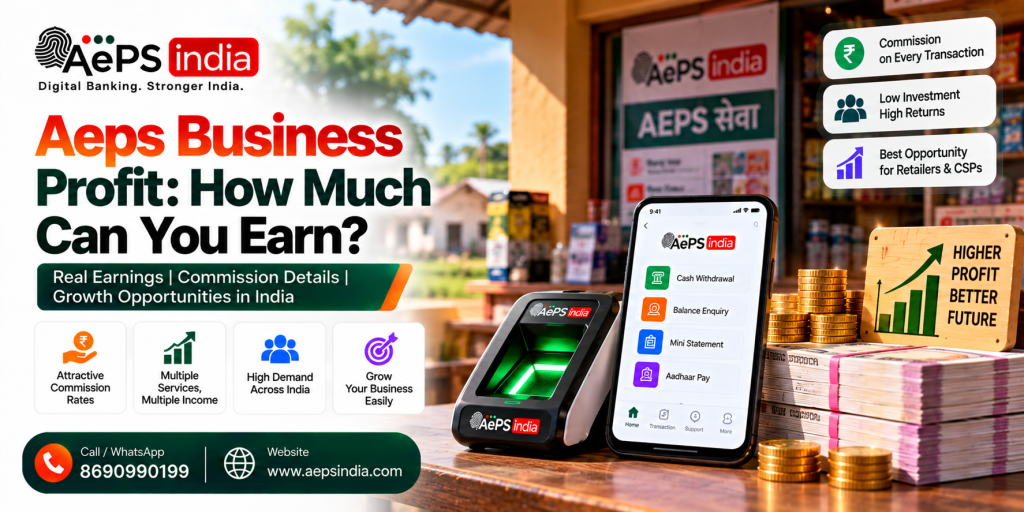
AEPS Business Profit is one of the most important questions for retailers, shop owners, CSC operators, fintech entrepreneurs, and digital service providers who want to start Aadhaar Enabled Payment System business in India. AEPS allows eligible customers to access assisted banking services through an agent or retailer outlet, creating an opportunity to earn commission from transactions while providing useful financial services in areas where customers may not have convenient access to a bank branch.
But how much can you actually earn from an AEPS business? There is no single fixed monthly income because profitability depends on several factors, including daily transaction volume, applicable commission, customer demand, location, service mix, operating expenses, settlement terms, and the Aeps india you choose. A retailer processing more genuine customer transactions can have a very different earning profile from a new outlet with limited footfall.
An AEPS Business lets small shop owners earn commissions of ₹2 to ₹15 per transaction by turning their shop into a local cash withdrawal and banking point.
The AEPS Business Profit opportunity can become stronger when retailers offer multiple services instead of depending only on cash withdrawal. Depending on the available platform and business model, services can include cash withdrawal, balance enquiry, mini statement, Aadhaar-based fund transfer, cash deposit, Aadhaar Pay, Micro ATM, DMT, BBPS, mobile recharge, and other digital financial services. This broader service mix can help increase customer visits and create additional earning opportunities. Aeps india, for example, presents AEPS alongside several other assisted financial and digital services, while Aeps india highlights transaction volume and commission as major profitability factors.
For a realistic AEPS Business Profit calculation, you should consider both revenue and expenses. A simple calculation can start with daily successful transactions × average commission × working days, followed by deductions for internet, biometric devices, shop or staff costs, Aeps platform charges, and other operating expenses. This gives a more realistic picture of potential net earnings than relying on a promotional monthly-income figure.
With Aeps India, businesses can explore AEPS solutions for retailers, agents, distributors, fintech companies, and digital service providers. Depending on the business requirement, an best AEPS platform can support transaction processing, biometric authentication, retailer management, wallet and settlement operations, reporting, AEPS API integration, and additional digital payment services.
In this complete guide to AEPS Business Profit, we will explain how AEPS earnings work, how much an AEPS retailer can potentially earn, how to calculate daily and monthly income, which factors affect profitability, what investment and operating costs to consider, how commission structures work, and how adding multiple services can improve the overall business model. The goal is to help you calculate AEPS Business Profit based on realistic transaction volume and costs rather than simply relying on a fixed earning claim.
Is AEPS Business Profitable in 2026?
Yes, an AEPS (Aadhaar Enabled Payment System) business is profitable in 2026, especially for local kirana stores, mobile shops, and rural/semi-urban retailers looking to boost store footfall and earn supplemental commission income.
Earning Potential & Commissions
- Cash Withdrawals: Agents earn roughly ₹2 to ₹15+ per transaction, with higher-value withdrawals (typically between ₹3,000 and ₹10,000) yielding the maximum commission payouts.
- Other Services: Additional revenue comes from handling mini-statements (₹2–₹7), balance inquiries (₹1–₹5), and Aadhaar Pay transactions.
- Monthly Earnings: Active retail agents in high-demand areas can generate roughly ₹10,000 to ₹30,000+ per month in combined commission income, alongside increased cross-selling opportunities from higher customer footfall.
How Much Can You Earn From an AEPS Business?
Retailers and agents running an AEPS (Aadhaar Enabled Payment System) business typically earn ₹10,000 to ₹30,000+ per month, with high-volume or Aeps API integrated setups potentially making ₹45,000 to ₹1,35,000+ per month.
Per-Transaction Commission Structure
Retailers earn a commission or interchange split on every successful financial transaction:
- ₹100 to ₹999: ₹0.20 to ₹2.00 per transaction
- ₹1,000 to ₹1,499: ₹1.00 to ₹3.00 per transaction
- ₹1,500 to ₹1,999: ₹3.00 to ₹4.50 per transaction
- ₹2,000 to ₹2,999: ₹4.00 to ₹5.50 per transaction
- ₹3,000 to ₹10,000 (High-Value Slabs): ₹10.00 to ₹15.00+ per transactio
- Balance Inquiries / Mini-Statements: ₹2.00 to ₹5.00 per check
Additional Income Streams
- Aadhaar Pay / Merchant Payments: Accept direct account payments with zero standard gateway charges, or optionally charge customers up to a 1% convenience fee.
- Value-Added Services (VAS): Earn extra margins by bundling utility bill payments, mobile and DTH recharges, and domestic money transfers (DMT).
- Increased Store Sales: Turning your shop into a neighborhood mini-bank drives higher footfall, boosting regular retail sales of your primary goods.
Growth of AEPS in India (Why It’s Profitable)
The Aadhaar Enabled Payment System (AePS) is a fast-growing, bank-led model by NPCI that lets customers do basic banking using just their Aadhaar number and fingerprint.
Growth of AePS in India
- Revenue grew from INR 5 billion (2019) to INR 51 billion (2024).
- Usage jumped past 370 million customers in 2023 alone.
- Volumes expanded from 345 million to nearly 5 billion transactions over recent years.
- Rural and semi-urban expansion drives exponential market adoption.
AEPS Business Profit Calculation: Daily, Monthly & Yearly Earnings
An Aadhaar Enabled Payment System business earns money via per-transaction commissions rather than a fixed salary or retail markup.
AEPS Commission Structure (Per Transaction)
Retailer commissions generally depend on the transaction amount and the Aeps india:
- Cash Withdrawal (Low Value, ₹500–₹1,000): ₹1.50 to ₹3.00 per transaction
- Cash Withdrawal (Mid to High Value, ₹3,000–₹10,000): ₹5.00 to ₹15.00+ per transaction
- Balance Inquiry / Mini-Statement: ₹1.00 to ₹7.00 per request
- Aadhaar Pay (Merchant Payments): Percentage-based or flat incentive tiers
Earning Scenarios (Moderate Volume Example)
Assuming an average commission of ₹7.00 per cash withdrawal and 30 successful transactions per day (a typical small-to-medium shop in a semi-urban or rural area):
| Period | Calculation Formula | Gross Earnings |
|---|---|---|
| Daily Earnings | 30 transactions × ₹7.00 | ₹210 |
| Monthly Earnings | ₹210 × 30 active days | ₹6,300 |
| Yearly Earnings | ₹210 × 365 days | ₹76,650 |
Note: High-volume shops handling 50–100+ transactions a day can scale gross monthly earnings to ₹15,000 – ₹30,000+, especially when cross-selling other services like Micro ATM (MATM), Domestic Money Transfer (DMT), and Mobile/DTH Recharges.
Net Profit vs. Gross Commission
To calculate your actual net profit, you must subtract operational and hidden costs from your gross commission:
Net Profit = Gross Commission − Cash Liquidity Costs − Operating Expenses
- Cash Liquidity / Payout Costs: To keep giving cash out to customers, you constantly need physical cash in your drawer. Moving money back and forth from your digital B2B Aeps wallet to your bank account can attract IMPS/transfer or cash-handling charges.
- Operating Expenses: Electricity, internet/Wi-Fi connection, thermal paper for mini-statements, and Aeps biometric device maintenance.
- Working Capital Locked: You need a heavy cash float (e.g., ₹50,000 to ₹1,00,000+ daily) sitting in your shop to service large cash withdrawals.
AEPS Commission Per Transaction: How Much Can Agents Earn?
AEPS agents typically earn ₹2 to ₹15+ per transaction, with the highest commissions paid on cash withdrawals between ₹3,000 and ₹10,000.
Commission Breakdown by Transaction Type
Agents earn varying commission rates depending on the service provided:
- Cash Withdrawal: ₹2 to ₹15+ per transaction (tiered higher for larger amounts)
- Balance Inquiry: ₹1 to ₹5 per transaction
- Mini-Statement: ₹2 to ₹7 per transaction
- Money Transfer (DMT): ₹10 to ₹20 per transaction
- Aadhaar Pay: No standard bank commission, though agents can optionally charge customers up to 1% of the transaction amount
How Much Can Agents Earn Monthly?
- Active Retailers / Low-to-Moderate Volume: Earning roughly ₹10,000 to ₹30,000+ per month by handling steady daily foot traffic.
- High-Volume Outlets: Agents processing 300+ transactions a day can gross between ₹45,000 and ₹1,35,000+ per month, though operating costs (such as portal fees, internet, and device maintenance) must be factored into the net profit.
Tips to Maximize AEPS Earnings
- Target Slab Sweet Spots: Focus on withdrawals in the ₹3,000 – ₹10,000 range to unlock the maximum tier payout per swipe.
- Cross-Sell Services: Combine AEPS with Micro-ATM (MATM), Domestic Money Transfer (DMT), bill payments, and mobile recharges to boost daily revenue.
- Strategic Location: Operate in rural areas, local markets, or near transit hubs with limited direct bank branch access.
How AEPS Earnings Actually Work for a Small Shop
An Aadhaar Enabled Payment System (AePS) turns your retail counter into a mini-ATM, letting you earn cash commissions while boosting regular store footfall.
How the Commission Structure Works
- Slab-based payouts: Commissions depend on the withdrawal amount, not a flat percentage.
- ₹100–₹2,000 withdrawals: Earns around ₹5 per transaction.
- ₹2,001–₹5,000 withdrawals: Earns around ₹8 per transaction.
- ₹5,001–₹10,000 withdrawals: Earns up to ₹12–₹15+ per transaction.
- Mini-statements: Earns a flat ₹1.5 per check.
- Balance enquiries: Completely free with zero commission.
Simulated Monthly Earnings Example
- Assumed volume: 15 transactions/day over 26 working days (390 total transactions/month).
- Average blended commission: ₹9 per transaction across mixed slabs.
- Total baseline commission: ₹3,510 per month in direct earnings.
- Hidden multiplier: Cross-sales on regular items lift actual profit further.
Hidden Costs & Risks to Watch Out For
- Device investment: You must buy an STQC-certified Aeps biometric fingerprint scanner separately (e.g., Mantra).
- Working capital lock: You need sufficient cash float in your shop drawer to dispense against digital balance transfers.
- Fraud risks: Strict adherence to biometric safety and “One Operator, One Bank” compliance rules is mandatory.
AEPS Business Profit: Transaction Volume vs Income
AEPS (Aadhaar Enabled Payment System) business profit depends directly on transaction volume and slab-based commission rates, meaning your income scales linearly with how many customer transactions you process and the size of each withdrawal.
Transaction Volume vs. Income Breakdown
- Core Formula: Monthly Income = Total Successful Transactions × Applicable Commission
- Slab-Based Structure: Commissions are not a flat rate; they scale based on the transaction amount:
- Cash Withdrawals (₹3,000 to ₹10,000): Yield the highest Aeps commission per transaction, typically ranging from ₹13 to ₹15+ (or ₹2 to ₹15+ depending on the Aeps india).
- Lower-Value Withdrawals (e.g., ₹500): Yield smaller commissions, starting around ₹1.50 to ₹2.
- Non-Financial Services: Balance inquiries earn ₹1 to ₹5 and mini-statements earn ₹2 to ₹7 per transaction.
Volume Milestones & Projections:
- 20 customers daily (averaging ~₹10 per transaction) = ₹200/day or roughly ₹6,000/month.
- 50+ transactions daily = Monthly income crosses ₹15,000/month.
- Active rural/semi-urban retailers: Frequently average ₹10,000 to ₹30,000+ per month with steady foot traffic.
- Bonuses and Incentives: High-volume agents (“Super Prime Retailers”) can earn extra monthly bonuses (up to ₹2,000) for completing high daily/monthly transaction counts (e.g., 150–200+ transactions).
Key Drivers to Maximize Profit
- Ticket Size: Encouraging larger cash withdrawals (closer to the ₹3,000–₹10,000 slab) maximizes your per-transaction payout.
- Service Mix: Combining cash withdrawals with mini-statements and balance inquiries stacks small supplemental fees onto your daily totals.
- Location: Operating in unbanked rural areas, near bus stands, or local markets drives repeat foot traffic.
AEPS Business Investment and Startup Cost
An AEPS (Aadhaar Enabled Payment System) business startup cost depends on whether you start as a local retail agent/mini-ATM point or build a tech-enabled white-label fintech portal.
1. Startup Cost Breakdown by Business Tier
| Business Model / Tier | One-Time Setup & Integration Cost | Recurring / Annual Maintenance Cost | Essential Equipment & Hardware |
|---|---|---|---|
| Retailer / Agent / Micro-ATM (Kirana shop, local service center) | ₹650 – ₹7,999 (often bundles agent activation and basic portal access) | Nil to minimal portal/software fees | STQC-certified L1 Biometric Fingerprint Scanner (₹2,000 – ₹3,500), Smartphone or PC, Internet connection |
| White-Label Fintech Startup (Branded B2B/B2C portal via parent banking license) | ₹12,000 – ₹35,000 (Standard API/White-label package) | ₹10,000 – ₹40,000 / year (Server hosting, domain, SMS gateway) | Branded admin/distributor/retailer software panel, payment wallet system |
| Enterprise / Direct Bank API (Direct bank connectivity with ICICI, Yes Bank, etc.) | ₹2,55,000 – ₹4,50,000+ | Custom / High-volume or per-transaction routing charges | Dedicated server infrastructure, compliance and security certifications |
2. Key Equipment and Hardware Requirements
- Biometric Fingerprint Scanner: Must be STQC-certified L1 (Level 1) compliant as per latest NPCI guidelines (brands like Mantra cost roughly ₹1,500 to ₹3,000).
- Device: An Android smartphone, tablet, or Windows PC/laptop with active internet connectivity.
- Documents for KYC: PAN card, Aadhaar card, bank account proof, and shop/business address proof.
3. Revenue and Commission Structure
- Cash Withdrawal / Banking Services: Agents earn a tiered commission ranging from ₹2 to ₹15+ per transaction depending on the withdrawal slab set by the Aeps india.
- Value-Add Services: You can boost earnings by bundling AEPS with Micro-ATMs, Best BBPS, Domestic Money Transfer (DMT), and PAN Card Verification API assistance.
4. Compliance & Regulatory Rules (2026 Mandates)
- One Operator, One Bank Rule: Strict compliance enforced by the RBI and NPCI regarding agent mapping and active KYC.
- Re-KYC: Mandatory re-verification if an agent ID remains inactive for 3 months.
- L1 Device Mandate: Older non-L1 Aeps biometric devices are phased out; you must use UIDAI/NPCI-approved L1 hardware.
What Actually Makes an AEPS Service “Cost-Effective”
A genuinely cost effective AEPS service goes beyond low initial fees. It balances setup costs, hidden overheads, transaction margins, and multi-service utility to maximize net earnings for retailers and small businesses.
1. Transparent Pricing & Zero Hidden Fees
- Upfront Agreements: A cost-effective Aeps india clearly discloses all costs upfront with no hidden traps like annual renewal fees, software maintenance charges, wallet loading cuts, or surprise Tax Deducted at Source (TDS) handling issues.
- Reasonable Setup Costs: Quality AEPS software or Aeps API integration typically ranges from ₹12,000 to ₹35,000 for white label Aeps or custom Aeps solutions, or ₹15,000 to ₹50,000 depending on the level of feature depth.
- Fair Transaction Charges: Look for competitive commission structures and nominal per-transaction slabs (ranging from ₹0.25 to ₹10 or balanced percentage shares) that do not eat into retail margins.
2. Multi-Service Bundling (One Roof, Multiple Streams)
- Beyond Standalone AEPS: The most cost-effective setup is never isolated; it bundles best AEPS with Micro ATMs, Domestic Money Transfer (DMT), Best Bharat Bill Payment System, mobile/DTH recharges, and UPI QR acceptance.
- Consolidated Overhead: Operating through a single agent ID, a single Aeps app, and a single wallet allows you to monetize every footfall in your shop without multiplying subscription or b2b Aeps software maintenance costs.
3. High Transaction Success Rates & Uptime
- NPCI Compliance & Strong APIs: Cheap Aeps software is useless if biometric authentication fails frequently. Aeps india ensures high-success-rate routing, minimal server downtime, and seamless integration with major banking switches.
- Low Hardware Dependency: It should run smoothly on standard Android smartphones or low cost Aeps biometric fingerprint/Aeps iris scanners without forcing expensive, proprietary hardware upgrades.
4. Low Infrastructure & Operational Footprint
- Last-Mile Efficiency: Top AEPS removes the need for physical brick-and-mortar setups, heavy paper documentation, or cash-handling overheads, turning local retail shops into functional micro-banks at a fraction of traditional banking costs.
AEPS Business Profit Margin: Gross Income vs Net Profit
In an Aadhaar Enabled Payment System (AEPS) business, the distinction between Gross Income (Commission) and Net Profit determines whether your retail or micro-ATM counter is actually making money.
1. Gross Income (Commission)
- Definition: Gross income is the total sum of the Aeps commissions and fees earned from processing customer transactions before subtracting any shop or operational costs.
- How It Is Earned: You earn tiered commissions per successful transaction (such as cash withdrawals, balance inquiries, or mini-statements) set by Aeps india.
Typical Commission Slabs (Cash Withdrawals):
- ₹100 to ₹999: ₹2 per transaction
- ₹1,000 to ₹1,499: ₹2 to ₹3 per transaction
- ₹1,500 to ₹1,999: ₹3 to ₹4.5 per transaction
- ₹2,000 to ₹2,499: ₹5.5 per transaction
- ₹3,000 to ₹10,000 (Sweet Spot): ₹10 to ₹15+ per transaction
- Other Services: Balance inquiries and mini-statements typically fetch ₹1 to ₹5, while Aadhaar Pay can offer up to 1% depending on the merchant agreement.
- Example: If you process 150 cash withdrawals a day averaging ₹10–₹12 in commission each, your daily gross income is roughly ₹1,500 to ₹1,800 (or ~₹45,000 to ₹54,000 a month).
2. Net Profit
- Definition: Net profit is the actual take-home money left in your pocket after deducting all overhead, operational, and financial expenses from your gross commission.
Hidden & Direct Costs to Subtract:
- Shop & Infrastructure: Rent, electricity, and internet/Wi-Fi bills.
- Portal/Software Fees: Annual maintenance charges, gateway or payout/settlement charges, and wallet-loading fees levied by Aeps india.
- Hardware Depreciation: Initial cost and wear-and-tear of the STQC-certified Aeps biometric scanner, smartphone, or thermal printer.
- Liquidity / Cash Management Costs: Transporting physical cash to/from your bank to keep your drawer stocked, or bank charges for cash-handling/deposits.
- Tax & Compliance: GST and TDS deductions on your commission payouts.
Example Calculation:
- Gross Monthly Income: ₹45,000
- Less Monthly Operating Expenses (Shop share of rent, power, internet, portal/bank/settlement fees, cash transit): ~₹8,000 – ₹12,000
- Less Taxes / TDS: ~₹1,500 – ₹2,000
- Actual Net Monthly Profit: ₹31,000 to ₹35,500
Gross Income vs. Net Profit Comparison
| Metric | What It Covers | Key Reality for AEPS Owners |
|---|---|---|
| Gross Income | Total commission accumulated in your retailer wallet. | Looks high on paper; can give a false sense of earnings if volume is small. |
| Net Profit | What remains after rent, electricity, internet, device costs, and settlement fees. | Your real financial take-home; typically 65%–80% of gross income depending on overheads. |
What Expenses Reduce AEPS Business Profit?
Several key operational, infrastructure, and financial costs reduce net profits in an Aadhaar Enabled Payment System (AEPS) business:
- Hardware and Equipment Costs: Initial investment in an STQC-certified L1 Aeps biometric fingerprint device or Aeps iris scanner device, smartphones, computers, or micro ATM devices, plus periodic device replacements or upgrades.
- Provider and Setup Fees: Best Aeps Portal setup charges, annual renewal fees, top Aeps platform maintenance fees, wallet recharge cuts, or Aeps API integrating fees charged by Aeps india.
- Settlement and Transfer Fees: Bank transfer or payout fees incurred when moving accumulated wallet balances into a primary bank account (unless managed via local cash rotation).
- Internet and Connectivity Expenses: Ongoing monthly costs for reliable high-speed broadband or mobile data required to process real-time biometric authentications through NPCI servers.
- Logistics and Cash Management Costs: Transportation, fuel, and time spent traveling to main bank branches to deposit or replenish physical cash stock for customer withdrawals.
- Taxation and Compliance Deductions: Applicable Goods and Services Tax (GST) and Tax Deducted at Source (TDS) levied on agent commissions by Aeps india.
- Failed Transaction Losses: Revenue loss and wasted time from failed or pending transactions, which erode customer trust and require support follow-ups without generating commission.
- Overhead Expenses: Proportionate shop rent, electricity, and security costs for physical retail outlets operating as mini-banks.
AEPS Profit Calculation for Different Transaction Volumes
Retailers and Business Correspondent (BC) agents earn money on Aadhaar Enabled Payment System (AePS) through tiered commission structures per successful transaction, offset by operational costs like settlement fees and utilities.
Profit Scenarios by Transaction Volume
Assuming an average blended commission of ₹10 per cash withdrawal and ₹3 per mini-statement/inquiry, gross and net estimates scale across different activity levels:
1. Part-Time / Beginner Volume (Low)
- Daily Volume: ~20 cash withdrawals + 5 mini-statements
- Gross Daily Income: (20 × ₹10) + (5 × ₹3) = ₹215
- Gross Monthly Income (30 Days): ₹6,450
- Estimated Net Profit (after nominal internet/power share ~₹500): ~₹5,950 per month
2. Moderate Volume (Average Retail Shop)
- Daily Volume: ~40 cash withdrawals + 15 mini-statements
- Gross Daily Income: (40 × ₹10) + (15 × ₹3) = ₹445
- Gross Monthly Income (30 Days): ₹13,350
- Estimated Net Profit (minus wallet settlement fees & utilities ~₹1,500): ~₹11,850 per month
3. High Volume (Busy Rural / Semi-Urban BC Outlets)
- Daily Volume: ~100+ cash withdrawals + 40 mini-statements
- Gross Daily Income: (100 × ₹10) + (40 × ₹3) = ₹1,120
- Gross Monthly Income (30 Days): ₹33,600
- Estimated Net Profit (minus aggregated B2B/settlement costs ~₹2,500): ₹30,000 to ₹35,000+ per month
Key Cost Factors to Subtract for True Net Profit
- Wallet Settlement / Move-to-Bank Charges: ₹5 to ₹10 per transfer batch (unless you recycle cash locally for BBPS/DMT).
- Fixed Infrastructure: Biometric device (L1 certified device amortization), shop electricity, and internet connectivity (~₹500 to ₹1,500/month).
- Failed / Pending Transactions: Cheap white label Aeps portal can increase drop rates; sticking to Aeps india protects success rates.
AEPS Business Profit Based on Location
An AEPS (Aadhaar Enabled Payment System) business typically generates ₹10,000 to ₹30,000+ per month in net earnings, though profitability depends heavily on the type of location where the outlet is set up.
Profit Potential by Location Type
Rural and Semi-Rural Areas (Highest Potential for Primary Income):
- Market Dynamics: Few physical bank branches, long distances to the nearest ATM, and high dependence on government pensions, DBT (Direct Benefit Transfer), and agricultural cash payouts.
- Customer Behavior: Residents regularly walk or travel short distances to local shops rather than spending time and money traveling to town.
- Earnings: High transaction volume. Can easily scale to ₹15,000–₹30,000+ per month if bundled with other digital services.
Urban and Tier-1/Tier-2 City Neighborhoods (Supplementary Income):
- Market Dynamics: Banks, ATMs, and digital UPI options are widely available on almost every street.
- Customer Behavior: Footfall for cash withdrawals is lower; customers mostly use AEPS for balance checks, mini-statements, or emergency cash needs.
- Earnings: Lower standalone AEPS revenue (₹3,000–₹8,000 per month), acting primarily as an add-on service to bring people into a core retail shop.
AEPS Business Profit for Retailers vs Distributors
An Aadhaar Enabled Payment System (AEPS) business profit model differs significantly between Retailers (Agents) and Distributors based on their operational role, income structure, and scaling capacity.
Retailer (Agent) Profit Model
Retailers (or Business Correspondents) operate physical storefronts that function as local mini-bank branches.
- Direct Commissions: Earn a direct slab-based commission per successful transaction, typically ranging from ₹1.50 to ₹15+ depending on the transaction type and amount.
- Cash Withdrawals (High-Value, ₹3,000 to ₹10,000): Highest payout tier (₹9 to ₹15+).
- Cash Withdrawals (Lower Values, e.g., ₹500): Lower payout tier (₹1.50 to ₹3).
- Balance Enquiry & Mini-Statements: Small fixed fee (₹0.50 to ₹5).
- Aadhaar Pay (Merchant Payments): Earns a percentage-based cut (roughly 1%) on higher merchant payments.
- Volume Bonuses: Earn extra monthly cash bonuses (often ₹2,000+ per month) upon hitting high transaction targets (such as 150–200+ monthly transactions).
- Indirect Store Revenue: Bringing customers into the shop for AEPS increases daily footfall, which boosts regular retail sales in the primary shop business.
- Cash Management: Helps recycle daily cash collected from retail sales directly back to customers, lowering cash-handling and bank-deposit risks.
- Investment Required: Very low (a standard smartphone/computer and a compliant biometric fingerprint scanner).
Distributor Profit Model
Distributors do not serve end-customers directly; instead, they recruit, onboard, and manage a network of retail shop owners within a designated territory.
- Overriding / Commission Split: Earns a smaller override commission on every single AEPS transaction (cash withdrawal, balance check, mini-statement) executed by every retailer in their network.
- Network Expansion Incentives: Earns direct referral or activation bonuses for every new retailer ID successfully registered and brought live on the platform.
- Volume-Based Slabs & Bonuses: Earns higher payout percentages or cumulative monthly bonuses as the total transaction volume across their entire retailer network scales up.
- Focus & Effort: Requires B2B relationship-building, training, technical support, and active management of shop owners rather than counter-level customer service.
- Investment & Scale: Requires broader organizational reach, market coverage, and time invested in network maintenance, scaling linear earnings into a passive/semi-passive distribution income.
How to Increase AEPS Business Profit?
To increase profits in an Aadhaar Enabled Payment System (AEPS) business, you need to drive higher transaction volume, cross-sell value-added services, and choose a Aeps india with the best Aeps commission structure.
1. Optimize Your Commission & Provider Choice
- Compare Payout Slabs: Switch to a Aeps india offers better slab-wise commissions for cash withdrawals, balance inquiries, and mini-statements.
- Aim for Volume Bonuses: Aeps india offer monthly volume-based incentive slabs and extra coins/rewards if you cross specific transaction counts. Track your monthly totals to hit these tiers.
- Negotiate Zero or Low Hidden Charges: Ensure Aeps service platform doesn’t eat into your margins with high payout, settlement, or AEPS service software renewal fees.
2. Drive Daily Footfall and Transactions
- Put Up Clear Signboards: Place a prominent “Aadhaar ATM / Cash Withdrawal Available Here” or ATM-style glowing board outside your shop. Visibility is your primary driver of new customers.
- Offer Mini-Statements Consistently: Run mini-statements alongside or after cash withdrawals. Mini-statement lookups often carry incremental commissions while adding extra value for the customer.
- Promote Trust and Speed: Keep your STQC-certified L1 Aeps biometric scanner clean and maintain a stable high-speed internet connection to minimize fingerprint-matching failures or transaction drops.
3. Cross-Sell Additional Financial Services
Do not rely on cash withdrawals alone. Turn your shop into a complete micro-banking and utility hub to multiply earnings from the exact same footfall:
- Micro ATM / POS Services: Accept debit card swipes for customers who prefer cards over fingerprints.
- Domestic Money Transfer (DMT): Charge nominal transfer fees to help walk-in customers send money to family members across India.
- Bill Payments & Recharges (BBPS): Offer electricity, water, gas bill payments, and mobile/DTH recharges.
- Aadhaar Pay: Enable merchant collections up to ₹50,000 per day for local small businesses.
- Pan Card & Government Services: Tie in PAN card applications, opening zero-balance savings accounts, or assisting with Direct Benefit Transfer (DBT) beneficiary payouts.
4. Maintain Strict Compliance & Security
- Upgrade to L1 Devices: Ensure buy Aeps biometric device complies with current mandatory L1 security and AI liveness detection rules to avoid sudden ID blocks or transaction failures.
- Follow “One Operator, One Bank” Rules: Keep your KYC, Aeps retailer ID, and bank mapping updated with Aeps india to prevent service disruptions
Increase AEPS Earnings With Multiple Services
Retailers and small business owners can increase their AEPS earnings by combining core biometric banking transactions with high-margin value-added digital services.
Core AEPS Optimization Strategies
- Focus on High-Value Cash Withdrawals: Target transactions between ₹3,000 and ₹10,000 to earn the highest tier commissions (up to ₹13 to ₹15+ per transaction) compared to lower-slab payouts.
- Offer Balance Inquiries and Mini-Statements: Aeps india charge a small service fee or collect incentives (₹1 to ₹5) for quick balance checks and statement printouts, which also drive repeat customer visits.
- Utilize Aadhaar Pay: Process merchant payments above ₹10,000 via best Aadhaar Pay to unlock higher Aeps commission rates or merchant service fees.
Bundling Multiple Services to Boost Income
- Utility Bill Payments & DTH/Mobile Recharges: Integrate electricity, water, gas, broadband, and mobile recharges onto your platform to earn recurring commissions on daily routine payments.
- Domestic Money Transfers (DMT): Help walk-in customers transfer money instantly to any bank account across India and earn a transfer fee per transaction.
- Travel & Insurance Bookings: Expand into railway, bus, or flight ticket booking, alongside micro-insurance add-ons, using Aeps platforms or multi service Aeps portals (index:0.6.5, 0.6.22) and (index:0.6.7, 0.6.10).
- Cash Deposit Services: Allow customers to deposit cash directly into their Aadhaar-linked bank accounts to capture local deposit fees.
Operational Tips for Maximum Revenue
- Choose a High-Commission Provider: Partner with Aeps india offer transparent commission slabs and real time Aeps wallet settlements.
- Ensure Reliable Equipment: Use a certified Aeps biometric fingerprint scanner, a stable internet connection, and a smartphone or terminal with a fast, user-friendly Aeps app dashboard.
- Pick a High-Traffic Location: Position your mini-bank setup in under-banked rural centers, local markets, or busy kirana stores to maximize daily footfall.
AEPS Business Profit: How Provider Selection Affects Earnings
Aeps india one of the right AEPS service provider directly determines your net earnings, transaction reliability, and long-term business growth.
How Aeps india Impacts AEPS Earnings
- Commission Structure & Slab Rates: Aeps india offer varying slab-based commission payouts per successful transaction typically ranging from ₹1.50 to ₹15+ depending on the withdrawal amount (with the highest payouts tied to ₹3,000–₹10,000 slabs). Aeps india with lower commission slabs reduces daily profit margins.
- Transaction Success Rate: Aeps india maintain high success rates (often above 98%) through stable NPCI and bank routing. Frequent technical failures or server timeouts from a poor provider lead to lost customers and missed earnings.
- Settlement Speed (T+0 / Instant): The frequency and speed of fund settlements (such as instant T+0 or same-day wallet payouts) affect your working capital. If cash gets locked up due to slow settlement cycles, you cannot quickly re-disburse cash to new customers.
- Hidden Charges & Membership Fees: Aeps india advertise high commissions but deduct hidden charges for Aeps service portal maintenance, best Aeps API usage, or money transfers. Aeps india preserves your actual take-home margin.
- Service Portfolio: Aeps india bundle AEPS with cross-selling services like Domestic Money Transfer (DMT), BBPS (Bill Payments), Micro ATMs, and Recharges. Offering multiple services increases footfall and secondary income per visitor.
- Compliance & Hardware Support: Current regulations (such as best Aeps biometric device mandates and AI liveness checks) require certified hardware and up-to-date Aeps b2b software. Aeps india prevents sudden service disruptions or account bans.
AEPS Business Profit & Transaction Success Rate
An AEPS (Aadhaar Enabled Payment System) business in India delivers a typical transaction success rate of 98% to 99% (with some platforms claiming up to nearly 100% via L1 biometric hardware and AI-backed routing), and generates profit margins ranging from ₹2 to ₹20 per transaction plus volume bonuses or ₹12 to ₹16 on cash withdrawals.
AEPS Profitability & Commission Structure
- Cash Withdrawal Commissions: Retailers typically earn tiered commissions between ₹2 and ₹20 per transaction, depending on the withdrawal slab amount and the Aeps india.
- Other Services: Balance inquiries and mini-statements offer smaller flat commissions or serve as free/low-margin footfall drivers.
- Aadhaar Pay: Capped up to ₹50,000 per day; Aeps india typically offer zero direct commission on Aadhaar Pay, agents are legally allowed to charge up to 1% directly from the customer.
- Cross-Selling Income: The primary business advantage for local shops (like Kirana stores) is footfall customers visiting for cash withdrawals frequently buy regular retail goods (snacks, groceries, mobile recharges).
- Settlement: Aeps india offer instant wallet settlement (T+0) to keep agent working capital fluid.
Transaction Success Rate & Performance
- Success Rate: Reliable AEPS API and b2b Aeps platforms maintain a 98% to 99%+ success rate, minimizing failed scans or bank-server timeouts.
Compliance & Hardware Requirements:
- Must use UIDAI/STQC-certified L1 Aeps biometric scanners (fingerprint or iris).
- Subject to NPCI and RBI security mandates, including AI liveness detection and “One Operator, One Bank” rules.
- Transaction Limits: Standard AEPS cash withdrawals are capped at ₹10,000 per transaction.
AEPS Business Profit Calculator: Simple Formula
An AePS (Aadhaar Enabled Payment System) business profit is calculated by subtracting your total operating expenses from your total commission and service earnings.
Simple Formulas
- Gross Profit (Total Commission):
Gross Profit = Σ(Number of Transactions × Commission per Transaction)
- Net Profit (Actual Take-Home):
Net Profit = Gross Profit − Total Operating Expenses
Key Components to Include
Income (Commissions & Fees):
- Cash withdrawals/deposits commission (e.g., ₹5 to ₹15 per swipe/transaction depending on slab)
- Customer convenience or surcharge fees (if charged locally)
- Ancillary earnings BBPS (utility bills), DMT (money transfers), or micro-ATMs done through the same wallet
Expenses (Deductions):
- B2B Aeps Portal/Aeps software subscription or package fees
- Bank settlement or “move-to-bank” transfer charges
- Shop rent, electricity, and internet bills
- Local travel or petrol costs (e.g., going to a main bank branch to restock cash)
AEPS Business Profit: Realistic Earnings Examples
An Aadhaar Enabled Payment System (AEPS) business allows local retail shops, Kirana stores, and digital service kiosks to act as mini-ATM points. Active agents typically earn between ₹10,000 and ₹30,000+ per month in pure commission, depending entirely on location, transaction volume, and service mix.
Because earnings are transaction-based, net profitability relies on mastering tiered commission structures and minimizing cash rotation friction.
Realistic Earnings Examples
1. The Rural/Semi-Urban Kirana Store (Steady Side Income)
In cash-dominant rural areas with sparse ATM connectivity, an top AEPS counter fills a critical gap.
- Daily Volume: 30 cash withdrawals + 15 mini-statements.
- The Math:
- 5 micro-withdrawals (under ₹500) @ ₹0.50 = ₹2.50
- 10 low-tier withdrawals (₹501–₹1000) @ ₹2.00 = ₹20.00
- 10 mid-tier withdrawals (₹1001–₹3000) @ ₹5.00 = ₹50.00
- 5 high-tier withdrawals (₹3001+) @ ₹10.00 = ₹50.00
- 15 Mini-Statements @ ₹1.50 = ₹22.50
- Daily Earnings: ~₹145
- Realistic Monthly Profit: ₹4,350 to ₹5,000 gross.
2. The Dedicated Digital Seva / Kiosk Hub (Primary Revenue Stream)
A seasoned agent located near a village market square, heavily publicizing banking services during government subsidy payout weeks.
- Daily Volume: 60 cash withdrawals + 25 mini-statements + bundled services.
- The Math:
- 40 high-value withdrawals (pensions/salaries averaging ₹3,000+) @ ₹12.00 = ₹480
- 20 mid-low tier withdrawals @ avg. ₹4.00 = ₹80
- 25 Mini-Statements @ ₹1.50 = ₹37.50
- Added services (BBPS utility bill payments, mobile recharges, PAN services) = ₹150
- Daily Earnings: ~₹747.50
- Realistic Monthly Profit: ₹20,000 to ₹23,000 net.
Hidden Costs & Profit-Killing Pitfalls
Gross revenue does not equal net profit. Successful agents guard their margins by understanding these mechanics:
- Wallet-to-Bank Settlement Fees: To replenish cash, agents must move digital wallet balances back to their local bank accounts. Flat settlement fees (ranging from ₹5 to ₹10 per transfer) eat profits if done multiple times a day.
- The Cash Squeeze: If you give out ₹1 Lakh in cash daily, you must have the physical liquidity to support it. Driving to a main commercial branch to fetch cash incurs travel expenses (petrol/time) that must be deducted from your earnings.
- Failed Transactions: Cheap, unauthorized platforms route traffic poorly, resulting in stuck transactions. Failed biometric matches produce zero commission and trigger customer complaints.
Strategies to Maximize Net Take-Home Pay
- Recycle Your Cash Locally: Instead of paying fees to transfer money to a bank account, use your digital wallet balance immediately to execute domestic money transfers (DMT) or clear customer utility bills (BBPS). You save on transfer fees and pull extra service charges from the customer.
- Upsell the Footfall: View AEPS as a lead magnet. A customer walking in for a cash withdrawal will often purchase high-margin impulse items like snacks, groceries, or accessories while waiting.
- Deploy Aadhaar Pay for High Amounts: Standard AEPS is capped at ₹10,000 per transaction. For customer requests up to ₹50,000, utilize Aadhaar Pay. Aeps india do not always pay commissions on this, it enables you to legitimately levy a standard 1% merchant convenience fee directly.
Is AEPS Business Worth Starting in 2026?
An AePS (Aadhaar Enabled Payment System) business is still worth starting in 2026 if you operate in a rural or semi-urban area with limited banking access, provided you can handle stricter compliance rules.
The Pros: Why It’s Still Attractive
- Low Investment & High Footfall: You do not need a banking background or a separate office. A standard kirana shop or retail outlet can turn into a mini-bank using a smartphone/PC and a biometric device, drawing more local customers.
- High Transaction Volume: Despite a slight dip in late 2025/2026, the system handles tens of millions of transactions monthly (processing billions of rupees in cash withdrawals and balance inquiries).
- Additional Services: You can bundle AePS with micro ATM services, bill payments, and money transfers to stack your daily commission.
The Cons & New 2026 Challenges
- Stricter RBI & NPCI Regulations: New rules enforced starting January 1, 2026, mandate:
- L1-Certified Biometric Devices with active Registered Device (RD) services.
- “One-Operator, One-Bank” linking rules and mandatory full KYC for agents.
- Accounts inactive for more than 3 consecutive months require a fresh KYC.
- Lower Margins & Fraud Risks: Competition is high, and increased compliance/risk-management measures mean you must be careful with fraud-prevention and margins on small-ticket cash withdrawals.
Aeps Security & Trust
The Aadhaar Enabled Payment System (AEPS) is a secure, biometric-based digital banking service in India regulated by the National Payments Corporation of India (NPCI) that lets users perform cardless transactions using their Aadhaar number and fingerprint.
Core Security Features
- Biometric Authentication: Verifies identity via UIDAI fingerprint or iris scans, eliminating debit cards and PIN theft.
- End-to-End Encryption: Protects sensitive data during transfer between the retailer device and the central bank server.
- Regulatory Compliance: Operates strictly under Reserve Bank of India (RBI), UIDAI, and NPCI protocols.
Best Practices for Users
- Keep Aadhaar Safe: Do not share your Aadhaar number or biometric details with untrusted individuals.
- Use Authorized Agents: Only complete transactions at verified retail touchpoints or authorized bank micro-ATMs.
- Enable Alerts: Turn on SMS and email notifications with your bank for real-time transaction updates.
Why Choose Aeps India for AEPS Business?
Aeps india one of the right AEPS service or Aeps software provider is essential for running a safe, profitable, and reliable micro-banking or fintech business.
Key Reasons to Choose a Good AEPS Provider
- Regulatory Compliance & Security: Aeps india guarantees strict adherence to RBI (Reserve Bank of India) and NPCI (National Payments Corporation of India) guidelines, utilizing L1-certified biometric RD (Registered Device) scanners and strong data encryption to prevent fraud.
- High Transaction Success Rates: Leading Aeps platform offer a 99%+ success rate and low server downtime, ensuring customer transactions do not fail mid-way.
- Fast Fund Settlements: Aeps india ensures rapid or real-time payout settlements into your business or agent wallet, keeping your cash flow smooth.
- Core Banking Services: They let Aeps india offer multiple essential services such as cash withdrawals, balance inquiries, mini-statements, fund transfers, and Aadhaar Pay turning your shop into a mini-bank.
- Attractive Commission Structures: Aeps india offer transparent, tiered commission plans so retailers and agents earn a solid margin on every transaction.
- Low Infrastructure Costs: You do not need heavy brick-and-mortar setups or traditional ATMs; a smartphone, an internet connection, and a certified biometric device are enough to launch.
- Rural Reach & Financial Inclusion: It allows you to tap into underserved or remote areas where people lack physical bank branch access.
Conclusion: AEPS Business Profit
Understanding AEPS Business Profit requires looking beyond a single commission figure. Your actual earning potential depends on transaction volume, commission rates, customer demand, operating expenses, location, retailer or agent network, service availability, and the number of best AEPS services you offer. A business with consistent transaction activity and controlled operating costs can build a stronger and more sustainable income stream than one that focuses only on advertised commission rates.
AEPS agents and digital service businesses can generate revenue through services such as cash withdrawal, balance enquiry, mini statement, Aadhaar-based banking services, cash deposit where supported, Aadhaar Pay, and other financial services. Adding complementary services can increase customer visits and create additional revenue opportunities instead of depending on one transaction type.
An AEPS Business lets local shopkeepers act as mini-banks to earn slab-based commissions of ₹2 to ₹15+ per cash withdrawal.
The key to improving AEPS Business Profit is therefore a combination of transaction volume, reliable AEPS processing, competitive commissions, efficient settlement, customer trust, secure biometric authentication, and proper business management. Retailers should also consider expenses such as internet connectivity, biometric devices, staff, shop operations, cash management, and other platform-related costs when calculating their actual net profit.
With Aeps India, businesses can explore AEPS designed to support retailers, agents, distributors, fintech businesses, and digital service providers. Features such as fast Aadhaar Enabled Payment System API integration, retailer management, transaction processing, wallet and settlement management, biometric support, reporting, and additional digital payment services can help create a more organized AEPS business operation.
There is no single fixed answer to “How much can you earn from an AEPS business?” because earnings vary from business to business. The most useful approach is to calculate expected monthly transactions, average commission per transaction, additional service revenue, and total operating expenses before estimating your net profit.
If you are planning to start or expand an AEPS business, focus on transaction volume, service quality, customer retention, commission structure, operating costs, and scalability rather than choosing a platform based only on a high earning claim. A well-managed AEPS business can become a valuable part of a broader digital banking and financial services model when it is built around genuine customer demand and sustainable unit economics.
AEPS Business Profit with Aeps India
Start and grow your AEPS business with a reliable AEPS platform designed for retailers, agents and digital service providers. Aeps India helps businesses offer AEPS services and build a sustainable income through secure and convenient digital banking services.
Frequently Asked Questions About AEPS Business Profit
Yes, an AEPS business can be profitable when there is consistent customer demand and sufficient transaction volume. Actual profit depends on commission, transaction volume, operating expenses, location and the services offered.
There is no fixed monthly income for every AEPS retailer. Earnings depend mainly on the number of successful transactions, average commission per transaction, working days and applicable business expenses.
A simple calculation is: Daily Transactions × Average Commission × Working Days = Gross AEPS Earnings. To estimate net profit, subtract applicable expenses such as internet, device maintenance, rent, staff and platform-related costs.
AEPS commission varies by Aeps india, transaction type, transaction amount and applicable commission structure. Retailers should check the current commission chart of their Aeps india instead of relying on a fixed industry-wide amount.
The required number depends on the average commission per successful transaction. For example, at an average ₹5 commission, approximately 2,000 successful transactions in a month would generate ₹10,000 in gross commission before expenses.
At an illustrative average commission of ₹5 per successful transaction, 4,000 successful transactions per month would generate ₹20,000 in gross commission. Actual results will vary according to the applicable commission structure.
AEPS monthly income varies significantly between retailers because customer demand, transaction volume, commission and operating costs are different. A realistic estimate should be calculated from your expected daily transactions rather than using a guaranteed income figure.
Common expenses can include internet, biometric-device purchase or maintenance, shop rent, staff costs, travel, platform/API charges and other operating expenses. These costs should be deducted from gross commission to calculate net profit.
AEPS commission is the revenue earned from eligible transactions, while profit is the amount remaining after business expenses are deducted. Therefore, a retailer earning higher commission does not necessarily have the same amount as net profit.
Yes, higher successful transaction volume can increase gross commission when the applicable commission remains positive. However, transaction quality, customer demand, service reliability and operating costs also affect the final profit.
AEPS can be useful in locations where customers need accessible banking and cash-related services. Profitability depends on local demand, competition, customer footfall, transaction volume, connectivity and the services available through the retailer.
Potentially, yes. Retailers may increase total business revenue by offering additional eligible services such as Micro ATM, DMT, BBPS, mobile recharge and other financial or utility services supported by Aeps india.
Both can have earning opportunities, but their roles are different. Retailers generally earn from customer transactions, while distributors may manage a network of retailers and operate under a different commission or business structure.
The investment depends on the setup you already have and the Aeps india requirements. Costs may include a biometric device, smartphone or computer, internet, working capital, Aeps onboarding and any applicable Aeps earning platform or service charges.
Focus on increasing genuine customer transactions, reducing failed transactions, maintaining adequate working balance, providing reliable service and adding relevant complementary services. A transparent commission structure and efficient operating costs can also improve margins.
Yes. Failed or pending transactions can increase support workload and affect customer trust and repeat business. A reliable AEPS platform can help reduce operational problems, although no Aeps india should be assumed to have a guaranteed success rate.
Location affects customer demand, transaction volume and competition. Rural and semi-urban markets may have different opportunities from urban locations, so expected customer traffic and local banking-service demand should be evaluated before starting.
Use this basic formula: Net AEPS Profit = Gross Commission − Total Business Expenses. First estimate daily successful transactions and average commission, multiply by working days, and then subtract your actual monthly operating costs.
Aeps India can be evaluated for its AEPS services, retailer onboarding, platform features, commission structure and other supported financial services. Before starting, verify the current commercial terms, applicable commission and onboarding requirements directly with Aeps India.
AEPS can be worth considering when there is sufficient local demand, manageable operating costs and a reliable Aeps service platform. Before investing, calculate expected transaction volume, commission, expenses and potential net profit instead of relying on guaranteed-income claims.
Start AEPS Service in India and Earn High Commission

Best AEPS Provider in India for Retailers and Business (2026 Guide)
Trusted AEPS Software in India: Complete Guide for Retailers and Business (2026)
About Author

