Best AEPS Biometric Device in 2026 – L1 Fingerprint Scanner, Price & Comparison
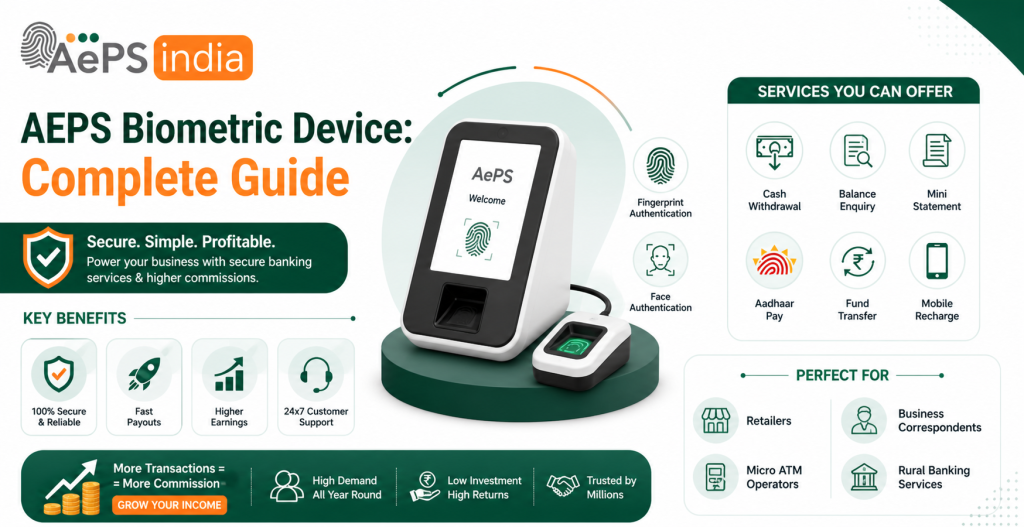
An AEPS biometric device is a key tool for retailers and CSPs who provide Aadhaar Enabled Payment System (AEPS) services in India. It allows customers to verify their identity using fingerprints and complete banking transactions like cash withdrawal, balance enquiry, and mini statements easily and securely. As more people depend on AEPS for basic banking needs, the demand for reliable biometric devices is increasing.
An AEPS Biometric Device is a hardware tool (like a fingerprint or iris scanner) used for the Aadhaar Enabled Payment System, allowing users to access their bank accounts for financial services (cash withdrawal, balance inquiry, fund transfer) using only their Aadhaar number and unique biometrics (fingerprint/iris) for secure, card-less, and PIN-less banking, especially in rural areas. These devices, often built into Micro ATM, capture biometric data to authenticate transactions, linking to the user’s Aadhaar-linked bank account.
As digital banking reaches rural and semi-urban areas, the demand for a reliable AEPS biometric device has increased rapidly. These devices are simple to use, portable, and designed to work smoothly with AEPS apps and platforms, helping agents serve more customers every day.
Using the right biometric device for AEPS ensures smooth transactions, fewer failures, and better customer trust. Aeps india supports certified and compatible AEPS biometric devices that work perfectly with its AEPS platform. These devices are easy to use, fast in response, and suitable for both rural and urban retail locations.
For smooth and successful AEPS transactions, using a certified and compatible biometric device is very important. Aeps india supports trusted AEPS biometric devices that work seamlessly with its AEPS platform, ensuring high success rates, fast authentication, and secure transactions. These devices are designed for daily use by retailers in both rural and urban areas.
Aeps india supports AEPS businesses by offering high-quality AEPS biometric device solutions that work smoothly with popular AEPS platforms. Our supported devices ensure fast response, accurate fingerprint capture, and secure Aadhaar verification, following all UIDAI and RBI guidelines.
Aeps india provides high-quality AEPS biometric devices that are NPCI-compliant, easy to use, and durable, making them ideal for businesses of all sizes. Our devices are designed to support real-time transactions, multiple bank integrations, and robust security features, helping businesses operate efficiently while enhancing customer trust.
This complete guide will help you understand what is AEPS biometric device is, how it AEPS biometric works, its benefits, and how Aeps india helps retailers choose the right device to run a successful AEPS business in India.
What Is an AEPS Biometric Device?
An AEPS Biometric Device is a secure micro-ATM or Point-of-Sale (PoS) terminal that enables basic banking services (cash withdrawal, deposit, balance check, fund transfer) in India, allowing users to access their Aadhaar-linked bank accounts using just their Aadhaar number and biometric data (fingerprint or iris scan) for authentication, boosting financial inclusion in remote areas. These devices capture biometric input via UIDAI-certified scanners, replacing the need for debit cards or PINs for transactions.

AEPS Biometric Devices Work
AEPS Aadhaar Enabled Payment System biometric devices work by using your Aadhaar number and unique biometrics (fingerprints or iris scans) to securely access bank accounts for cardless transactions like cash withdrawal, deposits, and fund transfers, facilitating banking in rural areas through banking agents and micro ATMs by verifying identity with the UIDAI system. The process involves capturing your biometric data via a certified scanner, sending it with your Aadhaar and bank details to NPCI, getting UIDAI verification, and then processing the transaction with your bank, ensuring secure, PIN-less banking.
Types of AEPS Biometric Devices in India
AEPS biometric devices in India primarily use fingerprint scanners, with some advanced options incorporating iris scanners or combo (fingerprint + iris) functionality, all needing STQC certification and Registered Device (RD) service for UIDAI compliance, commonly from brands like Mantra. These devices range from basic scanners (MFS100) to integrated Micro ATM, often with Bluetooth/GPRS connectivity and thermal printers for banking transactions.
Types of Devices
- Fingerprint Scanners: Most common for AEPS, capturing unique fingerprints for authentication (e.g., Mantra MFS100).
- Iris Scanners: Capture iris patterns for high-security verification, often integrated into PoS devices (e.g., Mantra MIS100).
- Combo Devices: Integrate both fingerprint and iris scanners for versatile authentication.
- Micro-ATMs: All-in-one AEPS biometric devices with scanners, card readers, printers, and connectivity for banking services.
- Biometric Tablets (MFSTAB): Android-based tablets with built-in scanners for mobile services and field verification.
Who Can Use AEPS Biometric Devices
Anyone in India who is an Indian resident, has an Aadhaar card linked to an active bank account, and can provide biometric authentication (fingerprint/iris scan) can use AEPS biometric devices for basic banking like withdrawals, deposits, and balance checks, even without a smartphone or card. The system works at Micro ATM and authorized agent points, making it great for financial inclusion in rural areas.
Who can use AEPS (End-User/Customer):
- Indian Citizen: Must be a resident of India.
- Aadhaar Card Holder: Must have a valid 12-digit Aadhaar number.
- Aadhaar-Linked Bank Account: Their Aadhaar must be linked to an active bank account.
- Biometric Data: Must be able to provide their fingerprint or iris scan for authentication.
- No Cards Needed: Doesn’t require debit/credit cards or PINs.

Why Use AEPS Biometric Device
Using an AEPS biometric device provides secure, convenient, and inclusive access to banking services, especially for rural and underserved populations, by allowing transactions using just Aadhaar and fingerprints/iris scans, eliminating the need for cards or PINs, and enabling cash withdrawals, deposits, and transfers at local agents. It promotes financial inclusion by bringing banking to remote areas, reduces dependency on physical currency, and offers high security through unique biometric authentication.
Key Benefits of AEPS Biometric Devices:
- Financial Inclusion: Bridges the gap between banks and remote areas, serving the unbanked and underbanked.
- Enhanced Security: Biometric authentication (fingerprint/iris) is highly secure, reducing fraud compared to PINs or cards.
- Convenience: Users don’t need to remember complex numbers; only their Aadhaar and biometrics are required.
- Accessibility: Services are available at local banking correspondents (agents) in villages, cutting travel to distant banks/ATMs.
- Versatile Transactions: Allows cash withdrawal, deposits, balance inquiries, and fund transfers.
- Interoperability: Enables transactions across different banks, offering flexibility.
- Empowerment: Allows easy access to government entitlements (DBT) and reduces reliance on physical cash.
- Privacy: Users don’t need to share account numbers, just their Aadhaar for authentication.
Popular AEPS Biometric Device Brands in India
In India’s AEPS (Aadhaar Enabled Payment System), Mantra (MFS100, MFS110 for fingerprint, MIS100 for iris) are dominant, alongside strong contenders Mantra known for reliable fingerprint scanners that are crucial for secure Aadhaar-based transactions and require STQC certification for compliance.
Top Brands & Devices:
- Mantra: A leading brand, popular for its affordable and dependable fingerprint scanners like the MFS100 and MFS110, and MIS100 for iris scanning. Mantra devices are biometric hardware solutions engineered for identity verification, authentication, access control, and Aadhaar-enabled services. They leverage fingerprint, iris, and multi-modal biometrics to deliver accurate and secure personal identification across industries like banking, government, enterprise security, and digital payments.
Mantra devices are widely used for:
- Aadhaar Enabled Payment System transactions
- Biometric authentication and eKYC
- Employee attendance and access control
- National ID and enrollment projects
- Secure logins and access to facilities/systems
MFS110 L1 Fingerprint Scanner
- L1-certified, high-security biometric device for Aadhaar authentication and secure identity verification.
- Suitable for financial transactions, government use, and high-security environments.
Benefits
- Strong authentication accuracy
- Rugged design with IP54 protection
- Secure USB interface and auto capture
- Compact and easy to deploy
3. Biometric Micro-ATM Terminals
These are all-in-one mobile terminals combining biometric sensors with handheld POS functionality ideal for AePS banking services like withdrawals, balance checks, and fund transfers.
Use Cases
- Banking correspondents (BC agents)
- Rural / micro-finance transactions
- Portable Aadhaar-based payment solutions
4. Integrated Aadhaar-Enabled Devices
Mantra Devices are touchscreen terminals used for:
- Aadhaar attendance systems (AEBAS)
- Facial + fingerprint biometric verification
- Field deployments requiring robust connectivity (3G/4G, Wi-Fi, GPS)
They are designed for enterprise and government usage.
5. Biometric Enrollment Devices
Used for large-scale registration and identity enrollment, these include:
- Mantra— multi-fingerprint capture (ten prints) for accurate enrollment.
Core Features of Mantra Biometric Devices
High-Precision Biometric Sensors
Mantra fingerprints and iris devices capture detailed biometric traits for accurate identification, reducing errors and false matches.
Compliance & Certifications
Mantra models are certified by UIDAI, STQC, FBI PIV, ISO/ANSI standards, ensuring adherence to global security benchmarks.
Multi-Platform Support
Mantra Devices work with major operating systems, including Windows, Android, and Linux, with SDK support for easy integration.
Ruggedness & Durability
Industrial-grade build quality with IP54 ratings resistant to dust and minor splashes suitable for field use.
Common Applications
1. Aadhaar Enabled Payment System (AePS)
Mantra devices are widely used by CSCs, banks, CSPs, and BC agents to authenticate users and enable biometric banking services without cards or PINs.
2. Biometric Authentication & eKYC
Used to verify users for mobile apps, government schemes, corporate access, and banking services.
3. Employee Attendance & Access Control
Touchscreen terminals and biometric attendance systems simplify workforce tracking and secure premises access.
4. National ID & Enrollment Projects
Multi-fingerprint and iris scanners are used in Aadhaar enrollment, voter registration, and identity verification missions.
Why Choose Mantra Devices?
✔ Reliable performance in diverse environments
✔ High security and compliance for sensitive applications
✔ Easy integration with APIs and SDKs for developers
✔ Versatility from small USB scanners to full kiosks
✔ Proven ecosystem for banking, government, and enterprise identity needs

Importance of Biometric Devices in AEPS Transactions
Biometric devices are crucial in AEPS (Aadhaar Enabled Payment System) for providing strong, fraud-resistant security by verifying unique fingerprints or iris scans, eliminating reliance on cards/PINs, and enabling financial inclusion for rural populations by making banking accessible through simple, identity-based transactions, thus boosting trust and facilitating direct benefit transfers. They offer a secure, convenient, and cost-effective way to conduct banking, ensuring only the actual account holder can access funds.
Key Importance of Biometric Devices in AEPS:
- Enhanced Security: Biometrics (fingerprint/iris) are unique identifiers, making transactions harder to spoof or fake compared to passwords or PINs, significantly reducing fraud and identity theft.
- Increased Accessibility: Users only need their Aadhaar number and biometrics, removing the need for physical cards, devices, or complex credentials, which is vital for unbanked and less tech-savvy rural populations.
- Financial Inclusion: Biometric Micro ATM bring banking services (cash withdrawal, balance inquiry, etc.) to remote areas, empowering local agents and ensuring last-mile access to financial services.
- Convenience & Trust: Users don’t need to carry multiple cards; their unique identity is the key, building confidence in digital payments, notes this site.
- Seamless Government Transfers: Facilitates transparent and secure Direct Benefit Transfers (DBT) of government subsidies and pensions directly to beneficiaries.
- Reduces Fraud in Traditional Systems: Addresses weaknesses in card-based systems by preventing skimming, phishing, and unauthorized access, according to this site.
- Certified & Encrypted: Devices use UIDAI-registered scanners with end-to-end encryption, adhering to strict security standards set by the National Payments Corporation of India (NPCI).
Biometrics form the secure backbone of AEPS, making digital banking simple, secure, and available to everyone, particularly in underserved regions.
Why Aeps Biometric Devices are Required
Biometric devices are essential for the AEPS provide unparalleled security, enable financial inclusion in rural areas, and eliminate the need for physical cards/PINs, ensuring transactions are linked to a unique identity (fingerprint or iris) rather than easily lost or stolen credentials, thus making banking accessible and safe for everyone.
Key Reasons for Biometric Devices in AEPS:
- High Security: Fingerprints and iris scans are unique and difficult to forge, offering a much stronger security layer than cards or passwords, preventing fraud.
- Financial Inclusion: Biometric authentication brings banking services to remote areas, allowing people without access to traditional banks or smartphones to perform transactions using just their Aadhaar.
- Convenience: Users only need their Aadhaar number and biometrics (fingerprint/iris), removing reliance on physical cards, devices, or remembering complex PINs.
- Identity Verification: It directly links transactions to an individual’s unique identity, verified by the UIDAI database, ensuring the right person is accessing funds.
- Streamlined Government Disbursements: Facilitates secure and direct transfer of government subsidies and benefits (like pensions) directly to beneficiaries.
- Trusted & Certified Devices: The system uses UIDAI-registered biometric devices (fingerprint scanners, iris scanners) that are certified for security, ensuring data integrity and preventing tampering.
Biometrics make AEPS a highly secure, user-friendly, and accessible platform for basic banking, particularly for India’s underserved populations.
Role of Biometric Authentication in Secure AEPS Transactions
Biometric authentication is the cornerstone of security in Aadhaar Enabled Payment System (AEPS) transactions, serving as the primary method to verify a user’s identity and effectively eliminating the need for physical cards, PINs, or passwords.
Core Functions of Biometric Authentication in AEPS
- Identity Verification: It verifies the identity of the user by comparing their live biometric data (fingerprint, iris scan, or face) against the data stored in the Unique Identification Authority of India (UIDAI) database. A successful match is required for the transaction to proceed.
- Fraud Prevention: Biometric data is unique to each individual and extremely difficult to replicate or steal, significantly reducing the risk of identity theft, card-not-present fraud, and unauthorized access to accounts, which are common vulnerabilities with traditional methods like passwords or physical cards.
- Ensuring Non-Repudiation: It ensures that the person physically present at the point of transaction is the actual account holder, as their unique biological markers must match the government’s records.
- Enhancing Trust: This robust verification method builds trust among users, particularly in rural or unbanked areas, who may be less familiar with formal banking systems.
Key Security Benefits
- Eliminates Password-Related Risks: By relying on “something you are” rather than “something you know” (like a PIN or password), AEPS bypasses vulnerabilities associated with forgotten, stolen, or weak credentials.
- Secure Infrastructure: Biometric data is captured using certified, tamper-resistant devices and is encrypted before being sent to the UIDAI for verification, preventing interception or misuse.
- Supports Financial Inclusion: In areas with limited traditional banking infrastructure or digital literacy, biometrics provide a simple, secure, and accessible means for citizens to access essential financial services without needing smartphones or reliable internet connectivity on the user end.
- Multi-layered Security Framework: While biometrics is the primary factor, the AEPS system operates within a secure, regulated framework monitored by the National Payments Corporation of India (NPCI) and adheres to RBI guidelines, with features like audit trails and, in some cases, optional multi-factor authentication (e.g., combining fingerprint with a PIN or OTP) for added security.
For added protection, Aadhaar holders can use the facility provided by the UIDAI to lock their biometrics when not in use, which prevents any form of biometric authentication until unlocked via the official Aeps india website.

AEPS Biometric Device for Retailers and CSPs
AEPS (Aadhaar Enabled Payment System) uses UIDAI-certified biometric devices to enable retailers and Customer Service Points (CSPs) to act as “micro-ATMs,” offering basic banking services. These devices connect to a smartphone or computer via USB or Bluetooth.
Required Equipment
To offer AEPS services, retailers and CSPs need the following:
- A UIDAI/STQC-certified biometric device: This is the core component for capturing a customer’s fingerprint or iris scan. Popular brands include Mantra.
- A primary processing device: A smartphone, laptop, or dedicated Micro ATM terminal to run the AEPS software OR Aeps app.
- Reliable internet connectivity: AEPS transactions require real-time online verification with the Aadhaar database and the customer’s bank.
- AEPS software/app: An Aeps application or Aeps portal provided by a registered AEPS service provider like Aeps india .
- A printer (optional but recommended): For providing physical transaction receipts to customers.
Types of Biometric Devices
Devices for AEPS are categorized for security and function:
- Fingerprint Scanners: The most common and affordable option. They are compact and typically connect via USB or Bluetooth.
- Iris Scanners: An alternative for users whose fingerprints may be worn or unreadable (e.g., manual laborers or the elderly), offering greater inclusivity.
- Face Authentication: An emerging, government-approved method that requires a standard mobile device camera, potentially eliminating the need for a specialized fingerprint scanner.
- L1 Certified Devices: These Aeps india process biometric data securely and in an encrypted format internally, offering enhanced security over L0 devices. Most modern, compliant devices are L1 certified.
Key Service Providers and Purchase Information
Retailers and CSPs must partner with an authorized Aeps india to get an AEPS ID and the necessary Aeps software integration. You cannot connect directly to the NPCI system.
- Providers: Companies like Aeps india offer AEPS admin platforms and Aeps agent registration.
- Purchase Locations: Biometric devices can be purchased from Aeps india website.
- Estimated Costs: Basic fingerprint scanners generally cost between ₹2,000 and ₹2,500, while integrate Micro ATM terminals with printers and advanced features can cost upwards of ₹2,500 to ₹2,500.
AEPS Biometric Mean
AePS (Aadhaar Enabled Payment System) biometric refers to India’s system for secure, cardless banking using your Aadhaar number and biometric data (fingerprint or iris scan) via Micro-ATMs, enabling cash withdrawals, deposits, balance checks, and fund transfers, especially in rural areas by linking your bank account to Aadhaar. These biometric devices capture your unique print or iris for authentication with the UIDAI system, ensuring secure, PIN-less transactions for financial inclusion.
Features AEPS Biometric Device
AEPS biometric devices are secure, portable micro-ATMs using Aadhaar (fingerprint/iris) for banking, enabling cash withdrawal, deposit, balance inquiry, and fund transfers for financial inclusion, especially in rural areas, requiring only the Aadhaar number, not cards or PINs, and featuring STQC certification for reliability. Key features include high-speed, low-failure rate sensors, durable scratch-free surfaces, compatibility with Windows/Android, and !/nav>>UIDAI-registered device compliance for secure transactions.
Core Features
- Biometric Authentication: Uses fingerprint or iris scans for secure identity verification, eliminating PINs/cards.
- Basic Banking Services: Facilitates cash deposit, withdrawal, balance inquiry, and mini-statement generation.
- Interoperability: Works across different banks using the Aadhaar-linked account.
- Financial Inclusion: Extends banking to remote areas via banking correspondents (agents).
Device & Performance Features
- High Speed & Accuracy: Fast authentication with low match ratios and failure rates.
- Durable Sensors: Scratch-free surfaces and reliable performance in various conditions.
- Connectivity: Secure high-speed USB 2.0 interface.
- Software Support: Compatible with Windows (x86 & x64) and Android OS.
- Certified: Must be STQC certified for AEPS compliance in India.
Security Features
- UIDAI Registered: Devices are mandated to be registered with UIDAI for security.
- Fraud Prevention: Biometric verification prevents unauthorized access.
- No Cards/PINs: Reduces risk associated with lost cards or forgotten PINs.
Benefits AEPS Biometric Devices
AEPS biometric devices offer significant benefits by enabling secure, cardless banking in rural India, promoting financial inclusion for the unbanked through easy cash withdrawals, deposits, and balance inquiries using just Aadhaar and fingerprints/iris scans, reducing travel to distant banks, and facilitating direct government benefit transfers (DBT) efficiently and securely. They empower local merchants as banking points, increase security by replacing PINs, and simplify banking for those with low digital literacy.
Key Benefits for Users
- No Card, No PIN Needed: Transactions use Aadhaar and biometrics (fingerprint/iris), making banking simple and secure, even without physical cards or remembering PINs.
- Financial Inclusion: Brings banking services to remote villages, reaching underserved populations.
- Convenience: Access banking at local shops (micro-ATMs) instead of traveling to distant bank branches.
- High Security: Biometric authentication reduces fraud risk, as fingerprints/iris scans are unique.
- Versatile Transactions: Offers cash withdrawal, deposit, balance inquiry, and fund transfers.
- Direct Benefit Transfers (DBT): Ensures government subsidies and pensions reach beneficiaries directly and transparently.
Benefits for Agents & Merchants
- Earn Commissions: Agents earn income by facilitating banking for their community.
- Increased Footfall: Attracts more customers to their shops for various banking and digital services.
- Low Investment: Can start a banking point with minimal investment in a smartphone and biometric device.
Broader System Benefits
- Cost-Effective for Banks: A cheaper way to expand banking reach into rural areas.
- Supports Digital Economy: Promotes cashless transactions and digital participation in villages.
- Interoperability: Allows customers of any bank to transact at any AEPS point, unifying the banking experience.

AEPS Biometric Device Setup and Usage Process
Setting up an AEPS biometric device involves choosing a Aeps india, completing KYC, acquiring a compliant device, installing their specific Aeps b2b software/drivers, and then configuring it in the Aeps admin portal for test runs before live transactions like cash withdrawals and balance inquiries, ensuring proper driver installation and device connection.
Here’s a step-by-step guide for an AEPS Agent:
1. Registration & KYC
- Choose Provider: Sign up with a AEPS service aggregator like Aeps India.
- Submit Details: Provide personal info and submit KYC documents (Aadhaar, PAN, Bank details, shop photo/video if applicable).
2. Hardware Acquisition
- Get Device: Purchase a certified biometric fingerprint scanner or micro ATM compatible with Aeps india.
3. Software & Driver Installation
- Install Software: Download and install the Aadhaar Enabled Payment System application or Aadhaar Enabled Payment System software from Aeps india onto your computer/smartphone.
- Install Drivers: Run the driver setup for your biometric device; only plug the device into the USB port when prompted by the software.
- Test Device: Use the device’s diagnostic utility or the AEPS portals settings to confirm the driver is installed and the device is detected (e.g., by scanning a finger and checking for an image).
4. Portal Configuration & Testing
- Login: Use your agent ID and credentials to log into the AEPS b2b portal.
- Configure Device: Go to device settings in the portal, select your device model, and click “Test Connection”.
- Test Transactions: Perform a small balance inquiry or cash withdrawal with a test customer to ensure everything works correctly.
5. Start Services
- Once confirmed, you can offer services like cash withdrawal, balance inquiry, and mini-statements using customer biometrics.
Key Compliance Point: Ensure your device is compatible and registered as per Aeps india guidelines to maintain security and compliance.
Cost of AEPS Biometric Devices in India
AEPS biometric device costs in India vary significantly, from basic fingerprint scanners around ₹1,500 – ₹2,500 (like Mantra MFS100/L1) to more advanced bundled Micro ATM devices and POS features costing ₹2,000 – ₹10,000+, depending on features, brand (Mantra are popular), and bundled services like RD Service.
Typical Price Ranges
- Basic USB Fingerprint Scanners (Mantra MFS100/L1, Evolute Identi5): ₹2,000 – ₹2,500.
- Bluetooth/Wireless Scanners: ₹2,000 – ₹2,500+.
- All-in-One Micro ATM Devices: ₹1,200 – ₹1,500.
Factors Influencing Cost
- Device Type: Standalone scanner vs. integration Micro ATM.
- Brand: Popular brands like Mantra have best price points.
- Features: Bluetooth, built-in battery, thermal printer, display, etc..
- RD Service: Registration Data Service often included or separate.
- Bundled Services: Packages with AEPS Cash Withdrawal Software/AEPS Transaction services.
Popular Models & Prices
- Mantra MFS100/L1: Around ₹2,000 – ₹2,500 depending on the model and features.
Security and Data Safety in Biometric Transactions
Biometric transactions enhance security by using unique, hard-to-replicate physiological (fingerprints, facial features, iris) or behavioral (voice, typing rhythm) traits for identity verification. However, this technology introduces critical data safety challenges because, unlike passwords, compromised biometric data is permanent and cannot be changed.
Key Security and Data Safety Mechanisms
To protect sensitive biometric data, the following mechanisms are used:
- Template Creation and Encryption: Raw biometric data (e.g., an image of a fingerprint) is converted into a unique mathematical representation called a template. This template is encrypted and stored, not the raw image itself, which reduces the risk of direct misuse if a database is breached.
- On-Device Storage: Modern systems, such as those in smartphones, often store the encrypted template locally in a secure hardware element (like a Secure Enclave) rather than on a central server. This decentralized approach protects against large-scale database breaches.
- Liveness Detection: Anti-spoofing techniques, such as checking for micro-movements, depth, or thermal signals, determine whether the presented biometric sample is from a live human or a fake replica (e.g., a photo, mask, or artificial fingerprint).
- Multi-Factor Authentication (MFA): Biometrics are often combined with other factors like a PIN, password, or security token. Even if an attacker compromises the biometric data, they still need the second credential to gain access.
- Data Minimization and Retention Policies: Organizations should only collect the minimum necessary data and have clear procedures for the secure deletion or de-identification of data when it is no longer needed.
Primary Risks and Concerns
Despite robust security measures, vulnerabilities and concerns remain:
- Irreversible Compromise: If biometric data is stolen, the user’s characteristic is permanently compromised, unlike a password which can be reset.
- Spoofing Attacks: Sophisticated fake artifacts, deepfakes, or high-resolution images can sometimes fool less advanced sensors, potentially granting unauthorized access.
- Centralized Database Breaches: While on-device storage is growing, some systems rely on central databases, which, if breached, could expose millions of users’ biometric records.
- Privacy Issues and “Function Creep”: There are concerns about the passive or covert collection of data and its potential misuse beyond its original, stated purpose (e.g., using a facial scan meant for building access for employee monitoring or surveillance).
Best Practices
For secure and safe biometric transactions, organizations must adhere to strict guidelines:
- Prioritize user consent and transparency about data collection, storage, and use.
- Ensure compliance with relevant regulations like GDPR or CCPA.
- Conduct regular security audits and maintain an incident response plan.
- Provide alternative authentication methods for users who cannot or do not wish to use biometrics.

Maintenance and Care Tips for Biometric Devices
To ensure the longevity and accuracy of AEPS (Aadhaar Enabled Payment System) biometric devices, regular maintenance and proper usage are essential. Key tips include keeping the sensor clean, updating software and drivers, and maintaining a stable operating environment.
Physical Maintenance and Care
- Clean the sensor daily: Use a soft, dry microfiber cloth to gently wipe the sensor surface and remove dust, smudges, oils, and dirt.
- Avoid harsh chemicals: Only use cleaning agents recommended by the manufacturer. Avoid abrasive materials, alcohol-based cleaners (unless specified as safe by the manufacturer), or excessive liquids, which can damage the sensor coating and internal components.
- Use caution with stubborn dirt: For difficult grime, some sources suggest using office or scotch tape to lift particles from the surface, or a 99% isopropyl alcohol wipe only if the manufacturer’s manual permits it.
- Handle with care: Prevent physical damage by avoiding drops or exposure to extreme temperatures (the ideal range is typically 20°C–30°C), direct sunlight, or high humidity.
- Check connections: Ensure all cables, especially USB connections, are secure and undamaged. A faulty cable or port can cause intermittent issues.
- Schedule professional servicing: While daily care is important, arrange for professional maintenance and deep cleaning every 6–12 months to inspect hardware and optimize performance.
Software and Environmental Tips
- Update software and drivers: Keep the AEPS service application, drivers, and firmware updated. Enable automatic updates or check the manufacturer’s website (e.g., Mantra ) for the latest versions to fix bugs and improve performance.
- Maintain a stable environment: Ensure the device operates in stable lighting conditions (avoiding direct glare or shadows), has a stable power supply (using a UPS backup is recommended), and a reliable internet connection for real-time authentication.
- Calibrate regularly: Follow manufacturer guidelines to recalibrate sensors periodically to ensure continued accuracy.
User Best Practices
- Train users: Educate agents and customers on proper usage, including correct finger placement (flat and firm pressure without excessive force), and the need for clean, dry hands.
- Manage finger conditions: If a user’s hands are too dry (common in winter), advise them to moisturize them lightly or rub their hands together to generate natural moisture. If they are wet or dusty, they should be cleaned and dried first.
- Use the best fingers: The thumb and index fingers usually work best. If one finger consistently fails, try an alternate one.
- Perform test transactions: Conduct a quick test transaction each morning to confirm the system is fully functional before peak usage begins.
- Follow UIDAI guidelines: Only use UIDAI-certified biometric devices that comply with security and encryption standards for AEPS services.
AEPS Biometric Device Compliance and Certification
AEPS (Aadhaar Enabled Payment System) biometric devices must be certified by the STQC (Standardisation Testing and Quality Certification) Directorate and comply with UIDAI (Unique Identification Authority of India) standards, specifically the L1 certification for enhanced security.
Key Compliance and Certification Requirements
- Mandatory Certification Body: All biometric devices used for Aadhaar-based services, including AEPS, must be tested and certified by the STQC Directorate, an office under the Ministry of Electronics & Information Technology (MeitY), Government of India.
- UIDAI Specifications: Devices must comply with the specific functional and security specifications mandated by the UIDAI.
- L1 Certification: As of June 30, 2025, a transition to L1 certified devices is mandatory. L1 devices provide stronger, on-device encryption within a Trusted Execution Environment (TEE), offering enhanced security and anti-spoofing measures. Older L0 devices are being phased out.
- Registered Device (RD) Service: Devices must support the UIDAI’s RD (Registered Device) Service, which ensures:
- Encryption of biometric data within the device itself.
- Prevention of data tampering.
- Secure transmission of only encrypted biometric templates to the UIDAI server.
- Unique device identification and traceability for fraud management.
- Aadhaar Data Security: Devices are designed to process and encrypt the biometric data within a secure environment, ensuring that raw, unencrypted biometrics are never stored or transmitted from the host machine (e.g., smartphone or PC).
- Liveness Detection: To combat fraud through spoofing (e.g., using silicone molds of fingerprints), modern certified devices incorporate liveness detection technology.
Why this is Important for AEPS
Compliance ensures that the entire AEPS ecosystem is reliable, safe, and secure. The use of certified devices helps prevent identity theft and fraud, builds customer trust, and maintains the integrity of India’s national financial inclusion mission.
When selecting an AEPS device, you should ensure it is an STQC-certified, UIDAI-approved L1 scanner from a reputable manufacturer (e.g., Mantra, Morpho, Secugen). Authorized dealers and AEPS service providers like Aeps india can confirm the certification status before purchase. You can find more details on device certification on the official Aeps india website.
Compatibility of AEPS Biometric Devices with AEPS Apps
Compatibility between AEPS biometric devices and AEPS apps is strictly regulated, requiring the use of UIDAI-certified hardware with the manufacturer’s specific Registered Device (RD) service software installed. Generic, non-certified devices (such as a phone’s built-in fingerprint sensor) are not compatible.
Key Compatibility Requirements
- UIDAI/STQC Certification: All biometric devices (fingerprint or iris scanners) must be certified by the Unique Identification Authority of India (UIDAI) and the Standardisation Testing and Quality Certification (STQC) Directorate. This ensures they meet the necessary security and accuracy standards for handling national-scale financial transactions.
- RD (Registered Device) Service: Devices require the specific manufacturer’s RD service software to securely capture and encrypt biometric data before sending it for authentication. This software must be installed and running on the host device (smartphone, PC, or micro-ATM). The AePS Service app communicates with this service, not the device directly.
- AEPS App/Software Provider Compatibility: The specific AEPS application provided by Aeps India must be designed to integrate with the chosen certified biometric device. Aeps India offer documentation and technical support for integrating specific models.
- Operating System Support: Certified devices often support multiple operating systems (e.g., Windows and Android) and connect via USB or Bluetooth to a host device (smartphone, laptop, or dedicated micro ATM terminal).
Popular Compatible Biometric Devices
Best brands offer devices that are widely used and certified for AEPS applications.
- Mantra: MFS100 and MFS110 models are widely used for their reliability and speed.
How to Ensure Compatibility
- Verify Certification: Always confirm the device’s UIDAI certification status before purchasing. The UIDAI maintains a list of approved devices on their official website.
- Check with App Provider: Before finalizing a purchase, confirm with your AEPS software provider like Aeps India that the specific device model is compatible with their Aeps admin app or Aeps b2b platform.
- Install RD Service: Ensure the manufacturer’s RD service software is correctly installed on the smartphone or computer running AEPS app.
- Regular Updates: Keep both the AEPS b2b app and the device’s drivers/RD service software updated to maintain compliance and security.

How to Choose the Best AEPS Biometric Device
Aeps india is the best AEPS biometric device, prioritize STQC Certification (UIDAI approved L1) for compliance, high DPI (500+) for image quality, fast scanning speed, low failure rates, strong durability, and good connectivity (USB/Bluetooth/Wi-Fi). Essential features include reliable performance in tough conditions, compatibility with your software (Android/Windows), and integration with a trusted AEPS service provider like Aeps india offering good commissions and strong security features like data encryption.
Key Factors to Consider
Certification & Compliance:
- STQC Certified (L1): Mandatory for UIDAI-based services like AEPS; ensures it’s approved for Aadhaar authentication.
- FBI Compliance: Look for standards like FBI IQS Appendix F for better image quality and security.
Performance & Accuracy:
- DPI: Aim for 500 DPI or higher for clearer fingerprints.
- Speed: Faster authentication means better customer experience.
- Low Match Ratio/Failure Rate: Fewer false rejections lead to smoother transactions.
Durability & Design:
- Rugged Build: Essential for tough conditions and high-traffic environments.
- IP Rating: For resistance against dust and water if used in industrial settings.
Connectivity & Compatibility:
- Connectivity Options: USB, Bluetooth, Wi-Fi, 3G/4G for versatility.
- Software Compatibility: Works seamlessly with your existing secure AEPS software (Android/Windows).
Security & Reliability:
- Data Encryption: Ensures biometric data is protected.
- Fraud Detection: Features to prevent unauthorized use.
Cost & Provider:
- Balance Cost: Don’t sacrifice quality for a lower price; consider setup fees and maintenance.
- Provider: Choose a reliable AEPS service provider like Aeps india using Mantra with good commissions and robust Aeps API.
Popular & Recommended Models
- Mantra MFS100/MFS110: Widely used, cost-effective, and reliable.
Pro-Tip: Don’t forget a thermal printer for receipts to provide proof of transaction, enhancing trust and resolving disputes.
Why Aeps india Is a Trusted AEPS AEPS Biometric Device Provider
Aeps india is an trusted AEPS biometric device provider is trusted because they offer NPCI/RBI certified technology, ensure robust security (encryption, biometric verification), provide multi-bank support, offer user friendly Aeps platforms, have reliable support, and promote financial inclusion by simplifying banking for rural/underserved populations. They adhere to strict data privacy, enable quick transactions, and offer training, making them reliable partners for agents and businesses.
Here are the key reasons for trust in such providers:
Security & Compliance
- Regulatory Adherence: They are certified by the National Payments Corporation of India (NPCI) and follow RBI/UIDAI guidelines, ensuring legal and secure operations.
- Biometric Authentication: Uses Aadhaar fingerprint/iris scans for secure, fraud-resistant transactions without PINs or cards.
- Data Encryption: Employs end-to-end encryption and strict data privacy protocols to protect sensitive customer information.
Reliability & Efficiency
- Multi-Bank Support: Allows transactions across a wide network of banks, offering convenience to customers.
- High Success Rates: Focus on real-time, stable processing for better transaction success.
- User-Friendly Platform: Simple interfaces and well-documented Aeps API for easy integration and use by agents.
Support & Business Growth
- Excellent Customer Support: Offers 24/7 assistance for technical issues and transaction problems, minimizing disruptions.
- Agent Training: Provides training to agents, empowering them to offer services effectively.
- Scalability: Supports business growth with features like reporting, multi-service options (bill pay, etc.), and new revenue streams.
Financial Inclusion
- Accessibility: Extends banking to remote areas, bridging the gap between formal banking and unbanked populations.
- Government Scheme Access: Facilitates direct benefit transfers (DBT) for welfare schemes, ensuring funds reach beneficiaries.
Examples of Providers: Aeps india are cited as examples of trusted providers that embody these qualities.
Future of AEPS Biometric Devices in Digital Banking
Future trends for AEPS biometric devices center on smarter, more secure, and integrated systems using AI/ML for fraud detection, advanced biometrics (iris/face), and !/nav>>biometric liveness detection, alongside deep integration with UPI/wallets, expansion into micro-loans/insurance, !/nav>>mobile-first interfaces, blockchain for transparency, and robust rural micro-ATM networks, all driving deeper financial inclusion through enhanced security and user convenience.
Key Technology Trends
- AI & Machine Learning (AI/ML): Real-time fraud detection, behavioral analytics, and risk assessment.
- Advanced Biometrics: Moving beyond fingerprints to multi-modal biometrics (iris, face) and mandatory liveness detection to prevent spoofing.
- Blockchain Integration: For transparent, immutable transaction records and enhanced security.
- Mobile-First & Seamless UX: User-friendly, mobile-optimized interfaces for easier access, especially in rural areas.
- API-Driven Scalability: Easier integration with other platforms for broader service delivery.
Expanded Service & Ecosystem Trends
- Deeper Integration: Seamless connection with UPI, digital wallets, and Bharat Bill Payment System (BBPS) for unified payments.
- Expanded Offerings: Incorporating micro-loans, insurance collection, e-commerce payments, and utility bill payments.
- Micro-ATM Networks: Expanding local merchant points into “micro-banks” to boost rural banking.
Security & Regulatory Trends
- Stronger Security Protocols: Driven by regulatory bodies like UIDAI to combat fraud and impersonation.
- Embedded Finance: Integrating financial services directly into everyday apps and platforms.
AEPS is evolving from basic banking to a comprehensive digital financial platform, leveraging advanced biometrics and AI to be more secure, accessible, and feature-rich for India’s underbanked population.

Conclusion
An AEPS biometric device is a key tool for delivering Aadhaar Enabled Payment System services across India. It allows secure fingerprint-based authentication to complete banking transactions such as cash withdrawal, balance enquiry, and mini statements. For retailers, CSPs, and service providers, using a reliable biometric device ensures smooth transactions and customer trust.
An AEPS Biometric Device is a small, portable machine (like a micro-ATM or PoS terminal) that allows people in India to perform basic banking via their Aadhaar number and fingerprints, enabling cash withdrawals, deposits, and balance checks without cards or PINs, especially in rural areas, by linking directly to their bank account. These devices capture biometric data (fingerprint/iris) for secure identity verification, making banking accessible and fraud-resistant.
With the growing demand for best AEPS services in rural and semi-urban areas, having a high-quality AEPS biometric device helps reduce transaction failures and speeds up customer service. These devices are easy to use, portable, and designed to work smoothly with best AEPS apps and best aeps platforms, making them ideal for daily use at retail outlets.
At Aeps india, we support businesses and agents with compatible and certified AEPS biometric devices that offer high accuracy, fast response, and secure authentication. Our solutions are designed to work seamlessly with top AEPS platforms while following UIDAI and RBI guidelines.
Aeps india offers high-quality AEPS biometric devices that are secure, durable, and easy to use. Our devices come with NPCI-compliant integration, real-time transaction processing, and dedicated technical support, making them ideal for businesses of all sizes. By investing in a trusted AEPS device, retailers and agents can expand their services, improve customer trust, and maximize revenue in India’s growing digital payments market.
Choosing the right AEPS biometric device in India is essential for offering secure Aadhaar-based banking services and growing a successful AEPS business. With Aeps india trusted AEPS solutions, agents and businesses can deliver reliable services, improve customer satisfaction, and increase daily earnings.
If you want to grow your AEPS business with a reliable biometric device, Aeps india provides a complete, future-ready solution that ensures smooth operations, high performance, and long-term success.
FAQs – AEPS Biometric Device
An AEPS biometric device is a hardware tool that enables Aadhaar-based banking transactions like cash withdrawal, balance enquiry, and mini statements through fingerprint authentication. It is essential for retailers, CSPs, and agents providing AEPS services.
Retailers, banking correspondents (CSPs), and digital service agents can use AEPS biometric devices to offer secure and convenient banking services in rural, semi-urban, and urban areas.
The device captures the customer’s fingerprint, verifies it with the Aadhaar database, and completes the requested banking transaction in real time. It works seamlessly with AEPS platforms and apps.
Yes, AEPS biometric devices follow UIDAI and RBI guidelines. They use encrypted communication to ensure secure transactions, preventing fraud and unauthorized access.
With an AEPS biometric device, you can perform:
Cash Withdrawal
Balance Enquiry
Mini Statement
Fund Transfer (if supported by the AEPS platform)
No, most AEPS biometric devices are user-friendly and plug-and-play. Basic instructions are enough for retailers and agents to start performing transactions immediately.
Yes, AEPS biometric devices are compatible with most major banks in India that support Aadhaar Enabled Payment System (AEPS).
Retailers need it to provide secure and smooth AEPS services, reduce transaction failures, and build customer trust while earning commissions.
Yes. Aeps india AEPS platform supports devices that are compatible with both B2B and B2C apps, making it easy to manage transactions digitally.
Absolutely. Certified devices ensure secure authentication, encrypted data transfer, and RBI-compliant operations, protecting both retailers and customers.
India offers fingerprint scanners and biometric card readers suitable for retail shops, CSPs, and fintech platforms. Aeps india helps retailers select the most reliable and compatible device.
Retailers should consider device certification, compatibility with AEPS apps, speed of fingerprint recognition, durability, and technical support. Aeps india provides guidance on all these factors.
Yes. By verifying the Aadhaar-linked fingerprint before transactions, the device reduces the risk of fraud and failed payments.
Setup is simple. Aeps india provides step-by-step guidance and technical support for quick installation and integration with your AEPS platform.
Yes. Reliable devices supported by Aeps india are scalable for daily high-volume transactions, making them suitable for growing retail businesses.
Aeps india provides reliable, certified, and high-performance AEPS biometric devices that ensure fast authentication, high accuracy, and secure transactions, helping agents and retailers grow their AEPS business efficiently.
Best AEPS Platform for B2B Businesses, Retailers & Distributors
NPCI AePS Guidelines 2026: New Rules, Latest Updates & Changes
AEPS Live Explained: Everything You Need to Know
About Author

