Buy Micro ATM Online in India – Best Price, Features, Benefits & Complete Guide
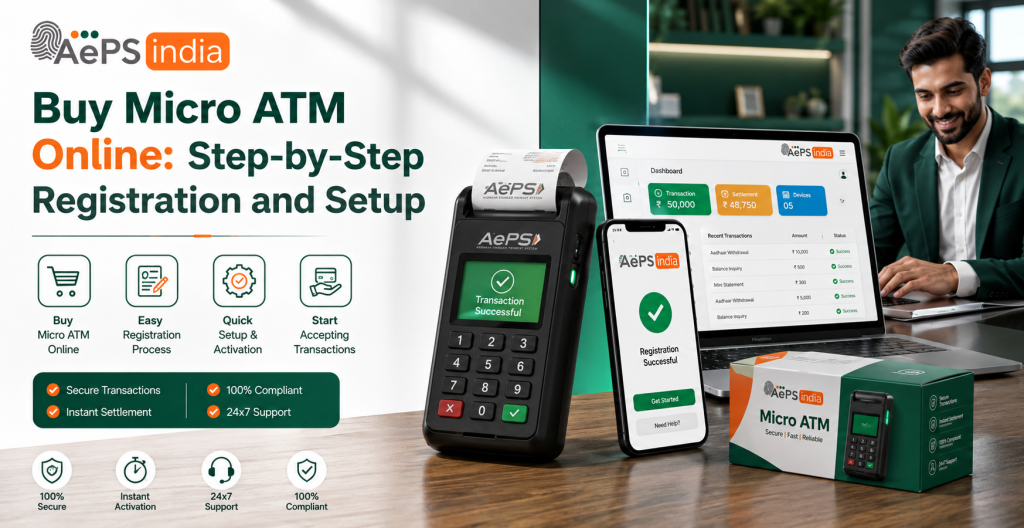
Looking to buy a Micro ATM online in India for your AEPS business or customer service point? Choosing the right Micro ATM device can be challenging when you need reliable hardware, easy operation, service support, and a solution that fits your business requirements. AEPS India helps address this need by providing Micro ATM devices and Micro ATM services designed for businesses and authorised banking service points.
A Micro ATM can help authorised AEPS touchpoints provide supported banking services to customers through the appropriate AEPS ecosystem. According to NPCI, AePS is a bank-led model that enables interoperable financial inclusion transactions at AePS touchpoints using Aadhaar authentication, with services including cash withdrawal, cash deposit, fund transfer, balance inquiry, and mini statement, subject to the applicable service and eligibility requirements.
You can buy a Micro ATM (mATM) online in India through fintech platforms like Aeps india. Prices generally range from ₹1,200 to ₹3,500 depending on the brand and model (such as MoreFun).
When you purchase a Micro ATM, it is important to look beyond the device price. Factors such as device compatibility, biometric functionality, connectivity, transaction support, ease of use, and after-sales assistance can make a significant difference to your day-to-day operations. That is why AEPS India focuses on offering both the Micro ATM device and Micro ATM Service, helping customers understand their requirements before making a purchase.
Whether you are an AEPS retailer, BC/CSP, fintech business, or a service provider looking to expand your assisted banking offerings, you can buy a suitable Micro ATM device and get the required service information from AEPS India. Our goal is to make the buying process clearer so you can choose a solution based on your actual business needs rather than simply selecting a device based on price or promotional claims.
In this guide, we will explain how to buy a Micro ATM online, what to check before purchasing a Micro ATM device, how Micro ATM services work, and how to get the right solution for your business requirements. This practical information is intended to help you make a more informed purchase decision while understanding the role of the device within the AEPS ecosystem.
What is a Buy Micro ATM
A micro ATM is a small, portable card-swipe device used by local shopkeepers and banking agents to act like a mobile bank branch. When you buy a micro ATM, you get a handheld terminal that connects to bank servers via mobile data. It lets customers withdraw cash or check account balances using their debit cards and PINs, or via Aadhaar biometrics.

Micro ATM Work
A Micro ATM is a portable, handheld card-swipe or biometric device operated by an authorized agent or business correspondent (BC). It connects to a bank’s core system via mobile data (GPRS) to process basic transactions like cash withdrawals, balance checks, and mini-statements without storing actual cash inside the machine.
The Step-by-Step Process
- Agent Setup: An authorized merchant or BC carries the portable micro ATM device to a local shop or remote location using mobile internet connectivity.
- Card or Aadhaar Input: The customer inserts or swipes their debit card or provides their Aadhaar number linked to their bank account.
- Customer Authentication: The user authenticates the transaction using their secure ATM PIN or a biometric fingerprint scanner.
- Transaction Request: The agent selects the desired service (such as cash withdrawal) and enters the specific amount on the device.
- Bank Verification: The machine routes the encrypted request securely through the banking network (via NPCI or AEPS) to the customer’s specific bank server.
- Cash Handover: Once approved instantly by the bank, the customer’s account is debited, the funds transfer to the agent’s digital ledger, and the agent physically hands the cash over from their own cash drawer.
How Micro ATM Works: Technical Transaction Flow
Understand the seamless journey of a cash withdrawal from the Agent to the Bank Server.
Authentication
Customer inserts Aadhaar/Debit card and enters PIN. The Micro ATM captures the encrypted data.
Request Routing
The device sends the transaction request to the AEPS/Banking Provider’s server via secure API.
NPCI / Bank Validation
The request reaches NPCI, which forwards it to the customer’s linked bank to verify funds and identity.
Approval & Debit
The bank approves the transaction, debits the amount from the account, and sends a success response.
🔒 Security Protocol
All Micro ATM transactions are protected by 256-bit AES encryption and multi-factor authentication (Biometric/PIN).
⚡ Transaction Speed
Our optimized API routing ensures that the entire flow from card swipe to cash dispense happens in under 10 seconds.
Micro Atm Service Provide
Micro ATM service provider like Aeps India offer portable devices to deliver basic banking to rural/underserved areas, enabling cash withdrawal, deposit, balance inquiry, fund transfer, and mini statements via debit cards or Aadhaar (AEPS), acting as local banking points for agents (like shopkeepers) to provide convenient, accessible, and secure financial services, bridging the gap to traditional banking.
Key Services Offered
- Cash Withdrawal: Customers use debit cards or Aadhaar (biometric/OTP) for instant cash from an agent’s cash drawer, with limits (e.g., up to ₹10,000).
- Cash Deposit: Agents can accept cash deposits from customers.
- Balance Inquiry & Mini Statement: Real-time account balance checks and recent transaction details.
- Fund Transfers: Transferring money between accounts.
- Aadhaar-Enabled Payment System (AEPS): Secure transactions using Aadhaar and biometrics.
- Bill Payments & Recharges: Aeps India also offer utility bill payments and mobile recharges.
Types of Micro Atm
A micro ATM is a portable, handheld terminal operated by a local agent or merchant to connect with bank networks via GPRS or mobile internet. Rather than distinct physical models, micro ATMs are categorized by their authentication and transaction types, using card swipes or biometric scans to process basic banking.
Types by Authentication and Operation
- Card Swipe with PIN: The user inserts or swipes a debit/credit card and enters a secure PIN, similar to standard POS machines.
- Aadhaar-Enabled (AEPS / Biometric): The user provides an Aadhaar number and authenticates the transaction using a fingerprint scanner attached to the device instead of a card or PIN.
- Card with Biometric/OTP: Combines a traditional bank card with a secondary biometric fingerprint verification or a one-time password for added safety.
Micro ATM Device Models
Popular micro ATM (mATM) and mini POS device models used by business correspondents and local shop owners in India range from basic pocket card swipers to advanced smart terminals with built-in printers and biometric scanners. Prices generally fall between ₹1,200 and ₹35,000 depending on features like touchscreens, 5G connectivity, and receipt printers.
Common Micro ATM Models
- MoreFun / PayNearby Devices: Compact wireless Bluetooth-enabled micro ATM/POS units built for merchant payment collections and cash-out services.
- Roinet VM30 (Aisino / Vanstone): Compact mPOS device popular for basic card swiping, cash withdrawals, and balance lookups, priced around ₹2,199.
- Roinet V72 (Aisino): Handheld mini ATM that includes an attached thermal receipt printer for printing transaction slips.
- Pax D180: Widely used wireless Bluetooth/GPRS card-swipe terminal supported by major banks and aggregators like UCO Bank, costing roughly ₹2,990 to ₹3,499.
- Mosambee QPOS: Portable mini ATM and mPOS utilized across various Customer Service Points (CSPs) like Bank of India and J&K Bank.
- Evolute LeoPro (5G / Android Smart POS): Advanced high-end terminal featuring an integrated L1 biometric fingerprint scanner, large touchscreen, and thermal printer, priced around ₹35,000.
Micro ATM Device Price
Micro ATM hardware prices in India generally range from ₹1,500 to ₹8,000 for standard handheld and Bluetooth-enabled mobile POS/card-swipe models, while advanced all-in-one biometric and thermal-printer variants range from ₹8,000 to ₹25,000.
Device Price Categories
- Basic Handheld / Bluetooth Models: ₹1,200 – ₹2,500 (e.g., Morefun MP63 ATM supporting simple card swiping and basic connectivity).
- Mid-Range / Bank-Specific CSP Units: ₹2,800 – ₹4,500 (e.g., specific encrypted pin-pad mPOS units configured for bank Customer Service Points like SBI, BoI, or ICICI).
- All-in-One Devices with Printers: ₹8,000 – ₹25,000 (Robust units featuring integrated thermal receipt printers, larger display panels, and high-duty battery backups).
Additional Costs & Structures
- Software / Activation Fees: Ranging from zero (bundled with specific corporate BC/retailer onboarding) up to ₹20,000 for independent white-label API software setups.
- Transaction Commissions: Retailers typically earn a per-withdrawal commission slab starting around ₹5 to ₹10 per transaction depending on the volume and banking partner.
Which Micro ATM Machine Should You Buy?
To buy the right micro ATM machine, pick a reliable brand like Spice Money, PayNearby, or Airtel Payments Bank. Prices range from ₹1,500 to ₹3,500 for compact card-swipe models like the PAX D180 or MoreFun devices. Choose a device that matches your existing banking service provider and offers good transaction commissions.
Key Features to Check
- Bank Support: Ensure the device connects smoothly with your current business correspondent (CSP) or fintech partner.
- Connectivity: Look for 4G, GPRS, or Bluetooth options that pair easily with your smartphone.
- Battery Life: Pick a rugged, rechargeable build if you move around or face frequent power cuts.
- Cost and Commission: Compare device purchase prices against the payout margin per cash withdrawal.

Micro ATM Machine Features to Check Before Buying
Before buying a micro ATM machine, check for interoperability (support for RuPay, Visa, and Mastercard), biometric scanner quality (STQC certification for Aadhaar/AePS), network connectivity (4G and Wi-Fi slots), built-in thermal printer, and a long-lasting battery for field use.
Card and Payment Support
- Universal Acceptance: Ensure the card reader processes chip, magnetic stripe, and contactless NFC debit or credit cards.
- AePS Integration: Must feature a high-accuracy, STQC-certified fingerprint or iris scanner for Aadhaar-based fingerprint verifications.
Hardware and Connectivity
- Network Options: Look for dual SIM 4G slots and Wi-Fi capability to prevent transaction failures in low-signal zones.
- Receipt Printer: Choose a model with an integrated thermal printer so you can hand customers physical transaction slips instantly.
- Battery Capacity: Pick a rugged, lightweight handheld device with a large battery that lasts through a full day of remote or high-volume shop transactions.
Software and Compliance
- Regulatory Approval: Verify that the device complies with local banking standards and is certified by relevant authorities like the NPCI.
- Service Provider Support: Partner with a Aeps india offering stable transaction settlement speeds, minimal server downtime, and responsive tech support.
Micro ATM vs POS Machine vs AEPS Device
| Feature | Micro ATM | POS Machine | AEPS Device |
|---|---|---|---|
| Cash Withdrawal | ✓ | Depending on setup | ✓ |
| Debit Card | ✓ | ✓ | — |
| Aadhaar Authentication | Depending on setup | — | ✓ |
| Balance Enquiry | ✓ | — | ✓ |
| Mini Statement | Depending on service | — | ✓ |
| Best For | Banking services | Merchant payments | Aadhaar banking |
Who Can Buy and Use a Micro ATM Machine?
A micro ATM machine can be bought and used by authorized Business Correspondents (BCs), local shop owners (such as kirana or grocery store operators), pharmacies, and small rural retailers who partner with commercial Aeps india. General consumers do not buy these devices; instead, they use them at local merchant shops to withdraw cash or check account balances.
Who Can Buy a Micro ATM
- Local Retailers & Shopkeepers: Small business owners with a physical storefront.
- Authorized Business Correspondents (BCs): Individuals officially appointed by a scheduled commercial bank or corporate BC.
- Common Service Center (CSC) Operators: Digital service providers operating in rural or semi-urban areas.
Who Can Use a Micro ATM
- Bank Account Holders: Any customer holding an account with a major public or private sector bank (such as SBI, PNB, HDFC, or ICICI) that supports interoperable National Payments Corporation of India (NPCI) networks.
- Local Residents: People living in rural or semi-urban areas who need quick access to basic banking services without traveling to a distant bank branch or standalone ATM.
How to Buy a Micro ATM Machine Online from AEPS India
To buy a micro ATM machine online, choose a verified fintech service provider or Business Correspondent (BC) network like Aeps india. Register as an agent on their portal, complete your KYC verification with your PAN and Aadhaar, purchase the hardware device online (usually costing between ₹1,500 to ₹3,000), and link it via Bluetooth to your smartphone app for activation.
Steps to Buy and Activate
- Pick a Provider: Go to an authorized Aeps india Website.
- Register Account: Sign up as a merchant or retailer by filling out your basic profile.
- Submit KYC: Upload clear copies of your PAN card, Aadhaar card, photo, and business address proof.
- Buy the Device: Pay online for the micro ATM hardware package through the provider’s secure checkout.
- Pair and Test: Connect the delivered machine to the Aeps india website and finish a test transaction.
Documents Required to Buy a Micro ATM
To buy and register a Micro ATM as a Business Correspondent (BC) or merchant in India, you need basic KYC documents, address proof, and active bank details. Costs for devices generally range from ₹1,499 to ₹5,000 depending on the provider.
| Document | Why It May Be Required |
|---|---|
| Aadhaar Card | Identity/KYC |
| PAN Card | KYC/Tax identification |
| Bank Account Details | Settlement/verification |
| Address Proof | Verification |
| Mobile Number | Communication/OTP |
| Business/Shop Details | Retailer onboarding |
Micro ATM Registration and Activation Process
To register and activate a Micro ATM, sign up with an authorized Aeps india complete your KYC verification, purchase the certified hardware device, and pair it via Bluetooth to the Aeps india mobile application for initial testing.
Registration Process
- Choose a Provider: Select an RBI-approved Aeps india website.
- Agent Sign-Up: Download the Aeps india provide app or visit their web portal to register with your mobile number.
- Submit KYC Documents: Upload your PAN card, Aadhaar card, passport-size photo, and bank account details.
- Business Verification: Provide your shop or commercial address proof for merchant onboarding approval.
Device Procurement & Setup
- Purchase Hardware: Order a compatible Micro ATM terminal (e.g., Pax or Morpho models) directly from the provider’s portal.
- App Installation: Install the official merchant app on your smartphone.
- Bluetooth Pairing: Turn on your Micro ATM device and pair it with your phone via Bluetooth settings inside the application.
Activation & Testing
- Device Mapping: Go to the app’s Device Settings or mATM Registration section and enter the serial number or device ID.
- Compliance Approval: Wait for the backend team to verify your mapping and whitelist the terminal (takes 2 to 5 business days).
- Micro Test Transaction: Perform a small balance inquiry or test withdrawal using a debit card to confirm successful server connection and activation.
Micro ATM Commission Structure
A Micro ATM (mATM) device allows local shopkeepers and merchants to process debit card cash withdrawals, balance inquiries, and mini statements. Agents earn a real-time per-transaction commission, typically ranging from ₹3 to ₹15 depending on the withdrawal amount, transaction type, and service provider.
Common Commission Streams:
- Cash Withdrawals/Deposits: Around 0.4% to 1% of the transaction value, capped at a specific amount (e.g., ₹25 for withdrawals, ₹15 for deposits).
- Account Opening: Fixed amounts, sometimes tiered (e.g., ₹20-₹25 per account, or bonuses for initial deposits).
- Balance Enquiry/Mini Statement: Often a small fixed commission per transaction (e.g., ₹0.8 – ₹2).
- Money Transfers (DMT): Around 0.5% of the transferred amount, with a cap.
- Other Services: Commissions for Aadhaar seeding, loan recovery assistance, insurance sales, and bill payments.
Earning Potential
- Daily Volume: Processing 20 to 50 transactions a day can yield steady secondary revenue.
- Location Advantage: Shops in rural or semi-urban areas with limited traditional ATM access experience high customer demand and steady footfall.
- Monthly Revenue: Retailers can typically accumulate a reliable passive side income, which scales directly with local cash demand and the total volume of daily operations.
Micro ATM Machine Warranty, Replacement & Technical Support
Micro ATM machines typically include a standard 1-year manufacturer or brand warranty covering hardware defects. Initial dead-on-arrival or dead-stock units usually qualify for a 7-day replacement policy through the original distributor, while technical assistance is managed via company helpdesks or Return Merchandise Authorization (RMA) workflows.
Warranty Coverage
- Duration: 1 year from the date of purchase or activation.
- Inclusions: Manufacturing faults, internal circuit issues, keypads, and screen malfunctions.
- Exclusions: Physical drops, liquid damage, burnt charging ports, and tampering with the secure tamper-proof casing.
Replacement Guidelines
- Dead on Arrival (DOA): Report issues within 7 days of delivery for a direct swap.
- RMA Process: Fill out an RMA request form via your service provider or device manufacturer (such as Mantra or local fintech distributors) and ship the defective unit to the designated service center.
- Turnaround Time (TAT): Standard replacement or repair cycles typically range between 7 to 14 working days depending on logistics.
Technical Support
- Channels: Accessible via phone, WhatsApp, or merchant helpdesk apps (e.g., Aeps india).
- Remote Troubleshooting: Support teams assist with Bluetooth pairing failures, app syncing, GPRS/SIM connectivity issues, and firmware updates.
Why Buy a Micro ATM Machine from AEPS India?
Buying Micro ATM online in India is great for shopkeepers and entrepreneurs to earn extra income by providing essential banking (cash withdrawal, balance check, mini-statements) in underserved areas, boosting financial inclusion, increasing footfall, and building customer trust through low-cost, portable, secure, Aadhaar/card-based transactions with good commissions, all while offering convenient banking access to communities lacking traditional ATMs.
Benefits for Agents/Shopkeepers (Why Buy)
- Extra Income: Earn commissions on every transaction (cash withdrawal, balance inquiry).
- Low Investment: Cheaper to set up and run than traditional ATMs, ideal for small businesses.
- Increased Footfall: Transforms your shop into a local financial hub, attracting more customers.
- Boosts Trust: Enhances your reputation as a reliable community Aeps India.
- Easy Operation: Simple to use with minimal technical skills needed.
- Financial Inclusion: Help your community access banking services, especially in rural/remote areas.
Why Buying a Micro ATM Is Beneficial for Businesses
Buying a Micro ATM is beneficial for businesses because it boosts revenue via transaction commissions, increases foot traffic by becoming a community financial hub, enhances customer loyalty by offering convenience, and requires low investment/maintenance compared to traditional banking, all while supporting digital inclusion by providing essential cash access. It turns a retail shop into a mini-bank, attracting more customers for regular purchases and creating an additional, stable income stream.
Key Benefits for Businesses:
- New Income Stream: Earn commissions on every cash withdrawal, balance inquiry, and mini-statement request.
- Increased Footfall: Attracts more customers to the store who need banking services, leading to higher sales of other products.
- Customer Loyalty: Positions your business as a trusted, essential service point, building stronger customer relationships.
- Cost-Effective: Low setup and maintenance costs compared to traditional Micro ATM, making it accessible for small businesses.
- Enhanced Service Offering: Provides a wider range of services (like government benefit access, bill payments) without needing a banking license.
- Financial Inclusion: Empowers communities by bringing banking to remote areas, supporting local economic growth.
- Operational Flexibility: Operates beyond bank hours, providing convenience and earning potential even when banks are closed.
- Smart Cash Management: Maximizes use of cash-on-hand by facilitating withdrawals and potentially increasing sales.

Importance of Micro ATM for Businesses and Rural Banking
Micro ATMs are vital tools for financial inclusion, particularly in underserved rural areas, by offering cost-effective, portable banking services through local businesses. They bridge the gap where traditional bank branches and ATMs are scarce or economically unfeasible.
Importance for Rural Banking
Micro ATMs are especially significant for rural banking due to several factors:
- Increased Accessibility They bring essential banking services like cash withdrawals, balance inquiries, and fund transfers to customers’ doorsteps via local shopkeepers or banking correspondents (BCs), eliminating the need for long-distance travel to a distant bank branch.
- Cost-Effectiveness For banks, deploying micro ATMs is a far more affordable alternative to establishing and maintaining full-fledged brick-and-mortar branches or traditional ATMs, which require significant infrastructure and operational expenses.
- Aadhaar Integration (AePS) In India, many micro ATMs leverage the Aadhaar Enabled Payment System (AePS), allowing users to conduct secure transactions using only their Aadhaar number and biometric authentication (fingerprint scan). This is crucial for people who may not have a debit card or formal identification documents beyond their Aadhaar.
- Government Benefit Disbursement They play a key role in the transparent and efficient transfer of government subsidies, pensions, and welfare payments (Direct Benefit Transfers) directly to beneficiaries’ accounts, reducing leakages and corruption.
- Enhanced Financial Literacy Regular interaction with the simple, user-friendly micro ATM interface helps rural populations become more comfortable with digital financial transactions, promoting digital and financial literacy over time.
Importance for Businesses
Local businesses, such as kirana shops or retailers, act as banking agents and benefit significantly from integrating micro ATM services:
- Additional Revenue Stream Businesses earn commissions on every transaction they facilitate, providing a sustainable source of extra income with minimal investment in the device itself.
- Increased Foot Traffic Offering banking services attracts more customers to the shop, which often leads to increased sales of other goods and services, stimulating the local economy.
- Community Support and Loyalty By providing vital financial services, local merchants become integral and trusted parts of their communities, fostering customer loyalty.
- Business Versatility Many micro ATM devices also function as Point-of-Sale (POS) terminals, allowing merchants to accept various payment modes (cards, UPI) and serve multiple customer needs with a single device.
- Empowerment The system creates entrepreneurial and employment opportunities for local residents, including women in self-help groups, empowering them economically and elevating their status within the community.

Benefits Buying Micro ATM Online
Buying a micro ATM online offers low initial investment, a new commission-based income stream, and the ability to attract more customers by becoming a local financial service point. It is a cost-effective way to provide essential banking services, especially in underserved areas.
Benefits for Businesses/Agents
- Additional Revenue Stream: You earn commissions on every transaction, such as cash withdrawals, balance inquiries, and mini statements, which can add up to significant extra income.
- Increased Customer Traffic: Offering a convenient service attracts more people to your shop, potentially boosting sales of your primary goods and services.
- Low Operational Costs: Compared to a traditional ATM, micro ATMs have much lower setup and maintenance costs, as they are portable and use existing mobile networks for connectivity.
- Community Trust: By providing vital financial services, especially in areas with limited bank access, your business becomes a trusted and integral part of the community.
- Ease of Use: The devices are user-friendly and require minimal technical expertise to operate, with providers often offering full training and support.
- No Banking License Required: Merchants operate under the compliance framework of their fintech partner or bank, simplifying the process of offering financial services.
- Versatile Functionality: Many devices double as Point of Sale (POS) terminals, allowing you to accept card payments for purchases in addition to offering banking services.
Benefits for Customers
- Convenience and Accessibility: Customers save time and effort by performing banking transactions at local shops instead of traveling long distances to a bank branch or traditional ATM.
- Financial Inclusion: Micro ATMs bring formal banking services to unbanked and underbanked populations, providing them with access to essential financial tools.
- Secure Transactions: Transactions are protected by robust security measures, including PIN verification and biometric authentication (fingerprint scanning), linked to the Aadhaar system in India.
- Access to Government Benefits: They facilitate the direct and transparent disbursement of government subsidies, pensions, and welfare payments.
Features Buying Micro ATM Online
Buying a micro ATM online involves selecting a device from a Aeps India, completing an online registration and KYC process, and then using the portable device to offer essential banking services for a commission.
Key Features to Consider When Buying
When purchasing a micro ATM online, look for the following features:
- Core Services: The device should support essential banking functions such as cash withdrawals, balance inquiries, and mini-statements.
- Authentication Methods: Ensure compatibility with both debit card + PIN (Chip & Pin, Magnetic Swipe, NFC) and Aadhaar-based biometric authentication (fingerprint scanning) for wider customer reach.
- Connectivity: Aeps India provide devices with reliable connectivity options like GPRS, 3G, 4G, or Wi-Fi to ensure real-time transaction processing.
- Portability: The device should be compact, lightweight, and ideally battery-operated for ease of use in various locations.
- Integrated Printer: Some models include a built-in printer for instantly generated physical receipts, though digital receipts via SMS/WhatsApp are also standard.
- Additional Services: Aeps India offer extra services through the same platform, such as mobile recharges, bill payments (BBPS), and domestic money transfers, which can increase your earning potential.
- Commission Structure: Aeps India offer commissions on each transaction, typically ranging from ₹5 to ₹15, which can be a significant source of additional income.
- Bank Compatibility: The device should be interoperable, meaning it works with all major bank debit cards and Aadhaar-linked accounts.
- Support & Training: Choose a Aeps India that offers robust customer support and training to help you set up and troubleshoot the device.

How to Set Up Your Micro ATM
Setting up a Micro ATM involves partnering with a fintech/banking agent like Aeps India, applying with required documents (ID, address proof), getting a portable device (smartphone + mATM machine), ensuring internet/power, and receiving training to offer cash withdrawal/balance check services to customers, earning commissions on each transaction.
1. Choose a Partner
- Apply to a Fintech: Select a Aeps India company that offers Micro ATM (mATM) services and acts as your banking correspondent.
- No Banking License Needed: You operate under their compliance as a merchant partner, no separate bank license required.
2. Meet Requirements
- Age: Be at least 18 years old.
- Documents: Provide Aadhaar Card, PAN Card, and address proof for verification.
- Infrastructure: You need a shop location, stable electricity, and an internet connection (Wi-Fi/data).
3. Get Your Device
- Hardware: You’ll receive a portable Micro ATM device, often a card reader that connects to your Android phone.
- Low Investment: Costs vary, with refurbished options available, and Aeps India offer devices with warranties.
4. Setup & Training
- Installation: Simple setup, often with one-click installation and activation.
- Training: Aeps India provides training on device operation, basic troubleshooting, and customer service.
5. Start Operations
- Customer Transactions: Customers use their debit card (PIN) or Aadhaar (biometric) for withdrawals, balance checks, and mini-statements.
- Transaction Flow: Device connects via API to the bank network for authentication and fund check.
- Earnings: You earn commission (₹5-₹15+) on each transaction, paid to your linked wallet.
How to Use Micro ATM for Transactions
To use a Micro ATM, visit a banking agent (like a local shop), provide your debit card or Aadhaar details, choose your transaction (withdrawal, balance check, transfer), authenticate with your PIN or fingerprint/iris scan, enter the amount, and receive cash and a receipt, all managed through a handheld device connected to the bank network.
Step-by-Step Transaction Guide:
- Locate a Micro ATM: Find a merchant or banking correspondent offering Micro ATM services.
- Choose Transaction Type: Tell the agent you want to withdraw cash, check your balance, or transfer funds.
- Provide Details: Give the agent your debit card or your Aadhaar number (for Aadhaar-enabled transactions).
- Authenticate:
- Debit Card: Swipe your card and enter your PIN on the keypad.
- Aadhaar: Use your fingerprint or iris scan for biometric verification.
- Enter Amount: Specify the amount you need to withdraw.
- Process & Receive: The device connects to the bank for real-time approval. Once approved, the agent gives you the cash and a printed receipt.
- Confirm: Check your SMS for bank confirmation and keep your receipt.
Key Things to Remember:
- Authentication: PIN or Biometrics (Fingerprint/Iris).
- Connectivity: The device uses GPRS to link to the bank’s network.
- Security: Never share your PIN, and be wary of strangers offering help.
- Transaction Limits: Daily withdrawal limits (often up to ₹10,000) apply.
Security and Compliance in Micro ATM Transactions
Micro ATM security relies on multi-factor authentication (card/Aadhaar + PIN/biometric), secure Micro ATM API, encryption, and regular software updates, while compliance involves adhering to data protection laws, reporting suspicious activities, and banks monitoring transactions, with users responsible for shielding PINs, checking statements, and reporting fraud to prevent skimming, unauthorized access, and data breaches.
Key Security Measures
- Authentication: Utilizes debit cards/Aadhaar + PIN/biometric (fingerprint) for two-factor verification.
- Encryption: APIs use secure protocols to protect data during transmission.
- Software/Firmware: Aeps India must keep micro ATM software, applications, and antivirus updated.
- Physical Security: Devices should automatically lock and log out operators after inactivity; look for skimming devices.
User Best Practices
- Protect PIN: Cover the keypad, don’t share it, and avoid writing it down.
- Verify Transactions: Check receipts, monitor bank statements, and report anomalies immediately.
- Be Aware: Don’t accept help from strangers or let anyone assist with the machine.
- Secure Details: Don’t share account info; shred documents with card numbers.
Compliance & Bank Responsibilities
- RBI Guidelines: Banks must ensure secure transactions and report unauthorized activity.
- Data Protection: Adherence to regulations regarding customer data handling.
- Fraud Prevention: Banks use surveillance and AI to detect suspicious behavior.
- Real-time Alerts: Registering for SMS alerts helps monitor transactions.
Common Threats & Solutions
- Skimming: Inspect for foreign objects on card slots; report suspicious devices.
- Phishing: Don’t reveal details to callers claiming to be bank officials.
- Unauthorized Access: Biometrics and PINs ensure only authorized users can transact.
Best Micro Atm Service Provider
Aeps India is a best Micro ATM Service Provider offers small, portable machines (mATMs) to local retailers (like kirana stores) to provide basic banking services (cash withdrawal, deposit, balance check, mini statements) to customers using any bank’s debit card via AEPS (Aadhaar Enabled Payment System), boosting financial inclusion, with key players including Aeps India connecting to bank networks for instant, convenient banking.

Why Buy a Micro ATM Machine from AEPS India?
| What You Get | AEPS India |
|---|---|
| Micro ATM Device | ✓ |
| Retailer Onboarding | ✓ |
| Device Activation | ✓ |
| AEPS Services* | ✓ |
| Setup Assistance | ✓ |
| Technical Support | ✓ |
| Business Guidance | ✓ |
Why Choose Aeps India for Micro ATM Services
Aeps india is an provider to buy a Micro ATM device, evaluate key factors like commission rates, device costs, transaction success rates, regulatory compliance, and customer support. A reliable provider ensures steady income and secure operations for your business.
Commission and Pricing
- Commission Structure: Look for high, competitive margins per cash withdrawal or balance inquiry, as this is your main source of income.
- Device Cost: Compare upfront hardware prices (ranging from ₹1,500 to over ₹5,000) against bundled features like built-in printers or biometric scanners.
- Hidden Fees: Check for hidden annual maintenance charges, activation fees, or software subscription costs.
Performance and Technology
- Success Rate: High transaction uptime prevents failed card reads and customer drop-offs.
- Interoperability: Ensure the device supports all major card networks (RuPay, Visa, Mastercard) and chip/swipe/NFC options.
- Connectivity: Choose devices offering flexible, steady connection types such as Bluetooth, Wi-Fi, or GPRS/4G mobile data.
Compliance and Support
- Regulatory Approval: Confirm the provider follows guidelines set by the Reserve Bank of India (RBI) and National Payments Corporation of India (NPCI).
- Security: Verify that end-to-end data encryption and secure banking settlement processes are active.
- Customer Service: Opt for vendors providing active technical support and training for smooth daily troubleshooting.
Future Scope of Micro ATM Device
The future scope of Micro ATM devices is promising, particularly in expanding financial inclusion in rural and underserved areas. They are evolving from basic cash transaction machines into comprehensive financial service hubs, integrating advanced technology and a wider range of services.
Key areas for future growth and development include:
Expanded Services
Micro ATMs will go beyond simple cash withdrawals and balance inquiries to offer a broader spectrum of financial services:
- Nano-loans: Facilitating access to small-scale credit and loan disbursements for individuals and micro-enterprises, especially in areas with limited traditional credit access.
- Investments & Insurance: Enabling users to invest in small savings schemes like Recurring Deposits (RD), Fixed Deposits (FD), mutual funds via Systematic Investment Plans (SIP), and purchasing micro-insurance policies.
- Bill Payments and Recharges: Integration with services like the Bharat Bill Payment System (BBPS) for utility bills, mobile recharges, and other routine payments.
- Government Initiative Support: Playing an integral role in e-governance initiatives such as the Public Distribution System (PDS) and the transparent disbursement of Direct Benefit Transfers (DBT) and subsidies.
Technological Advancements
Future Micro ATMs will feature enhanced technology for better security, efficiency, and user experience:
- Advanced Biometrics: Moving beyond basic fingerprint scans to include more sophisticated biometric authentication methods like iris and facial recognition for enhanced security.
- Integration with Digital Wallets & UPI: Seamlessly integrating with mobile payment solutions and digital wallets, allowing for wallet-to-wallet transfers, QR code payments, and UPI-based cash withdrawals.
- Improved Connectivity: Utilizing advanced connectivity options like 4G and 5G networks, and potentially offline transaction capabilities, to ensure reliable operation even in areas with poor internet infrastructure.
- AI and Data Analytics: Incorporating AI for personalized services, predictive analysis of customer needs, and improved fraud detection and risk management.
Market and Operational Trends
The adoption and deployment model of Micro ATMs will continue to evolve:
- Growth of the Agent Banking Model: The reliance on local merchants and Business Correspondents (BCs) as “mini bank branches” will expand, providing them with new revenue streams and increasing banking touchpoints in underserved communities.
- Cost-Effective Infrastructure: Due to their low operational and setup costs compared to traditional ATMs, banks and fintech companies will continue to favor Micro ATMs for expanding their reach and achieving financial inclusion goals.
- Focus on User Experience: Devices will feature simpler, multi-language user interfaces and potentially voice-assisted services to cater to users with limited literacy or technical knowledge.
Micro ATMs are poised to become versatile, smart, and secure platforms that act as a primary driver of financial inclusion, ensuring that essential banking services are accessible to a wider population.

Conclusion
If you are planning to buy a Micro ATM online and start offering banking services from your shop or business, choosing the right Micro ATM device and service provider is an important first step. A suitable Micro ATM solution can help authorized agents provide supported services such as cash withdrawal, balance enquiry, mini statement and other AEPS-enabled banking services.
Buying a Micro ATM online means purchasing a portable, card-swipe device (like a fancy POS machine) to offer basic banking services (cash withdrawal, balance check) at local shops, especially in areas without physical bank ATMs, enabling agents to earn commissions and boosting financial inclusion by bringing banking to people’s doorsteps. These devices connect via Bluetooth or GPRS to the banking network, allowing customers to use their debit cards for transactions.
You can buy a Micro ATM (Mini ATM) online in India through specialized portals like Aeps india. Prices typically range from ₹1,200 to ₹6,000 depending on the brand (such as Aeps india) and whether it includes a built-in printer.
By choosing the right Micro ATM device and completing proper Micro ATM registration, you can ensure smooth and secure transactions for your customers. AEPS technology makes banking accessible, especially in rural and semi-urban areas, and helps businesses grow by increasing footfall and trust. When set up correctly, a Micro ATM becomes a reliable source of income and a valuable service point for digital banking.
AEPS India provides Micro ATM devices along with Micro ATM Service, software and mobile application support, helping retailers, agents and businesses set up a convenient banking service point. Instead of purchasing only a device, businesses should consider the complete solution including device compatibility, registration, activation, transaction support, software and ongoing assistance.
Whether you are a retailer, shop owner, AEPS agent, Business Correspondent or entrepreneur, AEPS India can help you explore the right Micro ATM device and Micro ATM service according to your business requirements. The actual services, eligibility, pricing, commission and onboarding requirements may vary based on the applicable program and provider terms.
Buying a Micro ATM online is not just an expense; it is a smart one-time investment for your future. By adding this small machine to your shop, you are not just offering cash withdrawal services you are becoming a trusted Mini Bank in your area.
Ready to buy a Micro ATM online? Contact AEPS India today to check the available Micro ATM device, registration process, service options and setup requirements, and take the next step toward starting your Micro ATM business.
FAQs – Buy Micro ATM Online: Step-by-Step Registration and Setup
A Micro ATM is a portable device that allows Aadhaar-based banking services like cash withdrawals, balance inquiry, and mini statements, making banking accessible even in rural areas.
You can purchase a Micro ATM online through trusted providers like AEPS India, complete the necessary documentation, and choose a device suitable for your business needs.
The AePS registration process involves KYC verification, linking your Aadhaar, and activating the device to start offering banking services securely.
No. A Micro ATM supports multiple services including cash withdrawals, balance checks, and mini statements for customers.
Yes. Micro ATMs use secure Aadhaar-based authentication and comply with RBI and AEPS security guidelines to ensure safe transactions.
Retailers, small business owners, and CSC operators can operate a Micro ATM after completing AePS registration and training.
Absolutely. Micro ATMs are designed to serve customers in rural and semi-urban areas where traditional banking infrastructure is limited.
Income depends on the number of transactions processed. Retailers earn commissions per transaction for cash withdrawals, balance checks, and mini statements.
Once registered with AEPS India, the device can be set up within 1-3 business days, depending on documentation and activation.
Yes! You can check the bank balance for any customer using their Debit card or Aadhaar number. Balance enquiry is usually free for customers and helps you build trust with them.
Your earnings depend on the transaction amount. Generally, you can earn a high commission of up to ₹10 to ₹12 per cash withdrawal. If you do 10-15 transactions daily, you can easily earn ₹15,000 to ₹25,000 extra per month from your shop.
AEPS India provides reliable, secure, and easy-to-use Micro ATM devices, fast AePS registration, and ongoing support to ensure smooth, safe, and profitable banking services for businesses.
Micro ATM Machine – Price, Features, Specifications & Buy in India
Micro ATM: What Is It, How It Works, Benefits, Uses & Cash Withdrawal
Micro ATM Software Development Company in India – Features, Cost & Benefits
About Author

