Biometric AEPS API: Complete Guide
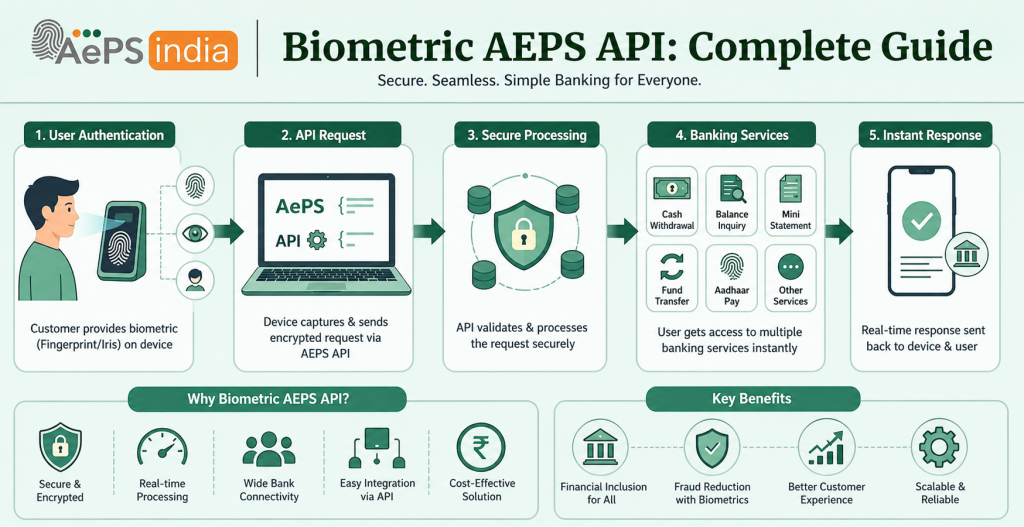
Are you searching for the best Biometric AEPS API in India to start or grow your digital payment business? With the rapid expansion of the Aadhaar Enabled Payment System (AEPS), biometric authentication has become the most secure and trusted way to provide banking services like cash withdrawal, balance enquiry, mini statement, and Aadhaar to Aadhaar fund transfer.
A Biometric AEPS Aadhaar Enabled Payment System API is a secure software interface that allows businesses to integrate Aeps banking services such as cash withdrawals, deposits, and balance inquiries directly into their apps or websites, using a customer’s Aadhaar number and Aeps fingerprint/iris scan for authentication. Developed by the NPCI, it enables, in particular, rural and underserved users to perform transactions without a debit card or PIN, acting as a virtual Micro ATM.
A Biometric AePS API enables secure, real-time banking transactions cash withdrawal, balance enquiry, and mini-statements using fingerprint or iris authentication against UIDAI records. It facilitates cardless, PIN-less transactions for, typically, rural and semi-urban banking, requiring RD-service compliant biometric scanners.
Aeps india is a reliable Biometric AEPS API provider allows businesses to integrate secure fingerprint-based Aadhaar authentication into their software, website, or mobile Aeps app. This ensures safe transactions, high success rates, real-time processing, and fast settlement cycles. For retailers, agents, and fintech startups, choosing the right AEPS API is essential for delivering smooth customer service and earning steady Aeps commission income.
In today’s competitive digital payments market in India, customers expect quick and secure financial services, especially in rural and semi-urban areas where AEPS demand is very high. The best Biometric AEPS API solution offers multi-bank support, strong uptime, easy Aeps Api integration, UIDAI compliance, and advanced data security to protect every transaction.
At Aeps India, we provide a higher performance Aeps API and scalable Biometric AEPS API platform designed for retailers, distributors, and fintech businesses. Our focus is on security, speed, and maximum earnings, helping you build a profitable AEPS business in 2026 and beyond.
If you want to build a stable and long-term AEPS business in India, choosing the best biometric AEPS API is the first and most important step toward success in 2026 and beyond.
In this guide, you will learn everything about Biometric AEPS API in India, including its features, benefits, integration process, security standards, and how to choose the Aeps india for long-term business success. If you want to build a scalable and profitable AEPS business in 2026, selecting a trusted biometric AEPS API partner is your first step toward growth.
What is Biometric AEPS API
A Biometric AEPS API allows businesses to integrate secure,, real-time banking services cash withdrawals, balance inquiries, and mini-statements into apps/websites using Aadhaar authentication. It facilitates cardless, PIN-less transactions by requiring only a customer’s Aadhaar number and fingerprint/Aeps iris scan, typically through Registered Device (RD) compliant hardware.

Biometric AEPS API Work
Biometric AePS API enables secure, cardless banking cash withdrawal, balance inquiry, and mini-statements by integrating Aadhaar and fingerprint/iris authentication directly into Aeps apps or websites. It facilitates real-time, interoperable transactions via NPCI and bank servers, bridging financial gaps in rural areas.
How Biometric AePS API Works (Technical & Workflow Flow):
- Initiation & Input: A merchant/agent initiates a transaction (e.g., cash withdrawal) by entering the customer’s 12-digit Aadhaar number and selecting their bank.
- Biometric Capture: The customer provides Aeps biometric data (fingerprint or iris) using a registered, certified Aeps biometric device (e.g., Mantra).
- Encrypted Transmission: The best Aeps API securely transmits encrypted Aadhaar data and biometric details to the NPCI network.
- Authentication & Verification: NPCI passes the data to UIDAI for identity verification and simultaneously checks with the respective bank (Issuer Bank).
- Transaction Settlement: Once authorized, the bank instantly debits the customer’s account, and the agent’s wallet is credited in real-time.
- Confirmation: A success or failure response is sent back to the merchant Aeps application.
Biometric AEPS API Services Offered
Biometric AePS API services enable secure, cardless banking by allowing instant, interoperable transactions via fingerprint or iris authentication. Core services include cash withdrawals (via Micro-ATMs), balance inquiries, mini-statements, cash deposits, Aadhaar-to-Aadhaar transfers, and BHIM Aadhaar Pay for merchant payments.
Key Biometric AePS API Services Offered
- Cash Withdrawal (Micro-ATM): Instant, secure cash withdrawal from Aadhaar-linked bank accounts using biometric authentication at retail locations.
- Balance Enquiry: Real-time checking of available funds in an account using fingerprint or iris scans.
- Mini Statement: Generates a summary of the last 5–10 transactions for account tracking.
- Aadhaar to Aadhaar Fund Transfer: Enables direct, secure, and instant transfers between two Aadhaar-linked bank accounts.
- Cash Deposit: Allows users to deposit money into their bank accounts at authorized retail outlets.
- BHIM Aadhaar Pay: A merchant payment solution allowing vendors to accept payments directly from a customer’s bank account using Aadhaar authentication.
- eKYC Services: Facilitates instant, paperless, and secure customer identity verification.
- Government Benefit Disbursal (DBT): Enables receipt of direct benefit transfers like pensions and subsidies.
Read Blog : Trusted AEPS API Provider in India : Complete Guide
Key Aspects of Biometric AEPS API
Biometric Aadhaar Enabled Payment System API enables secure, cardless banking by allowing users to perform transactions like cash withdrawals, deposits, and balance inquiries using fingerprint or iris authentication. Key aspects include 24/7 reliability, >98% success rates, real-time T+0 settlement, and compliance with NPCI/RBI guidelines.
Key Aspects of Biometric AEPS API:
- Secure Biometric Authentication: Uses unique fingerprint or Aeps iris scans via Aadhaar, eliminating the need for PINs or debit cards and reducing fraud risk.
- Interoperability: Customers can access Aeps banking services at any Business Correspondent (BC) or micro-ATM, regardless of their home bank.
- Core Banking Transactions: Supports cash withdrawal, cash deposit, balance inquiry, and mini-statement services.
- Real-Time Processing & Settlement: Transactions are processed instantly, with funds often settled in real-time (T+0) to the merchant’s wallet.
- Easy Integration: Designed for seamless Aeps API integration into existing mobile aEPS apps, websites, and POS systems.
- Aadhaar Pay & Transfers: Enables high-limit merchant payments (Aadhaar Pay) and direct fund transfers between Aadhaar-linked accounts.
- Financial Inclusion: Expands banking access in rural/semi-urban areas without requiring smartphones.
- Data Security & Compliance: Adheres to strict UIDAI guidelines, including encrypted data transmission and zero storage of biometric data.

Documents Required for AEPS Registration in India
AEPS API registration in India requires mandatory Aeps KYC documentation to ensure secure financial transactions, including a PAN card, Aadhaar card (linked to a bank account and mobile number), and bank account details (cancelled cheque/passbook). A STQC-certified Aeps biometric device (fingerprint/iris scanner) is also mandatory.
Key Documents Required for AEPS API Registration:
- Aadhaar Card: The primary document, which must be linked to a functional mobile number for OTP verification.
- PAN Card: Mandatory for tax compliance and identity verification.
- Bank Account Details: A cancelled cheque, bank statement, or the front page of the bank passbook for settlement of transactions.
- Proof of Business/Address: Documents for the shop or business, such as a Shop & Establishment license, GST certificate, Udyam registration, electricity bill, or rent agreement.
- Photographs: Recent passport-sized photographs.
- Active Mobile Number & Email: For registration, communication, and receiving notifications.
- Biometric Device: A UIDAI/STQC-certified Aeps biometric scanner (e.g., Mantra) is required for authentication.
Important Considerations:
- Age Requirement: The applicant must be at least 18 years old.
- Onboarding Process: Registration involves e-KYC/physical verification, and Aeps india now offer video-based, real-time, geo-tagged verification.
- Device Registration: The Buy Aeps biometric device must be registered and compatible with the AEPS portal.
Who Can Use Biometric AEPS API?
Biometric AePS API can be used by authorized fintech companies, banks, Business Correspondents (BCs), and small business owners (e.g., Kirana shops, pharmacies) to provide secure, cardless cash withdrawals, deposits, and balance inquiries. It enables rural and underserved users to access banking via fingerprint/iris authentication.
Key Entities Eligible to Use/Integrate AePS API:
- Fintech Startups & Software Providers: To integrate Aeps biometric banking into apps, websites, and digital Aeps platforms.
- Retailers & Small Business Owners: Kirana stores and pharmacies acting as “micro-ATMs” to facilitate transactions.
- Business Correspondents (BCs) & Agents: Authorized individuals providing Aeps banking services on behalf of banks.
- Banks & NBFCs: To expand their reach in rural and remote areas.
- Common Service Centers (CSCs) & E-Mitra: Aeps india offer government-to-citizen financial services.
Requirements for Using AePS Services (End Users):
- Aadhaar Linking: The user’s bank account must be linked with their 12-digit Aadhaar number.
- Biometric Data: A functional fingerprint or iris scanner must be used for authentication.
- Participating Bank: The bank must be part of the NPCI network.
Read Blog : Buy AEPS API Online – Complete Guide 2026
Who Should Use Biometric AEPS API
Biometric AePS API should be used by fintech companies, banks, Business Correspondents (BCs), microfinance institutions, and retail shop owners (Kirana stores) to enable secure, cardless cash withdrawals, balance inquiries, and mini-statements. It is ideal for facilitating banking in rural, underserved areas,, and for enhancing security via fingerprint/iris authentication.
Key users and stakeholders include:
- Fintech Startups & Apps: To integrate Aeps banking API directly into digital Aeps apps.
- Retailers & Small Businesses (Kirana Shops, Pharmacies): To act as Micro ATM providing cash-out services to customers.
- Business Correspondents (BCs) & Agents: Authorized personnel bringing banking to remote locations without physical bank branches.
- Common Service Centers (CSCs) & E-Mitra Centers: To deliver government-to-citizen financial services.
- Banks & Financial Institutions: To expand their reach in unbanked areas and reduce infrastructure costs.
- Microfinance Institutions (MFIs): To securely handle loan disbursements and collections.

Top Use Cases of Biometric AEPS API
Biometric AEPS API enables secure, cardless banking using fingerprints or iris scans, crucial for financial inclusion in India. Top use cases include cash withdrawals/deposits via micro-ATMs, real-time balance inquiries, mini-statement generation, Aadhaar-to-Aadhaar fund transfers, Direct Benefit Transfers (DBT) of government subsidies, and biometric merchant payments (Aadhaar Pay).
Top Use Cases of Biometric AEPS API:
- Cash Withdrawal and Deposit (Micro-ATMs): Transforms local Kirana shops and retail outlets into mini-banks, allowing residents to withdraw or deposit cash using their Aadhaar number and biometrics, removing the need for physical bank branches.
- Balance Inquiry and Mini Statement: Customers can securely check their real-time bank account balance and fetch the last 5–10 transactions (mini-statement) using biometric authentication.
- Aadhaar Pay (Merchant Payments): Enables merchants to accept payments from customers via biometric authentication, which is cardless and PIN-less, ideal for rural digital payments.
- Direct Benefit Transfer (DBT) Distribution: Facilitates the immediate disbursement of government subsidies, pensions, and welfare payments directly into the beneficiary’s Aadhaar-linked account.
- Aadhaar-to-Aadhaar Fund Transfer: Allows for instant, secure money transfers between two bank accounts that are linked to Aadhaar, enhancing interoperability.
- eKYC Services: Supports rapid, paperless, and secure digital Know Your Customer (KYC) verification for new bank accounts, loans, or SIM card activations.
Role of Biometric Aeps API in Digital Banking
The Biometric AePS API plays a critical role in digital banking by enabling secure, cardless, and PIN-less financial transactions, transforming local retail shops into “micro-ATMs”. This Aeps API technology allows users to access basic Aeps banking services such as cash withdrawals, deposits, balance inquiries, and fund transfers using only their Aadhaar number and fingerprint or iris scan.
Key Roles of Biometric AePS API in Digital Banking:
- Financial Inclusion: AePS bridges the gap for rural and underbanked populations, providing access to banking services without requiring a smartphone, debit card, or physical bank branch.
- Enhanced Security: Aeps Biometric authentication (fingerprint/iris) is used to verify the user’s identity against Aadhaar records, reducing fraud risks compared to traditional PIN-based systems.
- Interoperability: Customers can use any Aadhaar-linked bank account at any AEPS-enabled terminal (BC/Agent), regardless of the bank they hold an account with.
- Direct Benefit Transfer (DBT) Distribution: It allows beneficiaries to directly receive and withdraw government subsidies, pensions, and wages (e.g., MGNREGA) at their doorstep.
- Business Empowerment: Retailers, kirana stores, and CSCs can act as Business Correspondents (BCs), earning commissions (up to ₹15 per transaction) and increasing foot traffic.
- Real-Time Processing: AePS API facilitate instant transaction processing and, in many cases, instant (T+0) settlement, providing immediate cash liquidity for agents.
Read Blog : Best AEPS API Service Provider in India – Complete Guide 2026
Why Biometric AEPS API is Important for Businesses
Biometric AEPS API is critical for businesses, particularly retailers and fintechs, by enabling secure, cardless, and PIN-less banking transactions (cash withdrawals, balance checks) using fingerprint/iris scans. It boosts revenue via commissions (₹12–₹15+ per transaction), increases footfall, and fosters financial inclusion in rural areas.
Key Reasons for Importance:
- High Security & Reduced Fraud: Utilizes Aadhaar-based, unique biometric authentication, making transactions safer than traditional PIN-based systems and preventing identity theft or card skimming.
- New Revenue Streams & Business Growth: Retailers act as mini-ATMs, earning competitive commissions on every transaction while boosting foot traffic.
- Financial Inclusion & Customer Reach: Allows businesses to serve rural and underbanked populations who lack easy access to traditional banks, tapping into a large, underserved market.
- High Success Rates & Efficiency: Provides
>98% transaction success rates and near-instant settlement (
 T+0/T+1) of funds, improving operational cash flow for businesses.
 - Easy Integration & Scalability: Easily Aeps API integrated into existing Aeps app, websites, or Point of Sale (POS) systems, enabling businesses to scale Aeps services without heavy infrastructure investment.
- Regulatory Compliance: Adheres to NPCI/UIDAI guidelines, ensuring legal compliance and trust for financial transactions.
By integrating Aeps API, businesses become vital local, trusted financial hubs, driving both profitability and social impact.

Features Biometric AEPS API
Biometric AePS API enables secure, real-time banking transactions cash withdrawal, balance inquiry, mini-statement, and funds transfer using fingerprint or iris authentication linked to Aadhaar. Key features include 98%+ success rates, NPCI compliance, instant (T+0) settlement, and inter-bank interoperability, ideal for rural financial inclusion.
Key Features of Biometric AePS API:
- Secure Authentication: Uses Aadhaar-linked biometric data (fingerprint or iris scan) to ensure high-level security, reducing fraud compared to traditional PIN-based systems.
- Core Banking Services: Facilitates essential transactions: cash withdrawal, cash deposit, balance enquiry, and mini-statement generation.
- Interoperability: Customers can access their bank account through any Business Correspondent (Bank Mitra) or device, regardless of where they hold their account.
- Real-Time Processing & Settlement: Provides instant transaction authorization and T+0 (same-day) settlement of funds to the merchant’s wallet.
- Financial Inclusion & Accessibility: Enables Aeps banking API services in rural/semi-urban areas, eliminating the need for debit cards or smartphones.
- Aadhaar Pay: Enables merchant payments, allowing customers to pay for goods/services using their biometric data.
- Easy Integration: Designed Aeps API for rapid integration into existing web portals, Android Aeps app, and POS systems via RESTful Biometric Aeps API.
- Low-Cost & Reliable: Requires minimal infrastructure (smartphone/computer + biometric device), reducing overhead costs while offering high (98-99%) success rates.
- Compliant & Secure: Adheres to NPCI and RBI regulations, often featuring end-to-end encryption for data security.
- Direct Benefit Transfer (DBT): Facilitates direct receipt of government welfare, pensions, and MNREGA wages.
- Instant Settlement (T+0): Enables immediate settlement of funds into the merchant or agent’s wallet.
- Regulatory Compliance: Adheres to strict NPCI, RBI, and UIDAI guidelines, including secure, encrypted transmission of biometric data.
These features enable secure, low-cost, and efficient banking services.
Benefits Biometric AEPS API
Biometric AEPS API offers secure, cardless, and PIN-less financial transactions, significantly boosting rural banking access and reducing fraud via fingerprint/iris authentication. It enables instant, 24/7 banking services like cash withdrawals, deposits, and balance inquiries, while providing businesses with new revenue streams and high Aeps commission opportunities.
Key Benefits of Biometric AEPS API:
- Enhanced Security: Transactions are secured through unique Aadhaar-linked biometric authentication, significantly reducing fraud compared to traditional PIN-based systems.
- Financial Inclusion: Extends Aeps banking service to unbanked and rural populations, eliminating the need to travel to distant bank branches.
- Cardless & PINless Convenience: Users only need their Aadhaar number and fingerprints/iris scans, making banking accessible for those without debit cards or who are tech-challenged.
- Convenience (Cardless & PIN-less): Eliminates the need for physical debit cards, credit cards, or remembering PINs, which is ideal for, or technologically challenged users.
- Interoperability: Allows users to perform transactions across different banks, offering a universal banking tool.
- Business Growth & Revenue: Businesses, agents, and retailers can act as Mini ATM, increasing customer footfall and earning Aeps commissions on transactions.
- Real-Time & Instant Settlement: Enables 24/7, immediate, and secure transaction processing.
- Direct Benefit Transfer (DBT): Facilitates direct receipt of government subsidies and pensions into bank accounts.
- Government Benefit Transfers (DBT): Facilitates the direct, secure receipt of subsidies and pensions.
- Low Cost Implementation: Requires minimal infrastructure (a smartphone/computer and a biometric device).
- Easy Integration: Provides developers with REST-based and robust Aeps API for fast and seamless integration into best Aeps apps or web platforms.
- Simple Infrastructure: Requires minimal Aeps api setup a smartphone or computer, a biometric device, and an internet connection.
Read Blog : AEPS in Banking in India – Complete Guide
How to Integrate Biometric AEPS API
Integrating Aeps biometric API involves partnering with an NPCI-certified Aeps india, completing Aeps KYC, and obtaining Aeps API credentials (MID/keys). Technical integration requires installing Registered Device (RD) services (like Mantra/Morpho) for fingerprint capture, implementing Aeps API (cash withdrawal, balance inquiry, mini-statement) using JSON/XML, setting up callback URLs, and testing in a sandbox environment.
Steps to Integrate Biometric AEPS API:
- Partner with an NPCI-Certified Provider: Select a Aeps india that offers robust support, high success rate Aeps API, and competitive Aeps commission structures.
- KYC and Onboarding: Submit business documents (PAN, Bank details, Aadhaar) to complete the registration. As of 2026, comply with the “One Operator, One Bank” rule.
- Acquire and Register Biometric Devices: Purchase Aeps L1 Devices (RD) (e.g., Mantra). Install the manufacturer’s RD Aeps service app on Android/Windows.
- Obtain API Documentation & Credentials: Receive Aeps API keys, Aeps ID (ID), and documentation (usually within 24-48 hours).
Technical Integration (Backend & Frontend):
- Frontend: Create a user interface to input the Aadhaar number and trigger biometric scanning via the device’s RD service.
- Backend: Implement Aeps API endpoints for services like Balance Enquiry, Cash Withdrawal, and Mini Statement using HTTPS POST.
- Secure Data: Ensure encrypted data capture (PID Data) for secure transmission.
- Setup Callback URL: Configure a secure callback URL to receive real-time transaction status (Success/Failure).
- Testing (Sandbox Environment): Test transactions, error handling, and biometric authentication in the Aeps india sandbox environment.
- Go Live: Move to the production environment to start Aeps API live transactions.
The integration process typically takes 3-8 weeks depending on compliance, technical Aeps API development, and testing.

Bio-metric AEPS API Charges Commission Structure & Profit Margin
Biometric AEPS API service in 2026 offer high-margin income for businesses, with Aeps API setup costs ranging from ₹12,000 to ₹35,000+ for white-label solutions. Retailers earn Aeps commissions of ₹2–₹15+ per transaction, typically higher for larger amounts. Key costs include Aeps API setup fees, biometric devices (₹1,500–₹5,999), and potential annual maintenance (₹9,999–₹30,000).
AEPS API Setup & Integration Charges
- One-time Setup Fee: Generally ranges between ₹12,000 and ₹35,000.
- White Label API: Costs typically fall between ₹15,000 and ₹1.2 Lakhs.
- Biometric Device Cost: Aeps L1-certified fingerprint scanners (e.g., Mantra MFS100) cost approximately ₹1,500–₹3,000.
- Direct/Premium Bank API: Highest commission Aeps API can cost between ₹2.5 Lakhs and ₹4.5 Lakhs.
- Maintenance: Annual Maintenance Charges (AMC) range from ₹9,999 to ₹30,000+.
- Transaction Charges: While UIDAI often does not charge, banks may levy up to 1% or fixed charges (₹0.25 to ₹10) per transaction.
- Hardware: Aeps Biometric scanners (e.g., Mantra MFS100) cost ₹1,500–₹3,000, while Micro ATM cost ₹10,000–₹15,000+.
Commission Structure (Retailer/Agent)
Aeps Commissions are tiered based on the transaction amount, with higher amounts offering better returns:
- ₹100–₹999: ~₹2 per transaction.
- ₹1,000–₹1,499: ~₹3 per transaction.
- ₹1,500–₹1,999: ~₹4.5 per transaction.
- ₹2,000–₹2,499: ~₹5.5 per transaction.
- ₹2,500–₹10,000: Up to ₹13–₹15 or 0.40%–1%.
- Balance Inquiry/Mini Statement: ₹2–₹7 per transaction.
AEPS Commission Structure (Retailer Earnings)
Commissions are typically tiered based on the transaction amount:
- Cash Withdrawal: ₹2 to ₹15+ per transaction.
- Higher Value Transactions: Withdrawals of ₹3,000+ can earn ₹10–₹13 or more per transaction.
- Balance Inquiry & Mini Statement: Approximately ₹2–₹5 and ₹3–₹7 per transaction, respectively.
- Aadhaar to Aadhaar Fund Transfer: Generally ₹5–₹10 per transaction.
Profit Margin & Key Takeaways
- High-Volume Profit: The model is based on high volume; high-frequency users can generate significant monthly income.
- Revenue Potential: Aeps india offer up to ₹15 per transaction, while standard, high-yield, and premium structures provide varied margins.
- Additional Revenue: Beyond commissions, retailers benefit from increased footfall, driving sales of other products.
- Instant Settlement: Aeps india with T+0 (same-day) or instant settlement ensures better cash flow management.
- Provider Choice: Choosing a high commission Aeps API(offering up to ₹15–₹17 per transaction) is essential for maximizing margins.
- Security: Ensure the Aeps india is compliant with NPCI/RBI guidelines and uses Aadhaar-based biometric security.
Key Considerations:
- Security: L1-certified Aeps devices are now mandatory for improved security and reduced transaction failures.
- Transaction Limits: RBI allows banks to set their own limits, though generally up to ₹50,000 per transaction.
- Alternative Methods: Aadhaar Pay is used for higher-value transactions where bank fees may apply.
Bio-metric AEPS API Security
Biometric AEPS API security is primarily enforced through NPCI and RBI-mandated, L1-certified Registered Devices (RD) and STQC-certified scanners. Key security measures include RSA encryption for transmitting sensitive biometric/Aadhaar data, liveness detection to prevent spoofing, and strict agent, 3-month inactivity re-KYC.
Key Security Components of AEPS API (2026 Standards):
- Mandatory L1 Registered Devices (RD Service): As of Jan 1, 2026, all devices must be Aeps L1 certified device for enhanced, encrypted biometric capture, replacing older L0 devices.
- Encrypted Data Transmission: Aadhaar numbers and biometric data (fingerprint/iris) are encrypted at the device level, ensuring secure, end-to-end transmission to prevent tampering.
- Biometric Liveness Detection: Advanced scanning technology verifies the “liveness” of the finger or iris to prevent spoofing with fake prints or photos.
API Security & Infrastructure:
- IP Whitelisting: Restricting Aeps API access to authorized server IPs.
- API Key Protection: Secure, unique keys for each client.
- No Data Storage: Strict prohibition against storing biometric data at the Aeps india level.
Regulatory & Process Compliance:
- “One Operator, One Bank” Rule: Limits agent-bank associations to enhance accountability.
- Re-KYC Policy: Mandatory re-verification for agents with 3 months of inactivity.
- Real-time Monitoring: Continuous monitoring to detect and block suspicious transactions.
- Biometric Data Security: The Aeps system matches biometric data directly against the UIDAI database.
For maximum security, users can also lock their Aadhaar biometrics via the UIDAI website or mAadhaar app.
Read Blog : Best AEPS API Service in India for AEPS Cash Withdrawal
Bio-metric AEPS API Compliance
Biometric AePS API compliance requires strict adherence to NPCI/RBI guidelines, focusing on secure, real-time, and fraud-resistant transactions. Key requirements include using STQC/L1-certified biometric devices, mandatory agent Aeps e-KYC, “One Operator, One Bank” policies, RSA encryption, and no storage of biometric data.
Core Compliance Requirements (As of 2026)
- Mandatory L1 Registered Devices: All Aeps biometric scanners (fingerprint/iris) must be L1 certified for secure, encrypted, and liveness-checked data capture.
Agent KYC & Operations:
- “One Operator, One Bank”: Agents must map to a single bank to reduce fraud.
- Full Agent KYC: Mandatory, rigorous Aeps e-KYC (Aadhaar, PAN, Bank details) is required.
- Inactivity Rule: 3-month inactivity mandates re-KYC.
Data Security & Encryption:
- No Data Storage: Biometric data must never be stored on the Aeps agent device.
- Encryption: RSA/AES-256 encryption is mandatory for Aadhaar and biometric data during transmission.
API Security:
- IP Whitelisting: Only Indian IP addresses are whitelisted for production mode.
- Real-time Fraud Monitoring: Aeps india must block suspicious, high-risk, or fraudulent transactions instantly.
Approved Biometric Devices
- Aeps Devices must be STQC certified, such as Mantra (MFS100, MFS110, MIS100).
Impact of Non-Compliance
Failure to follow these regulations results in immediate suspension of the agent AePS ID and potential legal action.

Bio-metric AEPS API NPCI Guidelines 2026
As of January 1, 2026, NPCI-mandated AePS guidelines require strict security: mandatory L1-certified, UIDAI-registered biometric devices, full KYC for agents, and a “One Operator, One Bank” policy. Aeps b2b API must use encrypted PID blocks, no storage of biometric data, and adhere to 3-month inactivity re-KYC rules.
Key NPCI Guidelines for AePS API (2026 Update)
- Mandatory L1 Registered Devices (RD): Only L1-certified, STQC-registered biometric devices (fingerprint/iris scanners) are permitted to prevent spoofing.
- “One Operator, One Bank” Rule: As of January 1, 2026, agents are restricted to linking only one acquiring bank for AePS transactions to improve accountability.
- Enhanced KYC: Full KYC is mandatory for all Business Correspondent (BC) agents, including PAN, Aadhaar, and, in some cases, police verification.
Data Protection & Security:
- No Storage: Encrypted PID blocks and license keys must never be stored in the Aeps operator system.
- Encryption: Data transmission must be secured with SSL/TLS encryption.
- Active RD Service: Devices must use Registered Device (RD) service software to capture encrypted biometrics.
- Inactivity Rule: If an agent account remains inactive for 3 months, they must undergo Re-KYC before resuming services.
- Transaction Limits: Maximum withdrawal is generally ₹10,000 per transaction, with daily caps of ₹50,000 imposed by banks.
Technical API Integration Requirements
- Authentication Flow: The secure Aeps API must capture the customer’s Aadhaar number and use a registered Aeps biometric scanner to capture encrypted biometric data.
- FIR-FMR Implementation: As per recent updates, the PID
fTypeparameter must be set to2to ensure the correctFIR(Finger Image Record) andFMR(Finger Minutiae Record) format. - Backend Security: Use HTTPS POST URL to receive real-time updates and ensure all communication is encrypted.
Core Compliance Requirements
- No Extra Charges: Agents are prohibited from charging extra fees to customers for using the best AePS service.
- Mandatory Account Linking: The customer’s bank account must be linked with their Aadhaar number.
- Data Audit: Authentication logs must be maintained for at least 2 years.
Bio-metric AEPS API with Multi-Bank Support
Biometric AEPS API with multi-bank support enables secure, real-time banking transactions cash withdrawal, balance inquiry, mini-statement, and Aadhaar Pay using fingerprint or iris scanning. It facilitates interoperability across multiple banks, allowing users to access accounts from any Business Correspondent (BC). The Aeps API integrating into apps/websites for seamless digital banking, often featuring >98% success rates, 99.9% uptime, and instant settlement.
Key Features of Multi-Bank AEPS API
- Interoperability: Allows customers of any bank to conduct transactions at any BC outlet, enabling access to diverse banks.
- Secure Authentication: Utilizes UIDAI-compliant biometric data (fingerprint or iris scan) for secure, fraud-resistant transactions.
- Core Banking Services: Supports cash withdrawal, cash deposit, balance inquiry, and mini-statement generation.
- Aadhaar Pay (Merchant Payments): Enables cashless, high-value payments (exceeding daily limits) directly from the customer’s account.
- Real-time Processing: Transactions are processed instantly through the NPCI network, providing immediate, secure confirmation.
- High Success Rates & Uptime: Reliable Aeps API, such as those provided by Aeps India, ensure 99.9% uptime and >98% success rates.
Integration and Implementation
- Setup Costs: Typically range from ₹15,000 to ₹1.2 Lakhs for white label Aeps API solutions, with biometric devices costing ₹1,500–₹3,000.
- Process: Involves partnering with an NPCI-certified Aeps india, completing KYC, integrate Aeps API endpoints/callback URLs, and testing in a sandbox before going live Aeps Api.
- Hardware Requirements: Requires RD-registered biometric scanners (e.g., Mantra).
- Financial Benefits: Agents/retailers earn Aeps commission, generally ₹2–₹15+ per transaction, which are higher for larger amounts.
Common Use Cases
- Financial Inclusion: Bridging the gap for unbanked populations, particularly in rural areas.
- Retail Banking: Turning small retail shops into micro-ATMs.
- Digital Payment Acceptance: Facilitating secure payments for merchants.
- Government Benefits: Enabling direct benefit transfers (DBT) and subsidies.
Read Blog : Complete Guide to AEPS API Integration for Businesses and Retailers
Bio-metric AEPS API High Transaction Success Rate
A high-performance biometrical AePS API offers >98% transaction success rates, 99.9% uptime, and 2-3 second processing times, ensuring secure Aadhaar-based authentication for cash withdrawals and balance inquiries. Aeps India offer reliable Aeps API integration with T+0 (instant) settlements, supporting higher volume Aeps API, secure, and compliant financial services.
Key Features for High-Success AEPS APIs
- High Success Rate: Consistently achieves >98% success rates, reducing transaction failures.
- Instant Settlement: T+0 or Same-day (T+1) settlement options to maintain cash flow.
- Rapid Processing: Real-time, 2-3 second transaction processing, ideal for high volume Aeps API, secure, and instant cash withdrawals up to ₹10,000.
- Superior Uptime: 99.9% API uptime for 24/7 reliability.
- Security Compliance: NPCI, RBI, and UIDAI compliant, utilizing encrypted biometric (fingerprint/iris) scans.
- Interoperability: Enables transactions across multiple banks.
- Fast Processing: 2-3 second transaction speed.
- Support & Reliability: 24/7 technical support for immediate issue resolution.
Common Pitfalls and Solutions
While Aeps API providers like Aeps india strive for high success, failures can occur.
- Biometric Issues: Use AI-based fingerprint enhancement to reduce failure rates by 35%.
- Network Failure: Highest volume top Aeps API with 99.9% uptime reduce failures due to connectivity issues.
- Compliance Risk: Only use NPCI-certified Aeps india to avoid fraud and service disruptions.

Aeps Biometric Device Compatibility and RD Service Integration
AePS (Aadhaar Enabled Payment System) requires STQC/UIDAI-certified Aeps biometric scanner (fingerprint or iris) that support Registered Device (RD) services for secure, real-time Aadhaar authentication. Popular compatible Aeps devices include Mantra MFS100/L1 RD service integration involves installing the Aeps india specific driver/top Aeps app to encrypt biometric data, ensuring compliance with UIDAI security standards.
Key Aspects of AEPS Device Compatibility & RD Service
- Mandatory Certification: Devices must be STQC (Standardisation Testing and Quality Certification) approved to work with the Aadhaar system.
- RD Service Requirement: To comply with security protocols, devices cannot store raw biometric data. They must use Registered Device (RD) service software, which manages the secure encryption of biometric data before transmission.
Compatible Devices:
- Fingerprint Scanners: Mantra MFS110/MFS100 (L1).
- Iris Scanners: Tantra Iris, Cogent.
- Operating System Support: Certified Aeps devices typically support Android (6.0+ with OTG) and Windows (7+).
Integration Process:
- Purchase Aeps device (L0 or L1).
- Install the manufacturer-specific RD Service app from the Google Play Store or their website.
- Register the device through the RD app.
- Configure the device with the chosen AEPS application or Aeps API service.
- Device Costs: Standalone scanners range from ₹3,000 to ₹7,000, while All in One Micro ATM machines (with scanner and printer) cost ₹10,000–₹30,000+
Proper RD service registration is critical; failure to do so will result in transaction failures.
How to Start AEPS Business with Biometric API Integration
Starting AEPS business requires partnering with an NPCI-certified Aeps india, completing KYC, acquiring STQC-certified biometric devices (Morpho/Mantra), and integration Aeps API into Aeps admin portal. Key steps include registering with Aeps India, setting up RD (Registered Device) Aeps service software, and testing in a sandbox environment.
1. Requirements for Starting AEPS Business
- Eligibility: Must be an Indian citizen, 18+ years old, with a shop/firm or working as an agent.
- Documents: Aadhaar Card, PAN Card, active bank account (for settlement), shop address proof, and passport-size photo.
- Hardware: Computer/Android smartphone, stable internet, and a STQC-certified fingerprint/iris scanner (Mantra, Morpho).
- Software: RD Service (Registered Device) drivers for the biometric scanner.
2. Steps to Start & Integrate AEPS API
- Select an API Provider: Choose a reputed Aeps India and Noble Web Studio.
- Register & KYC: Submit documents for approval (takes 24-48 hours) to receive Aeps API credentials, including Aeps API Key and Merchant ID (MID).
Technical Integration:
- Backend: Integrated Aeps API endpoints for cash withdrawal, balance inquiry, and mini-statement.
- Frontend: Configure the UI to capture Aadhaar number and trigger the biometric device.
- Callback URL: Set up a secure HTTPS POST URL to receive transaction updates.
- Testing & Live: Test in the sandbox/test environment for security and correct Aeps service API responses, then move to production.
3. Cost & Investment
- Registration/API Cost: ₹99 – ₹1,250 for agent IDs, while full Aeps API integration for businesses can cost ₹12,000 – ₹35,000.
- White Label Portal: Ranging from ₹15,000 to over ₹1 Lakh.
- Hardware: Approximately ₹2,000 – ₹3,000 for a single biometric device.
4. Key Considerations
- Security: Ensure AES-256 encryption for biometric data transmission (PID data).
- Support: Aeps india offering 24/7 technical support, as transaction failures require immediate resolution.
- Commission: Check the Aeps commission structure per transaction; typically, higher volume brings better, higher commissions.
Read Blog : The Ultimate Guide to AEPS API: Everything You Need to Know in 2025
How to Choose the Best Biometric AEPS API Provider in India
Aeps india is the best Biometric AEPS API provider in India requires selecting an NPCI-certified entity offering >98% transaction success rates, 99.9% uptime, and instant (T+0) settlement, such as Aeps India. Aeps india with highest Aeps commission structures (₹10–₹1710–17 per transaction), robust security, 24/7 technical support, and support for Aeps L1-certified biometric devices.
Key Factors to Evaluate
- Security & Compliance: Ensure the Aeps india is authorized by the National Payments Corporation of India (NPCI) and adheres to RBI and UIDAI guidelines to protect biometric data.
- Transaction Success Rate & Uptime: Aeps india offering a high transaction success rate (>98%) and 99.9% server uptime to minimize transaction failures and maintain user trust.
- Settlement Speed (T+0): Look for instant (T+0) or same-day (T+1) settlement to maintain healthy cash flow.
- Commission & Fees: Evaluate competitive payouts, which can range from
₹55 to
₹15+15+ per transaction. - Hardware Compatibility: Verify that the Aeps API supports STQC-certified and L1-certified (Level 1) biometric devices for enhanced security, which is required as of 2026.
- Technical Support: 24/7 support via phone or WhatsApp is essential for immediate issue resolution.
- Advanced Features: Opt for smooth Aeps API that support multi-factor authentication (fingerprint, iris, face) and additional services like Micro ATM service, BBPS service, and Domestic Money Transfer API Service.

Why Choose Aeps India for Biometric AEPS API Services
Choosing a Aeps india for Biometric Aadhaar Enabled Payment System API services is essential for ensuring high-security, 99.9% uptime, and NPCI/RBI-compliant transactions, which reduces failure rates. These Aeps india offer secure and reliable, instant Aeps API integrated, facilitating seamless Aeps cash withdrawal service, Aeps balance inquiries service, and Aeps mini statements service through fingerprint or iris scans, ultimately boosting customer trust and generating higher transaction commissions.
Key reasons to choose a specialized Biometric AEPS API provider include:
- Security & Compliance: Aeps India ensure 100% compliance with NPCI/RBI and UIDAI guidelines, utilizing encrypted biometric authentication to prevent fraud.
- High Reliability & Uptime: A robust infrastructure ensures 99.9% uptime, which minimizes transaction failures and builds trust, essential for both urban and rural markets.
- Maximum Revenue (High Commission): Businesses can earn higher Aeps commissions, typically ₹12–₹15 per transaction, along with transparent reporting.
- Instant Settlements (T+0): They facilitate instant or same-day (T+0/T+1) settlements, ensuring consistent cash flow for Aeps software for agents and businesses.
- Easy Integration & Support: Well-documented Aeps Api, user friendly Aeps API are available, backed by 24/7 technical support for immediate issue resolution.
- Comprehensive Services: Beyond basic Aeps cash withdrawal Api, Aeps india offer integrated services such as Micro ATM services, Aadhaar Pay, and Domestic Money Transfer service (DMT), allowing for increased revenue streams.
- Increased Earnings: With competitive Aeps commission structures (often ₹12–₹15 per transaction) and transparent reporting, businesses can maximize their daily income.
- Scalability: The Aeps API designed to scale, accommodating high Aeps transaction volumes as the business grows.
Choosing a Aeps india turns retail shops into trusted, local, digital banking hubs.
Future Trends of Biometric AEPS API
The future trends of Biometric Aadhaar Enabled Payment System API are focused on enhancing security, increasing transaction speed, and broadening functionality to transform rural retail shops into comprehensive “micro-banking hubs.” By 2026, the AEPS ecosystem is evolving towards AI-driven, mobile-first, and highly compliant Aeps systems designed to handle over 3.5 billion annual transactions.
Here are the key future trends in Biometric AEPS API for 2026 and beyond:
1. Advanced Security and Regulatory Compliance
To combat fraud and biometric spoofing, the RBI and NPCI are enforcing stricter, mandatory, and technology-heavy guidelines:
- Mandatory L1-Certified Devices: As of January 1, 2026, all biometric devices (fingerprint/iris scanners) must be STQC-certified Level 1 (L1) devices, which provide enhanced on-device encryption (RSA) and security, replacing older L0 devices.
- AI-Driven Liveness Detection: Real Time Aeps API integration now require liveness detection to distinguish between a live person and a spoofed photo or fake fingerprint, ensuring the person is physically present.
- “One Operator, One Bank” Rule: To improve accountability and curb fraud, agents (AePS Touchpoint Operators) are limited to being mapped to only one acquiring bank.
- Mandatory Re-KYC: Agents inactive for three consecutive months must undergo a new Aeps KYC process to reactivate their services.
2. Multi-Modal Biometric Authentication
Moving beyond just fingerprint scans, the next generation of AEPS Payment API will incorporate multi-modal biometrics, including:
- Iris Recognition: Aeps india offering higher accuracy and reduced failure rates compared to fingerprints.
- Face Authentication: Providing a more hygienic (touchless) and faster authentication method for users, especially in high-traffic areas.
3. Deeper Ecosystem Integration (Embedded Finance)
AEPS is moving beyond simple cash withdrawals to become a “one-stop shop” for rural financial services:
- UPI-AEPS Interoperability: Seamless, 24/7 integration between AEPS and UPI-ATM systems, allowing for a more unified digital experience.
- Broader Service Offerings: Aeps API solutions are expanding to include micro-loans, insurance, digital gold, and mutual fund investments directly at local Kirana shops.
- Embedded Finance: Secure AEPS services are being embedded into non-financial apps to make banking accessible directly within everyday, local, and rural fast Aeps apps.
4. High-Performance Infrastructure (T+0 Settlement)
- Instant Settlement (T+0): The industry standard is shifting towards instantaneous, real-time, or same-day (T+0/T+1) settlement of funds to the agent’s wallet, maximizing liquidity.
- Cloud-Native & Mobile-First: Aeps API design for high performance Aeps Api, cloud Aeps api, and mobile-first apps, capable of processing 600+ transactions per second, ensuring >99.9% uptime.
- Blockchain for Transparency: Implementation of blockchain technology to create secure, tamper-proof, and transparent transaction logs.
5. Increased Accessibility
- Voice-Based Payments: Developing Aeps API voice-activated, multilingual interfaces to make banking accessible to users with low digital or traditional literacy.
- “App-less” Interfaces: Exploring Aeps india where the user only needs a biometric device, reducing the dependency on a high-end smartphone for the agent.
These trends are essential to support the rapid adoption of Digital India in rural areas, turning local Kirana stores into secure banking access points and reducing the reliance on traditional, distant bank branches.

Conclusion
Choosing the right Biometric AEPS API in India is the most important step for building a secure and profitable digital payment business. With the growing demand for Aadhaar Enabled Payment System (AEPS) services, biometric authentication has become the backbone of safe and reliable transactions. Through fingerprint-based Aadhaar verification, businesses can offer cash withdrawal, balance enquiry, mini statement, and Aadhaar to Aadhaar fund transfer quickly and securely.
A Biometric AEPS API is a secure software interface that allows businesses to integrated Aeps banking services such as cash withdrawal, balance inquiries, and mini-statements directly into their Aeps android app or websites. It enables real-time transactions by authenticating customers using their Aadhaar number and biometric data (fingerprint or iris) via National Payments Corporation of India (NPCI).
A Biometric AEPS Aeps API enables secure, real-time banking transactions cash withdrawals, balance inquiries, and deposits by authenticating users via fingerprint or iris scanners through their Aadhaar-linked bank accounts. It requires NPCI-compliant, L1-certified devices for secure, cardless transactions, often costing ₹12,000–₹35,000 for setup.
Aeps india is a reliable biometric AEPS API provider ensures secure Aadhaar verification, high transaction success rate, fast settlement cycle, real-time processing, and strong data protection. These features help businesses deliver smooth transactions, reduce failures, and build long-term customer trust. In rural and semi-urban areas, biometric AEPS API services are highly demanded, making it a strong opportunity for steady commission income.
Aeps india is an trusted Biometric AEPS API provider ensures high transaction success rate, real-time processing, strong data encryption, UIDAI compliance, and fast settlement cycles. These features are essential for retailers, agents, fintech startups, and distributors who want to deliver smooth services and earn consistent commission income. In rural and semi-urban India, biometric AEPS services are in high demand, making it a strong opportunity for long-term business growth.
Before selecting Aeps india is an best AEPS API provider, always check security standards, uptime performance, biometric device compatibility, integration support, commission structure, and technical assistance. The Aeps india will not only protect customer data but also help you scale your operations in India’s fast-growing digital payments market.
At Aeps India, we provide a secure and advanced Biometric AEPS API solution designed for retailers, agents, and fintech businesses who want reliable service and consistent income. Our Aeps b2b platform supports high commission, instant settlement, and seamless Aeps API integration to help partners succeed in 2026 and beyond.
As financial inclusion continues to grow across India, the demand for secure and reliable Biometric AEPS API services will increase in 2026 and beyond. By partnering with a Aeps india, you can build a stable, scalable, and high profit AEPS business with confidence.
If you want to grow your digital payment business and stay ahead in the competitive AEPS market, partnering with a Aeps india trusted Biometric AEPS API provider in India is the smart step toward sustainable growth, higher profits, and long-term success.
Contact Us today Aeps india to get the best Biometric AEPS API in India and start growing your secure digital payment business with confidence.
FAQ – Biometric AEPS API in India
Biometric AEPS API is a secure Aadhaar Enabled Payment System integration that allows Aeps india to offer cash withdrawal and banking services using fingerprint authentication. It connects your software or mobile app with AEPS services through biometric verification.
The process is simple:
Customer enters Aadhaar number
Fingerprint is scanned using a biometric device
Authentication is completed through secure servers
Transaction like cash withdrawal or balance enquiry is processed instantly
This ensures safe and real-time AEPS transactions in India.
Biometric AEPS API is designed for:
Retail shop owners
CSC operators
AEPS agents and distributors
Fintech startups
Payment service providers
It is ideal for anyone looking to start a low-investment, high-commission AEPS business.
Aeps india offers:
AEPS cash withdrawal
Balance enquiry
Mini statement
Aadhaar-based authentication
Secure transaction tracking
These services help retailers provide complete digital banking support.
To use Biometric AEPS API, you need:
Aadhaar-linked fingerprint scanner
RD (Registered Device) service
Internet connection
Basic KYC documents
A compatible biometric device ensures secure Aadhaar-based authentication.
Yes. Aeps india is an reliable AEPS API provider in India uses encrypted systems and secure authentication channels. Biometric verification adds an extra layer of protection, reducing fraud risk and ensuring safe digital transactions.
Commission depends on the Aeps india and transaction volume. Most high commission AEPS API provider like Aeps india offer attractive margins on cash withdrawals. Retailers with regular transactions can earn stable monthly income.
Yes, you need a compatible STQC-certified fingerprint scanner to complete Aadhaar authentication for AEPS transactions.
After completing KYC and submitting required documents, activation usually takes a short time. Once approved, you can start offering AEPS cash withdrawal and biometric Aeps banking API services immediately.
Aeps india offer instant or same-day settlement, ensuring smooth cash flow for retailers and agents.
You need a certified biometric fingerprint scanner, stable internet connection, and registration with Aeps india one of the trusted AEPS API service provider.
Yes. AEPS API integration allows you to connect biometric AEPS services directly to your mobile app or website. This helps Aeps india scale services and handle high transaction volumes.
In 2026, digital payments and Aadhaar-based banking are growing rapidly in India. Biometric AEPS API helps retailers and businesses provide secure, instant, and reliable services while earning steady commission. It supports financial inclusion and expands digital banking access in rural and urban areas.
With the rapid growth of digital payments and financial inclusion, Biometric AEPS API will continue to expand across India, Aeps india offering strong business opportunities for retailers and fintech companies.
Before selecting a Aeps india, check:
High transaction success rate
Fast settlement system
Multi-bank support
Secure biometric integration
Transparent commission structure
Dedicated technical support
Aeps India provides a secure, high-performance Biometric AEPS API in India with fast integration, high commission, reliable server uptime, and strong support helping retailers and agents build a profitable AEPS business in 2026 and beyond.

AEPS B2B Provider in india– Complete Business Guide

AePS Payment System Solution: Complete Guide, Features & Benefits
AEPS Retailer Registration: Step-by-Step Guide
About Author

