Complete Guide to AEPS API Integration for Businesses and Retailers
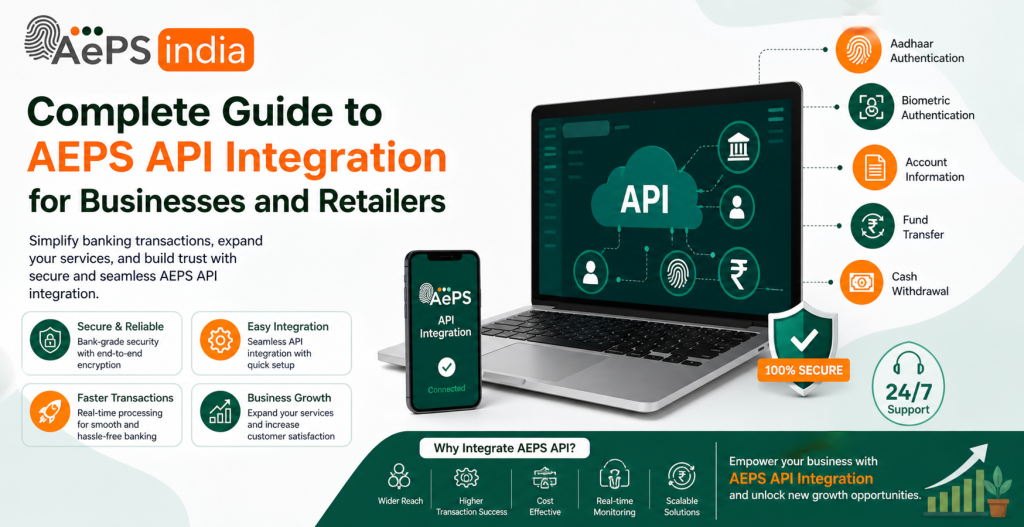
In today’s digital payment era, AEPS API Integration has become one of the most powerful tools for businesses and retailers to offer banking and financial services directly to their customers. With AEPS (Aadhaar Enabled Payment System), retailers can provide secure and instant cash withdrawals, balance inquiries, and fund transfers using just an Aadhaar number and fingerprint authentication. This system not only supports financial inclusion but also helps businesses grow by expanding their service portfolio.
AEPS (Aadhaar Enabled Payment System) API integration allows businesses to embed basic banking services, such as cash withdrawals and balance inquiries, into their own applications or platforms. This is achieved by using a software tool, an API, that connects a business’s system to the AEPS infrastructure, enabling customers to conduct transactions using their Aadhaar number and biometric authentication. The process involves a business choosing a provider, integrating the provided API or SDK into their platform, and then initiating transactions for customers.
Partnering with a trusted AEPS API provider like Noble Web Studio ensures seamless integration, strong security, and real-time transactions. Their advanced AEPS software solutions are designed for retailers, distributors, and B2B businesses who want to enter the digital banking ecosystem with ease. Through AEPS API integration, businesses can boost customer trust, generate more revenue, and become a part of India’s fast-growing digital finance network.
If you are looking to upgrade your business with digital payment services, this complete guide by Noble Web Studio will help you understand everything about AEPS API integration, its benefits, working process, and how it can transform your retail business into a digital payment hub.
What is AEPS API Integration
AEPS API integration allows businesses to embed Aadhaar-based banking services (cash withdrawal, balance inquiry, etc.) into their applications. The process involves partnering with a certified service provider, meeting legal and technical requirements, and integrating their API into your platform.
AEPS API Integration Work
AEPS (Aadhaar Enabled Payment System) API integration work involves embedding Aadhaar-based banking services into a business’s application or platform. This process allows customers to perform basic financial transactions using their Aadhaar number and biometric authentication (typically fingerprint or iris scan), effectively transforming a merchant’s location into a micro ATM.
AEPS (Aadhaar Enabled Payment System) API integration allows businesses to offer basic banking services through their own applications or platforms using a customer’s Aadhaar number and biometric authentication. This integration connects the business’s system to the AEPS network, facilitated by the National Payments Corporation of India (NPCI), and then to the customer’s bank.
Here’s how AEPS API integration typically works:
- Customer Interaction: A customer initiates a transaction (e.g., cash withdrawal, balance inquiry) at an AEPS-enabled point, such as a merchant’s store equipped with a biometric device and the integrated application. The customer provides their Aadhaar number and the desired banking service.
- Biometric Authentication: The merchant uses a certified biometric device (fingerprint scanner or iris scanner) to capture the customer’s biometric data for verification.
- API Request: The merchant’s application, integrated with the AEPS API, sends a request containing the customer’s Aadhaar number, bank name (IIN), transaction details, and the encrypted biometric data to the AEPS network via the API provider.
- Network Routing and Verification: The request travels through the AEPS network to NPCI’s platform and then to the customer’s bank. The bank verifies the Aadhaar number and biometric data against records at the Unique Identification Authority of India (UIDAI).
- Transaction Processing: Upon successful verification, the customer’s bank processes the requested transaction.
- Confirmation and Response: The bank sends a transaction status back through the AEPS network and the API provider to the merchant’s application. The merchant then provides a confirmation or receipt to the customer and completes the service, such as dispensing cash for a withdrawal.
Top Use Cases of AEPS API Integration
The top use cases for AEPS API integration include basic banking services like cash withdrawal, deposit, and balance inquiry in rural areas, disbursement of government benefits, and Aadhaar-to-Aadhaar fund transfers. This integration allows businesses, particularly retailers, to offer financial services via micro-ATMs or apps, increasing foot traffic and earning commissions, while promoting financial inclusion for customers.
Banking services for customers
- Cash Withdrawal and Deposit: Facilitates cash-in and cash-out services through micro-ATMs or retail points, especially in areas with limited traditional banking infrastructure.
- Balance Inquiry and Mini Statement: Enables customers to check their bank balance and get recent transaction history securely using their Aadhaar and biometrics.
- Fund Transfers: Allows for secure money transfers between Aadhaar-linked accounts.
Business and government applications
- Financial Inclusion: Provides banking services to underserved populations in rural areas, promoting economic participation.
- Government Benefit Disbursement (DBT): Offers a secure and efficient channel for governments to deliver welfare payments directly to beneficiaries.
- Revenue Generation for Retailers: Allows retailers to earn commissions on transactions, attract more customers, and increase sales of other products.
- eKYC: Supports identity verification for various services by leveraging Aadhaar authentication.
Why Businesses Need AEPS API Integration
Businesses need AEPS API integration to generate new revenue through commissions, expand their customer reach, particularly in rural and unbanked areas, and increase foot traffic by becoming a local banking hub. It also enhances security and customer trust via biometric authentication, streamlines transactions, and promotes financial inclusion by providing convenient access to basic banking services.
Business and revenue opportunities
- New revenue stream: Businesses can earn commissions on basic banking services like cash withdrawals and deposits.
- Increased foot traffic: Offering banking services can attract more customers to a physical store, potentially increasing sales of other products and services.
- Broader customer reach: It allows businesses to serve a larger customer base, especially in areas with limited access to traditional bank branches.
Operational and customer benefits
- Financial inclusion: Businesses can help bring essential financial services to unbanked and underbanked populations.
- Enhanced security: Transactions are secured by Aadhaar-based biometric authentication (fingerprint or iris scan), which reduces the risk of fraud and card skimming.
- Improved customer convenience: Customers can perform transactions without a debit card or PIN, using only their Aadhaar number and biometrics.
- Streamlined operations: The API allows for the seamless integration of banking functions into existing mobile applications and point-of-sale (POS) devices.
Compliance and strategic advantages
- Regulatory compliance: Integrating with AEPS ensures compliance with government regulations and supports the push for a cashless economy.
- Competitive advantage: Offering convenient and secure basic banking services can differentiate a business from its competitors.
- Diversified services: Businesses can use AEPS as a foundation to offer other digital services, such as utility bill payments and mobile recharges, says usetopay.in.
Benefits AEPS API Integration
AEPS API integration offers benefits like enhanced financial inclusion for underserved communities, increased convenience and security for users through biometric authentication, and new revenue streams for businesses by expanding customer reach and service offerings. Businesses can integrate services like cash withdrawal, balance inquiries, and fund transfers into their platforms, creating more revenue opportunities and improving customer engagement.
For customers
- Enhanced financial inclusion: Provides access to banking services in rural and underserved areas, reaching the unbanked and underbanked.
- Increased convenience: Allows for easy cash withdrawals, balance inquiries, and other transactions at local points of service, without needing debit cards or visiting a bank branch.
- Greater security: Uses Aadhaar-based biometric authentication (fingerprint verification), which is highly secure and eliminates the need for PINs.
For businesses
- New revenue streams: Creates opportunities for commission-based earnings from providing basic banking services.
- Expanded customer base: Attracts new customers by serving those in remote areas who may lack access to traditional banking.
- Increased customer loyalty: Enhances customer engagement by offering a convenient and secure way to perform financial transactions.
- Cost-effectiveness: Reduces the need for extensive physical infrastructure like bank branches.
- Competitive advantage: Provides a competitive edge by enabling the seamless integration of secure and inclusive financial solutions.
Features Integrating AEPS API
AEPS (Aadhaar Enabled Payment System) API integration offers core banking services like cash withdrawal, balance inquiry, fund transfers, and cash deposit, all secured by biometric authentication and real-time processing. Key features include interoperability across multiple banks, mini-statement generation, secure data encryption, and easy integration into business platforms to facilitate financial inclusion.
Core financial services
- Cash Withdrawal: Allows customers to withdraw cash from their Aadhaar-linked bank accounts.
- Cash Deposit: Enables customers to deposit cash into their Aadhaar-linked bank accounts.
- Balance Inquiry: Provides real-time information on the customer’s account balance.
- Fund Transfer: Facilitates the transfer of funds between Aadhaar-linked accounts.
- Mini Statement: Generates a summary of recent account transactions.
Security and authentication
- Aadhaar-based Biometric Authentication: Uses fingerprint or iris scans to securely verify user identity.
- Secure Data Encryption: Protects sensitive financial information during transmission.
- Fraud Detection: Employs system-level checks to prevent unauthorized access.
Technical and operational features
- Real-Time Transaction Processing: Ensures immediate transaction authorization and settlement.
- Multi-bank Support: Allows integration with a wide range of banks, ensuring interoperability.
- Easy Integration: Designed with developer-friendly APIs to be easily integrated into various business platforms.
- Developer-Friendly APIs: Provides tools and documentation for seamless integration.
Step-by-Step Guide to AEPS API Integration
To integrate an AEPS API, select a certified provider and complete their registration and KYC process, including acquiring and registering a compliant biometric device. After receiving API credentials and documentation, integrate the API into your system, test it thoroughly in a sandbox environment, and then go live to offer services like cash withdrawal and balance inquiries.
1. Choose an AEPS API Provider
- Select a provider that is certified by the National Payments Corporation of India (NPCI) and has a good reputation, security, and reliable support.
- Consider factors like commission structure, transaction speed, and the quality of their API documentation and sandbox environment.
2. Register and Complete KYC
- Sign up with the chosen provider by filling out their online registration form.
- Complete the mandatory Know Your Customer (KYC) verification process by submitting necessary documents like your Aadhaar card, PAN card, and bank account details.
3. Acquire and Register a Biometric Device
- Purchase a UIDAI-certified biometric device (fingerprint or iris scanner) that is compatible with the provider’s platform.
- Register the device with your AEPS service provider.
4. Integrate the API
- Once your registration is verified, you will receive API keys, credentials, and comprehensive documentation from the provider.
- Use the provided documentation and any Software Development Kits (SDKs) to integrate the AEPS API into your website, mobile application, or Point-of-Sale (POS) system.
5. Test and Go Live
Once you have confirmed that the integration is seamless and efficient, deploy the system to your live environment to begin offering AEPS services to customers.
Before deploying to a live environment, thoroughly test all AEPS functionalities in the provider’s sandbox or testing environment.
AEPS API Integration Cost
AEPS API integration costs typically involve a one-time setup fee of ₹12,000–₹35,000, plus ongoing costs like software fees (₹25,000–₹60,000 one-time or monthly/annual charges) and transaction fees of 0.5%–1% per transaction. White-label solutions, which are pre-branded, can range from ₹25,000 to ₹1.2 Lakhs.
Cost breakdown
- One-time setup fee: Expect to pay between ₹12,000 and ₹35,000 for the initial API integration.
- Software costs:
- One-time purchase: Basic admin portals can cost between ₹25,000 and ₹60,000.
- Monthly/annual fees: Some providers charge on a recurring basis, with annual costs around ₹40,000 for certain B2B software.
- Transaction fees: Most providers charge a commission for each transaction, typically ranging from 0.5% to 1% of the transaction amount.
- White-label solutions: If you need a complete, pre-branded AEPS portal, the cost can range from ₹25,000 to ₹1.2 Lakhs.
Other potential costs
- Maintenance and support: Factor in any ongoing support and maintenance fees, which may be included in the monthly/annual software charges or be a separate cost.
- Customization: Additional fees may apply for specific customizations beyond a standard white-label package.
How to Choose Right AEPS API Integration Provider
Choosing the Best AEPS (Aadhaar Enabled Payment System) API integration provider involves evaluating several key factors to ensure a secure, reliable, and efficient solution for your business.
1. Regulatory Compliance and Security:
- NPCI and RBI Certification: Verify that the provider is certified by the National Payments Corporation of India (NPCI) and adheres to Reserve Bank of India (RBI) guidelines. This ensures compliance and security standards are met.
- Data Encryption and Security Protocols: Inquire about their data encryption methods and security protocols to protect sensitive Aadhaar and transaction data.
2. Reliability and Performance:
- Transaction Success Rate and Uptime: Choose a provider with a proven track record of high transaction success rates and minimal downtime to ensure consistent service availability.
- Real-time Processing: Look for fast biometric authentication, real-time transaction confirmation, and instant commission updates for a smooth user experience.
3. Features and Functionality:
- Multi-bank Compatibility: Ensure the API supports transactions across a wide network of banks.
- Robust Admin Panel: A comprehensive admin panel is crucial for managing agents, monitoring transactions, setting commissions, and efficiently resolving disputes.
- Additional Services: Consider if the provider offers other relevant services like bill payments, recharges, or micro-ATM services, which can enhance your offerings.
4. Ease of Use and Integration:
- Seamless Integration: The API should integrate smoothly with your existing systems and infrastructure, with clear documentation and developer resources.
- User-Friendly Interface: If applicable, evaluate the user-friendliness of any associated platforms or dashboards for agents and administrators.
5. Cost and Support:
- Competitive Commission Structure and Transparent Pricing: Compare commission rates and understand the entire cost structure, including any licensing fees or hidden charges.
- Technical Support and Documentation: Assess the quality of their technical support and the availability of comprehensive documentation for troubleshooting and integration guidance.
6. Reputation and Scalability:
- Provider Reputation: Research the provider’s reputation through reviews, testimonials, and industry standing.
- Scalability: Ensure the API can handle your current transaction volumes and scale effectively as your business grows.
Why Choose Noble Web Studio for AEPS API Integration
Choosing an AEPS API provider is beneficial for new revenue streams, increased customer traffic, and promoting financial inclusion. Providers offer seamless integration, enhanced security through biometric authentication, and reliable, scalable platforms to handle transactions. This allows businesses to offer essential banking services like cash withdrawals and balance inquiries without the high cost of traditional infrastructure.
Benefits of choosing a provider
- Revenue Generation: Earn commissions from transactions like cash withdrawals and balance inquiries, creating a new income stream.
- Increased Footfall and Loyalty: Attract more customers to your location by offering convenient and secure local banking services.
- Financial Inclusion: Help provide essential banking services to underserved populations in rural and remote areas.
- Cost-Effectiveness: Set up banking services at a lower cost compared to building a traditional bank branch.
- Security: Ensure customer data and transactions are protected with strong protocols like biometric authentication and data encryption.
- Seamless Integration: Easily integrate the API into your existing applications with clear documentation and support from the provider.
- Scalability and Performance: Choose a provider whose platform can handle a high volume of transactions and grow with your business needs.
Key factors to consider
- Reliability and Uptime: Ensure the provider has a high transaction success rate and minimal downtime to avoid customer frustration.
- Security and Compliance: Verify that the provider complies with regulations and security standards, such as UIDAI and RBI regulations.
- Technical Support: Look for a provider that offers responsive customer support and comprehensive documentation.
- Commission Structure: Understand the commission structure and how it will benefit your business.
- Multi-bank Support: Choose a provider with support for multiple banks to expand your service offerings.
Future of AEPS API Integration
The future of AEPS API integration focuses on enhanced security, deeper ecosystem integration, and improved user experience. Key trends include using AI and biometrics for fraud detection, integrating with other services like UPI and Bharat Bill Pay (BBPS), and a shift to mobile-first, user-friendly platforms. Real-time settlement, blockchain technology for transparency, and broader adoption for government benefits will also be central to future development.
Enhanced security and performance
- AI and biometrics: Advanced fraud detection will be implemented using AI and machine learning to analyze transaction patterns and user behavior, making the system more secure.
- Stricter controls: Compliance with stricter regulations from bodies like the RBI will mandate stronger security measures for all transactions.
Deeper ecosystem integration
- UPI and BBPS: AEPS APIs will be integrated with UPI for broader digital payments and with BBPS for utility bill payments, creating multi-service platforms.
- Embedded finance: Banking services will be increasingly integrated directly into non-financial applications, making financial services more accessible in everyday apps.
Improved user experience and accessibility
- Mobile-first solutions: The development of user-friendly, mobile-first platforms will make AEPS services more accessible to both customers and agents across India.
- Real-time settlement: Faster transaction processing will become a standard feature, improving user experience and operational efficiency.
Broader adoption and new use cases
- Wider use: AEPS API will be used more broadly for both government benefit disbursements and private sector payments, especially in rural and underbanked areas.
- Financial inclusion: The goal remains to expand financial inclusion by transforming merchant locations into convenient, accessible banking points.
Emerging technologies
- Blockchain: This technology will be increasingly used to provide greater transparency and efficiency in transactions.
Conclusion
AEPS API Integration has become a powerful tool for businesses and retailers who want to offer instant digital banking and cashless services. With the growing demand for secure and reliable payment systems, AEPS API allows retailers to provide services like cash withdrawal, balance inquiry, and fund transfer directly from their outlets. This not only increases business revenue but also builds customer trust by offering essential financial solutions locally.
AEPS API integration allows businesses to embed basic banking services into their applications by using the Aadhaar Enabled Payment System (AEPS). The process involves partnering with an AEPS API provider, completing their registration and KYC, acquiring compliant biometric devices, and integrating the API key into your system for secure, Aadhaar-based transactions like cash withdrawals and balance inquiries.
Partnering with a trusted AEPS API provider like Noble Web Studio ensures seamless integration, advanced security, and 24/7 technical support. Their AEPS solutions are designed to help businesses expand financial access across rural and urban areas with easy setup, real-time transaction management, and complete admin control. They also support retailers, agents, and distributors with real-time reporting, commission tracking, and secure data handling, making operations efficient and reliable.
If you are a retailer, distributor, or entrepreneur looking to grow your digital payment network, Noble Web Studio’s AEPS API integration is the right choice. It empowers your business with fast, secure, and scalable banking services while promoting financial inclusion across India.
Start your AEPS journey today with Noble Web Studio and take your business towards smart digital growth.
Complete Guide to AEPS Banking in India
AEPS Banking Portal in India: Complete Guide to Aadhaar-Enabled Banking

Best AEPS Company for Retailers in 2026 is Only Aeps india– Here’s Why
About Author

