AePS Cash Withdrawal Limit 2026: Daily & Bank Limits
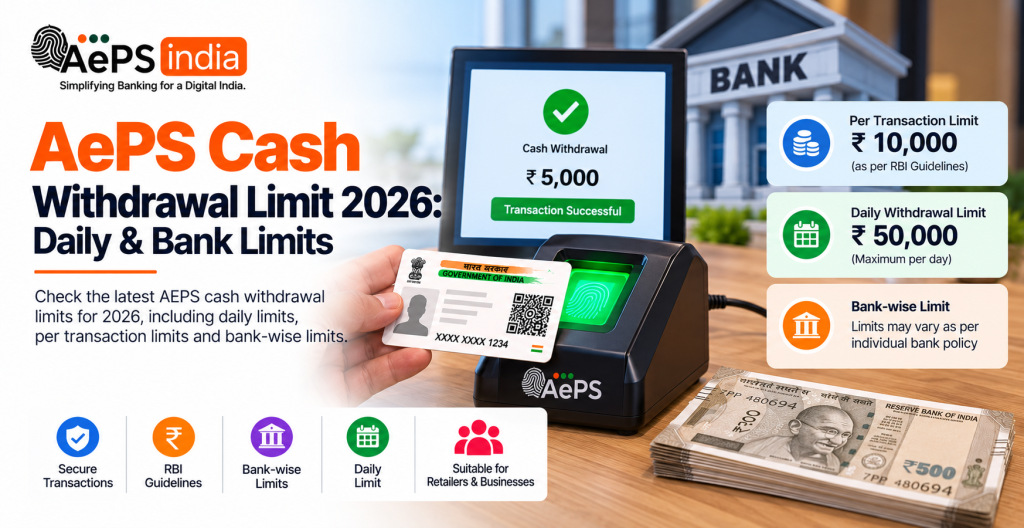
The AePS Cash Withdrawal Limit determines how much money a customer can withdraw from an Aadhaar-linked bank account through the Aadhaar Enabled Payment System (AePS). AePS allows customers to access basic banking services, including cash withdrawals, through authorised banking outlets using Aadhaar-based biometric authentication. Understanding the applicable withdrawal limit helps customers plan transactions, avoid limit-related declines, and know when to contact their bank.
For a single AePS financial transaction, the maximum transaction amount specified by NPCI is ₹10,000. However, the total amount a customer can withdraw may also depend on the issuing bank’s policies, customer profile, and applicable transaction restrictions. NPCI has also recommended a cumulative limit of ₹50,000 over a rolling 30-day period for AePS cash withdrawals and BHIM Aadhaar Pay transactions, subject to the applicable bank rules. Customers should verify the latest limits with their bank rather than assume that the same daily or monthly restriction applies to every account.
The Aadhaar Enabled Payment System (AePS) cash withdrawal limits are set by the National Payments Corporation of India (NPCI) and individual issuing banks. The maximum cash withdrawal limit for the Aadhaar Enabled Payment System (AePS) is ₹10,000 per single transaction as mandated by the National Payments Corporation of India (NPCI).
Customers should also understand the difference between a per-transaction limit and any daily or monthly restrictions. A withdrawal may be declined because of a bank-specific limit, insufficient balance, biometric authentication failure, or a temporary technical issue. If a transaction fails or remains pending, check its status and retain the transaction reference number before attempting another withdrawal.
Aeps india provides fintech software and Aeps API integration services. Businesses planning an AEPS platform can discuss their technical requirements with the team and confirm available integrations, service-provider arrangements, and applicable authorisation requirements.
Before making a withdrawal, always confirm the current rules with your issuing bank or authorised Aeps india, as applicable restrictions can differ.
In this guide, you will learn about the AePS cash withdrawal limit, bank-specific restrictions, how to check the applicable amount, and what to do when an AePS transaction fails. We also explain how fintech businesses can use suitable Aeps software solution to manage transaction records, status checks, and reconciliation.
How does AEPS Cash Withdrawal Work?
An Aadhaar Enabled Payment System (AEPS) cash withdrawal lets you take out money from your bank account using only your Aadhaar number and biometric fingerprint scan, without needing a debit card or ATM PIN.
How the AEPS Cash Withdrawal Process Works
- Link Aadhaar: Your bank account must be linked to your Aadhaar number.
- Visit a Touchpoint: Go to an authorized Aeps india.
Provide Details:
- Share your Aadhaar number.
- Select your Bank Name.
- Choose the Cash Withdrawal service.
- Enter the amount you wish to withdraw.
- Biometric Authentication: Place your finger on the biometric scanner to verify your identity against UIDAI records.
- Cash Dispensation: Once the bank validates the transaction, the operator hands you the cash and a transaction receipt.
What Is the Maximum AePS Cash Withdrawal Limit?
The maximum Aadhaar Enabled Payment System (AePS) cash withdrawal limit is ₹10,000 per single transaction as mandated by the National Payments Corporation of India (NPCI).
Breakdown of AePS Limits
- Per Transaction Limit: Maximum of ₹10,000 per swipe or biometric authentication.
- Daily Limit: While NPCI does not enforce a strict universal daily cap across all banks, individual issuer banks typically cap total daily transactions between ₹25,000 and ₹50,000.
- Monthly Limit: NPCI recommends a cumulative monthly limit of ₹50,000 for AePS cash withdrawals and BHIM Aadhaar Pay (calculated on a rolling 30-day basis), though some banks may apply specific transaction counts or higher/lower risk-based caps.
- Bank-Specific Rules: Individual banks can set stricter caps depending on their internal security policies, account types, or customer risk profiles. You can review general variations via AEPS Transaction Limits by Bank 2025.
AePS Cash Withdrawal Limit: Per Transaction vs Daily vs Monthly
The Aadhaar Enabled Payment System (AePS) cash withdrawal limits are structured across per-transaction, daily, and monthly thresholds set by the National Payments Corporation of India (NPCI) and individual issuer banks.
Limit Breakdown
Per-Transaction Limit:
- Maximum of ₹10,000 per single cash withdrawal transaction, as mandated by the NPCI.
Daily Limit:
- Typically capped at ₹25,000 to ₹50,000 per day cumulative value, depending on the guidelines and security protocols enforced by your specific issuer bank. Some banks also restrict the total number of daily transactions (frequently between 1 to 5 transactions per day).
Monthly Limit:
- Generally capped at a cumulative value of ₹50,000 per month or a maximum number of transactions (such as 4 to 15 transactions monthly, depending on the bank and account tier).
Examples by Bank Policy
- State Bank of India (SBI): Up to ₹10,000 per day (1 transaction/day; monthly limits apply).
- Axis Bank: Up to ₹10,000 per transaction and ₹40,000 daily (up to 4 transactions/day).
- HDFC Bank / ICICI Bank: Daily caps commonly range around ₹25,000 across multiple smaller transactions, with specific monthly counts set by bank risk models.
How much is the Monthly AePS Funds Transfer Limit?
The monthly AePS (Aadhaar Enabled Payment System) fund transfer and transaction limit is recommended at ₹50,000 by the National Payments Corporation of India (NPCI).
However, because the NPCI allows individual banks to set their own parameters based on risk management and customer profiles, exact monthly limits can vary significantly by bank.
Key Transaction Parameters
- NPCI Recommended Monthly Cap: ₹50,000 (calculated on a rolling 30-day basis rather than a strict calendar month).
- Single Transaction Limit: Maximum ₹10,000 per transaction across all banks.
- Daily Cap: Most banks restrict the cumulative daily limit to ₹50,000.
- Bank-Specific Variances: Some banks allow higher cumulative monthly limits (up to ₹1,00,000 or ₹2,50,000 for internal transactions), while others restrict the number of transactions to between 4 and 15 per month.
AePS Cash Withdrawal Limit for Different Banks
The National Payments Corporation of India (NPCI) has set the maximum per-transaction limit for an Aadhaar Enabled Payment System (AePS) cash withdrawal at ₹10,000.
However, individual issuing banks set their own cumulative daily and monthly limits, as well as specific transaction frequency rules based on security and risk management.
General NPCI Limits
- Per-Transaction Limit: ₹10,000.
- Daily Cumulative Limit: Up to ₹50,000 (varies by bank policy).
- Cooldown / Frequency Rule: Limited to 1 financial transaction per customer per 30 minutes.
Bank-Specific AePS Limits
Limits and rules vary across major Indian banks:
State Bank of India (SBI):
- Per Transaction: Up to ₹10,000
- Daily Limit: ₹10,000 (1 transaction per day typical for many accounts)
Airtel Payments Bank:
- Daily Limit: 2 transactions or up to ₹10,000
- Monthly Limit: 5 transactions or up to ₹50,000
HDFC Bank:
- Daily Limit: Up to 5 transactions or ₹25,000
ICICI Bank:
- Daily Limit: Up to 5 transactions or ₹25,000
Axis Bank:
- Daily Limit: Up to 4 transactions or ₹40,000
Yes Bank:
- Daily Limit: Up to 5 transactions or ₹40,000
Bank of Baroda (BoB):
- Imposes stricter rules (such as a lower per-transaction cap around ₹5,000 and limited transactions per day/month depending on current risk updates).
Bank of India (BoI):
- Restricted to strict monthly caps (e.g., 1 transaction per month in some account categories).
Why Can the AePS Cash Withdrawal Limit Differ?
An Aadhaar Enabled Payment System (AePS) cash withdrawal limit can differ because of specific rules set by the National Payments Corporation of India (NPCI), individual issuer banks, and risk-management policies.
Key Reasons Why Limits Differ
- NPCI Per-Transaction Cap: The NPCI has established a standard maximum limit of ₹10,000 per single transaction for AePS cash withdrawals.
- Issuer Bank Policies: While NPCI sets the single-transaction ceiling, individual banks can set their own stricter internal rules for daily, weekly, or monthly cumulative caps based on account types (e.g., zero-balance accounts, Jan Dhan accounts, or standard savings accounts).
- Monthly Rolling Caps: Many issuer banks enforce a cumulative monthly or rolling 30-day limit (such as a total cap of ₹50,000 per month across AePS transactions) to curb misuse or fraud.
- Security and Verification Tiers: NPCI guidelines mandate extra security controls such as dual authentication (fingerprint scan combined with an OTP) for higher-value transactions (such as amounts over ₹5,000), which can cause restricted behavior if a customer’s mobile number is unlinked.
- Touchpoint or Micro-ATM Liquidity: The availability of physical cash or operational limits imposed by the Aeps india website can also restrict how much cash you can withdraw in a single visit.
What is the withdrawal limit for IPPB AEPS?
The National Payments Corporation of India (NPCI) has set a maximum limit of ₹10,000 per single transaction for Aadhaar Enabled Payment System (AePS) financial transactions.
Key Details for IPPB AePS Withdrawals
- Single Transaction Limit: NPCI caps each AePS cash withdrawal at ₹10,000.
Acquirer vs. Issuer Limits:
- As an acquirer bank, India Post Payments Bank (IPPB) does not impose an overall cumulative daily or monthly cap on AePS cash withdrawals for customers of other banks.
- However, your issuing bank (the bank where your account is held) sets your overall daily/per-transaction limit based on your account profile and risk management rules.
- IPPB Account Withdrawals (Regular Savings Account): Regular Savings Accounts at IPPB have a free cash withdrawal limit of up to ₹25,000 per month, after which a fee of 0.50% (minimum ₹25 per transaction) applies.
- Access Point / Doorstep Limits (IPPB Cash Withdrawals): Cash withdrawals through IPPB access points or doorstep banking (DoP End Users / Gramin Dak Sevaks) have specific per-day limits depending on the post office type:
- Head Post Office / Sub Post Office: Up to ₹20,000 per customer per day (or up to ₹2,00,000 depending on specific branch updates).
- Branch Post Office / Doorstep (GDS/Postman): Up to ₹10,000 to ₹25,000 per customer per day.
What is the AePS withdrawal limit at Punjab National Bank?
The maximum cash withdrawal limit for an Aadhaar Enabled Payment System (AePS) transaction at Punjab National Bank (PNB) is ₹10,000 per single transaction and ₹25,000 to ₹50,000 per day depending on the channel and Business Correspondent (BC) network settings.
Key AePS Limits for Punjab National Bank
- Per-Transaction Limit: ₹10,000 (set by NPCI regulations).
- Daily Withdrawal Limit: Up to ₹10,000 per day through standard PNB BC/Kiosk channels (or up to ₹25,000 depending on specific account/BC limits).
- Monthly Rolling Limit: Generally capped around ₹50,000 over a rolling 30-day window under standard NPCI/bank guidelines, though this can vary based on individual risk profiling and account types.
What is the AePS withdrawal limit at State Bank of India?
At State Bank of India (SBI), the maximum Aadhaar Enabled Payment System (AePS) cash withdrawal limit is ₹10,000 per single transaction, in accordance with National Payments Corporation of India (NPCI) guidelines.
Key SBI AePS Limits & Rules
- Per-Transaction Limit: Maximum of ₹10,000 per withdrawal.
- Free vs. Excess Transactions: SBI allows up to four free cash withdrawals in a month for CIF/AePS (ONUS) transactions; any additional transactions incur a charge of ₹15 plus GST per transaction.
- Daily and Cumulative Caps: While NPCI sets the per-transaction cap at ₹10,000, total daily or monthly caps may vary depending on individual risk parameters, customer profile, and security controls enforced by SBI.
- Authentication: Transactions require biometric verification (fingerprint or iris scan) linked with your Aadhaar-seeded bank account.
What is AePS withdrawal limit at Bank of India?
The Aadhaar Enabled Payment System (AePS) cash withdrawal limit at Bank of India follows National Payments Corporation of India (NPCI) guidelines:
- Per Transaction Limit: Up to ₹10,000 per single transaction.
- General NPCI / Industry Standards: Maximum cumulative limit of up to ₹50,000 per month (calculated on a rolling 30-day period), though specific cumulative daily or monthly caps may vary depending on your risk profile, account type, and internal risk management policies set by Bank of India.
- Merchant / BHIM Aadhaar BOI Limit: If using the BHIM Aadhaar-BOI merchant payment app, the maximum transaction limit is also ₹10,000.
Key Features of AEPS cash withdrawal
AEPS (Aadhaar Enabled Payment System) cash withdrawal allows customers to withdraw money from their bank accounts using only their 12-digit Aadhaar number and biometric authentication (fingerprint or iris scan) at authorized micro-ATMs or Business Correspondent (BC) outlets.
Key Features of AEPS Cash Withdrawal
- Cardless and PIN-Free: Eliminates the need for a physical debit/credit card or an ATM PIN.
- Biometric Security: Uses unique fingerprint or iris scans via an Aadhaar-linked device for identity verification.
- No Smartphone Required: Customers do not need a smartphone or internet connection to transact, making it ideal for rural and remote areas.
- Transaction Limit: NPCI sets a standard per-transaction limit of up to ₹10,000, while individual banks may set separate daily or monthly cumulative limits.
- Accessibility: Available through local micro-ATMs, banking correspondents, kirana store operators, and India Post Payments Bank touchpoints.
- Instant Confirmation: Generates a paper or digital receipt immediately after dispensing cash.
- Prerequisite: The bank account must be seeded/linked with the user’s Aadhaar number.
What Happens When an AePS Withdrawal Exceeds the Limit?
When an Aadhaar Enabled Payment System (AePS) withdrawal exceeds the allowed limit (such as the NPCI cap of ₹10,000 per single transaction or cumulative daily/monthly bank limits), the following happens:
- Transaction Failure & Decline: The issuing bank automatically declines the transaction.
- Response Code 61: The issuer bank sends a specific response code ’61 – Exceeds withdrawal amount limit’back to the micro-ATM or banking correspondent terminal.
- No Cash Dispensation: No money is paid out by the operator or micro ATM device.
- No Account Debit: Because the transaction is rejected at the authorization stage, your bank account is not debited. (If a rare technical glitch shows a debit alert, the amount is auto-reversed or refunded within up to 5 days).
- Temporary Block / Risk Threshold: Repeated attempts or bypassing daily caps (often ₹50,000 cumulative across most banks) can trigger security flags, risk threshold blocks, or temporary suspension of AePS services on the account by specific banks (such as SBI’s risk controls).
AePS Cash Withdrawal Limit and Transaction Failure
Aadhaar Enabled Payment System (AePS) cash withdrawal limits and common transaction failure reasons are governed by NPCI guidelines and individual issuer bank policies.
AePS Cash Withdrawal Limits
- Per Transaction Limit: Generally capped at ₹10,000 per single financial transaction.
- Per Day Limit: Up to ₹50,000 per day per Aadhaar (depending on the bank’s risk framework and specific account rules).
- Per Month Limit / Rolling Basis: NPCI guidelines allow limits across a rolling 30-day window (or calendar month) with standard transaction caps set by issuing banks.
- Customer Service Point (CSP) Limit: Maximum daily transaction limit at many individual micro-ATM/CSP touchpoints is typically capped around ₹30,000.
AePS Cash Withdrawal: Requirements and Process
An Aadhaar Enabled Payment System (AePS) cash withdrawal lets you take out cash from your bank account at a local micro-ATM or Business Correspondent (BC) outlet without using a debit card or ATM PIN.
Requirements for AePS Cash Withdrawal
- Aadhaar-Linked Bank Account: Your bank account must be active and officially seeded/linked with your 12-digit Aadhaar number.
- Aadhaar Number: You must know and provide your 12-digit Aadhaar number (carrying the physical card is optional).
- Bank Name: You need to specify the name of the bank where your account is held.
- Biometric Authentication: You must provide fingerprint or iris verification matched via UIDAI.
- Registered Mobile Number: An active mobile number linked to your account is recommended to receive instant SMS transaction alerts.
- Transaction Limits: NPCI caps individual cash withdrawals at ₹10,000 per transaction, though your issuer bank may apply separate daily or monthly cumulative caps.
Step-by-Step Cash Withdrawal Process
- Locate an Outlet: Visit an authorized Aeps india.
- Provide Identification Details: Give the operator your 12-digit Aadhaar number and name your linked bank.
- Select Transaction Type: Inform the operator that you want to perform a Cash Withdrawal and state the desired amount.
- Biometric Verification: Place your finger on the Aeps biometric scanner (or complete the iris/face scan) so your identity can be authenticated in real time against the UIDAI database.
- Cash Dispensation & Receipt: Once the bank approves the transaction, the operator hands you the cash, and you collect a printed or digital transaction receipt.
AePS Cash Withdrawal Limit: Important Safety Tips
The Aadhaar Enabled Payment System (AePS) has a maximum single cash withdrawal limit of ₹10,000, with a cumulative monthly cap of ₹50,000 calculated over a rolling 30-day period.
AePS Withdrawal Limits
- Per-Transaction Limit: Maximum of ₹10,000 per single cash withdrawal.
- Monthly Limit: Maximum of ₹50,000 across a rolling 30-day period (or set by individual bank risk policies).
- Step-Up Authentication Rule: For withdrawals exceeding ₹5,000, an additional OTP verification tied to your Aadhaar-linked mobile number is required alongside fingerprint authentication.
Important Safety Tips for AePS Cash Withdrawals
- Verify Transaction Amounts: Always check the amount displayed on the micro ATM or point-of-sale (PoS) device screen before providing your fingerprint.
- Beware of Repeated Scans: Do not place your finger repeatedly on the scanner if a transaction fails due to an unexplained error, as fraudulent operators may capture extra scans.
- Collect and Check Receipts: Always request a printed transaction receipt and cross-verify it immediately with your bank SMS alert or passbook.
- Link and Update Mobile Numbers: Ensure your active mobile number is linked to your bank account and Aadhaar to receive mandatory OTPs for higher-value transactions (>₹5,000).
- Use Only Authorized Touchpoints: Transact exclusively through verified Business Correspondents or trusted micro ATM system locations rather than unverified roadside agents.
- Lock Your Biometrics: Use the Biometric Lock/Unlock feature on the official Aeps Portal when you are not actively using your fingerprints for banking.
- Report Unauthorized Debits: Contact your bank immediately if you notice an unrecognised deduction from your account.
AePS Cash Withdrawal Limit for Retailers and Business Correspondents
The National Payments Corporation of India (NPCI) and partner banks set the following cash withdrawal limits for the Aadhaar-Enabled Payment System (AePS) at retailer and Business Correspondent (BC) touchpoints:
1. Transaction & Daily Limits
- Per-Transaction Limit: The maximum limit per single AePS cash withdrawal transaction is ₹10,000, as mandated by NPCI.
- Daily Cumulative Limit: Most issuing and acquiring banks cap total daily withdrawals per customer at ₹50,000, though this can vary based on individual bank risk policies.
- Monthly Limits: Some banks or account types impose cumulative monthly caps (such as a maximum number of transactions or a ₹50,000 ceiling depending on the account tier).
2. Retailer / Business Correspondent Specific Rules
- Cash Availability (Liquidity): Retailers and BCs must maintain adequate physical cash and float at their shop/micro-ATM counter to service customer withdrawals.
- Hardware & Compliance: Operators must use certified L1 Aeps biometric (fingerprint or iris) scanners, maintain active agent KYC, and re-verify after periods of inactivity as per RBI/NPCI guidelines.
- Commissions: Retailers earn slab-based commissions on successful cash withdrawals, typically ranging from ₹3.00 to ₹13.00+ per transaction depending on the withdrawal amount slab.
How AePS Software Supports Limit and Transaction Management
Aadhaar Enabled Payment System software supports limit and transaction management through automated controls, real-time tracking, and NPCI/bank-compliant rules.
Transaction Management
- Live Tracking & Monitoring: Aeps Dashboards allow administrators and agents to view real-time logs of cash withdrawals, balance enquiries, mini-statements, and fund transfers.
- Biometric Authentication Workflows: Integrates L1-compliant fingerprint or Aeps iris scanner workflows to verify customer identity directly against NPCI and bank servers before processing.
- Status & Reconciliation Logs: Tracks transaction statuses (success, declined, or timed-out) and automates daily reconciliation and dispute/reversal handling (typically T+5 days for failed/stuck amounts).
- Service Control Toggles: Enables administrators or agents to switch specific banking services on or off via a centralized panel.
Limit Management
- Per-Transaction & Daily Caps: Enforces standard NPCI and bank-mandated thresholds:
- Cash Withdrawal: Standard cap of ₹10,000 per transaction.
- Aadhaar Pay (Merchant Payments): Extended limit of up to ₹50,000 per transaction.
- Daily Cumulative Limits: Configures bank-specific or agent-specific daily turnover caps (frequently up to ₹50,000 or custom limits per risk profile).
- Dynamic Role & Tier Restrictions: Allows Aeps admin software to assign different transaction ceilings and permissions based on agent onboarding tiers, KYC levels, and risk parameters.
How to Verify the Latest AePS Cash Withdrawal Rules
To verify the current rules, limits, and guidelines for an Aadhaar Enabled Payment System Cash Withdrawal, check official channels and verify transaction details directly through official financial bodies.
How to Verify AePS Rules and Status
- Check the Official NPCI Portal: Visit the National Payments Corporation of India (NPCI) AePS Page to review the baseline guidelines, network rules, and interoperability standards set by the governing body.
- Contact Your Issuing Bank: Call your bank’s official customer care helpline, use your bank’s mobile banking app, or log into your net-banking portal to confirm your specific account’s daily withdrawal caps, transaction limits, and charges.
- Inspect the Transaction Receipt: Always collect a printed or digital slip from the Aeps india immediately after a withdrawal. Ensure the amount on the receipt matches the cash dispensed.
- Cross-Check Bank SMS Alerts: Verify that the debit notification SMS or account statement from your bank matches the exact amount and time of the transaction.
- Use UIDAI Biometric Controls: Manage your biometric security settings using the UIDAI Official Website to lock or unlock your fingerprint/iris authentication when best AePS services are not in use.
Standard AePS Cash Withdrawal Guidelines
- Per-Transaction Limit: Capped at a maximum of ₹10,000 per single transaction by NPCI, though individual banks may enforce lower caps.
- Additional Security Rules: Transactions of ₹5,000 or more often require secondary verification methods like an OTP (One-Time Password) sent to your registered mobile number.
- Required Credentials: You only need your 12-digit Aadhaar number, the name of your bank, and your biometric input (fingerprint or iris scan); no physical debit card or secret PIN is required.
- Dispute Resolution: If a transaction fails but your account is debited, the amount is typically auto-refunded within 5 days, or you can log a complaint through your bank or the national helpline 155299.
Conclusion: Understand the AePS Cash Withdrawal Limit Before Your Transaction
Understanding the AePS Cash Withdrawal Limit helps customers avoid unnecessary transaction declines and make informed decisions when accessing banking services through best AePS. The applicable withdrawal amount may depend on the issuing bank, customer profile, current banking rules, and Aeps india restrictions.
Before making a withdrawal, confirm the latest per-transaction limit with your bank and check whether any additional daily or cumulative restrictions apply. If a transaction fails or remains pending, verify its status using the authorised service channel and keep the transaction reference number for follow-up. If money is debited but cash is not received, contact the relevant bank or service provider and follow its official complaint-resolution process.
The Aadhaar Enabled Payment System (AePS) cash withdrawal limit is generally ₹10,000 per single transaction, as per guidelines set by the National Payments Corporation of India (NPCI).
For fintech businesses and retailers, reliable transaction tracking, accurate records, and clear status verification are important for managing trusted AePS services. Aeps India can be contacted to enquire about its available top AEPS services and related b2b Aeps software solutions. Confirm the supported features, service arrangements, onboarding requirements, and commercial terms before proceeding.
Whether you are a customer checking your withdrawal eligibility or a business exploring fast AEPS services, always rely on current, verified information rather than assuming the same limit applies to every bank.
Check the latest applicable AePS Cash Withdrawal Limit with your bank before completing your next transaction.
AePS Cash Withdrawal Service with Aeps India
Looking for a reliable AePS Cash Withdrawal Service for your business? Contact Aeps India to discuss service features, integration options, and the requirements for launching your AePS cash withdrawal solution.
Frequently Asked Questions About AePS Cash Withdrawal Limit
The AePS Cash Withdrawal Limit is the maximum amount a customer can withdraw through the best Aadhaar Enabled Payment System (AePS). The maximum amount for a single AePS financial transaction is ₹10,000 under NPCI’s stated transaction limit. The issuing bank may also apply its own restrictions based on the customer profile and risk-management requirements.
The maximum amount for a single AePS financial transaction is ₹10,000. However, the amount a customer can actually withdraw may be lower if the issuing bank applies a stricter limit or the account has insufficient available balance. Always confirm the applicable rules before completing a transaction.
No. Although the maximum amount for a single AePS financial transaction is ₹10,000, individual banks may apply additional restrictions. The permitted amount can depend on the issuing bank’s rules, customer profile, account status, and risk controls. Check with your bank for the limit applicable to your account.
The daily AePS cash withdrawal limit may depend on the issuing bank’s current policy and any applicable cumulative restrictions. Do not assume that the ₹10,000 single-transaction limit automatically means you can withdraw ₹10,000 multiple times every day. Contact your bank or check its official AePS guidelines to confirm your daily allowance.
A ₹50,000 cumulative monthly limit has been referenced in AePS guidance, including guidance relating to a rolling 30-day period. However, customers should verify the latest applicable NPCI instructions and their issuing bank’s rules rather than assume the same monthly limit applies identically to every account and transaction situation.
SBI customers using AePS should check the current restrictions applicable to their SBI account. The general single-transaction ceiling is ₹10,000, but the bank may apply additional limits. For an accurate answer about your account’s daily or cumulative withdrawal allowance, contact SBI through its official customer-service channels.
Punjab National Bank (PNB) customers should confirm their applicable AePS withdrawal limits with PNB. The single-transaction ceiling for AePS financial transactions is ₹10,000, while any additional daily or cumulative restrictions depend on applicable rules and bank policy. Do not rely on an unverified limit published for another bank.
India Post Payments Bank (IPPB) states that it does not impose a separate limit on AePS transactions for customers of other banks using IPPB as the acquiring bank. The issuing bank maintains limits based on customer profile and risk-management practices, while the maximum amount for a single AePS financial transaction is ₹10,000. Check the latest official IPPB FAQ for current details.
A withdrawal below ₹10,000 can still fail because of insufficient balance, an issuing-bank restriction, incorrect bank selection, unsuccessful biometric authentication, temporary connectivity problems, or another transaction-processing issue. Check the response message and transaction status, and contact the relevant bank or authorised service provider if the problem continues.
Not necessarily. Although ₹10,000 is the maximum amount for a single AePS financial transaction, your bank may apply daily or cumulative limits. Previous transactions may also affect the amount available for further withdrawals. Confirm your remaining allowance with your issuing bank before attempting another transaction.
Keep the transaction receipt, reference number, date, amount, and any status message. Check whether the transaction is successful, pending, or failed, and raise a complaint with your account-holding bank if the amount was debited without cash being dispensed. Follow the bank’s instructions and track the complaint until the transaction is resolved.
You can check your current limit by contacting your issuing bank, reviewing its official high speed AePS service information, or asking an authorised banking correspondent to help you understand the applicable restrictions. For the single-transaction ceiling and system rules, consult the latest official information from NPCI and the relevant bank.
The Aeps india facilitates the transaction, but the issuing bank the bank where the customer’s Aadhaar-linked account is held plays an important role in applying account-level restrictions. A retailer or software provider should not promise a withdrawal amount that exceeds the applicable system or bank limit.
Before processing a withdrawal, a retailer should confirm the selected bank, requested amount, customer authentication, transaction status, and available cash. The retailer should also follow the authorised Aeps india operating procedure and issue a receipt for a completed transaction. If a transaction is pending or failed, the retailer should check its status before attempting it again.
For reliable information, refer to official NPCI guidelines and your issuing bank’s current AePS terms or customer support. AEPS India readers should verify bank-specific and cumulative restrictions before relying on a particular amount, as banking rules and service conditions may change.
Buy AEPS API Online – Complete Guide 2026
AEPS in Banking in India – Complete Guide

Best AEPS Portal Provider in India 2026
About Author

