AEPS Debit Facility: What It Means, Why It Is Disabled & How to Enable It
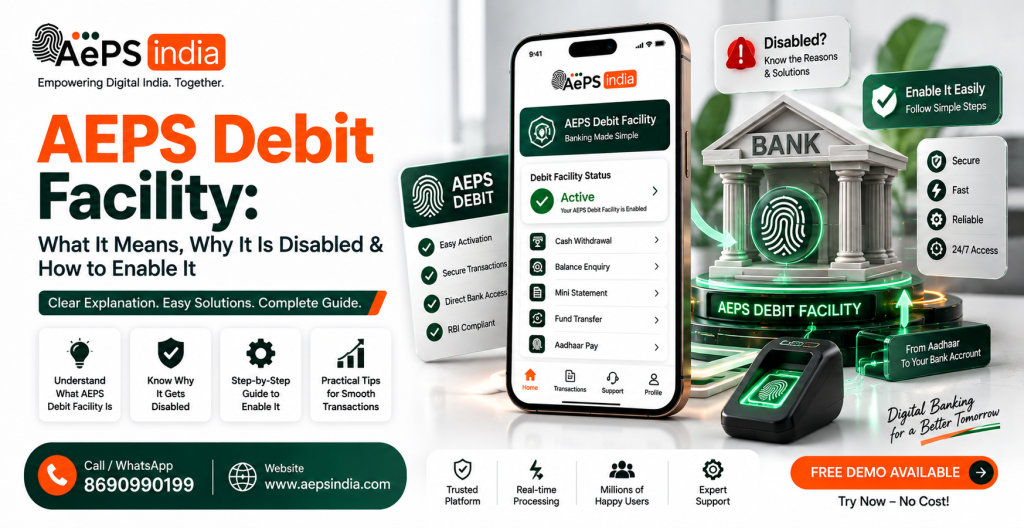
The AEPS debit facility in India is a modern and secure way to provide banking services using Aadhaar-enabled authentication. With this system, customers can easily perform cash withdrawals, balance enquiries, and mini statements without needing an ATM card or PIN. For retailers, CSPs, and fintech businesses, offering AEPS debit services opens up opportunities to reach more customers, especially in rural and semi-urban areas, while earning daily commission on transactions.
Aadhaar Enabled Payment System (AePS) Debit Facility is a National Payments Corporation of India (NPCI) service allowing bank account holders to withdraw cash, check balances, or transfer funds securely using their Aadhaar number and biometric authentication (fingerprint) through a Business Correspondent or Micro ATM. It eliminates the need for physical debit cards, PINs, or smartphones.
Aadhaar Enabled Payment System (AEPS) is a secure, NPCI-developed, bank-led model in India that allows users to perform instant, interoperable transactions cash withdrawals, deposits, balance inquiries, and mini-statements using only their Aadhaar number and biometric authentication at micro-ATMs or via business correspondents, eliminating the need for physical debit cards or PINs.
With the AEPS debit facility, customers can withdraw money by providing their Aadhaar number, bank name, and fingerprint at an AEPS-enabled outlet. Aeps india help businesses and retailers offer this facility smoothly by providing secure AEPS onboarding and reliable transaction support.
For businesses, fintech companies, and retailers, offering AEPS services is a great way to expand digital payments, earn commission, and provide cashless, card-free banking solutions to customers. Aeps india is a trusted partner in India for AEPS integration and Aeps onboarding, helping businesses quickly set up secure AEPS debit services that comply with RBI and NPCI guidelines.
For retailers and businesses, the AEPS debit service is a powerful digital payment solution that increases customer footfall and trust. By using Aeps india is an AEPS solutions, businesses can offer fast, safe, and Aadhaar-based debit transactions, helping them grow in India’s expanding digital payment ecosystem.
At Aeps india, our AEPS solutions designed to be fast, secure, and user-friendly, allowing businesses to integrate AEPS debit facilities seamlessly into their operations. By leveraging a reliable AEPS platform, businesses can ensure RBI-compliant transactions, high success rates, and smooth customer experiences, making AEPS debit services a valuable addition to India’s digital banking ecosystem.
Many people still search online for questions like:
- “What is AEPS Debit Facility?”
- “AEPS Debit Facility means?”
- “Aeps Debit Meaning”
- “Aeps debit facility”
- “Aeps Transaction Means”
- “Aeps Debit Facility Disabled”
- “Aeps Debit Dacility Disabled Meaning”
- “Why is AEPS debit facility disabled in my account?”
- “What is AEPS Debit Facility in Indian Bank?”
- “NPCI guidelines AEPS debit facility”
Choosing the right AEPS debit facility in India ensures smooth operations, enhanced customer trust, and long-term growth in the competitive digital payment and banking sector.
In this blog, we will explain everything about the AEPS debit facility in India, how it works, its benefits for users and businesses, and why choosing Aeps india ensures smooth, fast, and reliable AEPS services for your business.
What Is AEPS Debit Facility
AePS (Aadhaar Enabled Payment System) Debit Facility allows Aadhaar-linked bank account holders to securely withdraw cash and make payments using only their Aadhaar number and fingerprint/iris scan at micro ATM or with business correspondents. It eliminates the need for physical debit cards, PINs, or smartphones.
Aeps Debit Meaning
AEPS debit refers to a transaction where money is deducted from a bank account using the Aadhaar Enabled Payment System. It allows users to withdraw cash, make payments, or transfer funds using only their Aadhaar number and Aeps biometric authentication (fingerprint/iris scan) at a Micro-ATM or with a Business Correspondent, without a physical debit card or PIN.

What is Means Aeps Debit Facility Disabled
AePS debit facility allows customers to perform basic banking services like cash withdrawal, balance inquiry, and fund transfers using their Aadhaar number and fingerprint/iris scan, without needing a physical debit card or smartphone, primarily through micro-ATMs at business correspondent (BC) points, making banking accessible, especially in rural areas. It links your Aadhaar to your bank account for secure, biometric-authenticated transactions, acting as a digital debit function for your linked bank account.
Common Reasons for Disabled AEPS Debit
- Inactivity: No AEPS usage for over a year triggers automatic disabling as a security measure.
- Security Concerns: Suspicious activity or potential fraud can lead to temporary blocks.
- NPCI Guidelines: Banks disable dormant users or accounts with only suspicious AEPS debits as per NPCI directives.
- Account Issues: Aadhaar not linked, KYC not updated, or linking multiple accounts to one Aadhaar can cause this.
- Bank-Specific Rules: Your bank might have its own reasons or technical issues.
AEPS Debit Facility Work
AEPS debit facility allows customers to withdraw cash, check balances, or transfer funds securely from their Aadhaar-linked bank account without a card or PIN. Using a micro-ATM or Business Correspondent (BC), the user provides their 12-digit Aadhaar number and biometrics (fingerprint/iris) for instant verification.
Key Aspects of AEPS Debit Operation:
- Process: A bank agent/merchant enters the Aadhaar number into a POS/micro ATM device, selects the bank and transaction type (e.g., cash withdrawal), and the customer scans their fingerprint for authentication.
- Requirements: A valid Aadhaar number linked to a bank account and a registered Aeps biometric device.
- Security: Biometric authentication directly matches with UIDAI records, reducing fraud risk, as reported by Finkeda.
- Limits & Fees: Maximum cash withdrawal per transaction is generally ₹10,000, with daily limits up to ₹50,000. While cash withdrawals are often free, banks may charge for other transactions.
- Access: It enables last-mile banking in rural areas where physical banks may not be accessible.
Services Covered Under AEPS Debit Facility
The (AEPS) Aadhaar Enabled Payment System debit facility enables secure, card-less banking transactions using Aadhaar authentication and biometrics (fingerprint or iris) at micro-ATMs or business correspondent outlets. Key services covered include cash withdrawal, balance inquiry, mini statements, Aadhaar-to-Aadhaar fund transfers, and cash deposits.
Core Services Covered Under AEPS Debit Facility:
- Cash Withdrawal: Allows users to withdraw cash from their linked bank accounts without a physical debit card.
- Cash Deposit: Enables users to deposit money into their bank account at any authorized AEPS point.
- Balance Enquiry: Provides real-time information about the available balance in the user’s bank account.
- Mini Statement: Allows users to view the recent transaction history of their bank account.
- Aadhaar to Aadhaar Fund Transfer: Facilitates instant money transfers from one Aadhaar-linked account to another.
- BHIM Aadhaar Pay: Enables merchants to receive payments directly from customer bank accounts using biometric authentication.

Who Can Use AEPS Debit Facility?
Any Indian resident with a bank account linked to their Aadhaar number can use the AEPS (Aadhaar Enabled Payment System) debit facility. It is designed for individuals to perform secure transactions specifically cash withdrawals, balance inquiries, and mini-statements using only their fingerprints or iris scan for Aeps biometric authentication at Micro ATMs or with Business Correspondents (BCs).
Key Requirements to Use AEPS:
- Bank Account: An account with a participating bank.
- Aadhaar Linking: The bank account must be mapped to an Aadhaar number.
- Biometric Authentication: Fingerprint or iris scan (no PIN or password needed).
- No Physical Card: A physical debit card or smartphone is not required.
Who Benefits Most?
- Rural Residents: Individuals in areas with limited bank branches or ATM access.
- Elderly or Illiterate Individuals: Those who find it difficult to manage ATM cards, PINs, or passwords.
- Beneficiaries of Government Schemes: For withdrawing Direct Benefit Transfers (DBT).
AEPS acts as a crucial tool for financial inclusion, allowing users to access banking services at their doorstep via bank agents.
Documents Required for AEPS Debit Facility
To use the AEPS debit/cash withdrawal facility, you generally do not need physical documents, but rather specific information to authenticate the transaction. The primary requirements are an Aadhaar number, a bank account linked to that Aadhaar, and biometric authentication (fingerprint or iris scan).
Essential Requirements for AEPS Transaction
- Aadhaar Number: The 12-digit unique ID.
- Linked Bank Account: Your Aadhaar must be linked to the bank account from which money is being withdrawn.
- Biometric Data: Fingerprint or iris scan for authentication.
- Bank IIN: The Bank’s Issuer Identification Number (IIN).
- Service Location: A Micro ATM or a Banking Correspondent (Business Correspondent/CSP).
Requirements for Agent/Merchant Registration
If you are registering to become an AEPS agent, the following documents are required:
- Aadhaar Card.
- PAN Card.
- Bank Account with IFSC code.
- Mobile Number (linked to Aadhaar).
- Aeps Biometric device (for scanning customer fingerprints).
Process to Use the Service
- Visit a Aeps india or buy Micro ATM.
- Provide your Aadhaar number and Bank name.
- Specify the transaction type (e.g., Cash Withdrawal).
- Authenticate using your fingerprint on the Aeps biometric devices.
- Collect the cash and transaction receipt.
Eligibility and Requirements for AEPS Debit Facility
To use the AEPS debit facility, individuals must have an Aadhaar-linked bank account, a valid Aadhaar number, and provide Aeps biometric authentication (fingerprint or iris scan) at a micro-ATM or banking correspondent. No physical debit card or smartphone is required for transactions, which include cash withdrawals, balance inquiries, and mini-statements.
Eligibility Criteria
- Indian Residency: Must be a resident of India.
- Bank Account: Must have a bank account with a participating bank.
- Aadhaar Linking: The bank account must be linked to the user’s Aadhaar number.
- Biometric Data: The user must be able to provide fingerprint or iris scan verification.
Key Requirements for Transactions
- Aadhaar Number: The 12-digit unique ID.
- Bank Name: Identification of the bank account holder.
- Biometric Device: A MicroATM or PoS (Point of Sale) device used by a Banking Correspondent (BC).
- Transaction Limit: While RBI has no set limit, individual banks often set daily transaction limits up to ₹50,000 to prevent misuse.

Why AEPS is a Game-Changer for India
Aadhaar Enabled Payment System (AEPS) is a game-changer for India by enabling secure, branchless banking through biometric authentication, which drives financial inclusion in rural areas. It allows users to withdraw cash, check balances, and transfer funds at local shops using only their Aadhaar number, eliminating the need for debit cards, PINs, or smartphones, and facilitating direct benefit transfers.
Key Reasons AEPS is a Game-Changer:
- Financial Inclusion for Remote Areas: AEPS bridges the urban-rural divide by allowing rural, unbanked, and underbanked populations to access essential banking services at local neighborhood stores, known as business correspondents, without traveling to distant bank branches.
- Simplicity and Accessibility: The system requires no physical debit/credit cards or complex PINs. Users authenticate transactions via fingerprint or iris scanning, making it accessible even to those with limited literacy or technical skills.
- Enhanced Security: Biometric authentication provides a high level of security, significantly reducing risks of fraud, theft, or phishing associated with traditional banking methods.
- Direct Benefit Transfers (DBT): AEPS ensures government subsidies and welfare payments (e.g., MGNREGA, pensions) reach beneficiaries directly and securely, reducing corruption and leakages.
- Empowering Local Economies: Small, local merchants can act as banking agents, offering services to their community and earning Aeps commission, thereby boosting local economies and increasing the use of digital payments.
- Interoperability: The system allows customers to access their bank accounts from any bank, provided it is linked to their Aadhaar number, ensuring a seamless experience across the country.
With over 2.4 billion transactions in FY 2024, AEPS is fundamentally transforming last-mile banking in India, making it a cornerstone of the country’s digital, financial empowerment.
AEPS Debit Facility Important Considerations
AEPS (Aadhaar Enabled Payment System) allows secure, cardless cash withdrawals and banking services via biometric authentication linked to a bank account. Crucial considerations include ensuring your Aadhaar is linked to the bank account, using only authorized micro ATM/BC agents, and confirming the primary account is used if multiple accounts exist. No PIN or OTP is required.
Key Considerations for AEPS Debit Facility:
- Mandatory Requirements: The user must have their Aadhaar number linked to their bank account. The bank must be part of the NPCI AEPS network.
- Authentication & Safety: Only Aeps biometrics authentication (fingerprint or iris scan) is required; no debit card or PIN is needed. Use only authorized business correspondents (BCs) or micro-ATMs.
- Transaction Limits & Fees: NPCI sets transaction limits. Agents are prohibited from charging extra fees to customers for using the AEPS service.
- Account Selection: If a user has multiple bank accounts linked to one Aadhaar, only the primary account will be used for transactions.
- Transaction Timing: The daily cut-off for transactions is usually 11:00 PM IST.
- Troubleshooting: If the facility is disabled, it may be due to KYC issues, biometric mismatches, or bank-specific restrictions.
- Safety Tip: Always verify the transaction amount before providing Aeps biometric authentication.
Top Use cases of AEPS Debit Facility
The top use cases of the AEPS debit facility focus on enabling cardless, PIN-less, and secure banking for rural and underserved populations via biometric authentication. Key Aeps application include instant cash withdrawals, balance inquiries, mini-statements, direct benefit transfers (DBT), and Aadhaar-to-Aadhaar fund transfers at micro-ATMs and local, authorized retail outlets.
Top AEPS Debit Facility Use Cases:
- Cash Withdrawals (Micro-ATM): Users can withdraw money directly from their Aadhaar-linked bank account at a local agent’s shop using their fingerprint/iris scan, avoiding travel to distant bank branches or ATMs.
- Cash Deposits: Allows cash deposit into an Aadhaar-linked account through AePS-enabled banking correspondents.
- Balance Inquiry & Mini Statement: Provides real-time, instantaneous access to check bank account balances and view a summary of recent transactions.
- Government Direct Benefit Transfers (DBT): Facilitates the immediate withdrawal of government subsidies, pensions, and NREGA wages, ensuring transparency and eliminating middlemen.
- Aadhaar to Aadhaar Fund Transfer: Enables secure, direct fund transfers between two different bank accounts that are linked to Aadhaar, without needing bank account numbers or IFSC codes.
- BHIM Aadhaar Pay (Merchant Payments): Allows merchants to accept payments directly from customers using Aadhaar authentication, promoting a cashless economy for small businesses.
- Financial Inclusion in Remote Areas: Acts as a “mini-bank” in villages, where banking correspondents enable basic financial services, serving the unbanked and rural population.
Key Features and Limits:
- Authentication: Requires only the Aadhaar number and fingerprint/iris scan.
- Transaction Limits: Typically up to ₹10,000 per transaction, with varying daily/monthly limits depending on the bank (often ₹50,000 to ₹1,00,000).
- Interoperability: Customers can use any bank’s AePS-enabled agent for their transactions.

Role of AEPS Debit Facility
The Aadhaar Enabled Payment System debit facility empowers users to perform secure, cardless cash withdrawals, balance inquiries, and mini-statements directly from their Aadhaar-linked bank accounts using biometric authentication at Micro-ATMs or Business Correspondent (BC) outlets. It facilitates last-mile banking in rural areas, eliminating the need for physical debit cards, PINs, or smartphones, thus fostering financial inclusion.
Key roles of the AEPS debit facility include:
- Cash Withdrawal: Enables users to withdraw cash from their bank accounts at any BC/agent outlet without needing a debit card or bank branch.
- Secure Transactions: Utilizes biometric authentication (fingerprint or iris scan), which is considered safer than PIN-based transactions.
- Increased Accessibility: Provides banking access to remote areas lacking ATM infrastructure, allowing for instant, real-time, and interoperable transactions across different banks.
- Convenience for All: Enables elderly, illiterate, or unbanked individuals to easily access their money without needing to remember account numbers or passwords.
- Transaction Types: Beyond withdrawals, it allows for balance inquiries, mini-statements, and, in some cases, fund transfers.
The facility is designed for easy,, secure access for all citizens and aids in making banking services more accessible to the rural population.
Why AEPS Debit Facility Important for Business
The AEPS debit facility is critical for businesses particularly in rural and semi-urban areas by transforming small retail shops into mini-banks, increasing footfall, and generating commission income on cash withdrawals. It allows merchants to offer secure, card-less, and PIN-less transactions using biometric authentication, reducing dependency on physical bank infrastructure.
Key Reasons AEPS Debit Facility is Important for Business:
- Increased Revenue and Footfall: Retailers earn commission on every transaction, enhancing profitability. Providing cash withdrawal services draws more customers to the store.
- Low-Cost Setup: Businesses can start offering banking services with minimal investment, using only a smartphone, a biometric scanner, and an internet connection.
- Enhanced Customer Experience: It provides convenience for customers who lack debit cards, smartphones, or access to nearby ATMs, boosting loyalty and trust.
- Security: Biometric authentication provides a secure, tamper-proof, and fraud-resistant method for handling financial transactions compared to traditional methods.
- Competitive Advantage: Small businesses can differentiate themselves by acting as a financial service hub, providing essential services like balance inquiries and cash withdrawals.
- Financial Inclusion: It helps in expanding services, particularly in remote areas, by enabling, for example, Direct Benefit Transfers (DBT).
AEPS enables a seamless and efficient cash management system, reducing manual effort for retailers while allowing them to earn substantial monthly income.
Why AEPS Debit Facility Is Growing Fast in India
The AePS debit facility is growing rapidly in India due to its critical role in financial inclusion, allowing rural and unbanked populations to access banking services like cash withdrawals and balance checks using only their Aadhaar number and biometrics at local Kirana stores. It eliminates the need for physical debit cards, PINs, or smartphones, making it highly accessible.
Key Drivers for Rapid Growth:
- Accessibility in Rural Areas: AEPS fills the gap in areas with few bank branches or ATMs, bringing “doorstep banking” to remote regions.
- Convenience and Simplicity: Transactions are cardless and pin-less, relying on secure fingerprint or iris authentication.
- Government Support (Digital India): The system facilitates Direct Benefit Transfers (DBT) for subsidies and promotes a cashless, digital economy.
- Expansion of Micro-ATMs: The rapid growth of Business Correspondents and local retail outlets acting as mini-banks increases reach.
- Enhanced Security: Biometric authentication reduces fraud risks compared to traditional card-based transactions.
- Cost-Effective for Users: It provides a free or low-cost, immediate, and safe way to access cash, particularly for senior citizens and those with low technical literacy.
The system has become a staple for daily financial transactions in rural India, with NPCI’s AEPS significantly increasing in transaction volumes yearly.

AEPS Debit Facility for Financial Inclusion in India
The Aadhaar Enabled Payment System (AEPS) is a NPCI-developed bank-led model enabling secure, cardless, and PIN-less, transactions including cash withdrawals, balance inquiries, and fund transfers using Aadhaar authentication (fingerprint/iris) at micro-ATMs or Business Correspondent (BC) outlets. It facilitates financial inclusion by providing last-mile banking services to unbanked, rural, and underserved populations.
Key Aspects of AEPS Debit Facility for Financial Inclusion:
- Access Requirements: Users need an Aadhaar-linked bank account and a BC/agent (locally available) equipped with a Aeps biometric scanner/POS machine.
Key Services Provided:
- Cash Withdrawal: Users can withdraw cash from their accounts without a debit card.
- Balance Enquiry & Mini Statements: Immediate access to account details.
- Aadhaar-to-Aadhaar Fund Transfer: Secure transfer between linked accounts.
- Government Subsidies: Direct benefit transfers (DBT) can be accessed through this, reducing reliance on distant bank branches.
- Security & Safety: Biometric authentication reduces fraud and enhances trust for users with minimal literacy.
Advantages for Inclusion:
- Last-Mile Access: Empowers rural, elderly, and unbanked populations to access banking.
- Low Cost: Generally free for customers, providing an affordable alternative to traveling to bank branches.
- Convenience: Removes the need for PINs, cards, or smartphones.
AEPS Debit Facility Status:
Banks now provide the option to enable or disable AEPS debit facilities for security. If disabled, users cannot perform biometric-based cash withdrawals until re-enabled by their bank.
AEPS Debit Facility for Rural and Urban Areas
AEPS debit facilities enable secure, cardless cash withdrawals and banking transactions (balance inquiry, mini-statement) at local micro-ATMs or via banking agents (BCs) using Aadhaar authentication. This service is crucial for rural, underserved areas, and for elderly individuals in urban areas, offering interoperable, instant, and PIN-less access to bank accounts.
Key Aspects of AEPS Debit Facility:
- How it Works: Customers visit a local Business Correspondent (BC) agent, provide their 12-digit Aadhaar number, select their bank, and authenticate via a fingerprint or iris scan to complete transactions, often for cash withdrawal, deposits, or fund transfers.
- Accessibility: AEPS is particularly useful in areas with limited ATM infrastructure, allowing for transactions to be made at local shops or with authorized agents.
- Security & Convenience: Aeps Biometric authentication provides a secure method, eliminating the need for physical debit cards or PINs.
- Transaction Limits: While daily limits can vary, a common maximum cash withdrawal limit per transaction is ₹10,000. Total daily transaction limits for AEPS are often set around ₹50,000.
- Applicability: AEPS designed for all, enabling, for example, the rural population to access banking services without visiting a bank branch.
- Benefits: It facilitates financial inclusion, reduces the reliance on physical branches for banking, and supports Direct Benefit Transfers (DBT).
What Does “AEPS Debit Facility Disabled” Mean?
AEPS Debit Facility Disabled means your bank account is temporarily restricted from withdrawing cash or transferring funds using Aadhaar based biometric authentication (micro-ATMs/CSP). While receiving funds still works, this block typically occurs for security reasons, inactive accounts, or pending Aeps KYC updates, requiring a visit to your bank branch to re-enable.
Key Implications and Reasons:
- What is Restricted: Cash withdrawals and Aadhaar-based fund transfers are blocked.
- What Still Works: Your account remains active for normal ATM, mobile, and internet banking.
- Common Reasons:
- Inactive/Dormant Account: Long-term disuse of best AEPS services.
- KYC Issues: Outdated biometric or PAN/Aadhaar data.
- Security Risk: Precautionary action by the bank.
- Unlinked Aadhaar: Mismatch in NPCI mapping.
AEPS Debit Facility for Retailers
AEPS (Aadhaar Enabled Payment System) allows retailers to act as mini-banks, offering customers cash withdrawals, balance inquiries, and mini-statements using Aadhaar authentication. Retailers need a smartphone/computer, Aeps device, and internet to provide these services via authorized Aeps apps, earning commissions while boosting footfall.
Key Aspects of AEPS Debit Facility for Retailers:
- How it Works for Retailers: Retailers register with an AEPS provider like Aeps india, complete Aeps KYC, and use a Aeps biometric scanner (fingerprint/iris) to verify customer identity linked to their bank account.
- Services Offered: Cash withdrawal, cash deposit (limited), balance inquiry, and mini-statements.
- Requirements: A smartphone, PC, or Micro ATM devices, a Aeps biometric scanner, internet connectivity, and registration with an authorized AEPS service provider like Aeps india.
Benefits for Retailers:
- Extra Income: Earn commissions on every transaction (roughly ₹15,000–₹25,000 potential monthly income).
- Increased Footfall: Attracts more customers needing banking services.
- Financial Inclusion: Serves rural/semi-urban areas with limited banking access.
- Transaction Limits & Security: While the, NPCI standard daily withdrawal limit is typically up to ₹10,000 per transaction, overall, bank-set limits might apply.
- Documentation for Registration: PAN card, Aadhaar card, bank proof (cancelled cheque/statement), and, business proof (rent agreement, electricity bill).

Benefits AEPS Debit Facility
The AePS debit facility allows users to withdraw cash, check balances, and perform banking transactions using only their Aadhaar number and fingerprint/iris scan at Micro-ATMs or Business Correspondents. Key benefits include secure, paperless transactions without a physical debit card, 24/7 access in rural areas, and direct, safe access to government, banking services, and subsidies.
Key Benefits of AePS Debit Facility
- Financial Inclusion: AEPS extends banking services to those in remote areas without easy access to traditional banking infrastructure.
- Accessibility and Convenience: Transactions can be conducted at local micro-ATMs operated by banking correspondents, reducing the need to travel long distances to bank branches.
- Ease of Use: The system is simple, requiring only an Aadhaar number and biometric authentication, which is helpful for those with limited digital literacy.
- Enhanced Security: Transactions are authenticated via biometrics (fingerprint or iris scan), eliminating risks associated with PINs, passwords, or lost cards.
- Convenience and Accessibility: Removes the need to visit a bank branch or ATM, providing easy access to cash in rural and remote locations.
- Interoperability: Customers from any bank can use any AEPS-enabled micro-ATM as long as their Aadhaar is linked to their account.
- Card-Free and Digital-Free Banking: It eliminates the need for physical cards or smartphones, benefiting those who might lose cards or lack internet access.
- Efficient Government Disbursements: Ideal for receiving government, social security pensions, and, MNREGA funds directly.
- User-Friendly: Simple, easy-to-use interface requiring minimal technical knowledge, suitable for, rural, illiterate, or elderly users.
- Direct Benefit Transfers (DBT): AEPS is used by the government for efficient and transparent distribution of subsidies and other payments directly to Aadhaar-linked accounts.
- Cost-Effectiveness for Banks: It allows financial institutions to expand their reach in remote areas without the expense of building traditional branches and ATMs.
- Basic Financial Services: It supports essential banking transactions, including cash withdrawals, balance inquiries, cash deposits (at certain locations), mini statements, and Aadhaar-to-Aadhaar fund transfers.
The AEPS debit facility utilizes Aadhaar to provide a secure, accessible, and inclusive banking channel, significantly impacting rural banking in India.
Features AEPS Debit Facility
The AEPS debit facility enables secure, cardless cash withdrawals and banking transactions (balance inquiry, mini-statement) directly from Aadhaar-linked bank accounts using biometric authentication at micro-ATMs or business correspondents. Key features include 24/7 accessibility in remote areas, high security,, and interbank interoperability without needing a physical PIN or card.
Key Features of the AEPS Debit Facility:
- Cardless & PIN-less Transactions: Transactions are authorized using biometric data (fingerprint or iris scan) linked to the Aadhaar number, eliminating the need for a physical ATM card or PIN.
- High Security & Reduced Fraud: Biometric authentication ensures that only the authorized account holder can access funds, which minimizes fraud risks.
- Interoperability: Users can access their bank accounts at any AEPS enabled micro-ATM, regardless of their bank, making it a universal banking tool.
- Accessibility in Remote Areas: The facility, operated via banking correspondents, allows users to withdraw money in areas with minimal banking infrastructure.
- Instant Cash Withdrawal: Direct debit from the linked bank account at local, accessible touchpoints.
- Financial Inclusion: Enables rural, elderly, or, non-tech-savvy users to access banking services without visiting a bank branch.
- Transaction Types: Beyond withdrawals, it supports cash deposits, fund transfers, and balance inquiries.
- Range of Services: Beyond withdrawals, it enables balance inquiries, mini-statements, and cash deposits.
- Real-Time Processing: Transactions are settled immediately, providing instant access to funds.
- Supports Government Schemes: It facilitates the withdrawal of government subsidies and pension schemes (MNREGA, social security).
- Accessibility: Operates in remote locations without traditional ATM infrastructure.
This Aeps design to provide seamless banking, especially in areas with limited bank branches or ATM connectivity.
AEPS API Integration for Debit Facility
AEPS API integration for debit (cash withdrawal) involves partnering with a Aeps india, completing KYC, obtaining Aeps API documentation, and integrating Aeps biometric authentication. Key steps include setting up a secure sandbox environment, implementing AEPS transaction API, and conducting testing before going live, ensuring compliance with Aadhaar-linked bank account validation.
1. Partner Onboarding and Registration
Since direct integration with the National Payments Corporation of India (NPCI) is not possible, you must partner with an Aeps india is an certified technology AEPS API provider.
- Choose a Provider: Select a reliable, NPCI-certified Aeps india based on reliability, security, support, and commission structures.
- Business Registration & KYC: Sign up and complete the mandatory Know Your Customer (KYC) process. This involves submitting business and personal documents, including your:
- Aadhaar Card (must be linked to your bank account and mobile number)
- PAN Card
- Bank account details (cancelled cheque or passbook first page)
- Proof of business registration (if applicable)
- Recent passport-sized photograph
- Sign Agreements: Finalize the terms and conditions in a formal agreement with the Aeps india.
2. Acquire and Register Biometric Devices
You will need UIDAI certified Aeps biometric devices (fingerprint or iris scanners) to capture customer data securely.
- Purchase Hardware: Procure the necessary devices from a compatible manufacturer (e.g., Mantra).
- Install RD Service: Install the manufacturer’s Registered Aeps Device (RD) service software on your computer or smartphone to ensure secure, encrypted data capture and transmission.
- Register Devices: Register the hardware with Aeps india provide Aeps platform.
3. Technical Integration and Development
Integrate AEPS functionality into your platform.
- Get API Credentials: Obtain necessary Aeps API keys, access tokens, and technical documentation from the Aeps india.
- Integrate the API: Use the integrate Aeps Api documentation and SDKs to build the user interface and back-end logic for Aeps API interaction.
- Handle Data Securely: Implement robust security measures like encryption (HTTPS/SSL) for sensitive data, especially biometric information.
4. Testing and Deployment (Go-Live)
Test thoroughly before launching the service.
- Sandbox Testing: Conduct testing in the Aeps india sandbox environment to simulate transactions.
- Implement Error Handling: Develop mechanisms to manage failed transactions.
- Go Live: Switch to the production environment after testing.
- Train Staff: Train users on system usage and support.
- Monitor and Support: Continuously monitor transactions and provide ongoing support.
Key Components of AEPS Debit Integration
- Authentication: Requires user Aadhaar number and fingerprint/iris scan via a certified Registered Aeps Device (RD).
- Authorization: The Aeps system sends the request through the NPCI switch to the customer’s bank.
- Transaction Types: Primarily used for cash withdrawal (debit), but also supports balance inquiry, mini-statements, and cash deposits.
- Security: Features end-to-end encryption for biometric data, adhering to NPCI and UIDAI guidelines.
- Workflow:
- Request: Merchant enters Aadhaar, bank details, and amount into the best Aeps application.
- Auth: Biometric data is captured and sent via best Aeps API for authentication.
- Process: Transaction is processed in real-time, debiting the customer’s bank account.
- Confirmation: Instant confirmation and digital/printed receipt generation.

How to Start AEPS Debit Facility
To start AEPS debit facility as a user, you must link your Aadhaar card to your bank account and verify your biometric data (fingerprint or iris) at your bank or a business correspondent. For agents, registration with a Aeps india, KYC completion, and a certified Aeps biometric device are required.
Steps for Users (Cash Withdrawal/Debit):
- Link Aadhaar: Ensure your bank account is linked to your Aadhaar number.
- Visit Correspondent: Go to a banking correspondent (bank agent or local kiosk) with a Micro-ATM/PoS machine.
- Provide Details: Enter your 12-digit Aadhaar number into the machine.
- Select Transaction: Choose “Cash Withdrawal” or “Debit” and enter the amount.
- Biometric Authentication: Scan your finger or iris on the device to authenticate.
- Complete & Collect: The transaction is processed instantly, with a receipt issued upon success.
Steps for Agents/Retailers to Offer Service:
- Register with Provider: Choose an Aeps india and complete the online registration form.
- Submit KYC: Submit required documents (Aadhaar, PAN card, photo) for verification.
- Get Device: Obtain a registered Aeps biometric scanner (fingerprint/Aeps iris device).
- Activate Service: Once approved, log in with your agent credentials to start facilitating transactions.
Key Considerations:
- Limits: Maximum withdrawal is generally ₹10,000 per transaction, with daily bank-specific limits (often up to ₹50,000).
- Security: AEPS is secure, requiring biometric authentication for every transaction.
- Requirements: A functional internet connection and a compliant biometric device are mandatory.
AEPS Debit Facility Registration Process
Registering AEPS debit facility allows you to perform banking transactions, such as cash withdrawals, using your Aadhaar number and biometric authentication (fingerprint) without needing a debit card or PIN. The process primarily involves linking your bank account to your Aadhaar and ensuring it is activated AEPS.
Here is the step-by-step Aeps Debit Facility registration and activation process:
1. Prerequisites for AEPS
Before registering, ensure you have the following:
- Active Bank Account: An account with a bank participating in the Aeps india.
- Aadhaar Number: Valid 12-digit UIDAI number.
- Mobile Number: Linked to both your bank account and your Aadhaar number for OTP alerts.
2. Linking Aadhaar to Bank Account (Mandatory)
If your account is not already linked with your Aadhaar, you must do so:
- Method A (Branch Visit): Visit your home bank branch, fill out the Aadhaar seeding form, and submit a photocopy of your Aadhaar card.
- Method B (Online/ATM): Log in to your net banking/mobile banking app or visit an ATM to seed your Aadhaar with your account.
3. Activating the AEPS Facility (Customer Side)
To enable the debit facility, you must register the service with your bank:
- Visit Bank Branch: Inform the bank officer that you wish to enable AEPS service for cash withdrawals.
- Biometric Verification: The bank will take your Aeps fingerprint or Aeps iris scan for Aeps kyc verification.
- Activation Confirmation: You will receive a notification via SMS once the service is enabled, usually within 24-48 hours.
4. How to Use the AEPS Debit Facility
Once registered, you can use the facility at any Business Correspondent (BC) or Micro-ATM:
- Find a Center: Locate a nearby kiosk or merchant (Bank Mitra) equipped with a Aeps biometric device.
- Provide Details: Give your 12-digit Aadhaar number and specify your bank name.
- Select Service: Choose “Cash Withdrawal” (Debit) on the machine.
- Authenticate: Place your finger on the scanner for verification.
- Complete Transaction: The amount is debited from your account, and you receive the cash and a transaction receipt.
5. Troubleshooting: If Service is Disabled
If your top AEPS service is inactive, you can re-enable it by:
- Contacting Customer Care: Call your bank’s helpline.
- Using Mobile Banking: Many banks allow you to manage AEPS services via their official Aeps app.
Note: For security, ensure your biometric data is locked on the UIDAI website/mAadhaar app, unlocking it only when performing a transaction, as per new 2026 RBI guidelines.
Income & Commission Opportunities with AEPS Debit Facility
The AEPS provides significant income and commission opportunities for small business owners, retailers, and Banking Correspondents (BCs) by enabling “doorstep banking” services, particularly in rural and underbanked areas. Retailers can turn their shops into “Aadhaar ATMs” to facilitate transactions, earning commission on each, typically ranging from ₹2 to ₹13+ per transaction depending on the volume.
Income & Commission Opportunities
AEPS agents (retailers) earn commissions through a tiered structure where higher transaction values yield higher earnings.
- Cash Withdrawal Commission (Approximate Rates):
- ₹100 – ₹999: ₹2 – ₹3 per transaction.
- ₹1,000 – ₹1,499: ₹3 – ₹4.5 per transaction.
- ₹1,500 – ₹1,999: ₹4.5 – ₹5.5 per transaction.
- ₹2,000 – ₹2,499: Around ₹5.5 per transaction.
- ₹3,000+: Can reach ₹13 or more per transaction.
- Balance Inquiry & Mini Statement: Generally offer a lower fixed commission, often around ₹1 to ₹2 per query.
- Aadhaar Pay: Allows for higher transactions (up to ₹50,000), where agents can charge up to 1% from the customer directly, rather than earning from the bank.
- Earning Potential: High-volume agents can earn a substantial income, with potential earnings ranging from ₹15,000 to ₹25,000, or even up to ₹1 Lakh per month in models.
Key Benefits of AEPS for Retailers
- Increased Customer Footfall: Offering banking services brings more customers to your shop, increasing the potential for sales of other goods.
- Low Investment, High Return: Only requires a smartphone/computer and a Aeps biometric device.
- Additional Revenue Streams: Beside Aeps india can offer allied services like Money Transfer (DMT), bill payments, and recharges.
- Instant Settlement: Aeps india offer instant credit of commissions to the wallet and, in some cases, 24/7 settlement to the bank account.
- Customer Loyalty: Builds trust and strengthens the presence of the business in the local community.
Requirements to Start
- Valid Documents: Aadhaar Card, PAN Card, and a bank account.
- Hardware: A biometric device (fingerprint scanner) and a smartphone or PC.
- Registration: Register with a top AEPS service provider in india like Aepsindia.

What is Aeps Debit Facility in Indian Bank
The AePS debit facility in Indian Bank is a secure, cardless banking service allowing customers to withdraw cash, check balances, or get mini-statements at micro-ATMs/Business Correspondents using only their Aadhaar number and fingerprint. It directly debits the linked bank account without requiring a debit card, PIN, or physical bank branch visit.
Key Aspects of AePS Debit Facility:
- Authentication: Uses biometric authentication (fingerprint or iris scan) for security.
- Core Services: Enables cash withdrawal, cash deposit, balance inquiry, mini statement, and Aadhaar-to-Aadhaar fund transfers.
- Requirements: Bank account must be linked with Aadhaar.
- Accessibility: Operates through Business Correspondents (BCs) and Micro ATM providing rural access.
- Limits: While specific limits can vary, NPCI guidelines generally allow cash withdrawals up to ₹10,000 per transaction and up to ₹50,000 per day.
This Aeps system designed to promote financial inclusion, particularly for individuals without smartphones or debit cards.
Aeps Debit Facility Disabled Indian Bank
An “AEPS Debit Facility Disabled” message at Indian Bank means your Aadhaar-based cash withdrawals are paused, usually due to no transactions in the last 12 months, security, or regulatory rules. To fix it, visit your Indian Bank home branch, submit a request, and perform a transaction to re-enable it.
Reasons for AEPS Disable at Indian Bank:
- Inactivity: No AEPS debit transaction (cash withdrawal) in the last 12 months.
- Fraud Suspicion: The account reported a fraudulent transaction via AEPS previously.
- Compliance: NPCI regulations or Aeps KYC updates.
Important Notes:
- This does not mean your account is frozen; other banking services (ATM, Net Banking) will still work.
- Ensure your Aadhaar biometrics are unlocked on the UIDAI portal before visiting the bank.
AEPS Debit Facility Charges and Limits
Aadhaar Enabled Payment System (AEPS) allows users to perform bank transactions using Aadhaar authentication, generally with no fees for cash withdrawals up to set limits, though some banks may charge nominal fees (₹1–₹20) or 1% for other transactions. Daily cash withdrawal limits are typically capped at ₹10,000 per transaction and ₹50,000 per day.
AEPS Debit/Withdrawal Limits
- Per Transaction Limit: Maximum of ₹10,000, as mandated by the National Payments Corporation of India (NPCI).
- Daily Limit: Most banks set a cumulative daily limit of ₹50,000 for all AEPS transactions.
- Monthly Limit: Some banks may impose a monthly cap, such as 5 transactions or ₹50,000, depending on the account type.
AEPS Charges and Fees
- Cash Withdrawal: Generally free at many banks, but some may charge ₹1–₹5 per transaction.
- Bank-Specific Charges: Some banks, such as Bank of Baroda and India Post Payments Bank (IPPB), may charge ₹20 + GST per withdrawal at non-base branch points, or a fee of up to 1% of the transaction amount (minimum ₹5, maximum ₹15) for specific services.
- Balance Enquiry/Mini Statement: Usually free, but some banks may charge up to ₹5 per transaction for mini statements beyond a free limit.
Key Considerations
- Security: As of January 2026, the RBI has implemented stricter regulations to enhance AEPS security, including better monitoring of operators.
- Authentication: Requires Aadhaar number and biometric authentication (fingerprint or iris).
- Eligibility: The bank account must be linked to an Aadhaar number.
Security and Compliance in AEPS Debit Transactions
Security and compliance in Aadhaar Enabled Payment System (AEPS) debit transactions are paramount for ensuring that financial services are safe, particularly for rural and underbanked populations in India. AEPS allows transactions (cash withdrawal, balance inquiry, etc.) using only an Aadhaar number and biometric authentication, eliminating the need for cards or PINs.
Key security, compliance, and regulatory aspects of AEPS, including new rules effective from January 1, 2026, are detailed below.
1. Key Security Features
- Biometric Authentication: Transactions require live fingerprint or iris scans, which are verified against the UIDAI database, significantly reducing the risk of unauthorized access.
- Data Encryption: Sensitive information is encrypted during transmission and storage, preventing data breaches.
- Registered Devices (RD): Only STQC-certified, Registered Device (RD) service compliant devices (e.g., Morpho, Mantra) are authorized for use, preventing the use of spoofed or fake biometric data.
- Real-time Processing & Monitoring: Transactions are processed instantly through the NPCI network, allowing for immediate confirmation and monitoring.
- Two-Factor Authentication (for specific cases): While primarily biometric-based, some high-value transactions may require additional authentication like an OTP.
2. Regulatory and Compliance Framework (RBI & NPCI)
Effective January 1, 2026, the Reserve Bank of India (RBI) and National Payments Corporation of India (NPCI) have introduced stricter norms to combat fraud:
- Full KYC for Agents: All Aadhaar Touchpoint Operators (ATOs) must undergo complete, rigorous KYC before onboarding.
- Mandatory Re-KYC: Agents inactive for three consecutive months must complete full re-KYC before resuming services.
- “One Operator, One Bank” Rule: Each agent/operator is restricted to working with only one acquiring bank, increasing accountability.
- Risk-Based Monitoring: Banks must implement real-time, AI/ML-driven surveillance to track agent activity based on location, transaction volume, and velocity.
- Secure L1 Devices: Mandatory migration to L1 certified biometric devices to prevent spoofing.
- Liability Framework: Strict procedures to freeze accounts within 48 hours of reporting fraud, with banks held liable for delays.
3. Transaction Limits and Safety
- Cash Withdrawal Limit: Maximum of ₹10,000 per transaction, with a daily cap often set at ₹50,000 across all transactions.
- Mandatory Receipts: Agents must provide a printed or SMS receipt for every transaction.
- Virtual ID (VID): Users are encouraged to use a 16-digit Virtual ID instead of their 12-digit Aadhaar number for added privacy.
- Biometric Locking: Users can lock their biometrics via the Aeps india website to prevent unauthorized use.
4. Risks and Challenges
- Biometric Spoofing: Criminals may attempt to use cloned fingerprints, necessitating the move to more secure L1 devices.
- Agent Misuse: Unauthorized agents might charge extra fees or misuse customer data.
- Technology Dependency: Reliance on internet connectivity and device reliability, which can cause transaction failures in remote areas.
5. Best Practices for Users
- Verify Agent: Only use authorized Banking Correspondents (BCs) with valid Aeps ID.
- Monitor Activity: Regularly check bank statements and SMS alerts for unauthorized transactions.
- Report Fraud: In case of fraud, report to the National Cyber Crime Reporting Portal (1930) within 90 days.
These measures ensure that while AEPS provide convenient “doorstep” banking, it maintains robust security standards to protect users.

How to Fix AEPS Debit Facility Disabled
Re-enabling the AEPS debit facility usually requires re-establishing the link between your bank account and your Aadhaar, often due to inactivity or, in some cases, because the service was disabled by the NPCI (National Payments Corporation of India) or the bank.
Here are the primary ways to reactivate your AEPS debit facility:
1. Visit Your Home Branch (Most Reliable Method)
For most banks, a physical visit to your base branch is the most secure and effective way to re-enable AEPS.
- Action: Submit a written request for “Aadhaar Seeding/Remapping for AEPS”.
- Documents: Bring your original Aadhaar card, bank passbook, and PAN card.
- KYC: Complete Aeps biometric KYC again if requested.
- Timeline: Once updated, secure AEPS services typically work within 24–48 hours.
2. Check and Unblock Aadhaar Biometrics
If you have locked your biometric data on the UIDAI portal for security reasons, AEPS will not work.
- Action: Visit the official Aeps india website to “Unlock” your biometrics temporarily.
3. Check for Multiple Account Conflicts
If your Aadhaar is linked to multiple bank accounts, the NPCI might not know which one to use, leading to disabled service.
- Action: Visit your preferred bank and request them to make it your Primary AEPS Bank.
4. Through Banking Channels (For Specific Banks)
Some banks allow you to manage AEPS through digital channels:
- Canara Bank: Send an SMS “STARTAEPS [last 4 digits of account no]” to 7799719408, or use the “ai1” mobile app under
Accounts & Services > Aadhaar Enabled Payment System. - IndusInd Bank: Send an SMS “AEPS START [last 4 digits]”.
- Indian Bank: Use the Net Banking/Mobile App or visit a branch.
Sometimes a simple, fresh transaction at a local Business Correspondent (BC) or micro-ATM can reactivate a dormant service.
5. Perform a “Refresh” Transaction
- Action: Visit a local banking agent (CSP/Kiosk) and attempt a Balance Inquiry or Mini Statement check using your fingerprint.
Why Was My AEPS Disabled?
- Inactivity: You have not used AEPS for more than 6–12 months.
- KYC Needed: Your bank KYC is outdated.
- Aadhaar Mismatch: The Aadhaar details in your bank records do not match the UIDAI database.
Tip: To avoid future issues, use best AEPS service at least once every 6 months.
Aeps Debit Transaction Disabled
An “AEPS debit transaction disabled” message means your Aadhaar-based, biometric cash withdrawal service is inactive, usually due to security, lack of use (no transactions in 12+ months), or KYC issues. To re-enable, visit your bank branch with your passbook and Aadhaar card, or use mobile Aeps banking apps to activate AEPS.
Key Reasons for AEPS Debit Facility Being Disabled:
- Inactivity: NPCI guidelines state that services are disabled for accounts with no AEPS activity in the last 12 months.
- Security Concerns: Suspicious activity or to prevent fraud, resulting in automatic disabling.
- Missing/Expired KYC: The bank requires updated KYC documents to re-enable.
- Aadhaar Unlinked: The Aadhaar number is not properly linked or mapped with the account.
Reasons Why AEPS Debit Facility Gets Disabled
The AEPS debit facility can be disabled for reasons including security and regulatory compliance, account inactivity, unlinked Aadhaar numbers, and multiple failed transactions.
Common reasons why your AEPS debit facility may be disabled include:
- Security Concerns/Fraud Prevention: Banks may disable the service if there is suspicious activity, unusual transaction patterns, or security breaches on your account. The National Payments Corporation of India (NPCI) also recommends disabling the service for accounts where transactions are reported as fraudulent.
- Account Inactivity: If your account has not been used for any AEPS debit transactions for a period of time (typically 12 months), the bank may automatically disable the service as a security measure.
- Aadhaar Not Properly Linked/Mapped: The AEPS facility requires your Aadhaar number to be correctly linked (seeded) to your bank account with the NPCI. An incorrect or unmapped status will prevent transactions.
- Incomplete or Outdated KYC: Banks may disable the service if your Know Your Customer (KYC) details are incomplete or need updating.
- Repeated Failed Attempts: Multiple incorrect Aadhaar entries or failed biometric authentication attempts (due to worn-out fingerprints or faulty scanners) can lead to a temporary deactivation of the service.
- Account Restrictions: If your bank account is dormant, frozen, or under review for other reasons, the AEPS facility will be disabled automatically.
- Technical or Bank-Specific Issues: The facility can be temporarily unavailable due to bank system upgrades, security audits, software glitches, or poor internet connectivity at the AEPS agent’s location.
If your AEPS debit facility disabled, you should contact your bank’s customer service or visit a branch directly to determine the specific reason and learn the steps needed for reactivation. You may need to submit a request for Aadhaar remapping or complete a biometric KYC update.

AEPS Debit Facility Disabled Meaning in Hindi
AEPS Debit Facility Disabled” का हिंदी में अर्थ है “आधार सक्षम भुगतान प्रणाली (AEPS) के माध्यम से पैसे निकालने की सुविधा बंद/अक्षम कर दी गई है”। इसका मतलब है कि आप बैंक शाखा या ATM के बजाय किसी ग्राहक सेवा केंद्र/एजेंट के माध्यम से आधार कार्ड का उपयोग करके अपने खाते से नकद नहीं निकाल सकते।
मुख्य विवरण:
- कारण: यह सुरक्षा कारणों से, बैंक द्वारा केवाईसी (KYC) अपूर्ण होने, या निष्क्रिय खाते के कारण हो सकता है।
- प्रभाव: आधार के जरिए पैसा निकालना और बैलेंस चेक करना काम नहीं करेगा।
- समाधान: इसे ठीक करने के लिए अपने बैंक से संपर्क करें या अपनी ई-केवाईसी (e-KYC) अपडेट करें।
Biometric Authentication in AEPS
AEPS debit facility allows secure, cardless banking transactions (cash withdrawal, balance inquiry, transfers) by using Aadhaar-linked biometric authentication (fingerprint or iris scan) at Micro-ATMs or Business Correspondent (BC) points. It requires the customer’s 12-digit Aadhaar number, bank name, and live biometric verification, making it accessible, interoperable across banks, and ideal for rural financial inclusion.
Key Aspects of AEPS Biometric Authentication
- Authentication Method: Transactions are authorized through UIDAI certified Aeps biometric scanners (fingerprint or iris scan), eliminating the need for a PIN or physical debit card.
- Process Flow: The customer enters their 12-digit Aadhaar number, selects the bank, selects the service (e.g., withdrawal), and provides a fingerprint to authenticate the transaction on a, agent’s micro-ATM or point-of-sale (PoS) terminal.
- Security & Safety: Biometric authentication provides high security by ensuring the user’s identity is verified directly against the UIDAI database.
- Transaction Limits: Typically, the maximum cash withdrawal per transaction is ₹10,000, with daily, aggregate transaction limits often set around ₹50,000, depending on the bank.
- Interoperability: Users can access any bank account from any AEPS-enabled BC agent, regardless of their home branch.
Requirements for AEPS Usage
- Aadhaar Linking: The bank account must be linked with the user’s 12-digit Aadhaar number.
- Biometric Device: A certified biometric device (scanner) is required, often operated by a Banking Correspondent.
- Supported Transactions: Cash withdrawal, balance enquiry, bank statements, and, in some cases, Aadhar-to-Aadhar fund transfers.
Npci Guidelines Aeps Debit Facility
NPCI guidelines for AePS debit facility mandate secure, biometric-only (fingerprint/iris) transactions for Aadhaar-linked accounts, typically limited to ₹10,000 per transaction. Key rules include mandatory, encrypted biometric authentication, strict data privacy, prohibiting agents from charging extra fees, and prompt, automatic reversals for failed transactions.
Key NPCI Guidelines and Features for AePS Debit (Cash Withdrawal)
- Mandatory Authentication: Only Aadhaar-based biometric authentication (fingerprint or iris scan) is permitted for debit transactions.
- Transaction Limits: NPCI has set a maximum limit of ₹10,000 per transaction. While not directly imposing a daily limit, many banks have implemented a daily total limit of ₹50,000.
- Account Requirement: The user’s bank account must be linked to their 12-digit Aadhaar number.
- No Extra Charges: Agents (Business Correspondents/CSPs) are prohibited from charging customers any additional fees for cash withdrawals, balance inquiries, or mini-statements.
- Usage Requirements: Users must have an Aadhaar-linked bank account. Only one account per bank can be used, with the primary account being selected if multiple exist.
- Location: Services are accessed via Banking Correspondents (BCs) or Business Agents using Micro ATMs or PoS devices.
- Security & Privacy: Customer data must be encrypted, and biometric data cannot be stored by agents or banks.
- Applicability: Only one bank account per bank can be used; if multiple accounts exist, the primary one is defaulted.
- No PIN/OTP: No PIN or OTP is required for transactions; biometric authentication is sufficient.
- Proactive Reversal: For failed transactions where the amount is debited but not dispensed, a proactive credit adjustment is required without waiting for a customer dispute.
- Operator Due Diligence: Banks must perform strict KYC on operators (agents) and re-verify them if they are inactive for three months.
- Operational Requirements: The account must be linked to an Aadhaar number, and if a customer has multiple accounts in one bank, the primary account is used.
Important Considerations
- Supported Transactions: Cash withdrawal, balance inquiry, mini-statement, and Aadhaar-to-Aadhaar fund transfers.
- Transaction Timing: Daily settlement (cutover) for AePS transactions usually occurs at 11:00 PM.
- Disabled Status: If biometrics fail repeatedly or the account is not properly linked, the service may be restricted.
Disclaimer: Daily limits may vary slightly between different banks.
If biometric authentication fails repeatedly or if the Aadhaar is not properly linked, the service may be disabled.
Challenges & Limitations of AEPS Debit Facility
AEPS debit facilities face significant challenges, primarily high transaction failure rates due to poor network connectivity and biometric mismatches (especially for manual laborers). Key limitations include restricted daily withdrawal limits (typically ₹10,000 per transaction), dependency on functional Aadhaar/UIDAI servers, and security risks from potential biometric spoofing.
Key Challenges and Limitations
- Technical Failures: High rate of transaction failures due to weak internet connectivity in rural, remote locations.
- Biometric Issues: Fingerprint authentication often fails due to worn-out fingerprints, particularly among elderly farmers and laborers.
- Fraud Risks: Potential for cloning or hacking biometric data (fingerprints) leads to security concerns.
- Limited Transactions: AEPS is generally restricted to basic banking (cash withdrawal, balance inquiry, mini-statement) rather than complex financial transactions.
- Operational Constraints: Limited availability of banking agents (Business Correspondents) and inconsistent service hours.
- Dependency on Infrastructure: Requires both a functional biometric scanner and a stable internet connection.
- Delayed Reversals: In cases of failed transactions where money is debited, the reversal process can take longer than anticipated (sometimes exceeding the recommended 5 days).
- Transaction Limits: NPCI has capped maximum AEPS transactions, limiting the amount of cash that can be withdrawn in a single go, often restricted to ₹10,000.
- Awareness and Trust: Lower adoption rates in certain areas due to lack of awareness or trust in the digital system.

How AEPS Supports Government Schemes
The Aadhaar-enabled Payment System (AePS) is a cornerstone of India’s financial inclusion strategy, designed by the National Payments Corporation of India (NPCI) to bridge the gap between formal banking and underserved, particularly rural, populations. It acts as a bridge for government initiatives by allowing beneficiaries to access funds directly via biometric authentication (fingerprint or iris scan) at local micro-ATMs, eliminating the need for physical bank branches, plastic cards, or PINs.
Here is how AePS supports government schemes:
1. Direct Benefit Transfers (DBT)
- Seamless Fund Transfer: Government subsidies, pensions (old age, handicap), and welfare payments are directly credited to beneficiaries’ Aadhaar-linked bank accounts.
- Elimination of Middlemen: By removing intermediaries, AePS ensures that the full amount reaches the intended beneficiary, increasing transparency and reducing corruption.
- Support for Over 1100 Schemes: AePS supports numerous central and state schemes, including Mahatma Gandhi National Rural Employment Guarantee Act (MGNREGA) wages and social security pensions.
2. Promoting Financial Inclusion (Jan Dhan Yojana)
- Banking at Doorstep: Through Business Correspondents (BCs) and Postmen equipped with micro-ATMs, AePS brings banking services to remote villages.
- Empowering the Underserved: It empowers senior citizens, daily wage earners, and those with low digital literacy to access their money securely.
- Active Bank Accounts: AePS helps in activating the millions of Jan Dhan accounts, making them operational for routine transactions.
3. Digitizing Rural Transactions
- Cashless Economy Initiatives: While facilitating cash withdrawals, AePS encourages a shift towards digital transactions in rural areas.
- BHIM Aadhaar Pay: This feature enables small merchants in rural areas to accept digital payments directly into their bank accounts using a customer’s Aadhaar biometric authentication.
4. Efficient Identity Verification (e-KYC)
- Paperless Account Opening: AePS facilitates instant, paperless Electronic Know Your Customer (e-KYC) processes, allowing for faster onboarding of beneficiaries for government schemes.
- Elimination of Duplicate Beneficiaries: Biometric authentication helps in cleaning up databases by removing fake or duplicate beneficiaries.
5. Key Advantages in Government Support
- Interoperability: Customers can use the AePS-enabled terminal of any bank to access their account, regardless of which bank they hold an account with.
- Security: Biometric authentication provides a high level of security, preventing unauthorized access and fraud.
- Cost-Effectiveness: It provides a low-cost, scalable infrastructure for delivering services compared to building physical bank branches.
AePS has transformed the last-mile delivery of services, making it a critical tool for the “Digital India” mission and ensuring that financial benefits are accessible to everyone.
Best Aeps Service Provider in India
Based on 2026 data, the best AEPS service providers in India like Aeps India, Aeps India are top contenders for high Aeps commissions (up to ₹15), high transaction success rates, and robust security. Other leading, reliable options for rural, secure banking services include Aeps India.
Key Factors for Choosing a Provider:
- Commission Structure: Aeps india offering competitive, transparent rates (e.g., up to ₹15).
- Success Rate & Speed: A high transaction success rate is crucial to avoid customer complaints.
- Support & Settlement: Instant wallet-to-bank settlement and 24/7 technical support are vital for business continuity.
- Additional Services: Aeps platform offer additional services like money transfer, bill payments, and recharge.
Disclaimer: Based on search results Aeps India appear to have the highest reported commission structures for 2026.
How to Choose Best AEPS Debit Facility Provider in india
Aeps india the Best AEPS Debit Facility Provider in India requires prioritizing security, high transaction success rates (98%+), and fast settlement speeds. Ensure the Aeps india is NPCI-authorized and offers competitive, transparent commissions, 24/7 technical support, and user-friendly, multi-bank compatible platforms to guarantee smooth operations and high earnings.
Key Factors for Choosing the Best AEPS Provider:
- Security and Compliance: Verify that the Aeps india is authorized by the NPCI (National Payments Corporation of India) and adheres strictly to RBI guidelines, ensuring secure, encrypted biometric data handling.
- User-Friendly App/Portal: The Aeps app should be stable, fast, and easy to navigate for cash withdrawals, balance inquiries, and mini-statements.
- Transaction Success Rate: Aeps india with a proven track record of 98% or higher, as low failure rates are crucial for maintaining customer trust.
- Settlement Speed: Look for instant or same-day (
T+0𝑇+0 or
 T+1𝑇+1) settlement capabilities, which are essential for maintaining cash flow.
 - Commission Structure: Prioritize transparent, competitive commission structures (e.g., ₹5-₹15 per transaction) that increase daily income.
- Technical Support: Aeps india offering 24/7 support via phone, WhatsApp, and email for quick issue resolution.
- Platform Usability: Ensure the Aeps portal or top Aeps app is easy to navigate, supports multi-bank transactions, and offers real-time reporting.
- Additional Services: Aeps india offer in addition to AEPS, services like Mini ATM, BBPS (Bharat Bill Payment System), and DMT (Domestic Money Transfer) for increased revenue.

Why Choose Aeps india for AEPS Debit Services
Aeps india the right provider for AEPS debit services is crucial for businesses, particularly retailers and fintech startups, to ensure secure, reliable, and profitable operations. Aeps india facilitates essential banking services such as cash withdrawals, balance inquiries, and mini-statements using biometric authentication, acting as a bridge between the merchant and the banking network.
Key Reasons to Choose a Top AEPS Service Provider:
- High Transaction Success Rates: Aeps india ensure a high success rate (often above 98%), which minimizes customer frustration and boosts trust in your retail outlet.
- Security and Compliance: Aeps india is certified by the National Payments Corporation of India (NPCI) and compliant with RBI guidelines. They use robust encryption for Aadhaar-based biometric authentication, significantly reducing the risk of fraud.
- Competitive Commission Structure: Aeps india offer transparent, tiered commission structures, allowing agents to maximize earnings (e.g., up to ₹13-₹15 per transaction).
- Fast Settlement (T+1): Aeps india ensures quick, often next-day (T+1) settlement of funds into your account, which is vital for maintaining working capital.
- 24/7 Technical Support: Access to round-the-clock support is critical to resolving transaction failures or technical issues instantly, preventing loss of business.
- Multi-Bank Support: Aeps india offers interoperability across a wide range of banks, ensuring that you can serve any customer regardless of their bank.
- Additional Services (One-Stop Solution): Aeps india bundle AEPS with other services like Bharat Bill Payment System (BBPS), mobile recharges, and Domestic Money Transfer (DMT), increasing customer footfall and revenue streams.
Why Choose a Specific Provider (e.g., Aeps India):
- Ease of Use: Aeps india provide user friendly aeps apps and web portals that require minimal training.
- White-Label Options: They enable Aeps india to launch their own branded AEPS portal.
- Low Setup Cost: Often offering free or low cost Aeps registration, making it easy to start an AEPS business.
Aeps india transforms a local shop into a “mini-bank,” building customer loyalty and creating a steady, daily income stream.
Future Trends AEPS Debit Facility
The future of the AEPS debit facility focuses on enhanced security (AI/ML fraud detection, facial/iris, and liveness detection), wider adoption of micro-ATMs, and deep integration with UPI/wallets for increased financial inclusion in rural areas. Driven by stricter RBI guidelines effective January 2026, AEPS will evolve from basic cash withdrawals into a comprehensive, mobile-first financial hub, supporting advanced authentication and, potentially, offline transaction capabilities.
Key Future Trends in AEPS Debit Facilities:
- Advanced Security Measures: The move beyond basic fingerprints to facial and iris recognition (liveness detection) will reduce fraud. AI and machine learning will provide real-time, risk-based transaction monitoring.
- AI and Machine Learning: Integration of AI for real-time transaction monitoring, predictive risk assessment, and fraud analytics.
- Blockchain Integration: Adoption of blockchain technology to create transparent, immutable records of transactions.
- Increased Service Portfolio: Moving beyond cash withdrawal and balance inquiries to include AEPS-based lending, micro-insurance, and UPI-linked payments.
- Expansion of Services: AEPS will evolve into a comprehensive, multi-service platform offering, in addition to withdrawals, features like,:
- Utility bill payments (BBPS) and mobile recharges.
- Micro-loan disbursements and insurance payments.
- Cash deposits and faster money transfers.
- Technological Evolution: Implementation of blockchain for transparent, immutable, and tamper-proof ledgers. The use of cloud-native and microservice architectures will enhance reliability.
- Offline Capability & Micro-ATMs: Growth in, and reliance on, robust, mobile-first, rural micro-ATM networks for last-mile banking.
- Stricter Regulatory Compliance: New RBI rules starting January 2026 mandate enhanced KYC for agents, stricter monitoring of banking correspondents, and better, quicker, and more secure authentication.
- Regulatory Tightening: Implementation of strict RBI guidelines by January 2026, including enhanced Know Your Customer (KYC) for operators to reduce fraudulent transactions.
- Mobile-First & Offline Functionality: Increased adoption of mobile-based, user-friendly interfaces to improve access, alongside potential offline transaction capabilities for remote, low-connectivity areas.
- Mobile-First & Cloud-Based Approach: Transitioning to mobile-optimized interfaces for easier access in remote, rural areas and leveraging cloud technology for scalability.
- Interoperability & Integration: Seamless linking with other digital platforms like UPI and wallets to create a unified, frictionless financial ecosystem.
- Stricter Regulatory Compliance: Enhanced KYC for agents and continuous, risk-based monitoring as mandated by the RBI from January 2026.
- Micro ATM Network Growth: Expansion of banking correspondent networks (local agents) for easier, immediate access in rural, unbanked regions.
- Expansion in Rural Areas: Continued focus on driving digital, cardless, and PIN-less transactions for underserved populations.
- Growth in Rural Infrastructure: The proliferation of micro-ATM networks (via Kirana stores) will continue to grow, acting as a crucial link for digital banking.
These Aeps development aim to make AEPS a more secure, efficient, and comprehensive tool for financial inclusion, acting as a “social and economic game-changer” in India’s digital economy.

Conclusion
The AEPS debit facility in India has transformed the way people access banking services by making transactions simple, fast, and secure through Aadhaar authentication. It allows customers to withdraw money, check balance, and perform debit transactions without a debit card, PIN, or smartphone. This makes AEPS an ideal solution for rural areas, small towns, and retail businesses.
AePS (Aadhaar Enabled Payment System) debit facility is a secure, cardless banking service allowing users to withdraw cash, check balances, and transfer funds via Micro-ATMs or banking correspondents. It requires only an Aadhaar number and biometric (fingerprint/iris) authentication, making it ideal for rural banking, with a maximum per-transaction limit of ₹10,000 and a daily limit of ₹50,000.
AePS (Aadhaar Enabled Payment System) debit facility is a secure National Payments Corporation of India (NPCI) developed service that allows customers to withdraw cash, check balances, and transfer funds directly from their bank account using only their Aadhaar number and biometric authentication (fingerprint). It eliminates the need for physical debit cards, PINs, or bank visits, enabling transactions through micro-ATMs and Banking Correspondents.
For retailers and businesses, the AEPS debit service is a strong opportunity to earn regular income while offering trusted digital banking services. With Aeps India, businesses get a secure, easy-to-use, and reliable AEPS platform that supports smooth transactions, quick settlements, and full compliance.
This facility supports Digital India and financial inclusion by bringing banking services closer to the common people. The AEPS debit service is safe, fast, and regulated by NPCI and RBI, ensuring secure transactions and customer trust. For retailers, CSPs, and fintech businesses, AEPS provides an opportunity to offer essential banking services while earning commissions.
For businesses looking to offer AEPS debit services, choosing the Aeps india is essential. Aeps india provides a reliable and secure AEPS debit facility with easy onboarding, strong compliance, and continuous support. Their AEPS solutions like Aeps india helps retailers and service providers deliver smooth Aadhaar-based debit transactions while ensuring customer trust and data security.
Aeps india the AEPS debit facility creates a strong opportunity to earn daily income while offering essential banking support to customers. It helps businesses increase footfall, build customer trust, and grow steadily with minimal investment. At the same time, customers benefit from safe, instant, and paperless transactions near their homes.
By choosing a trusted platform like Aeps India, businesses can provide a reliable AEPS debit facility with high success rates, real-time settlements, and smooth operations. In conclusion, the AEPS debit facility is an important part of India’s digital banking system, benefiting customers and creating steady income opportunities for retailers and service providers.
If you are searching for a trusted AEPS debit facility provider in India, Aeps india stands out with its user-friendly system, fast processing, and scalable AEPS solutions. Partnering with Aeps india enables businesses to grow confidently in India’s digital banking and payment ecosystem.
If you are looking to start AEPS debit services in India or want a trusted AEPS service provider, contact us today Aeps india to get secure AEPS solutions, easy onboarding, and reliable support for your business.
FAQ: AEPS Debit Facility in India
The AEPS debit facility allows customers to withdraw cash directly from their bank account using Aadhaar authentication. It is part of the Aadhaar Enabled Payment System (AEPS) and does not require debit cards or PINs, making it fast, secure, and convenient.
Customers provide their Aadhaar number, bank name, and fingerprint at an AEPS-enabled outlet. The transaction is verified through the Aadhaar-linked bank account, and cash is debited instantly.
AEPS debit services are available to all Aadhaar-linked bank account holders, including individuals in rural, semi-urban, and urban areas. Retailers and businesses can offer this service by partnering with Aeps india.
Fast and cashless transactions
Increased customer convenience and trust
Compliance with government regulations
Ability to expand services to rural and semi-urban areas
Cash Withdrawal
Balance Enquiry
Mini Statement
Aadhaar-based Fund Transfer (if enabled)
Yes. AEPS uses biometric authentication, encrypted transactions, and follows NPCI regulations, ensuring all transactions are safe and reliable for both businesses and customers.
The AEPS Debit Facility allows customers to withdraw money directly from their bank account using Aadhaar authentication. It is part of the Aadhaar Enabled Payment System (AEPS) and does not require debit cards or PINs. Businesses and retailers can also use it to provide secure and instant cash withdrawal services.
The National Payments Corporation of India (NPCI) regulates AEPS transactions. Key guidelines include:
Transactions must be Aadhaar-linked.
Biometric authentication is mandatory.
Maximum withdrawal limits and transaction charges must follow bank rules.
All transactions must be secure and compliant with RBI regulations.
If your AEPS debit facility is disabled, you can:
Check if your Aadhaar is linked to your bank account.
Ensure your bank account is active.
Contact Aeps india for reactivation.
Verify if there are any technical issues with the AEPS system.
AEPS Debit Facility Disabled means your account cannot currently perform cash withdrawals via AEPS. This could be due to Aadhaar linkage issues, bank restrictions, or technical problems.
Common reasons include:
Aadhaar not linked properly with your bank account.
Daily transaction limits reached.
Bank account inactive or blocked.
Technical issues at the Aeps india end.
No. AEPS requires Aadhaar authentication for all debit, credit, and balance enquiry transactions. Without an Aadhaar link, AEPS services cannot function.
Yes. AEPS uses biometric authentication and Aadhaar verification, making it a secure and reliable way to perform cash withdrawals, deposits, and fund transfers. It is fully regulated by NPCI and RBI.
AEPS Debit Facility Disabled का मतलब है कि आपका खाता अभी AEPS के माध्यम से नकद निकासी (Cash Withdrawal) नहीं कर सकता। इसका कारण Aadhaar लिंक न होना, बैंक प्रतिबंध, या तकनीकी समस्या हो सकती है।
Retailers and CSPs earn commission on every successful AEPS transaction, including cash withdrawals and balance enquiries. Higher transaction volume increases daily income potential.
Yes. AEPS debit transactions are RBI and NPCI-compliant, fully encrypted, and secure, protecting both retailers and customers from fraud.
Yes. Aeps India provides easy Aeps API integration and white label Aeps solutions to offer AEPS debit services under your own brand, helping businesses expand services efficiently.
Yes. Daily transaction limits are set according to bank and NPCI guidelines, but Aeps India’s provide Aeps b2b platform supports high-volume transactions for growing AEPS businesses.
Retailers earn a commission per cash withdrawal and balance inquiry, which varies by bank and transaction amount. Using AEPS India’s provide Aeps admin portal, commissions are transparent and settled in real-time.
Absolutely. AEPS is designed to provide financial inclusion across India, allowing customers in rural and semi-urban areas to withdraw cash and check balances without visiting a bank branch.
Businesses can integrated AEPS debit facility via AEPS India, complete KYC, and start offering services with secure systems, real-time settlement, and technical support from the Aeps india.
AEPS debit can be done using biometric enabled AEPS devices, mobile apps, or POS systems provided by Aeps India.
Transactions are processed instantly in real-time, ensuring quick service for customers and smooth operations for retailers.
Yes, AEPS debit facility is designed to bring banking services to rural and semi-urban areas, improving financial inclusion.
Aeps India provides a secure, easy-to-use, and reliable AEPS debit platform, with real-time support, scalable Aeps solutions, and full RBI compliance.
Trusted AEPS Panel: Features, Benefits and Business Opportunities
Best AEPS Portal in India for Retailers – Complete Guide
AEPS KYC: Complete Guide for Businesses in India
About Author

