Best AEPS System Provider in India for Secure Aadhaar Banking
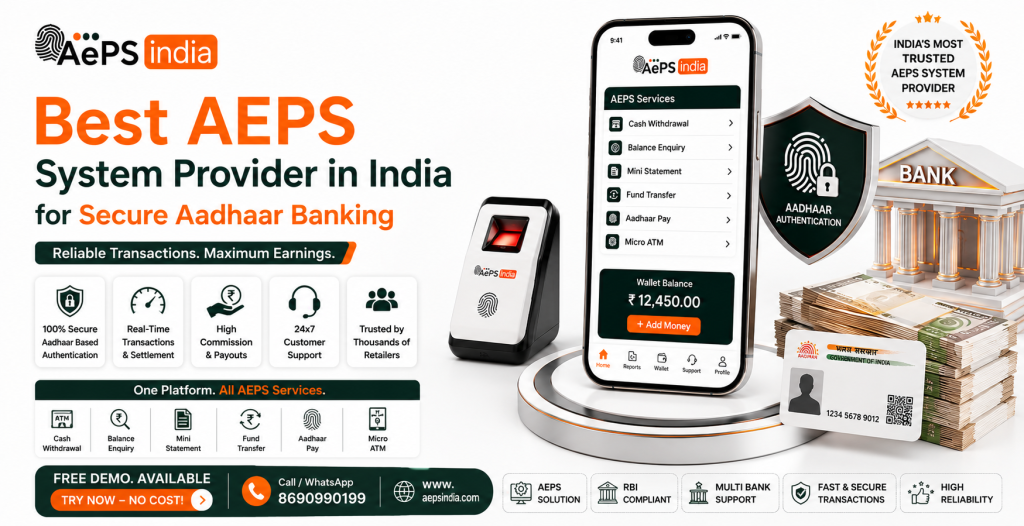
The AEPS System in India is changing the way people use banking services. AEPS stands for Aadhaar Enabled Payment System, a secure banking service that allows users to do transactions using their Aadhaar number and fingerprint authentication. With AEPS, customers can easily access services like cash withdrawal, balance enquiry, and mini statement without visiting a bank branch or using an ATM card.
With the growing demand for digital payments and online banking services, the use of AEPS services in India is increasing rapidly among retailers, agents, and fintech businesses. The biggest advantage of the AEPS system is that customers can access banking services without using a debit card or visiting a bank branch, making banking simple and accessible for everyone.
The Aadhaar Enabled Payment System (AePS) is a bank-led, secure digital model developed by NPCI that allows users to perform banking transactions (cash withdrawal, balance enquiry, mini statement) simply by using their Aadhaar number and biometric authentication (fingerprint/iris) at micro ATM or via business correspondents. It enables cardless, pinless, and paperless banking, providing access to funds for rural residents without needing a bank branch or smartphone.
Today, many retailers, shop owners, and fintech startups are searching for the best AEPS system in India to start a digital banking business and earn regular income. A reliable AEPS platform helps businesses provide fast and secure Aeps banking services while building customer trust.
One of the biggest benefits of the AEPS banking system is that it brings banking services to villages and remote areas where traditional banking facilities are limited. Customers can withdraw money instantly and check their account details with simple Aadhaar verification.
Aeps India provides a trusted and advanced AEPS solution in India designed for retailers, agents, and fintech businesses. With features like secure Aeps API integration, fast settlement, user-friendly Aeps dashboard and strong technical support, businesses can easily manage best AEPS services and grow faster in the digital finance market.
In this blog, you will learn everything about the AEPS system in India, including its features, benefits, uses, business opportunities, Aeps API integration and future growth. With Aeps India, you can explore advanced and secure AEPS solution designed for retailers, fintech companies, and entrepreneurs looking to grow in the digital banking industry.
What is AEPS System
Aadhaar Enabled Payment System (AePS) is a bank-led model developed by the National Payments Corporation of India (NPCI) that allows customers to conduct basic banking transactions (cash withdrawal, balance enquiry, mini statement) using their Aadhaar data and biometric authentication. It requires no physical card, PIN, or signature, and enables interoperable transactions at micro ATM device via Business Correspondents (BCs).

AEPS System Work
The Aadhaar Enabled Payment System (AePS) is a bank-led model developed by NPCI that allows customers to perform basic banking transactions cash withdrawal, balance inquiry, and transfers using their Aadhaar authentication at Micro ATM system or bank correspondent outlets. It connects a user’s bank account to their Aadhaar, eliminating the need for a PIN or debit card.
The AEPS transaction process follows a simple and secure workflow:
- Initiation: The customer visits a local banking correspondent (BC) or micro ATM machine and provides their 12-digit Aadhaar number, selects their bank, and chooses the required Aeps service.
- Authentication: The customer places their finger on a biometric scanner to verify their identity against the UIDAI database.
- Processing: The Aeps system routes the data through the National Payments Corporation of India (NPCI) switch to the respective bank.
- Completion: Upon successful validation, the transaction is processed and the cash or transaction receipt is issued.
Services Available in AEPS System
The AEPS provides essential, interoperable banking services cash withdrawal, balance enquiry, mini-statement, and funds transfer using Aadhaar authentication. It allows individuals to securely access their bank accounts through business correspondents (agents) or best micro ATM without needing debit cards or PINs.
Key services available under the AEPS system include:
- Cash Withdrawal: Allows customers to withdraw cash from their Aadhaar-linked account via an agent.
- Cash Deposit: Enables depositing cash into their own Aadhaar-linked account.
- Balance Enquiry: Enables checking the current available balance in the bank account.
- Mini Statement: Generates a summary of the last few transactions on the account.
- Aadhaar to Aadhaar Fund Transfer: Enables transferring money between two Aadhaar-linked bank accounts.
- BHIM Aadhaar Pay: Allows customers to make cashless payments at merchant stores using biometric authentication.
- eKYC: Facilitates instant paperless Aeps KYC verification.
Documents Required for AEPS Registration
AEPS registration requires key KYC documents: a bank-linked Aadhaar card, PAN card, bank account details (passbook/cancelled cheque), passport-sized photos, and an active mobile number/email. Additionally, you must have a certified biometric device (fingerprint or iris scanner) to complete the Aeps onboarding.
Detailed Document and Equipment Requirements
To successfully register for AEPS, the following items are required for verification and onboarding:
- Identification & Financial: Bank-linked Aadhaar Card (with updated mobile number) and PAN Card.
- Bank Verification: A cancelled cheque or bank passbook for account verification.
- Business Proof: Proof of address, such as a Udyam Registration, shop license, or utility bill.
- Onboarding Components: Recent passport-size photographs, an active mobile number, and email ID.
- Technical Tools: A certified Aeps biometric device (e.g., Mantra scanner) for capturing fingerprints.
Summary of Requirements
- KYC & Bank: Bank-linked Aadhaar (updated), PAN card, and bank account proof (cancelled cheque/passbook).
- Proof of Business: Documents like Udyam registration or utility bills.
- Onboarding: Passport photos, active email, and mobile number.
- Equipment: Certified Aeps biometric device for fingerprint scanning.

Who Can Use AEPS System
Any Indian resident with an Aadhaar-linked bank account can use the best Aadhaar Enabled Payment System (AePS) to conduct banking transactions, such as Aeps cash withdrawal service, Aeps cash deposit service and Aeps balance inquiry service. It is primarily Aeps designed to provide banking access, especially to those in rural or remote areas, via a Business Correspondent (BC) or bank agent.
Who Can Use AEPS?
- Individuals with Aadhaar-linked Accounts: Any person whose bank account is linked to their Aadhaar number, regardless of age, can use this service.
- Beneficiaries of Government Schemes: Individuals receiving payments for services like MNREGA, social security pensions, or disability aid can use top AEPS to receive funds directly.
- Rural and Urban Customers: Both rural and urban customers can use this, though it is particularly aimed at those in remote areas where bank branches or ATMs are sparse.
- Users Lacking Smartphones/Internet: Because the system uses biometric data (fingerprint or iris scan) via a Business Correspondent’s device, users do not need a smartphone to initiate transactions.
Why Use AEPS System
The Aadhaar Enabled Payment System (AePS) is used to provide accessible, cardless banking services specifically Aeps cash withdrawal api, Aeps balance inquiry api and Aeps mini statement api using only biometric authentication at local agent outlets. It bridges the financial gap in rural India by allowing secure transactions without needing a debit card, PIN, or smartphone, making it a critical tool for financial inclusion and 24/7 banking access.
Key Reasons to Use AePS:
- Convenience and Accessibility: Allows users to perform transactions at local Business Correspondent (BC)/Agent outlets, removing the need to travel long distances to bank branches or ATMs.
- Cardless & PIN-Free: Transactions are authenticated securely using Aeps biometrics (fingerprint/iris scan), eliminating the risks associated with losing debit cards or forgetting PINs.
- Boosts Financial Inclusion: Empowers rural and underbanked populations by providing easy access to, as described in the AePS Benefits and the Understanding Aadhaar Enabled Payment System (AePS), basic services like Aeps cash deposit services, Aeps cash withdrawal services, and balance checks.
- High Security: Transactions are authorized via biometric data (Aeps fingerprint or Aeps iris scan), which is nearly impossible to fake compared to PINs or signatures.
- Interoperability: Customers can use their Aadhaar-linked account to transact at any AePS-enabled terminal, regardless of which bank holds their account.
- Safe and Instant: As a NPCI-led system, transactions are instant, secure, and authenticated via the Aadhaar database.
- Comprehensive Services: Aeps india offers multiple services at one place, including cash withdrawal, balance enquiry, mini-statements, and Aadhaar-to-Aadhaar fund transfers.
Top Use Cases of AEPS System provider
The top use case of an Aadhaar Enabled Payment System (AePS) provider is enabling micro-ATM services like cash withdrawals and deposits at local neighborhood shops using biometric authentication.
Key Use Cases of AePS Providers
- Cash Withdrawal & Deposit: Local retail agents and kirana shops act as mini-banks, letting users withdraw or deposit cash from their Aadhaar-linked accounts without physical cards.
- Balance Inquiry & Mini-Statement: Customers instantly check account balances and view recent transaction summaries on a smartphone or POS terminal via fingerprint verification.
- Direct Benefit Transfer (DBT): Governments and local authorities disburse subsidies, pensions, and welfare wages (such as MGNREGA funds) straight to beneficiaries at nearby retail touchpoints.
- Aadhaar Pay (Merchant Payments): Small business owners accept direct digital payments from customers using only biometric validation, avoiding expensive card-swipe machines.
- Aadhaar-to-Aadhaar Fund Transfers: Users execute secure, peer-to-peer or interbank money transfers directly using Aadhaar details and biometric confirmation.

Key Aspects of AEPS System
The Aadhaar Enabled Payment System (AePS) is a NPCI-developed, bank-led model enabling secure, cardless banking Aeps cash withdrawal api services, Aeps cash deposit api services, and Aeps balance inquiry api services using Aadhaar authentication and biometrics (fingerprint/iris) at Micro ATM software or Business Correspondent (BC) outlets. It drives financial inclusion, particularly in rural areas, by removing the need for debit cards, PINs, or smartphones.
Key aspects of the AePS system include:
- Core Functionalities: Facilitates essential services such as cash withdrawals, cash deposits, balance enquiries, and mini-statements.
- Interoperability: Customers can perform transactions at any AePS-enabled terminal, regardless of which bank they have an account with.
- Authentication Method: Transactions require 12-digit Aadhaar identification paired with biometric verification (fingerprint or iris scan), eliminating the risk of card skimming or lost PINs.
- Accessibility: Operates via Business Correspondents (BCs/agents) and Micro ATM software solution, providing Aeps banking api services to rural and underbanked areas.
- Security: High-security level with minimal fraud potential, as the transaction is directly linked to the user’s unique identity (UIDAI).
- Transaction Limit: Typically allows for daily transactions, with many banks maintaining a daily withdrawal limit of roughly ₹10,000.
- Targeted Demographic: Aeps Designed for users who may lack access to traditional ATMs or smartphones, facilitating access to government benefit payments.
AEPS System with Multi-Bank Support
An Aadhaar Enabled Payment System (AePS) with multi-bank support is a secure, interoperable platform that allows customers to perform cardless banking transactions across different financial institutions using their Aadhaar number and biometric verification.
Core Features
- Multi-Bank Connectivity: Connects software backends to multiple banking switches (such as NPCI infrastructure) to prevent single-bank downtime and ensure high transaction success rates.
- Interoperability: Allows users to access any Aadhaar-linked bank account from a Business Correspondent (BC) or micro-ATM managed by a completely different bank or provider.
- Essential Services: Supports cash withdrawals, cash deposits, balance inquiries, mini statements, and Aadhaar-to-Aadhaar fund transfers.
- Biometric Security: Relies on fingerprint or iris scanning authenticated securely through UIDAI guidelines, removing the need for physical debit cards or PINs.
- L1 Compliance: Mandates certified L1 biometric devices and real-time processing for enhanced fraud prevention and immediate agent settlements.
How AEPS System Helps in Rural Banking Services
The Aadhaar-enabled Payment System (AePS) revolutionizes rural banking by enabling secure, doorstep financial transactions cash withdrawals, deposits, balance inquiries, and fund transfers using only an Aadhaar number and fingerprint authentication. By leveraging local Banking Correspondents (BCs), it eliminates the need for distant bank branches, promoting financial inclusion.
Key Ways AePS Helps Rural Banking Services:
- Doorstep Banking Accessibility: Residents can access banking services within their villages, removing the need to travel long distances, saving time and money.
- Easy Cash Withdrawal & Deposit: Through local merchants serving as agents, villagers can withdraw or deposit cash, making banking as simple as local shopping.
- Government Benefit Distribution: It provides direct access to government subsidies, pensions, and other payments, ensuring prompt and secure delivery to beneficiaries.
- Increased Financial Inclusion: Individuals, including those with low literacy, can participate in the formal banking system without the need for a PIN or debit card, using only their biometric ID.
- Enhanced Security: Transactions are secured by unique biometric identification (fingerprint), minimizing the risk of theft and fraud compared to carrying cash.
- Economic Empowerment: The Aeps software allows local shopkeepers and kirana stores to become business correspondents, enhancing local business and creating new income streams.
- Quick Transactions: It facilitates real-time, instantaneous banking transactions.
AEPS Role in Financial Inclusion in India
The Aadhaar-enabled Payment System (AePS) is a cornerstone of financial inclusion in India, enabling bank-led, branchless banking by allowing users to conduct transactions via biometric authentication at local Micro ATM/Kiosk points. By linking bank accounts to Aadhaar, it provides rural, unbanked, and underserved populations access to services like cash withdrawals, deposits and balance inquiries.
Key Roles and Impact of AePS in Financial Inclusion:
- Last-Mile Banking Access: As of early 2026, AePS continues to bring, banking services to the doorstep of villagers, eliminating the need to travel long distances to physical bank branches.
- Empowering Direct Benefit Transfer (DBT): AePS ensures that government welfare, scholarships, and pensions reach beneficiaries securely and directly, reducing middlemen and leakages.
- Simple & Secure Transactions: It uses Aadhaar authentication, removing the need for physical debit cards, PINs, or high-level digital literacy, making it ideal for rural users.
- Boosts Local Economies: Through a network of Business Correspondents (BCs) and local agents, it enables local kirana shops to act as best micro ATM device, strengthening the rural financial ecosystem.
- Significant Volume Impact: By January 2023, AePS had facilitated over 1,600 crore last-mile banking transactions, highlighting its immense scale.
By bridging the gap between rural residents and formal banking, the system (supported by Aeps platform enhances the economic stability of millions.

AEPS Uses in Rural Banking and Digital Payments
The Aadhaar Enabled Payment System (AePS) is a bank-led model enabling instant, cardless, and PIN-free financial transactions via Aadhaar-based biometric authentication. Key uses in rural areas include doorstep banking through local agents (cash withdrawal, deposits), balance enquiries, and Direct Benefit Transfers (DBT) of government subsidies.
Key Uses of AePS in Rural Banking & Digital Payments:
- Doorstep/Local Banking: Enables cash withdrawals, deposits, and account transfers at local Kirana stores or Business Correspondents (BCs), bypassing the need for long travel to bank branches.
- Direct Benefit Transfer (DBT): Facilitates the direct receipt of government benefits like pensions, scholarships, and MGNREGA wages.
- Cardless & PIN-free Transactions: Eliminates the need for debit cards or PINs, making it ideal for individuals with limited digital literacy or those who cannot remember passwords.
- Balance Enquiry & Mini-Statements: Enables users to check their account balance and verify transactions instantly.
- Aadhaar-to-Aadhaar Fund Transfer: Facilitates secure money transfers between Aadhaar-linked accounts.
Impact on Rural Financial Inclusion:
- Increased Accessibility: Bridges the urban-rural divide by providing Aeps banking access in remote, unbanked, and underserved areas.
- Enhanced Security: Transactions are authenticated using unique biometric identifiers (fingerprint or iris scan), reducing fraud.
- Boosts Local Economies: Supports small village merchants acting as BCs, boosting their income and local commerce.
- Efficiency: Processes transactions in seconds, saving time and costs associated with commuting to banks.
Why AEPS System is Important in Digital India
The Aadhaar Enabled Payment System (AePS) is crucial to Digital India because it democratizes financial access, enabling rural and underserved populations to perform secure, cardless, and PIN-less transactions using only their Aadhaar number and biometrics. It drives financial inclusion, facilitates government benefits, and bridges the digital divide.
Key Reasons for Importance:
- Financial Inclusion (Last-Mile Banking): AePS allows citizens in remote villages to access banking services such as cash withdrawals, deposits, and balance inquiries via local Business Correspondents (BCs) or micro ATM service, eliminating the need to travel to distant bank branches.
- Secure & Accessible Transactions: The best Aeps software relies on biometric authentication (fingerprint or iris scan), which is highly secure and prevents fraud, especially for those uncomfortable with PINs or passwords.
- Facilitating Direct Benefit Transfers (DBT): It ensures that government subsidies, pensions, and welfare payments reach beneficiaries directly, reducing corruption and delays.
- Empowering Rural Areas: By eliminating the requirement for debit cards or smartphones, it provides banking access to the unbanked and illiterate, thus bringing them into the mainstream digital economy.
- Interoperability: AePS offers an interoperable best Aeps platform, meaning a customer can use the services of any bank’s BC/agent, regardless of where their account is held.
How Does an AEPS System Provider Help Your Business?
An AEPS System Provider helps your business by turning a local shop or retail outlet into a mini-bank, letting you offer basic banking services and earn extra money.
Core Benefits for Your Business
- Extra Income: You earn a commission on every cash withdrawal, balance check, or mini-statement processed through your terminal.
- More Customers: Offering handy banking services brings more people through your door, which can lead to higher sales in your primary shop.
- Easy Technology: Providers supply the mobile apps, web portals, and software integration needed to connect your biometric scanner to the national NPCI network.
- Fast Money Flow: Most platforms offer real-time or instant same-day fund settlements straight to your business wallet.
- Safe and Legal: Providers handle regulatory compliance and use secure biometric fingerprint or iris scans to stop fraud, making transactions safer than traditional card PINs.
Features AEPS System
The Aadhaar Enabled Payment System (AEPS) allows bank customers to perform secure, cardless, and PIN-less transactions using Aadhaar-linked biometrics. Key features include instantaneous cash withdrawals, deposits, balance inquiries, and fund transfers through business correspondents or top micro ATM, promoting rural financial inclusion with high security.
Key Features of AEPS System:
- Secure Biometric Authentication: Transactions require fingerprint or iris scans via a PoS or micro-ATM, ensuring only the genuine user accesses the account.
- Cardless & PIN-less Transactions: Users do not need a debit/credit card or PIN; only their 12-digit Aadhaar number and biometrics are required.
- Interoperability: AEPS allows customers to access their Aadhaar-linked accounts from any bank, enabling transactions at any AEPS-enabled merchant or low cost micro ATM across India.
- Core Banking Services: Provides access to essential services, including cash withdrawal, cash deposit, balance inquiry, mini-statement generation, and Aadhaar-to-Aadhaar fund transfers.
- Financial Inclusion: Specifically Aeps design to bridge the banking gap in rural areas, enabling citizens in remote locations to access their accounts without visiting a physical bank branch.
- Real-time Transactions: Payments and transfers are processed instantly, offering a fast and reliable Aeps banking service experience.
- Easy to Use: Requires only an Aadhaar number and biometric verification, making it user-friendly for all, including those without technical expertise.
- Direct Benefit Transfer (DBT): Facilitates the direct receipt of government subsidies, such as MNREGA wages and social security pensions, into Aadhaar-linked accounts.
- Daily Transaction Limits: As of 2026, the typical daily cash withdrawal limit for AEPS is 10,000.
- Bank Account Privacy: Users can transact without revealing their full bank account details.
- Privacy Protection: The system allows transactions without sharing bank account details.
- Government Scheme Payments: Facilitates direct disbursement of government welfare schemes like Mahatma Gandhi National Rural Employment Guarantee Act (MNREGA), social security pensions, and old-age pensions.
AEPS allows individuals to perform banking transactions, such as checking their balance or withdrawing money, through a secure channel using their Aadhaar card, promoting a digital, cashless economy.
Benefits AEPS System
The Aadhaar Enabled Payment System (AePS) drives financial inclusion in India by enabling cardless, PIN-less banking via biometric authentication. Key benefits include secure, convenient, and instant banking services (cash withdrawals, deposits, balance inquiries) directly in rural areas, enabling Direct Benefit Transfers (DBT) and reducing reliance on cash.
Key Benefits of the AEPS System:
- Doorstep Banking Services: Customers can access essential banking services like cash withdrawals, deposits, and balance inquiries through local, authorized banking agents, removing the need for long-distance travel to bank branches.
- Cardless & PIN-less Transactions: Transactions are authorized using only biometric data (fingerprint or iris scan) and the Aadhaar number. This removes the risk of losing debit cards or forgetting PINs.
- Enhanced Financial Inclusion: AEPS plays a vital role in reaching underserved and rural populations, providing them with secure, reliable access to the formal financial system.
- Instant Transactions & Increased Footfall: Provides instant cash withdrawal and deposit services. For retailers and local shopkeepers, it acts as a “mini-bank,” increasing customer footfall and generating commission income.
- Interoperability: Allows customers to access their Aadhaar-linked accounts from any bank-compliant Micro-ATM, regardless of which bank they hold an account with.
- Secure and Safe: Biometric authentication is a highly secure, unique identifier that reduces the risk of fraud compared to traditional bank cards.
- High Interoperability: It allows users to access their bank account through any AEPS-enabled micro-ATM or agent, regardless of their bank.
- Digital Record Keeping: All transactions are logged electronically, assisting in efficient and reliable financial tracking for both users and merchants.
- User-Friendly: The system is simple to operate for those who may be illiterate or uncomfortable with complex banking technology.
- Reduced Travel Costs: Enables people to access funds locally, saving money and time on travel to distant towns.
- Business Opportunity: Retailers can act as agents to earn commission, enhancing their income.
- Supports Digital India Initiative: By promoting digital transactions and reducing reliance on cash, it aligns with government efforts toward a cashless economy.
- Empowers Local Commerce: Enables local Kirana shop owners to act as banking correspondents, fostering community reliance and supporting the digital economy.
- Cost-Effective and Simple: Reduces operational costs for banks and eliminates the need for expensive, complex technology for users to perform transactions.
- Easy Access to Government Benefits: Facilitates seamless receipt of Direct Benefit Transfer (DBT) funds, such as MNREGA, social security pensions, and other government subsidies.
- 24/7 Availability: Banking services like withdrawals and mini-statements are available around the clock, providing convenience, especially when banks are closed.

AEPS API Integration and Its Importance
AEPS API integration enables secure, Aadhaar-based banking transactions (cash withdrawal, balance inquiry) into your app or website. Key steps involve choosing a Aeps india, completing KYC, obtaining Aeps API credentials, integrating with biometric RD services, sandbox testing, and launching to production.
Steps for AEPS API Integration Process
Select a Certified AEPS API Provider
- Partner with a trusted, NPCI-registered Aeps india. Consider factors like success rates, Aeps commission structures and technical support.
Register and Complete KYC
- Sign up with the Aeps india and submit necessary documents for verification, including your Aadhaar card (linked to a phone number), PAN card, and business PAN/bank account details for settlement.
Acquire and Register a Biometric Device
- Purchase Aeps biometric device (fingerprint or iris scanner). Register the device using the manufacturer’s Registered Device (RD) Aeps Service software.
- Obtain API Credentials and Documentation
Once KYC is verified, the Aeps india will supply Aeps API documentation, Aeps Merchant ID (MID), and secret keys.
Technical Integration (Frontend & Backend)
- Frontend: Aeps Develop the interface to capture customer details (Aadhaar number, bank IIN) and capture biometric data using the RD service.
- Backend: Integrate the Aeps API to send encrypted biometric data (JSON or XML) to the NPCI and bank server.
Sandbox Testing
- Use the sandbox/testing environment provided by the Aeps india to test all transaction types (Cash Withdrawal, Balance Inquiry, Mini Statement) without using real money.
Go Live (Production)
- After successful testing, switch to the production environment to start processing real-time transactions with your new credentials.
AEPS System Cost Structure
The AEPS system cost structure for 2026 involves a one-time Aeps API integrate/white label Aeps setup fee (roughly ₹12,000–₹1.2 Lakhs), annual maintenance charges (₹9,999–₹40,000), and recurring transaction fees. Agents/retailers typically pay for buy Aeps biometric devices (approx. ₹2,000–₹3,000) and earn Aeps commissions, while customers often face no charges for self-bank transactions but pay ₹5–₹20 for third-party withdrawals.
Key Components of AEPS Cost Structure
1. AEPS Portal Development & Setup Costs (2026)
- API Integration/Setup: Typically ₹12,000 – ₹35,000 for standard Aeps API.
- White Label Solution: Fully branded, ready made Aeps portal cost ₹10,000 – ₹1,00,000+.
- Premium Bank API: Direct integrations (e.g., ICICI/Yes Bank) can cost up to ₹4.5 Lakhs.
- Recurring Costs: Annual Maintenance Charges (AMC) range from ₹9,999 to ₹40,000.
2. Retailer/Agent Investment (To Start Business)
- Registration/KYC Fee: Often free to nominal, though Aeps india charge for onboarding.
- Biometric Device: UIDAI-certified L1 finger/iris scanner (e.g., Mantra) costs ₹2,000 – ₹3,000.
- Working Capital: A minimum of ₹10,000 – ₹20,000 is required for liquidity.
3. Operational & Hardware Costs (Agent Level)
- Biometric Device: ₹2,000 – ₹3,000 (e.g., Mantra, Morpho)
- Registration/KYC Fee: Often free or nominal (under ₹1,000)
- Working Capital: Recommended ₹10,000–₹20,000 for cash liquidity
4. Transaction Charges & Commissions (As of Feb 15, 2026)
- Customer Fees: While basic transactions are often free via bank BCs, third-party agents may charge ₹5 – ₹20 per withdrawal.
- Other Bank Charges (Airtel Payments Bank Example): Free for the first 3 transactions; ₹15 + GST for subsequent transactions.
- Agent Commission: Retailers earn roughly 0.5% to 1% of the transaction value, typically ₹12–₹15 per transaction, depending on volume.
- Settlement: Best Aeps platform offer immediate settlement functionality.
Transaction Charges and Commissions (As of 2026)
- Customer Charges: Typically ₹5 to ₹20 for cash withdrawals, though many banks offer free services through their own BC agents.
- Agent Commissions: Retailers can earn up to ₹13–₹15 per withdrawal, depending on the transaction slab (e.g., higher Aeps commissions for transactions above ₹3,000).
- Settlement Fees: Immediate settlement is often provided by top Aeps platform to enable instant cash flow.
Key 2026 Compliance Requirements
- L1 Device: Mandatory biometric L1 compliance.
- Mapping: Adherence to “One Operator, One Bank” regulations.
- Security: High security Aeps API for secure authentication.
AEPS Commission Structure and Earning Potential
AEPS allows retail agents to earn ₹2 to ₹15+ per transaction, with monthly earnings commonly ranging between ₹10,000–₹30,000+ through high-volume cash withdrawals. Retailers earn the highest Aeps commission on transactions of ₹3,000–₹10,000, usually paid as a tiered Aeps commission or roughly 0.25% – 0.50% of the transaction amount.
AEPS System Commission Structure (2026)
The best Aeps commission is generally structured in slabs based on the transaction amount, with better payouts from Aeps india:
- ₹100 – ₹999: ₹2 (approx.)
- ₹1,000 – ₹1,499: ~₹3.00
- ₹1,500 – ₹1,999: ~₹4.50
- ₹2,000 – ₹2,499: ~₹5.50
- ₹2,500 – ₹2,999: ₹5 – ₹7
- ₹3,000 – ₹10,000: ₹13 – ₹15+ (Highest Slab)
- Balance Enquiry/Mini Statement: ₹0.50 – ₹5 per transaction
Earning Potential and Factors
- Monthly Income: Active agents can earn ₹10,000–₹30,000+ monthly, particularly in rural or semi-urban areas with high cash-out demand.
Daily Earnings: Agents often make ₹300–₹1,000 per day depending on the volume of customers.
Bonuses: High volume Aeps agents can earn up to ₹2,000 extra per month. - Key Providers: Aeps India offer competitive, highest Aeps commission structures for agents.
How to Maximize Earnings
- Target High Value: Focus on transactions between ₹3,000 and ₹10,000 to trigger the highest slabs.
- Provide Additional Services: Use the Aeps platform provide mini-statements and Aadhaar Pay software, which offer additional commission opportunities.
- Boost Footfall: High daily footfall directly increases earnings, especially for services requiring no debit card.

How to Increase Income Using AEPS System
Increasing income through the Aadhaar-Enabled Payment System (AePS) involves becoming a local banking point to maximize commissions on cash withdrawals, balance inquiries and mini-statements. Retailers can earn substantial income potentially ₹6,000–₹10,000+ monthly by encouraging high-value transactions (₹3,000–₹10,000), using reliable Aeps platform and promoting services to increase footfall.
Key Strategies to Maximize AEPS Revenue:
- Target High-Value Transactions: Focus on withdrawals between ₹3,000 and ₹10,000 to secure the highest commission tiers, often resulting in ₹13–₹25 per transaction.
- Offer Comprehensive Services: Do not limit yourself to cash withdrawals. Offer mini-statements (earning ₹1–₹7 per request) and balance inquiries to build trust and increase service fees.
- Use Reliable and Fast Providers: Choose a high-success rate AePS API platform with 99.9% uptime and fast (T+0 or instant) settlement to ensure high-volume reliable operations.
- Use Aadhaar Pay for Large Transactions: For transactions exceeding the standard limits (up to ₹50,000), use the Aadhaar Pay service, which can provide higher commissions, sometimes around 1%.
- Boost Footfall and Visibility: Actively promote your shop as a “local bank” or “banking hub” using clear signage, including “Cash Withdrawal Here” and “Balance Check Available”.
- Provide Additional Services: Leverage your AEPS ID to provide complementary services like mobile recharge API, and utility bill payments to increase earnings.
- Choose Reliable Technology: Use a high-speed and reliable AEPS API/Aeps b2b platform to minimize failed transactions, which ensures consistent, daily earnings.
- Offer Comprehensive Banking: Partner with Aeps india to offer a full suite of services, including utility bill payments, which increase cross-selling opportunities to existing customers.
- Maintain Sufficient Cash Flow: Ensure you have enough daily cash to fulfill withdrawal requests, as higher availability leads to higher transaction volumes.
- Utilize Additional Services: Do not rely solely on cash withdrawals. Use AePS for mini-statements (which can pay ₹1–₹7 per query) and best Aadhaar Pay for transactions up to ₹50,000 to earn up to 1% commission.
Potential Earnings Breakdown
- Per Transaction: Generally, agents earn Aeps commissions ranging from ₹5 to ₹15 on successful transactions.
- Monthly Potential: Processing approximately 30 high-value transactions daily can generate significant monthly income.
Common Pitfalls to Avoid
- High Failure Rates: Aeps india has a robust system; too many transaction failures due to poor connectivity (a common issue) can ruin customer trust.
- Low-Value Dependence: Relying only on small transactions (< ₹1,000) will yield very low commissions compared to the effort.
How Retailers Earn Money Using AEPS System
Retailers earn money using the Aadhaar Enabled Payment System (AePS) by acting as mini-bank branches, earning commission on cash withdrawals, balance enquiries, and mini-statements. By facilitating these services, they earn a tiered commission (typically ₹2 – ₹15 per transaction) and increase store footfall, leading to higher retail sales.
How Retailers Earn Money with AePS (2026):
- Cash Withdrawal Commission: Retailers earn a commission on each cash withdrawal made by customers using their Aadhaar and biometric data.
- High-Value Earnings: Transactions between ₹3,000 and ₹10,000 generate the highest commission, often exceeding ₹15 per transaction.
- Slab-Based Structure: Top Aeps Commissions are usually structured in tiers (e.g., ₹2.00 for ₹100–₹999; higher amounts for higher slabs).
- Balance Enquiry & Mini-Statement Fees: Retailers earn small, consistent fees roughly ₹0.50 to ₹5 for providing balance enquiries or printing mini-statements for customers.
- Aadhaar Pay Services: For transactions up to ₹50,000, retailers can use top Aadhaar Pay, which often pays around 1% commission on larger, non-withdrawal payments.
- Increased Footfall & Cross-Selling: Aeps india offering banking services attracts more customers to the store, increasing the likelihood of selling regular products like groceries or electronics.
- Monthly Bonuses & Incentives: AePS India, offer monthly bonuses, such as ₹2,000 or more, for high-volume agents (e.g., 150–200+ transactions per month).
- Cash Management Optimization: Retailers can use the cash generated from their primary business to fulfill withdrawal requests, reducing the risk of holding excessive cash and the costs associated with transporting it to a bank.
Common Earnings Potential:
- Daily Earnings: Active agents often generate ₹7–₹10 per transaction, enabling significant daily income.
- Monthly Earnings: Depending on volume, active agents can earn between ₹10,000 and ₹30,000+ per month.
- High Volume Impact: Processing 20–30 customers a day can translate to ₹15,000–₹25,000 per month just from banking services.
Security & Biometric Authentication in AEPS System
Aadhaar Enabled Payment System (AEPS) security relies on real-time biometric authentication (fingerprint or iris) matched against UIDAI records, eliminating traditional PINs/cards. It ensures secure transactions using liveness detection, encryption, and instant, secure validation for banking services like withdrawals, balance inquiries, and funds transfers.
Key Security & Biometric Features in AEPS
- Real-time Authentication: Transactions are authorized instantly by verifying the user’s biometrics against the UIDAI database, ensuring that only the rightful owner accesses funds.
- Biometric Modalities: Uses advanced Aeps fingerprint scanners or iris scanners to ensure accuracy and prevent unauthorized access.
- Liveness Detection: Modern AEPS devices use “liveness detection” to distinguish between live, human biometrics and fake, cloned, or latent fingerprints.
- Two-Factor Authentication (2FA): Enhanced RBI guidelines for certain AEPS transactions may require a second authentication layer, such as an OTP combined with a biometric scan, to increase security.
- Encrypted Data Transmission: Biometric data is encrypted at the point of capture (the device) to prevent interception during transmission to the CIDR (Central Identities Data Repository).
- Reduced Fraud Risks: Because the system relies on unique physical traits rather than passwords, it significantly mitigates risks like password theft or skimming.
Role of Certified Devices
- UIDAI-Certified Scanners: Only STQC Aeps certified biometric devices are authorized to interact with the AEPS system.
- Instant Verification: These Aeps devices ensure the secure capture and instant validation of fingerprints or iris scans, ensuring the transaction is genuine.
Benefits of AEPS Security
- Cardless & PIN-less: Eliminates the need to carry debit cards or remember complex PINs, making it more accessible and secure.
- Inclusivity: Enables banking access for individuals in rural or underserved areas, ensuring safe, secure, and easy access to financial services.

How to Choose Best AEPS System Provider in India
Aeps india one of the best AEPS System provider, evaluate their transaction success rates, regulatory compliance, and settlement speeds.
Key Factors to Evaluate
- Success Rate and Uptime: Look for a Aeps india offering a success rate of 98% to 99%+ and high server uptime to minimize failed cash withdrawals or balance checks.
- Security and Compliance: Ensure the Aeps service platform has strict authorization certified by the National Payments Corporation of India (NPCI) and UIDAI, featuring end-to-end data encryption.
- Settlement Speed (T+0): Choose a Aeps india offering real-time or same-day (T+0) fund settlements so your retail outlet or agent wallet does not run out of working capital.
- Commission Structure: Compare the per-transaction earnings or slab rates, avoiding hidden fees while checking for competitive payouts (often ranging between ₹10–₹20 per transaction).
- Device Compatibility: Verify that the system or Aeps API supports your specific USB biometric or iris scanning hardware, such as Mantra devices.
- Customer Support: Aeps india offer 24/7 technical assistance to quickly resolve server downtime, transaction errors, or failed debits.
Why Aeps India is a Trusted AEPS Solution Provider
Aeps india is an trusted AEPS solution provider is evaluated by its official certification, high transaction uptime, fast settlement speeds, and transparent commission structures.
What Makes an AEPS Provider Trusted
- Security & Compliance: The platform must be authorized by the National Payments Corporation of India (NPCI) and follow RBI and UIDAI guidelines for encrypted biometric data.
- High Success Rate: A reliable Aeps system maintains at least 99.9% server uptime and a transaction success rate above 98% to prevent failed customer requests.
- Fast Settlements: Look for instant (T+0) or same-day (T+1) fund settlements so your business working capital remains fluid.
- Transparent Commissions: Earnings should range clearly from ₹5 to ₹15+ per transaction with no hidden administrative fees.
- 24/7 Technical Support: Round-the-clock help via phone or WhatsApp is necessary to fix biometric or server errors immediately.
Future Trends AEPS System
By 2026, the Aadhaar Enabled Payment System (AEPS) is evolving into a secure, AI-driven “phygital” (physical + digital) hub for rural financial services. Key trends include mandatory STQC-certified Aeps L1 biometric devices, AI-driven liveness detection, multi-modal authentication (iris/face), and instant T+0 settlements, transforming small shops into comprehensive digital banks.
Key Future Trends in AEPS System (2026-2030):
- Advanced Security (L1 Compliance): As of January 2026, all biometric devices must be Level 1 (L1) compliant to ensure secure, encrypted data transmission, replacing older L0 devices.
- AI & Blockchain Integration: Real-time AI analysis will monitor user behavior to detect fraud, while blockchain is being explored to enhance security and transparency in transaction records.
- Multi-Modal Biometrics: Moving beyond single fingerprints, systems will incorporate AI-driven liveness detection, facial recognition, and iris scanning to ensure the user is physically present.
- “Rural Financial Hub” Expansion: Local shops will go beyond cash withdrawals to offer integrated services such as micro-loans, insurance, and premium payments, turning them into comprehensive rural bank branches.
- Instant T+0 Settlements: Retail agents will experience real-time (T+0) settlement, improving liquidity and efficiency compared to deferred settlement systems.
- Mandatory L1 Certified Devices: Stricter regulatory compliance by the RBI will mandate the use of Registered Device (RD) Service Level 1 (L1) scanners for higher security.
- Increased Fraud Prevention: The implementation of “Liveness Detection” ensures the biometric being scanned is live and not a spoofing attack.
- Regulatory Focus: Increased monitoring by the NPCI/RBI on agent banking to curb fraud, focusing on “One Agent, One Bank” principles.
- Infrastructure Growth: Continued expansion in rural areas to ensure access to digital payments for underserved populations.
- Mobile-First & Phygital Expansion: The ecosystem is moving towards mobile-first solutions, allowing agents to operate via smartphones. It combines physical, local shop presence (“phygital”) with digital dashboards and instant settlement.
- Unified Interface & Interoperability: Increased integration between AEPS and UPI/BBPS (Bharat Bill Payment System) allows for seamless, faster interbank transactions and broader service capability, increasing transaction volumes.
- Operational Shifts: Increased focus on compliance with “One Agent, One Bank” rules and DPDP data privacy acts.
- Growth Outlook: Projected to account for 10% of total digital transactions by 2030, enhancing rural digital infrastructure.
- Voice-Based Transactions: To support users with low literacy, voice-command features in regional languages are being introduced.
- Deepened UPI Integration: Enhanced interoperability will enable seamless transactions between AEPS and UPI, broadening the scope of digital payments in areas with low smartphone penetration.
- Stricter Regulatory Oversight: Implementation of “One Agent, One Bank” policies and mandatory re-KYC for inactive agents, reducing fraud and strengthening accountability.
- Increased Transaction Limits/Interoperability: As AEPS grows projected to handle 10% of all digital transactions by 2030 higher transaction limits and deeper interoperability with UPI are expected to enhance its usability.

Conclusion
The AEPS system in India (Aadhaar Enabled Payment System) has become one of the most important parts of the country’s growing digital banking ecosystem. By allowing users to perform banking services like cash withdrawal, balance enquiry, mini statement, and Aadhaar Pay using biometric authentication, AEPS has made banking simple, fast, and accessible for millions of people.
Today, the demand for best AEPS services in India is increasing rapidly because it helps both customers and businesses. Customers get secure and easy banking services without visiting a bank branch, while retailers and fintech businesses can earn daily commission through AEPS transactions. This makes the AEPS business model a profitable opportunity for retailers, distributors, CSP agents, and startups.
The Aadhaar Enabled Payment System (AePS) is a NPCI-developed, bank-led model allowing instant, interoperable financial transactions via Aadhaar authentication. It enables cash withdrawals, balance inquiries, and mini-statements at micro-ATMs/business correspondents using biometric data (fingerprint/iris). It promotes financial inclusion, particularly in remote areas, by linking bank accounts to Aadhaar.
For retailers, shop owners, and entrepreneurs, the AEPS business in India offers a great opportunity to earn regular income through commission on every transaction. By using a high commission Aeps platform like Aeps india , agents can provide secure and real-time banking services while building customer trust and growing their business.
One of the biggest features of AEPS is its secure biometric authentication and real-time transaction processing, which make transactions fast Aeps, safe, and reliable. Customers can access banking services instantly, while retailers and agents can provide these services and earn commission on every transaction.
Choosing the right AEPS software is very important for long-term business success. A secure Aeps platform with advanced features, fast transactions and reliable technical support can help your business grow faster in the digital payment industry.
At Aeps India, we provide advanced and secure AEPS solution, AEPS portal development and AEPS API integration services designed for retailers, fintech companies and entrepreneurs who want to build a successful digital banking business.
If you are planning to start AEPS business in India, this is the perfect time to take advantage of the growing digital payment market. With the right AEPS system and business strategy, you can create a strong and scalable source of income in the fintech industry.
Frequently Asked Questions (FAQs) – AEPS System in India
The AEPS System (Aadhaar Enabled Payment System) is a digital banking service that allows users to perform banking transactions using their Aadhaar number and biometric authentication. It provides services like cash withdrawal, balance inquiry, mini statement without needing an ATM card.
The AEPS system works through Aadhaar verification and fingerprint authentication. Customers visit an AEPS retailer, enter their Aadhaar number, select the banking service, and complete biometric verification to process the transaction instantly.
The main AEPS services in India include:
Cash withdrawal
Balance inquiry
Mini statement
Aadhaar to Aadhaar transfer
Basic banking services
To use AEPS services, you need:
Smartphone or computer
Internet connection
Biometric fingerprint scanner
Anyone can start, including:
Retail shop owners
Agents and distributors
Entrepreneurs
Small business owners
You generally need:
Aadhaar card
PAN card
Bank account details
Mobile number
Passport-size photo
Yes, the High volume AEPS platform is highly useful in villages and semi-urban areas where people may not have easy access to banks or ATMs, making banking services more accessible.
Yes, the AEPS business model is highly profitable because agents earn commission on every transaction. With increasing demand for digital banking services, AEPS provides a stable source of daily income.
The biggest benefits of the AEPS system in India are:
Easy banking access in rural areas
Secure biometric transactions
Low investment business opportunity
Fast and real-time banking services
Support for digital India mission
The key features of AEPS include:
Secure biometric authentication
Real-time transaction processing
High success rate
Instant bank settlement
Easy access to banking services
To start AEPS services, you need:
Aadhaar-linked bank account
Biometric fingerprint device
Smartphone or computer
Internet connection
Registration with an AEPS india
Yes, AEPS is a secure digital banking system because it uses fingerprint authentication and encrypted transaction technology, which reduces fraud risks.
Aeps india is known for its fast transactions, secure system, easy dashboard, and high commission structure.
Retailers earn commission on every transaction performed through the top AEPS API or Aeps admin portal.
Your income depends on daily transactions. Aeps india offer commission on cash withdrawal and other banking services, helping retailers earn regular monthly income.
AEPS helps bring banking services to people living in villages and small towns. It supports financial inclusion and makes digital banking easier for everyone in India.
AEPS business requires low investment. Basic setup includes internet connection, biometric device, and system access.
Yes, you can run AEPS business from home or shop using a mobile or computer with internet connection.
Yes, AEPS is a profitable business because digital banking demand is increasing rapidly across India.
Yes, Aeps india offer AEPS API integration for Aeps b2b apps and websites. This helps fintech startups and businesses build their own digital Aeps banking platform.
You can register with Aeps india, complete KYC verification, get AEPS API or Aeps portal access and start offering AEPS services easily.
Aeps India provides:
Secure AEPS API integration
Fast transaction processing
Easy Aeps setup system
High earning potential
Reliable customer support
The future is very strong due to growing digital payments and financial inclusion initiatives.

AEPS Software Development Company in India 2026
Trusted AEPS Provider in India: Complete AEPS Business Setup Guide
AEPS B2B Admin Panel – Everything You Need to Know in 2026
About Author

