AEPS Retailer Software: Features, Benefits & Complete Guide
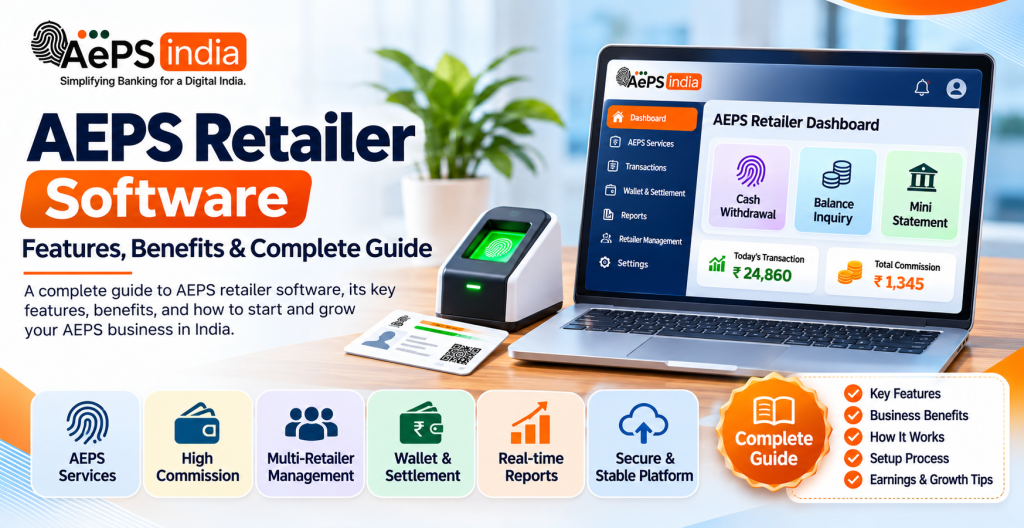
AEPS Retailer Software is a digital platform that helps retailers offer Aadhaar Enabled Payment System (AEPS) services to customers from their shops or service centres. Using Aadhaar-based authentication and a supported biometric device, eligible customers can access banking services such as cash withdrawal, balance enquiry, and mini statements through an authorised AEPS india. For mobile shop owners, Kirana stores, CSC operators, and digital service entrepreneurs, AEPS Retailer Software provides a way to manage these services through a dedicated Aeps retailer platform.
Running an AEPS business requires more than simply processing transactions. Retailers need an easy-to-use dashboard to submit customer requests, check transaction status, view available wallet balance, track commissions, and review transaction history. They should also be able to identify successful, pending, and failed transactions, check reference details, and follow the correct process for resolving transaction-related issues. Clear records and proper transaction monitoring are important for managing customer queries and daily business operations.
An AEPS (Aadhaar Enabled Payment System) Retailer Software turns a local shop into a micro-ATM or mini-bank, letting customers perform basic banking services using their Aadhaar number and fingerprint authentication.
AEPS India provides AEPS software solution for businesses looking to offer Aadhaar-enabled banking services through a structured retailer and distributor network. Depending on the selected Aeps platform and available Aeps integration, the solution can support services such as cash withdrawal, balance enquiry, mini statement, cash deposit, fund transfer, and other enabled services. Retailer and administrator functions can help manage user accounts, monitor transactions, review commission records, and control business operations from a centralised system.
Before choosing AEPS Retailer Software, check the supported banking services, biometric device compatibility, retailer onboarding requirements, transaction-status verification, wallet and commission records, security controls, and technical support. Also confirm the Aeps india authorisation, applicable KYC requirements, transaction limits, settlement terms, and procedures for failed or disputed transactions. These details help retailers understand how the Aeps platform works before offering AEPS services to customers.
In this guide, you will learn how AEPS Retailer Software works, which features retailers should look for, how biometric authentication and AEPS transactions are processed, how retailer commissions and transaction records are managed, and how AEPS India can help businesses plan their AEPS service operations.
What is AEPS Retailer Software?
AEPS retailer software is a digital platform or mobile/web application that allows local shopkeepers, small business owners, and authorized agents to provide banking and financial services to customers using the Aadhaar Enabled Payment System (AePS).
How AEPS Retailer Software Works
An AEPS Retailer App turns a smartphone and a biometric fingerprint scanner into a micro-banking outlet, letting local shopkeepers offer cardless financial services powered by the National Payments Corporation of India (NPCI).
How AEPS Retailer Software Works
- Device & App Setup: The retailer installs an approved AEPS app or Aeps portal on a smartphone/computer and connects a compatible Aeps biometric scanner (such as Mantra) via OTG.
- Customer Request: A walk-in customer provides their 12-digit Aadhaar number, the name of their linked bank, and the desired service (e.g., cash withdrawal or balance check).
- Biometric Authentication: The retailer enters the details into the Aeps software, and the customer places their finger on the scanner.
- UIDAI & Bank Verification: The encrypted fingerprint data is sent via the AEPS network to UIDAI for matching and then to the customer’s bank for authorization.
- Completion & Commission: Once approved, the cash is dispensed by the retailer (for withdrawals) or the inquiry is displayed, and the retailer earns a direct transaction commission.
Features AEPS Retailer Software
AEPS (Aadhaar Enabled Payment System) retailer software empowers small shop owners, micro ATM, and digital service points to offer basic banking services using Aadhaar numbers and biometric authentication.
Retailer Dashboard & Management Features
- User-Friendly Interface: Clear, simplified dashboards allowing retailers to navigate services, process transactions quickly, and view daily statuses.
- Real-Time Transaction Processing & Reconciliation: Instant validation and tracking of transaction logs to handle successful or failed requests.
- Wallet & Commission Management: Built-in digital wallet systems where transaction commissions are credited in real time.
- Instant Settlement: Automated or fast-track payout systems to transfer earned money and liquidity to retailer bank accounts.
- Agent KYC & Onboarding: Digital document upload and verification tools for quick agent registration.
Security & Compliance
- Biometric & RD Device Integration: Seamless compatibility with UIDAI-compliant Registered Devices (RD) for secure thumb/iris authentication.
- Encrypted Communication: Data protection safeguards, audit logs, and role-based access controls to prevent fraud.
- Multi-Bank Support: Connectivity across major nationalized and private banks through integrated AEPS API.
Benefits AEPS Retailer Software
An AePS Retailer App turns a local shop or small business into a neighborhood banking touchpoint using the AePS developed by the Aeps india.
Key Benefits for Retailers
- New Income & Commissions: Retailers earn direct commissions on every successful transaction, such as cash withdrawals, balance inquiries, and mini-statements.
- Increased Footfall & Repeat Business: Aeps india offering essential banking services attracts more people to the store, creating cross-selling opportunities for regular retail goods.
- Low-Space, Low-Cost Setup: No heavy branch setup or physical bank infrastructure is required. Retailers only need a compatible smartphone, a micro-ATM or buy Aeps biometric scanner (fingerprint/iris), and an authorized software platform.
- Multi-Bank Interoperability: A single Aeps platform lets retailers handle transactions for customers across virtually any participating Indian bank.
- Cardless & PIN-less Simplicity: Customers do not need physical debit cards, passbooks, or PINs only their Aadhaar number and biometric scan.
- Real-Time Settlements & Management: Aeps dashboard offer instant transaction alerts, automated reconciliation tools, and clear audit logs.
AEPS Retailer Software Development
An Aadhaar Enabled Payment System (AePS) retailer software development process involves building a secure, UIDAI-compliant platform that connects local shopkeepers (Business Correspondents) to banking infrastructure via biometric authentication.
Step-by-Step AEPS Retailer Software Development Process
1. Requirement Analysis & Compliance Scope
- Define Platform Architecture: Determine whether you are building a B2B multi-tier network (Admin → Master Distributor → Distributor → Retailer) or a single-tier retailer app.
- Identify Core Features: Cash withdrawal, balance inquiry, mini statement, Aadhaar-to-Aadhaar fund transfer, wallet management, commission engine, and receipt generation.
- Regulatory Understanding: Note that building software alone does not grant financial authorization. You must partner with an Aeps india to plug into the national switch.
2. System Design & UI/UX Architecture
- Dashboard Design: Build distinct interfaces for the Retailer/Agent (transaction screens, customer lookup, thermal receipt print format) and the Owner/Admin (ledger tracking, dispute management, commission slabs, KYC approvals).
- Low-Connectivity Optimization: AEPS Retailer Software Design lightweight web or Android/mobile-web layouts engineered to function smoothly in low-bandwidth rural or semi-urban areas.
Tech Stack Selection:
- Backend: Java, Python, or .NET for heavy transaction routing, encryption, and high speed Aeps API communication.
- Frontend/Mobile: Java, Kotlin (Android), or cross-platform tools like Flutter.
3. Biometric Device Integration
- Integrate RD (Registered Device) service SDKs and Aeps Fund Transfer API for certified fingerprint and iris scanners (such as Mantra).
- Ensure proper capture, local encryption, and transmission of ISO-standard biometric blocks as mandated by UIDAI guidelines.
4. API Selection & Bank/Switch Integration
- Onboard with an authorized Aeps india to access staging credentials. [
- Connect your middleware to handle the request flow:
Retailer App → AEPS API Layer → NPCI Switch → Customer’s Bank → UIDAI Biometric Auth → Response & Ledger Credit.
5. Development & Coding
- Wallet & Ledger System: Write atomic database transactions to track retailer float, payout balance, daily limits, and real-time commission credits upon transaction success.
- e-KYC & Onboarding Module: Implement video/document KYC verification workflows so administrators can approve retail agents before they go live.
- Security Layer: Implement end-to-end encryption (E2EE), HMAC signature verification, IP whitelisting, and session timeouts to prevent tampering or fraudulent payouts.
6. Testing & Quality Assurance (QA)
- Staging Sandbox Testing: Run mock fingerprint captures, failed-pin/failed-biometric scenarios, low-balance checks, and drop-out/timeout tests using the bank’s sandbox environment.
- Reconciliation Testing: Verify that dropped, pending, or disputed transactions auto-reconcile or flag properly without double-debiting or double-crediting wallets.
7. Deployment & Staff Training
- Deploy backend services to a scalable, hardened cloud infrastructure (AWS/Azure) with database backups and SSL/TLS certificates.
- Conduct live/manual training sessions for Aeps admin and support staff on handling retailer grievances, settlement cycles, and daily ledger reports.
AEPS Retailer Software Cost in india
The cost structure for an Aadhaar Enabled Payment System (AEPS) retailer software and setup depends on whether you are joining as an individual retailer/agent under an existing parent company or launching your own white label Aeps/custom Aeps portal.
1. Retailer Onboarding & Joining Cost (For Individual Agents)
- Cost Range: ₹0 to ₹3,000 (often free to a nominal KYC/registration fee with major brands like Aeps india).
- Includes: Retailer app login, basic Aeps biometric device registration (Mantra device purchased separately for ₹1,500 – ₹2,500), and access to AEPS services like cash withdrawal, balance inquiry, and mini-statements.
2. White-Label / Ready-Made AEPS Software Cost (To Start Your Own AEPS Brand)
If you want to run your own AEPS business with your own network of retailers and distributors:
- Basic Ready-Made / White-Label Solutions: ₹12,000 to ₹35,000 (sometimes up to ₹50,000)
- Includes: Pre-built admin panel, distributor dashboard, retailer login app, basic Aeps wallet system, and third-party Aeps API integration.
- Advanced Multi-Service / Multi-Bank API Portals: ₹50,000 to ₹4,50,000+
- Includes: Direct bank Aeps API integrated, automated settlement systems, custom hierarchies, high-uptime multi-bank routing (98%+), and advanced fraud/complaint management.
3. Ongoing / Recurring & Operational Costs
- API / Switch Charges or Slab Margins: Revenue is typically shared via transaction commissions rather than heavy fixed monthly fees, though Aeps india charge annual maintenance or server hosting fees (₹5,000 to ₹20,000 per year).
- Hardware Cost: Mandatory Aadhaar-registered biometric fingerprint/iris scanner (e.g., Mantra device), which costs around ₹1,500 to ₹3,000 one-time.
- Working Capital / Wallet Float: Initial liquidity required in your settlement/payout wallet to manage daily cash-out demands from customers before bank-to-bank settlements clear.
Retailer Commission Structure (Earnings)
Retailers earn a commission per transaction slab processed through the AEPS portal:
- ₹100 – ₹999: ₹2
- ₹1,000 – ₹1,499: ₹3
- ₹1,500 – ₹1,999: ₹4.50
- ₹2,000 – ₹2,499: ₹5.50
- ₹3,000 – ₹10,000: Capped up to ₹9 – ₹15 depending on the Aeps india.
AEPS Retailer Software for Different Business Models
Aadhaar Enabled Payment System (AEPS) retailer software adapts to different operational structures ranging from single store owners to multi-tier Aeps B2B networks.
Core AEPS Software Business Models
1. Direct Retailer / Single-Store Model
- How it works: An individual shopkeeper, kirana store owner, or pharmacy uses a standalone app or web portal to provide micro-banking services directly to local customers.
Key Software Features:
- Simple Retailer/Agent Panel for quick daily transactions.
- Biometric integration (UIDAI-certified Aeps fingerprint or Aeps iris scanner).
- Real-time wallet crediting and instant settlements (T+0).
- Basic services: Cash withdrawal, balance inquiry, mini-statement, and cash deposit.
2. Distributor & Super-Distributor Network Model
- How it works: Aeps india company manages a hierarchy of distributors who onboard, train, and support a large network of local retail agents.
Key Software Features:
- Distributor Dashboard for retailer Aeps onboarding, activity tracking, and performance monitoring.
- Multi-level commission configuration and automated payout splits.
- Network-wide transaction analytics and dispute-resolution logs.
3. White-Label & B2B Fintech Platform Model
- How it works: Aeps india launch their own branded micro-Aeps banking software without building certified banking infrastructure from scratch.
Key Software Features:
- Full White-Label Customization (custom domain, brand logo, and app skin).
- Centralized Admin Dashboard managing multi-bank routing, compliance, and ledger balances.
- AEPS API / SDK Integration to plug banking features into existing Aeps apps or Aeps portals.
4. Enterprise / Multi-Service Integration Model
- How it works: Large commercial networks combine AEPS with utility bill payments (BBPS), domestic money transfers (DMT), mobile recharges, and Aadhaar Pay into a single unified POS or retailer super-app.
Key Software Features:
- Cross-service wallet management.
- Bharat Connect / B2B ID reconciliation tools.
- Automated compliance reporting and high-concurrency transaction handling.
How to Choose the Right AEPS Retailer Software
Choosing the right Aadhaar Enabled Payment System retailer software requires evaluating key operational, security, and financial factors.
Core Factors to Consider
Security & Regulatory Compliance:
- Ensure the b2b Aeps software is NPCI-certified and UIDAI-compliant.
- Look for strong data encryption, multi-factor authentication (2FA), and biometric (fingerprint or iris) security.
System Uptime & Transaction Success Rate:
- Prioritize providers that guarantee high uptime (e.g., 99.9%) to avoid failed cash withdrawals or balance inquiries that frustrate customers.
- Fast Aeps Service API connectivity and low transaction latency are crucial during peak business hours.
Commission Structure & Pricing:
- Compare commission rates for cash withdrawals, mini-statements, and balance checks to ensure high profitability.
- Look beyond the initial Aeps setup or Aeps software license cost to check for hidden subscription, best Aeps API, or wallet-loading fees.
Ease of Use & Retailer Onboarding:
- The Aeps retailer app or dashboard should be simple, intuitive, and quick to navigate with minimal technical training.
- Check how fast the KYC and agent Aeps onboard process takes.
Settlement System & Wallet Management:
- Look for real-time or instant settlement options into your bank account or wallet.
- Automated ledger tracking, commission calculations, and transparent account statements help maintain clean daily books.
Value-Added Services (VAS):
- Beyond basic AEPS (cash withdrawal, deposit, balance check, mini-statement), check if the Aeps b2b software includes BBPS (utility bill payments), DMT (domestic money transfers), mobile/DTH recharges, and Micro-ATM support.
Customer & Technical Support:
- Responsive backend support is vital when a transaction gets stuck or biometric devices experience handshake/connectivity errors.
Common Problems AEPS Retailer Software Should Understand
Effective AePS (Aadhaar Enabled Payment System) retailer software must understand, handle, and build automated workflows around the real-world technical, operational, and security issues that rural and semi-urban agents face daily.
1. Biometric & Authentication Errors
- Fingerprint Mismatch / L1 Device Drops: Retailer software needs to recognize L1 Aeps biometric scanner disconnections, surface dust issues, or poor fingerprint capture, prompting the agent to clean the device, re-initiate the service/app, or ask the customer to switch fingers (thumbs or index).
- Suspended or Unlinked Aadhaar (Error Code 52): The system should immediately flag if an Aadhaar number is not linked to the target bank’s IIN (Issuer Identification Number), guiding the retailer to direct the customer to their home branch.
2. Transaction Failures & Bank-Server Downtimes
- Issuer/Switch Inoperative: Bank-specific server outages or NPCI/UIDAI technical drops happen frequently. Aeps admin Software must clearly categorize whether a failure is local, at the bank level, or network-related so the agent doesn’t blindly retry and lock a customer out.
- Insufficient Funds / Limit Reached (Error Code 51): The Aeps service software should prompt the agent to run a quick Balance Inquiry before attempting a cash withdrawal to prevent failed debit attempts or hitting daily/single-transaction caps (standard limits capped at ₹10,000 per transaction).
- Dormant, Closed, or Frozen Accounts: Clear status translation is required so retailers know if an account is inactive rather than assuming it’s a best Aeps software glitch.
3. Stuck & Debited Transactions (Pending Status)
- Account Debited, Cash Not Disbursed: One of the most critical customer-trust issues is when a customer’s bank account gets debited, but the micro-ATM/portal shows a timeout or failed response.
- Automated Reconciliation & Status Check: The top Aeps software must provide a real-time dashboard or log to verify the exact status via the Aeps india Troubleshooting Guide or RRN (Retrieval Reference Number) tracking rather than relying on raw pop-up messages. It should strictly adhere to RBI/NPCI auto-reversal and refund guidelines.
4. Network & Connectivity Instability
- Low-Bandwidth / Rural Dropouts: Retailers often operate in low-connectivity areas. The reliable Aeps software needs lightweight data payloads, automatic retry handshakes, and smooth switching between mobile data (4G/5G) and Wi-Fi without corrupting a session in progress.
5. Security, Fraud Prevention & Compliance
- Real-Time Alerts & Device Binding: Lack of real-time SMS alerts leaves agents and customers vulnerable to late fraud detection. Software should enforce strict device locking (binding the app/portal to a registered STQC-certified L1 device), two-factor authentication (2FA) for the agent, and instant notification logging.
- Data Privacy: Safe handling of Aadhaar data to prevent unauthorized local caching, leaks, or identity theft.
6. Cash Management & Liquidity Tracking
- Working Capital Visibility: Retailers act as micro-ATMs and must manage physical cash flow versus digital wallet balances. Good Aeps software includes cash-in-hand ledgers, settlement summaries, and commission calculators (ranging from ₹1.50 to ₹9 per transaction depending on slab) to help agents track daily liquidity.
AEPS Retailer Mobile App or Web Portal: Which Is Better?
Choosing between an AEPS mobile app and a web portal depends on your shop setup, hardware needs, and how you handle daily transactions. Both options connect to the same NPCI and banking network, but they offer very different working experiences.
AEPS Retailer Mobile App
A mobile app turns your smartphone or tablet into a portable micro-ATM counter.
- Best For: Small shop owners, mobile merchants, high-speed counter service, and limited counter space.
Pros:
- Portability: You can carry your setup anywhere or handle quick walk-ins without turning on a computer.
- Speed & Simplicity: Apps usually feature a clean, streamlined Aeps dashboard designed for fast cash withdrawals, balance inquiries, and mini statements.
- Instant Alerts: Get real-time push notifications for commission credits, wallet updates, and transaction statuses.
- Lower Power Needs: Works easily on battery power or small power backups during power cuts.
Cons:
- OTG / Biometric Connectivity: You must plug in an external fingerprint or iris scanner (like Mantra) via USB/OTG, which can sometimes have driver or connection glitches on certain Android versions.
- Screen Size: Smaller screens make deep accounting, extensive ledger matching, or downloading bulky PDF reports harder to view.
AEPS Web Portal
A web portal runs through a browser (Chrome, Edge) on a desktop PC, laptop, or billing terminal.
- Best For: Established retail stores, common service centers (CSCs), high-volume transaction points, and shops with connected receipt printers and desktop scanners.
Pros:
- Larger Dashboard View: Easier to manage multi-service offerings (bill payments, DTH, micro-insurance, Top AEPS all in one screen), view detailed ledger histories, and filter transaction logs by Retrieval Reference Numbers (RRN).
- Hardware Stability: Desktop USB drivers for biometric scanners and thermal receipt printers tend to be more stable and easier to troubleshoot on Windows PCs.
- Multitasking: You can easily switch between your shop’s billing/inventory Aeps earning software and the best AEPS portal side-by-side.
Cons:
- Fixed Location: Tied to a desk, power supply, and laptop/PC setup you cannot move around easily.
- Slower Startup: Takes longer to boot up compared to unlocking a smartphone and tapping an best Aeps app.
Comparison at a Glance
| Feature | Mobile App | Web Portal |
|---|---|---|
| Mobility | High (Anywhere with cellular/Wi-Fi) | Low (Tied to a desktop/laptop) |
| Biometric Plug-and-Play | Requires OTG cable / mobile-compatible RD service | Standard USB driver setup |
| Reporting & Ledger | Basic summary & daily totals | Detailed CSV/PDF downloads & deep analytics |
| Best Suited For | Kirana shops, mobile vendors, quick cash-out | Cybercafes, CSCs, high-volume counter shops |
Security Tips for AEPS Retailer Software
An Aadhaar Enabled Payment System (AePS) retailer software handles sensitive biometric and financial data. Keeping the system and terminals secure protects both your business and your customers from fraud.
1. Software & Data Protection
- End-to-End Encryption: Best Aeps platform uses strong encryption protocols (such as SSL/TLS) for data in transit and storage so biometric and financial details cannot be intercepted.
- Role-Based Access Control (RBAC): Restrict panel access based on staff roles (e.g., separating retailer, distributor, and admin privileges) to ensure employees only view or manage authorized data.
- API & System Security: Use verified, UIDAI-compliant Aeps Cash Withdrawal API that include proper request validation, authentication, and continuous activity monitoring.
2. Biometric Device & Hardware Safety
- Registered Devices (RD Services): Only use UIDAI-certified Aeps fingerprint or Aeps iris scanners that integrate proper RD Services to guarantee encrypted communication between the scanner and the software.
- Clean the Sensor Daily: Wipe fingerprint sensor glass regularly so residual prints cannot be captured, lifted, or cloned by malicious actors.
- Inspect Physical Terminals: Periodically check your counter and biometric scanner for unauthorized overlay devices, skimmers, or hidden cameras.
3. Transaction & Compliance Best Practices
- Dual-Factor Authentication (OTP): Comply with regulatory mandates for high-value transactions such as cash withdrawals exceeding ₹5,000, which require both fingerprint verification and an OTP.
- Real-Time Monitoring: Track daily transaction histories, wallet balances, and settlement reports to spot unusual activity immediately.
- Customer Privacy: Never store customer Aadhaar numbers or biometric impressions locally on unencrypted files, and advise customers to keep their Aadhaar details private.
How AEPS Retailer Software Supports Business Growth
Aadhaar Enabled Payment System (AEPS) retailer software turns local shops into mini-banking centers, driving business growth through new income streams, increased customer footfalls, and stronger community trust.
Key Ways AEPS Software Supports Business Growth
- New Revenue Streams (Commissions): Retailers earn direct Aeps commission on every completed transaction such as cash withdrawals, balance inquiries, and mini-statements adding a steady passive income to daily sales.
- Increased Customer Footfall: Offering essential banking services (like cash withdrawal or deposits) attracts people into the shop who might not have visited otherwise, directly boosting sales of the retailer’s primary goods.
- Expanded Customer Base (Financial Inclusion): Especially valuable in rural and semi-urban areas, the AEPS Retailer App lets shopkeepers serve unbanked or underbanked residents who lack nearby bank branches or ATMs.
- Cardless & PIN-Less Convenience: Customers complete transactions using only their Aadhaar number and a biometric fingerprint or iris scan, removing friction and building high trust.
- Operational Control & Reconciliation: Fast AEPS platform include built-in wallets, real-time transaction tracking, automated settlements, and detailed reporting dashboards to help business owners manage cash flow and monitor performance easily.
Why Choose Aeps India for AEPS Retailer Software Solution
Aeps india one of the right provider for an Aadhaar Enabled Payment System (AEPS) Retailer Software Solution is essential for running a safe, smooth, and profitable digital banking service.
Key Reasons to Choose a Reliable AEPS Provider
- Bank-Grade Security & Compliance: Aeps india ensures end-to-end data encryption, biometric authentication, and full compliance with NPCI and UIDAI guidelines to prevent fraud and unauthorized access.
- High Uptime & Real-Time Processing: Fast transaction speeds and high system uptime prevent failed cash withdrawals or balance inquiries, keeping customers satisfied.
- Instant & T+0 Settlements: Access to fast or real-time fund settlements ensures your daily shop liquidity and working capital keep moving without delay.
- Transparent Commission & Earnings Tracking: Dedicated dashboards let you track commission margins on every cash withdrawal, balance check, or mini-statement in real time.
- User-Friendly Dashboards & Multi-Device Access: Intuitive web portals and Android mobile Aeps apps make it easy for store owners, agents, and distributors to manage operations with minimal training.
- Increased Store Footfall & Revenue: Turning your local storefront into a mini-bank attracts more regular customers, generating extra monthly income with low setup costs.
- Technical Support: Reliable 24/7 technical assistance helps troubleshoot biometric device integration, Aeps Balance Inquiry API connectivity, or software glitches immediately.
Conclusion
Choosing the right AEPS Retailer Software is an important step for anyone planning to offer Aadhaar-enabled banking services through a retail shop, CSC, Kirana store, or digital service centre. A suitable high margin Aeps platform helps retailers manage customer transactions, access supported banking services, check wallet balances, view transaction history, and monitor commission records. It can also make daily operations easier by keeping important retailer activities organised in one place.
However, selecting reliable AEPS software should not be based only on the number of services advertised. Before choosing a Aeps india, check biometric device compatibility, supported banking services, retailer Aeps onboarded requirements, transaction-status verification, commission terms, settlement procedures, security measures, and technical support. Understand how the platform handles pending, failed, and disputed transactions so you can respond to customer queries with accurate transaction records. Also confirm the applicable KYC requirements, transaction limits, and Aeps india authorisation before starting operations.
AEPS (Aadhaar Enabled Payment System) retailer software lets local shopkeepers and micro-banking agents act as banking points to offer basic financial services using biometric authentication.
AEPS India provides AEPS software solutions for businesses planning to offer Aadhaar-enabled banking services through a retailer and distributor network. Depending on the selected Aeps b2b platform and available authorised integrations, supported services may include cash withdrawal, balance enquiry, mini statement, cash deposit, fund transfer, and other enabled banking services. Available management features can help administrators manage retailer accounts, monitor transactions, review commission records, and organise business operations.
Whether you are starting a new AEPS retail business or expanding an existing digital service centre, choose fast Aeps software that matches your operational requirements and provides clear processes for transaction monitoring and customer support. Evaluate the available features, biometric device requirements, commercial terms, and integration arrangements before making your decision.
Contact AEPS India to discuss your AEPS Retailer Software requirements and explore suitable Aeps commission platform options for your business. Build an organised AEPS service operation with practical retailer management, transaction tracking, and the banking services supported by your selected Aeps india.

AEPS API for Recharge Software: Benefits & Integration Guide
AEPS Payment API in India: Everything You Need to Know

Trusted AEPS Provider in India – Complete Guide for Business
About Author

