Real-Time AEPS API Integration for Fintech, Banks & B2B Platforms
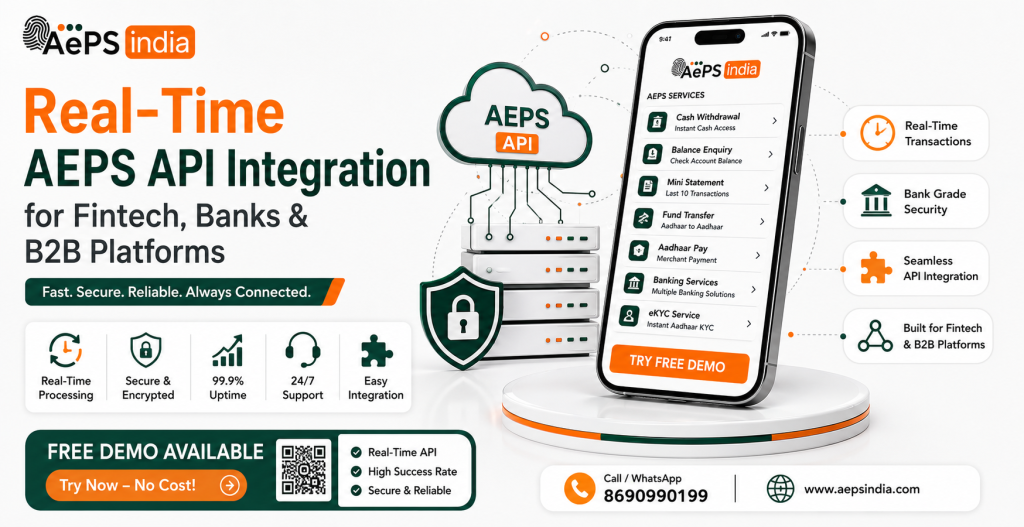
The demand for real-time digital banking services is growing rapidly across India, making AEPS API Integration an essential solution for fintech companies, banks, NBFCs, payment service providers, and B2B platforms. A secure Real-Time AEPS API enables businesses to offer Aadhaar-enabled banking services such as cash withdrawal, balance enquiry, mini statement, Aadhaar Pay, and biometric authentication with fast and reliable transaction processing.
Whether you are building a fintech application, Aeps banking platform, Aeps B2B portal, or digital payment ecosystem, integrating AEPS Service API helps you deliver secure banking services, improve customer satisfaction, and expand your financial service offerings. With real time Aeps API connectivity, businesses can automate banking transactions, reduce manual processes, and provide a seamless user experience across India.
A real time Aadhaar Enabled Payment System API enables businesses to process instant, biometric-based banking transactions such as cash withdrawals, balance inquiries, and mini-statements. Transactions are processed via the Aeps india network and usually take just 2 to 3 seconds with instant settlement.
AEPS India provides advanced Real Time AEPS API Integration solutions designed for modern businesses. Our Aeps platform offers secure Aeps API connectivity, high transaction success rates, scalable infrastructure, easy integration, and dedicated technical support, enabling businesses to launch Aadhaar-enabled banking services quickly and efficiently.
A professional AEPS API Solution also includes retailer management, transaction monitoring, reporting, wallet management, and enterprise-grade security, making it suitable for startups as well as large financial institutions. As digital banking adoption continues to increase, Aeps india is a reliable AEPS API provider helps businesses scale faster while delivering secure and uninterrupted banking services.
In this blog, you’ll learn everything about Real-Time AEPS API Integration, including how it works, its key features, business benefits, integration process, security standards, and why it is an ideal best Aeps API solution for fintech companies, banks, and B2B platforms looking to grow in India’s digital banking ecosystem.
What Is a Real-Time AEPS API?
A real time AEPS API is a software link that lets apps process instant bank tasks like cash withdrawals and balance checks using an Aadhaar number and a fingerprint scan. It connects local shops to the national banking system without needing a debit card or a PIN.
How Real-Time AEPS API Works (Step-by-Step)
A real-time AePS API works by connecting a merchant or Aeps banking app through encrypted channels to the NPCI switch, validating a user’s 12-digit Aadhaar number and biometric fingerprint against the UIDAI database to instantly execute cash withdrawals, balance checks, or mini-statements.
Transaction Workflow
- Initiation: The agent or retailer enters the customer’s 12-digit Aadhaar number, selects the bank name, and chooses the transaction type (such as cash withdrawal or balance check) on their best Aeps application.
- Biometric Capture: A certified biometric scanner captures the customer’s fingerprint or iris scan and securely encrypts the data package.
- Routing and Verification: The best real time Aeps API transmits this packet to the National Payments Corporation of India (NPCI) switch, which routes it to UIDAI for biometric matching and to the customer’s specific bank for ledger validation.
- Settlement and Confirmation: Once approved by the core Aeps banking system, funds transfer or account details return via the top Aeps API in 2 to 3 seconds, triggering an instant digital confirmation receipt and wallet credit for the merchant.
Real-Time AEPS API Services Supported
Real-Time AePS API Service support core financial transactions including cash withdrawals, balance inquiries, and mini statements. These services use biometric verification through the National Payments Corporation of India (NPCI) switch.
Core Transaction Types
- Cash Withdrawal: Cardless and PIN-less money extraction using an Aadhaar number and fingerprint or iris scan.
- Balance Enquiry: Instant viewing of bank account balances in real time.
- Mini Statement: Retrieval of recent transaction logs and history.
- Cash Deposit: Direct funding into Aadhaar-linked accounts where supported by the acquiring bank.
- Aadhaar Pay: Merchant-focused biometric payment collections.
- Direct Benefit Transfers (DBT): Streamlines the delivery of government pensions, subsidies, and welfare funds straight to verified recipients.
- Instant eKYC Verification: Executes paperless, rapid customer identity checks using UIDAI-approved biometric scanning.
Documents Required for Real-Time AEPS API
A real-time Smooth AEPS API requires a PAN card, an Aadhaar card linked to an active mobile number, and bank settlement proof. Review the comprehensive Aeps onboarding checklist provided by AEPS India to ensure complete regulatory compliance before production deployment.
Identity and KYC Proof
- PAN Card: Mandatory for individual or business tax and financial compliance.
- Aadhaar Card: Must be actively linked to your mobile number for OTP-based e-KYC verification.
- Passport-Sized Photographs: Recent colored photographs of the applicant, director, or registering agent.
Business and Address Proof
- Registration Document: GST Certificate, Udyam MSME Registration, or Shop & Establishment License.
- Address Verification: Electricity bill, water bill, or a valid rent agreement for your shop or office location.
Bank Settlement Proof
- Cancelled Cheque: Essential for mapping the payout account where daily transaction settlements will land.
- Bank Passbook or Statement: First page of the passbook or a recent certified bank statement.
Mandatory Hardware and Technical Needs
- Biometric Scanner: An STQC/UIDAI-certified Aeps L1 fingerprint or Aeps iris scanner (such as Mantra) with registered device (RD) services active.
- Contact Details: An active mobile number and email address configured for instant communication and Aeps API credential delivery.
Who Can Use Real Time AEPS API
Top Real-time AEPS API can be used by fintech companies, retail shop owners, and corporate business correspondents. They integrate these tools to offer biometric banking services like cash withdrawals and balance checks.
Who Can Use and Integrate the API
- Fintech Startups & Software Developers: To build custom mobile Aeps app or web portals offering banking features.
- Retailers & Local Shop Owners: To act as mini-ATMs and earn Aeps commissions on cash transactions.
- Business Correspondents (BCs) & Banks: To extend secure, cardless banking to rural and unbanked areas.
Technical & Compliance Requirements
- Regulatory Approval: Must follow guidelines from the NPCI and RBI.
- Biometric Hardware: Requires certified STQC/UIDAI Aeps fingerprint or Aeps iris scanners.
- Agent Verification: Mandatory KYC verification for all operators using the Aeps API live production system.
Industries Using Real Time AEPS API
Real time AEPS API are used across 5 primary sectors: Fintech & Digital Banking, Retail & Kirana Stores, Microfinance & NBFCs, Banking & Business Correspondents, and Government & E-Governance.
Key Industries and Applications
- Fintech & Digital Banking: Integrates biometric authentication into mobile wallets and Aeps banking software for core cardless banking.
- Retail & Kirana Stores: Turns local pharmacies and shops into neighborhood “Micro ATM” for cash withdrawals and balance checks.
- Microfinance (MFIs) & NBFCs: Manages instant loan disbursals and local EMI collections in remote areas.
- Banking & Business Correspondents (BCs): Expands last-mile banking accessibility in underserved rural regions.
- Government & E-Governance: Processes Direct Benefit Transfers (DBT) for pensions and welfare funds via service centers.
Why Use Real Time AEPS API
Using a real time Aadhaar Enabled Payment System API enables cardless banking, provides instant settlements, and ensures top-tier security. It achieves this through biometric verification, cross-bank compatibility and rapid transaction processing.
Core Benefits for Businesses and Users
- Cardless and PIN-less Access: Customers complete transactions using only their 12-digit Aadhaar number and a fingerprint or iris scan, removing the need for debit cards or passwords.
- Instant Wallet Liquidity: Real-time processing through the AEPS Portal provides immediate
T+0fund settlements, keeping agent working capital unblocked. - New Revenue and Footfall: Local shopkeepers and retailers function as “mini-ATMs”, increasing store visitors and earning commission revenue per transaction.
- High-Level Security: UIDAI-compliant biometric matching cuts down risks tied to stolen cards or guessed security codes.
- Universal Interoperability: Users access accounts across different participating banks through a single unified software interface.
- Rural Financial Inclusion: Essential services reach remote and underbanked areas, allowing citizens to collect Direct Benefit Transfers (DBT) locally.
Real Time AEPS API for Banks and Financial Institutions
A Fast real time Aadhaar Enabled Payment System API is a secure Aeps software link that lets banks and financial groups offer cardless, PIN-less banking using an NPCI switch. It handles cash withdrawals, balance checks, and mini statements instantly via biometric Aeps fingerprint or biometric Aeps iris scans.
Security & Compliance Mandates
- Biometric Verification: Connects with STQC-certified fingerprint or Aeps iris scanners to match user data with UIDAI records.
- Interoperability: Works across all participating banks, letting a customer use any bank’s agent regardless of where their account is held.
- Speed and Settlement: Processes transactions in a few seconds with immediate wallet credit or T+0/T+1 settlements for business operators.
- Compliance: Adheres to Reserve Bank of India (RBI) and NPCI rules, requiring L1 Aeps biometric devices and strict data encryption.
AEPS API for B2B Platforms and Retail Networks
An Secure AEPS API lets best Aeps B2B platform and retail networks turn local shops into mini ATMs. It provides cardless, biometric cash withdrawals, balance checks, and mini-statements using a customer’s fingerprint and Aadhaar number.
Key Features for B2B Platforms
- Biometric Security: Uses STQC certified Aeps fingerprint scanners to verify users safely via UIDAI.
- Real-Time Settlement: Credits or debits retailer wallets instantly when a transaction clears through the National Payments Corporation of India (NPCI).
- White-Label Support: Allows parent companies to brand Aeps apps and web portals with their own logos and names.
- Multi-Bank Routing: Connects to various banking partners to ensure high uptime and transaction success rates.
Benefits for Retail Networks
- Extra Income: Local shopkeepers and Kirana owners earn a commission on every cash payout or inquiry.
- More Footfall: Brings extra people into the shop who may buy goods while doing their banking.
- No Cash Heavy Burden: Helps retailers manage and recycle cash flow directly through digital wallet adjustments.
Why Businesses Need Real-Time AEPS API Integration
Real time AEPS API integration is essential for businesses to turn retail points into cardless micro ATM device, process instant biometric banking transactions and drive revenue through Aeps commission.
Key Operational Benefits
- Instant Processing: Completes cash withdrawals, balance inquiries and mini-statements in 2 to 3 seconds through direct National Payments Corporation of India (NPCI) network switches.
- Cardless Security: Uses UIDAI-approved biometric fingerprint or iris authentication, removing debit cards or PIN requirements to reduce fraud.
- Immediate Settlement: Credits merchant and agent wallets instantly via T+0 or same-day processing to maintain strong cash flow.
- Interoperable Access: Connects customers to accounts across all participating banks regardless of the specific service outlet they visit.
Business and Growth Impacts
- Increased Footfall: Attracts local and rural customers needing immediate banking access directly to retail storefronts like kirana shops.
- New Revenue Streams: Generates High Aeps commission earnings per successful transaction alongside enhanced customer loyalty.
- Regulatory Compliance: Adheres strictly to Reserve Bank of India (RBI) and NPCI mandates, including mandatory L1-certified Aeps biometric hardware and liveness checks.
Real-Time AEPS API Architecture
Real-Time AEPS API Architecture
A clean, SEO-friendly architecture graph for Aadhaar Enabled Payment System integration inside a WordPress blog.
Fast Processing
Designed for quick request handling, biometric validation, and real-time banking response flow.
Secure Flow
Uses encrypted requests, RD service data, and bank-side authentication for safe AEPS transactions.
Clear Routing
Moves requests from agent device to AEPS gateway, bank network, and final response layer.
Live Response
Shows transaction status, balance response, and settlement updates in a structured format.
Agent / Merchant Device
Customer Aadhaar, amount, and biometric input are captured from the AEPS service device.
RD Service & Biometric Capture
Fingerprint or iris data is encrypted and packaged into a secure PID block for transmission.
AEPS Gateway / API Layer
API validates merchant credentials, Aadhaar format, transaction type, and request integrity.
Bank / NPCI Processing
Bank network processes the request and checks customer authentication, balance, and limits.
Success / Failed Response
API returns transaction status, RRN, balance, reference IDs, or failure code back to the system.
Cash Withdrawal Flow
Customer selects withdrawal, provides Aadhaar and biometrics, and the AEPS system sends the request to the bank for approval and processing.
Balance Enquiry Flow
For balance enquiry, the same secure biometric and API flow is used, but no money is debited from the bank account.
Mini Statement Flow
The AEPS system fetches the latest transaction data and returns a concise statement in API response format.
Failure Handling
If biometric mismatch, insufficient funds, or bank rejection occurs, the API returns a clear failure response code.
Core AEPS API Endpoints
| Endpoint | Method | Description |
|---|---|---|
| /v1/aeps/cash-withdrawal | POST | Processes Aadhaar based cash withdrawal request with biometric verification. |
| /v1/aeps/balance-enquiry | POST | Returns live account balance using secure Aadhaar authentication. |
| /v1/aeps/mini-statement | POST | Fetches the last account transactions for the authenticated customer. |
| /v1/aeps/transaction-status | GET | Checks transaction status using RRN or reference number. |
Key Features of a Real-Time AEPS API
A real time AEPS Payment API includes key features like Aeps Cash Withdrawal API, Aeps Balance Enquiry API and Aeps Mini Statement API processing transactions instantly through secure biometric verification.
Performance and Processing
- Real-Time Execution: Connects directly via the NPCI switch to process requests and deliver immediate response statuses within 2 to 3 seconds.
- Instant Settlements: Supports automated T+0 or same-day wallet credits for agents and retailers.
- High Uptime and Success: Delivers high reliability with a 98%–99% success rate and 99.9% service uptime.
Security and Compliance
- Biometric Verification: Utilizes UIDAI and STQC-certified Aeps registered devices (RD service) for secure fingerprint and iris matching.
- Data Encryption: Protects sensitive financial data and masks Aadhaar numbers in compliance with strict government, RBI, and NPCI mandates.
- Interoperability: Bridges transactions smoothly across distinct participating banks using a unified developer Aeps platform.
Benefits of Real-Time AEPS API
The benefits of a real time professional Aeps API include instant transactions, cardless biometric security and financial inclusion.
Financial and Business Advantages
- New Revenue Streams: Retailers earn Aeps commission of ₹10 to ₹16 per transaction by acting as micro ATM System.
- Increased Footfall: Local shops attract more walk-in customers, boosting cross-sales for regular store items.
- Low Setup Cost: Requires only a smartphone and a certified Aeps biometric fingerprint scanner instead of heavy ATM infrastructure.
Security and Speed
- Cardless & PIN-less: Eliminates physical debit cards and PIN-forgetting issues using UIDAI-compliant fingerprint or iris scans.
- Real-Time Processing: Transactions finish in 2 to 3 seconds with immediate confirmation callbacks.
- Instant Settlements: Aeps india offers T+0 or T+1 liquidity flow directly to agent/merchant wallets.
Accessibility
- Universal Interoperability: Connects via NPCI to allow customers from any bank to transact at any enabled agent point.
- Government Support: Makes it easy for rural citizens to draw Direct Benefit Transfers (DBT) like pensions and MNREGA wages locally.
Real-Time AEPS API Integration Process
Integrate Real Time AEPS API involves partnering with an Aeps india, implementing secure frontend and backend infrastructure, and complying with stringent UIDAI biometric standards.
The complete step-by-step integration process is detailed below.
1. Select an Aeps india
- Choose a Aeps india operating under multi banking guidelines.
- Evaluate Aeps india based on high Aeps API uptime, real-time logging capabilities, and success rates.
- Verify compatibility with standard Registered Device (RD) biometric hardware.
2. Complete Merchant Onboarding & KYC
- Register your business entity on the chosen trsuetd Aeps platform.
- Submit mandatory Know Your Customer (KYC) documents.
- Provide the Aadhaar card linked to your official mobile number.
- Provide your PAN card, business proof, and settlement bank account details.
- Adhere to regulatory checks like the mandatory “One Operator, One Bank” rule.
3. Procure Compliant Biometric Hardware
- Acquire STQC certified Aeps biometric devices (older L0 devices are restricted to prevent fraud).
- Select devices supporting AI-driven liveness detection to isolate spoofing attempts.
- Install the manufacturer’s RD Service driver software on your deployment environments.
- Ensure the best Aeps software handles on-device hardware-level encryption (RSA) securely.
4. Acquire API Credentials and Documentation
- Access your Aeps india developer console after secure Aeps onboarding approval (usually 24–48 hours).
- Retrieve your Aadhaar Merchant ID (MID) and sandbox network credentials.
- Secure your production Aeps API private keys and OAuth access tokens.
- Download technical documentation containing endpoints for Cash Withdrawal, Balance Inquiry, and Mini-Statements.
5. Execute Frontend & Backend Technical Integration
- Frontend Development: Build UI inputs capturing the customer’s 12-digit Aadhaar number and Issuer Identification Number (IIN/Bank Code).
- SDK Integration: Link the biometric vendor’s SDK to handle hardware triggers and pull encrypted PID blocks.
- Backend Development: Program REST/SOAP endpoints to package data into standard JSON payloads.
- Encryption Standards: Ensure end-to-end payload transit security using strong protocols like AES-256.
- Webhooks Configuration: Set up an active, secure HTTPS Callback URL to asynchronously receive real-time webhook status posts.
6. Sandbox Testing & Error Management
- Target endpoints toward the Aeps india isolated sandbox simulation portal.
- Execute mock tests for every core transaction category using test profiles.
- Program edge cases for handling distinct NPCI transaction response codes.
- Map clear error states for scenarios like “invalid biometrics,” “insufficient funds,” or “bank server down”.
7. Comply with Security Audits & Go Live
- Perform internal verification ensuring data loops never temporarily cache raw biometric inputs or PIN numbers.
- Submit required compliance sign-offs or verification checklists to Aeps india.
- Switch your internal environment routes from sandbox URLs to live production endpoints.
- Deploy the updated build to initiate real-time, live Aadhaar-based banking transactions.
Real Time AEPS API Documentation
Real-time AEPS API documentation covers integration frameworks for cash withdrawals, balance inquiries, and mini-statements. Standard implementations require RESTful Aeps API architecture, STQC-certified L1 Aeps biometric device SDKs, and NPCI/UIDAI compliance.
Core API Endpoints & Parameters
Complete Aeps API Documentation
Real Time AEPS API Cost Structure
A real-time AEPS API cost structure involves a one-time best Aeps API integration fee of ₹12,000 to ₹35,000, annual maintenance charges of ₹9,999 to ₹40,000, and variable per-transaction or Aeps commission fees.
Setup and Integration Costs
- Standard API Setup: ₹12,000 to ₹35,000 (one-time fee to connect best Aeps API documentation and SDKs).
- White-Label Portals: ₹15,000 to ₹1,20,000 (turnkey, ready-made branded web and mobile Aeps app).
- Direct Bank Integration: ₹2,50,000 to ₹4,50,000 (custom enterprise connection directly with partner banks).
Recurring and Hardware Expenses
- Annual Maintenance Charges (AMC): ₹9,999 to ₹40,000 per year for technical support and server uptime.
- Biometric Hardware: ₹1,500 to ₹3,000 per unit for L1-certified fingerprint or iris scanners.
- Per-Transaction Charges / Commissions: Ranging from ₹0.10 to ₹2.00 per query/verification (like balance checks or mini-statements) or structured agent commissions paying out ₹2.00 to ₹15.00 per successful cash withdrawal.
Real Time AEPS API Commission Structure
AEPS API commission structures are slab-based, typically paying retailers ₹2.00 to ₹15.00+ per cash withdrawal transaction, with top payouts on high-value brackets (₹3,000 to ₹10,000) and additional revenue from mini-statements or balance checks.
Cash Withdrawal Slab Rates
- ₹100 – ₹999: ₹1.00 to ₹2.00 per transaction.
- ₹1,000 – ₹1,499: ~₹3.00 per transaction.
- ₹1,500 – ₹1,999: ~₹4.50 per transaction.
- ₹2,000 – ₹2,499: ~₹5.50 per transaction.
- ₹2,500 – ₹2,999: ₹5.00 to ₹8.00 per transaction.
- ₹3,000 – ₹10,000: ₹13.00 to ₹15.00+ per transaction (Highest slab).
Additional Services and Payouts
- Balance Inquiry / Mini-Statement: ₹1.00 to ₹5.00 per lookup.
- Aadhaar Pay: Up to 1% commission on high-value transactions up to ₹50,000.
- Settlement Types: Instant (T+0) or next-day (T+1) bank/wallet transfers depending on the Aeps india.
AEPS API Transaction Flow
AEPS API Transaction Flow
Customer Input
Customer provides their Aadhaar number and selects the linked Bank.
Biometric Authentication
Merchant captures the fingerprint for secure identity verification.
Aadhaar Validation
Biometric data is verified in real-time against Aadhaar records.
Bank Processing
The authenticated request is processed directly by the customer’s Bank.
Instant Confirmation
Transaction result is shown instantly on the merchant’s screen.
*Direct Bank-Led Transaction ensuring maximum security and speed.
Real Time AEPS API Request & Response Format
A real-time AePS API operates via RESTful JSON endpoints, utilizing an encrypted XML PID (Parameter Identifier) block captured from a UIDAI-compliant Registered Device (RD) biometric scanner. This Aeps API structure enables instant, real-time banking transactions such as cash withdrawals, balance inquiries, and mini-statements processed over the National Payments Corporation of India (NPCI) network.
Below are the industry-standard request and response formats for Real-Time AePS transactions.
API Request Format (HTTP POST)
Requests are sent over secure HTTPS, usually requiring authentication headers (Token or Bearer Token alongside a unique merchant or partner ID).
AEPS API Request and Response Format
Below is a clean, indexable HTML structure for AEPS transaction request and response data, designed to be easy for users and search engines to read.
Sample Request JSON
Example request for cash withdrawal through AEPS API.
{
  "merchant_code": "BC_AGENT_99812",
  "transaction_type": "WITHDRAWAL",
  "aadhaar_number": "123456XXXXXX",
  "bank_iin": "607152",
  "amount": "2000.00",
  "mobile_number": "9876543210",
  "latitude": "26.8289",
  "longitude": "75.8056",
  "biometric_data": "<PidData><Resp errCode="0" errInfo="Success" fCount="1" fType="FMR" nmPoints="67" qScore="85"/><DeviceInfo dpId="MANTRA.L0" rdsId="MANTRA.RD.001" rdsVer="1.0.4" mi="MFS100" mc=""/><Skey ci="20261130">ENC_SESSION_KEY_HERE</Skey><Hmac>HMAC_DATA_HERE</Hmac><Data type="X">ENCRYPTED_BIOMETRIC_PID_BLOCK_DATA_HERE</Data></PidData>"
}
Key Request Parameters
| Parameter | Description |
|---|---|
merchant_code | Unique identification code assigned to the retail agent or Business Correspondent. |
transaction_type | Requested action such as WITHDRAWAL, BALANCE_ENQUIRY, or MINI_STATEMENT. |
aadhaar_number | The customer’s 12-digit Aadhaar number, usually masked or securely processed via UIDAI tokens. |
bank_iin | 6-digit Issuer Identification Number that maps to the customer’s bank. |
amount | Amount to be debited; use 0.00 for balance inquiry or mini-statement. |
mobile_number | Customer mobile number used for instant SMS receipts. |
biometric_data | Encrypted XML PidData payload generated by the RD service app on the client machine. |
API Response Format
Once processed through the NPCI switch and authorized by the customer’s bank, the system responds within 2 to 3 seconds with a standardized JSON structure.
SUCCESSCash Withdrawal Response
{
  "status": "SUCCESS",
  "response_code": "00",
  "message": "Transaction processed successfully",
  "transaction_id": "TXN20260729145210",
  "rrn": "621114098712",
  "stan": "342109",
  "auth_code": "887121",
  "data": {
    "bank_name": "State Bank of India",
    "customer_name": "John Doe",
    "amount": "2000.00",
    "account_balance": "4350.50",
    "masked_aadhaar": "XXXXXXXX8912"
  }
}SUCCESSMini-Statement Response
{
  "status": "SUCCESS",
  "response_code": "00",
  "message": "Mini statement fetched successfully",
  "transaction_id": "TXN20260729145215",
  "rrn": "621114098715",
  "data": {
    "bank_name": "HDFC Bank",
    "account_balance": "12050.00",
    "statement": [
      {"date": "2026-07-28", "type": "CR", "amount": "500.00", "description": "UPI Transfer"},
      {"date": "2026-07-25", "type": "DR", "amount": "1000.00", "description": "AePS Cash Wdl"},
      {"date": "2026-07-20", "type": "CR", "amount": "15000.00", "description": "Salary"},
      {"date": "2026-07-18", "type": "DR", "amount": "200.00", "description": "ATM Fee"}
    ]
  }
}FAILEDError / Failed Response
{
  "status": "FAILED",
  "response_code": "51",
  "message": "Insufficient Funds",
  "transaction_id": "TXN20260729145220",
  "rrn": "621114098799",
  "data": null
}
Key Response Parameters
- status: Current state of the operation such as
SUCCESS,FAILED, orPENDING. - response_code: Two-digit standard code aligned with NPCI guidelines, for example
00for success,51for insufficient funds, andM3for biometric mismatch. - rrn: Retrieval Reference Number used for transaction tracking.
- account_balance: Ledger balance remaining after execution.
- statement: Array containing the last 5 to 10 financial entries on the account.
Real Time AEPS API Security, Authentication and Compliance
Real-time AePS API security relies on Level-1 (L1) biometric device encryption, RSA-encrypted data streams, and strict non-storage compliance mandates regulated by the NPCI and UIDAI.
Security Architecture
- L1 Registered Devices (RD): Fingerprint or iris scanners must be STQC-certified Level-1 units that encrypt the Personal Identity Data (PID) block at the hardware source to block spoofing.
- Encrypted Data Transit: Communication streams employ RSA and AES-256 encryption to protect payload blocks during transit across open Aeps API Service pathways.
- API Endpoints Safeguards: Integrations require IP whitelisting, OAuth 2.0 or mutual TLS (mTLS) protocols, and multi-factor authorization (MFA) for agent operations.
Authentication Mechanisms
- Biometric Validation: Real-time matching of live fingerprint or iris data against the central UIDAI repository.
- Liveness Detection: Scanners check for active pulse/finger parameters to reject fake silicone or rubber mold replicas.
- Dual Factor Agent Verification: Retailers or banking correspondents must log into the BEST Aeps portal using 2FA before initiating client requests.
Compliance and Regulatory Frameworks
- No-Storage Rule: Caching, logging, or saving raw biometric images, customer PINs, or Aadhaar numbers on local merchant databases or mobile Aeps software is strictly banned.
- Operational Mandates: Adherence to “One Operator, One Bank” binding rules and mandatory agent re-KYC after three months of inactivity.
- Audit and Logs: Transaction trails and authentication metadata must be retained securely to comply with the Aadhaar Act guidelines.
Real Time AEPS API Transaction Success Rate & Performance
Top-tier real-time AEPS API delivery a transaction success rate of 98% to 99%, system uptime of 99.9%, and processing speeds of 2 to 3 seconds via the NPCI network.
Performance Metrics
- Success Rate: Maintained between 98%–99% using smart multi-bank routing and automated failover to bypass unresponsive bank servers.
- Processing Speed: End-to-end biometric matching and transaction execution take roughly 2–3 seconds.
- System Availability: Cloud-native architecture targets 99.9% uptime to manage peak traffic spikes smoothly.
- Fund Settlement: Instant or same-day liquidity (T+0) directly credits agent or merchant wallets upon transaction clearance.
Technical & Security Architecture
- Biometric Compliance: Utilizes UIDAI-approved L0/L1 certified fingerprint or iris scanners with mandatory Registered Device (RD) service encryption.
- Interoperability: Connects across all NPCI-approved and RBI-licensed public and private banks in India.
- Core Functions: Supports real-time cash withdrawals, balance inquiries, mini-statements, and best Aadhaar Pay API.
How to Choose the Best Real-Time AEPS API Provider
Aeps india one of the best real time Aeps API provider, evaluate critical factors including NPCI/UIDAI compliance, transaction success rates (98%+ uptime), and real-time (T+0) settlements.
Key Evaluation Criteria
- Security & Compliance: Ensure the Aeps india is legally authorized, strictly adheres to Reserve Bank of India (RBI) and NPCI rules, and supports UIDAI-certified L0/L1 biometric scanners with Registered Device (RD) encryption.
- Uptime & Success Rates: Look for best Aeps system offering at least 98% to 99% success rates backed by multi-bank failover routing to bypass individual bank server downtime.
- Settlement Speed: Choose best Aeps platform supporting instant T+0 or same-day fund updates to keep agent working capital fluid.
- Multi-Bank Routing: Ensure the top Aeps platform has multi-bank switching connectivity (such as ICICI or Yes Bank) so that if one bank server drops, traffic shifts automatically.
- Commission Slabs: Compare payout margins per withdrawal slab, typically ranging from ₹10 to ₹16 per successful transaction.
- Hidden Fees: Verify there are no unexpected setup, maintenance, or annual Aeps software licensing costs.
- Documentation & Sandbox: Look for clear Aeps System API and a functional testing environment to trial cash withdrawals, balance inquiries, and mini-statements before launch.
- Developer Support: Require clear top Aeps API documentation, webhook support, and an active sandbox testing environment.
- Technical Support: Round-the-clock (24/7) assistance is vital to fix sudden server or authentication timeouts immediately.
Why Choose AEPS India for Real-Time AEPS API Integration?
Aeps india osn or the a reliable Aeps API provider for real-time AEPS API integrate ensures high transaction success rates, instant T+0 wallet settlements, and strict NPCI and UIDAI regulatory compliance. Top solutions like Aeps India allow businesses to turn retail counters into micro ATM Software while maximizing commission earnings.
Core Benefits of Real-Time AEPS Integration
- Security & Compliance: Adheres strictly to NPCI and UIDAI mandates with end-to-end encrypted biometric (fingerprint/iris) authentication.
- High Uptime & Success Rates: Delivers up to 99.9% uptime to prevent failed transactions in rural or urban banking touchpoints.
- Instant Liquidity: Features rapid T+0 or T+1 real-time settlements directly into merchant or agent wallets.
- Interoperability: Enables customers across all major domestic banks to complete withdrawals, balance checks, and mini statements through a single node.
- Lucrative Revenue: Generates per-transaction commission margins for local shop owners and fintech aggregators.
Essential Technical Capabilities
- Developer Tools: Provides clear documentation, sandbox environments, and webhooks for fast web/Aeps app deployment.
- Multi-Bank Routing: Bypasses individual bank outages by failing over automatically across multiple partner banking switches.
- Comprehensive Dashboards: Aeps india offers real-time tracking for commission logs, dispute management, and volume analytics.
Conclusion
Real-time AEPS API Integration has become an essential technology for fintech companies, banks, NBFCs, payment service providers, and Aeps admin platform that want to deliver secure, fast, and reliable Aeps banking API services. By integrating a modern AEPS API, businesses can offer cash withdrawal, balance enquiry, mini statement, Aadhaar Pay Software, and other Aadhaar-based banking services through a single, scalable Aeps platform.
A professional AEPS API Solution helps businesses automate banking transactions, improve transaction success rates, reduce operational effort, and provide a seamless customer experience. Features such as secure biometric authentication, real-time transaction processing, easy Aeps API integration, centralized Aeps API dashboard, and advanced reporting make AEPS an ideal solution for modern digital banking businesses.
A Real-Time Fast AePS API enables secure, biometric-based banking such as cash withdrawals, balance inquiries, and mini-statements using only an Aadhaar number and fingerprint. Transactions are processed via the NPCI in 2-3 seconds with instant settlement and typically 99.9% system uptime.
AEPS India provides a secure and high performance AEPS API designed for fintech companies, banks, and Aeps admin Portal. With reliable infrastructure, developer friendly Aeps API integration, scalable architecture, and dedicated technical support, businesses can launch Aadhaar-enabled banking services quickly and expand their digital financial network with confidence.
As India’s digital banking ecosystem continues to grow, investing in a trusted AEPS API Provider like Aeps india can help businesses improve operational efficiency, increase customer reach, strengthen financial inclusion, and create new revenue opportunities. Choosing the right AEPS technology today can support long-term business growth and deliver a better banking experience for customers across India.
Ready to integrate a secure and high-performance Real-Time AEPS API into your platform? Contact AEPS India today to discuss your business requirements, request a live Aeps API demo, and get expert assistance with fast Aeps API integration. Our team is ready to help you launch Aeps API secure, scalable, and reliable Aadhaar-enabled banking services for your fintech business, bank, or Fast Aeps B2B platform.
FAQ – Real-Time AEPS API Integration for Fintech, Banks & B2B Platforms
A Real-Time AEPS API is a secure Aeps Service API that enables businesses to provide Aadhaar-enabled banking services such as cash withdrawal, balance enquiry, mini statement, and top Aadhaar Pay with fast transaction processing and real-time responses.
The customer enters Aadhaar and bank details, biometric authentication is captured through an RD service device, and the request is processed through a bank approved Aeps API flow. The system then returns a real-time response such as success, failure, or pending status.developers.eko+1
A Real-Time AEPS API is ideal for:
Fintech Companies
Banks
NBFCs
B2B Platforms
Payment Service Providers
Retailers
Distributors
CSP Operators
A Low Cost AEPS API can support:
Cash Withdrawal
Balance Enquiry
Mini Statement
Aadhaar Pay
Cash Deposit (where supported by the Aeps india)
Retailer Banking Services
The major benefits include:
Fast transaction processing
Secure biometric authentication
High transaction success rate
Easy API integration
Improved customer experience
Additional revenue opportunities
Business scalability
To integrated AEPS API, you usually need a business account with the Aeps india, merchant onboarding approval, best Aeps API credentials, and an RD service biometric device for authentication. Aeps india may also require IP whitelisting for production access.
High Speed AEPS API allows fintech companies to expand their digital banking services, Aeps onboard retailers, automate transactions, improve operational efficiency, and reach customers in urban and rural areas.
Yes. A branded AEPS API uses encrypted communication, secure Aeps API authentication, biometric verification, and industry-standard security practices to help protect transactions and user data.
Yes. Aeps india can integrate AEPS API to provide Aadhaar-enabled banking services through their own top Aeps portal or Aeps application subject to applicable banking and partner requirements.
Yes, AEPS depends on biometric authentication for identity verification. The biometric payload is captured from a registered RD service device and sent securely with the Aeps API request developers.
Yes, Low Budget AEPS API can be integrated into web portals, mobile Aeps application and backend systems. It is commonly embedded in fintech Aeps dashboard, partner apps and business Aeps service platform.
The integration timeline depends on technical requirements, documentation, testing, and Aeps api onboarding. Aeps india can complete integration quickly with proper technical support and Complete Aeps API documentation.
The flow usually starts with customer Aadhaar input, biometric capture, request validation, bank processing, and then a final response with transaction details like RRN, status, and amount.developers.
Yes, Developed AEPS API are built for real-time transaction handling, so the response is generally returned within seconds depending on bank and network conditions.developers.eko+1
Common failure reasons include biometric mismatch, insufficient funds, invalid Aadhaar or bank mapping, bank-side issues, or network timeout.
Yes, AEPS is widely used for rural and semi-urban banking because it enables basic banking services without requiring debit cards or complex digital Aeps onboarding.
The bank authorizes and processes the transaction after biometric verification and account validation. The bank is the core financial processor in the AEPS flow.
Businesses choose AEPS business API to expand banking access, serve cash-based customers, reduce branch dependency, and create a new service line for assisted financial transactions.
Choose an Aeps india that offers secure technology, reliable uptime, real-time transactions, comprehensive Aeps API documentation, responsive technical support, transparent pricing, scalability, and a feature rich Aeps platform that fits your business needs.
AEPS India provides secure AEPS API integration with real-time transaction processing, a seamless Aeps platform, high system reliability, an easy-to-use dashboard, and dedicated technical support for businesses.

AEPS B2B Software for Startups and Fintech
AEPS API for Android Apps and Websites: Complete Guide

Get AEPS Service in India: Complete Guide for Retailers and Businesses
About Author

