AEPS B2B API: Features, Integration & Benefits Explained
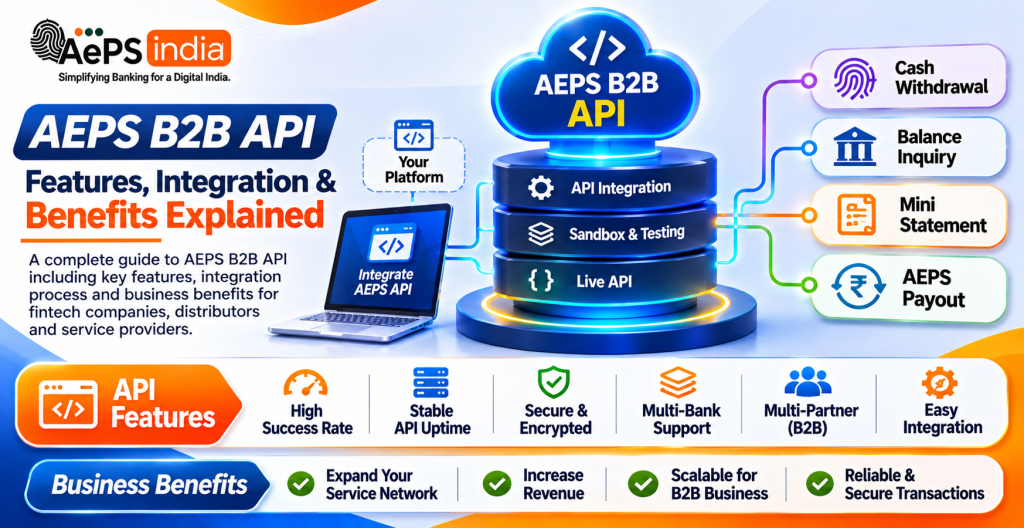
Are you looking for a reliable AEPS B2B API in India to integrate Aadhaar Enabled Payment System services into your fintech website, mobile application, retailer portal, or digital banking platform? An AEPS B2B API provides a technology interface that enables businesses to connect supported Aadhaar-based banking services with their existing software and offer convenient financial services through an integrated platform.
An AEPS B2B API (Aadhaar Enabled Payment System Business-to-Business Application Programming Interface) lets fintech platforms, distributors, and service aggregators connect their apps or portals to NPCI-backed AePS banking infrastructure. Through authorized Business Correspondents (BCs) and biometric authentication, retailers can offer cardless and PIN-less banking services to customers.
AEPS India focuses on AEPS software development and Aeps API integration solutions for businesses looking to establish or expand their fintech operations. With the right AEPS B2B API integration, businesses can connect supported services such as Aadhaar-based cash withdrawal, balance enquiry, and mini statement, depending on their banking partner, service activation, and applicable authorization.
A well-planned B2B AEPS API integration involves more than connecting Aeps API endpoints. It requires secure authentication, Aeps retailer onboarding, biometric device compatibility, transaction processing, real-time status management, callback handling, reporting, and proper reconciliation. These capabilities help businesses manage their AEPS operations and build an organized network of distributors and retailers.
Whether you are a fintech startup, payment service business, Aeps software developer, distributor, or established financial technology company, choosing the right AEPS API provider is essential for developing a scalable Aeps business platform. Before integrating Aeps API, it is important to evaluate technical documentation, supported banking services, integration assistance, transaction security, pricing transparency, settlement processes, and regulatory compliance.
In this guide, we will explore everything you need to know about the AEPS B2B API, including how it works, its important features, integration process, business benefits, Aeps india selection criteria, security requirements, and frequently asked questions. This information will help you understand how AEPS API integration can support your fintech business in India.
What is an AEPS B2B API?
An AEPS B2B API (Aadhaar Enabled Payment System Business-to-Business Application Programming Interface) is a technical interface that lets fintech companies, distributors, and service platforms integrate Aadhaar-based banking services into their own software or agent networks. It connects a business’s app or portal to authorized AEPS banking infrastructure (linked to the National Payments Corporation of India’s AEPS network) so retailers and agents can process card-less, PIN-less transactions using a customer’s 12-digit Aadhaar number and biometric authentication.
How an AEPS B2B API Works
An AEPS B2B API (Aadhaar Enabled Payment System Business-to-Business Application Programming Interface) is a software bridge that lets fintech companies, retailer portals, and mobile apps offer basic banking services directly to their agents and merchants. Instead of building complex banking infrastructure from scratch, businesses use this API to connect their apps to authorized banking networks backed by the NPCI (National Payments Corporation of India) and UIDAI.
Step-by-Step Transaction Workflow
When a customer visits a local retail shop or banking agent to make a transaction, the Aeps API processes the request in real time through the following steps:
- Customer Input. The retail agent opens their B2B Aeps portal or app, selects the desired banking service, and enters the customer’s 12-digit Aadhaar number along with their bank name.
- Biometric Capture. The customer scans their fingerprint or iris using a UIDAI-certified biometric device connected to the agent’s phone or computer.
- API Request Transmission. The B2B Aeps application encrypts the biometric data and transaction details, sending them via the AEPS Service API to the backend infrastructure of an acquiring Aeps india.
- NPCI & UIDAI Verification. The request is routed through the NPCI switch to UIDAI to verify the biometric match and to the customer’s bank to check account status and funds.
- Instant Settlement & Response. Once approved, the bank debits or credits the customer’s account and sends an instant confirmation back through the best Aeps API to the retailer’s screen. The retailer then hands over the cash to the customer, and the transaction amount (plus commission) is settled into the retailer’s Aeps B2B wallet.
Why AEPS APIs Matter for B2B Fintech
AEPS B2B APIs matter for B2B fintech platforms because they let you offer Aadhaar-enabled banking like cash withdrawals, balance enquiries, and mini statements through an existing distributor and retailer network without building physical bank branches.
Why They Matter
- Recurring Revenue & Footfall: Everyday cash and banking needs drive repeat visits to local retailers, generating steady commission volume.
- Tier 2, Tier 3 & Rural Reach: Assisted biometric banking serves customers who rely on local merchants rather than bank branches.
- Multi-Service Bundling: AEPS pairs naturally with Domestic Money Transfer (DMT), BBPS bill payments, recharges, and payouts to turn a Aeps portal into a one-stop hub.
- Scalable Distribution: Adding sub-agents and retailers expands reach faster than physical rollouts.
AEPS API Transaction Flow
An AEPS (Aadhaar Enabled Payment System) B2B API transaction routes a customer’s biometric authentication through a multi-tier fintech network to the National Payments Corporation of India (NPCI), UIDAI, and the customer’s issuing bank for real-time banking operations.
1. Pre-Transaction Setup & Daily Agent Auth
Before processing customer transactions, a B2B Aeps platform enforces strict compliance checks:
- Merchant Onboarding & KYC. The retailer (Business Correspondent / Agent) completes eKYC and gets mapped to an acquiring bank via the Aeps india.
- Daily Two-Factor Authentication (2FA). Per NPCI mandates, the retail agent must authenticate their own identity using biometric verification once every 24 hours before initiating customer cash withdrawals.
2. Step-by-Step Transaction Flow
[Customer + Biometric L1 Device]
       │ (1. Encrypted PID XML)
       ▼
[Retailer App / B2B Portal]
       │ (2. REST API / JSON Payload)
       ▼
[B2B Aggregator / API Provider Switch]
       │ (3. ISO 8583 / Bank Protocol)
       ▼
[Acquiring Bank] ──► [NPCI AEPS Switch] ──► [UIDAI (Biometric Auth)]
                            │
                            ▼
                     [Issuing Bank (CBS)]
                            │ (4. Debit/Credit & RRN)
                            ▼
[Wallet Settlement & Commission Split]
- Transaction Initiation. The retailer enters the customer’s 12-digit Aadhaar number (or Virtual ID), selects the customer’s bank using its Issuer Identification Number (IIN), chooses the transaction type (Cash Withdrawal, Balance Enquiry, Mini Statement, or Aadhaar Pay), and enters the amount.
- Biometric Capture (RD Service). The Aeps app invokes a UIDAI-certified L1 Registered Device (RD) service (such as Mantra). The scanner captures the fingerprint/iris and encrypts it at the hardware level into an encrypted PID (Personal Identity Data) XML block so raw biometrics are never exposed to the best Aeps app.
- API Request to B2B Switch. The client app sends the encrypted PID XML, Aadhaar number, bank IIN, agent outlet ID, device metadata, and an idempotency key over HTTPS (TLS 1.3) to the Aeps india server.
- Acquiring Bank & NPCI Routing. The Aeps india validates the request, applies security checks, and forwards the payload to its partner acquiring bank, which translates and routes it into the NPCI AEPS switch.
- UIDAI Authentication & Bank Authorization. NPCI forwards the biometric block to UIDAI for identity verification. Once UIDAI confirms the match, NPCI routes the financial request to the customer’s issuing bank Core Banking System (CBS) to verify account balance and debit/credit the funds.
- Real-Time Response & RRN. The issuing bank returns an approval or decline code along with a 12-digit Retrieval Reference Number (RRN) back down the chain to the retailer’s screen.
3. Post-Transaction Settlement & Ledgering
In a B2B hierarchy (Super Admin → Master Distributor → Distributor → Retailer), financial settlement happens across two tracks:
- Instant Wallet Credit. For a successful cash withdrawal, the Aeps B2B platform immediately credits the principal withdrawal amount into the retailer’s trade/AEPS wallet (as the retailer hands physical cash to the customer).
- Automated Commission Split. The platform’s commission engine calculates the slab-based margin and distributes instant commissions across the retailer, distributor, and master distributor wallets.
- Timeout & Status Check Handling. If a network timeout occurs at the bank or NPCI switch, the B2B Aeps system marks the transaction as
PENDINGand triggers an asynchronous Status Check API or webhook reconciliation before altering wallet balances.
AEPS Services That Can Be Exposed Through APIs
An Aadhaar Enabled Payment System (AEPS) B2B API typically exposes core biometric banking services such as cash withdrawal, balance enquiry, mini statement, cash deposit, Aadhaar Pay API, and fund transfers, depending on what the underlying banking partner and NPCI-aligned integration support.
Core AEPS Services Exposed via API
- Cash Withdrawal: Allows customers to withdraw cash from an Aadhaar-linked bank account at an agent or retail touchpoint using their Aadhaar number, bank selection, and biometric authentication (fingerprint or iris).
- Balance Enquiry: Checks the real-time balance of an Aadhaar-seeded bank account via biometric verification.
- Mini Statement: Retrieves a short list of recent transactions (commonly around 9–10 entries) along with the current balance.
- Cash Deposit: Enables depositing cash directly into an Aadhaar-enabled bank account where supported by the participating Aeps india.
- Aadhaar Pay: Lets merchants collect payments from customers using biometric Aadhaar authentication rather than a card or UPI app.
- Fund Transfers: Supports Aadhaar-to-Aadhaar or enabled interbank transfers when supported by the connected switch/bank rails.
AEPS API Request Structure
An AEPS (Aadhaar Enabled Payment System) B2B API request typically follows a secure RESTful architecture using POST over HTTPS. While exact field names vary by Aeps india, almost all B2B implementations follow a standardized structure defined by NPCI and UIDAI guidelines.
1. HTTP Headers & Authentication
To ensure security and B2B partner verification, requests require specific authentication headers:
- Endpoint Method. POST
- Content-Type. application/json (or multipart/form-data if passing raw XML files)
- Authorization. Bearer <API_TOKEN> or custom Aeps API Key/Secret pairs
- Signature / Checksum. An HMAC-SHA256 or AES-encrypted signature header generated from the payload to prevent tampering.
2. Core Payload Parameters
A standard B2B AEPS transaction payload combines merchant/agent identification, customer banking details, and encrypted biometric data.
| Parameter | Type | Description |
|---|---|---|
merchantCode / retailerId | String | Unique ID of the B2B retailer/agent initiating the transaction (mandatory for NPCI tracking). |
clientRefId / txnId | String | A unique alphanumeric transaction reference generated by your system for reconciliation. |
transactionType | String | Identifies the service: CW (Cash Withdrawal), BE (Balance Enquiry), MS (Mini Statement), or AP (Aadhaar Pay). |
aadhaarNumber | String | Customer’s 12-digit Aadhaar number (often encrypted or tokenized before transmission). |
bankIIN | String | 6-digit Institution Identification Number (IIN) of the customer’s bank. |
amount | Number | Transaction amount in INR (0 for Balance Enquiry and Mini Statement). |
mobileNumber | String | Customer’s 10-digit mobile number for SMS alerts and audit trails. |
latitude & longitude | String | GPS coordinates of the retailer’s device (strictly required by NPCI to prevent fraud). |
biometricData (pidData) | String/XML | The encrypted XML block captured directly from the UIDAI-certified RD (Registered Device) scanner. |
3. Sample JSON Request Payload
Most modern B2B gateways expect the RD service’s XML output to be Base64-encoded or stringified inside a JSON body:
{
  "merchantCode": "RET100458",
  "clientRefId": "TXN20261119987654",
  "transactionType": "CW",
  "aadhaarNumber": "123456789012",
  "bankIIN": "607094",
  "amount": 1500,
  "mobileNumber": "9876543210",
  "latitude": "26.8505",
  "longitude": "75.7628",
  "biometricData": "<PidData><Resp errCode=\"0\" errInfo=\"Success\" fCount=\"1\" ... /><DeviceInfo ... /><Skey ci=\"20280915\">...</Skey><Hmac>...</Hmac><Data type=\"X\">...</Data></PidData>"
}
4. Critical Integration Rules
- Do Not Store Biometrics. Under UIDAI regulations, your B2B platform must never log, cache, or store the PidData block; pass it straight from the client device to the API gateway.
- Daily 2FA Requirement. NPCI mandates that B2B agents complete a Two-Factor Authentication (2FA) biometric scan once every 24 hours (and before every cash withdrawal) using a separate 2FA endpoint before regular transactions succeed.
- IP Whitelisting. Production B2B API requests will fail unless your server’s static IP address is whitelisted with the API aggregator.
AEPS B2B API Response Structure
B2B AEPS APIs typically return a standardized JSON payload containing transaction status, banking references (RRN), account balances, and mini-statement arrays.
While exact field names vary slightly across aggregators and switches, a complete AEPS B2B API integration handles synchronous HTTP responses alongside asynchronous webhook callbacks.
1. Standard Transaction Response (Withdrawal & Balance Inquiry)
For Cash Withdrawal (CW), Cash Deposit (CD), Aadhaar Pay (AP), and Balance Inquiry (BE), the synchronous response includes core status indicators and NPCI/bank identifiers:
{
  "status": "SUCCESS",
  "response_code": "00",
  "message": "Transaction Approved",
  "data": {
    "transaction_type": "CW",
    "client_reference": "TXN_9876543210",
    "reference_id": "AGGR_1122334455",
    "bank_rrn": "632310482910",
    "uidai_auth_code": "894512",
    "amount": "2500.00",
    "remaining_balance": "14250.75",
    "bank_iin": "607094",
    "masked_aadhaar": "XXXX-XXXX-4321",
    "timestamp": "2026-11-19T10:25:14+05:30"
  }
}
2. Mini Statement Response (MS)
When requesting a Mini Statement, the response includes the remaining balance along with an array of the last 5 to 10 account transactions:
{
  "status": "SUCCESS",
  "response_code": "00",
  "message": "Mini Statement Fetched",
  "data": {
    "transaction_type": "MS",
    "client_reference": "MS_9876543211",
    "bank_rrn": "632310482999",
    "remaining_balance": "14250.75",
    "mini_statement": [
      {
        "date": "18/11/2026",
        "txn_type": "Dr",
        "amount": "500.00",
        "narration": "UPI/432198765432/P2M"
      },
      {
        "date": "15/11/2026",
        "txn_type": "Cr",
        "amount": "15000.00",
        "narration": "NEFT/SALARY/ICIC0001"
      }
    ]
  }
}
3. Key Payload Fields Explained
- Status & Response Codes.
status(e.g.,SUCCESS,PENDING,FAILED) dictates UI flow, whileresponse_codemaps directly to NPCI/bank ISO-8583 codes (00for approval; numeric/alphanumeric codes like51for insufficient funds orU3for biometric mismatch). - Reference Identifiers.
client_referenceechoes your internal unique ID for idempotency,reference_idis the aggregator’s gateway ID, andbank_rrn(Retrieval Reference Number) is the 12-digit NPCI tracking number required for customer receipts and dispute resolution. - UIDAI Auth Code. Proves successful biometric verification against UIDAI servers.
- Remaining Balance. Returned as a string/float in decimal format after the transaction settles.
4. Error & Timeout Handling (Webhook Callbacks)
Because banking switches frequently experience latency, your backend must handle PENDING states via status check Aeps API or webhooks (aeps.success, aeps.failed):
{
  "event": "aeps.failed",
  "status": "FAILED",
  "response_code": "51",
  "message": "Insufficient Funds",
  "data": {
    "client_reference": "TXN_9876543210",
    "bank_rrn": "632310482910",
    "amount": "2500.00"
  }
}AEPS B2B API Transaction Status Design
Designing a robust transaction status architecture for an AEPS (Aadhaar Enabled Payment System) B2B API requires handling asynchronous bank switches, biometric authentication timeouts, and strict NPCI reconciliation rules. Unlike basic applications that only track Success or Failed, a production B2B financial ledger needs a granular state machine.
1. Core Transaction State Machine
A reliable AEPS B2B architecture separates internal validation from external NPCI/bank switch processing:
INITIATED. The retailer submits the request with a unique client_ref_id. The system generates an internal transaction ID and reserves wallet limits (if applicable).VALIDATED. The best Aeps platform verifies retailer KYC, two-factor authentication (2FA), biometric PID data structure, and duplicate client_ref_id checks before routing.SUBMITTED. The payload is dispatched to the upstream bank switch or Aeps india.PROCESSING/PENDING. The upstream switch has acknowledged receipt, or a network timeout occurred while waiting for the issuer bank. Crucial Rule: Never auto-refund a retailer’s wallet or dispense cash while in this state.SUCCESS. The issuer bank approves the request and returns a valid Retrieval Reference Number (RRN / UTR). For Cash Withdrawal, the retailer’s B2B Aeps settlement wallet is credited (principal + commission).FAILED. The transaction is definitively declined by UIDAI (e.g., biometric mismatch) or the issuer bank (e.g., insufficient funds, bank server down).REVERSED/DISPUTED. A transaction initially markedSUCCESS(or stuck inPENDING) is rolled back due to an NPCI chargeback, timeout reversal, or T+1 settlement mismatch.
2. Status Resolution & Reconciliation Flow
Because AEPS relies on multiple hops (Retailer App → B2B Platform → Acquirer Switch → NPCI → Issuer Bank), dropped responses are common. Implement a three-tier resolution mechanism:
- Synchronous Response: Capture immediate SUCCESS or FAILED codes during the initial Aeps API call.
- Asynchronous Webhooks: Expose a secure callback endpoint to receive push updates from the upstream partner when a
PENDINGtransaction settles. - Automated Status Check (Polling): Run a scheduled cron job (e.g., at 1 min, 5 mins, 15 mins, and 1 hour) calling the upstream Transaction Status Enquiry API using the client_ref_id and transaction date for any unresolved records.
3. Essential API Payload & Schema Fields
To prevent duplicate payouts and simplify support disputes, structure your status Aeps API responses and database records around these core attributes:
| Field | Type | Purpose |
|---|---|---|
client_ref_id | String (Max 20) | Idempotency key generated by the B2B partner to prevent duplicate processing. |
txn_id | String | Internal platform transaction ID. |
rrn / utr | String (12-digit) | NPCI/Bank Unique Transaction Reference; mandatory proof for customer disputes. |
txn_type | Enum | CW (Cash Withdrawal), BE (Balance Enquiry), MS (Mini Statement), or AP (Aadhaar Pay). |
status | Enum | Standardized state (SUCCESS, FAILED, PENDING, REVERSED). |
response_code | String | Standardized NPCI/ISO 8583 error code (e.g., 00 for approval, U3 for biometric mismatch). |
available_balance | Decimal | Customer’s remaining bank balance returned by the issuer bank. |
commission_ledger | Object | Breakdown of retailer commission, TDS, and net wallet credit (for CW / AP). |
4. Critical Guardrails for B2B Ledgers
- Strict Idempotency. Reject any incoming transaction request carrying an already-used
client_ref_idby returning the current status of the existing transaction rather than initiating a new debit. - Atomic Wallet Updates. Tie the SUCCESS state transition and the B2B Aeps wallet credit inside a single database transaction so a retailer is never credited twice if both a webhook and a status-check cron job resolve the same transaction simultaneously.
- Clear Error Mapping. Translate cryptic bank switch codes into actionable UI messages for retailers (e.g., mapping biometric errors to “Ask customer to clean finger and retry” vs. mapping
PENDINGto “Do not hand over cash; check status in 5 minutes”).
Why AEPS B2B API Pending Status Is Important
In an Aadhaar Enabled Payment System (AEPS) B2B API, a Pending status is critical because it represents a transaction whose final bank outcome is not yet confirmed due to timeouts, network drops, or delayed responses. Treating a pending transaction as immediately failed or successful can cause financial discrepancies and operational errors.
Why Pending Status Matters
- Prevents duplicate transactions: Retailers and systems avoid blindly retrying a transaction that may have already gone through, reducing duplicate processing and customer disputes.
- Protects against wrong wallet or commission updates: Marking a pending request as failed when the customer’s bank account was actually debited creates ledger mismatches. Marking it as successful too early risks paying commissions on funds that never settled.
- Supports accurate status resolution: Platforms can hold the transaction in a pending state and resolve it reliably through Aeps status enquiry API, callbacks/webhooks, or scheduled reconciliation jobs.
- Improves transparency and dispute handling: Showing retailers and customers that bank confirmation is still awaited prevents premature repeat attempts and helps support teams investigate unresolved cases cleanly.
For further details on handling delayed responses and verification flows, see AEPS B2B API, Fast AEPS API Transaction Status Check, and AEPS API Transaction Errors & Solutions.
Idempotency in AEPS B2B API
Idempotency in an AEPS B2B API ensures that submitting the exact same transaction request multiple times produces the exact same outcome as processing it once, preventing duplicate cash withdrawals, fund transfers, or retailer wallet updates.
In rural and semi-urban banking networks where AEPS is heavily used, unstable mobile connections, Aeps biometric scanner timeouts, or impatient retailers double-clicking the submit button frequently cause the same top Aeps API payload to be sent repeatedly.
Why It Matters in AEPS B2B
- Prevents duplicate bank debits. Without idempotency, a retried cash withdrawal request could deduct money from a customer’s bank account twice while the retailer only hands out cash once.
- Protects B2B retailer wallets. When an AEPS transaction succeeds, the aggregator credits the B2B retailer’s settlement wallet; idempotency ensures retries do not credit the wallet multiple times for a single transaction.
- Eliminates manual reconciliation. It removes the need for operations teams to manually untangle phantom transactions caused by network drops between the Aeps B2B portal, the Aeps mini statement API and NPCI.
AEPS B2B API Authentication
AEPS B2B API authentication relies on a multi-layered security process mandated by the National Payments Corporation of India (NPCI) and the Unique Identification Authority of India (UIDAI) to verify both the Aeps API request and the human participants.
Because AEPS involves direct bank-to-bank biometric transactions, authentication occurs across three distinct levels:
API & Server-Level Authentication (Platform to Aeps india)
Before passing any user data, your Aeps B2B application must authenticate itself with the Aeps india.
- API Keys & Tokens. Aeps india issue a unique Client ID, Aeps API Keys, or OAuth/Bearer token passed in the HTTPS request headers.
- IP Whitelisting. Requests are strictly restricted to pre-approved static IP addresses belonging to your servers.
- Payload Encryption & Checksums. Sensitive payloads are encrypted (often using AES-256) and signed with an HMAC/SHA-256 hash or digital signature to prevent tampering in transit over TLS 1.3.
Agent Two-Factor Authentication (2FA)
To prevent unauthorized terminals from initiating transactions, NPCI mandates strict agent verification:
- One-Time Onboarding (eKYC). When a retail agent or Business Correspondent is registered via Aeps B2B API, their PAN, Aadhaar, and physical location are verified.
- Daily Biometric 2FA. Agents must complete a biometric fingerprint scan every 24 hours (or once per day) to unlock their AEPS terminal before processing any customer transactions.
Customer Biometric Authentication (Transaction Level)
Every individual transaction (cash withdrawal, balance inquiry, or mini-statement) requires live customer consent:
- RD Service Capture. Your frontend app communicates with a UIDAI-certified, STQC-compliant biometric device (e.g., Mantra) via its local Registered Device (RD) Service.
- Encrypted PID Block. The RD service captures the fingerprint or iris scan and immediately encrypts it inside the hardware into a PID (Personal Identity Data) block. Raw biometric data is never exposed to your application.
- API Transmission. Your backend bundles the encrypted PID block, the customer’s Aadhaar number (or VID), and the Bank IIN (Issuer Identification Number) into the Aeps balance inquiry API payload, which the Aeps india routes to NPCI and UIDAI for real-time verification.
- High-Value OTP. Depending on Aeps india and banking rules, cash withdrawals above ₹5,000 may also trigger an additional SMS OTP verification.
AEPS B2B API Signature Verification
AEPS B2B API signature verification is a cryptographic security check that proves a payment request or callback came from an authorized Aeps india and was not altered in transit. Because NPCI does not enforce a single universal JSON schema across Aeps india the exact hashing formula depends on your specific Aeps API documentation.
How Signature Verification Works
Aeps india follow a standard cryptographic flow for both outgoing high speed Aeps API request and incoming webhook callbacks:
- Payload Construction. The sender gathers specific request parameters (such as merchantId, referenceId, amount, and timestamp) or the raw JSON request body.
- String Concatenation. Parameters are joined in a strict, Aeps india-defined order often separated by a pipe (
|), colon (:), or sorted alphabetically and combined with your Secret Key or Salt. - Cryptographic Hashing. The combined string is hashed using HMAC-SHA256, SHA-512, or signed using RSA-SHA256 (with an X.509 certificate for direct bank integrations) and encoded in Base64 or Hexadecimal format.
- Header Transmission. The generated signature is sent in a custom HTTP header (e.g., X-Signature, Authorisation, or
Hash). - Server Validation. The receiving server repeats the exact same hashing steps using its stored copy of the Secret Key and compares the result against the incoming header. If they do not match, the transaction is rejected.
AEPS B2B API Encryption
AEPS B2B API encryption protects Aadhaar and biometric transaction data across multiple layers to meet strict UIDAI and NPCI compliance standards. Security spans from the physical biometric scanner to the backend banking servers so raw customer credentials are never exposed or stored in plain text.
Core Encryption Layers
- Biometric Hardware Encryption (L1 RD Service). Certified Level-1 (L1) fingerprint and iris scanners encrypt biometric data directly inside a secure hardware environment at the exact moment of capture. The device’s Registered Device (RD) service generates an encrypted PID (Personal Identity Data) block using UIDAI public keys before the data even reaches the best Aeps B2B application.
- Payload-Level Encryption. Aeps india require sensitive JSON request and response bodies such as Aadhaar numbers, transaction amounts, and agent IDs to be encrypted before transmission. Standard implementations rely on AES-256 (symmetric encryption) for the payload, paired with RSA-2048 (asymmetric encryption) to securely exchange the session keys.
- Transport Layer Security. All communication between the best Aeps B2B portal, middleware, and bank switch travels over HTTPS using TLS 1.2 or TLS 1.3. This prevents man-in-the-middle attacks and packet sniffing during transit.
- Digital Signatures and Checksums. Reliable Aeps API request typically include an HMAC-SHA256 hash or digital signature in the header. This verifies that the payload originated from an authorized Aeps india and was not altered in transit.
Compliance & Data Protection Mandates
- Strict Non-Storage Policy. Under UIDAI and RBI guidelines, Aeps india are strictly prohibited from storing raw biometric data or plain-text Aadhaar numbers on local servers or logs.
- Tokenization and Aadhaar Data Vaults. If an entity must retain references for audit or reconciliation, Aadhaar numbers must be masked or replaced with reference keys via an HSM-backed Aadhaar Data Vault.
- Static IP Whitelisting & Key Rotation. Production Aeps API access is restricted to pre-approved static IP addresses, and encryption keys or client secrets must be rotated periodically to minimize exposure.
Typical B2B Integration Flow
- Capture. The merchant’s device triggers the certified RD service (e.g., Mantra) to capture the fingerprint and return a signed, encrypted XML PID block.
- Encrypt. Your backend wraps the PID block, masked Aadhaar/VID, and transaction metadata into a JSON payload, then encrypts it using the AES/RSA public key.
- Transmit. The encrypted payload, along with an authentication token and HMAC signature, is sent via POST request over TLS 1.3 to the aggregator or bank switch.
- Decrypt & Verify. Upon receiving the response, your server validates the response signature and decrypts the payload using your private key to display the transaction status.
AEPS B2B API Gateway
An AEPS B2B API Gateway is a Aeps software interface that connects a Aeps business application or retailer Aeps portal to the National Payments Corporation of India (NPCI) Aadhaar Enabled Payment System infrastructure. It acts as a single, secure entry point that routes biometric banking requests from local agents to authorized banking networks for real-time processing.
Key Gateway Features
- Traffic Isolation and Routing. Modern Aeps B2B architectures modularize their gateways to separate high-priority Best AEPS biometric traffic from non-AEPS services like utility bills or travel bookings.
- Biometric Device Compatibility. Gateways integrate Registered Device (RD) services for popular UIDAI-certified scanners such as Mantra and Morpho across Android, Windows, and iOS.
- Network and Wallet Management. Aeps B2B platforms provide multi-tier dashboards to manage master distributors, distributors, and retailers with instant wallet settlements and automated commission splits.
- Digital Agent Onboarding. Integrated e-KYC APIs allow businesses to verify retailer PAN and Aadhaar details for rapid activation.
AEPS B2B API Integration Layer
The AEPS (Aadhaar Enabled Payment System) B2B API integration layer acts as the middleware bridge connecting a fintech business’s front-end application (web portal or mobile Aeps app) with banking partners and the National Payments Corporation of India (NPCI). It enables Aeps B2B network, distributors, and retail agents to offer cardless, PIN-free banking services such as cash withdrawals, balance inquiries, mini statements, and Aadhaar Pay using biometric authentication.
Essential Components of the Integration Layer
| Component | Technical Function | Business Purpose |
|---|---|---|
| Biometric RD SDK | Interfaces with local device drivers to capture encrypted PID XML/JSON blocks. | Ensures UIDAI compliance so raw biometric data never touches your servers. |
| Authentication & Security | Uses AES-256 encryption, HMAC signatures, JWT/OAuth tokens, and static IP whitelisting. | Protects sensitive financial payloads and prevents unauthorized API calls. |
| Merchant Onboarding (eKYC) | Automates agent registration, PAN/Aadhaar verification, and two-factor authentication (2FA). | Meets NPCI and RBI compliance rules requiring daily biometric 2FA for retail agents. |
| Webhooks & Status APIs | Handles asynchronous callbacks and timed status-check polling for pending transactions. | Prevents duplicate debits and resolves “deemed approved” or timeout states. |
| Wallet & Commission Engine | Executes atomic ledger credits/debits and splits margins across super-distributors, distributors, and retailers. | Automates real-time payouts and eliminates manual accounting errors. |
Multi-Provider AEPS B2B API Architecture
A Multi-Provider AEPS (Aadhaar Enabled Payment System) B2B API Architecture is a resilient, middleware-driven system designed to route biometric banking transactions (Cash Withdrawal, Balance Inquiry, Mini Statement, Aadhaar Pay) across multiple upstream Aeps india through a single unified modern Aeps API exposed to downstream.
1. High-Level Architectural Flow
[Retailer / Agent App (Android / Web)]
       │  (Captures PID Data via RD Service: Mantra)
       ▼
[API Gateway & WAF] (Rate Limiting, IP Whitelisting, TLS 1.3, Auth/JWT)
       │
       ▼
[Unified AEPS Orchestration Service]
  ├── 1. Agent Onboarding & 2FA Verification (Daily NPCI Biometric Auth)
  ├── 2. Smart Routing Engine (Health Check, Bank SR%, Commission Slab)
  ├── 3. Provider Adapter Layer (Normalizes JSON/XML, ISO-8583 payloads)
  └── 4. Transaction State Machine & Idempotency Manager
       │
       ├──────────────────┬──────────────────┐
       ▼                  ▼                  ▼
 [Provider A API]   [Provider B API]   [Provider C API]  (e.g., Aeps india)
       │                  │                  │
       └──────────────────┴──────────────────┘
                          │
                          ▼
              [NPCI / Acquiring Banks]
2. Core Architectural Components
Client & RD Service Layer:
- The client app interfaces with UIDAI-certified Registered Device (RD) Services (L1 devices are mandatory per current NPCI guidelines).
- It generates an encrypted PID (Personal Identity Data) block and Device Info XML, which are passed directly to your backend without decryption.
API Gateway & Security Layer:
- Handles IP whitelisting, OAuth2/JWT authentication, and HMAC-SHA256 payload signature verification.
- Enforces strict idempotency keys (client_ref_id) so network retries never result in duplicate bank debits.
Agent Onboarding & Daily 2FA Module:
- NPCI mandates a unified agent registry and daily Two-Factor Authentication (2FA) via biometric scan before an agent can process transactions.
- In a multi-Aeps setup, your system tracks which upstream Aeps india is Aeps onboarded with and ensures daily 2FA is completed on the Aeps india before routing traffic.
Smart Routing & Failover Engine:
- Bank-Specific Success Rate (SR) Routing: Tracks real-time SR per Issuing Bank (IIN) across Aeps india (e.g., routing SBI transactions to Provider A if Provider B has high timeouts).
- Circuit Breaker Pattern: Automatically removes a Aeps from the active pool if error rates (e.g.,
U3/91Timeout) cross a threshold within a rolling window. - Commercial & Slab Routing: Routes based on commission margins or transaction amount caps.
Adapter Layer (Anti-Corruption Layer):
- Translates your standardized internal request schema into each Aeps specific format (REST JSON, SOAP XML, AES-256 encrypted payloads, or PGP/RSA signatures).
- Maps disparate upstream error codes into a unified internal status taxonomy (SUCCESS, FAILED, PENDING, REVERSAL).
Double-Entry Ledger & Wallet Engine:
- Implements strict ACID transactions using pessimistic or optimistic locking.
- Credits the retailer’s AEPS/Main wallet immediately upon a confirmed
SUCCESSresponse and computes real-time multi-tier commissions (Retailer -> Distributor -> Master Distributor -> Admin).
Reconciliation & Webhook Processor:
- Listens for asynchronous Aeps india callbacks/webhooks for transactions stuck in
PENDING(TIMEOUT). - Runs scheduled T+0 / T+1 Automated Reconciliation (Recon) jobs comparing internal ledger logs against MIS reports and bank settlement files.
AEPS B2B API Error Handling
Effective AEPS B2B API error handlingrequires categorizing failures across the biometric device, Aeps Fund Transfer API payload, UIDAI authentication, and NPCI/issuer bank layers rather than displaying generic error messages. Proper error management reduces support tickets, prevents duplicate debits during network drops, and guides retailers on immediate recovery steps.
1. Core Error Categories & Resolution Logic
A robust B2B Aeps architecture separates errors into four distinct layers so your frontend and backend can react appropriately.
| Error Layer | Common Triggers | Actionable Handling Strategy |
|---|---|---|
| Hardware & RD Service | Unregistered biometric device, missing RD service, or poor fingerprint capture. | Verify device readiness via local RD service status checks before initiating the API call. Prompt the operator to clean the scanner or try a different finger. |
| API & Payload Validation | Incorrect IIN (Institution Identification Number), malformed XML/JSON tags (H02, T01, R01), or inactive agent KYC. | Enforce strict client-side schema validation and verify merchant onboarding states before routing requests to the gateway. |
| UIDAI Authentication | Biometric mismatch (300), locked biometrics (330), or invalid PID XML format. | Map UIDAI codes to plain-language instructions. Ask the customer to unlock biometrics via mAadhaar or retry with a cleaner scan. |
| NPCI & Issuer Bank | Insufficient funds (51), Aadhaar unlinked (52), limit exceeded (61), or bank switch downtime (96). | Block immediate retries on hard declines (51, 52, 57). Display an advisory to wait on switch errors (96). |
2. Handling Timeouts and “Deemed” Transactions
Network drops between rural micro-ATMs, your B2B Aeps server, and the NPCI switch frequently cause HTTP timeouts. Treating a timeout as a hard failure leads to reconciliation mismatches.
- Avoid automatic blind retries. Never automatically re-submit a cash withdrawal payload after a read timeout, as the NPCI switch may have already processed the debit.
- Implement a Status Check (TSQ) loop. Mark timed-out transactions as PENDING or DEEMED in your database. Poll Aeps Transaction Status Query endpoint at spaced intervals (e.g., 15s, 45s, 120s) before updating the retailer’s wallet.
- Configure idempotent webhooks. Set up secure HTTPS webhook listeners to capture asynchronous status updates from the Aeps india when an issuer bank responds late.
AEPS B2B API Timeout Handling
Handling timeouts in an AEPS (Aadhaar Enabled Payment System) B2B API requires a strict state-machine approach rather than simple automatic retries. Because Best AEPS relies on a multi-tier pipeline connecting the retailer’s biometric device, B2B Aeps API switch, NPCI, UIDAI, and the customer’s issuing bank a timeout does not guarantee that a transaction failed.
1. Core Timeout Recovery Workflow
When an Aeps Cash Deposit API call exceeds its read timeout threshold, your system must prevent double-debits and wallet discrepancies by following a four-step recovery loop:
- Never Auto-Retry Financial Requests. If a cash withdrawal or Aadhaar Pay request times out, do not automatically re-submit the transaction. The upstream bank may have already debited the customer’s account.
- Mark as
PENDINGorUNKNOWN. Immediately update the local transaction state to pending. Hold any retailer wallet settlement or commission payout until a definitive status is confirmed. - Trigger a Status Check API. Aeps b2b API Transaction Status Enquiry endpoint using your unique client reference ID (
merchantTransactionIdorRRN). - Finalize State Transitions. Only transition the transaction to SUCCESS (crediting the retailer’s wallet) or FAILED (releasing the hold) once the status check or webhook confirms the final NPCI/bank response.
2. Technical Implementation Best Practices
To build resilient B2B AEPS integration, implement safeguards across your network, database, and client layers:
- Idempotency Keys. Generate a unique transaction reference ID on your server before calling the smooth AEPS API. If a retailer double-clicks or experiences a network drop, your backend should catch the duplicate ID and return the existing transaction status rather than initiating a new debit.
- Asymmetric Timeout Thresholds. Configure your HTTP client’s connection timeout to be short (e.g., 5–10 seconds) so dead connections fail fast. Set your read timeout higher (e.g., 45–60 seconds) to accommodate upstream latency from UIDAI biometric matching and issuing bank servers.
- Webhook & Callback Listeners. Rely on server-to-server callbacks from Aeps india as your primary source of truth for delayed responses. Ensure your callback endpoint is idempotent so receiving the same webhook twice does not double-credit a retailer’s wallet.
- Exponential Backoff Polling. If a webhook is not received after a timeout, run a background cron job to poll the Status Check Aeps API. Space out checks (e.g., at 15s, 45s, 2m, and 5m) to avoid hitting rate limits.
3. Handling Biometric & Client-Side Timeouts
Timeouts often originate at the retail touchpoint before reaching the banking rails:
- RD Service Capture Timeouts. Registered Device (RD) services (such as Mantra or Morpho) enforce their own capture timeouts when waiting for a customer’s fingerprint. If the RD service times out locally, no financial request was sent, making it safe for the retailer to recapture the biometric data.
- PID Data Expiration. Encrypted biometric PID (Personal Identity Data) blocks have a strict validity window under UIDAI guidelines. If top Aeps app experiences a local network stall after capturing the fingerprint, discard the old PID block and prompt a fresh scan rather than sending an expired payload.
- Clear Retailer UI States. Never show a generic “Failed” message to a retail agent on a network timeout. Display a clear “Transaction Processing / Pending” screen with the reference ID so the agent does not hand out cash prematurely or run a duplicate withdrawal.
4. Reconciliation & Dispute Management
- Automated EOD Reconciliation. Schedule an end-of-day reconciliation job to match your internal ledger against the Aeps Settlement/MIS report.
- Deemed Approved / T+1 Reversals. Under NPCI guidelines, if a customer’s account is debited during a timeout and the transaction remains unresolved, the issuing bank typically auto-reverses the funds within T+1 to T+5 working days. Ensure your support dashboard flags unresolved PENDING transactions older than 24 hours for manual dispute tracking.
AEPS B2B API Retry Mechanism
An AEPS B2B API retry mechanism requires strict control because Aadhaar Enabled Payment System transactions involve real-time biometric authentication, bank switches, and NPCI settlement. Blindly retrying a failed or timed-out Aeps payment API call can lead to duplicate debits or UIDAI biometric replay errors.
Core Rules for AEPS Retries
- Never Auto-Retry Financial Debits. If a cash withdrawal or Aadhaar Pay transaction times out, do not automatically re-trigger the payment endpoint. Biometric PID (Personal Identity Data) blocks generated by RD services are single-use and expire quickly, meaning a direct retry will fail or trigger duplicate processing.
- Enforce Strict Idempotency. Generate a unique transaction reference ID (client_ref_id) for every retailer request before calling the Aeps admin API. If a network drop occurs before the request reaches the Aeps india, passing the exact same ID ensures the downstream server blocks duplicate execution.
- Poll Status Before Acting. Transition any timed-out or unknown transaction into a Pending state. Trigger automated status-check Aadhaar Enabled Payment System API calls rather than re-initiating the financial transaction.
Error Classification & Action Matrix
| Failure Type | Example Scenarios | Retry Strategy |
|---|---|---|
| Network / Gateway Timeout | HTTP 504, 502, connection reset before response | Do not re-submit payment. Move to PENDING and run the Transaction Status API using exponential backoff. |
| Biometric / UIDAI Errors | Biometric mismatch, expired PID block, device error | Do not retry. Prompt the retailer to recapture the customer’s fingerprint and generate a new transaction ID. |
| Validation & Auth Errors | HTTP 400, 401, 403, invalid Aadhaar/IFSC | Do not retry. Fix the payload, regenerate expired auth tokens, and initiate a fresh request. |
| Bank Switch / NPCI Timeout | NPCI response code 91 (Issuer/Switch inoperative) | Do not auto-retry payment. Mark as PENDING, wait for webhook/callback, or verify via status inquiry. |
| Status Inquiry Timeouts | Status check endpoint fails to respond | Safe to retry. Use exponential backoff (e.g., 5s, 15s, 45s) up to a maximum of 3 to 5 attempts. |
AEPS B2B API Webhooks
AEPS (Aadhaar Enabled Payment System) B2B API webhooks are real-time HTTP callbacks that notify Aeps fintech platform or best B2B Aeps portal about the final status of a biometric banking transaction. Because Aadhaar authentication and bank settlements routed through the National Payments Corporation of India (NPCI) can occasionally experience network timeouts or pending states, webhooks eliminate the need to constantly poll the real time Aeps API for status updates.
Key Webhook Events in AEPS B2B APIs
When integrated AEPS API into a B2B Aeps network, your server typically listens for automated JSON payloads covering several core operational stages:
- Transaction Status Updates. Confirms whether a cash withdrawal, Aadhaar Pay, or fund transfer succeeded, failed, or moved out of a pending state.
- Agent Onboarding and KYC. Alerts Aeps b2b system when a retailer or Business Correspondent completes biometric e-KYC and is approved by the acquiring bank to process transactions.
- Reversals and Chargebacks. Notifies your ledger if a previously marked successful or pending transaction fails at the issuer bank and requires an automatic wallet reversal.
- Settlement and Payout Confirmation. Updates your Aeps admin dashboard when transaction funds and retailer commissions are settled into your B2B pool account or retailer wallets.
Typical Webhook Payload Data
While exact field names vary by Aeps india, a standard AEPS callback payload includes specific identifiers for automated reconciliation:
- Reference IDs. Includes your unique client transaction ID, the Aeps system ID, and the 12-digit Bank RRN (Retrieval Reference Number) used to track disputes.
- Status and Response Codes. Provides a clear status flag (SUCCESS, FAILED, PENDING) alongside standard NPCI response codes (such as
00for approved) and human-readable error descriptions. - Transaction Details. Lists the transaction amount, service type (Cash Withdrawal, Balance Inquiry, Mini Statement), masked Aadhaar number, and the customer’s bank IIN (Issuer Identification Number).
Aeps B2B API Webhook Security
Securing AEPS B2B API webhooks protects real-time transaction callbacks (such as cash withdrawal, balance inquiry, and mini-statement status updates) against spoofing, replay attacks, and duplicate ledger entries.
Core Webhook Security Controls
- Cryptographic Signature Verification: Verify HMAC-SHA256 or asymmetric signatures on every incoming request header using a shared secret key before parsing or trusting the payload.
- Transport & Network Hardening: Enforce HTTPS with TLS 1.2/1.3, restrict webhook endpoints to Aeps india IP addresses, and store secrets in a vault or environment variables rather than source code.
- Timestamp & Replay Protection: Include a timestamp in the signed payload or headers and reject events outside a tight tolerance window (such as ±5 minutes) to block captured replay requests.
- Idempotency & Deduplication: Deduplicate incoming events using a unique event or transaction ID so network retries never credit or debit a retailer or distributor wallet twice.
- Asynchronous Processing & Status Reconciliation: Acknowledge valid webhooks quickly (HTTP
200/2xx) after signature checks, queue ledger updates asynchronously, and poll status endpoints for pending or timed-out transactions.
AEPS B2B API Reconciliation
AEPS B2B API reconciliation matches Aadhaar Enabled Payment System (AEPS) transaction logs from your B2B platform against Aeps india, bank settlement reports, and NPCI files to verify balances, commissions, and failed or pending transactions.
Core Reconciliation Workflow
- Collect Data Sources: Export your internal B2B ledger and webhook/reputed Aeps API logs alongside Aeps india settlement statements, bank account credits/debits, and NPCI/BC-wise files (where applicable).
- Match by Unique Keys: Cross-check transactions using unique reference IDs, timestamps, Aadhaar/bank IIN metadata, and amounts.
- Verify Fees & Commissions: Confirm agent/distributor commissions, platform margins, and GST/TDS entries match agreed slabs.
- Resolve Exceptions: Flag mismatches (success in one system but pending/failed in another, or missing bank credit) and run status-check APIs or raise Aeps india dispute tickets.
- Lock Daily Cycles: Close daily batches once wallet balances, payouts, and bank settlements align.
AEPS B2B API Transaction Logs
AEPS B2B API transaction logs are structured records of Aadhaar-based biometric financial activities processed through a business-to-business Aeps banking API. They serve as the primary audit trail for tracking real-time transaction statuses, reconciling agent wallets, and resolving banking disputes.
Core Data Fields
Every transaction record captured via a webhook callback, status check Aeps transaction API, or best Aeps admin dashboard typically includes standardized identifiers and financial data:
- Transaction Identifiers. Logs record Aeps earning platform internal
order_id, the bank’s Unique Transaction Reference (UTRorRRN), and the Aeps india internalreport_idfor cross-system tracking. - Customer and Bank Details. Records capture the customer’s masked 12-digit Aadhaar number (
xxxx-xxxx-1234), the issuingbank_name(or IIN), and the outlet or agent ID. - Operation Type. Entries specify the service executed, such as cash withdrawal (
CW), balance inquiry (BE), mini-statement (MS), or Aadhaar Pay. - Financial Figures. Logs detail the requested transaction
amount, the customer’s remaining accountbalance, and the agent’s credited commission. - Status and Response Codes. Systems log numeric status flags (such as
00for success,01for insufficient balance, or06for timeout) alongside raw JSON messages for debugging. - Timestamps. Exact date and time stamps track when the request was initiated and when the final bank response was settled.
Operational Uses in B2B Platforms
- Real-Time Reconciliation. Automated scripts Aeps match API logs against internal ledger wallets to verify instant payouts, retailer commissions, and bank settlements.
- Status Verification and Webhooks. When network timeouts leave a transaction pending, Aeps platforms query the AEPS Transaction Status Check API using the
order_idorRRNto update the log state. - Dispute and Chargeback Resolution. Detailed audit trails provide proof of biometric authentication and bank settlement when customers report failed cash disbursements or erroneous debits.
- Role-Based Reporting. Multi Aeps platform filter logs so administrators see system-wide activity while distributors and retailers view only their assigned network transactions.
AEPS B2B API Monitoring
AEPS B2B API monitoring is the continuous tracking of Aadhaar Enabled Payment System API endpoints, transaction lifecycles, and banking switch health to maintain high transaction success rates and instant reconciliation. Effective monitoring tracks real-time metrics across the aggregator gateway, NPCI switch, and issuing banks.
Core Technical & Operational Metrics
- API Response Time & Uptime. Track latency across key endpoints (cash withdrawal, balance enquiry, mini statement) and verify uptime against service level agreements, such as the 99.9% uptime benchmark offered by Aeps commission platform.
- Transaction Status Tracking. Monitor real-time states (
Success,Failed,Pending) using automated webhooks and status-check APIs. - Bank-Wise Success Rates. Measure approval rates by Bank IIN (Institution Identification Number) to quickly detect downtime or throttling at specific issuing banks.
- Biometric RD Service Errors. Log device-level failures, such as UIDAI Registered Device (RD) timeouts or PID data encryption errors, before requests reach the banking switch.
Reconciliation & Ledger Controls
- Automated Dispute Resolution. Track pending or timed-out transactions to trigger automated status checks and reverse debited amounts without manual intervention.
- Wallet & Auto-Settlement Logs. Audit internal B2B ledger entries across master distributors, distributors, and retailers to ensure commissions and instant bank settlements match NPCI clearing reports.
- Limit & Compliance Alerts. Monitor transaction caps such as the ₹10,000 per transaction limit and ₹50,000 monthly customer limit alongside velocity checks to prevent fraud and maintain NPCI/RBI compliance.
Monitoring Architecture & Best Practices
- Dual-Layer Observability. Combine application performance monitoring (APM) tools (like Prometheus, Grafana, or Datadog) for server latency with custom business dashboards for agent and bank-level analytics.
- Intelligent Failover Routing. Configure automated alerts to switch traffic between Aeps API gateways when a primary bank node experiences high failure rates.
- Webhook Verification. Implement retry queues and signature validation for asynchronous callbacks so network drops do not leave retailer wallets out of sync.
AEPS B2B API Rate Limiting
AEPS B2B API rate limitingrestricts the number of requests a partner application or agent network can send to an AEPS server within a specific time window. It prevents server overload, blocks automated abuse, and aligns Aeps API traffic with National Payments Corporation of India (NPCI) switch capacities.
How Rate Limiting Works in AEPS B2B Platforms
In a B2B AEPS architecture, a master distributor or top Aeps platform connects to an Aeps india. Rate limits are applied at multiple levels to ensure fair usage and system stability.
- Tenant and Agent Isolation. Sharing a single Aeps API key across hundreds of retail agents can cause one high-volume retailer to exhaust the entire Aeps platform request quota. Aeps india prevent this by enforcing limits per Merchant ID (MID), Agent ID, or IP address rather than just the master Aeps API key.
- Endpoint-Specific Quotas. Different best AEPS services carry different infrastructure costs and processing weights. Non-financial requests like Balance Enquiry or Mini Statement often have tighter rate limits than Cash Withdrawal or Aadhaar Pay to prevent automated scraping or unnecessary load on bank switches.
- HTTP 429 Enforcement. When an application exceeds its allotted requests per second (RPS) or minute (RPM), the Aeps API gateway rejects excess calls with an HTTP 429 (Too Many Requests) status code.
Common Rate Limiting Algorithms
Aeps API gateways like Aeps india typically use one of these algorithms to manage B2B traffic:
| Algorithm | How It Works | Best Use Case in AEPS |
|---|---|---|
| Token Bucket | Tokens refill at a steady rate up to a maximum cap, allowing short bursts of traffic. | Handling peak retail hours (such as government benefit disbursement days) without dropping legitimate customer queues. |
| Leaky Bucket | Requests enter a queue and process at a constant, fixed outflow rate. | Smoothing out traffic before it hits downstream sponsor banks or UIDAI biometric authentication servers. |
| Sliding Window | Tracks request counts across a rolling time frame rather than resetting at fixed clock intervals. | Preventing sudden spikes at the boundary of every minute from overwhelming transaction engines. |
API Rate Limits vs. NPCI Transaction Limits
Developers must distinguish between technical Aeps API rate limits and regulatory banking limits:
- Technical API Rate Limits. Govern server-to-server traffic, such as capping a partner at 50 requests per second or blocking duplicate biometric payloads sent within a few seconds.
- NPCI and RBI Transaction Limits. Govern the end-customer’s bank account. According to Aeps india NPCI sets a maximum single cash withdrawal limit of ₹10,000, a typical daily customer limit of ₹50,000, and generally allows up to 5 biometric transactions per day per customer.
AEPS B2B API Based Retailer Management
An AEPS B2B API enables fintech platforms and aggregators to programmatically onboard, verify, and manage retail agents offering Aadhaar Enabled Payment System (AEPS) banking services such as cash withdrawal, balance enquiry, and mini statements under India’s NPCI framework.
Core Retailer Management Functions via API
- Onboarding & KYC: Create retailer profiles, submit Aadhaar/PAN KYC details, and check approval status programmatically.
- Hierarchy & Mapping: Assign retailers to distributors or master distributors and map them to multi-level agent networks.
- Service & Device Control: Activate or suspend specific AEPS/Aadhaar Pay services, fetch enabled services, and bind certified biometric devices (such as Mantra, Morpho, or Startek).
- Status & Limit Management: Update profile details, toggle active/inactive status, control transaction limits, and lock wallets when needed.
- Monitoring & Ledgers: Retrieve real-time retailer transaction histories, wallet ledgers, commission payouts, and dispute/complaint records.
AEPS B2B API Based Transaction History
AEPS B2B API-based transaction history allows fintech platforms, aggregators, and white-label portals to programmatically fetch, filter, and reconcile Aadhaar Enabled Payment System logs. Instead of relying solely on manual portal exports, your backend queries dedicated REST endpoints or listens to webhooks to keep retailer ledgers and settlement records synchronized in real time.
Core API Endpoints & Mechanisms
- Bulk Transaction History / Report API. Retrieves paginated lists of past transactions across your retailer and distributor network using filters like date range, service type, and status.
- Single Transaction Status Enquiry API. Queries the live banking switch state (
SUCCESS,FAILED,PENDING, orREVERSED) of a specific transaction using your uniqueClientRefIdor the bank’s Retrieval Reference Number (RRN). - Asynchronous Webhooks / Callbacks. Pushes automated JSON notifications directly to your server’s callback URL whenever a pending or timed-out transaction updates its final settlement status.
Standard Request & Response Schema
While exact field names vary across Aeps india, most B2B transaction history APIs follow a standardized JSON structure.
| Component | Typical Parameters / Fields | Purpose |
|---|---|---|
| Authentication Headers | client_id, client_secret, API Token, IP Whitelisting | Secures server-to-server access to sensitive financial logs. |
| Query Filters (Request) | start_date, end_date, retailer_id, txn_type, status, page, limit | Narrows down results and enables pagination for high-volume histories. |
| Transaction Identifiers (Response) | txnId, clientRefId, rrn (Bank Reference), retailerId | Links your internal order ID with the NPCI/bank switch reference. |
| Transaction Details (Response) | txnType (CW, BE, MS, AP), txnAmount, maskedAadhaar, bankName, txnDateTime | Captures the core financial event without exposing full Aadhaar numbers. |
| Status & Settlement (Response) | status, responseCode, statusDesc, commission, reconciliationStatus | Tracks whether funds were settled to the agent’s wallet or marked for refund. |
AEPS B2B API Pagination
In AEPS B2B APIs, pagination is not standardized by NPCI’s core transaction switches (which process single real-time transactions). Instead, pagination is implemented by Aeps india on their reporting, ledger, bank list, and settlement endpoints to prevent timeouts when fetching high-volume distributor/retailer transaction histories.
1. Where Pagination Applies in AEPS B2B APIs
You will typically encounter pagination on secondary management and reconciliation endpoints rather than the core biometric transaction endpoints:
- Transaction History & Status Reports. Fetching bulk logs of cash withdrawals, balance inquiries, and mini-statements across a network of retailers.
- Wallet & Commission Ledgers. Retrieving credit/debit entries, distributor commission payouts, and TDS deductions over a date range.
- Agent / Merchant Onboarding Lists. Querying KYC statuses for onboarded retailers and sub-distributors.
- Supported Bank Master Lists. Fetching the directory of live AEPS banks and their IIN (Issuer Identification Number) codes.
2. Common Pagination Patterns Used by AEPS Aggregators
Depending on the Aeps india integrate with, they generally use one of two REST pagination structures:
A. Page-Based (Offset) Pagination
Most legacy and standard Indian fintech B2B Aeps APIs use page numbers and limits passed via query parameters or JSON POST bodies.
- Request Structure:json{ “from_date”: “2026-11-01”, “to_date”: “2026-11-19”, “page”: 1, “limit”: 50 } Use code with caution.
- Response Metadata:json{ “status”: true, “pagination”: { “current_page”: 1, “per_page”: 50, “total_records”: 420, “total_pages”: 9 }, “data”: [ … ] } Use code with caution.
B. Cursor / Token-Based Pagination
Modern high-throughput fintech gateways use cursor-based pagination for real-time reconciliation logs to avoid skipped or duplicate records when new transactions arrive mid-fetch.
- Request Structure: GET /api/v1/aeps/transactions?limit=100&cursor=eyJpZCI6OTg3NjV9
- Response Metadata: Includes a
next_cursor(or next_page_token) and ahas_moreboolean flag. You loop requests using next_cursor untilhas_moreisfalse.
3. Best Practices for Handling AEPS API Pagination
- Enforce Date-Range Chunking. Aeps india strictly limit query windows (often to 7 or 31 days max) and cap
limitsizes (usually 50 to 100 records per call). Break large historical syncs into daily or weekly date loops before paginating. - Use Webhooks Over Polling. Do not rely on paginating transaction report Aeps API to check pending transaction statuses. Configure server-to-server callbacks (webhooks) for real-time status updates and use paginated report professional Aeps API strictly for end-of-day (EOD) reconciliation.
- Deduplicate Using
rrnorclient_ref_id. During offset pagination, if a new AEPS transaction occurs while you are reading page 1, records can shift onto page 2. Always upsert records in your database using the unique NPCI RRN (Retrieval Reference Number) or your internal reference ID. - Respect Rate Limits. B2B reporting APIs often enforce stricter rate limits (e.g., 10–30 requests per minute) than live transaction Aeps API. Add a short delay (
200ms–500ms) between page requests and implement exponential backoff forHTTP 429responses.
AEPS B2B API and Mobile Applications
An AEPS (Aadhaar Enabled Payment System) B2B API and Mobile Application setup allows fintech businesses, distributors, and retail networks to deliver cardless, PIN-less banking services using Aadhaar numbers and biometric authentication. Powered by the National Payments Corporation of India (NPCI) infrastructure, this ecosystem connects retail touchpoints to major banks through mobile Aeps apps and web portals.
AEPS B2B API Architecture & Features
An AEPS B2B API acts as the backend bridge between your custom software and authorized banking servers. Key technical capabilities include:
- REST APIs and Webhooks. Developers integrate standardized endpoints to trigger transactions, verify statuses, and receive instant automated callbacks.
- Biometric Device SDKs. Aeps india supply Android and web SDKs to capture encrypted Registered Device (RD) biometric data from fingerprint scanners (such as Mantra).
- Automated Reconciliation and Wallets. The system manages internal B2B ledger wallets, real-time commission payouts, and instant bank settlements (IMPS/NEFT) for agents.
- Multi-Bank Interoperability. A single integration routes transactions across public, private, and rural banks in India.
B2B Mobile Applications & White-Label Portals
Businesses that prefer not to build front-end Aeps b2b software from scratch typically use white label B2B Aeps platforms, such as those offered by AePS India. These solutions bundle Aeps mobile apps and web dashboards with multi-tier hierarchy controls:
- Retailer Mobile App (Android). A lightweight, field-ready Aeps app featuring biometric scanner pairing, instant receipt sharing, wallet top-ups, and add-on services like Domestic Money Transfer (DMT), Micro-ATM, and BBPS utility bill payments.
- Distributor and Master Distributor Panels. Web and mobile dashboards that allow network managers to onboard retailers, track regional transaction volumes, and configure tiered commission structures.
- Admin Control Panel. A central back-office portal for KYC verification, dispute resolution, liquidity management, and audit logging.
AEPS B2B API for White-Label Applications
An AEPS (Aadhaar Enabled Payment System) B2B API for white label Aeps application lets you launch a branded micro-banking web portal or best Aeps commission app without building core banking integrations or NPCI certifications from scratch. Your branded frontend connects directly to an aggregator’s backend infrastructure to process live biometric banking transactions.
Essential White-Label & B2B Features
- Multi-Level User Hierarchy. A master Aeps admin panel lets you onboard and manage Super Distributors, Distributors, and Retailers/CSPs under your own brand.
- Custom Branding. You can apply your own domain name, logo, color scheme, and Android mobile app package to the frontend.
- Automated Commission & Wallet Engine. Admins configure custom commission slabs per user tier and manage real-time wallet settlements and payouts.
- Biometric RD Service Support. The Aeps bank API must support STQC-certified biometric scanners (such as Mantra, Morpho, or Startek) using UIDAI Registered Device (RD) services.
- Multi-Bank Routing & Failover. Enterprise Aeps API route transactions across multiple acquiring banks with automatic failover to keep success rates high during bank downtime.
AEPS B2B API and Admin System
An AEPS B2B API connects your fintech platform, web portal, or mobile app to Aadhaar Enabled Payment System banking rails, while an AEPS Admin System gives operators centralized control over multi-tier networks, wallets, commissions, settlements, and compliance.
Core AEPS B2B API Capabilities
- Supported Banking Transactions: Cash withdrawal, balance enquiry, mini statements, and optional Aadhaar Pay.
- Biometric & Device Integration: Connects with RD-compliant fingerprint/biometric scanners and POS/micro-ATM flows to authenticate customers using Aadhaar number, bank selection, and biometrics.
- Backend & Webhook Workflows: Handles Aeps API authentication, transaction status callbacks (success, failed, pending), error handling, and server-side authorization for sensitive ledger updates.
- Security & Compliance: Uses encrypted data transmission, Aadhaar data masking, device binding, and IP restrictions aligned with NPCI and UIDAI requirements.
AEPS B2B API Security Architecture
An AEPS (Aadhaar Enabled Payment System) B2B API security architecturerelies on a multi-layered, zero-trust framework designed to protect sensitive biometric data and financial transactions across Aeps india server. Because B2B networks operate through multi-tier hierarchies (Admin, Master Distributor, Distributor, and Retailer/Business Correspondent), security controls must isolate every hop from the physical scanner to the issuing bank.
1. Edge & Biometric Capture Layer (L1 Hardware)
- STQC-Certified L1 Devices. Terminals must use UIDAI-certified Level-1 Registered Devices (RD) that feature a Trusted Execution Environment (TEE). Raw biometric templates are never exposed to the host application or local device memory.
- Hardware-Level PID Encryption. The scanner’s RD service signs and encrypts the Personal Identity Data (PID) block inside the hardware firmware immediately upon capture using UIDAI’s public key. This prevents replay attacks and biometric injection.
- Liveness & Anti-Spoofing. Scanners enforce active liveness detection and device binding to reject cloned or silicone fingerprints.
2. Transport & Cryptographic Payload Layer
- TLS 1.3 & Mutual TLS (mTLS). All communication between the B2B frontend, Aeps gateway API and acquiring bank switch runs over encrypted HTTPS channels using TLS 1.3. Server-to-server connections with banking partners enforce mutual TLS (mTLS) to authenticate both endpoints via X.509 certificates.
- Hybrid AES-256 & RSA Encryption. Sensitive JSON payloads including Aadhaar numbers, device metadata, and transaction details undergo application-layer encryption. A dynamic 256-bit AES session key encrypts the request payload, while the partner’s RSA public key encrypts the AES key.
- HMAC Request Signing & Replay Protection. Each Aeps Request API call includes a cryptographic signature (such as HMAC-SHA256) generated from the payload and a high-precision timestamp. Gateways reject requests with expired timestamps or duplicate nonces to stop replay attacks.
3. API Gateway & Access Control Layer
- Static IP Whitelisting & Credential Vaulting. Aeps india strictly restrict API traffic to pre-approved static IP addresses. API keys, merchant IDs (MID), and signing secrets are stored in isolated hardware security modules (HSM) or secret vaults rather than application code.
- Hierarchical RBAC (Role-Based Access Control). Aeps B2B platforms enforce strict role separation across white label Aeps software, distributors, and retail agents. Object-level authorization guarantees that sub-agents can only query or settle transactions tied to their own Aeps merchant ID.
- Rate Limiting & Payload Validation. Fast Aeps API gateways enforce strict throttling quotas per merchant ID and validate incoming JSON schemas to block malformed data or denial-of-service spikes.
4. Agent & Transaction Governance (RBI & NPCI Mandates)
- Daily Agent Two-Factor Authentication (2FA). Per NPCI AEPS Guidelines and RBI directives, every Business Correspondent (BC) or retailer must complete biometric 2FA at least once every 24 hours before initiating customer transactions.
- One-Agent-One-Bank Linking. High volume Aeps Platform enforce strict mapping so a single AEPS Touchpoint Operator (ATO) is linked to only one acquiring bank, preventing regulatory arbitrage and cross-fast Aeps platform velocity abuse.
- Step-Up Customer Authentication. High-value withdrawals and sensitive operations trigger additional verification layers, such as customer OTP validation or step-up biometric checks.
- Mandatory Re-KYC for Dormant Agents. If an agent remains inactive beyond a regulator-defined threshold, the system automatically suspends Aeps Authentication API privileges until fresh KYC verification is completed.
5. Real-Time Risk Engine & Audit Architecture
- Behavioral Fraud Monitoring. A real-time risk engine scores every transaction against velocity rules, sudden volume spikes, odd operating hours, and repeated biometric mismatches.
- Geo-Fencing & Location Tracking. Aeps API payloads capture mandatory GPS coordinates and device fingerprints, flagging impossible travel or transactions occurring outside the agent’s registered shop location.
- Immutable Audit Trails & Tokenization. Systems log every lifecycle event from request initiation to bank callback in append-only audit logs. Aadhaar numbers are masked or tokenized in databases and logs so raw identifiers are never stored at rest.
AEPS B2B API and Commission Management
An AEPS B2B API connects fintech platforms and agent networks to Aadhaar Enabled Payment System (AePS) banking services such as cash withdrawal, balance inquiry, mini statement, and Aadhaar Pay while a commission management module automates payouts across multi-tier hierarchies.
Commission Management Essentials
When a transaction succeeds, the commission engine reads the transaction amount and active rules to credit each tier and write ledger entries automatically:
- Slab & Service Rules: Configure flat or percentage payouts by transaction amount slab and service type (cash withdrawal vs. Aadhaar Pay vs. mini statement).
- Multi-Level Splits: Assign distinct commission rates or margins to retailers, distributors, super distributors, and white label Aeps APP.
- Effective Dates & Reversals: Schedule rate changes ahead of time, support automated reversals on failed or disputed transactions, and maintain full audit and ledger histories.
AEPS B2B API and Settlement
An AEPS (Aadhaar Enabled Payment System) B2B API allows fintech businesses, distributors, and retail networks to integrate Aadhaar-based banking services directly into their applications. Built on the National Payments Corporation of India network, it enables agents to act as micro-ATMs for customers using biometric authentication.
How B2B Settlement Works
In an AEPS ecosystem, transaction processing and financial settlement are separate stages. Even when an API returns a successful transaction response, the business must track the actual movement of funds.
- Wallet Crediting. When a customer withdraws cash through a retailer, the withdrawn amount is instantly credited to the retailer’s or B2B partner’s virtual portal wallet.
- Move-to-Bank (Payouts). Retailers transfer their accumulated wallet balance into their linked business bank accounts via IMPS, NEFT, or RTGS.
- Settlement Modes. Depending on the Aeps india, businesses can choose real-time instant settlement or periodic batch settlements (such as T+0 or T+1 cycles).
- Three-Tier Tracking. Aeps india, robust Aeps B2B platform separately track Transaction Status, Settlement Status, and Reconciliation Status to ensure accurate accounting and handle chargebacks or disputes.
AEPS B2B API Dashboard
An AEPS B2B API Dashboard is a centralized control panel for fintechs, distributors, and service aggregators to manage best Aadhaar Enabled Payment System API, agent networks, commissions, and settlements. It typically combines technical Aeps API monitoring with B2B network administration.
Core Capabilities
- API & Technical Monitoring: Track requests per minute, success/failure rates, timeouts, average response times, Aeps uptime, pending transactions, error codes, and webhook events.
- Agent & Network Management: Onboard agents/retailers, complete KYC checks, and manage multi-tier roles (such as Master Distributor, Distributor, Retailer, or White-Label).
- Transaction & Wallet Control: Monitor live cash withdrawals, balance inquiries, mini statements, and Aadhaar Pay alongside wallet balances and bank settlements.
- Commission & Pricing Slabs: Configure slab-wise commissions or markups across tiers and transaction types.
AEPS B2B API for Multiple Business Roles
An Aadhaar Enabled Payment System (AEPS) B2B API for multiple business roles enables fintech platforms and white-label portals to support hierarchical users such as Admins, Master/Super Distributors, Distributors, and Retailers/Agents with role-based access, commission splits, and wallet ledgers. Platforms like Aeps india outline multi-role B2B setups that combine AEPS with services like BBPS, money transfer, and recharges.
Key Roles and Capabilities
- Admin / Super Admin: Full platform visibility, user onboarding and KYC approval, commission structure setup, settlement controls, dispute management, and system-wide reporting.
- Master / Super Distributor & Distributor: Onboard and manage assigned sub-distributors or retailers, track downline network performance, earn override commissions, and view network ledger reports.
- Retailer / Agent (CSP): Perform customer-facing AEPS actions (cash withdrawal, balance enquiry, mini statement, Aadhaar Pay) using biometric devices (such as Mantra, Morpho, or Startek) and manage personal wallet balances and transaction history.
AEPS B2B API Compliance and Regulatory Considerations
AEPS (Aadhaar Enabled Payment System) B2B APIs operate under a bank-led model governed by the Reserve Bank of India (RBI), the National Payments Corporation of India (NPCI), and the Unique Identification Authority of India (UIDAI). Businesses cannot integrate directly with NPCI for B2B retail networks and must partner with an authorized Aeps india.
Regulatory & Governance Requirements
- Authorized Partnership: Operate through an NPCI/RBI-compliant aggregator or bank partner rather than assuming software alone grants AEPS authorization.
- RBI & NPCI Directives: Follow RBI rules for Business Correspondents (BCs), agent monitoring, and fraud controls, alongside NPCI AEPS technical and operational guidelines.
- UIDAI Compliance: Adhere strictly to Aadhaar usage, consent, and biometric authentication rules.
- Transaction Limits: Enforce statutory caps, such as up to ₹10,000 per cash withdrawal, ₹50,000 daily per customer, and up to ₹50,000 per Aadhaar Pay transaction (with bank-specific monthly limits and daily biometric transaction caps).
KYC & Onboarding Due Diligence
- Entity & Agent KYC: Complete business verification and agent onboarding checks before enabling live transactions.
- Required Documentation: Collect PAN, Aadhaar (for authorized signatories/agents as permitted), business proof (such as GST or Shop & Establishment certificate), bank account details for settlement, and photographs.
- Multi-Tier Controls: Maintain clear accountability across admins, distributors, and retail agents.
Data Security & Technical Controls
- Biometric Standards: Use certified biometric devices (such as STQC-certified L1 devices) with liveness/anti-spoofing support and UIDAI-approved capture flows.
- Encryption & Transport: Encrypt sensitive data in transit (such as TLS 1.3) and protect stored credentials or tokens; avoid improper storage of raw biometric data.
- Fraud & Reliability Controls: Implement real-time fraud monitoring, duplicate-transaction prevention, webhook verification, and complete audit logs.
How to Build an AEPS B2B API
To build an AEPS (Aadhaar Enabled Payment System) B2B API, you typically create a middleware wrapper and business logic layer on top of an upstream banking or NPCI-certified aggregator API. Because direct integration with the National Payments Corporation of India (NPCI) requires a banking license or Business Correspondent (BC) sponsorship, B2B fintech platforms build their own APIs by connecting to authorized sponsor banks or licensed aggregators.
1. Secure Regulatory & Upstream Partnerships
Before writing code, establish the legal and banking foundation required to process Aadhaar-based transactions.
- Partner with a Licensed Aggregator or Sponsor Bank. Sign up with an NPCI-approved Aeps india or partner directly with an acquiring bank.
- Complete Business KYC. Submit your company registration (GST, Certificate of Incorporation, or MSME/Udyam), PAN, bank account details, and director KYC to acquire your Merchant ID (MID) and sandbox credentials.
- Acquire Certified Biometric Hardware. Obtain UIDAI/STQC-certified Registered Devices (RD) like Mantra, Morpho, or Startek with active RD service subscriptions for testing encrypted fingerprint captures.
2. Design the B2B System Architecture
Your B2B API sits between your clients (distributors, retailers, or white-label partners) and the upstream banking gateway.
- Multi-Tenant Hierarchy & Wallet Ledger. Build a database schema supporting hierarchical roles (Admin, Master Distributor, Distributor, Retailer) with an ACID-compliant double-entry wallet ledger to handle instant settlements and real-time commission splits.
- API Gateway & Authentication. Expose RESTful endpoints secured via HTTPS/SSL. Implement API key management, HMAC request signing, JWT tokens, and IP whitelisting for your B2B partners.
- Commission & Surcharge Engine. Create a flexible slab-based rule engine so you can configure custom commission margins per transaction tier and user role.
3. Develop Core AEPS Endpoints
Your backend must expose standardized endpoints that validate incoming client requests, forward encrypted payloads to your upstream Aeps india, and update your internal ledger.
- Agent Onboarding & Daily 2FA. Build endpoints for merchant eKYC registration and mandatory daily two-factor biometric authentication before an agent can initiate customer transactions.
- Transaction Endpoints. Implement core banking services including Cash Withdrawal, Balance Enquiry, Mini Statement, and Aadhaar Pay.
- Biometric PID Data Handling. Ensure your frontend SDKs capture the encrypted Personal Identity Data (PID) XML/JSON block directly from the local RD Service on the user’s device and pass it untouched to your API without logging sensitive biometric data.
4. Implement Security, Webhooks & Reconciliation
Financial APIs require strict compliance with RBI and UIDAI data security guidelines.
- Data Encryption & Masking. Never store raw Aadhaar numbers or biometric data in your database. Mask Aadhaar numbers (showing only the last four digits) in logs and receipts, and encrypt payloads in transit using TLS 1.2+.
- Callback & Webhook Handlers. Build asynchronous webhook listeners to receive transaction status updates from your upstream Aeps india and forward real-time callbacks to your B2B clients.
- Automated Reconciliation. Write scheduled cron jobs to check pending transactions via status-check APIs and reconcile daily settlement files against your internal wallet ledger.
5. Test in Sandbox & Go Live
- Sandbox Simulation. Use Aeps india UAT/sandbox environment to test successful transactions, biometric mismatches, bank server timeouts, and wallet reversal flows.
- Publish Developer Documentation. Generate clean API documentation (using Swagger/OpenAPI) detailing request headers, payload schemas, error codes, and webhook formats for your B2B clients.
- Production Whitelisting. Whitelist your production server IPs with your upstream partner, load your settlement pool account, and switch your environment keys to live.
Technology Stack for AEPS B2B API Development
Building an Aadhaar Enabled Payment System (AEPS) B2B API requires a secure, high-concurrency, and NPCI-compliant technology stack capable of handling real-time biometric authentication, multi-tier commission ledgers, and instant bank settlements.
A production-ready AEPS B2B architecture uses a distinct set of technologies across every layer:
1. Backend & API Layer
The backend must handle high transaction throughput, strict timeout windows, and complex state management for pending or reversed transactions.
- Core Languages & Frameworks. Java (Spring Boot), Node.js (NestJS / Express), .NET Core, or Go are standard choices for handling concurrent financial requests and low-latency API routing.
- Communication Protocols. RESTful JSON APIs are used for B2B partner integrations, while ISO 8583 or XML over HTTPS/TLS 1.3 is typically required when connecting directly to acquiring banks or NPCI switches.
- Asynchronous Processing & Queues. Apache Kafka or RabbitMQ handles webhook callbacks, automated transaction reversals, and asynchronous ledger updates without blocking live payment threads.
2. Database & Ledger Architecture
AEPS platforms require ACID compliance for wallet balances alongside fast read/write speeds for transaction logs.
- Relational Database (Primary Ledger). PostgreSQL or MySQL stores user hierarchies (Admin, Super Distributor, Distributor, Retailer), double-entry wallet ledgers, and commission structures.
- In-Memory Caching & Rate Limiting. Redis manages session tokens, idempotency keys (preventing duplicate transactions), and API rate limiting.
- Audit & Log Storage. Elasticsearch or MongoDB archives raw XML/JSON request-response payloads for dispute resolution and regulatory audits.
3. Biometric & Device Integration (Client-Side)
Because AEPS relies on UIDAI-certified biometric authentication, your frontend and mobile apps must communicate directly with local hardware drivers.
- RD Service (Registered Device) Integration. Native integration with UIDAI-certified L1 Registered Device (RD) Services (such as Mantra, Morpho, or Startek) to capture encrypted PID (Personal Identity Data) blocks.
- Web Portal (B2B & Admin Dashboards). React.js, Next.js, or Angular paired with TypeScript for building white-label agent portals, KYC onboarding workflows, and reconciliation dashboards.
- Mobile Applications. Kotlin (Android) or Flutter / React Native with native Android Intent bridges to invoke local RD Service apps on retailers’ smartphones.
4. Security & Compliance Stack
Strict security controls are mandatory to pass bank and NPCI audits.
- Encryption & Cryptography. AES-256 for payload encryption, RSA for asymmetric key exchange, and SHA-256 HMAC signatures to verify request integrity and prevent webhook tampering.
- API Gateway & WAF. Kong, AWS API Gateway, or NGINX with a Web Application Firewall (WAF), static IP whitelisting, and OAuth 2.0 / JWT authentication.
- Hardware Security Module (HSM). Cloud HSM (such as AWS CloudHSM) or on-premise HSM for securely storing cryptographic keys used to sign banking requests.
5. Infrastructure & DevOps
- Cloud & Containerization. Docker and Kubernetes deployed on AWS (Mumbai Region) or Azure (Central India) to comply with RBI data localization mandates.
- Monitoring & Alerting. Prometheus, Grafana, and ELK Stack to track real-time transaction success rates, bank switch downtime, and API latency.
Benefits AEPS B2B API
An AEPS B2B API lets fintech platforms, distributors, and retail networks offer Aadhaar Enabled Payment System (AEPS) banking—such as cash withdrawals, balance inquiries, mini statements, and cash deposits using biometric authentication. It helps businesses add banking services without building bank integrations from scratch.
Revenue & Growth
- Commission income: Earn commissions on eligible transactions across your retailer and distributor network.
- Higher customer footfall: Bring walk-in customers to local retail touchpoints, increasing cross-sales of other goods or services.
- Service bundling: Pair AEPS with BBPS bill payments, recharges, micro-ATMs, or travel bookings on one platform.
- Broader reach: Serve users in semi-urban and rural areas with limited bank branch or ATM access.
Operations & Technology
- Faster launch: Plug banking capabilities into existing web or mobile apps rather than building core connectivity from scratch.
- Multi-layer network control: Manage onboarding, roles, permissions, and commissions across distributors and retailers from one system.
- Automated wallets & settlements: Track real-time ledgers, handle payouts, and reconcile failed or pending transactions.
Security & User Experience
- Cardless, PIN-less access: Customers authenticate with their Aadhaar number and biometric scan without needing a debit card or PIN.
- Compliance & encryption: Built around NPCI standards, encrypted data flows, and biometric verification to curb unauthorized access.
Aeps india One of The AEPS B2B API Provider in india
Aeps india one of the Aadhaar Enabled Payment System (AEPS) B2B API provider in India, focus on regulatory compliance, transaction reliability, settlement speed, and network management tools.
Key Factors to Evaluate
- Compliance & Security: Confirm the Aeps india aligns with NPCI and UIDAI guidelines, uses end-to-end encryption, supports biometric RD-service authentication, and clarifies its banking partnerships (as an API vendor is not automatically a bank).
- Success Rate & Uptime: Look for high uptime (around 99%+) and multi-bank routing to reduce failed transactions and keep customer drop-offs low.
- Settlement Speed & Liquidity: Check settlement cycles and wallet reconciliation speed—slow settlements can strain retailer cash flow.
- Pricing & Commission Structure: Compare onboarding/setup fees, software or maintenance charges, and commission rates (which can vary by volume and transaction type) without hidden fees.
- B2B Hierarchy & Reporting: Ensure the platform supports multi-tier distributor and retailer management, commission splits, real-time reports, and transaction status tracking.
- Integration & Developer Support: Check for clear API documentation, sandbox testing environments, reliable webhooks/callbacks, and responsive technical support.
- Scalability & Service Suite: Verify that the API handles peak transaction volumes and lets you add complementary services (such as DMT, BBPS, Micro ATM, or payouts) as your network grows.
Why Choose Aeps india for AEPS B2B API Solution
Aeps india is an AEPS B2B API Solution lets you integrate Aadhaar Enabled Payment System (AEPS) banking services—like cash withdrawal, balance enquiry, mini statements, and Aadhaar-to-Aadhaar transfers into your own app, portal, or retailer network without building core banking infrastructure from scratch.
Key Reasons to Choose an AEPS B2B API Provider
- Faster, Lower-Cost Launch: Plugging into an existing API avoids building banking rails from zero, helping fintechs and startups launch faster.
- Multi-Tier Network Management: B2B APIs and portals typically support super distributors, distributors, and retail agents/CSPs with commission tracking, wallet management, and white-label branding.
- Success Rates & Uptime: Look for high transaction success rates and multi-bank routing to reduce bank server timeouts.
- Higher Reliability & Settlements: Aeps india offer strong API uptime, multi-bank connectivity, real-time transaction tracking, and fast settlement cycles (such as T+0 or T+1).
- Regulatory & Biometric Compliance: Transactions run on NPCI’s AEPS framework using Aadhaar biometric authentication, helping align operations with NPCI and RBI rules.
- Sandbox & Device Support: Test API documentation in a sandbox and verify compatibility with supported biometric scanners.
- Footfall & Revenue Growth: Merchants and platforms earn transaction commissions while turning retail touchpoints into local banking hubs, especially in underserved or rural areas.
- Support & Dispute Handling: Ensure responsive technical support and clear reconciliation tools for pending or failed transactions.
Future Trends AEPS B2B API
Aadhaar Enabled Payment System (AEPS) B2B APIs are evolving from single-purpose cash-out integrations into modular, API-first banking infrastructures. Future growth centers on multi-Aeps routing, AI-driven fraud prevention, automated reconciliation, and embedded financial services.
Architecture & Reliability
- API-first and modular design: Platforms are shifting toward reusable financial APIs and cloud-native setups that embed easily into fintech apps, retail portals, and business software.
- Multi-bank routing and failover: Integrating multiple banking switches and Aeps india reduces downtime and boosts transaction success rates through automatic failover.
- Real-time observability: Better webhook callbacks, instant notifications, and granular analytics help teams spot failures and bottlenecks faster.
Security & Operations
- AI-driven fraud detection: Machine learning helps flag unusual withdrawal patterns, biometric spoofing attempts, and high-risk agent behavior in real time.
- Automated reconciliation and settlements: Automated ledger matching and faster payout settlement cycles cut manual back-office work for distributors and B2B operators.
- Stronger biometric compliance: Tighter adherence to UIDAI and NPCI security standards including liveness checks and encrypted device communication protects sensitive authentication flows.
Service & Market Expansion
- Bundled financial services: AEPS APIs are increasingly paired with utility bill payments, recharges, micro-ATMs, money transfers, insurance, and government benefit disbursements on one platform.
- Embedded finance beyond fintech: Non-financial businesses, rural supply chains, and local retail networks are embedding AEPS workflows to serve customers without forcing them to visit bank branches.
Final Thoughts
Choosing the right AEPS B2B API in India is an important step for fintech companies, payment service businesses, distributors, retailers, and entrepreneurs looking to expand their digital banking services. A reliable AEPS API does more than connect an application to a banking service. It provides the foundation for secure transaction processing, retailer management, business expansion, and efficient financial operations.
With an integrated AEPS B2B API, businesses can offer essential Aadhaar Enabled Payment System services such as cash withdrawal, balance enquiry, mini statement, and other services supported by their authorized banking and technology partners. It also helps businesses connect their existing fintech applications, retailer portals, distributor panels, and white-label platforms through a structured API integration.
An AEPS B2B API (Aadhaar Enabled Payment System Business-to-Business Application Programming Interface) lets fintechs, platforms, and agent networks integrate card-less, biometric banking services into their own apps or portals. Using an Aadhaar number and UIDAI-approved biometric verification (such as fingerprint devices), end users or banking agents can perform core banking operations across Aadhaar-linked bank accounts.
However, selecting an AEPS API provider should not be based on pricing alone. Businesses should carefully evaluate Complete Aeps API documentation, integration support, transaction status management, settlement processes, security standards, transparent commission structures, system availability, and applicable regulatory requirements before making a decision.
AEPS India aims to help businesses understand AEPS B2B API integration and build a stronger foundation for their fintech operations. Whether you are starting a new AEPS business, expanding your retailer network, or integrating Aadhaar-enabled banking services into an existing platform, choosing the right technology partner can make a meaningful difference to your long-term business growth.
If you are looking for an AEPS B2B API in India, explore the available integration options, understand the technical and compliance requirements, and choose a solution that matches your business model. Focus on security, reliability, scalability, transparent operations, and long-term technical support to build a sustainable fintech business.
Ready to explore AEPS B2B API integration for your business? Contact AEPS India to discuss your business requirements, API integration options, and the right approach to developing your AEPS service platform.

Highest Commission AEPS Service Provider in India – Trusted AEPS API Platform
How AePS API Service Is Transforming Rural Banking in India
AePS Software Provider in India for B2B Financial Service Providers
About Author

