AEPS Technology: Complete Guide to Aadhaar Enabled Payment System in India
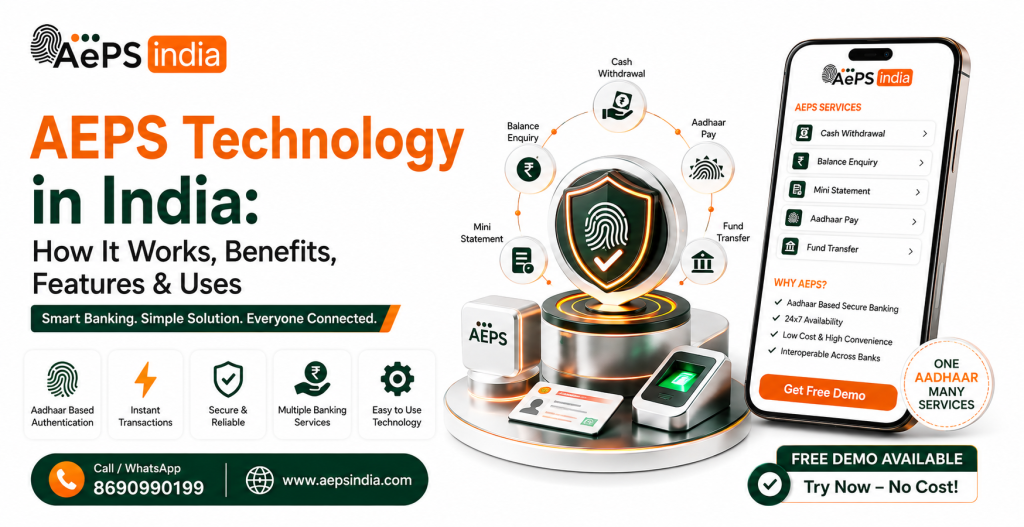
Are you looking to understand how AEPS technology works in India or planning to offer Aadhaar-based banking services through an AEPS platform? The Aadhaar Enabled Payment System (AEPS) is a bank-led payment system developed by Aeps india that enables customers with Aadhaar-linked bank accounts to access supported banking services through an authorised Business Correspondent (BC) using Aadhaar authentication.
Today, AEPS technology in India is helping bring essential banking services closer to customers, particularly through local BC and agent touchpoints. Depending on the applicable AEPS setup, services can include cash withdrawal, balance enquiry, mini statement, cash deposit and Aadhaar-to-Aadhaar fund transfer.
Aadhaar Enabled Payment System (AePS) is a bank-led technology model built by the NPCI that allows users to perform basic banking tasks like cash withdrawals, deposits, and balance checks using just their Aadhaar number and a fingerprint or iris scan at micro ATM or business correspondent touchpoints, without needing a debit card, smartphone, or PIN.
For fintech companies, AEPS service provider, retailers, distributors and businesses building digital banking platforms, the technology is also an important part of creating a centralized AEPS software, AEPS portal or AEPS API integration. A well-Aeps platform designed can connect the required best AEPS services with retailer management, transaction monitoring, wallet and commission management, reporting and other business modules.
The core strength of AEPS technology is its authentication-based transaction model. A customer provides the required Aadhaar/Virtual ID and bank information, while the transaction uses an applicable authentication method such as biometric authentication. AEPS documentation notes support for fingerprint and iris biometric matching, along with other authentication methods in the Aadhaar authentication ecosystem.
For businesses, choosing the right AEPS software and AEPS technology provider is therefore important. Aeps API capability, security, transaction-status handling, supported services, scalability, reporting, technical support and applicable NPCI and banking requirements should be evaluated before implementation.
AEPS India provides AEPS technology solutions, Best AEPS software and AEPS API solution for businesses that want to build or expand their digital banking services. Whether you need an best AEPS API, AEPS Admin Portal, B2B AEPS Software or a complete AEPS platform, the right Aeps solution can help you manage your AEPS operations through a structured and centralized system.
This guide explains how AEPS technology works, its key features, benefits for businesses and retailers, AEPS transaction flow, biometric authentication, AEPS software requirements, Aeps API integrated and important factors to consider before choosing an AEPS technology provider in India.
What Is AEPS Technology in India?
Aadhaar Enabled Payment System (AEPS) is a bank-led financial service model created by the National Payments Corporation of India (NPCI). It allows users to complete basic banking tasks using their Aadhaar number and fingerprint scan at a micro ATM or point-of-sale terminal with a local banking agent, eliminating the need for physical debit cards, PINs, or smartphones.
How Does AEPS Technology Work?
The Aadhaar Enabled Payment System (AePS) is a bank-led technology framework built by the National Payments Corporation of India (NPCI) that allows users to perform basic banking tasks such as cash withdrawals, deposits, and balance checks using only their Aadhaar number and biometric Aeps fingerprint or Aeps iris scan via a business correspondent.
Core Workflow Steps
- Data Input: The customer or agent inputs the 12-digit Aadhaar number and selects the specific bank name on a micro-ATM, smartphone app, or POS terminal.
- Biometric Capture: The customer scans their finger or eye on a UIDAI-certified Aeps biometric device.
- Encryption & Routing: The Aeps device encrypts the biometric data and sends the request securely through the NPCI central switching gateway.
- UIDAI Verification: The data routes to the Unique Identification Authority of India (UIDAI) to confirm identity match.
- Bank Settlement: Once verified, the host bank processes the financial transaction in real time and sends a confirmation SMS.
AEPS Services Available Through the Technology
The Aadhaar Enabled Payment System (AePS) is a bank-led model managed by the National Payments Corporation of India (NPCI). It allows users to perform basic financial and non-financial transactions using only their Aadhaar number and biometric authentication through a business correspondent or micro ATM device.
Core Financial Services
- Cash Withdrawal: Get money from an Aadhaar-linked bank account without a debit card or PIN.
- Cash Deposit: Add funds directly to an Aadhaar-linked account at supported banking touchpoints.
- Aadhaar to Aadhaar Fund Transfer: Send money securely from one Aadhaar-linked account to another.
- BHIM Aadhaar Pay: Accept merchant payments biometrically using an Aadhaar number.
Informational & Administrative Services
- Balance Enquiry: Check the current available balance in a linked bank account.
- Mini Statement: View recent transaction logs and history.
- Government Disbursements: Receive direct benefit transfers (DBT) like MNREGA wages and social security pensions.
Key Components of AEPS Technology
AePS technology relies on a combination of unique identification numbers, biometric verification, and centralized routing platforms to enable cardless and PIN-less financial transactions through local banking agents.
Core Identity & User Components
- Aadhaar Number: A unique 12-digit identification number issued by UIDAI that acts as the primary financial address for the customer.
- Bank Account Linkage: The user’s Aadhaar number must be properly seeded and linked to their specific bank account (AEBA) to route funds.
- Biometric Data: Aeps Fingerprints or Aeps iris scans captured from the user to authorize financial actions securely without a debit card or PIN.
Hardware & Touchpoint Infrastructure
- Biometric Scanner: STQC-certified and Registered Device (RD) compliant Aeps fingerprint device or Aeps iris scanner device that encrypt biometric inputs at the source.
- Micro-ATMs / POS Terminals: Handheld or mobile-connected hardware operated by local Business Correspondents (BCs) or micro-merchants to process requests.
- Computing and Network Device: An Android phone, tablet, or PC paired with stable internet connectivity to run the banking application interface.
Backend & Software Architecture
- UIDAI Authentication Server: Validates the captured biometric data against the central Aadhaar identity repository.
- National Payments Corporation of India (NPCI): The central switching and routing platform that processes, clears, and settles interoperable transactions across different participating banks.
- AePS API: Secure Aeps software interfaces that connect merchant or fintech Aeps apps with banking net.
Who Can Use AEPS Technology?
Any resident of India with a bank account linked to their Aadhaar number can use the AePS developed by the National Payments Corporation of India (NPCI). It requires no debit card, credit card, or smartphone, relying instead on biometric authentication.
Who Can Use It
- Bank Customers: Anyone whose bank account is mapped to an Aadhaar number (an Aadhaar-enabled bank account).
- Rural and Underserved Populations: People living in remote areas who lack access to physical bank branches or standard ATMs.
- Non-Smartphone Users: Individuals who cannot use standard mobile Aeps banking apps.
- Micro-Merchants and Shopkeepers: Small business owners who want to accept digital payments using Aeps biometric scanners without heavy POS hardware.
Industries Use AEPS Technology
Aadhaar-Enabled Payment System (AePS) technology is used across multiple industries in India to drive financial inclusion, enable cardless and password-free biometric authentication, and turn regular storefronts into micro-banking access points.
Key Industries Using AePS
- Fintech & Digital Banking: Companies integrate Aeps biometric API into Aeps application and Aeps platform to offer secure, cardless transactions and mobile wallet banking services.
- Retail & Kirana Stores: Local grocery shops, pharmacies, and general merchants use micro ATM hardware and top Aeps software to function as “Mini ATMs” for cash withdrawals and balance checks.
- Microfinance Institutions (MFIs) & NBFCs: Organizations use the technology to smoothly disburse loans and collect repayments in remote or unbanked areas without physical bank branches.
- Common Service Centers (CSCs) & E-Mitra: Digital citizen hubs use Aadhaar authentication to deliver essential government-to-citizen and basic banking utilities to rural populations.
- Banking & Financial Services (BFSI): Traditional commercial banks and authorized Business Correspondents (BCs) rely on the National Payments Corporation of India (NPCI) infrastructure to expand interoperable banking reach.
Requirements to Use AEPS Technology
To use or provide Aadhaar Enabled Payment System (AePS) technology, the requirements differ depending on whether you are an end customer making a transaction or a merchant/agent setting up an AePS touchpoint. Customers need an Aadhaar-linked bank account and their biometric data, while agents need certified hardware and Aeps portal registration.
Customer Requirements
- Aadhaar-Linked Bank Account: The customer’s bank account must be mapped and linked with their 12-digit Aadhaar number.
- Aadhaar Number/Details: The 12-digit Aadhaar number or virtual ID (or remembering the last digits).
- Biometric Authentication: Fingerprint impression or Aeps iris scan provided at the micro ATM software or agent terminal for verification.
- Bank Name: Knowing the name of the specific bank where the account is held.
Merchant / Agent Setup Requirements
- Smart Device: An internet-connected smartphone (Android 7.0+), tablet, or Windows computer.
- Biometric Scanner: A UIDAI/STQC-certified L1 Aeps Registered Device (RD) fingerprint or buy Aeps iris scanner device (such as Mantra).
- Internet Connection: A stable mobile data, broadband, or Wi-Fi network for real-time authentication.
- AePS App or Portal: Access to a banking correspondent best Aeps application, Aeps merchant portal, or Aeps API integrating via an authorized Aeps india.
- KYC & Documentation: Valid PAN card, Aadhaar card, active settlement bank account, and basic business registration proof.
Why Need AEPS Technology
Aadhaar Enabled Payment System (AePS) technology is needed to bridge the financial inclusion gap by allowing users to perform cardless, PIN-free banking transactions such as cash withdrawals, deposits, and balance checks using only their Aadhaar number and fingerprint verification via local micro ATM or business correspondents.
Core Reasons for AePS Technology
- Financial Inclusion: Brings essential Aeps banking services directly to rural and underserved populations who lack traditional bank branches or ATMs.
- No Cards or PINs Needed: Eliminates the necessity of carrying physical debit cards, remembering passwords, or generating OTPs.
- Biometric Security: Uses unique fingerprint or iris scans via UIDAI authentication, making transactions highly secure and difficult to forge.
- Interoperability: Allows any bank customer to use a micro ATM system or banking correspondent outlet operated by any participating member bank.
- No Smartphone Required: Empowers individuals who do not own smartphones or have access to advanced internet banking to safely handle basic funds.
Key Aspects of AEPS Technology
The Aadhaar Enabled Payment System (AEPS) is a bank-led model managed by the National Payments Corporation of India (NPCI) that allows cardless, PIN-free financial transactions using an Aadhaar number and biometric verification via local business correspondents or micro ATM service.
Technology & Security Aspects
- Biometric Authentication: Uses unique Aeps fingerprint or purachse Aeps iris scan device via UIDAI records, removing the need for physical debit cards or secret PIN passwords.
- Interoperability: Customers can use any bank’s best micro ATM device or agent point, regardless of where their account is held.
- Real-Time Processing: Transactions execute instantly through the central NPCI switch for immediate confirmation.
Impact & Accessibility
- Financial Inclusion: Brings formal banking to remote, rural, and unbanked populations.
- No Smartphone Needed: Users do not require a mobile phone or internet access; local agents handle the digital interface using connected biometric scanners.
- Government Disbursements: Streamlines direct delivery of social welfare payments, pensions, and MGNREGA wages.
Why Is AEPS Technology Important for Financial Inclusion in India?
The Aadhaar Enabled Payment System (AePS) operated by the National Payments Corporation of India (NPCI) drives financial inclusion by letting unbanked rural citizens use just an Aadhaar number and fingerprint biometrics at local micro ATM device or shopkeeper touchpoints for cardless cash withdrawals, deposits, and balance checks, eliminating travel to distant bank branches.
Removing Barriers to Banking
- No Cards or PINs: Users do not need debit cards, credit cards, or secret numbers.
- Doorstep Access: Local micro-retailers and business correspondents act as mini-banks right inside rural villages.
- No Literacy Hurdles: Top Aeps Fingerprint or Top Aeps iris scans replace complex text passwords and English interfaces.
Supporting Government Welfare
- Direct Benefit Transfers (DBT): Subsidies, pensions, and rural wages (like NREGA) go straight into accounts.
- Zero Middlemen: Funds reach actual citizens without leakages or corruption by local intermediaries.
Security and Interoperability
- Biometric Safety: Unique fingerprints prevent identity theft and unauthorized withdrawals.
- Interoperable Network: Any bank customer can use any bank’s micro ATM terminal.
AEPS Technology for Fintech Businesses
Aadhaar Enabled Payment System (AePS) technology allows fintech businesses to turn local retail shops into best micro ATM system. Customers can perform cardless, pin-less banking transactions such as cash withdrawals, balance checks, and mini-statements using just their Aadhaar number and fingerprint biometric verification.
Core Features of AEPS for Fintech
- Biometric Authentication: Uses UIDAI-compliant Buying Aeps fingerprint or Buying Aeps iris scanners for secure user identity verification.
- Interoperability: Connects seamlessly with the NPCI central switch to support accounts across multiple banks.
- White-Label Solutions: Allows startups to brand ready made Aeps software and top Aeps API portal as their own financial service.
- Real-Time Settlement: Processes transactions instantly with immediate Aeps commission credits for agents.
AEPS Technology for Retailers and Banking Agents
Aadhaar Enabled Payment System (AePS) technology allows retailers and banking agents to turn local shops into mini-banks. Using a biometric scanner and an internet-connected smartphone or computer, agents process cardless and PIN-less transaction such as cash withdrawals, deposits, and balance checks directly through the National Payments Corporation of India (NPCI) network.
How AePS Works for Agents
- Connect Hardware: Plug a certified Aeps biometric fingerprint or certified Aeps iris scanner into a mobile device or PC.
- Enter Details: Type in the customer’s 12-digit Aadhaar number and select their bank name.
- Select Service: Choose an action like cash withdrawal or balance inquiry on the agent portal.
- Biometric Scan: The customer scans their thumb or finger on the device to verify their identity.
- Instant Settlement: The bank account updates, funds transfer, and the agent earns a direct commission.
Benefits for Retailers
- Extra Income: Earn fixed commissions per successful transaction.
- More Footfall: Attract new local customers to the shop.
- Interoperability: Service customers from virtually any participating bank in India.
- No Cash Heavy Setup: Reduce the need to run to physical banks for small business liquidity.
AEPS Technology for Rural and Semi-Urban Banking
The Aadhaar Enabled Payment System (AEPS) is a bank-led model managed by the National Payments Corporation of India that allows cardless, PIN-less financial transactions. Using an Aadhaar number and biometric verification at local best micro ATM system or business correspondent touchpoints, rural and semi-urban residents can withdraw cash, check balances, and access government subsidies without visiting distant bank branches.
Core Features and Operations
- Biometric Security: Uses fingerprint or iris scans via STQC Aeps certified devices to verify identity.
- Interoperability: Connects customers of various banks to a central switch, enabling multi-bank support.
- Micro-ATM Network: Turns local rural mom-and-pop shops into functional banking kiosks.
- Direct Benefit Transfer (DBT): Grants immediate access to government welfare payouts and subsidies right at the village level.
Benefits for Underserved Regions
- Zero Travel Costs: Eliminates the need to travel long distances or spend money to reach urban bank branches.
- Financial Inclusion: Reaches populations lacking smartphones, debit cards, or high literacy levels.
- Local Empowerment: Allows small local retailers to work as banking agents and earn extra income through transaction commissions.
AEPS Technology for Businesses: What Software Should Include?
Good Aadhaar Enabled Payment System software for businesses must include core banking transaction tools, UIDAI-compliant biometric integration, a multi-tier Aeps admin and Aeps wallet management dashboard, and secure NPCI gateway connectivity.
Security & Hardware Integration
- Biometric device support: Connect smoothly with certified fingerprint and iris scanners (such as Mantra).
- UIDAI/NPCI compliance: Encrypt sensitive personal and financial data safely through official routing channels.
- Multi-bank routing: Support universal bank identification numbers (IIN) so any customer can use the platform regardless of their home bank.
Management & Administration Features
- Admin & wallet panel: Manage retailer, distributor, and super-distributor hierarchies.
- Automated commissions: Split and distribute agent commissions in real time after a successful transaction.
- Instant settlements (T+0/Payouts): Move funds instantly from the digital wallet to primary bank accounts.
- Reporting & analytics: Track active ledger logs, success/failure rates, and audit trails.
AEPS Technology Architecture
AEPS Technology Architecture
The multi-tier structural framework of Aadhaar Enabled Payment Systems
Features AEPS Technology
Aadhaar Enabled Payment System (AePS) is a bank-led model managed by the National Payments Corporation of India (NPCI) that allows cardless, PIN-free financial transactions. Users can access basic banking services anywhere using just their Aadhaar number and biometric verification through authorized Aeps india.
Core Functional Features
- Cardless & PIN-Free: Eliminates the need for physical debit cards, credit cards, or passwords.
- Biometric Authentication: Uses unique fingerprint or iris scans via UIDAI-backed data to safely verify identity.
- Interoperable Network: Allows customers of any participating bank to use micro ATM machine or banking kiosks managed by any other participating bank.
- Multi-Service Access: Supports Aeps cash withdrawal, Aeps cash deposit, Aeps balance inquiry, Aeps mini statement and Aadhaar-to-Aadhaar fund transfers.
System and Operational Advantages
- Financial Inclusion: Reaches rural and remote regions where physical bank branches are unavailable.
- Government Disbursements: Streamlines direct transfers for social welfare funds, pensions, and subsidies.
- High Security & Real-Time Processing: Delivers immediate transaction verification and instant processing over secure encrypted channels.
Benefits AEPS Technology
The Aadhaar Enabled Payment System (AePS) is a bank-led model managed by the National Payments Corporation of India (NPCI). It allows users to perform basic banking tasks like cash withdrawals, deposits, and balance checks using only their Aadhaar number and Aeps biometric fingerprint scan at local micro ATM machine or business correspondent touchpoints.
Financial Inclusion
- Reaches remote areas: Brings banking to rural and unbanked populations who live far from physical bank branches.
- No card or smartphone needed: Eliminates the requirement for debit cards, PINs, or internet-enabled mobile phones for customers.
Security & Convenience
- Biometric verification: Uses unique fingerprint authentication to make transactions secure and lower the risk of fraud.
- No memorization required: Users do not need to remember complicated passwords, PINs, or account numbers.
- Interoperable: Allows customers to access any Aadhaar-linked bank account through any authorized Aeps india.
Government Support
- Direct benefit transfers: Helps citizens safely and instantly withdraw government subsidies, pensions, and financial aid credited straight to their Aadhaar-linked accounts.
AEPS Transaction Process Step by Step
An Aadhaar Enabled Payment System (AePS) transaction allows customers to perform basic banking tasks such as Aeps cash withdrawal service, Aeps balance inquiry service, or Aeps mini-statement service using their 12-digit Aadhaar number and fingerprint authentication through a buy micro ATM device without needing a debit card or PIN.
Step-by-Step Transaction Process
- Visit a Banking Outlet: Go to any authorized Micro ATM Device.
- Provide Aadhaar Details: Give your 12-digit Aadhaar number to the operator.
- Select the Bank: Name the specific bank linked to your Aadhaar account.
- Choose Transaction Type: Select the service you need, such as Aeps Cash Withdrawal services, Aeps Balance Enquiry services, or Aeps Mini Statement services.
- Enter Amount: Specify the cash amount if you are making a withdrawal.
- Biometric Verification: Place your finger on the connected biometric scanner to verify your identity via UIDAI.
- Completion and Receipt: Once authenticated successfully, the transaction processes instantly, cash is dispensed by the agent (if withdrawing), and a physical or digital receipt is provided.
AEPS Technology Cost in India
An Aadhaar Enabled Payment System technology cost structure for businesses and fintech developers typically includes a one-time setup or Aeps integration fee of ₹12,000 to ₹35,000, white-label Aeps portal solutions from ₹15,000 to ₹1,20,000, annual maintenance fees of ₹10,000 to ₹40,000, and per-transaction switching or operational fees.
Development & Software Setup Fees
- Standard API Integration: ₹12,000 to ₹35,000 as a one-time Aeps API developer fee to plug AePS features into an existing application.
- White-Label Portals: ₹15,000 to ₹1,20,000 for a pre-branded web platform and mobile Aeps app to build a Aeps B2B retailer network.
- Direct Bank Integration: ₹2,50,000 to ₹4,50,000 for custom enterprise setups connecting directly with sponsor banks.
Recurring & Operational Costs
- Annual Maintenance (AMC): ₹10,000 to ₹40,000 billed yearly for server uptime, security patches, and technical support.
- Per-Transaction Fees: ₹0.25 to ₹1.50 per successful hit, or 0.5% to 1% value slabs charged by master aggregators/banks.
- Failed Authentications: Around ₹0.50 charged per Aeps biometric scan that fails UIDAI/server validation.
Hardware & Retailer Requirements
- Biometric Scanners: ₹1,500 to ₹3,000 per unit for L1 Aeps certified fingerprint devices (such as Mantra).
- Agent Commissions Payouts: Retailers earn back ₹2.00 to ₹15.00+ per successful cash withdrawal based on tiered slab amounts.
How AEPS Technology Helps Retailers Increase Income
Aadhaar Enabled Payment System (AePS) technology helps retailers increase income by turning local shops into neighborhood “mini-ATMs”. Retailers earn direct cash commissions on every financial transaction like withdrawals or balance checks, while higher customer footfall drives extra sales for their primary retail goods.
Direct Commission Earnings
- Per-Transaction Pay: Retailers get a small commission or fee from service providers for every successful cash withdrawal, balance check, or mini-statement.
- Steady Revenue Stream: High daily transaction volumes turn routine banking tasks into a reliable secondary income source.
Increased Shop Visitors
- More Footfall: People look for local spots to withdraw money instead of traveling far to a bank branch or ATM.
- Cross-Selling Goods: Customers who enter a shop just to use the best AePS service often buy regular groceries, snacks, or products on impulse.
Low Setup and Operation Costs
- Minimal Investment: Retailers only need a basic smartphone, internet access, and a cheap Aeps biometric fingerprint scanner.
- No Extra Staff: Existing shop workers can run the service easily during normal business hours.
AEPS Technology Devices and Hardware
Aadhaar Enabled Payment System (AePS) hardware relies on STQC-certified, UIDAI-compliant Aeps biometric devices such as single-finger USB/Bluetooth scanners, integrated Android POS terminals, and handheld Micro ATM featuring built-in thermal printers and L1 encryption security to facilitate cardless, pinless banking transactions via the NPCI switch.
Core Hardware Components
- Biometric Fingerprint Scanners: Captures high-resolution fingerprint impressions (e.g., Mantra MFS100).
- Iris Scanners: High-security optical readers used when fingerprints are worn out.
- Micro-ATM Terminals: All-in-one portable units with card slots, fingerprint pads, and printers.
- Biometric POS & Tablets: Android-driven handheld devices (e.g., Mantra series) with 4G/Wi-Fi.
Technical & Security Standards
- STQC / UIDAI Certification: Mandatory quality and safety validation for data capture.
- L1 Device Compliance: Hardware-level encryption ensuring biometric data is securely signed at the device endpoint.
- Registered Device (RD) Service: Branded Aeps Software layer connecting hardware safely to UIDAI servers without storing raw data.
AEPS Transaction Limits, Charges and Commission
Aadhaar Enabled Payment System (AePS) transactions are typically capped at ₹10,000 per cash withdrawal. Customer charges are often free for initial monthly transactions, then cost ₹15 to ₹20 + GST, while micro ATM/retail agents earn a tiered commission ranging from ₹2 to ₹20+ per successful transaction.
Transaction Limits
- Maximum per transaction: ₹10,000 for cash withdrawals.
- Daily cumulative cap: Usually up to ₹50,000 depending on the specific bank’s risk policies.
- Aadhaar Pay limit: Up to ₹50,000 per transaction for merchant payments.
- Frequency: Typically restricted to 3 to 5 biometric authentications per day per user.
Customer Charges
- Cash withdrawal & Balance inquiry: Usually 3 to 4 free transactions per month at non-home bank touchpoints or Business Correspondents (BCs).
- Post-free limit fees: Generally ₹15 to ₹20 + GST per transaction.
- Mini-statement: Often includes up to 5 free queries monthly, with subsequent checks costing around ₹5 + GST.
Agent/Retailer Commission Slabs
- Balance inquiry / Mini-statement: ₹1 to ₹5 fixed reward per check for the agent.
- Low-value withdrawals (₹100 – ₹1,000): ₹2 to ₹5 commission.
- High-value withdrawals (₹3,000 – ₹10,000): Tiered peak High Aeps commission ranging from ₹10 to ₹20+ per transaction.
- Aadhaar Pay merchant sales: Retailers can optionally charge customers roughly 1% of the transaction amount.
AEPS Biometric Authentication Technology
The Aadhaar Enabled Payment System (AePS) uses biometric authentication technology such as fingerprints or iris scans matched with a 12-digit Aadhaar number. Aeps Developed by the Aeps india, it allows cardless and PIN-less banking transactions through top micro ATM at local business correspondent touchpoints.
Core Technologies Used
- Fingerprint Scanners: Optical or capacitive STQC-certified sensors capture unique ridge patterns from fingers.
- Iris Scanners: High-resolution cameras capture distinct iris patterns for secure, contactless verification.
- Registered Devices (RD) Service: Aeps Software framework ensuring biometric data is encrypted at the hardware level before leaving the Aeps scanner device.
AEPS Technology Architecture and Transaction Flow
Best AePS is a bank-led model managed by the Aeps india that enables cardless, pinless financial transactions using 12-digit Aadhaar numbers and biometric authentication (fingerprint or iris scan) via top Micro ATM system.
Core Technology Architecture Components
- Customer Touchpoint: A micro ATM, PoS terminal, or mobile Aeps app operated by a Aeps india attached to a UIDAI-certified Aeps biometric scanner.
- BC/Aggregator Server: Encapsulates transaction requests from the terminal into standardized ISO/XML messages and routes them securely.
- NPCI Switch: The central clearing and routing hub that maps the transaction to the correct destination bank or authority.
- UIDAI Central ID Data Repository (CIDR): Validates the user’s biometric data and Aadhaar number match.
- Issuer Bank Core Banking System (CBS): Maintains the actual user bank account, performs balance checks, and authorizes financial debits/credits.
AEPS Technology Transaction Flow Example
AEPS Transaction Technology Flow
The Customer provides their Aadhaar number and selects the transaction type (Cash Withdrawal/Balance Inquiry) to the Business Correspondent (BC).
The BC captures the customer’s fingerprint using a registered biometric scanner. This data is encrypted and sent to the server.
The request is routed through NPCI (National Payments Corporation of India), which acts as the central switch to find the customer’s linked bank.
The Bank (Issuer) verifies the biometric data with UIDAI and checks for sufficient funds in the account.
The bank debits the amount and sends a success response back through NPCI to the BC Agent.
The BC Agent provides the cash to the Customer, and the transaction is marked as completed.
AEPS Technology Transaction Status and Reconciliation
Aadhaar Enabled Payment System (AePS) transaction status tracking and reconciliation involve matching real-time biometric and financial logs across the agent touchpoint, the National Payments Corporation of India (NPCI) switch, UIDAI, and the issuer bank to ensure funds and settlement records match completely.
Transaction Status Lifecycle
- Initiation: The agent or micro-ATM terminal submits the customer’s Aadhaar number, bank IIN, and biometric data.
- Authentication: UIDAI and the NPCI switch verify the fingerprint against the Aadhaar vault.
- Authorization: The customer’s bank processes the debit or credit request in real-time.
- Response States: The system returns a status of Success, Failed, or Pending/Timeout back to the terminal.
The Reconciliation Process
- Data Ingestion: Downloading end-of-day transaction logs, switch report files from NPCI, and core Aeps banking system (CBS) settlement files.
- Matching Engine: Cross-verifying transaction IDs, amounts, and timestamps to find exact matches for successes and failures.
- Exception Handling: Flagging mismatches such as customer account debits where the terminal reported a failure or timeout.
- Adjustment & Chargebacks: Raising automated credit adjustments, refunding failed debits, or processing chargeback claims with partner banks.
AEPS Technology Security and Compliance
AEPS security and compliance rely on hardware-level biometric encryption, real-time verification through NPCI, and strict data-privacy regulations. Systems must utilize L1 Aeps certified scanners, enforce a strict non-storage policy for biometrics, and comply with the Reserve Bank of India mandates.
Core Technology Security Measures
- Registered Device (RD) Services: Hardware-level encryption captures fingerprints or iris scans via STQC Aeps certified devices before data reaches the best Aeps application layer.
- End-to-End Encryption (E2EE): Data packets containing Aadhaar and transaction details are encrypted using SSL/TLS and RSA protocols during transit.
- Liveness Detection: Scanners verify that fingerprints belong to a live human, blocking fake silicone or rubber impressions.
- Data Non-Storage Policy: Local servers and agent terminals are strictly prohibited from saving biometric logs, Aadhaar numbers, or PINs.
Regulatory and Compliance Framework
- NPCI & RBI Mandates: Operations must align directly with the Reserve Bank of India framework, implementing real-time transaction monitoring and risk caps.
- One Operator, One Bank: Rules tie specific micro ATM operator or merchants to singular banking channels to increase accountability.
- Mandatory Agent KYC: Comprehensive verification (Aadhaar/PAN) of all active business correspondents and re-KYC requirements after periods of prolonged inactivity.
- Access Control: Role-Based Access Control (RBAC) secures backend infrastructure from internal data exposure.
AEPS Technology vs Traditional Banking
The Aadhaar Enabled Payment System (AEPS) is a cardless, biometric-driven financial service model allowing basic banking transactions via local business correspondents using an Aadhaar number. Traditional banking relies on physical brick-and-mortar branches, debit/credit cards, cheque books, and manual or ATM-based self-service.
Core Differences
Access Point:
- AEPS: Local micro ATMs, banking correspondents, or neighborhood retail shop touchpoints.
- Traditional Banking: Physical bank branches, standalone ATMs, or formal office setups.
Authentication:
- AEPS: Biometric verification (fingerprint or iris scan) matched via UIDAI.
- Traditional Banking: Signature, physical debit/credit card PINs, passwords, or passbooks.
Required Items:
- AEPS: Only an Aadhaar-linked bank account number and biometric impression; no cards, phones, or PINs needed.
- Traditional Banking: Physical cards, passbooks, check leaves, or smartphone/internet banking credentials.
Service Range:
- AEPS: Limited to fundamental operations like cash withdrawal, balance inquiry, mini-statements, and Aadhaar-to-Aadhaar transfers.
- Traditional Banking: Full-service spectrum including complex loans, lockers, foreign exchange, large corporate accounts, and detailed account management.
Target Audience:
- AEPS: Rural, unbanked, or tech-hesitant populations needing immediate last-mile cash access.
- Traditional Banking: Urban and rural populations requiring exhaustive financial instruments and high-value asset handling.
Common AEPS Transaction Problems and Solutions
Aadhaar Enabled Payment System (AePS) transaction failures typically happen due to biometric mismatches, unlinked bank accounts, or server timeouts. Resolving them requires checking error prompts, re-scanning fingerprints cleanly, or verifying Aadhaar seeding status with the respective issuer bank.
Biometric Authentication Failures
- Cause: Worn or dusty fingerprints, dry skin, or poor scanner quality.
- Solution: Clean the biometric scanner glass and customer’s finger. Use lotion for dry fingers or try scanning an alternative finger.
Aadhaar Not Seeded or Mapped
- Cause: Bank account is not linked to Aadhaar or missing from the NPCI mapper.
- Solution: Ask the customer to visit their home bank branch to complete Aadhaar seeding and e-KYC mapping.
Insufficient Funds or Limits Exceeded
- Cause: Account balance is lower than the requested withdrawal amount, or daily frequency/amount limits are reached.
- Solution: Perform a balance inquiry first. Advise the customer to try a lower withdrawal amount or return the next day.
Network and Server Timeouts
- Cause: Poor internet connectivity at the agent point or downtime at the UIDAI or issuer bank server.
- Solution: Restart the modern micro ATM device, check network signal strength, and wait a few minutes before retrying.
How to Choose the Right AEPS Technology Provider in India
Aeps india one of the right AEPS technology provider, evaluate core factors like AEPS India compliance, 99.9% system uptime, instant T+0 settlements, transparent Aeps commission model and robust 24/7 technical support to ensure seamless, secure, and profitable financial service operations.
Security and Compliance
- NPCI & UIDAI Rules: Verify that the best Aeps platform complies fully with National Payments Corporation of India and Reserve Bank of India mandates.
- Biometric Security: Ensure the top Aeps software supports L0/L1 certified Aeps biometric fingerprint and Aeps iris scanning devices for safe customer authentication.
- Data Encryption: Look for end-to-end encryption across all data packets to prevent financial fraud.
Reliability and Performance
- Uptime Stability: Choose infrastructure aiming for 99.9% uptime to prevent service drops during peak business hours.
- High Success Rates: Prioritize networks with multi-bank failover routing that bypasses individual bank server downtimes automatically.
- Fast Processing: Transactions should complete within 2 to 3 seconds to maintain consumer trust at retail counters.
Financials and Liquidity
- Instant Settlements: Demand real-time or same-day (T+0) wallet settlements so working capital is never locked or delayed.
- Commission Payouts: Compare transparent per-transaction earnings without hidden service fees or unexpected charges.
- Value-Added Services: Check for integrated features like buy Micro ATM software, BBPS Software and mini-statement options.
Integration and Support
- Developer Tools: Clear Aeps API documentation, developer assistance, and sandbox testing environments speed up Aeps admin platform launch times.
- Technical Assistance: Round-the-clock (24/7) support via phone or chat is critical to instantly fix failed requests or technical glitches.
Why Choose AEPS India for AEPS Technology Solutions?
Aeps india one of the right Aeps provider for AEPS technology solution, evaluate key aspects like NPCI and UIDAI compliance, 99.9% system uptime, instant T+0 fund settlements, and competitive Aeps commission structure to protect your business against failed transactions and cash-flow delays.
Security and Compliance
- Regulatory rules: Verify adherence to NPCI and UIDAI specifications.
- Biometric security: Ensure support for STQC-certified L0/L1 fingerprint or iris scanners.
- Data protection: Look for end-to-end encryption across transaction pipelines.
Performance and Reliability
- Success rate: High uptime (99%+) prevents dropped requests and user drops.
- Fast processing: Biometric requests should process within 2 to 3 seconds.
- Failover routing: Multi-bank switching mechanisms lower failure frequency.
Commercials and Liquidity
- Commission margins: Compare per-transaction payouts for cash withdrawals and balance checks.
- Settlement speed: Instant T+0 or same-day liquidity keeps working capital active.
- Transparent pricing: Check for hidden Aeps b2b platform or maintenance fees.
Integration and Management
- API flexibility: Aeps Developer-friendly documentation and sandbox testing environments.
- Admin dashboard: Real-time transaction monitoring, reports, and wallet control.
- Technical support: Responsive 24/7 assistance to troubleshoot server or device errors.
Get AEPS Technology & API Solutions for Your Business
AEPS Technology in India has made essential banking services more accessible by enabling assisted, Aadhaar-authenticated transactions through Business Correspondents and supported banking infrastructure. NPCI describes top AePS as a bank-led model that enables interoperable financial inclusion transactions through PoS/Micro-ATM channels.
For fintech companies, retailers, distributors, and digital banking businesses, the right AEPS Technology, right AEPS API, and AEPS earning Software can help create a centralized top Aeps platform for supported services such as cash withdrawal, balance enquiry, mini statement, and other applicable AEPS services. The technology should be selected based on secureAeps API integration, security, transaction handling, scalability, reporting, and support—not simply on a list of features.
Aadhaar Enabled Payment System (AePS) is a bank-led technology model created by the National Payments Corporation of India (NPCI). It lets people do basic banking using just their Aadhaar number and fingerprint scan. You do not need a debit card, credit card, or password.
AEPS India provides AEPS API and AEPS Software solution for businesses that want to integrate Aadhaar-enabled banking services into their website, mobile application, B2B platform, or digital payment system. Its published AEPS solution focus on Aadhaar Enabled Payment System API integration, transaction management, Aeps business dashboard and support for fintech and retail networks.
If you are planning to start AEPS business, integrated AEPS API, develop AEPS Software, or upgrade an existing digital Aeps banking platform, choose a solution that matches your business requirements and applicable banking, NPCI, UIDAI, and other regulatory requirements.
Ready to build or upgrade your AEPS platform? Contact AEPS India to discuss your AEPS API, AEPS Software, and business requirements and request a suitable demo or integration solution.
Build Your AEPS Technology Solution with Expert Support
Looking to start or expand your AEPS business? Get a professional AEPS Technology solution designed for secure Aadhaar-enabled transactions, retailer management, commission management, banking services, and smooth business operations. Discuss your requirements with our team and choose the right solution for your business.
Frequently Asked Questions About AEPS Technology in India
AEPS (Aadhaar Enabled Payment System) is a bank-led payment system that enables customers to access certain banking services through Aadhaar authentication at authorised Business Correspondent channels. NPCI describes AEPS as supporting transactions through Micro-ATMs, kiosks and mobile devices operated by authorised BCs.
AEPS generally works through a customer, authorised BC/agent, AEPS-enabled device or application, authentication process, and participating bank. The customer provides the required Aadhaar/VID and authentication information, the request is processed through the relevant AEPS infrastructure, and the transaction response is returned after bank-side processing.
Supported AEPS services can include cash withdrawal, balance enquiry, mini statement, cash deposit and Aadhaar-to-Aadhaar fund transfer, depending on the applicable service and participating institutions. NPCI’s AEPS documentation lists these transaction types among the system’s supported services.
Important AEPS technology features include Aadhaar-based authentication, biometric authentication, interoperable banking transactions, Micro-ATM/BC access, transaction processing and support for basic banking services. The exact features available to a business depend on its authorised best AEPS setup and Aeps india.
AEPS helps extend basic banking access through authorised BCs and other supported channels, which can be particularly useful where traditional bank branches or ATMs are less accessible. This makes AEPS an important part of India’s financial-inclusion infrastructure.
An AEPS Software Provider supplies the technology layer businesses can use to manage their AEPS operations, such as an b2b AEPS app, Aeps b2b portal, Aeps admin dashboard, retailer management, transaction reporting and Aeps API connectivity. The actual banking service and transaction processing remain subject to the relevant authorised banking and AEPS ecosystem.
Yes. Businesses can use an professioanl AEPS API to integrate supported AEPS functionality into compatible websites, mobile Aeps application, B2B Aeps platform or other Aeps commission software. Before integration, businesses should evaluate best Aeps API documentation, authentication, transaction-status handling, security requirements and technical support.
Yes. Fast AEPS software and Fast AEPS platform can help authorised retailers, Business Correspondents and Aeps B2B networks manage supported Aeps banking API services from a central system. For a business solution, useful capabilities can include retailer management, transaction monitoring, commission configuration, wallet management and reporting.
Requirements depend on the business model and authorised AEPS arrangement. Customers generally need an AEPS-enabled bank account relationship and the required authentication, while businesses and agents need the appropriate Aeps onboarding, authorisation, technology, compatible biometric/device infrastructure and applicable compliance processes. AEPS India’s FAQ similarly notes the importance of a participating bank account, Aadhaar linkage and biometric authentication.
If you want to start or expand an AEPS business, AEPS India offers AEPS-focused technology solutions for businesses looking for best AEPS earning Software, AEPS Service API, branded AEPS Platform, retailer management and related top AEPS services. Before purchasing, discuss your business model, required services, best Aeps API integration, retailer/distributor structure and technical requirements so you can select the appropriate solution.
What Is AEPS Transaction? Meaning, Process, Types & Benefits

AEPS Portal Benefits That Help You Earn More Commission

Latest AEPS Software Trends Every Retailer Should Know
About Author

