AEPS API Integration in India for B2B Networks
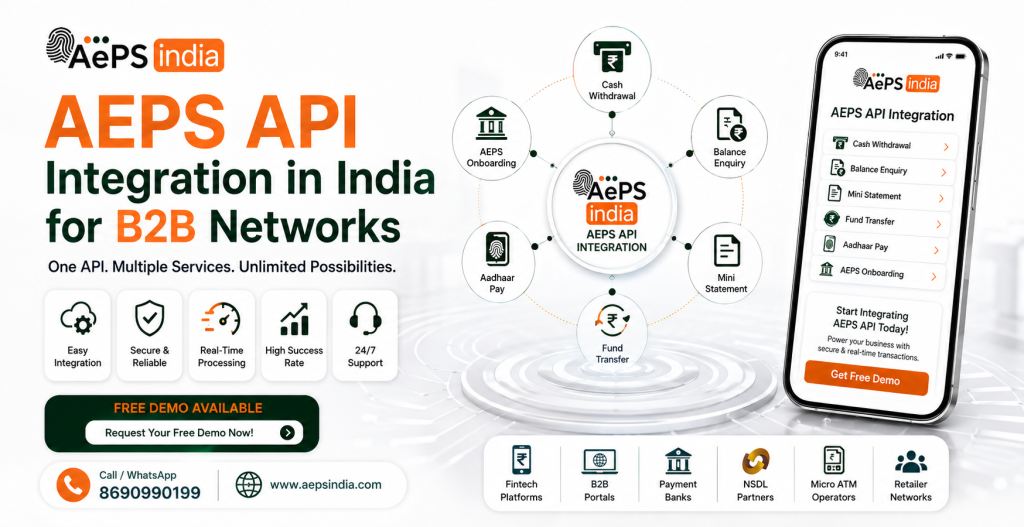
Are you looking for a reliable AEPS API to integrate Aadhaar-enabled banking services into your website, mobile app, fintech platform, or existing software? With the right AEPS API Integration, businesses can connect supported AEPS services with their own digital platform and provide a smoother transaction experience for retailers and customers.
An AEPS API provides the technical connection required to add services such as cash withdrawal, balance enquiry, and mini statement to compatible applications and software. A practical integration also requires proper Aeps API documentation, authentication, transaction-status handling, secure callbacks/webhooks where applicable, testing, and technical support.
AEPS API integration allows software applications and websites to process cardless, biometric-backed banking transactions such as cash withdrawals, balance checks, and mini-statements directly via NPCI and UIDAI networks using an Aadhaar number and fingerprint scan.
For fintech companies, AEPS businesses, B2B payment platforms, retailers, distributors, and digital banking businesses, the challenge is not simply finding an Aeps API. You need an AEPS API Provider in India that can support your technical requirements and business workflow from integration through deployment.
AEPS India provides AEPS API and AEPS API Integration solution for businesses that want to integrate AEPS services into their existing Aeps software or build a new AEPS platform. You can discuss your required services, best Aeps API requirements, retailer or distributor setup, transaction workflow, and integration environment before moving to production.
A successful AEPS API Integration should be evaluated on more than marketing claims. Before choosing a Aeps india, check the best Aeps API documentation, supported services, security practices, transaction response and failure handling, integration support, scalability, applicable compliance requirements, and overall commercial terms.
In this complete guide, you will learn how AEPS API Integration works, the AEPS API integration process, required technical components, supported best AEPS services, security considerations, Aeps API testing, common integration challenges, pricing factors, and how to choose the Aeps india for your business.
Ready to integrate AEPS API into your best Aeps platform? Explore the AEPS India solution, discuss your requirements, and request an AEPS API demo before you start your integration.
What is AEPS API Integration?
AEPS API Integration is the technical process of connecting a software app, website, or digital platform to the Aadhaar Enabled Payment System. It lets businesses offer cardless, PIN-free banking services like cash withdrawals, balance checks, and mini-statements using a customer’s Aadhaar number and fingerprint verification via the NPCI network.
AEPS API Integration Work?
AEPS (Aadhaar Enabled Payment System) API integration enables apps or websites to process cardless banking transactions such as cash withdrawals, balance checks, and mini-statements using a customer’s Aadhaar number and fingerprint via the NPCI network.
Core Transaction Workflow
- Initiation: The agent inputs the customer’s 12-digit Aadhaar number, bank name (or IIN), and service type into the top Aeps platform.
- Biometric Capture: The customer scans their finger on an STQC-Aeps certified biometric device using Registered Device (RD) services.
- Encryption: The application encrypts the biometric and Aadhaar block data locally for maximum security.
- Routing & Validation: The top Aeps API sends the request to the fintech/bank switch, which routes it through NPCI to UIDAI and the issuer bank for validation.
- Settlement: The bank authorizes the transaction, debits the user’s account, and instantly credits the merchant’s wallet.
AEPS Services You Can Integrate Through API
Integrating Aadhaar Enabled Payment System API allows Aeps fintech platform, retail networks, and financial institutions to turn any web portal or mobile Aeps application into a digital micro-ATM. These secure Aeps API leverage the National Payments Corporation of India (NPCI) network to deliver cardless, biometric-based banking.
The primary AEPS services you can integrate through an API include:
1. Core Banking Services
- Cash Withdrawal: Allows customers to withdraw money securely from their Aadhaar-linked bank accounts using biometric authentication (fingerprint or iris scan) without needing a debit card or ATM PIN.
- Balance Inquiry: Enables real-time checking of the available balance in an Aadhaar-linked bank account.
- Mini Statement: Retrieves a short summary of the account’s last 5 to 10 transactions instantly.
- Cash Deposit: Allows users to deposit cash into an Aadhaar-linked bank account via an authorized merchant terminal or business correspondent agent.
2. Payment & Transfer Services
- Aadhaar Pay (Merchant Payments): A merchant-specific payment solution that lets retailers accept digital payments directly from a customer’s bank account using biometrics, bypassing traditional POS card machines.
- Fund Transfer: Facilitates direct, secure interbank or intra-bank money transfers between two Aadhaar-linked bank accounts using only the recipient’s Aadhaar number.
3. Ancillary Identity & Business Services
- eKYC Services: Facilitates paperless, real-time electronic Know Your Customer (eKYC) verification for Aeps onboarding customers, opening bank accounts, or activating services via UIDAI data validation.
- Agent Payout & Settlement: Automates real-time or instant payout routes to distribute agent commissions and manage wallet-to-bank settlements for business networks.
Documents Required for AEPS API Integration
To integrated AEPS API, you must submit personal KYC documents, business registration, settlement bank details, and use a STQC-certified Aeps biometric fingerprint or Aeps iris scanner for mandatory identity authentication.
Personal Identity & KYC
- PAN Card: Mandatory for individual or corporate tax compliance and financial tracking.
- Aadhaar Card: Essential for performing e-KYC; the Aadhaar must link to an active mobile number for OTP verifications.
- Passport-Sized Photograph: Recent colored photo of the applicant, director, or authorized merchant.
- Active Contact Info: A valid email address and a mobile number linked directly to Aadhaar.
Business & Address Proof
- Registration Proof: GST Certificate, Udyam MSME Registration, or a Shop & Establishment License.
- Business Address Proof: Utility bills (electricity or water) or official registration paperwork matching the operating location.
Bank Settlement Details
- Cancelled Cheque: Required to configure the payout and settlement account.
- Bank Passbook or Statement: Front page copy of the bank passbook or a certified bank statement.
Hardware & Technical Requirements
- Biometric Scanner: A UIDAI and STQC-certified fingerprint or Aeps iris scanner device (such as Mantra) with active RD service.
- Server Environment: Secure HTTPS endpoints and a compliant technical architecture to process encrypted cryptographic PID blocks.
What You Need for AEPS API Integration
To successfully integrate AePS API, you need an NPCI-approved and RBI-licensed Aeps india, verified business KYC documentation, a secure HTTPS server environment, and a UIDAI/STQC-certified Aeps biometric fingerprint scanner that supports Registered Device (RD) services.
Core Requirements
- Licensed API Partner: Partner with a Aeps india authorized by the Multi Bank.
- Business & Agent KYC: Submit official business registration proof (GST, MSME/Udyam, or Shop Act) along with the owner’s PAN card and Aadhaar card.
- Certified Hardware: Obtain a UIDAI/STQC-certified Aeps biometric device (such as Mantra) with active RD service subscriptions for encrypted data capture.
- Technical Infrastructure: Maintain a secure cloud or local server environment using HTTPS/SSL protocols to handle encrypted requests and payloads safely.
- Developer Credentials: Acquire your Aeps Merchant ID (MID), Aeps API keys, and sandbox documentation from Aeps india to run initial tests.
Who Can Use AEPS API Integration
Fast AEPS API integration can be used by authorized Aeps india company to offer biometric-based, cardless banking services like cash withdrawals and balance inquiries directly through their Aeps software platform.
Key Eligible Entities
- Fintech Startups and Developers: Integrate biometric banking into custom mobile Aeps app or websites to expand digital wallet and financial service offerings.
- Business Correspondents (BCs) and Agents: Authorized representatives who bring banking access to rural or unbanked areas on behalf of banks.
- Local Retailers and Shop Owners: Kirana stores, pharmacies, and mobile recharge shops use integration to turn storefronts into functional “micro ATM device“.
- Common Service Centers (CSCs) and E-Mitra Hubs: Provide essential government-to-citizen financial services and cash-out options locally.
- Microfinance Institutions (MFIs): Manage secure cash disbursements and remote loan collections.
- Banks and NBFCs: Aeps india use backend infrastructure to power digital delivery channels and agent networks.
Why Use AEPS API Integration
Best AEPS API integration lets businesses turn mobile apps or websites into virtual micro ATM. It allows customers to perform cardless and PIN-less transactions such as cash withdrawals, balance checks, and mini-statements using just their Aadhaar number and fingerprint verification.
Key Business Benefits
- New Income Sources: Retailers and local shops earn Aeps commission fees on every successful cash withdrawal or balance lookup.
- More Foot Traffic: Aeps india offering Aeps banking API services brings more people into physical stores or local businesses.
- No Cards or PINs Needed: Customers do not need physical debit cards or secret passwords, which reduces failed transactions caused by forgotten PINs.
- Reaches Rural Areas: Helps people in remote regions access cash and government subsidies easily without visiting a distant bank branch.
Core Technical Features
- Biometric Security: Uses UIDAI-approved Aeps fingerprint scans to confirm customer identity and prevent fraud.
- Bank Interoperability: Connects smoothly with the National Payments Corporation of India (NPCI) network to support almost all major Indian banks.
- Real-Time Speed: Processes requests instantly so funds transfer and confirm within seconds.
Industries Use AEPS API Integration
AEPS API integration is used by fintech companies, retail stores, microfinance institutions, banking correspondents, and government e-governance hubs. It allows apps and local storefronts to process cardless financial transactions such as cash withdrawals, balance checks, and mini-statements using an Aadhaar number and a fingerprint.
Key Industries Using AEPS API Integration
Fintech & Digital Banking:
- Embeds biometric security into mobile Aeps wallets and Aeps apps.
- Offers cardless banking services to digital users.
Retail & Local Stores:
- Kirana shops, pharmacies, and local merchants use it.
- Turns ordinary shops into micro ATM system for local cash delivery.
Banking Correspondents (BCs) & Agents:
- Acts as mobile bank branches in rural or unbanked areas.
- Bridges the gap where physical banks are not close by.
Microfinance Institutions (MFIs) & NBFCs:
- Collects local loan repayments and EMIs securely.
- Distributes funds quickly using fingerprint confirmation.
Government & E-Governance Hubs:
- Common Service Centers (CSCs) process welfare funds and pensions.
- Manages Direct Benefit Transfers (DBT) for citizens.
AEPS API Integration Use Cases
AEPS API integration empowers best Aeps software platforms, Aeps fintech app and retail networks to execute cardless, PIN-less financial transactions via biometric authentication mapped to a user’s Aadhaar-linked bank account.
Business & Merchant Operations
- Aadhaar Pay (Merchant Payments): Permits retail customers to clear purchase bills directly from their bank accounts using biometric validation, eliminating card-swipe infrastructure costs.
- Micro-ATM and Kiosk Banking: Empowers local neighborhood shops or rural banking correspondents to turn storefronts into functional nano-bank branches.
- B2B / White-Label Fintech Portals: Enables Aeps software aggregator to build custom Aeps apps that route multi-bank transactions with instant Aeps commission settlements.
Government & Institutional Disbursements
- Direct Benefit Transfer (DBT): Streamlines the local distribution of state or central government subsidies, pensions, and relief funds directly into beneficiaries’ accounts.
- Aadhaar-to-Aadhaar Transfers: Facilitates peer-to-peer or internal account transfers using unique identification data verified through UIDAI infrastructure.
AEPS API for Mobile Apps, Websites & B2B Platforms
An Fast AEPS API is a secure software bridge that allows mobile Android Aeps apps, websites, and Aeps B2B platform to offer cardless, PIN-less banking services using a customer’s Aadhaar number and fingerprint or iris scan via the National Payments Corporation of India (NPCI) network.
Use Across Platforms
- Mobile Apps: Powers Android/iOS micro ATM software utilities for on-the-go agents.
- Websites: Embeds banking services into merchant and retailer digital Aeps portal.
- B2B Platforms: Manages multi-tiered distributor networks, Aeps merchant onboarding, and automated commission splits.
AEPS API Integration With Admin & Retailer Panels
An AEPS API integration connects your backend software to banking switches via the NPCI. This allows merchants to offer biometric cash withdrawals, balance inquiries, and mini-statements. A multi Aeps panel system divides controls into an Aeps Admin Panel for business owners and a Aeps Retailer Panel for storefront agents.
Admin Panel Features
- Network Hierarchy: Create and manage master distributors, distributors, and retail agents.
- Commission Engine: Configure slab-wise margins and automated commission splits.
- Transaction Monitoring: Track live successes, failures, and unique Retrieval Reference Numbers (RRN).
- Wallet & Ledger: Supervise liquidity flows, main credit limits, and bank settlements (T+0/T+1).
- KYC Approvals: Verify and approve merchant documentation and biometric requests.
Retailer Panel Features
- Biometric Capture: Interface with STQC-certified fingerprint scanners via RD service.
- Transaction Trigger: Input Aadhaar numbers, bank IINs, and select cash withdrawal or balance checks.
- Instant Receipts: Generate digital mini-statements and transaction slips for customers.
- Wallet Balance: View live merchant earnings and instant commission credits.
Technical Integration Flow
- Frontend UI: Collects customer Aadhaar number, bank name/IIN, and request type.
- Biometric Device: Captures encrypted PidData via the local scanner app/service.
- Backend API Call: Submits REST requests containing the merchant ID and encrypted biometric block to the Aeps india.
- Response Handling: Receives real-time approval or decline data via a secure callback URL.
AEPS API Integration for B2B Fintech Businesses
AEP API integration allows B2B fintech platforms to offer cardless, biometric-driven banking transactions such as cash withdrawals, balance checks, and mini-statements using a customer’s Aadhaar number and fingerprint scan. It turns local merchant networks and retailer apps into functional best micro ATM via real-time NPCI switching.
Core Features of B2B AEPS APIs
- Biometric Authentication: Captures finger or iris scans via STQC-certified hardware for secure UIDAI verification.
- Interoperability: Connects clients to any bank account across India regardless of the merchant’s host bank.
- Real-Time Settlement: Processes transactions instantly with immediate wallet adjustments or T+0 payouts.
- Transaction Variety: Supports cash withdrawals, balance inquiries, mini-statements, and Aadhaar Pay API.
Why Businesses Integrate AEPS API
Businesses integrate the Aadhaar Enabled Payment System API to offer cardless, biometric-based banking services like cash withdrawals, balance checks, and mini-statements. It turns regular retail stores or digital Aeps apps into TOP micro ATM using just a customer’s Aadhaar number and fingerprint, expanding market reach and driving new revenue streams.
Key Reasons for Integration
- Turn Key Stores into Micro-ATMs: Local shops and neighborhood stores can provide banking services directly, attracting more foot traffic and everyday customers.
- Cardless and PIN-Free Access: Users authorize transactions via Aeps fingerprint biometric, removing the need to carry physical debit cards or remember banking passwords.
- Wider Customer Reach: Reaches semi-urban and rural demographics who prefer biometric verification or lack easy access to physical bank branches.
- New Revenue and Commissions: Retailers and fintech platforms earn commission fees on every successful cash withdrawal, balance check, or mini-statement processed.
- Real-Time Settlement: Direct connectivity with the National Payments Corporation of India switch allows fast transaction verification and automated processing.
Features AEPS API Integration
AEPS API integration allows Aeps software system, mobile Aeps app, and websites to offer cardless, PIN-less banking services. It uses a 12-digit Aadhaar number and a fingerprint or iris scan via an RD-certified Aeps biometric device to connect with bank servers through the National Payments Corporation of India (NPCI).
Technical & Security Highlights
- NPCI Certification: Complies with strict RBI and NPCI security and switching frameworks.
- Biometric Authentication: Uses UIDAI-approved fingerprint and iris scanners to verify user identity.
- Interoperability: Connects users to multiple banks across India through a single shared switch.
- Real-Time Settlement: Processes transactions instantly with immediate wallet updates or T+0 settlements for agents and retailers.
- End-to-End Encryption: Encrypts sensitive personal and biometric data packets during transit to prevent tampering.
- Regulatory Compliance: Adheres to strict security frameworks mandated by NPCI, RBI, and UIDAI.
Benefits AEPS API Integration
Integrating AEPS API lets Aeps platforms, top Aeps apps, and local shops offer cardless, PIN-free banking services like cash withdrawals, balance checks, and mini-statements using just an Aadhaar number and a biometric fingerprint scan. It is backed by the National Payments Corporation of India (NPCI) and serves as a major driver for digital financial inclusion.
Business and Financial Benefits
- New Revenue Streams: Aeps india earn direct commission revenue on every successful cash withdrawal, balance check, or mini-statement processed through their platform.
- Increased Footfall: Local storefronts (such as kirana or general stores) turn into best micro ATM device, attracting local neighborhood traffic that frequently converts into purchases of core retail goods.
- Low Infrastructure Costs: Businesses do not need heavy physical ATM setups; an Android smartphone or terminal paired with an affordable Aeps fingerprint scanner is all that is required to launch.
- Expanded Customer Base: Empowers businesses to tap into underbanked, rural, and remote demographics who lack debit cards or digital literacy but possess Aadhaar-linked accounts.
Technology and Security Advantages
- Cardless and PIN-Free: Eliminates transaction failures or security risks tied to forgotten debit cards, lost tokens, or stolen PIN codes.
- High-Level Security: Relies on unique Aeps biometric fingerprint device or iris authentication rather than easily compromised physical cards or numerical PINs, reducing fraud risks.
- Real-Time Settlement: Aeps india offers immediate transaction execution and instant electronic confirmations/settlements for end users and merchant accounts.
- Full Interoperability: Operates via NPCI’s centralized switch, meaning customers from any participating bank in India can transact seamlessly at your integrated touchpoint.
AEPS API Integration Workflow
AEPS API Integration Requirements
Integrating Aadhaar Enabled Payment System API requires partnering with an Aeps india completing business KYC, obtaining a UIDAI/STQC-certified Level 1 Aeps fingerprint scanner, and setting up a secure HTTPS server environment to handle encrypted PID blocks.
Business and Legal Prerequisites
- Authorized Partnership: Direct connection to the National Payments Corporation of India (NPCI) is unavailable; you must partner with a Aeps india
- Entity Documentation: Valid company registration proof (Pvt Ltd, LLP, Partnership), PAN card, GSTIN, and a cancelled cheque or bank statement for transaction settlements.
- KYC Compliance: Mandatory merchant/agent KYC verification, including an active Aadhaar-linked mobile number.
Hardware Requirements
- Biometric Scanner: A UIDAI and STQC-certified Level-1 (L1) fingerprint scanner (such as Mantra).
- Registered Device (RD) Service: The scanning hardware must be integrated with official RD services to encrypt biometric data securely at the device level before transmission.
Technical and Security Standards
- Secure Hosting: A reliable web or cloud server supporting HTTPS/SSL protocols to process secure requests.
- API Architecture: Capability to manage RESTful endpoints, parse JSON/XML responses, and handle bank Issuer Identification Number (IIN) routing.
- Mandatory 2FA: Implementation Aeps API of daily Two-Factor Authentication for agents via fingerprint verification prior to initiating customer transactions.
How to Integrate AEPS API Step by Step
Integrating AEPS API into your Aeps software application allows you to offer cardless, biometric-based banking services like Aeps cash withdrawal API, Aeps balance inquiry API, and Aeps mini statement API. The process requires selecting an Aeps india, completing business verification, setting up biometric device SDKs, and executing backend Aeps API calls.
1. Choose an Authorized Aeps india
- Select a Aeps india.
- Ensure the Aeps india is compliant with the National Payments Corporation of India (NPCI) and UIDAI guidelines.
2. Complete Merchant Registration and KYC
- Submit business registration documents, PAN card, Aadhaar card, and bank account details to Aeps india.
- Complete the mandatory Business Correspondent (BC) or merchant KYC verification.
- Once approved, receive your developer credentials, including the Merchant ID (MID), Aeps API key and access to technical Aeps API documentation.
3. Integrate Biometric RD (Registered Device) Services
- Connect a UIDAI certified Aeps biometric scanner (fingerprint or iris device like Mantra).
- Install and register the respective device’s Registered Device (RD) service on your mobile or desktop Aeps application environment.
- Configure the RD service to capture encrypted biometric data (
PidData) securely from the user.
4. Build the Frontend User Interface
- Design input fields to capture the customer’s 12-digit Aadhaar number and select the bank via its Issuer Identification Number (IIN).
- Add options to pick the transaction type (cash withdrawal, balance check, or mini-statement).
- Trigger the top Aeps fingerprint scanner capture event via the RD service interface before form submission.
5. Develop Backend API Integration
- Set up secure server endpoints to handle requests using REST or SOAP protocols provided by Aeps india.
- Encrypt sensitive blocks of Aadhaar and biometric data packets according to NPCI security standards.
- Send the payload containing the transaction type, IIN, Aadhaar number, and encrypted biometric block to the Aeps india server endpoint.
6. Handle Callbacks and Go Live
- Configure an HTTPS callback URL on your server to receive real-time transaction responses, status logs, and error codes.
- Test the complete flow extensively in Aeps india sandbox/staging environment before switching to production credentials.
How Long Does AEPS API Integration Take?
AEPS API integration typically takes 1 to 3 weeks for basic technical Aeps API setup. However, the complete end-to-end timeline including business KYC, sandbox approvals, biometric device mapping, and production rollout generally ranges from 3 to 8 weeks.
Timeline Breakdown
- Documentation & KYC (1–3 days): Submitting business registration, PAN, Aadhaar, and partner credentials.
- Credential Issuance (24–48 hours): Aeps india verifies compliance data and issues sandbox test access.
- Technical Integration & Testing (1–3 weeks): Connecting endpoints, mapping STQC-certified biometric L1 AEPS device SDKs, and running test transactions.
- Production Go-Live (24–48 hours): Final approvals and shifting the system to the Aeps API live environment.
AEPS API Documentation: What Should Developers Check?
When reviewing Aadhaar Enabled Payment System (AEPS) API documentation, developers must prioritize checking strict security compliance, biometric hardware integration protocols, endpoint structure, and webhook callback handling. Because AEPS handles sensitive financial data linked to India’s Aadhaar infrastructure, overlooking these details can cause transaction failures or compliance penalties from the National Payments Corporation of India (NPCI) and UIDAI.
AEPS API Integration Cost & Pricing
An AEPS API integration cost structure typically involves a one-time setup fee of ₹12,000 to ₹35,000 for standard developer access, annual maintenance charges (AMC) of ₹10,000 to ₹40,000, and per-transaction pricing or Aeps commission slabs ranging from ₹0.25 to ₹15 depending on the transaction type.
Setup and Development Fees
- Standard API Setup: ₹12,000 to ₹35,000 as a one-time Aeps API developer integration fee.
- White-Label Portals: ₹15,000 to ₹1,20,000 for pre-branded web and best Aeps mobile applications.
- Direct Bank/Custom Enterprise Integration: ₹2,50,000 to ₹4,50,000 for heavy-volume custom switches.
- Annual Maintenance (AMC): ₹10,000 to ₹40,000 billed yearly for server uptime, security patches, and technical support.
Transaction & Commission Slabs
Instead of a flat fee per request, Aeps india mostly operate on a revenue-sharing or slab-based commission framework:
- Cash Withdrawal Slabs (₹3,000 – ₹10,000): Earns or costs up to ₹13 to ₹15 per successful transaction depending on volume.
- Lower Withdrawal Slabs (₹100 – ₹999): ₹2.00 per transaction.
- Balance Inquiry & Mini Statement: ₹0.10 to ₹5.00 per query/request depending on the Aeps india and processing cost.
- Aadhaar Pay: Around 0.40% to 1.00% or fixed fee per transaction.
Important Prerequisites & Compliance
- Mandatory legal and technical Aeps onboard compliant with NPCI guidelines.
- Certified biometric fingerprint/iris scanner device integration (Mantra).
- Mandatory merchant/agent KYC verification.
Standard Cost Structure
| Cost Element | Approximate Pricing Range (INR) | Billing Type |
|---|---|---|
| White-Label Portal Implementation | ₹15,000 – ₹1,20,000 | One-time Setup |
| Standard API Integration Only | ₹12,000 – ₹35,000 | One-time Setup |
| Annual Maintenance Cost (AMC) | ₹10,000 – ₹40,000 | Billed Yearly |
| L1 Biometric Fingerprint Scanners | ₹1,500 – ₹3,000 per unit | Device Purchase |
| Micro ATM POS Devices | ₹10,000 – ₹15,000+ per unit | Device Purchase |
AEPS API Transaction Flow: Request, Response & Callback
An AEPS API transaction flows securely through a synchronous Request-Response cycle and concludes with an asynchronous Webhook Callback to update local ledgers.
Here is the technical breakdown of the Request, Response, and Callback structure for a standard AEPS transaction (such as a cash withdrawal).
The transaction originates from a merchant portal or Android application using a registered biometric L1 device.
Step-by-Step Request Protocol
Sample Request Payload (JSON)
{
  "api_key": "YOUR_AEPS_API_KEY",
  "merchant_id": "BC_AGENT_9912",
  "transaction_type": "CW",
  "aadhaar_number": "123456789012",
  "iin": "607152",
  "amount": 2000.00,
  "pid_block": "ENCRYPTED_BIOMETRIC_DATA_STRING_FROM_RD_SERVICE...",
  "client_ref_id": "TXN20260813001"
}Once the AEPS API gateway receives the request, it routes it to the National Payments Corporation of India (NPCI). NPCI forwards the biometric data to UIDAI for identity authentication and requests the financial transfer from the customer’s Issuing Bank.
The gateway returns a synchronous JSON response back to your server within 2 to 3 seconds.
Sample Synchronous Response (JSON)
{
  "status": "SUCCESS",
  "response_code": "00",
  "message": "Transaction Processed Successfully",
  "client_ref_id": "TXN20260813001",
  "rrn": "621459871235",
  "balance_amount": "5420.50",
  "timestamp": "2026-08-13T10:45:00Z"
}
RRN (Retrieval Reference Number): The core financial audit track number generated by the bank.
Response Codes: 00 denotes Success. Common failure codes include 51 (Insufficient Funds) or U0 (Biometric Match Timeout).
Because network drops can happen between the terminal and the API gateway, a synchronous response might fail to reach your app. To ensure data integrity, the AEPS server broadcasts an asynchronous HTTPS POST Callback to your predefined endpoint URL to confirm final status and trigger wallet credit/debit automation.
Sample Callback Payload (JSON)
{
  "event": "transaction.updated",
  "status": "SUCCESS",
  "client_ref_id": "TXN20260813001",
  "rrn": "621459871235",
  "amount": 2000.00,
  "commission_earned": "4.50",
  "agent_wallet_balance": "14500.00",
  "hash_signature": "e3b0c44298fc1c149afbf4c8996fb92427ae41e4649b934ca495991b7852b855"
}
Critical Steps for Processing Callbacks
AEPS API Security & Transaction Protection
AePS API security relies on end-to-end hardware encryption, certified biometric capture, and strict compliance with UIDAI and NPCI frameworks. It ensures that cardless, PIN-less cash withdrawals, balance checks, and mini-statements processed by local business correspondents remain protected against interception or fraud.
Core Security Architecture
- L1 Certified Devices: Scanners must be STQC-certified Level 1 Aeps biometric hardware that locks and encrypts the Personal Identity Data (PID) block directly at the device level.
- Zero-Data Storage: Aeps Merchant apps and intermediate servers are strictly prohibited from caching, logging, or storing raw fingerprint data or 12-digit Aadhaar numbers.
- Encrypted Payload Transmission: Data in transit is secured using advanced cryptographic protocols (such as AES-256 or RSA encryption) conforming to UIDAI specifications.
- Network & Endpoint Safeguards: Production Aeps system enforce strict server IP whitelisting, mutual TLS (mTLS) or OAuth 2.0, and multi-factor authentication (2FA) for operator access.
Transaction Protection Mechanisms
- Interoperable Routing: Requests securely traverse through the NPCI and UIDAI central switches directly to the customer’s resident bank for validation.
- Liveness Detection: Advanced Aeps biometric scanner detect fake or cloned silicone fingerprints to block spoofing attacks.
- Immediate Audit Trails: Every authorized request generates mandatory real-time digital or physical transaction receipts for absolute accountability.
AEPS API Testing & Sandbox
An AePS API sandbox allows developers to test biometric-based financial transactions such as cash withdrawals, balance inquiries, and mini-statements using mock data and simulated bank responses before going live on production networks.
Core Sandbox Features
- Simulated Responses: Test success, decline, insufficient funds, and network timeout scenarios.
- Mock Biometrics: Validate fingerprint or iris data capture formats without needing physical L1/L2 hardware immediately.
- Dummy Credentials: Use test Aadhaar numbers, virtual Issuer Identification Numbers (IIN), and mock Aeps ID (MID).
Typical Testing Workflow
- Onboarding: Register with an Aeps india and complete business KYC to receive staging best Aeps API keys.
- Endpoint Mapping: Integrate REST or SOAP endpoints for requests and configure secure HTTPS webhooks for callbacks.
- Hardware Integration: Connect STQC Aeps certified biometric devices via Registered Device (RD) service apps.
- Validation: Execute test case scripts for edge cases, error handling, and encryption protocols.
AEPS API Integration With AEPS Software
AePS API integration connects your top Aeps software platform to the Aadhaar Enabled Payment System, turning web portals or top mobile Aeps app into micro ATMs. It allows users to perform cardless cash withdrawals, balance checks, and mini-statements using a 12-digit Aadhaar number and fingerprint biometric authentication.
Technical Integration Steps
- Prerequisites: Secured Aeps API contract from a certified Aeps india.
- Biometric Device Setup: Register and integrate a UIDAI/RD-certified fingerprint or iris scanner (such as Mantra).
- Capture Request: Trigger the Registered Device (RD) service to capture encrypted biometric PidData from the hardware.
- API Payload Execution: Send the customer’s Aadhaar number, bank IIN (Institution Identification Number), and captured biometric block via a secure REST/JSON endpoint.
- Response & Settlement: Receive real-time authentication confirmation via NPCI, triggering instant wallet or account settlements.
(Merchant/BC App)
(Service Provider)
(Core Banking System)
(Response)
(Final Status)
AEPS API Integration With Admin & Retailer Panel
An Professional AEPS API integration with an Aeps admin and retailer Aeps panel enables businesses to offer biometric-based banking services like cash withdrawals, balance inquiries, and mini-statements. The admin panel manages multi-tier commissions, user hierarchies, and wallets, while the best Aeps retailer panel processes customer transactions via STQC certified Aeps fingerprint devices.
Core System Architecture
Admin Panel Features
- User Hierarchy Management: Control multi-level structures including Master Distributors, Distributors, and Retailers.
- Commission & Slabs Setup: Configure distinct profit margins and slab-wise commission structures for every tier.
- Wallet & Ledger Tracking: Monitor main and AEPS-specific operational wallets with real-time balance tracking.
- Transaction Monitoring: View live logs of successful, pending, or failed requests with automated dispute resolution tools.
- White-Label Branding: Customize Aeps platform with corporate logos, custom color schemes, and domain mapping.
Retailer Panel Features
- Customer Onboarding: Capture 12-digit Aadhaar numbers and map customer bank selections.
- Biometric Authentication: Interface directly with Registered Device (RD service) drivers for fingerprint or iris scans.
- Banking Services: Execute cash withdrawals, balance lookups, mini-statements, and Aadhaar-to-Aadhaar transfers.
- Instant Settlement: Transfer processed funds instantly from the best AEPS virtual ledger to a registered bank account.
Common AEPS API Integration Problems & Solutions
AePS API integration faces specific hurdles like biometric capture failures, high transaction drop rates, and complex bank-end reconciliation. Solving these requires proper RD (Registered Device) service management, strict UIDAI encryption compliance, and automated pending-status query loops.
Biometric & Device Registration Issues
- Problem: Fingerprint scan failure or RD service mismatch. Device not detected by the host app.
Solution:
- Ensure correct RD service app (Mantra, etc.) is installed and active on the host device.
- Validate that the app dynamically captures and passes the strict XML/JSON biometric block encrypted as per UIDAI standards.
Transaction Failures & Pending Status (Timeouts)
- Problem: Money gets deducted from the customer’s bank account, but the response times out or fails at the retailer terminal.
Solution:
- Avoid manual guesswork. Build an automated cron job or status check Aeps API loop to query the switch/aggregator for real-time transaction updates.
- Integrate automatic auto-reversal mechanisms for un-disbursed failed debits within standard banking turnaround times (T+1 or immediate callback).
Settlement & Reconciliation Errors
- Problem: Mismatch between internal ledger entries and aggregator/bank settlement reports at the end of the day.
Solution:
- Implement an automated daily ledger reconciliation script matching unique Transaction Reference Numbers (TRN) and Retrieval Reference Numbers (RRN) provided in the Aeps API callback.
Security and Compliance Lapses
- Problem: Non-compliance with data privacy laws or insecure payload transmission exposing Aadhaar data.
Solution:
- Enforce end-to-end SSL pinning, IP whitelisting for server requests, and never store raw Aadhaar numbers or biometric templates locally in logs.
White-Label AEPS API Integration
White Label AEPS API Integration allows fintech startups and business networks to offer retail-based banking services under their own corporate brand, logo, and domain. By plugging this smooth Aeps API into your website or best mobile Aeps application, you can establish an independent Aeps B2B network of agents who use biometric verification to turn local shops into functional top micro ATM software.
How to Choose the Best AEPS API Provider in India
Aeps india one of the best AEPS API provider, focus on security compliance, high transaction success rates (98%+), instant fund settlements (T+0), competitive Aeps commission margins (up to ₹15–₹20 per transaction), robust uptime, and smooth developer integration support.
Core Evaluation Factors
Security and Compliance
- NPCI & UIDAI Guidelines: Ensure full adherence to National Payments Corporation of India rules and statutory biometric data privacy.
- L1/L2 Biometric Device Support: Check compatibility with mandatory certified fingerprint and iris scanners.
- Data Encryption: Look for end-to-end encryption for secure packet transmission during authentication.
Performance and Reliability
- Success Rate & Uptime: Aeps india offering 98% to 99%+ uptime via multi-bank routing layers to minimize dropped requests.
- Settlement Speed: Prefer fast Aeps platform enabling real-time or same-day (
T+0) fund transfers to maintain operational liquidity.
Commercials and Integration
- Commission Pay-outs: Compare per-transaction revenue margins for cash withdrawals, mini-statements, and balance inquiries.
- API Documentation: Assess availability of developer sandbox environments, clean SDKs, and responsive technical assistance.
- Dashboard Transparency: Real-time transaction tracking, automated dispute logging, and detailed ledger management.
- Integration & Support: Verify the availability of clear developer documentation, a sandbox environment for testing, and 24/7 technical assistance.
Why Choose AEPS India for AEPS API Integration?
Aeps india one of the trusted AEPS API provider, evaluate key elements like transaction success rates (98%+), strict NPCI and UIDAI compliance, instant T+0 fund settlements, strong commission margins, and developer friendly Aeps API integration support with clear documentation and active sandbox testing.
Security and Compliance
- NPCI Certification: Ensure Aeps service system strictly follows RBI and National Payments Corporation of India rules.
- Biometric Security: The API must support L0/L1 compliant fingerprint or iris scanner authentication.
- Data Encryption: Look for end-to-end encryption to secure user Aadhaar data.
Reliability and Performance
- Success Rate: Choose a Aeps india with a 98% to 99%+ transaction success rate via multi-bank routing.
- System Uptime: Look for a guaranteed 99.9% uptime to prevent failed cash withdrawals.
- Processing Speed: Transactions should process in real time (2 to 3 seconds).
Financials and Payouts
- Settlement Speed: Opt for instant or same-day (T+0 or T+1) settlements to maintain smooth working capital.
- Commission Margins: Compare per-transaction earnings (slabs up to ₹15–₹20) to ensure profitability.
- Transparent Pricing: Check upfront setup costs and watch out for hidden gateway or maintenance fees.
Integration and Support
- Developer Tools: Clear Aeps API documentation, sample codes, and a working sandbox environment make Aeps API development easy.
- Dashboard Features: Real-time analytics, transaction logs, and dispute-handling tools are essential.
- Customer Support: Reliable 24/7 technical assistance helps resolve failed bank responses or server errors instantly.
Conslusion
A successful AEPS API Integration is not only about connecting an API. Businesses need a reliable AEPS API, clear documentation, secure transaction handling, proper testing, transaction-status management, and ongoing technical support. The integration should also be planned around the applicable AEPS, banking, security, and compliance requirements.
For fintech companies, AEPS businesses, retailers, distributors, and digital payment platforms, the right AEPS API Integration can make it easier to add supported services such as cash withdrawal, balance enquiry, and mini statement to an existing trusted AEPS Software, mobile Aeps b2b app, website, or B2B Aeps platform. A structured integration process normally includes Aeps API onboarding, Aeps API credentials, Aeps API Develop, biometric/RD-service requirements where applicable, sandbox testing, secure callbacks, and production deployment.
AEPS API integration allows Aeps software application or websites to process cardless, biometric-secured banking transactions such as cash withdrawals, balance inquiries, and mini-statements using a customer’s Aadhaar number and fingerprint matched via UIDAI and NPCI.
With the right AEPS API Integration, businesses can connect supported AEPS services with their own Aeps platform create a smoother workflow for retailers and customers. The integration process should be planned carefully, including Aeps API authentication, transaction requests and responses, callbacks or webhooks where applicable, testing, error handling, and production deployment.
AEPS India provide AEPS API and AEPS API Integration solution for businesses that want to build or expand their digital banking platform. You can discuss your required trusted AEPS services, existing Aeps b2b software, technical requirements, retailer or distributor network, and business workflow to select a suitable Aeps integration solution.
Ready to integrated AEPS API into your business? Contact AEPS India today to discuss your requirements, get AEPS API integration support, and request a demo before you go live.
AEPS API Integration – Frequently Asked Questions
AEPS API Integration is the process of connecting Aadhaar Enabled Payment System services with a website, mobile application, fintech Aeps admin platform, retailer portal or Aeps banking software through leading Aeps API. With AEPS API Integration, businesses can offer services such as cash withdrawal, balance enquiry and mini statement using Aadhaar-based biometric authentication.
AEPS API Integration connects your application with an AEPS service provider through secure Aeps API endpoints. After merchant or retailer authentication, the customer selects an advanced AEPS service, provides the required Aadhaar and bank details, completes biometric authentication through a supported device, and the Aeps API processes the transaction and returns its status to the best Aeps application.
A standard AEPS API Integration can provide services such as AEPS cash withdrawal, balance enquiry and mini statement. Depending on the Aeps india and available banking services, additional AEPS-related functionality may also be supported.
AEPS API Integration can be useful for fintech companies, Aeps payment platform, Start AEPS businesses, retailers, distributors, business correspondents, CSP networks and developers who want to add Aadhaar-enabled banking services to their own website, application or software platform.
AEPS API Integration allows businesses to add Aadhaar-based banking services without developing the complete transaction infrastructure from scratch. It can help provide cash withdrawal, balance enquiry and mini statement services through a single digital Aeps commission platform while supporting retailer networks and last-mile banking services.
The requirements depend on the Aeps india, but an AEPS API Integration generally requires reputed Aeps API credentials, technical documentation, merchant onboarding, KYC, a compatible top Aeps application or server environment, secure low cost Aeps API communication and a supported biometric authentication Aeps setup. Production access may also require additional verification or technical configuration.
Yes. Biometric authentication is a fundamental part of AEPS transactions. During an AEPS API Integration, the application needs to work with an appropriate biometric authentication flow and supported device or RD service so that the customer’s transaction can be authenticated securely.
To integrate AEPS API, first select an appropriate Aeps india and complete the required Aeps onboarding process. After receiving Aeps API credentials and documentation, developers integrate the required endpoints, configure authentication and callbacks, test the integration in the available testing environment, and move the trusted Aeps application to production after successful testing and approval.
For biometric-based AEPS transactions, a compatible biometric authentication device and the required device/RD service are generally needed. The exact supported devices and technical requirements depend on the Aeps india and its integration specifications.
A sandbox or testing environment allows developers to test Aeps API requests, authentication, responses and transaction flows before moving to production. Using a testing environment can help identify integration errors and improve the reliability of an AEPS API Integration before live transactions are enabled.
You can connect the AEPS API with your existing recharge software through backend Aeps API calls. The integration can add AEPS services alongside mobile recharge, DTH, BBPS or other fintech services. The exact implementation depends on your Aeps software architecture, API documentation, authentication method, transaction workflow and callback/status mechanism.
Depending on the Aeps india, AEPS API provide immediate responses, callbacks or webhooks for transaction updates. During Aeps india selection, check whether the Aeps API supports real-time status updates, callback/webhook notifications and transaction-status checking, because these features are important for accurate transaction reconciliation. Competitor offerings specifically promote real-time processing and status handling.
Your integration should be Aeps API designed to process different transaction statuses rather than assuming every Aeps API request is immediately successful. A reliable implementation should store a unique transaction/reference ID, process the Aeps API response, support callbacks where provided, and include a transaction-status or reconciliation mechanism for pending cases. This helps prevent duplicate processing and makes customer support easier.
Security should be a core part of the integration. Businesses should use secure HTTPS communication, protect Aeps API credentials, validate incoming data, restrict access to sensitive endpoints, maintain transaction logs and follow the applicable AEPS, Aadhaar and payment-system requirements. The exact compliance obligations depend on your business model and the partner arrangement, so these should be confirmed before going live.
The AEPS API Integration cost in India depends on factors such as the Aeps india, onboarding requirements, transaction model, Aeps API services, Aeps software development work, Aeps software requirements, device integration and expected transaction volume. Instead of comparing only the initial price, businesses should also compare documentation, support, transaction handling, settlement/reconciliation and overall integration requirements.
The timeline depends on your existing Aeps service software, API documentation, testing requirements, biometric-device setup, Aeps onboarded and Aeps india approval. A simple Aeps API connection can be faster than a complete AEPS platform involving retailer, distributor, wallet, reporting and device workflows. The actual timeline should be confirmed after reviewing your technical requirements.
Look beyond pricing and commission. Before selecting an Aeps india, check API documentation, sandbox access, supported AEPS services, authentication, transaction-status handling, callbacks/webhooks, biometric-device compatibility, security practices, reporting, reconciliation, scalability, technical support and onboarding requirements. These factors have a direct impact on the reliability of your final AEPS platform.
Yes, if AEPS India offers the API integration service you need, you can discuss your business model and technical requirements before starting development. Whether you want to integrate AEPS into a recharge platform, fintech application, best AEPS portal, retailer network or B2B platform, the right approach is to first understand the API workflow, supported services, integration requirements and commercial terms, then proceed with testing and production integration.
AEPS Technology: Complete Guide to Aadhaar Enabled Payment System in India
Complete Guide to AEPS API Integration for Businesses and Retailers
AEPS Debit Service: Complete Guide to AEPS Debit Transactions
About Author

