AEPS Software Company in India for Retailer & Distributor Networks
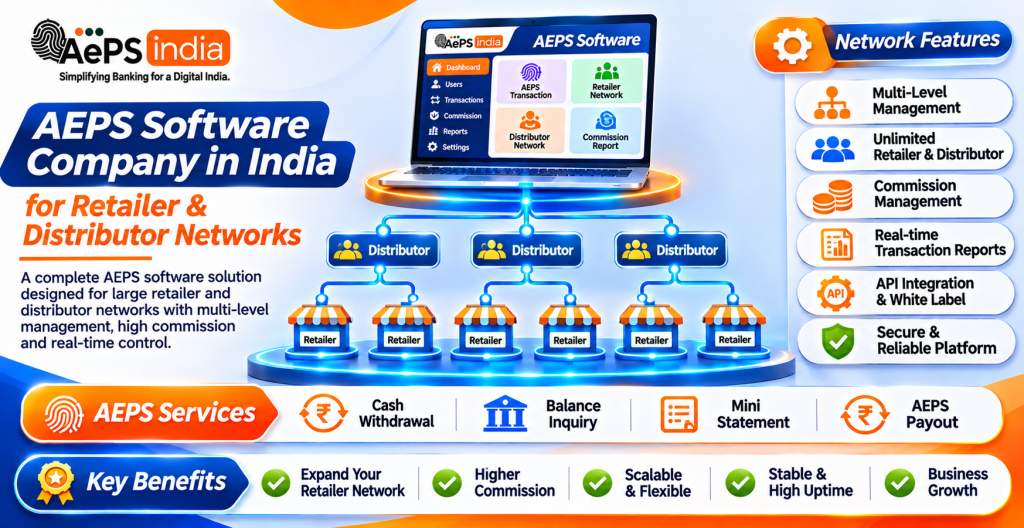
Are you planning to start a fintech business, expand your digital banking services, or build a strong retailer and distributor network across India? Choosing the right AePS Software Company is one of the most important decisions for building a reliable and scalable business.
Today, the Aadhaar Enabled Payment System (AePS) has become an important part of India’s assisted digital banking ecosystem. It allows customers to access essential banking services through authorized banking touchpoints using Aadhaar-based authentication. Services such as cash withdrawal, balance enquiry, mini statement, and other supported banking transactions make AePS useful for retailers, distributors, fintech startups, and businesses operating in both urban and rural markets.
However, starting an AePS business is not just about getting an application or a retailer login. You need a reliable AePS Software Provider in India that offers stable banking connectivity, secure biometric authentication, an easy-to-manage dashboard, transparent commission management, proper transaction tracking, and dependable technical support.
This is where choosing the Best AePS Software Company in India makes a real difference. A well-designed AePS software platform should help you manage your complete business operations, from Aeps retailer onboarding and distributor management to wallet handling, transaction monitoring, settlement reports, and commission distribution.
Whether you are looking for White Label AePS Software to launch your own branded Aeps fintech platform or an AePS API Provider to integrate banking services into your existing application, understanding the available solutions is essential before making a decision.
But how do you identify a reliable AePS software provider? Which features should you compare? What should you know about Aeps API integration, biometric device compatibility, transaction failures, settlement processes, and regulatory requirements?
In this guide, we will explain everything you need to know about AePS software in India, including its working process, essential features, business benefits, Aeps software and API differences, and the important factors to consider before choosing an AePS Software Company for your business.
Our goal is to help you make an informed decision and select an AePS software solution that matches your business requirements, supports your retailer network, and is built for long-term growth.
What is AEPS Software Company
An AEPS software company is a Aeps india company that builds and supplies platforms enabling Aadhaar Enabled Payment System (AePS) banking services. AePS is a bank-led payment model developed by the National Payments Corporation of India (NPCI) that lets customers perform basic banking transactions using their Aadhaar number and biometric authentication.

AEPS Software Company Work
An AEPS (Aadhaar Enabled Payment System) software company builds and maintains platforms that let businesses and local agents offer basic Aadhaar-authenticated banking services. These companies connect Aeps payment API with user-friendly Aeps portal or mobile Aeps apps for admins, distributors, and retail agents.
Core Work & Responsibilities
- API & Bank Integration: Connect banking and payment APIs governed by NPCI and UIDAI frameworks so users can perform cash withdrawals, balance inquiries, mini statements, cash deposits, and Aadhaar fund transfers.
- Biometric & Security Compliance: Support fingerprint/biometric device integration, encryption, and compliance protocols to keep transactions secure.
- Platform & Portal Development: Build web dashboards, mobile Aeps apps, and white label Aeps portal so fintech businesses can launch under their own brand.
- Multi-Tier & Wallet Management: Provide tools for onboarding agents/distributors, tracking transactions, managing wallets, and calculating commissions.
- Settlements & Routing: Handle payout/settlement workflows, multi-bank routing, and error/reconciliation reporting.
- Add-On Fintech Modules: Bundle extra services like DMT (Domestic Money Transfer), micro-ATM, utility bill payments/recharges, or UPI into a single system.
AEPS Software Company Service Provide
AEPS (Aadhaar Enabled Payment System) software companies provide biometric-authenticated Aeps banking software, best Aeps API, and white label Aeps portal that allow retailers, agents, and fintech businesses to offer basic banking services using a customer’s Aadhaar number and fingerprint.
Core AEPS Services Offered
- Cash Withdrawal: Customers withdraw cash from Aadhaar-linked bank accounts using biometric verification.
- Cash Deposit: Customers deposit cash into Aadhaar-linked accounts (where supported by partner banks).
- Balance Enquiry: Instant checking of available bank account balances.
- Mini Statement: Quick display of recent account transactions.
- Aadhaar Pay: Merchant payments or higher-value Aadhaar-based transactions.
- Aadhaar-to-Aadhaar Fund Transfer: Account-to-account transfers linked via Aadhaar.
Top Use Cases of AEPS Software Company
AEPS (Aadhaar Enabled Payment System) software companies build Aeps platform that let authorized agents and businesses process cardless banking transactions using a customer’s Aadhaar number and biometric verification.
Core Transaction & Banking Use Cases
- Cash Withdrawals and Deposits: Customers withdraw or deposit cash at local touchpoints using their Aadhaar number, bank name, and fingerprint, iris, or face scan without needing a debit card or PIN.
- Balance Inquiries and Mini Statements: Users check account balances and view recent transaction histories through local agents.
- Fund Transfers and Aadhaar Pay: B2B Aeps Platform support Aadhaar-to-Aadhaar transfers and merchant payments.
- Rural and Last-Mile Banking: AEPS brings basic banking services to remote or semi-urban areas where bank branches or ATMs are far away.
Business & Ecosystem Use Cases
- Retailer and CSP Operations: Local shopkeepers and Customer Service Points (CSPs) act as banking touchpoints, earn transaction commissions, and increase store footfall.
- Distributor and Network Management: Distributors onboard retailers, track activity, set commission structures, manage wallets, and generate compliance reports.
- Fintech API and White-Label Launches: Startups and fintech firms integrate AEPS API or launch white label Aeps portals and apps under their own brand.
- Micro-Merchant and Doorstep Collections: Small shops accept biometric payments without heavy POS hardware, and field agents collect micro-insurance premiums at customers’ homes.
- Bundled Digital Services: Fast AEPS platform pair biometric banking with Domestic Money Transfer (DMT), micro-ATM, utility bill payments, mobile recharges, and payouts.

Who Should Buy AEPS Software?
(AEPS) Aadhaar Enabled Payment System software is best suited for local shopkeepers, business correspondents (BCs), distributors, and fintech startups looking to offer cardless, biometric banking services like cash withdrawals, balance inquiries, and mini statements.
Who Benefits Most
- Local Kirana Stores & Micro-Merchants: Retailers in semi-urban or rural areas who want to earn commissions and drive foot traffic by acting as a neighborhood banking point.
- Distributors & Agent Networks: Operators managing multiple retailers who want a centralized best Aeps portal to onboard agents, track commissions, and generate recurring transaction revenue.
- Fintech Startups & Entrepreneurs: Businesses launching a branded digital banking or payment portal without building bank integrations from scratch.
- Existing Service Aggregators: Recharge, bill payment, or money transfer providers adding AEPS to increase customer retention and per-user transactions.

What to Look For in an AEPS Software Company
When choosing an Aadhaar Enabled Payment System software company, prioritize high transaction success rates, UIDAI-compliant security, and reliable backend settlement.
Reliability & Security
- Uptime and success rates: Look for high uptime (such as 99.9%) and multi-bank routing over NPCI rails to reduce failures and latency.
- Regulatory compliance: Ensure UIDAI-compliant biometric handling, encrypted data flows, and proper Aeps onboarding workflows.
- Pending & reconciliation handling: Confirm the system tracks pending transactions clearly and reconciles settlements without ledger mismatches.
Core Features & Architecture
- Essential AEPS & add-on services: Check support for cash withdrawal, balance inquiry, mini statements, cash deposit, and Aadhaar Pay, plus room for DMT, micro-ATM, or utility recharges.
- Multi-tier dashboards: A complete setup typically includes an Aeps admin panel, distributor/network views, and a Aeps retailer app or Aeps b2b portal with wallet and commission tracking.
- APIs or white-label options: Decide whether you need developer Aeps API to build into your own product or a ready-made white label Aeps panel under your brand.
Operations & Support
- Payouts and settlements: Verify how quickly agents or partners can settle funds and view commission histories.
- Biometric & low-connectivity readiness: Make sure biometric device flows work smoothly and the interface stays usable in areas with patchy internet.
- Responsive technical support: Confirm clear Aeps API documentation and timely support when transactions stall or complaints arise.
What Does an AEPS Software Company Actually Do?
An AEPS software company builds and manages Aeps platform that let agents, retailers, and businesses process Aadhaar- and biometric-based banking transactions. Powered by NPCI infrastructure, these systems let customers access bank accounts without a physical card or PIN.
Core Functions
- Transaction Processing: Enables cash withdrawals, balance inquiries, mini statements, and Aadhaar-based merchant payments.
- API & Bank Connectivity: Connects b2b Aeps portals or apps to Aeps banking API and acquiring banks for real-time routing.
- Biometric Integration: Supports fingerprint or Aeps iris scanner devices to verify customer identity securely.
- Agent & Network Management: Provides Aeps dashboards for retailers, distributors, and Aeps admins to track transactions, Aeps wallet and commissions.
- Compliance & Security: Implements encryption, fraud checks, and workflows aligned with NPCI and UIDAI rules.
AEPS Software Company for B2B and B2C Models
An AEPS (Aadhaar Enabled Payment System) software company provides the core technical infrastructure, bank/NPCI connectivity, and compliance framework needed to run biometric banking services across B2B and B2C models. Building these integrations in-house is slow and complex, making a Aeps india essential for launching and scaling.
Why It Matters for a B2B Model
- Multi-Tier Network Management: Lets you Aeps onboard and manage master distributors, distributors, and local retail agents (such as kirana stores or CSPs) from one system.
- Automated Commissions & Settlements: Tracks transaction volumes, calculates tiered commissions/overrides, and manages wallet balances and settlements automatically.
- Scalable Expansion: Helps businesses grow assisted banking reach across Tier 2, Tier 3, and rural areas without opening physical bank branches.
Why It Matters for a B2C Model
- Direct Customer Experience: Powers simple, fast biometric cash withdrawals, balance inquiries, mini statements, and fund transfers for end users.
- Trust & Security: Uses encrypted communication, biometric authentication, and UIDAI/RBI/NPCI-aligned security controls to protect user data.
- Repeat Engagement & Cross-Selling: Turns routine banking needs into recurring traffic and lets you bundle services like DMT, BBPS, recharges, and payouts.
Why AEPS Software Company is Important for Retailers
Aeps india is an AEPS software company gives retailers the technology, banking connectivity, and tools needed to turn a regular shop into a micro-ATM or mini-bank. Instead of building complex banking integrations on their own, retailers rely on these platforms to process biometric transactions safely and earn extra income.
Why AEPS Software Companies Matter to Retailers
- Banking & Biometric Connectivity: Connects a retailer’s smartphone or Aeps biometric scanner to bank networks so customers can do cash withdrawals, balance enquiries, and mini statements using their Aadhaar number and fingerprint.
- Extra Commission Income: Lets retailers earn a per-transaction commission or slab-based payout on banking services, adding a steady revenue stream alongside regular shop sales.
- Higher Foot Traffic & Repeat Visits: Brings customers into the shop regularly for cash and account checks, creating chances for cross-selling and repeat visits.
- Wallet, Commission & Dispute Tracking: Provides Aeps dashboard to check wallet balances, track commissions, view transaction history, and follow up on pending or failed transactions.
- Security & Compliance Support: Uses encrypted biometric authentication and structured Aeps onboarding so retailers can operate through authorized channels safely.
- Bundled Digital Services: Aeps b2b platform bundle AEPS with Domestic Money Transfer (DMT), bill payments (BBPS), mobile/DTH recharges, and payouts under one login.
Why Choose a Professional AEPS Software Company
Choosing a professional Aadhaar Enabled Payment System (AEPS) software company gives you a compliant, reliable, and scalable Aeps platform to offer biometric banking services like cash withdrawals, balance inquiries, and mini statements.
Key reasons to partner with a professional provider include:
- Regulatory Compliance & Security: Adherence to NPCI and UIDAI security standards, biometric encryption, and fraud-prevention protocols.
- High Uptime & Multi-Bank Routing: Reliable Aeps API connectivity and multi-bank routing help maintain higher transaction success rates and faster processing.
- Agent & Network Management: Centralized Aeps admin panels to manage super distributors, distributors, retailers, wallets, ledgers, and automated commissions.
- Real-Time Settlements & Reporting: Instant wallet updates, settlement tracking, and detailed transaction logs to reduce manual reconciliation.
- Scalability & Service Expansion: White label Aeps app branding options and easy integration of add-on services like Domestic Money Transfer (DMT), BBPS bill payments, recharges, micro-ATM, and UPI QR collections.
AEPS in Numbers: Is the Market Still Worth Entering in 2026?
Entering the Aadhaar Enabled Payment System (AePS) market in 2026 is no longer viable as a standalone, margin-driven business, though it remains a useful footfall hook and cross-sell wedge in rural India. While the network still moves over ₹24,000 crore a month, shrinking year-on-year volumes, a decade-old fee cap, and strict Reserve Bank of India (RBI) compliance rules that took effect in January 2026 have fundamentally changed the unit economics.
AePS in Numbers (2026 Snapshot)
Data from the National Payments Corporation of India (NPCI) and the Reserve Bank of India (RBI) shows a mature, cash-heavy utility facing gradual volume contraction:
| Metric | 2026 Figure | Trend / Context |
|---|---|---|
| Monthly Financial Volume | 100.87 million (Oct 2026) | Daily average of 3.25M/day, down 7.69% YoY from Oct 2025 |
| Monthly Cash Withdrawal Value | ₹24,383.47 crore (Oct 2026) | September 2026 saw ₹23,734 crore (down 13% YoY) |
| Full-Year Baseline (FY26) | 1,212.64 million txns / ₹3.22 trillion | Driven heavily by rural Direct Benefit Transfers (DBT) |
| Primary Use Case | 98.2% Cash Withdrawals | BHIM Aadhaar Pay accounted for only 1.78M transactions |
| Interchange Fee Cap | 0.5% capped at ₹15 | Unchanged for nearly a decade (vs. ₹19 for standard ATMs) |
Key Headwinds Reshaping the Market
- Stagnant unit economics. The NPCI interchange fee remains capped at ₹15 per transaction, leaving acquiring banks, Business Correspondents (BCs), and retailers to split a shrinking margin pool while operational costs rise.
- Stricter RBI operator compliance. Under the RBI Due Diligence Directions for AePS Touchpoint Operators effective January 1, 2026, acquiring banks must complete full KYC on every agent, restrict operators to a single acquiring bank, and enforce mandatory re-KYC if an outlet is inactive for three consecutive months.
- Higher security and hardware costs. Fraud prevention mandates including STQC-certified L1 Aeps biometric scanners, liveness detection, and step-up OTP verification for withdrawals above ₹5,000 have raised upfront Aeps setup and tech integration costs.
- UPI encroachment. As smartphone and UPI adoption deepens in semi-urban areas, peer-to-peer transfers and merchant payments have largely migrated off Aadhaar rails, leaving best AePS concentrated in rural cash-out pockets.

Features AEPS Software Company
Aeps india is a reliable Aadhaar Enabled Payment System (AEPS) software company provides secure biometric banking infrastructure, multi-bank API routing, real-time wallet management, and multi-tier user controls built on NPCI and UIDAI standards. Key capabilities to look for in an top AEPS platform such as those highlighted by AEPS India include:
Core AEPS & Biometric Capabilities
- Essential Banking Services: Cash withdrawals, balance inquiries, mini statements, and Aadhaar Pay using a 12-digit Aadhaar number and fingerprint biometrics.
- Biometric Device Compatibility: Smooth integration with standard Aeps biometric scanners and works reliably on low-end Android devices and slower connections.
- Multi-Bank Routing & High Uptime: Routes transactions across multiple banks/Aeps API to improve success rates and maintain high availability.
Security & Compliance
- Regulatory Adherence: Aligns with NPCI and UIDAI security and authentication protocols.
- Risk & Fraud Controls: Includes transaction limits, real-time monitoring, risk flags, and fraud detection.
Agent Network & Wallet Management
- Super Admin, Distributor & Retailer Panels: Role-based dashboards for Aeps onboarding agents, managing hierarchies, setting limits, and handling disputes.
- Wallet, Ledger & Settlements: Unified wallet management, automated commission calculations, ledger statements, and fast bank payouts/settlements.
- Reporting & Analytics: Live transaction tracking, business reports, and reconciliation tools.
Scalability & Extra Fintech Modules
- White-Label & API Access: Custom branding options and Aeps developer API to embed AEPS into web portals or Aeps mobile apps.
- Add-On Services: Modular support for Domestic Money Transfer (DMT), Micro ATM, dynamic UPI QR, and mobile/DTH recharges from one dashboard.
Benefits AEPS Software Company
Partnering with an Aadhaar Enabled Payment System (AePS) software company lets businesses, fintech startups, and retail networks offer cardless, PIN-less biometric banking services connected to the NPCI network.
Key Benefits for Businesses & Fintechs
- Faster Market Entry & Lower Setup Costs: Aeps india offer ready-to-use portals, white label Aeps apps, or pre-integrated Aeps API instead of building banking infrastructure from scratch.
- Multi-Bank Routing & Higher Uptime: Aeps india route transactions across multiple banks with automated reconciliation and high availability, reducing transaction failures.
- Compliance & Security: Reputable Aeps platform follow RBI, NPCI, and UIDAI biometric encryption and authentication standards, helping lower compliance and fraud risks.
- Centralized Operations & Settlements: Aeps Admin dashboard track retail agents, distributors, commissions, transaction logs, and payouts or settlements in one place.
- Service Bundling & Cross-Selling: Standard AEPS platform let you add Domestic Money Transfer (DMT), BBPS bill payments, micro-ATM, UPI, or recharges to increase user retention and revenue streams.
Benefits for Agents, Distributors & Customers
- Commission Earnings: Retailers and distributors can earn per-transaction commissions on services like cash withdrawals, deposits, balance inquiries, and mini statements.
- Rural & Semi-Urban Access: Local shopkeepers act as assisted banking touchpoints where customers only need their 12-digit Aadhaar number and biometric verification no debit card or ATM PIN required.
Aeps Api Integration Process
Integrating an AePS (Aadhaar Enabled Payment System) API into your web or mobile Aeps application requires partnering with an Aeps india (as direct access to the NPCI switch is restricted to member banks), completing regulatory KYC, and connecting UIDAI-certified Aeps biometric hardware.
1. Partner Selection & Business Onboarding
- Choose an API Provider. Select a certified Aeps india that offers REST Aeps API and native SDKs.
- Complete Business KYC. Submit corporate registration documents, PAN, GST details, bank account proofs, and director KYC for compliance verification.
- Sign Agreements. Execute the Aeps india agreement and pay any applicable setup or licensing fees.
2. Technical Setup & Credentials
- Obtain Sandbox Credentials. Once verified, access the Aeps developer portal to generate your Sandbox Aeps API keys, client secrets, and endpoint URLs.
- Whitelist Server IPs. Provide your staging and production server IP addresses to the Aeps india to authorize incoming requests.
- Integrate Biometric RD Service. Configure your frontend (Android, iOS, or Web) to communicate with UIDAI-certified Registered Device (RD) services (e.g., Mantra) to capture encrypted fingerprint or iris PID (Personal Identity Data) blocks.
3. API & SDK Implementation
- Merchant / Agent Onboarding API. Build the flow to Aeps onboarded your retail agents using their Aadhaar, PAN, and shop details, as NPCI mandates agent-level registration and daily 2FA (Two-Factor Authentication).
- Bank List & Device Initialization. Integrate the endpoint to fetch supported NPCI member banks and initialize the connected biometric scanner.
- Core Transaction APIs. Implement the REST endpoints (typically JSON-based) for your required services:
- Cash Withdrawal
- Balance Enquiry
- Mini Statement
- Cash Deposit / Aadhaar Pay (if enabled)
- Configure Webhooks. Set up callback URLs to receive real-time asynchronous status updates (Success, Pending, Failed) and handle transaction timeouts or reversals cleanly.
4. Testing & Go-Live
- UAT / Sandbox Testing. Simulate successful, failed, and timeout scenarios using dummy Aadhaar numbers and test biometric payloads in the staging environment.
- Security & Compliance Audit. Ensure no raw biometric data or full Aadhaar numbers are stored on your servers, adhering strictly to UIDAI and RBI data-masking guidelines.
- Production Switch. Swap sandbox keys and URLs with production credentials, fund your settlement wallet, and run a live penny-drop/low-value test transaction before rolling out to agents.

AEPS Software Development Process
Developing AEPS software involves building secure web and mobile applications connected to authorized banking/AEPS bank API under NPCI and UIDAI guidelines, plus completing business compliance and onboarding.
1. Planning & Compliance Setup
- Define scope and services: Decide on core features like cash withdrawal, balance inquiry, mini statement, and Aadhaar Pay, plus add-ons like DMT, BBPS, or Micro ATM.
- Establish partnerships and authorization: Developed Aeps software alone does not authorize you to offer regulated financial services; secure partnerships, onboarding, and compliance with NPCI/UIDAI requirements.
- Plan user hierarchy: Design roles for super admins, distributors, and retail agents/touchpoint operators.
2. Architecture & Security Design
- Build a multi-layer flow: Connect the customer and retail agent interface to your best Aeps app, backend Aeps API layer, and authorized best Aeps banking API.
- Protect sensitive data: Enforce end-to-end encryption for authentication requests and ensure biometric data is never stored or logged.
- Design ledger-backed wallets: Track wallet balances through a ledger system and assign unique references to every transaction before calling a Aeps india.
3. Core Development & API Integration
- Frontend & panels: Develop agent/Aeps retailer portal, mobile apps, and admin/distributor dashboards.
- Backend & provider APIs: Integration AEPS API/SDKs, biometric scanner SDKs, role-based access controls, callback verification, and automated commission/settlement logic.
- Handle edge cases: Build automatic status re-checks for pending transactions and daily reconciliation workflows.
4. UAT, Deployment & Maintenance
- Test in sandbox/UAT: Verify biometric capture, transaction flows, idempotent callbacks, and IP whitelisting in test environments before production.
- Go live & monitor: Deploy to production with server-side best Aeps API keys, live monitoring for success rates and outages, and daily reconciliation reports.
- Maintain & scale: Update compliance/Aeps API versions, onboard KYC-verified agents, and add new utility services as transaction volume grows.
Aeps Commission Structure and Revenue Opportunities
AEPS agents and retailers typically earn ₹2 to ₹15+ per transaction, with commissions structured in slabs based on transaction value and service type. Distributors and master distributors earn smaller per-transaction overrides (often ₹1 to ₹2+ per slab) across large merchant networks.
How the AEPS Commission Structure Works
- Slab-Based Cash Withdrawals: Higher transaction values generally yield higher Aeps commission. For example, sample slab structures show retailer earnings starting around ₹2 for smaller withdrawals (e.g., ₹500–₹999) and scaling up to ₹8–₹15+ for larger amounts (₹3,000+).
- Other Banking Services: Commissions vary by transaction type:
- Balance Inquiry: Roughly ₹2 to ₹5 per transaction.
- Mini Statement: Roughly ₹3 to ₹7 per transaction.
- Aadhaar-to-Aadhaar Fund Transfer / Cash Deposit: Varies by trusted Aeps platform and banking arrangement, often around ₹5 to ₹10 or aligned with withdrawal slabs.
- Tiered Hierarchy: Commissions split across the ecosystem typically flowing from the sponsor bank/NPCI interchange through fintech/B2B Aeps service platform, master distributors, distributors, and retailers based on Aeps india agreements.
Revenue Opportunities & Earning Potential
- Retailer & Agent Income: Active retail shops in areas with steady footfall or limited ATM access commonly earn roughly ₹10,000 to ₹30,000+ per month in commissions, depending on daily volume, slab rates, and local demand.
- Distributor Scaling: Distributors earn override margins on transactions processed by their onboarded retailers, making active merchant retention and daily transaction volume the main drivers of profit.
- Cross-Selling & Service Bundling: Pairing AEPS with adjacent services such as Bharat Bill Payment System (BBPS), mobile/DTH recharges, Domestic Money Transfer (DMT), Micro ATM, or regular retail shelf sales increases customer visits and adds extra income streams.
AEPS Software Cost Provide
AEPS software cost in India typically ranges from ₹500 to ₹1,00,000+ for packaged Aeps API, white-label Aeps service portal, and basic setups, and can reach ₹2 lakh to ₹25 lakh+ for custom or enterprise-grade best Aeps software development. Total cost depends on whether you buy an Aeps API integrated, a white label Aeps platform, or custom-built Aeps software, plus ongoing transaction and maintenance fees.
1. Cost Structure by Model
- AEPS API Integration / Basic Setup: Connects your existing app or website to AEPS services (cash withdrawal, balance inquiry, mini statement). Ready made Aeps API/Aeps system packages often start from a few hundred rupees up to ~₹10,000–₹20,000 depending on features and bundled hardware.
- White-Label AEPS Software: A pre-built portal/app under your brand with admin, distributor, and retailer panels, wallet, and commission engine. Packaged white label Aeps setup commonly range from ₹10,000 to ₹50,000+, while broader Aeps platform build can run higher depending on scope and mobile apps. See Aeps India for a breakdown of modern Aeps API, white-label, and B2B pricing models.
- Custom / Enterprise Fintech Software: Built from scratch or heavily customized with multi service Aeps API, advanced reporting, and custom workflows. Typically costs ₹4 lakh to ₹25 lakh+ depending on complexity and integrations.
2. Core Cost Components
- Upfront Setup / License / Development Fee: One-time fee for Aeps API onboarding, white label Aeps branding, or custom engineering.
- Platform & Module Add-ons: Admin/distributor/retailer panels, Aeps wallet management, commission slab engines, mobile apps (Android/iOS), and extra services like Aadhaar Pay or cash deposit.
- Per-Transaction Charges / Slabs: Fees or cuts tied to transaction type and volume such as flat per-transaction charges (e.g., ₹0.10 to ₹10 depending on service/slab) or percentage shares (e.g., 0.5%–1% on certain services).
- Biometric Hardware: Aeps Fingerprint scanners required at agent counters for Aadhaar authentication (sometimes bundled or bought separately).
- Hosting, Security & Maintenance: Cloud servers, SSL/security compliance, annual maintenance/support packages, and applicable taxes (such as GST).

AEPS Software Security and Compliance
AEPS b2b software requires strict regulatory compliance and multi-layered security to protect sensitive biometric data and financial transactions. Platforms built on NPCI rails must align with Reserve Bank of India (RBI) and Unique Identification Authority of India (UIDAI) standards.
Regulatory & Compliance Requirements
- NPCI & RBI Alignment: Top Aeps Software must follow NPCI operational rules, transaction limits, and RBI guidelines for payment systems, settlements, and banking partners.
- UIDAI Biometric Rules: Biometric capture and authentication must comply with UIDAI standards, including using registered devices (RD service) and avoiding unauthorized storage of raw biometric data.
- Agent KYC & Onboarding: Touchpoint operators/agents require identity and financial verification (such as Aadhaar and PAN) along with approval workflows and device mapping before transacting.
- Audit Trails & Reporting: Aeps System need complete transaction logs, reconciliation records, dispute tracking, and compliance reporting.
Core Security Controls
- End-to-End Encryption: Protect biometric payloads, Aadhaar numbers, and smooth Aeps API traffic in transit and at rest using strong encryption.
- Authentication & Access Control: Enforce role-based access control (RBAC), strong session security, and authenticated Aeps API calls across admin, distributor, and agent portals.
- Fraud & Risk Monitoring: Implement velocity limits, device binding, geo-checks, anomaly alerts, and anti-spoofing defenses to detect unusual activity or tampered hardware.
- Testing & Infrastructure Resilience: Conduct regular penetration testing, vulnerability checks, and high-availability monitoring to prevent outages and unauthorized access.
RBI’s 2026 AePS Rules: What Your Software Must Handle
Best AePS software must enforce stricter operator KYC, 3-month inactivity re-verification, continuous risk monitoring, and restricted Aeps API access under the Reserve Bank of India AePS Touchpoint Operator (ATO) directions (effective January 1, 2026).
Operator KYC and Lifecycle Management
- Full Onboarding KYC: Support customer-grade KYC workflows for every ATO aligned with RBI’s Master Direction on KYC before enabling live transactions.
- 3-Month Inactivity Lockout & Re-KYC: Track each ATO’s last financial or non-financial transaction date. Automatically block transactions if an operator is idle for more than 3 continuous months, requiring fresh KYC verification before reactivation.
- Periodic KYC & Bank Mapping: Trigger periodic KYC refresh reminders and enforce acquiring-bank onboarding/mapping rules (including one-operator-one-bank constraints where applicable).
Risk Monitoring and Transaction Controls
- Continuous Anomaly Detection: Log and stream touchpoint attributes such as transaction velocity, amounts, location, and operator behavior for ongoing risk-based monitoring and fraud alerts.
- Dynamic Limits & Step-Up Checks: Support risk-based limits for new or higher-risk touchpoints, plus step-up authentication flows (such as OTP/biometric checks where mandated by bank/NPCI rules) and real-time reversal/verification handling.
API, Device, and Data Security
- Strictly Scoped APIs: Restrict best Aeps API access and credentials exclusively to authorized AePS operations to prevent unauthorized access or misuse.
- Certified Biometrics & Privacy: Integrate compliant biometric capture SDKs/devices and protect Aadhaar data (such as using VIDs instead of raw Aadhaar numbers where required) with audit trails for reconciliation and grievance redressal.
AEPS Software Company Support, Training, and Technical Assistance
Aeps india typically offer technical assistance, agent/admin training, and ongoing maintenance across onboarding, biometric integration, and daily transaction operations.
What AEPS Providers Typically Offer
- Technical Assistance: Aeps payment API/Aeps portal integration, biometric scanner (RD service/L1) troubleshooting, server uptime monitoring, bug fixes, and real-time transaction routing support via phone, WhatsApp, email, or ticketing.
- Training & Onboarding: Walkthroughs for KYC verification, distributor/retailer onboarding, wallet and Aeps commission slab setup, biometric capture workflows, and data privacy practices.
- Maintenance & Updates: Ongoing patches, compliance/security updates, and AMC/SLA options for custom or white label Aadhaar Enabled Payment System portal.
White-Label Portal vs AEPS API vs Reseller: Which Model Fits You?
Choosing between a White-Label Aeps Portal, AEPS API, and Reseller model depends on your brand goals, technical resources, and network size.
| Feature | White-Label Portal | AEPS API | Reseller |
|---|---|---|---|
| What It Is | Turnkey web/app platform under your brand | Raw banking/AEPS endpoints integrated into your app | Tiered partner panel under an existing provider’s system |
| Branding | Custom logo, domain, colors, and UI | Fully custom UI built by your team | Usually parent brand (limited/no custom branding) |
| Tech Effort | Low; ready-made dashboard & wallet | High; requires developers, UI, & ongoing maintenance | Very low; ready-to-use panel |
| Launch Speed | Fast | Slower (integration & sandbox testing needed) | Immediate |
| Control & Network | Manage distributors/retailers & set commission slabs | Full UX/workflow control; custom or tiered setup | Onboard & support sub-agents/retailers within set rules |
| Best For | Entrepreneurs launching a branded fintech network | Tech startups/companies with dev teams & custom apps | Distributors or agents building a retailer network quickly |
Which Model Fits You?
- White-Label Portal: Best if you want your own brand identity and multi-tier network (distributors/retailers) without building software or handling core banking compliance yourself.
- AEPS API: Best if you have in-house developers and want to embed Aadhaar-enabled services (cash withdrawal, balance inquiry, mini statement, Aadhaar Pay API) into an existing or custom product.
- Reseller: Best if you want low setup friction to onboard shopkeepers/agents, fund wallets, and earn aeps commission from network transactions.
How to Launch Your AEPS Business in 5 Steps
Launching Aeps business in India takes five main steps: choosing a Aeps india, completing KYC verification, setting up biometric hardware, activating Aeps portal or activate Aeps API, and starting customer transactions.
5 Steps to Launch Your AEPS Business
- Choose an AEPS Provider: Partner with an authorized AEPS India. Compare transaction commission rates, settlement speed, bank support, and customer support.
- Complete Registration and KYC: Submit your identity and business details for verification. Typical requirements include your Aadhaar card, PAN card, passport-size photo, bank account details, mobile number linked to Aadhaar, and shop details or photo if applicable.
- Set Up Biometric Hardware: Get an RD-certified biometric fingerprint or iris scanner (such as Mantra) along with a smartphone, laptop, or desktop and a stable internet connection.
- Activate Portal or API Access: Once KYC is approved, log in to the retailer dashboard or integrate AEPS Cash Withdrawal API /app into your system.
- Start Offering Services: Provide cash withdrawals, balance enquiries, mini statements, and Aadhaar Pay software using customers’ Aadhaar numbers and biometric authentication to earn per-transaction commissions.
Before You Sign: 5 Tests to Run in the Sandbox
- A failed transaction — see whether the wallet reverses correctly and the retailer gets a clear message.
- A bank outage — ask the provider to show what happens when one bank is down.
- Your own device — test with the exact fingerprint scanner model your retailers will use.
- A commission split — run a test withdrawal and check that distributor and retailer amounts match your slabs.
- A report — download the day’s transaction and settlement report and check it matches.
How to Choose an AEPS Software Company: 10-Point Checklist
Use this 10-point checklist to evaluate and choose an Aadhaar Enabled Payment System (AEPS) software company in India:
- Regulatory Compliance & Bank Tie-Ups: Verify that the Aeps india aligns with NPCI, RBI, and UIDAI guidelines and operates through authorized banking partners.
- Biometric & Data Security: Confirm strong encryption, two-factor authentication (2FA), and strict protection of Aadhaar numbers and biometric data.
- Uptime & Transaction Success Rate: Look for high Aeps platform availability (such as 99.9% uptime) and low failure rates to avoid lost transactions and customer drop-offs.
- Transparent Commission Slabs: Request the full slab-wise commission chart and check for any hidden fees or deductions.
- Upfront & Recurring Pricing: Get a complete cost breakdown covering setup, licensing, white label Aeps software/best Aeps admin panel, and ongoing maintenance or support fees.
- Settlement & Payout Speed: Check how quickly commissions and transaction settlements are credited to your account or your agents’ accounts.
- API Quality & Documentation: Have your technical team review complete Aeps API documentation, webhook reliability, and integration ease before committing.
- Supported Services & Scalability: High speed Aeps platform supports core AEPS features (cash withdrawal, balance inquiry, mini statement, Aadhaar Pay) and can scale with add-ons like DMT, Micro ATM, BBPS, or recharge.
- Hierarchy & Branding Controls: If building a network, verify multi-tier panels (admin, distributor, retailer) and white-label Aeps software customization options.
- Responsive Technical & Dispute Support: Check support channels, response times, and processes for handling failed transactions or chargeback disputes.

Aeps india is the Best AEPS Software Company in India
Aeps india one of the reliable AEPS software provider in India protects transaction success rates, ensures regulatory compliance, and supports business growth across retail and rural networks.
Key Reasons to Choose a Top AEPS Software Provider
- Regulatory Compliance & Security: Aeps india align with Reserve Bank of India (RBI) and NPCI guidelines, using encrypted biometric authentication and secure protocols to protect sensitive user data.
- High Uptime & Success Rates: Stable backend infrastructure and multi-bank connectivity reduce transaction failures, latency, and reconciliation errors during peak hours.
- Fast Settlements & Liquidity: Instant or timely payout and wallet settlement features help agents and businesses maintain steady working capital.
- Bundled Fintech Services: Online Aeps platform combine AEPS (cash withdrawal, balance inquiry, mini statement) with Domestic Money Transfer (DMT), Micro ATM, BBPS bill payments, and recharges in one dashboard.
- Scalability & API Support: White-label portals, developer friendly Aeps API, and retailer/distributor management tools allow businesses to expand without rebuilding core infrastructure.
- Dependable Technical Support: Responsive support and real-time reporting help resolve failed transactions, device issues, or onboarding bottlenecks quickly.

Conclusion
Choosing the right AePS Software Company in India is not just about finding a reputed Aeps platform that offers cash withdrawal or balance enquiry services. It is about selecting a Aeps india that understands your business requirements, supports your retailer network, and provides the infrastructure needed to manage daily banking transactions efficiently.
Whether you are a fintech startup, an established B2B distributor, a payment service business, or someone planning to launch a white-label digital Aeps banking platform, the right AePS Software Provider can make a significant difference in your business operations.
Before making your final decision, take time to evaluate important factors such as banking connectivity, biometric device compatibility, fast Aeps API integration, transaction monitoring, failed transaction handling, settlement transparency, commission management, security standards, and technical support. A reliable AePS software solution should offer more than basic transaction processing; it should help you manage your complete business network through a structured and user friendly Aeps platform.
It is equally important to understand the regulatory responsibilities associated with AePS operations. With the RBI’s AePS Touchpoint Operator due diligence directions effective from January 1, 2026, proper operator onboarding, KYC processes, transaction monitoring, and fraud risk management have become particularly important considerations when evaluating an AePS india.
If you are comparing the Best AePS Software Company, looking for a dependable AePS Software Provider in India, or exploring White Label AePS Software and AePS API Integration, always prioritize actual infrastructure capabilities, transparent business terms, regulatory alignment, and long-term technical support over attractive marketing promises.
Ultimately, the best AePS software for your business is the one that fits your operational model, provides dependable technology, and helps you build a sustainable digital banking distribution network across India. Make an informed choice, verify the Aeps india capabilities, and choose a technology partner that can support your business as it grows.
FAQ – AEPS Software Company in India
The best AEPS software company in India depends on your business requirements, supported banking connections, software features, transaction monitoring, biometric device compatibility, settlement process, and technical support. Before selecting a provider, request a live Aeps software demo, verify its banking and onboarding arrangements, and compare the complete service offering rather than choosing based only on price. AEPS India offers businesses an opportunity to explore AEPS software and integration solutions according to their requirements.
An AEPS software company provides the technology platform required to offer Aadhaar Enabled Payment System services through supported banking infrastructure. Its solutions may include retailer applications, admin dashboards, distributor panels, biometric integration, transaction management, commission management, and Aeps API connectivity. These platforms help eligible businesses manage Aadhaar-based banking services through authorized arrangements.
The cost of AEPS software in India varies according to the type of solution, customization, Aeps API integrating, number of user panels, banking connectivity, maintenance, and support requirements. White-label software, custom Aeps software development, and API integration may have different pricing structures. Businesses should request a complete quotation that includes setup fees, recurring charges, transaction-related fees, and maintenance costs.
Yes, eligible businesses can explore white-label AEPS software to operate Aeps platform under their own brand, subject to the applicable banking arrangements, operator onboarding, and regulatory requirements. A white label Aeps software solution may include branded Aeps application, retailer and distributor panels, transaction management, and commission configuration.
The main features of AEPS software include:
Cash withdrawal and balance enquiry
Mini statement
Retailer and distributor management
Admin dashboard
Commission management
Wallet and ledger management
Transaction history and reporting
Failed transaction tracking
Biometric device integration
API connectivity
Actual functionality depends on the Aeps india and its supported banking integrations.
AEPS software generally provides a ready-made platform with user dashboards, retailer management, transaction history, and administrative features. An AEPS API provides programmatic connectivity that developers can integrate into their own applications or websites. Businesses that want a ready-to-use solution may prefer branded Aeps software, while fintech companies with Aeps software development teams may prefer API integration.
AEPS transactions use supported biometric authentication devices, such as fingerprint scanners and other permitted authentication devices. Device compatibility depends on the acquiring bank, service provider, technical specifications, and applicable UIDAI requirements. Always verify device certification and Registered Device (RD) service compatibility before purchasing hardware.
AEPS retailers may earn commissions for eligible transactions according to the commission structure agreed with their Aeps india. The actual amount depends on the transaction type, applicable commercial terms, and provider policy. Retailers should check commission slabs, deductions, payout conditions, and settlement timelines before joining.
When an AEPS transaction fails but the customer’s account is debited, the retailer should first check the transaction reference number and final status through the authorized platform. The retailer should avoid immediately repeating the transaction without checking its status. If the amount is not reversed within the applicable timeline, raise a complaint through the Aeps india or acquiring bank’s official grievance process and retain the transaction receipt.
AEPS software security depends on the complete transaction ecosystem, including the acquiring bank, authentication infrastructure, registered biometric devices, Aeps API security, access controls, and monitoring systems. Businesses should verify encryption practices, access permissions, audit logs, data handling policies, and applicable regulatory requirements before using a platform.
The documents may include identity proof, PAN, address proof, bank account details, and additional KYC or business documents requested by the acquiring bank or authorized Aeps india. The exact requirements depend on the business model and onboarding policy.
Yes. Businesses with an existing fintech application can explore AEPS API integration, provided they meet the applicable eligibility, technical, and banking requirements. Integration generally requires Aeps API documentation, authentication configuration, transaction status handling, biometric device compatibility, testing, and production approval.
An AEPS software provider primarily supplies the technology platform, applications, dashboards, and integration tools. An Aeps india may be responsible for the underlying authorized service arrangements and transaction processing. In some business models, one company may provide multiple functions through different partnerships. Always verify the actual roles of each party.
Compare the companies using the following criteria:
Supported banking partners
Service availability
Software demo and user experience
API documentation
Transaction success and decline reporting
Settlement and reconciliation
Biometric device compatibility
Security controls
Technical support
Total operating cost
Aeps india to demonstrate the same transaction workflows so the comparison is meaningful.
AEPS supports interoperable transactions through its authorized banking framework. However, the number of banking connections available through a particular software platform depends on the Aeps india actual integrations, acquiring bank arrangements, and service eligibility. Ask for a verified list of supported banks rather than relying on a general multi-bank claim.
The launch time depends on whether you choose ready made white label Aeps software, API integration, or custom development. Configuration, KYC verification, banking approvals, device testing, and production activation can affect the timeline. Ask the Aeps india team for a written implementation schedule.
Before purchasing, check the live Aeps demo, supported services, API documentation, banking arrangements, security practices, device compatibility, pricing, settlement procedures, support availability, and contract conditions. Also confirm who handles failed transactions and customer complaints.
A beginner can explore an AEPS business by understanding the required business model, eligibility, onboarding requirements, hardware, investment, and banking arrangements. It is advisable to understand transaction processing and customer grievance handling before onboarding retailers.
An AEPS admin panel helps authorized administrators manage retailers, distributors, user permissions, transactions, commissions, wallet records, reports, and platform settings. The available controls depend on the Aeps india configuration.
Transaction reconciliation helps businesses compare transaction records, bank responses, settlement records, and wallet entries. It helps identify pending transactions, mismatches, settlement delays, and disputed transactions, making daily financial operations easier to monitor.
Best AEPS System Provider in India for Secure Aadhaar Banking

Best AEPS Platform Provider Company in India 2026
Best AEPS App for Cash Withdrawal and Balance Inquiry
About Author

