AePS Payment System 2026: How It Works, Services, Benefits & Complete Guide
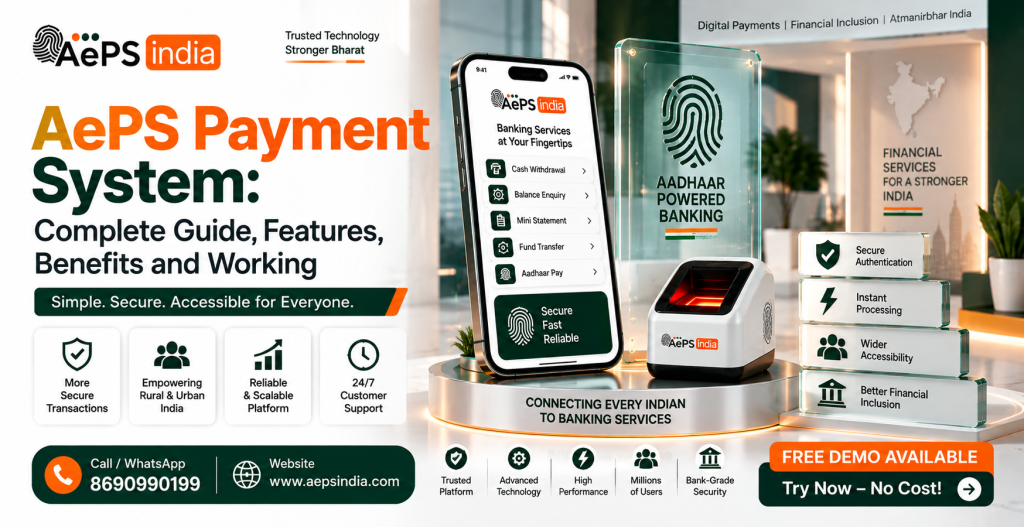
An AePS Payment System (Aadhaar Enabled Payment System) makes basic banking services available through an authorised AePS touchpoint using Aadhaar-based authentication. It allows customers to access supported banking services without depending entirely on a traditional bank branch or ATM, making it useful for assisted banking and last-mile financial services in India.
With an AePS Payment System, customers can access services such as cash withdrawal, cash deposit, balance enquiry, mini statement and fund transfer, depending on the services supported by the participating bank and AePS ecosystem. These services can be available across participating banks through AePS’s interoperable model.
The Aadhaar Enabled Payment System (AePS) is a bank-led digital financial service model developed by the National Payments Corporation of India (NPCI) that allows customers to perform basic banking transactions using their Aadhaar number and biometric authentication (fingerprint or iris scan).
It eliminates the need for physical debit cards, credit cards, ATM PINs, or signatures, making formal banking accessible to underserved and rural populations via local Micro ATMs or Business Correspondents (BCs/agents).
AePS is also important for retailers, Business Correspondents and digital banking businesses. A local merchant can act as a banking touchpoint and help customers access essential services using a compatible biometric device and the required transaction process. Fino, for example, highlights the use of registered biometric devices along with a mobile, laptop or tablet for merchants offering AePS services.
For a business, however, choosing an AePS Payment System should not be based only on the availability of cash withdrawal. Transaction reliability, biometric-device support, security, settlement, transaction-status handling, reporting, merchant onboarding and customer support are equally important when selecting an AePS solution.
In this guide, Aeps India explains the AePS Payment System in simple language from how AePS works and its services to merchant requirements, benefits, transaction problems, security, AEPS API integrate and how to choose the right AePS solution for your business.
What Is an AePS Payment System?
An AePS transaction (Aadhaar Enabled Payment System transaction) is a cardless banking service that lets you perform basic financial and non-financial operations using just your Aadhaar number and biometric verification (fingerprint or iris scan). Developed by the National Payments Corporation of India (NPCI), it removes the need for a debit card, credit card, or bank PIN.
How Does an AePS Payment System Work?
The Aadhaar Enabled Payment System (AePS) is a bank-led digital service created by the National Payments Corporation of India that lets you perform basic banking tasks using just your 12-digit Aadhaar number and your fingerprint. You do not need a debit card, a bank passbook, an ATM PIN, or a smartphone.
How AePS Works (Step-by-Step)
- Visit an Agent: You go to a Aeps india website with a micro ATM or Aeps fingerprint scanner.
- Provide Details: You give the agent your Aadhaar number, the name of your bank, and the type of transaction you want.
- Biometric Scan: You place your finger on a buy Aeps biometric scanner to verify your identity.
- Secure Verification: The system sends your fingerprint data to UIDAI (Unique Identification Authority of India) for safety checks.
- Transaction Complete: Once verified through the central NPCI switch, the bank processes your request and the agent hands you a printed receipt and cash (if withdrawing).
What Services Does an AePS Payment System Provide?
An AePS provides cardless, PIN-free interoperable banking and financial services using an NPCI infrastructure that authenticates users via their 12-digit Aadhaar number and biometrics (fingerprint or iris scan).
Core Banking Services Provided by AePS
Cash Withdrawal
- Allows users to withdraw money from their bank accounts.
- Requires only an Aadhaar number and fingerprint scan.
- Eliminates the need for physical debit cards or ATM PINs.
Cash Deposit
- Enables cash deposits directly into an Aadhaar-linked bank account.
- Offered at select participating bank networks and BC (Business Correspondent) touchpoints.
Balance Enquiry
- Provides real-time checking of available bank account balances.
- Requires instant biometric authentication at a micro ATM device or agent outlet.
Mini Statement
- Generates a brief, on-the-spot record of recent transaction history.
- Typically lists the last 5 to 10 recent transactions.
Fund Transfers
- Facilitates Aadhaar-to-Aadhaar account transfers.
- Permits money movement between participating bank accounts through Aeps india.
Extended and Micro-Business Services
Micro Merchant Payments
- Allows small rural shops to accept digital customer payments.
- Replaces costly traditional Point-of-Sale (PoS) card machines.
Micro Insurance & Utility Collections
- Supports doorstep collection of insurance policy premium payments.
- Aids in government benefit distribution, subsidy withdrawals, and basic eKYC options.
What Are the Requirements for AePS Transactions?
To complete an AePS transaction, you need a bank account linked to your Aadhaar number and your biometric verification.
Mandatory Customer Prerequisites
- Valid bank account
- Bank participates in AePS network
- Aadhaar number linked to the bank account
- Biometric data registered during Aadhaar enrollment
Essential Transaction Inputs
- Your 12-digit Aadhaar number
- Name of your bank
- Selected transaction type (withdrawal, deposit, balance check)
- Biometric scan (fingerprint or face)
- Transaction amount (for financial services)
Access and Hardware
- Visit an authorized Aeps india.
- Use a micro ATM system or point-of-sale terminal
- No ATM card or PIN required
AePS Biometric Device: What Do You Need?
To setup Aadhaar Enabled Payment System (AePS), you need a UIDAI-certified Aeps biometric fingerprint scanner along with a connected smartphone or computer and an active agent registration.
Essential Hardware
- Certified Fingerprint Scanner: You must use an approved, STQC- and UIDAI-certified Aeps L1 device. Popular models include the Mantra MFS110 or Morpho MSO 1300 E3, which cost between ₹2,000 and ₹3,500. Standard phone sensors do not work.
- Computing Device: An Android smartphone, tablet, or Windows laptop/desktop.
- Internet Connection: A stable 4G or broadband connection for real-time UIDAI server verification.
- Optional Mini Thermal Printer: Used to print physical transaction receipts for customers.
Software and Registration Requirements
- Registered Device (RD) Service: Aeps Software provided with your Aeps scanner that encrypts biometric data securely inside the hardware.
- AePS Merchant/Agent ID: Registration through a certified Aeps fintech platform.
- KYC Documents: Your PAN card, Aadhaar card, bank account details, and business proof.
Who Can Use AePS Payment System?
Any Indian resident with a valid Aadhaar number linked to a bank account can use the best Aeps.
Who Can Use AePS?
- Bank Customers: Individuals who want to perform basic banking without a debit card, credit card, or PIN.
- Rural and Underserved Populations: Villagers and remote communities who lack access to physical bank branches or standard ATMs.
- Senior Citizens and Daily Wage Workers: People who may find smartphones or complex banking apps difficult to use.
- Beneficiaries of Government Schemes: Citizens receiving direct benefit transfers, social security pensions, or MGNREGA funds.
Industries USE AePS Payment System
The AePS is a bank-led model built by the National Payments Corporation of India (NPCI) that allows users to perform basic banking and financial transactions using their Aadhaar number and Aeps biometric authentication (fingerprint or iris scan) through a Aeps india server.
How Industries and Businesses Use AePS
While individual consumers use AePS for personal banking, various industries, fintech companies, and retail networks integrate or leverage the AePS framework for specific operational benefits:
- Fintech and Banking Service Providers: Aeps india integrate AePS API to turn local kirana stores, pharmacies, and retail shops into micro-ATMs, enabling rural and semi-urban cash-in/cash-out services.
- Direct Benefit Transfers (DBT) and Payouts: Microfinance institutions and rural-focused enterprises use AePS-enabled touchpoints to disburse or collect payments where traditional debit cards or smartphones are scarce.
- Merchant Collections (Aadhaar Pay): Retail and service industries use biometric-backed Aadhaar Pay Software to accept digital payments directly from a customer’s bank account without needing point-of-sale (PoS) card swipe machines.
- Financial Inclusion & Remote Workforce Operations: Enterprises operating in remote areas (such as mining, construction, or rural manufacturing) partner with banking correspondents to provide basic cash access and balance checks for workers on-site.
Why Use AePS Payment System
The Aadhaar Enabled Payment System (AePS) lets you perform basic banking transactions using just your Aadhaar number and Aeps fingerprint scan, eliminating the need for a debit card, PIN, or smartphone.
Key Benefits of Using AePS
No Card or PIN Needed
- Uses only your Aadhaar number and Aeps biometric fingerprint.
- Removes the risk of forgetting ATM passwords.
High Security
- Secured by unique biometric data (fingerprint or iris).
- Prevents unauthorized access without your physical presence.
Banking at Your Doorstep
- Accessible via local Business Correspondents (BCs) and Micro ATM service.
- Saves travel time to distant bank branches or ATMs.
Promotes Financial Inclusion
- Brings formal banking to rural and underserved populations.
- Allows easy account access for illiterate or tech-unsavvy users.
Multiple Services Available
- Check your account balance quickly.
- Withdraw cash or make small merchant payments.
- Transfer funds between Aadhaar-linked accounts.
- Generate a mini statement.
Why Aeps Payment System is Growing 2026
The Aadhaar Enabled Payment System (AEPS) is growing rapidly in 2026 because it drives cardless rural banking and turns local retail shops into fast micro ATM device.
Rural Inclusion
- No debit card or PIN needed
- Simple fingerprint or biometric verification
- Easy banking access in remote areas
Retailer Benefits
- Local shops convert into micro ATMs
- Extra daily commission income for agents
- Higher footfall at neighborhood stores
Enhanced Security
- New RBI and NPCI safety guidelines
- Mandatory Aadhaar OTP for large withdrawals
- L1-certified secure biometric hardware compliance
Government Support
- Direct Benefit Transfer (DBT) subsidy linkage
- Backed by the trusted national NPCI network
How AePS Payment System Supports Rural and Semi-Urban India
The Aadhaar Enabled Payment System (AePS) brings essential banking services directly to rural and semi-urban India by using an individual’s 12-digit Aadhaar number and biometric fingerprint or iris authentication instead of physical cards, PINs, or smartphones.
Core Support Systems in Rural Areas
- Direct Benefit Transfer (DBT): Residents can locally and instantly withdraw government subsidies, pensions, and rural employment wages (like MGNREGA) without traveling far to a physical bank branch.
- Basic Banking Services: Enables everyday transactions including cash withdrawals, cash deposits, balance inquiries, mini-statements, and Aadhaar-to-Aadhaar fund transfers.
- Interoperability: Connects users across different banks through a central switch managed by the National Payments Corporation of India (NPCI), meaning any enabled micro ATM works for any supported bank account.
- Fraud Reduction: Secures payouts by tying every transaction directly to real-time biometric verification with the Unique Identification Authority of India (UIDAI), which eliminates middleman leakages and ghost beneficiaries.
| Region / District | Type | Transactions | Users | Earnings |
|---|---|---|---|---|
| Varanasi (Rural Belt) | Rural | 482 | 1,240 | ₹4,820 |
| Patna outskirts | Semi-Urban | 384 | 980 | ₹3,840 |
| Indore rural blocks | Rural | 312 | 842 | ₹3,120 |
| Jaipur periphery | Semi-Urban | 284 | 724 | ₹2,840 |
| Gorakhpur villages | Rural | 246 | 648 | ₹2,460 |
AePS Payment System for Retailers, BCs and Fintech Companies
The Aadhaar Enabled Payment System (AePS) is a bank-led model built by the National Payments Corporation of India that allows customers to perform cardless, PIN-less financial transactions using their 12-digit Aadhaar number and Aeps biometric authentication (fingerprint or iris scan).
Role for Retailers
- Mini-Bank Setup: Turns local Kirana or grocery shops into neighborhood banking points.
- Foot Traffic: Attracts more local customers to physical stores.
- Extra Income: Earns a per-transaction commission from the service aggregator.
- Hardware Needed: Smartphone/computer, internet connection, and an RD-certified Aeps fingerprint scanner.
Role for Business Correspondents (BCs)
- Last-Mile Reach: Acts as authorized banking agents bringing formal financial services to unbanked rural or semi-urban areas.
- Government Support: Facilitates Direct Benefit Transfers (DBT), pensions, and subsidies distribution for rural citizens.
Role for Fintech Companies
- API Integration: Embeds AePS Payment API into white label Aeps mobile applications or B2B Aeps web portal.
- Ecosystem Scale: Powers thousands of micro-entrepreneurs and local agents under a single unified transaction routing infrastructure.
| Partner Name | Type | Transactions | Volume | Earnings |
|---|---|---|---|---|
| Sharma Retail Store | Retailer | 142 | ₹2,84,500 | ₹4,280 |
| Rajesh Kumar BC | BC | 128 | ₹2,56,800 | ₹3,852 |
| PayNow Fintech | Fintech | 98 | ₹1,96,400 | ₹2,946 |
| Gupta Kirana Store | Retailer | 86 | ₹1,72,200 | ₹2,583 |
| Village BC Point | BC | 74 | ₹1,48,600 | ₹2,229 |
Aeps AePS Payment System Live Deshboard
Features AePS Payment System
The Aadhaar Enabled Payment System (AePS) is a bank-led model developed by the National Payments Corporation of India that allows users to perform basic banking transactions using their Aadhaar number and biometric authentication.
Biometric Security
- Uses fingerprint or iris scans for user verification.
- Eliminates the need for physical debit cards or secret PINs.
- Minimizes fraud risk through unique biometric matching via UIDAI.
Interoperability
- Works seamlessly across multiple banks and financial institutions.
- Customers of any bank can use any authorized top micro ATM.
- Backed by a central switching mechanism managed by NPCI.
Core Banking Services
- Supports cash withdrawals and cash deposits at local touchpoints.
- Enables quick balance inquiries and mini statements.
- Facilitates Aadhaar-to-Aadhaar fund transfers.
Financial Inclusion
- Brings formal banking services directly to rural and underserved villages.
- Eliminates the need to travel long distances to physical bank branches.
- Relies on local Business Correspondents (micro ATM operators) in assisted mode.
Benefits AePS Payment System
The Aadhaar Enabled Payment System (AePS) lets users perform basic banking transactions using just their 12-digit Aadhaar number and biometric authentication (fingerprint or iris scan) at a top micro ATM device or through a Aeps india.
Key Benefits of AePS
Cardless and PIN-Free
- Eliminates physical debit or credit cards
- Removes the need to remember a secret PIN
Financial Inclusion
- Reaches underserved or unbanked rural populations
- Connects non-tech-savvy users to formal banking
Doorstep Banking Services
- Brings local micro ATM via shopkeepers/agents
- Saves travel time and transport costs to physical banks
High Security
- Uses unique biometric verification
- Reduces identity fraud or unauthorized access
Government Subsidy Transfers
- Simplifies Direct Benefit Transfers (DBT)
- Streamlines NREGA and pension payouts
Interoperable Network
- Allows banking access across different institution types
- Works with any Aadhaar-seeded bank account
AePS Payment System Development Process
Developing AePS portal requires integrating certified Aeps API acquiring STQC-approved Aeps biometric hardware, and completing strict regulatory and Aeps KYC onboarding.
Development & Setup Process
- Business Registration & Compliance: Register a Aeps india, complete corporate KYC (PAN, GST, Certificate of Incorporation), and sign an agreement with an Aeps india.
- Hardware Acquisition: Procure STQC-certified Aeps biometric scanners (fingerprint or iris devices) compatible with Android or Windows operating systems.
- API Integration: Integrate secure AePS Banking API into your web or mobile Aeps portal to handle transaction requests like cash withdrawals, balance inquiries, and mini-statements.
- UIDAI & Central Mapping: Connect the Aeps software client to the UIDAI biometric authentication gateway through the host bank's secure channel for real-time validation.
- Wallet & Settlement Setup: Configure a virtual settlement bank account where commissions and transaction liquidity pools are managed dynamically.
- Testing & Certification: Conduct sandbox and live-environment testing (Proof of Concept) to ensure encryption, security compliance, and error handling meet national payment standards.
AePS Payment System Cost and Pricing Factors
AePS cost structures involve Aeps setup fees for developers, interchange fees between banks, and transaction or commission slabs for agents.
Software & Integration Costs
- Basic API Integration: ₹7,999 to ₹15,000 for standard developer connectivity.
- Standard Setup & Configuration: ₹12,000 to ₹35,000 for full Aeps platform configuration.
- Ready-Made B2B Panels: ₹35,000 to ₹60,000 including retailer and distributor modules.
- Custom White-Label Solutions: ₹1 Lakh to ₹4.5 Lakhs+ for bespoke enterprise architectures.
- Biometric Hardware (L1 Scanner): ₹1,500 to ₹3,000 for an STQC certified Aeps fingerprint device.
AEPS API Integration with AePS Payment System
The Aeps API integration process allows fintech applications, B2B Aeps networks, and Aeps retail platform to securely embed Aadhaar-based biometric banking services. Direct integration with the National Payments Corporation of India (NPCI) is restricted; instead, Aeps developers must partner with a certified Aeps india is an AEPS API service provider.
The standard integration workflow involves five major steps:
1. Vendor Selection and Business KYC Verification
Before touching code, your business identity must be validated by the licensed AEPS india.
- Documentation: Submit company registration, PAN card, business address proof, and settlement bank account details.
- Compliance Checks: Complete required Aeps india verification and due diligence screening.
- Credential Issuance: Once authorized, the Aeps india grants access to the staging environment along with your Aeps API Keys, Client Aeps ID, and Technical Aeps API Documentation.
2. Hardware and SDK Integration (RD Services)
AEPS transactions require certified hardware scanner interactions to capture biometrics.
- Procure Hardware: Acquire STQC-certified L1 Aeps biometric fingerprint or L1 Aeps iris scanners.
- Implement RD Service: Integrate the manufacturer's Registered Device (RD) Service SDK into your frontend (Android or Windows application).
- Biometric Capture: Your frontend must invoke the local RD Service app/driver to wake up the purchase Aeps biometric device and securely capture raw data.
3. Frontend UI Development
Build a clean, intuitive layout to capture transactional fields from the agent or customer:
- 12-digit Aadhaar Number (or Virtual ID).
- Bank Selection: Dropdown or search field containing the bank’s IIN (Institution Identification Number).
- Transaction Type Selection: Options for Cash Withdrawal, Balance Enquiry, Mini Statement, or best Aadhaar Pay.
- Biometric Trigger Button: A button that communicates with the hardware SDK to scan the user's finger.
4. Backend Technical API Implementation
When the client clicks "Scan & Submit", the local RD Service returns an XML block called the PidData. Your backend must handle this payload securely:
- Payload Construction: Serialize the biometric
PidDataXML string exactly as specified by the Aeps documentation. - Data Security: Construct a secure HTTPS POST request containing the Aadhaar number, Bank IIN, transaction amount (if withdrawal), and the encrypted
PidDatablock. - Callback Configuration: Set up a secure, public Webhook / Callback URL to handle asynchronous real-time transaction responses from the server.
5. Sandbox Testing and Production Go-Live
- Sandbox Testing: Run mock transactions in the Aeps developer sandbox to test success, failure, timeout, and insufficient balance scenarios.
- Security Audits: Ensure your infrastructure complies with UIDAI and PCI-DSS data handling requirements (e.g., never save raw biometric logs or plaintext Aadhaar numbers).
- Go-Live & Self-Authentication: Switch best Aeps API endpoints to production URLs. The newly Aeps onboarded merchant or agent must typically perform an initial biometric self-authentication to activate their live wallet before servicing customers.
How to Start an AePS Payment Service in India?
To start an AePS payment service in India, you must register as an authorized Aeps india.
Step-by-Step Registration Process
- Choose a Service Provider: Select a licensed Aeps india offers reliable AePS API or Aeps portal integration.
- Sign Up: Register on their Aeps service portal or mobile Aeps application by providing your basic contact details and completing mobile verification.
- Complete KYC: Submit your PAN, Aadhaar, and business/shop address proof, and complete video or digital KYC verification.
- Connect Biometric Device: Plug your certified Aeps scanner into your phone or computer and install the required device driver software.
- Activation: Once your best Aeps application and KYC are approved by the Aeps india, you will receive your Retailer/Agent Login ID to start processing transactions and earning Aeps commission.
AePS Payment System Commission Provide
The AePS commission structure relies on tiered retail rewards per transaction slab, varying by Aeps india.
Standard Retailer Commission Slabs
Retailer earnings scale upward based on the size of the cash withdrawal amount:
- ₹100 – ₹999: ₹2.00 per transaction
- ₹1,000 – ₹1,499: ₹1.00 to ₹3.00 per transaction
- ₹1,500 – ₹1,999: ₹3.00 to ₹4.50 per transaction
- ₹2,000 – ₹2,499: ₹4.00 to ₹5.50 per transaction
- ₹3,000 – ₹10,000: Up to ₹13.00 – ₹15.00 per transaction (depending on the API provider)
Non-Withdrawal Services
- Balance Inquiry / Mini-Statement: ₹1.00 to ₹2.00 per lookup
- Aadhaar Pay (Merchant / Acceptance): Usually zero merchant MDR fee or flat minor commission depending on platform bundles.
Underlying Interchange vs. Agent Payout
- Bank Interchange: NPCI mandates background bank-to-bank interchange fees (e.g., ~₹5 for cash withdrawals) to settle costs between issuer and acquirer banks.
- Provider Variations: Final agent payouts are decided by Aeps india which share parts of this margin with distributors and retailers.
AePS Payment System Transaction Process
The Aadhaar Enabled Payment System (AePS) allows customers to perform basic banking transactions using just their 12-digit Aadhaar number and biometric authentication through a Aeps india or micro-ATM.
Step-by-Step Transaction Process
- Visit Outlet: Go to an authorized Aeps india.
- Provide Aadhaar: Enter or share your 12-digit Aadhaar number with the operator.
- Select Bank: Specify the name of your bank linked to your Aadhaar.
- Choose Service: Select the desired transaction type (e.g., cash withdrawal, balance inquiry, mini-statement, or fund transfer).
- Enter Amount: Specify the transaction amount (if applicable for withdrawals or transfers).
- Biometric Authentication: Provide Aeps fingerprint or provide Aeps iris scan on the attached biometric scanner for verification via UIDAI.
- Transaction Completion: Once authenticated, the transaction is processed in real time, and a physical or digital receipt is generated.
| Transaction ID | Time | Service | Bank | Amount | Status |
|---|---|---|---|---|---|
| TXN-884219 | 10:42 AM | Cash Withdrawal | SBI | ₹2,500 | Success |
| TXN-884218 | 10:38 AM | Balance Enquiry | PNB | ₹0 | Success |
| TXN-884217 | 10:35 AM | Mini Statement | BOB | ₹0 | Pending |
| TXN-884216 | 10:29 AM | Cash Withdrawal | HDFC | ₹1,200 | Success |
| TXN-884215 | 10:22 AM | Money Transfer | Axis | ₹5,000 | Failed |
Is the AePS Payment System Safe and Secure?
Yes, the Aadhaar-enabled Payment System (AePS) is generally secure because it uses encrypted biometric authentication via the UIDAI database, but it remains vulnerable to sophisticated cloning and data misuse.
Core Security Features
- Biometric Lock: Relies on unique fingerprint or iris scans instead of easily guessable PINs or passwords.
- NPCI Network: Processes transactions through the National Payments Corporation of India for standardized, encrypted routing.
- No Cards Needed: Eliminates physical debit card theft or skimming risks.
Known Vulnerabilities & Risks
- Biometric Cloning: Fraudsters can capture leaked fingerprints from physical documents or land records to create fake silicone replicas.
- Unauthorized Access: Rogue business correspondents or compromised micro ATMs can misuse saved biometric data.
- Data Exposure: Sharing Aadhaar details on unsecured public platforms or devices increases exposure.
Safety Best Practices
- Lock Biometrics: Use the UIDAI Residental Aeps Service Portal to lock your biometric data when not in use.
- Virtual ID (VID): Share a temporary VID instead of your permanent 12-digit Aadhaar number for verifications.
- Instant Alerts: Enable SMS and email notifications for every transaction linked to your bank account.
- Verified Outlets: Only perform AePS transactions at trusted, authorized banking points or micro ATM Software.
AePS Payment System With AEPS Software and Portal
An Aadhaar Enabled Payment System (AePS) is a bank-led model built by the National Payments Corporation of India that lets users perform cardless financial transactions using an Aadhaar number and biometric verification.
What is an AePS Software and Portal?
An Top AePS portal and Aeps service software provide the digital infrastructure for businesses, retailers, and financial service providers to act as micro-ATMs or mini-bank branches.
- Backend Infrastructure: Handles secure Aeps API connections, biometric processing (fingerprint/iris), and real-time bank settlements.
- Retailer/Agent Panel: A web portal or mobile Aeps app where agents enter customer Aadhaar numbers, select bank names, and capture biometric inputs to process requests.
- Commission Engine: Automatically calculates and credits commissions per transaction to the agent or partner Aeps wallet.
| Integration Point | Last Sync | Data Flow | Latency | Status |
|---|---|---|---|---|
| Transaction Sync | Just now | Software → Portal | 42ms | Active |
| User Authentication | 2 sec ago | Portal → Software | 68ms | Active |
| Commission Updates | 5 sec ago | Bidirectional | 124ms | Syncing |
| Report Generation | 12 sec ago | Software → Portal | 248ms | Active |
| KYC Verification | 30 sec ago | Portal → UIDAI | 312ms | Idle |
AePS Payment System Security and Transaction Protection
The AePS secures transactions by replacing traditional debit cards and PINs with unique biometric authentication (fingerprint or iris scan) verified directly through the UIDAI database.
Core Security Features
- Biometric Verification: Requires a live Aeps fingerprint or live Aeps iris scan matched against central UIDAI records, ensuring only the account holder can authorize a fund movement.
- No Card or PIN Exposure: Eliminates risks associated with lost cards, skimming devices, or compromised numerical PINs.
- NPCI & Central Switching: Processed via the National Payments Corporation of India (NPCI) network, maintaining encrypted, real-time interbank transaction tracks.
- Biometric Locking: Users can lock their biometrics via the Aeps india provide when not using AePS, temporarily blocking any authentication requests.
Transaction Protection Best Practices
- Keep Aadhaar Private: Never share your 12-digit Aadhaar number or physical copy casually with unverified entities.
- Use Trusted Touchpoints: Conduct transactions only through authorized Aeps server official bank touchpoint operators.
- Lock Biometrics: Turn on biometric locking through the official UIDAI portal and unlock it only right before an authorized transaction.
- Monitor Statements: Regularly check your bank account activity and mini-statements to immediately spot and report any unauthorized withdrawals.
| Event ID | Time | Threat Type | Source | Transaction | Action |
|---|---|---|---|---|---|
| SEC-4021 | 10:42 AM | Duplicate Request | IP: 192.168.x.x | TXN-884219 | Blocked |
| SEC-4020 | 10:38 AM | Biometric Spoof | Device: RD-7742 | TXN-884218 | Blocked |
| SEC-4019 | 10:35 AM | Unusual Amount | User: AGT-1124 | TXN-884217 | Flagged |
| SEC-4018 | 10:29 AM | Invalid Token | API Key: xxxxx | — | Blocked |
| SEC-4017 | 10:22 AM | Rate Limit Exceeded | IP: 10.0.x.x | — | Cleared |
AePS Payment System Transaction Limits and Charges
The National Payments Corporation of India (NPCI) sets a maximum limit of ₹10,000 per single transaction for Aadhaar Enabled Payment System (AePS) cash withdrawals.
Transaction Limits
- Per Transaction Limit: Maximum ₹10,000 for financial transactions like cash withdrawals.
- Daily / Monthly Limits: Many issuing banks cap total usage at ₹50,000 per day or up to specific monthly transaction counts depending on internal risk profiles.
- Frequency Cap: Some banking touchpoints limit customers to a specific number of free or allowed transactions per month (e.g., 10 transactions or ₹1,00,000 cumulative value).
Transaction Charges
- Aadhaar-to-Aadhaar / Balance Check: Generally offered as free or with a minimal allowance (like 1 free cash withdrawal/balance inquiry or 5 mini-statements per month via specific operators).
- Operator Fees: Beyond free limits, touchpoints or business correspondents may levy small fees ranging from ₹5 to ₹15 + GST per transaction depending on the Aeps india policy.
- Hidden Costs: Always confirm fees verbally with the micro-ATM/banking correspondent operator before scanning your biometrics, as off-us transactions (using another bank's touchpoint) can attract interchange or operator service fees.
| Service | Per Txn Limit | Daily Limit | Customer Charge | Agent Commission |
|---|---|---|---|---|
| Cash Withdrawal | ₹10,000 | ₹25,000 | ₹15-20 | ₹8.50 |
| Balance Enquiry | N/A | Unlimited | ₹3-5 | ₹2.00 |
| Mini Statement | N/A | Unlimited | ₹5-8 | ₹3.00 |
| Aadhaar to Aadhaar Transfer | ₹50,000 | ₹1,00,000 | ₹15-25 | ₹10.00 |
White Label AePS Payment System
A White Label AePS (Aadhaar Enabled Payment System) Payment System is a ready-made, customizable digital Aeps banking platform that lets your business offer biometric-based financial services under your own brand name and logo without building the complex backend technology from scratch.
Key Features
- Custom Branding: Add your own company logo, domain name, color scheme, and Android mobile application.
- Core Banking Services: Aeps india offer cash withdrawals, balance inquiries, mini-statements, and Aadhaar-to-Aadhaar fund transfers.
- Multi-Level Hierarchy: Create and manage an unlimited network of sub-admins, distributors, and retail agents with custom commission slabs.
- Integrated Utilities: Bundle additional services like BBPS Software, mobile/DTH recharges, and PAN card Software.
Aeps india One Of the Best AePS Payment System Provider in India
Aeps india one of the best AePS Payment System Provider requires evaluating regulatory compliance, transaction success rates, and payout structures.
Regulatory Compliance & Security
- NPCI/RBI Certification: Ensure the Aeps india strictly adheres to NPCI and UIDAI guidelines.
- Data Encryption: Look for multi-layered biometric security to protect customer identity data.
- Fraud Prevention: Verify they use secure device registration and two-factor authentication.
Transaction Success Rate & Uptime
- 98%+ Uptime: High reliability prevents transaction failures during peak operational hours.
- Fast Processing: Quick response times reduce customer wait times at retail or micro-ATM touchpoints.
- Bank Interoperability: Support for a wide range of issuing banks ensures fewer declined requests.
Commission & Settlement Structure
- Transparent Earnings: Compare per-transaction commissions without hidden platform fees.
- Settlement Speed: Look for instant or same-day payout options to maintain healthy cash flow.
- Chargebacks & Refunds: Check clear policies for handling failed or disputed transactions.
API Integration & Software Usability
- Developer Support: Clear documentation and a functional sandbox environment for testing.
- User-Friendly App/Web: Simple interfaces make it easy for local agents and retailers to operate.
- 24/7 Technical Support: Reliable customer service helps resolve server or biometric device errors quickly.
Why Choose AEPS India for an AePS Payment System?
Aeps india is a reliable Aeps provider for an Aadhaar Enabled Payment System (AePS) is essential for securing high transaction success rates, timely settlements, and robust compliance.
Key Reasons to Choose a Quality AePS Provider
High Transaction Success Rates
- Reliable uptime: Prevents failed biometric scans and incomplete fund transfers.
- Maximized earnings: Higher success rates (98%+) directly boost daily agent commissions.
- Fewer customer disputes: Stable routing reduces timeout errors during NPCI verification.
Instant Settlement Speed
- Real-time liquidity: Fast credit to business wallets keeps working capital moving.
- Immediate cash-out: Agents can continuously service cash withdrawals without float shortages.
- Transparent ledgers: Automated tracking minimizes manual reconciliation delays.
Multi-Layered Security & Compliance
- NPCI & RBI compliance: Ensures lawful operations and adherence to national banking rules.
- Biometric encryption: Protects sensitive fingerprint/iris data from interception or fraud.
- Safe audit trails: Simplifies dispute resolution if transaction queries arise.
Expanded Product Stack & Revenue
- New income streams: Earn commissions on cash withdrawals, balance checks, and mini-statements.
- Cross-selling opportunities: Increased footfall brings more local customers to your shop.
- Value-added bundles: Add utility bill payments, micro-loans, and recharges.
Expanded Product Stack
- Aeps india allow you to bundle AePS with utility bill payments, microloans, and domestic money remittances, increasing customer footfall and average revenue per user.
Get an AePS Payment System With AEPS India
An AePS Payment System has become an important part of assisted and last-mile banking in India by enabling customers to access supported banking services through Aadhaar-based authentication at a Business Correspondent or merchant point. Depending on the participating bank and service setup, AePS can support services such as cash withdrawal, cash deposit, balance enquiry, mini statement and other supported transactions.
For retailers and digital banking businesses, the value of an AePS Payment System goes beyond offering a single transaction service. A well-designed AePS setup can help bring banking closer to customers, particularly in locations where convenient access to traditional banking infrastructure may be limited. Fino's merchant model, for example, highlights AePS as part of a wider merchant-service ecosystem and connects it with customer service, merchant operations and additional revenue opportunities.
An AePS transaction (Aadhaar Enabled Payment System transaction) is a cardless banking service that lets you perform basic financial and non-financial operations using just your Aadhaar number and biometric verification (fingerprint or iris scan). Developed by the National Payments Corporation of India (NPCI), it removes the need for a debit card, credit card, or bank PIN.
However, choosing an AePS Payment System should not be based only on commission or the lowest Aeps onboarding cost. Businesses should evaluate transaction reliability, biometric device compatibility, supported services, security, settlement process, transaction-status handling, reporting, Aeps merchant onboarding, technical support and applicable compliance requirements before selecting a provider.
For Aeps India, the goal should be to make AePS practical for both sides of the transaction customers who need convenient banking access and retailers who want to provide reliable digital banking services. A scalable solution can help businesses build a stronger local service network while contributing to broader financial inclusion.
The right AePS Payment System in India should combine security, reliability, accessibility and business value rather than focusing on a single feature. As assisted digital banking continues to develop, businesses that choose a dependable and scalable AePS ecosystem will be better positioned to serve customers and expand their financial-services offerings.
Frequently Asked Questions About AePS Payment System
An AePS Payment System (Aadhaar Enabled Payment System) is a banking service that allows customers to access basic banking services using Aadhaar-based authentication through an authorised AePS touchpoint or Business Correspondent. Depending on the participating bank and service provider, customers can use services such as cash withdrawal, balance enquiry, mini statement and Aadhaar-to-Aadhaar fund transfer.
The customer provides the required Aadhaar details, selects the bank account to be used where applicable, and completes biometric authentication through a supported AePS device. The transaction is then verified and processed through the AePS network. A transaction response confirms whether the request was successful or declined.
An AePS Payment System can support services such as cash withdrawal, balance enquiry, mini statement and Aadhaar-to-Aadhaar fund transfer. The exact services available can depend on the participating bank and service provider.
The customer generally needs an AePS-participating bank account with Aadhaar linked to the account and must complete biometric authentication. For an AePS service point, an authorised platform and compatible biometric device are also required.
Yes. Aadhaar linking with the bank account is a basic requirement for AePS transactions. The customer does not necessarily need to carry the physical Aadhaar card, but the Aadhaar number must be linked with the eligible bank account.
Yes. Biometric authentication is a key part of the AePS transaction process. It allows the customer's identity to be verified without depending on a debit card and ATM PIN.
Yes. AePS cash withdrawal is one of the main services provided through the system. An eligible customer can withdraw cash through an authorised AePS service point after successful authentication.
Yes. Balance enquiry is a supported AePS service. Customers can check the available balance of their eligible Aadhaar-linked bank account through an authorised AePS touchpoint.
Yes. AePS mini statement is a supported non-financial banking service and can provide recent account transaction information, depending on the participating Aeps service setup.
Yes. Aadhaar-to-Aadhaar fund transfer is one of the services supported under AePS. Availability and applicable limits depend on the participating banks and current service rules.
No. AePS is designed around Aadhaar-based authentication and biometrics, so a customer does not normally need to use a debit card or ATM PIN for an AePS transaction.
An authorised and compatible biometric device is required for biometric authentication. The exact device supported depends on the AePS platform or service provider. For example, Fino states that a registered biometric device is required along with a paired laptop, mobile or tablet for its merchant best AePS service.
AePS uses Aadhaar-based identification and biometric authentication as part of the transaction process. Customers should use authorised top AePS service points, verify transaction details and keep the transaction reference information for support or dispute resolution.
RRN (Retrieval Reference Number) is a transaction reference number used to identify an AePS transaction. IPPB describes the RRN as a 12-digit number. It can be useful when checking a transaction or raising a complaint.
If the customer's account is debited but the AePS transaction is not completed, the amount may be reversed according to the applicable banking and transaction process. If the amount is not reversed within the applicable period, the customer should contact the bank where the account is held and raise a complaint.
Check the transaction status and keep the RRN or transaction reference number. If the problem continues, contact the bank holding the account and provide the transaction details so the issue can be investigated. An incorrect Aadhaar number or selecting a bank where the Aadhaar-linked account is not held can also cause a transaction to decline.
Yes. AePS transactions can be subject to limits set by the issuing bank, customer profile and applicable network rules. IPPB's current FAQ notes an NPCI maximum of ₹10,000 for a single AePS financial transaction, while the issuing bank may apply its own limits.
Charges can vary according to the bank, service, transaction type and applicable pricing. Therefore, customers should check the current charges of the Aeps india rather than relying on a single fixed charge.
The AePS transaction can be declined if the Aadhaar number is incorrect or the selected bank does not have the customer's Aadhaar-linked account. The customer should select the correct bank and provide the required details before submitting the transaction.
Yes. If Aadhaar is linked with accounts in different banks, the customer can generally select the relevant bank for the transaction. If multiple accounts are linked within the same bank, the primary Aadhaar-linked account may be used according to that bank's AePS process.
The transaction status is normally displayed through the AePS transaction platform or device. The customer's bank may also send an SMS or other notification if mobile alerts are enabled.
Free AEPS Registration Online in India
AEPS B2B Admin Panel – Everything You Need to Know in 2026
AePS Payment System Solution: Complete Guide, Features & Benefits
About Author

