Micro ATM Service in India: Complete Guide, Features, Benefits & Business Solutions
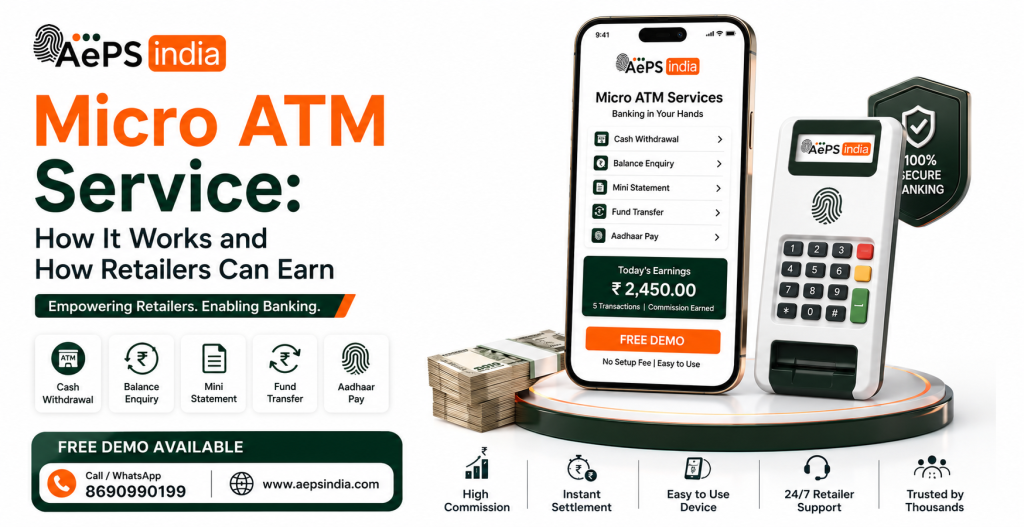
Are you looking for a reliable Micro ATM Service to offer convenient banking services from your shop and create an additional source of income? A Micro ATM can help retailers, agents, and digital service providers offer eligible banking transactions to customers who need access to basic financial services without visiting a traditional bank branch for every transaction.
With the right Micro ATM Service, a retailer can provide services such as cash withdrawal and other supported banking transactions through an authorized service network. The exact services available depend on the device, bank, payment partner, and applicable operating model. For customers, this can offer greater convenience, especially in areas where access to a nearby bank branch or ATM is limited.
A micro ATM service uses a small, portable card-swipe device run by a local shop agent to act as a mobile bank. It connects to bank networks using mobile data so people can withdraw cash, check account balances, or transfer funds without visiting a bank branch.
A simple Micro ATM workflow generally involves the customer selecting an available service, providing the required account or authentication details, completing the applicable authentication process, and receiving the transaction result. The transaction is processed through the relevant authorized banking and payment infrastructure, subject to the rules and availability of the participating institutions.
Whether you are a Kirana store owner, retailer, digital service provider, entrepreneur, or business looking to expand your financial service offerings, choosing the right Micro ATM solution can help you build a more useful service point for your customers.
For retailers, a Micro ATM business can create an opportunity to serve more customers from an existing shop. Instead of relying only on traditional product sales, a retailer can add digital banking services and earn according to the applicable commission or business model. Actual earnings can vary based on transaction volume, service availability, location, customer demand, and the commercial terms offered by the authorized Aeps india.
AEPS India provides Micro ATM Service solutions for retailers and businesses looking to add digital banking services to their operations. Before choosing a Micro ATM provider like Aeps india, it is important to understand the device requirements, supported services, Micro ATM onboarding process, transaction workflow, settlement process, security practices, technical support, and applicable banking or payment-network requirements.
In this complete guide, you will learn how Micro ATM Service works, which banking services may be available, how retailers can earn, what is required to get started, how transactions are processed, and how to Aeps india is the right Micro ATM Service provider for your business.
What is a Micro ATM Service?
A Micro ATM service is a portable, handheld card-swipe or biometric device operated by local banking agents or shop owners. It connects to a bank’s core system via mobile internet to let people perform basic banking tasks like cash withdrawals, balance checks, and fund transfers in areas without regular ATMs.
Micro ATM Service Work?
A Micro ATM is a portable, handheld card-swipe device used by designated bank agents or local shopkeepers to perform basic interoperable banking transactions without needing a full-sized physical ATM.
How a Micro ATM Works
- Card & PIN Input: The customer inserts or swipes their debit card into the portable machine and types their secret PIN.
- Network Connection: The device connects to the bank’s core system via mobile data (GPRS/4G).
- Authentication: The bank server checks the account details and approves the transaction.
- Cash Handover: The device prints a receipt, the customer’s account is debited, and the local merchant hands over physical cash from their store register.
What Services Are Available Through Micro ATM?
A micro ATM is a portable handheld device used by bank agents or local shop owners to deliver basic, interoperable banking services via debit cards or Aadhaar verification. It acts as a mobile point-of-sale terminal connected to bank networks.
Core Banking Services
- Cash withdrawals: Get cash using a debit card and PIN or through local store cash-drawers.
- Balance inquiries: Check current bank account balances.
- Mini statements: Print or view recent transaction logs.
- Fund transfers: Move money between bank accounts.
- Cash deposits: Deposit money into connected accounts.
Micro ATM Service Requirements
To set up and offer Micro ATM services as a merchant or business correspondent, you need a physical handheld card-swipe device, an active bank or fintech service tie-up, a smartphone with internet, basic KYC identity documents, and working working capital (cash) to hand out to customers.
Hardware and Technical Requirements
- Micro ATM Device: A certified, portable PIN-pad device equipped with a magnetic stripe and chip card reader (and often a biometric fingerprint scanner).
- Connectivity: A reliable GPRS, 4G cellular SIM card, or Wi-Fi network to connect securely to bank servers.
- Smartphone/Terminal: An Android phone or tablet to pair with the device and run the banking application.
Business and Legal Requirements
- KYC Documents: PAN card, Aadhaar card, passport size photos, and address proof of the shop or business location.
- Bank Account: A functional current or savings bank account linked for daily transaction settlements and commission payouts.
- Business Correspondent (BC) Registration: Approval and Micro ATM onboarding through an Aeps india.
- Cash Liquidity: Sufficient physical cash reserves on hand at your shop to dispense to customers during cash withdrawals.
Documents Required for Micro ATM Retailer Registration
To register as a Micro ATM retailer in India, you need personal KYC documents, business identity verification, and active banking details for daily settlement of cash transactions and commissions.
Essential Documentation
- Identity & Address Proof: PAN Card (mandatory) and Aadhaar Card for quick e-KYC. Alternatives include Voter ID or Passport.
- Business Proof: Shop address proof such as a utility bill (electricity/landline) or rent agreement.
- Financial Details: A cancelled cheque or bank passbook for daily settlement of transactions and commissions.
- Others: Passport-size photographs.
Who Can Apply for a Micro ATM Service?
Any local shopkeeper, merchant, or small business owner with a permanent physical location and basic identity proof can apply to become a Business Correspondent (BC) and operate a best micro ATM service.
Eligible Applicants
- Kirana and Grocery Store Owners: Local neighborhood shop operators.
- Small Retailers and Chemist Shop Owners: Independent store vendors with fixed premises.
- Common Service Center (CSC) Operators: Digital service point and internet kiosk managers.
- Rural and Semi-Urban Entrepreneurs: Individuals looking to offer last-mile banking services.
Basic Requirements
- Physical Space: A operational shop, kiosk, or office space with electricity and stable internet.
- Identity and Address Proof: Aadhaar card, PAN card, and passport-size photographs.
- Business Proof: Shop registration, commercial license, or utility bill for the address.
- Active Bank Account: A valid current or savings account linked to the applicant’s PAN to receive commissions and settlements.
- Device Investment: Ability to purchase or lease an RBI-approved micro ATM card-swipe machine via a certified fintech or banking partner.
Why Need Micro ATM Service
Micro ATM services are needed to bridge the gap in last-mile banking, bringing essential financial services like cash withdrawals, balance checks, and mini statements to remote or underserved areas through portable, handheld devices operated by local merchants.
Key Reasons for Micro ATM Services
- Reaches Remote Areas: Brings banking directly to rural or semi-urban locations where traditional bank branches and large ATMs are far away.
- Low Setup Cost: Eliminates the heavy infrastructure, large space, high maintenance, and security costs of conventional ATMs.
- Financial Inclusion: Helps unbanked populations access formal banking systems easily using debit cards or Aadhaar-based verification.
- Extra Income for Shopkeepers: Allows local store owners to act as banking agents (Business Correspondents) and earn commissions on every transaction.
- Increased Footfall: Drives more local customers into neighborhood shops to handle cash needs.
- Portable and Flexible: Uses mobile data connectivity, allowing agents to operate efficiently even with basic power and network requirements.
Read Blog: Micro ATM in India: How It Works, Benefits, Services & Complete Guide
Top Use Cases of Micro ATM Services
Micro ATM services use portable handheld card-and-biometric devices operated by local business correspondents to provide banking access. They bring essential financial transactions to rural or remote areas without requiring large physical ATM infrastructure.
Financial Inclusion & Rural Banking
- Cash Withdrawals and Deposits: Customers can use debit cards or Aadhaar biometric scans (AePS) to withdraw or deposit cash at local neighborhood shops.
- Government Subsidy Access: Beneficiaries easily withdraw direct benefit transfers (DBT), pensions, and rural employment wages (like MGNREGA) locally.
- Account Services: Users can check account balances and print or view mini statements on the spot.
Field Collections & Microfinance
- Loan EMI Collection: Field agents use portable micro ATM to collect loan installments or insurance premiums directly at a customer’s doorstep.
- Daily Savings Collection: Cooperative bank agents use them to gather recurring or pigmy deposits from local vendors.
Merchant & Retail Utility
- Dual POS Functionality: Small shop owners use a single device to accept customer card/UPI payments as a point-of-sale terminal and disburse cash as a mini bank.
- Utility Bill Payments: Consumers pay electricity, water, and telecom bills in real time through the agent network.
Key Aspects of Micro ATM Services
Micro ATM are small, portable card-swipe and biometric devices used by authorized banking agents to deliver basic financial services. They connect via mobile data to a central bank server, bridging the gap for rural and unbanked populations without requiring full-scale brick-and-mortar ATM infrastructure.
Core Features & Operation
- Portability: Small, lightweight handheld machines that agents can carry anywhere.
- No Cash Storage: They do not hold or dispense physical cash internally; the local agent hands out the money from their own cash drawer after a successful digital authorization.
- Dual Authentication: Supports traditional debit cards with PINs as well as Aadhaar-based biometric fingerprint scans.
- Connectivity: Works on low-power mobile internet connections (GPRS, 3G, or 4G).
Why Are Retailers Adding Micro ATM Services?
Retailers are adding micro ATM services to boost store traffic, earn extra commission income on every transaction, and turn their shops into local banking hubs that offer convenient cash withdrawals and balance checks without heavy infrastructure costs.
Financial Benefits for Retailers
- Extra earnings: Shopkeepers make a small commission fee on every cash withdrawal or balance inquiry they process.
- More customers: Offering financial services brings extra people through the door, which often leads to higher regular retail sales.
- Low setup cost: Handheld micro ATM units cost a fraction of traditional Micro ATM and require no special room, heavy security, or expensive maintenance.
Community and Operational Advantages
- Fills banking gaps: Local stores serve as convenient cash points in areas where physical bank branches or standard ATMs are far away.
- Simple technology: Devices use standard mobile data and support secure debit card or Aadhaar-based biometric verification.
- Flexible hours: Shops stay open longer than traditional bank branches, giving people access to money during holidays or after regular banking hours.
Mini Statement • Bill Payment
Micro ATM Service for Rural and Semi-Urban Areas
A micro ATM is a pocket-sized, portable card-swipe or biometric device operated by local merchants or Business Correspondents (BCs). It connects to bank servers via mobile data to deliver doorstep essential banking like cash withdrawals, balance inquiries, and mini-statements in areas lacking traditional banking infrastructure.
Benefits for Rural & Semi-Urban Regions
- Financial Inclusion: Brings core banking to remote or unbanked populations without requiring expensive brick-and-mortar branches.
- Travel Reduction: Eliminates the need to spend hours traveling to distant towns just to check balances or withdraw cash.
- Merchant Earnings: Gives local small business owners and vendors an extra source of income through transaction commissions.
- Subsidy Access: Simplifies the direct local distribution of government grants and welfare payouts.
Read Blog: Micro ATM Software Development Company in India – Features, Cost & Benefits
How Retailers Can Grow Their Business With Micro ATM Services
Retailers can grow their business with micro ATM services by turning their shop into a local banking hub. Using a small handheld device, store owners can offer cash withdrawals, balance checks, and card payments. This brings in more walk-in customers, boosts store sales, and earns the retailer an instant commission on every single transaction.
Key Benefits for Retailers
- Extra Money: Earn a cash commission or profit margin on every card swipe or Aadhaar-based withdrawal.
- More Foot Traffic: Draw new people into your shop who may buy items while they visit for cash.
- Low Setup Cost: Avoid the heavy cost and large space needed for a traditional Micro ATM.
- Dual Purpose: Use the exact same portable machine as a point-of-sale (POS) terminal to accept regular store payments.
Features Micro ATM Service
A Micro ATM is a portable, handheld card swipe device operated by a banking agent or merchant to deliver basic interoperable financial services like cash withdrawals, balance inquiries, and mini-statements using bank debit cards and PIN verification or biometric scans.
Core Functionality
- Portable & Handheld: Compact size makes it easy to carry and set up anywhere by local shop owners or business correspondents.
- Dual Authentication: Supports secure debit card swiping with a PIN as well as biometric fingerprint scanning.
- Flexible Connectivity: Connects to core banking servers through GPRS, 3G, 4G, or mobile data networks.
- Transaction Services: Allows cash withdrawals, balance checks, fund transfers, and mini-statement printouts.
- Receipt Generation: Includes a built-in thermal printer to instantly hand out physical transaction receipts.
Operational Advantages
- Interoperable Network: Works seamlessly with cards issued by major banks linked via the National Payments Corporation of India (NPCI).
- Financial Inclusion: Brings doorstep banking to rural or unbanked areas without requiring heavy ATM infrastructure.
- Low Setup Cost: Inexpensive for local merchants to deploy compared to traditional, large automated teller machines.
Benefits Micro ATM Service
A micro ATM is a pocket-sized, portable card swipe and biometric device operated by local business agents. It connects via mobile data to deliver core banking services such as cash withdrawals, balance inquiries, and mini statements without needing a full-sized Micro ATM setup.
Benefits for Customers
- Easy Doorstep Access: Get cash and check balances locally without traveling long distances to a bank branch.
- No Card Needed Options: Use Aadhaar biometric (fingerprint) authentication alongside traditional debit cards.
- Interoperable Network: Perform transactions seamlessly using bank accounts from almost any major bank.
Benefits for Small Businesses and Agents
- Extra Income: Shopkeepers and local merchants earn a commission on every successful cash transaction.
- Low Setup Cost: Requires minimal investment, no heavy infrastructure, and runs on a basic smartphone with mobile data.
- More Footfall: Attracts more local customers into retail shops to handle daily financial needs.
Benefits for Banks and Government
- Financial Inclusion: Reaches unbanked populations in remote, rural, or tier-3/tier-4 regions cost-effectively.
- Welfare Delivery: Streamlines direct benefit transfers (DBT) and government subsidies to citizens on the ground.
How to Start a Micro ATM Service in India
To start a Micro ATM service in India, partner with an RBI-approved Aeps india, complete your KYC verification, purchase a portable card/biometric device (usually costing ₹1,500 to ₹5,000), link the mobile application, and begin processing customer cash withdrawals or balance checks from your shop.
Step-by-Step Setup Process
- Register as an Agent: Sign up via an authorized Aeps india.
- Complete KYC Verification: Submit your identity proofs, business address proof, and bank credentials for verification.
- Procure the Device: Buy the certified handheld Micro ATM machine or integrated biometric scanner device through Aeps india.
- Install and Test: Download the Micro ATM mobile app, pair your hardware via Bluetooth or USB, complete basic operational training, and run a test transaction.
How to Become a Micro ATM Retailer?
To become a micro ATM retailer, apply through an authorized Aeps india complete your KYC verification, purchase or lease a handheld micro ATM device, and link it to your business account to start processing withdrawals and earning commissions.
Requirements to Start
- A fixed shop or business location (like a grocery or general store)
- A smartphone or computer with active internet connectivity
- Valid KYC documents including Aadhaar Card, PAN Card, and passport-size photographs
- A functional bank account for daily transaction settlements
- Working cash liquidity in your shop to disburse cash to customers during card swipes
Step-by-Step Application Process
- Choose a Aeps india: Select an RBI-approved Aeps india offering micro ATM infrastructure.
- Register Online: Visit the official website or download the agent application of your chosen Aeps india to sign up.
- Submit KYC Details: Upload your identity proof, address proof, and business details for verification.
- Acquire the Device: Pay the required registration or device fee to receive your portable micro ATM card-swipe terminal.
- Activate and Train: Complete the basic training provided by the company, log in to the merchant app, pair your device via Bluetooth/network, and begin operations.
Micro ATM Setup Process for Retailers
To setup Micro ATM as a retailer, register with an authorized Aeps india network, complete your KYC verification using your PAN and Aadhaar, purchase or lease a pocket-sized card/biometric device, and link it to the Micro ATM mobile app to start processing transactions and earning Micro ATM commissions.
Step-by-Step Registration Process
- Choose a Aeps india: Select a trusted, RBI-compliant Aeps india offering Micro ATM or AePS services (such as Aeps india).
- Register as a Merchant: Sign up on the Micro ATM portal or Micro ATM mobile application using your mobile number and basic business details.
- Complete KYC Verification: Submit your digital identity proofs, business registration documents, and PAN/Aadhaar details for background verification.
- Acquire the Device: Order the portable Micro ATM hardware device through the Micro ATM platform.
- Link and Activate: Download the partner app on your phone, pair the card-swipe/biometric device via Bluetooth, and complete your initial activation.
Read Blog: Best Micro ATM Software Solution in India: Features, Cost & Benefits
Micro ATM Service Cost and Setup
A basic micro ATM setup in India costs between ₹1,500 and ₹5,000 for handheld hardware, with total entry costs often starting around ₹2,149 including initial registration.
Setup Costs and Hardware Pricing
- Basic Handheld Models: Cost ₹1,200 to ₹2,500 for portable Bluetooth or card-swipe mPOS units.
- Mid-Range / Bank-Specific Units: Cost ₹2,800 to ₹4,500 for encrypted pin-pads configured for specific banking networks.
- Advanced All-in-One Devices: Cost ₹8,000 to ₹25,000 for heavy-duty units with built-in thermal printers and fingerprint scanners.
- Hidden/Ongoing Costs: Aeps india charge zero monthly rental fees, earning revenue through commissions on cash withdrawals and balance inquiries.
Micro ATM Commission Structure
Micro ATM (mATM) commission structures reward agents and retailers with real-time per-transaction payouts for debit card withdrawals, balance inquiries, and mini-statements. Earnings generally range from ₹1 to ₹15 for withdrawals and ₹1 to ₹5 for non-financial checks, varying by Aeps india.
Cash Withdrawal Tiers (Approximate)
- ₹500 – ₹999: ₹1 commission
- ₹1,000 – ₹1,999: ₹2 commission
- ₹2,000 – ₹2,999: ₹4 commission
- ₹3,000 – ₹10,000: ₹7 up to ₹15+ commission (Aeps india schemes can peak around ₹12 – ₹15 for high-value brackets like ₹10,000)
Non-Financial Transactions
- Balance Inquiry: ₹0.80 to ₹2.00 per check
- Mini Statement: ₹1.00 to ₹3.00 per print/view
- Fund Transfer / DMT: Around 0.5% of the transaction amount (subject to maximum caps)
Micro ATM Services Earnings in India
Micro ATM service earnings rely on a per-transaction commission model where local shop owners and merchant agents earn fixed fees or percentage-based margins for providing cash withdrawals, balance inquiries, and mini-statements to customers using interoperable bank debit cards or biometric authentication.
Commission and Payout Structure
- Cash Withdrawals: Higher slab-based or flat commissions ranging from ₹5 to ₹12+ per successful transaction depending on the withdrawal amount tier and the specific Aeps india.
- Balance Inquiries: Small non-financial flat fees usually ranging from ₹1 to ₹2 per check.
- Mini Statements: Flat incentives matching balance inquiries, generally around ₹1 to ₹2 per print or view.
- Aadhaar Pay / AePS Slabs: Variable percentage margins (often up to 0.25% to 1% or capped slab limits) for high-value Aadhaar-authenticated transfers.
Key Factors Impacting Monthly Income
- Daily Footfall: High-traffic retail locations or underserved rural/semi-urban pockets yield larger transaction volumes.
- Liquidity Management: Maintaining adequate physical cash float at the counter to honor continuous customer withdrawal demands.
- Aggregator Policies: Aeps india enforce varying slab rates and monthly volume incentives.
How Can Retailers Earn From Micro ATM Services?
Retailers earn from micro ATM services by collecting a direct commission on every customer transaction such as cash withdrawals, balance checks, or mini-statements while driving higher in-store foot traffic and boosting direct retail sales.
Direct Revenue Streams
- Per-Transaction Commission: Earn a fixed fee or percentage on cash withdrawals, balance inquiries, and fund transfers processed through the device.
- Cash Management Efficiency: Safely rotate daily shop cash collections by dispensing physical cash to customers in exchange for digital bank settlements into your business account.
Indirect Business Growth
- Increased Foot Traffic: Attract new visitors to your store who need local banking access, especially in semi-urban or rural zones.
- Cross-Selling Opportunities: Convert cash-withdrawing visitors into shoppers who purchase regular goods or impulse items on-site.
- Low Setup Overhead: Use compact, affordable handheld hardware requiring minimal infrastructure compared to traditional standalone ATMs.
Read Blog: Affordable Micro ATM in India: Best Options for Retailers and Agents
How Much Can a Retailer Earn From a Micro ATM?
A retailer can earn a commission of ₹2 to ₹15 per cash withdrawal transaction and ₹1 to ₹5 for non-financial tasks like balance checks. Total monthly earnings range from ₹5,000 to over ₹35,000, depending directly on daily customer footfall and the transaction volume in areas with limited bank access.
Earnings Breakdown
- Cash Withdrawals: Higher withdrawal amounts yield larger commissions, typically scaling from ₹2 for small amounts up to ₹12–₹15 for large amounts (₹8,000–₹10,000).
- Balance Inquiries & Mini Statements: Fixed smaller rewards of about ₹1 to ₹4 per lookup.
- Extra Customer Charges: Some local shop owners charge a nominal convenience fee directly to customers for cash delivery, though this depends on Aeps india terms.
Key Cost and Setup Factors
- Device Price: Handheld micro ATM and mPOS hardware ranges from ₹1,200 to ₹25,000 depending on whether it includes a printer or biometric options.
- Working Capital: You must maintain adequate cash float in your shop cash drawer and a funded digital wallet with Aeps india to dispense cash smoothly.
Micro ATM Machine and Software: What Do You Need?
A micro ATM setup requires specific hardware, secure banking software, and regulatory approval. You need a portable mPOS terminal with a card reader and PIN pad, an active internet connection, and backend software linked to the National Payments Corporation of India (NPCI) network to process cash withdrawals and balance checks.
Essential Hardware
- mPOS Terminal: A handheld, card-swipe device with a secure, encrypted PIN pad (PCI-PED compliant).
- Biometric Scanner: An STQC-certified fingerprint scanner if you also plan to support Aadhaar-based (AePS) transactions.
- Connectivity: A device that supports GPRS, dual-SIM cellular data, or Wi-Fi to reach banking servers in real time.
- Built-in Printer: For instant physical paper receipts or an option to send electronic e-receipts.
Software and Backend Requirements
- Micro ATM Application: A mobile or web app (Android/iOS) that pairs via Bluetooth with your card terminal.
- Banking APIs / Gateway: Middleware software that securely routes card and PIN data to partner banks and payment networks.
- Agent Dashboard: A portal to track daily transaction ledgers, settlement histories, and commission earnings.
- Security Layer: End-to-end encryption and PCI DSS compliance to protect user financial data.
Business and Legal Prerequisites
- KYC and Verification: Business registration, PAN card, address proof, and individual KYC for agent onboarding.
- Bank/Fintech Partnership: Tie-up with an authorized Aeps india to enable live switch routing and cash settlements.
How a Micro ATM Cash Withdrawal Works
A micro ATM is a portable, handheld device operated by a banking agent or shopkeeper. It does not store or dispense cash itself. Instead, the human agent hands you physical cash from their own drawer after your debit card or biometric fingerprint verification is digitally approved by your bank.
The Step-by-Step Withdrawal Process
- Visit an Agent: Go to a local store or authorized banking correspondent who has a micro ATM machine.
- Share Details: Give the agent your bank name and your debit card or Aadhaar number.
- Choose Service: The agent selects the cash withdrawal option on the handheld device.
- Verify Identity: Swipe, insert your debit card and type your secret PIN, or scan your fingerprint via a biometric reader linked to your Aadhaar.
- Enter Amount: Type the exact money value you want to withdraw.
- Bank Approval: The machine connects securely over mobile data to check your account balance and approve the payout instantly.
- Collect Cash: The agent hands you the physical cash and a printed or digital receipt.
How Micro ATM Cash Withdrawal Works
A simple, step-by-step visual guide to the digital cash withdrawal process.
Customer Request
The customer approaches the retailer and requests a specific amount (e.g., ₹5,000) for withdrawal.
Visit Retailer/Agent
The customer visits a registered Business Correspondent (BC) or a local retail shop equipped with a Micro ATM device.
Authentication Initiation
The retailer initiates the transaction. The customer inserts their Debit Card into the Micro ATM or provides Aadhaar details.
Security Verification
Customer performs verification via PIN (for cards) or Biometric/Fingerprint scan (for AEPS).
Server Communication
The Micro ATM sends an encrypted request to the banking server to check for sufficient funds and validity.
Bank Approval
The bank verifies the details and approves the transaction, deducting the amount from the customer’s account.
Cash Delivery
Once the approval is received on the device, the retailer hands over the requested cash (₹5,000) to the customer.
Confirmation Receipt
A digital or printed receipt is generated as proof of the successful transaction for both the retailer and the customer.
Understanding the Micro ATM Ecosystem
A Micro ATM is a handheld Point of Sale (PoS) device that allows banking agents to provide basic financial services in remote areas. This process eliminates the need for large ATM machines and reduces the distance customers have to travel for their money.
The security of this process is managed by NPCI and the respective banks, ensuring that every single rupee is tracked through a secure encrypted channel, making it as safe as a traditional ATM withdrawal.
Micro ATM Transaction Limits
Standard micro ATM (mATM) transactions in India are generally capped at a maximum of ₹10,000 per single transaction. Daily cumulative limits and transaction frequencies depend heavily on the specific card-issuing bank’s rules and the operational guidelines of the Aeps india network.
Key Micro ATM Limits
- Per-Transaction Limit: Maximum of ₹10,000 for cash withdrawals.
- Daily Frequency: Often restricted to a set number of swipes or a combined daily cap set by your bank card limits.
- Free Quotas: Standard banking rules apply for monthly free usage (such as 5 free transactions on own-bank setups), after which financial institutions may charge up to ₹23 per transaction plus applicable taxes.
Read Blog: Buy Micro ATM Online in India: Best AEPS Device Price & Complete Guide
Micro ATM Security and Compliance
Micro ATM security and compliance rely on end-to-end transaction encryption, hardware-level certifications like PCI PTS and L1 biometric standards, and strict adherence to regulatory frameworks laid down by the RBI, NPCI, and UIDAI.
Core Security Protocols
- End-to-End Encryption (E2EE): All PIN entries and transaction data are encrypted at the hardware level inside the device before transmission via mobile data (GPRS/3G/4G).
- Multi-Factor Authentication: Combines physical debit card swiping with secret PINs, or Aadhaar numbers with L0/L1 certified biometric fingerprint scanners.
- Device Integrity: Terminals feature tamper-detection mechanisms that wipe sensitive keys if physical intrusion is detected.
Key Compliance Standards
- Regulatory Bodies: Operations must comply with guidelines from the Reserve Bank of India (RBI), National Payments Corporation of India (NPCI), and Unique Identification Authority of India (UIDAI).
- Hardware & Payment Certifications: Devices require PCI PTS (PIN Transaction Security) for card processing, EMV Level 1 & 2 for chip compliance, and STQC certification for biometric scanners.
- Agent Accountability: Business Correspondents (BCs) must be authorized by scheduled commercial banks, mapped through centralized Micro ATM dashboards, and restricted on cash float limits.
What Happens When a Micro ATM Transaction Fails?
When a micro ATM transaction fails and money leaves your bank account without the cash being handed over, the system triggers an automatic reversal. Under regulatory guidelines, the bank must credit your money back within 5 calendar days (T+5). If they delay past this window, you receive a penalty payment of ₹100 for each extra day.
What Happens Behind the Scenes
- Connection Drop: The portable device loses network signal mid-way through talking to the bank server.
- Timed Out Sessions: The system stops because the server takes too long to reply.
- Logistical Errors: The transaction logs as a debit on your bank app, but the micro ATM terminal fails to complete the cash dispense or receipt print.
What You Should Do
- Check the Status: Look at your mobile Micro ATM banking app to confirm if the money actually left your account.
- Save the Slip: Keep the printed mini-ATM failure receipt or write down the time, date, and terminal ID.
- Raise a Complaint: Contact your home bank customer service or visit the local branch if the automated credit does not show up within 2 to 5 days.
- Community Consensus: Most users on forums agree that keeping a photo of the error screen speeds up manual dispute resolution if the auto-reversal stalls.
Micro ATM Service vs Running Without Digital Banking Services
A Micro ATM service uses a small, portable card-swipe or biometric device operated by a local shop agent to connect people to formal digital banking networks. In contrast, running without digital banking services means relying entirely on physical cash, traditional bank branches, or hiding physical money, completely missing out on instant electronic financial access.
Access and Convenience
- Micro ATM: Gives you card or fingerprint cash withdrawals, balance checks, and fund transfers right inside your neighborhood store.
- No Digital Services: Forces you to travel long distances to official bank branches and wait in long lines just to handle basic cash needs.
Security and Tracking
- Micro ATM: Uses safe, encrypted digital networks with real-time text alerts and printed paper receipts.
- No Digital Services: Leaves you handling unsecured physical paper cash with zero electronic paper trails or immediate fraud notifications.
Cost and Inclusion
- Micro ATM: Connects you to interoperable banking using mobile data, bringing cheap and fast financial services to rural or unbanked areas.
- No Digital Services: Keeps you completely isolated from modern financial growth, government direct transfers, and fast merchant payments.
Read Blog: All You Need to Know About Micro ATM Machine: Features and Working
Micro ATM Service Demo
Micro ATM Service Demo
Interact with our simulated device to understand the user journey.
Micro ATM
Simulation Controls
Click the buttons below to simulate the Micro ATM process:
System: Online
Server: Connected
Biometric: Ready
Why Experience our Micro ATM Demo?
Our Micro ATM service is designed for maximum efficiency and security. By simulating the process, retailers and fintech partners can understand the seamless integration between the hardware and the banking server.
Key Highlights of our Service:
- Instant settlement for retailers.
- Highly secure AES-256 encryption for data transfer.
- Compatible with all major Indian banks via NPCI guidelines.
- Easy-to-use interface for rural and urban customers.
Micro ATM vs Traditional ATM vs POS Machine vs AEPS
Micro ATM, Traditional ATM, POS Machine, and AEPS are distinct financial service access points. Traditional ATMs are large, self-service kiosks using debit cards. Micro ATMs are handheld agent-run card/biometric terminals. POS machines process merchant retail card payments. Best AEPS is a biometric, Aadhaar-based server authentication network often run on mobile or micro ATM hardware.
Feature Comparison
| Feature | Traditional ATM | Micro ATM | POS (Point of Sale) Machine | AEPS (Aadhaar Enabled Payment System) |
|---|---|---|---|---|
| Primary Use | Self-service cash withdrawal & deposit | Agent-assisted cash withdrawal & basic banking | Merchant payment processing for goods/services | Cardless, biometric-based banking & cash withdrawal |
| Authentication | Debit Card + PIN | Debit Card + PIN (or Aadhaar/Biometric on hybrid units) | Card (swipe/dip/tap) or UPI / QR code | Aadhaar Number + Fingerprint Biometric |
| Form Factor | Large, fixed kiosk/cabinet | Handheld, portable card-swipe terminal | Handheld or countertop card terminal | Smartphone/terminal attached to a fingerprint scanner |
| Operation | Fully automated self-service | Operated by a banking correspondent/retailer | Operated by a store merchant/cashier | Operated by a banking correspondent/retailer |
| Connectivity | Leased line / wired high-speed internet | Mobile data / GPRS / Wi-Fi | Mobile data / GPRS / Wi-Fi / Broadband | Mobile data / internet via smartphone or terminal |
| Core Services | Cash out, balance check, mini-statement | Cash withdrawal, balance inquiry, mini-statement | Retail purchase payments, merchant settlements, some cash-at-pos | Cash withdrawal, balance check, mini-statement, fund transfer |
Micro ATM Service Provider Comparison
Top micro ATM service provider in India include Aeps india,Noble Web Studio, Spice Money and BANKIT. Hardware device costs range from ₹1,200 to ₹4,500, offering terminal portability, interoperability across major banks, and merchant commissions per cash withdrawal.
AEPS India offers an affordable Micro ATM solution starting from ₹1,500 to ₹2,500, along with Micro ATM devices, software, mobile application support, transaction reporting and retailer-focused services. Instead of choosing a Aeps india only on device price, businesses can compare the complete package including usability, service support, transaction management and onboarding.
Trusted choice for businesses: AEPS India positions its Micro ATM solution for retailers, agents, BCs and businesses that want to provide supported banking services through portable devices.
Price note: Keep the ₹1,500–₹2,500 range as the current starting/available price only if that is your actual live selling price. AEPS India’s published material shows basic Micro ATM models in approximately this range, while pricing varies by device model and features.
Affordable Micro ATM pricing, complete service support, easy onboarding and business-ready technology all from AEPS India.
Provider Comparison
| Feature / Provider | Aeps india | Noble Web Studio | Spice Money | BANKIT |
|---|---|---|---|---|
| Approx. Device Cost | ₹1,000 – ₹2,500 | ₹1,500 – ₹2,500 | ₹2,200 – ₹3,500 | ₹2,500 – ₹3,000 |
| Core Services | Cash withdrawal, balance check, mini-statement | Cash withdrawal, balance check, mini-statement | Cash withdrawal, balance check, mini-statement | Cash withdrawal, balance check, mini-statement |
| Additional Features | AEPS, BBPS, recharges, domestic money transfer | AEPS, BBPS, travel bookings, cash collection | AEPS, prepaid cards, bill payments, insurance | AEPS, mPOS, cash management services |
| Card Support | Major domestic/international debit cards (Chip/Swipe) | Major debit cards (Chip/Swipe/NFC) | Major debit cards (Chip/Swipe) | Major debit cards (Chip/Swipe) |
| Target User | Retailers, local kirana store owners and Small businesses | Rural and semi-urban banking correspondents | Small businesses and shopkeepers | Micro-merchants and agents |
Micro ATM Buying Checklist
A micro ATM buying checklist helps shop owners and banking agents select a secure, reliable handheld device for cash withdrawals, balance checks, and mini statements. Evaluate compliance, hardware durability, connectivity, and software integration before making a purchase.
Compliance & Security
- Verify RBI and bank approvals to ensure legal operation.
- Check for encrypted banking networks and secure PIN entry pads.
- Confirm support for Aadhaar biometric verification (fingerprint scanning) if offering best AePS services.
Hardware & Performance
- Test the card reader for smooth chip, swipe, and contactless (NFC) support.
- Look for a rugged build and durable physical keypad to withstand daily retail use.
- Ensure a long battery life to prevent shutdowns during power outages.
Connectivity & Integration
- Check for 4G/3G and Wi-Fi dual connectivity options.
- Confirm seamless app integration with your chosen Aeps india.
- Review the Micro ATM commission structure and hidden transaction or maintenance fees.
Aeps india One of The Right Micro ATM Service Provider
Aeps india one of the right Micro ATM service provider requires evaluating transaction security, device reliability, high uptime, and commission structures. Look for RBI-approved compliance, seamless interoperability with major debit cards and Aadhaar systems, transparent pricing, and responsive technical support to ensure profitable operations.
Safety and Compliance
- Regulatory Approval: Pick a Aeps india that complies with RBI guidelines and integrates safely with the National Payments Corporation of India (NPCI).
- Data Protection: Ensure end-to-end encryption and secure biometric or PIN authentication.
Performance and Hardware
- High Uptime: Select a Best Micro ATM platform with minimal server downtime to prevent failed cash withdrawals.
- Device Quality: Look for durable, portable hardware (such as PAX or MoreFun terminals) with strong battery life and stable 4G/Bluetooth connectivity.
- Interoperability: The machine must accept all major domestic and international debit cards (RuPay, Visa, MasterCard) along with Aadhaar-enabled payments (AePS).
Costs and Earnings
- Transparent Pricing: Check the upfront cost Micro ATM device versus hidden maintenance or Micro ATM software fees.
- Commission Margins: Compare the per-transaction commission payouts to guarantee a solid return on investment (ROI).
- Settlement Speed: Opt for Aeps india offering quick or instant settlement cycles to maintain daily cash flow.
Support and Usability
- User Interface: The Micro ATM app and device menu must be simple for both you and your customers to use.
- Customer Service: Reliable, fast technical support and staff training help fix connectivity or transaction errors immediately.
Why Choose AEPS India for Micro ATM Services?
Aeps india is a Micro ATM service provider, key factors include high transaction success rates (uptime), low device and per-transaction costs, robust security compliance (RBI and NPCI), and reliable 24/7 customer support. Additional Micro ATM service integration like AePS Software and bbps software also matter.
Reliability and Security
- Uptime: High success rates prevent failed cash withdrawals and build local trust.
- Compliance: Ensure the Micro ATM system follows RBI guidelines and uses end-to-end encryption via NPCI networks.
- Interoperability: The Micro ATM device must accept all major debit cards (RuPay, Visa, MasterCard) alongside Aadhaar biometric options.
Costs and Support
- Pricing & Commissions: Compare initial device purchase costs and merchant commission margins per transaction.
- Customer Support: Look for active technical help and staff training to handle sudden device or network failures.
- Extra Features: Check for value-added services like mini-statements and utility Best BBPS Software.
Contact AEPS India for Micro ATM Services
Looking for reliable Micro ATM Services for your business? Connect with AEPS India to discuss Micro ATM solutions, service requirements, and the right setup for your business.
Conclusion
A Micro ATM Service can help retailers and businesses offer convenient banking services to customers, especially in areas where access to a traditional bank branch or ATM may be limited. By using a supported Micro ATM solution, eligible customers can access services such as cash withdrawal and other available banking transactions, subject to the capabilities of the device, bank, and service network.
For retailers, a Micro ATM business can create an additional service point for regular customers while helping increase daily customer visits. However, actual earnings depend on factors such as transaction volume, the applicable commission structure, location, customer demand, operating costs, and the terms of the authorized Aeps india.
Best Micro ATM services use small, portable card-swipe devices operated by local shop owners or bank agents to provide basic banking. They connect to bank servers via mobile data, allowing customers to withdraw cash, check account balances, and print mini-statements right at a neighborhood store without visiting a traditional bank branch.
AEPS India provides Micro ATM Service solution for retailers and businesses looking to add digital banking services to their existing business. Aeps india is a top Micro ATM provider, it is important to check device compatibility, available banking services, Micro ATM onboard requirements, transaction support, settlement process, technical assistance, applicable fees, and the Micro ATM commission structure.
If you are planning to start Micro ATM business, provide cash withdrawal services, or add a Micro ATM to your retail shop, choose a Aeps india that matches your business requirements and is supported through the appropriate banking and payment ecosystem.
Contact AEPS India to discuss Micro ATM Service requirements, available solutions, onboarding, device options, and how you can add Micro ATM services to your business.
Frequently Asked Questions About Micro ATM Services
A Micro ATM Service allows customers to access selected banking services through a small, portable device operated by an authorised retailer or banking agent. Depending on the Aeps india and setup, customers can use the service for cash withdrawal, balance enquiry, mini statement and other supported banking transactions without visiting a traditional ATM.
A customer visits a Micro ATM retailer and provides the required authentication, usually through a debit card and PIN or another supported authentication method. The retailer processes the transaction through the Micro ATM, the request is sent through the banking network, and the customer receives the transaction result and cash when the withdrawal is approved.
The services depend on the Aeps india and banking setup. Common services include cash withdrawal, balance enquiry and mini statement. Some Micro ATM ecosystems may support additional banking services, so retailers should confirm the exact services available with their Aeps india before registration.
Yes. Retailers may earn commission on eligible Micro ATM transactions according to the commission structure offered by Aeps india. The actual amount can depend on the transaction type, Aeps india, customer bank and applicable commercial terms. Aeps india, for example, promotes commission earnings for Micro ATM transactions.
There is no fixed income amount for every retailer. Earnings depend mainly on the number and type of eligible transactions, the applicable commission rate and the retailer’s customer traffic. A simple way to estimate gross commission is:
Monthly Transactions × Commission Per Transaction = Estimated Gross Commission
Retailers should check the current commission slab and terms with their Aeps india instead of relying on guaranteed income claims.
The transaction limit depends on the Aeps india and applicable transaction rules. For example, Fino currently lists ₹100 as the minimum transaction amount and ₹10,000 as the maximum limit for its mATM service. Aeps india also states a ₹10,000 maximum while noting that limits can vary by bank/customer.
For card-based Micro ATM services, yes. The customer generally uses a supported debit card and PIN to authenticate the transaction. Fino states that its mATM accepts bank debit cards including Visa, Mastercard and RuPay. However, requirements can vary between Aeps india.
Some Micro ATM setup can support biometric authentication, depending on the device, service and banking infrastructure. For example, Best Micro ATM solution can include fingerprint-based authentication alongside card-based transactions. Always check the supported authentication methods before purchasing or activating a device.
Micro ATM and AEPS are related but they are not the same service.
Micro ATM is a portable banking device/channel commonly used for card-based transactions, while AEPS uses Aadhaar-based authentication through an eligible banking/BC ecosystem.
A retailer may be able to offer both services through a suitable financial services platform, but the authentication method, device and transaction flow can differ.
The exact requirements depend on the Aeps india. Commonly requested information can include Aadhaar, PAN, mobile number, bank details, address information and business/shop details. Aeps india may also require KYC, physical verification or other onboarding checks before activating services. Aeps india, for example, states that KYC and physical verification are part of its Micro ATM onboarding process.
The usual process is:
Choose a Aeps india→ Submit registration details → Complete KYC → Complete required verification → Receive/activate your retailer or agent ID → Set up the device → Start transactions.
The exact process, fees and activation requirements vary by Aeps india. Aeps india currently provides online registration and an Micro ATM agent app as part of its Micro ATM onboarding process.
The price depends on the device model, features, Aeps india and onboarding package. For example, Aeps india currently lists its Micro ATM device at ₹1,799, while its package page separately shows an agent ID + mATM device package at ₹2,149. Prices and packages can change, so buyers should confirm the latest total cost before ordering.
Yes. One of the main purposes of Micro ATM services is to extend banking access to locations where customers may have limited access to traditional ATM or branch infrastructure. Portable Micro ATM devices allow authorised retailers or agents to provide supported banking services closer to customers.
If a transaction fails, the retailer should first check the transaction status rather than immediately repeating the transaction. If the customer’s account has been debited but the transaction is unsuccessful, the reversal or refund process depends on the Aeps india and transaction status. The retailer should keep the transaction reference number and contact the Aeps india support team when required.
Activation time varies by Aeps india and depends on registration, KYC, verification, device allocation and technical setup. Aeps india may require physical or video verification before services are activated. For this reason, it is better to confirm the expected activation timeline with the Aeps india before purchasing Micro ATM device. Aeps india, for example, requires KYC and physical verification as part of its activation process.
Affordable Micro ATM Starting at ₹1,500 – Features & Service
Micro ATM Machine – Price, Features, Specifications & Buy in India
Micro ATM Software Development Company in India – Features, Cost & Benefits
About Author

