AEPS Banking Portal in India: Complete Guide to Aadhaar-Enabled Banking
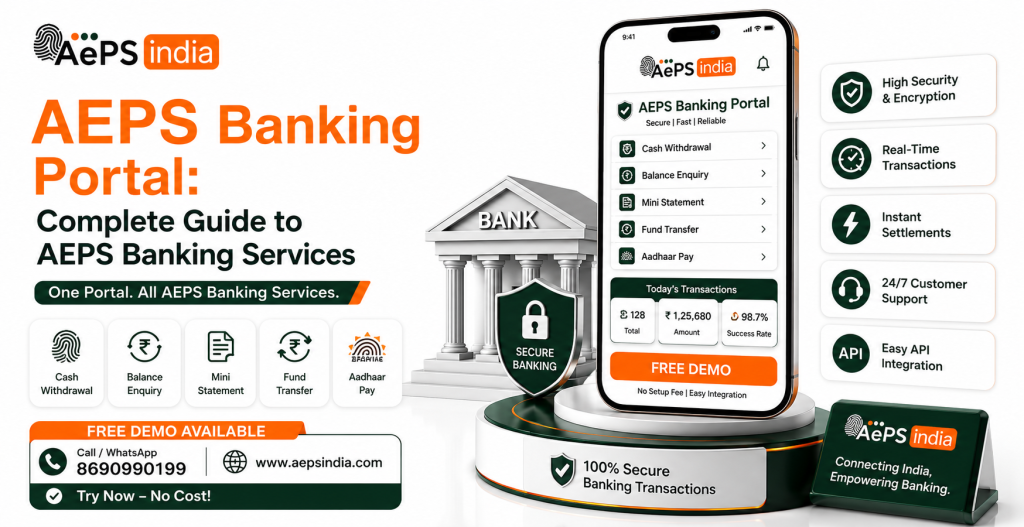
Are you looking for a reliable AEPS Banking Portal to manage your AEPS business, retailers, distributors, transactions, commissions, and digital banking services from one centralized platform? An AEPS Banking Portal can help businesses build a structured system for managing Aadhaar Enabled Payment System services and related operational workflows without handling every process manually.
For a growing fintech or Aeps B2B business, managing multiple retailers, monitoring transactions, checking wallet balances, calculating commissions, and generating reports through separate systems can become time-consuming. A professionally developed AEPS Portal brings these important business functions together through a centralized Aeps dashboard, making daily operations easier to monitor and manage.
An AEPS banking portal is a digital platform backed by the Aeps india. It allows customers to perform interoperable, cardless financial transactions using their Aadhaar number and fingerprint or iris biometric authentication through authorized micro ATM or banking correspondents.
AEPS India provides AEPS Banking Portal and AEPS Software solutions for businesses looking to launch, upgrade, or expand their digital banking operations. Depending on the selected business model and available integrations, the Aeps platform can include an AEPS Admin Panel, Aeps Retailer Portal, Distributor Management, Transaction Monitoring, Aeps Wallet Management, Aeps Commission Management, Reports, and AEPS API Integrate.
A complete AEPS Banking Software solution is especially useful for fintech companies, B2B payment businesses, distributors, retailer networks, CSP-related businesses, and entrepreneurs who want to build their own digital Aeps banking platform. The software can be configured around the required user hierarchy and operational workflow, helping the business manage multiple users and services from one system.
When choosing an AEPS Banking Portal Provider in India, businesses should look beyond a basic Aeps dashboard. Important factors include the available integration model, transaction-status handling, retailer and distributor management, security controls, role-based access, reporting, scalability, customization options, technical documentation, and ongoing support. The final services and functionality should always be aligned with applicable requirements and the capabilities of authorized banking and service partners.
With AEPS India, you can discuss whether you need a ready made AEPS Banking Portal, custom AEPS Software, White Label AEPS Solution, or best AEPS API Integration based on your business requirements.
In this complete guide, you will learn what an AEPS Banking Portal is, how it works, its key features, AEPS services, retailer and distributor management, Aeps admin control, Aeps API integration, security considerations, pricing factors, and how to choose the right AEPS Banking Software for your business.
What is an AEPS Banking Portal?
An AEPS (Aadhaar Enabled Payment System) Banking Portal is an online Aeps platform that lets users run basic financial tasks using just an Aadhaar number and a fingerprint or iris scan. Created by the National Payments Corporation of India (NPCI), it turns local shops and micro-ATMs into mini-banks.
AEPS Banking Portal Work?
An AEPS (Aadhaar Enabled Payment System) banking portal works by allowing customers to perform cardless, PIN-free financial transactions using their 12-digit Aadhaar number and biometric verification (fingerprint or iris scan) through an authorized business correspondent or retail agent.
Step-by-Step Working Process
- Agent Login: The authorized banking agent or retailer logs into the AEPS portal or mobile Aeps app.
- Details Entry: The agent enters the customer’s Aadhaar number and selects the customer’s bank name.
- Service Selection: The desired service such as cash withdrawal, balance inquiry, or a mini statement is chosen.
- Biometric Scan: The customer places their finger on a certified Aeps biometric scanner attached to the agent’s phone or device.
- Secure Verification: The portal routes the data through the NPCI (National Payments Corporation of India) gateway to match the fingerprint with UIDAI records and authorize the bank account.
- Transaction Completion: : Once approved, the bank processes the request in real-time, the customer gets an SMS confirmation, and cash is handed over by the agent.
AEPS Banking Services Available Through the Portal
An Aadhaar Enabled Payment System (AePS) portal lets users perform interoperable, cardless banking transactions using an Aadhaar number and biometric fingerprint authentication. These services are managed through the NPCI AePS Framework via authorized business correspondents or micro-ATMs.
Core Banking Services
- Cash Withdrawal: Take out money from an Aadhaar-linked bank account without a debit card.
- Cash Deposit: Add funds directly into an Aadhaar-connected bank account at supported agent outlets.
- Balance Enquiry: Check the real-time available balance of a bank account.
- Mini Statement: View a quick summary of the recent transactions on the account.
Advanced & Payment Services
- Fund Transfer: Send money securely from one Aadhaar-linked account to another.
- Aadhaar Pay: Allow small merchants to accept digital payments seamlessly through biometric verification.
- Authentication Services: Perform basic demographic or biometric “Yes/No” identity authentications.
Types of AEPS Banking Portal
Aadhaar Enabled Payment System (AePS) banking portals are categorized based on their business model, deployment type, and target users. They enable cardless, PIN-less financial transactions via biometric authentication.
Classification of AEPS Portals
White Label AEPS Portals
- Fully customizable Aeps software solutions provided to companies wanting to run a banking service business under their own brand name and logo.
- Includes dedicated best Aeps admin panel, multi-level user management (distributors and retailers), and automated Aeps wallet systems.
Admin / Master Distributor AEPS Portals
- High-level master Aeps portal that control large distribution networks.
- Allows owners to create distributor and Aeps retailer ID, monitor regional transactions, and manage commission payouts.
Retailer / Merchant AEPS Portals
- Frontline Aeps portals used by local shop owners, pharmacies, or local business kiosks acting as mini-banks.
- Focused on executing direct customer transactions like cash withdrawals, balance checks, and mini-statements.
Bank-Led / Direct BC Portals
- Official b2b Aeps portals tied directly to specific commercial or public sector banks (e.g., SBI, Punjab National Bank).
- Operated by authorized Business Correspondents (BCs) under strict banking regulations.
AEPS API Integration Portals
- Back-end technology portals that allow existing Aeps fintech app or larger Aeps software systems to plug AePS functionalities via Application Programming Interfaces (APIs).
Documents Required for AEPS Banking Portal
To register as an agent and set up an Aadhaar Enabled Payment System banking portal, you need to submit personal Know Your Customer (KYC) documents, business proof, and basic hardware.
Personal and Identity Documents
- Aadhaar Card: Mandatory for identity verification and biometric e-KYC.
- PAN Card: Required for tax compliance and financial tracking.
- Passport-Sized Photograph: Recent clear photo for your agent profile.
- Active Mobile Number & Email ID: Must be functional for OTP verifications and receiving login credentials. The mobile number should ideally be linked to your Aadhaar.
Business and Address Proof
- Shop or Business Address Proof: Any document like a Shop & Establishment Certificate, GST registration, Udyam Registration, or trade license.
- Utility Bill / Rent Agreement: Recent electricity bill, water bill, or rent agreement for your shop or outlet.
Financial Details for Settlement
- Bank Account Proof: A cancelled cheque, the first page of your bank passbook, or a recent bank statement to settle your daily Aeps commission earnings and cash withdrawals.
Technical Equipment Required
- Biometric Scanner: A certified Aeps fingerprint or Aeps iris scanner (such as Mantra).
- Smartphone or Computer: Connected to the internet to run Aeps portal and the scanner’s Registered Device (RD) service app.
AEPS Banking Portal Screenshot
AEPS Digital Banking Portal
Safe & Secure Aadhaar Enabled Payment System
💰 Cash Withdrawal
Aadhaar से पैसे निकालने की सुविधा
📊 Balance Inquiry
अपने बैंक खाते का बैलेंस चेक करें
📄 Mini Statement
हाल की बैंक ट्रांजैक्शन जानकारी देखें
Transaction Panel
Secure AEPS Digital Banking Services
AEPS यानी Aadhaar Enabled Payment System के माध्यम से ग्राहक cash withdrawal, balance inquiry और mini statement जैसी banking services प्राप्त कर सकते हैं। यह सुविधा retailers, banking agents और digital service providers के लिए उपयोगी है।
Who Can Use an AEPS Banking Portal?
Any resident of India who has an Aadhaar-linked bank account can use the Aadhaar Enabled Payment System (AePS) to perform basic, interoperable banking transactions through authorized micro ATM or Business Correspondents (BCs) without needing a debit card or PIN.
Eligible Users and Participants
- Bank Customers: Any individual account holder whose bank account is actively connected to their 12-digit Aadhaar number.
- Rural and Underserved Populations: People living in remote areas who lack easy physical access to traditional bank branches or standard ATMs.
- Government Beneficiaries: Individuals receiving direct benefit transfers, social security pensions, or MGNREGA wages.
- Merchants and Agents: Local shopkeepers or authorized micro ATM operators (Business Correspondents) who use an AePS portal device to process cash-in/cash-out services for customers.
Why Use AEPS Banking Portal
The Aadhaar Enabled Payment System (AEPS) banking portal allows customers to perform basic, cardless banking transactions such as cash withdrawals, balance checks, and fund transfers using only their Aadhaar number and biometric fingerprint verification through authorized local agents. Managed via the National Payments Corporation of India, it bridges the gap in areas with limited physical bank infrastructure.
Key Benefits for Users
- Cardless and PIN-less: Eliminates the need to carry debit cards or remember secret PIN numbers.
- High Security: Uses unique fingerprint or iris scans, which prevents unauthorized access or fraud.
- Interoperability: Lets you use any bank’s local micro ATM agent or business correspondent to access your account, no matter which bank holds your money.
- Government Subsidies: Simplifies receiving direct benefit transfers (DBT), such as old-age pensions or MGNREGA funds, right at your local touchpoint.
- Local Accessibility: Saves travel time and money by bringing banking services directly to rural and remote neighborhoods.
Key Benefits for Retailers and Agents
- Extra Income: Shop owners and local merchants earn a commission on every successful cash withdrawal or balance inquiry.
- More Customers: Increases daily footfall at local retail shops.
- Low Setup Cost: Requires only a basic smartphone or computer paired with a certified Aeps biometric scanner.
Top Use Cases of AEPS Banking Portal
An Aadhaar Enabled Payment System (AEPS) portal provides cardless, PIN-free financial and banking services using biometric authentication through local agent touchpoints. It transforms everyday retail shops into micro ATM device, bridging the last-mile financial inclusion gap in underserved areas.
Core Banking & Micro-ATM Services
- Cash Withdrawals & Deposits: Allows customers to withdraw or deposit cash using an Aadhaar number and a fingerprint scan without a debit card.
- Balance Inquiry: Provides instant, real-time checking of bank account balances.
- Mini-Statements: Generates a short summary of recent ledger transactions.
Financial Inclusion & Government Support
- Direct Benefit Transfer (DBT): Streamlines the local collection and distribution of government subsidies, pensions, and welfare funds.
- Aadhaar-to-Aadhaar Transfers: Transfers money securely between two Aadhaar-linked accounts without needing bank account numbers or IFSC codes.
Merchant & Business Operations
- Aadhaar Pay (Merchant Payments): Empowers small shops to accept digital payments via fingerprint verification without traditional POS card machines.
- Paperless eKYC: Enables instant digital identity verification for new customer onboarding and Aeps service activation.
What Can You Manage From an AEPS Banking Portal Dashboard?
An AePS banking portal dashboard lets you centrally control financial transactions, monitor downline agent networks, track real-time Aeps commission margins, and handle automated bank settlements.
Financial Transactions & Core Services
- Cash Withdrawals: Process and view biometric-authenticated cash pull requests for customers.
- Balance Inquiries: Track instant checking of customer bank account ledgers.
- Mini-Statements: Review recent transaction logs and short account history queries.
- Aadhaar-to-Aadhaar Transfers: Manage direct peer-to-peer or account fund movements.
Network & Hierarchy Management
- Member Onboarding: Create and configure accounts for Super Distributors, Distributors, and Retailers.
- KYC Approvals: Review, verify, or suspend digital merchant and agent profiles.
- Service Control: Turn specific Aeps portal services on or off for individual agents or regions.
Wallet & Commission Operations
- Commission Slabs: Set and modify profit margin structures across different agent tiers.
- Virtual Wallets: Add or deduct digital funds and monitor live ledger balances.
- Payout Settlements: Handle automatic or manual fund transfers from the platform to primary bank accounts.
Reporting & Monitoring
- Transaction Logs: View live success and failure rates for all processed volumes.
- Analytics: Generate business statements, volume statistics, and performance audits.
- Dispute Resolution: Access logs and data tools to troubleshoot failed customer transactions.
AEPS Banking Portal for Retailers, Distributors & Fintech Businesses
An AEPS (Aadhaar Enabled Payment System) banking portal enables local shop owners, regional distributors, and fintech companies to function as mini-banks. Using a certified biometric fingerprint scanner and an Aadhaar number, customers can complete cardless financial transactions like cash withdrawals, balance checks, and mini-statements directly through the National Payments Corporation of India (NPCI) network.
Core Architecture & Roles
- Retailers / Agents: Local store operators who capture customer fingerprints and process immediate cardless cash transactions to earn per-transaction commissions.
- Distributors / Master Distributors: Regional managers responsible for onboarding retail agents, handling local KYC verification, and balancing merchant wallets.
- Fintech Businesses / Admin Panels: Enterprises utilizing white label Aeps software solution or New Aeps API to run custom-branded Aeps banking platform with automated commission distribution and ledger control.
AEPS Business Partnership Portal
Empowering Retailers, Distributors & Fintech Entrepreneurs
Retailer / Agent
Start your own mini-bank and offer cash withdrawal and balance inquiry services in your local area.
Low Investment | Instant Setup
Distributor
Manage a network of retailers and earn from their total transaction volume every single day.
Passive Income | Team Management
Fintech Business
Integrate AEPS APIs into your own app or website with white-label branding and custom solutions.
Custom API | White Label Solution
Partner Commission Structure
| Service Type | Retailer Earns | Distributor Earns | Fintech Margin |
|---|---|---|---|
| Cash Withdrawal | ₹2 – ₹10 | ₹0.50 – ₹2 | Customizable |
| Balance Inquiry | ₹1 – ₹3 | ₹0.20 – ₹1 | Customizable |
| Mini Statement | ₹1 – ₹3 | ₹0.20 – ₹1 | Customizable |
Become a Business Partner
Scaling Your Business with AEPS Fintech Solutions
Our AEPS portal is designed for scalability. Whether you are a single Retailer looking to increase shop footfall, a Distributor aiming to build a network, or a Fintech Company needing high-uptime APIs, we provide reliable infrastructure for digital banking services across India.
With features like real-time settlement, risk management, and dedicated partner support, our platform helps businesses offer Aadhaar Enabled Payment System services and expand digital banking access across every district of India.
Why Businesses Need an AEPS Banking Portal
A business needs an Aadhaar Enabled Payment System (AEPS) banking portal to turn a regular retail shop into a mini-bank. It lets local stores offer cardless cash withdrawals, balance checks, and mini-statements using a Aeps fingerprint scanner. This best Aeps system brings in more customers, creates a new way to earn money through commissions, and makes basic banking easy for nearby people.
Key Benefits for Businesses
- More Shop Visitors: Offering banking services brings more people through your door, which helps sell more of your regular store items.
- Earn Extra Money: Store owners get paid a commission for every cash withdrawal or balance check they process.
- No Cards or PINs Needed: Customers only need their 12-digit Aadhaar number and a Aeps fingerprint scan, making transactions safe and simple.
- Help Your Community: Local residents do not have to travel long distances to reach a bank branch or ATM.
- Safe and Secure: Biometric verification stops fraud and removes risks tied to lost cards or stolen PINs.
- Government Payments: People can easily collect pensions or welfare funds directly at your shop.
AEPS Banking Portal Architecture
AEPS Banking Portal Architecture
Secure End-to-End Transaction Flow for Aadhaar Enabled Payment System
Features AEPS Banking Portal
An Aadhaar Enabled Payment System (AePS) banking portal is a secure, platform-driven financial service model backed by the National Payments Corporation of India (NPCI) that allows cardless, PIN-less transactions using an Aadhaar number and biometric verification.
Security & Authentication
- Biometric Verification: Uses UIDAI-backed fingerprint or Aeps iris scan device to confirm identity, removing the need for a physical debit card or secret PIN.
- Interoperability: Connects customers of any participating bank to micro-ATMs or agents managed by any other distinct bank.
- Real-Time Data Matching: Cross-checks user biometrics immediately with central databases to block unauthorized access.
- Two-Factor Authentication (2FA): Requires agents or retailers to perform biometric logins before accessing portal panels.
Business & Operational Advantages
- Turn Local Shops into Banks: Empowers local retailers and merchants to function as micro-ATM touchpoints.
- Instant Settlements: Offers real-time or rapid wallet and account balance updates for business operators.
- Financial Inclusion: Delivers last-mile financial access to rural or unbanked populations without requiring smartphones.
Benefits AEPS Banking Portal
An AePS banking portal provides secure, cardless, and PIN-free financial services using an Aadhaar number and biometric verification. It bridges the gap between traditional banks and underserved or rural populations, turning local retail shops into functional micro ATM system.
For Customers and Users
- Cardless and PIN-free: No need to carry physical debit cards or remember complex passwords.
- High Security: Transactions use unique fingerprints or iris scans, reducing fraud risks.
- Local Accessibility: Enables basic banking at nearby neighborhood shops instead of distant bank branches.
- Government Subsidies: Direct Benefit Transfers (DBT) like pensions and welfare funds are easily accessed.
- Interoperability: Use any bank account at any certified agent terminal regardless of the bank brand.
For Retailers and Business Owners
- Extra Income: Earn Aeps commissions on every successful cash withdrawal, balance check, or mini-statement.
- More Footfall: Attract more local customers to your shop for daily utility services.
- Fast Settlements: Receive real-time or rapid wallet and commission settlements directly.
- Digital Growth: Participate in secure digital micro-merchant payments without expensive hardware.
AEPS API Integration With a Banking Portal
Aadhaar Enabled Payment System API integration enables your application or website to securely process financial transactions such as cash withdrawals, balance checks, and mini-statements using a customer’s Aadhaar number and biometric authentication through the National Payments Corporation of India (NPCI) network.
The complete step-by-step process to integrate AEPS API into your business system typically spans 1 to 3 weeks and flows through the following phases:
1. Provider Selection and Onboarding
- Choose a Provider: Select an certified Aeps india.
- Submit Business KYC: Complete corporate registration by providing documents like corporate PAN card, business registration proof, and active bank account details.
- Sign Agreements: Finalize legal terms regarding transaction commercial split or interchange fee structures.
2. Procure and Setup Hardware
- Buy Certified Hardware: Purchase Aeps biometric devices (such as Mantra MFS100 fingerprint scanners).
- Install RD Service: Integrate and install the manufacturer’s Registered Device (RD) Service software. This Aeps b2b software ensures biometric data is fully encrypted at the hardware level before transmission.
3. API Credentialing & Architecture Setup
- Receive Sandbox Access: Once identity verification clears, Aeps india generates a Merchant ID (MID), technical Aeps API documentation, and sandbox secure Aeps API tokens.
- Understand the Architecture: Review endpoints mapped to the primary core banking functions:
- Cash Withdrawal: Debits the user’s account and updates the agent’s wallet balance.
- Balance Enquiry: Returns available balances via real-time customer account lookup.
- Mini Statement: Fetches the last 5 to 10 historical transaction logs.
4. Technical Integration (Frontend & Backend)
- Frontend Development: Build a user interface (UI) to capture input fields safely: the customer’s 12-digit Aadhaar number, transaction amount, and the destination Bank Issuer Identification Number (IIN).
- SDK Implementation: Embed the buy Aeps biometric scanner SDK into your Aeps application to trigger the physical device and stream the encrypted biometric payload.
- Backend Architecture: Develop backend endpoints using JSON/XML to send payloads securely over HTTPS to the payment gateway switch.
- Callback Webhooks: Configure secure HTTPS callback URL endpoints on your server to handle asynchronous real-time event updates from NPCI.
5. Testing and Production Rollout
- Sandbox Validation: Run simulated end-to-end tests using mock test profiles to validate your error-handling architecture under scenarios like insufficient funds or system downtime.
- IP Whitelisting: Provide your production Aeps application server static IP addresses to the low cost Aeps API gateway vendor for system security lockdown.
- Production Switch: Migrate configuration settings to live environment production credentials, swap reliable Aeps API base URLs, and begin live payment transactions.
AEPS Banking Portal Development Process
Developing AePS banking portal requires partnering with an NPCI-certified Aeps india, completing strict corporate KYC, integrating STQC-Aeps certified biometric hardware, and building a secure transaction engine to handle encrypted UIDAI and bank switch data.
Planning and Compliance
- Partner with an authorized Aeps india providing AEPS API Integration credentials.
- Submit business proof, PAN card, GST registration, and director/partner KYC documents.
- Sign legal service agreements and adhere to data privacy and UIDAI compliance frameworks.
Hardware and Software Integration
- Procure certified L1/L2 biometric fingerprint or iris scanners (such as Mantra).
- Integrate Registered Device (RD) service drivers for secure biometric capture on web and mobile interfaces.
- Build a responsive frontend UI to collect user Aadhaar numbers, Bank Issuer Identification Numbers (IIN), and transaction types.
Backend and Security Setup
- Develop secure backend endpoints using JSON/XML to process requests through an Aadhaar Enabled Payment System API gateway.
- Implement heavy data encryption (AES-256) for sensitive biometric blocks before routing them to the NPCI switch.
- Establish HTTPS callback URLs to handle real-time transaction responses, error codes, and automated webhook logs.
Testing and Launch
- Conduct end-to-end sandbox environment testing for cash withdrawals, balance checks, and mini-statements.
- Configure wallet ledger systems, commission payout structures, and automated transaction reconciliation.
- Move credentials to the live production server and deploy the Aeps portal for merchants or Business Correspondents (BCs).
How to Start Your AEPS Banking Portal
To start AEPS banking portal, partner with an authorized Aeps india, complete your online Aeps KYC verification, purchase Aeps L1 biometric fingerprint scanner, and integrate Aeps service software to begin processing secure transactions.
Registration Steps
- Choose Provider: Sign up with an authorized Aeps india.
- Submit KYC: Upload digital copies of your PAN, Aadhaar, and bank account proof (cancelled cheque or passbook).
- Portal Activation: Wait 24 to 48 hours for document verification and Aeps merchant ID generation.
- Start Services: Log into your dashboard or mobile Android Aeps application to offer Aeps cash withdrawal service, Aeps balance check service, and Aeps mini statement service.
How Much Does an AEPS Banking Portal Cost?
An best AePS banking portal cost structure varies depending on whether you opt for a basic white label Aeps admin panel, best Aeps API integration, or individual Aeps retailer registration. Aeps Setup fees range from ₹12,000 to ₹35,000 for standard integrations, while white label Aeps platform cost ₹15,000 to ₹1.2 lakh+, and secure Aeps software reaches up to ₹4.5 lakh+.
Setup and Software Costs
- White-Label / B2B Admin Portal: ₹15,000 to ₹1,20,000+ for a ready-made, branded Aeps system to manage sub-merchants and retailers.
- Standard API Integration: ₹12,000 to ₹35,000 as a one-time setup fee to link Aeps bank API.
- Custom Development: ₹1,00,000 to ₹4,50,000+ for a tailored best Aeps platform built from scratch.
- Direct Bank API (Premium): ₹2,50,000 to ₹4,50,000 for direct tie-ups with sponsor banks like ICICI or Yes Bank.
Hardware and Operational Expenses
- Biometric Scanners: ₹1,500 to ₹3,000 per L1 Aeps certified fingerprint device (Morpho, Mantra, etc.).
- Annual Maintenance Charges (AMC): ₹10,000 to ₹40,000+ per year for Aeps software updates and server uptime.
- Retailer/Agent ID Registration: Free to ₹3,000 per individual outlet or Aeps agent onboarded.
Transaction Fees and Commissions
- Interchange / Provider Fees: Ranging from minimal per-transaction gateway costs to 0.5%–1% depending on the financial service structure.
- Agent Commissions: Retailers typically earn ₹2 to ₹15+ per successful cash withdrawal, balance check, or mini-statement transaction.
AEPS Banking Portal Commission Management
An Highest AePS commission structure pays retailers and agents a slab-based fee for cash withdrawals, balance checks, and mini-statements. Payouts range from ₹2 to ₹15+ per successful transaction, with maximum earnings concentrated on higher withdrawal amounts between ₹3,000 and ₹10,000.
Cash Withdrawal Slabs
- ₹100 – ₹999: ₹2.00 per transaction.
- ₹1,000 – ₹1,499: ₹3.00 per transaction.
- ₹1,500 – ₹1,999: ₹4.50 per transaction.
- ₹2,000 – ₹2,499: ₹5.50 per transaction.
- ₹2,500 – ₹2,999: ₹5.00 to ₹7.00 per transaction.
- ₹3,000 – ₹10,000: ₹10.00 to ₹15.00+ per transaction.
Non-Cash Services
- Balance Inquiry: ₹1.00 to ₹5.00 per check.
- Mini-Statement: ₹2.00 to ₹7.00 per request.
- Aadhaar Pay / Fund Transfer: Variable fixed fee or small percentage up to 1% on merchant sales.
Commission Structures
- Tiered Slabs: Earnings scale based on transaction size, favoring higher amounts (₹3,000 to ₹10,000).
- Flat vs. Percentage: Some services use flat fees per withdrawal, while others pay a percentage (0.40% to 1%) of the ticket size.
- Zero-Payout Services: Aeps Balance inquiry API and Aeps mini statement API generally offer no direct agent commission or yield a nominal fractional reward.
Admin Panel Management
- Hierarchy Splits: Automatically divides revenue across multi-tier channels, including Master Distributors, Distributors, and Retailers.
- Real-Time Credit: Successful transactions immediately credit earnings to the agent’s digital Aeps wallet via instant (T+0) settlement models.
- Automated Ledger: Removes manual tracking by logging every successful biometric authentication via the NPCI gateway.
AEPS Banking Portal Wallet & Ledger Management
An Best AEPS Admin Portal manages digital fund flows, retailer Aeps commissions, and bank payouts for Aadhaar-enabled financial services. It uses a multi-wallet architecture, automated digital ledgers, and real-time settlement engines to track cash withdrawals, balance checks, and margins across a Aeps B2B agent network.
Wallet Management Structure
- Main & Working Wallets: Separates operational cash loading from immediate payout funds to maintain liquidity.
- Instant Settlement (T+0 / T+1): Automatically credits agent and merchant balances upon successful biometric authentication.
- Payout Control: Handles movement of funds from the virtual system to registered corporate or agent bank accounts.
Ledger & Financial Tracking
- Double-Entry Logs: Records every debit, credit, commission split, and TDS deduction immutably.
- Reference Reconciliation: Links entries directly to Retrieval Reference Numbers (RRN) for instant error or dispute tracing.
- Hierarchy Profitability: Tracks tiered Aeps commission margins passing from master distributors down to local retailers.
Wallet & Ledger Management
Real-time synchronization with Sponsor Bank Settlement Engine
| Date & Time | Reference ID | Transaction Type | Bank Node | Amount | Balance |
|---|---|---|---|---|---|
| 21 Aug, 10:20 AM | TXN992011 | Cash Withdrawal | Bank Verified | – ₹ 2,000 | ₹ 12,450 |
| 21 Aug, 09:15 AM | SETL44201 | Wallet Top-up | Bank Credit | + ₹ 10,000 | ₹ 14,450 |
| 20 Aug, 04:30 PM | TXN99150 | Balance Inquiry | Bank Query | ₹ 0 | ₹ 14,450 |
| 20 Aug, 11:00 AM | TXN99120 | Cash Withdrawal | Bank Verified | – ₹ 5,000 | ₹ 14,450 |
Note: This ledger is a mirror of the Sponsor Bank’s internal records. Settlement is performed on a T+1 basis.
AEPS Retailer and Distributor Management in a Banking Portal
AePS retailer and distributor management inside a B2B banking or fintech Aeps portal governs a multi-tiered hierarchy that processes cardless, biometric-authenticated financial transactions like cash withdrawals and balance inquiries. Central administrators use this software framework to control user Aeps onboarding, liquid wallet allocations, and automated commission structures.
Distributor Management Features
- Network Hierarchy Control: Oversees master distributors, regional distributors, and assigned sub-regions.
- Onboarding & KYC: Verifies and approves documentation (PAN, Aadhaar, business proof) for downline retailers.
- Liquidity & Wallet Balancing: Transfers operational float and cash-load limits to active merchant wallets.
- Commission Slabs: Configures and tracks override margins earned from downline transaction volumes.
Retailer (Agent) Management Features
- Biometric Terminal Linking: Registers certified fingerprint or iris scanners to individual shop keeper IDs.
- Transaction Execution: Manages cash withdrawals, balance checks, and mini-statements via the Aeps gateway.
- Real-Time Commission Tracking: Credits immediate per-transaction commissions to the agent’s ledger.
- Settlement Controls: Automates bank account withdrawals or cash-to-digital balance adjustments.
Network Administration
Sponsor Bank Management Console for Distributors & Retailers
Network Hierarchy
View All| User ID | Role | Status | KYC |
|---|---|---|---|
| DIST_001 | Distributor | Active | ✅ Verified |
| RET_1024 | Retailer | Active | ✅ Verified |
| RET_1025 | Retailer | Pending | ⏳ Review |
| DIST_005 | Distributor | Active | ✅ Verified |
Commission Matrix (Per Txn)
Edit RatesAeps Admin Panel, Wallet and Commission Management in a Banking Portal
An Aadhaar Enabled Payment System admin panel is a centralized, secure dashboard designed for managing micro-banking networks, tracking real-time biometric transactions (cash withdrawals, balance inquiries), and configuring multi-level commission structures.
AEPS Admin Panel Core Functions
- User Hierarchy Control: Create and manage hierarchies, including Super Distributors, Distributors, and Retailers.
- KYC & Onboarding: Perform agent verification, document approval, and biometric device mapping.
- Transaction Monitoring: View live logs and manage transaction statuses via NPCI switches.
- Dispute Management: Track failed transactions and initiate resolutions using Retrieval Reference Numbers (RRN).
Wallet Management System
- Double-Wallet Architecture: Separates main funds from commission earnings to ensure clear ledger management.
- Fund Loading & Liquidity: Facilitates real-time agent wallet top-ups and credit limit management.
- Settlement Engine: Processes instant (T+0) or scheduled (T+1) transfers to bank accounts.
Commission Management
- Tiered Slabs Configuration: Defines customized commission margins (percentage or flat) for different user levels.
- Real-Time Distribution: Automatically credits earnings to retailers, distributors, and admin upon successful transactions.
- Reporting: Generates detailed transaction reports and manages agent earnings.
Total Bank Balance
Active Retailers
Today’s Transactions
Commission Paid
Wallet Credit & Debit Management
Commission Slab Configuration
Set the commission per transaction for different retailer levels based on bank policy.
| Service Type | Slab / Range | Bank Share | Retailer Share | Action |
|---|---|---|---|---|
| Cash Withdrawal | ₹ 1 – ₹ 1,000 | 0.10% | ₹ 2.00 | |
| Cash Withdrawal | ₹ 1,001 – ₹ 10,000 | 0.10% | ₹ 5.00 | |
| Balance Inquiry | Flat Rate | 0.05% | ₹ 0.50 |
AEPS Banking Portal Transaction Flow
Step-by-Step AEPS Transaction Flow
Real-time data movement from Biometric Capture to Bank Ledger
Agent captures customer Aadhaar number and fingerprint via RD Service.
The request is sent to the Service Provider $\rightarrow$ NPCI $\rightarrow$ Sponsor Bank.
The Sponsor Bank verifies the fingerprint with UIDAI and checks the account balance/status in the Core Banking System (CBS).
Bank debits/credits the account and sends a “Success” or “Failure” response back through NPCI.
Bank updates the internal ledger and triggers the settlement process for the BC/Agent wallet.
Agent receives the final transaction ID and prints the receipt for the customer.
AEPS Banking Portal Security and Compliance Considerations
An Aadhaar Enabled Payment System (AePS) banking portal requires strict compliance with Reserve Bank of India (RBI) and National Payments Corporation of India (NPCI) guidelines. Core requirements include mandatory use of STQC-certified L1 Aeps biometric devices, absolute zero storage of raw biometric or Aadhaar data, full operator Aeps KYC, and strict “One Operator, One Bank” mapping to prevent multi-bank access fraud.
Data Security Controls
- Zero Data Storage: Portals must never save raw fingerprints, iris scans, or PIN blocks on local systems or Aeps API server.
- End-to-End Encryption: Data in transit must use strong encryption protocols (AES-256 or RSA) directly from the registered hardware.
- Liveness Detection: Integrated software must check for live biometric inputs to block cloned or rubber fingerprints.
- Role-Based Access (RBAC): Backend branded Aeps portal dashboard must limit employee and merchant access to necessary functions only.
Regulatory & Operational Compliance
- Operator Onboarding: Agents must complete full Aeps KYC verification (PAN, Aadhaar-linked mobile, and business registration proof) before activation.
- Inactivity Re-KYC: Operators inactive for three continuous months must undergo mandatory re-validation before processing transactions.
- Hardware Mandate: Scanners must utilize Registered Device (RD) services and upgrade to best Aeps biometric devices for enhanced security.
- Audit & Monitoring: Systems must maintain complete audit logs and use real-time risk profiling to flag unusual transaction velocity or geographic drift.
AEPS Banking Portal vs AEPS Admin Portal
An AEPS Banking Portal (Retailer/Merchant Panel) is the front-line transaction interface used by local shop owners or agents to perform biometric customer banking. An AEPS Admin Portal is the centralized backend control best Aeps system used by fintech owners or master distributors to manage the entire agent network, monitor live traffic, and configure commission margins.
| Feature | AEPS Banking / Retailer Portal | AEPS Admin Portal |
|---|---|---|
| Primary User | Retailers, shop owners, and local Business Correspondents (BC). | Fintech startup owners, master distributors, and company admins. |
| Main Purpose | Execute face-to-face Aadhaar banking transactions for customers. | Manage downline channel networks, margins, and system configurations. |
| User Management | Restricted to individual agent profile and personal transaction tracking. | Full control to create/block distributors, super-distributors, and retailers. |
| Transaction Scope | Cash withdrawal, balance check, mini-statements, and Aadhaar Pay. | Global system oversight, real-time transaction monitoring, and failure logs. |
| Commission Control | View earned commission per transaction and check ledger balances. | Configure and distribute custom commission structures and slabs for all user levels. |
| Wallet & Settlement | Request payouts or check immediate working capital balance. | Manage liquidity, bank-level pool accounts, and automated margin splits. |
AEPS Banking Portal vs AEPS B2B Portal
An AEPS Banking Portal is a front-line transaction platform used directly by single merchants or bank agents to perform biometric cash withdrawals and balance checks for customers. An AEPS B2B Portal is a broader administrative and white label Aeps software infrastructure that allows distributors and fintech companies to create sub-agents, manage large networks, and monitor regional banking transactions.
| Feature / Parameter | AEPS Banking Portal (Retailer/Agent Portal) | AEPS B2B Portal (Admin/Distributor Portal) |
|---|---|---|
| Primary Target User | Individual shop owners, local kirana stores, or single bank agents. | Master distributors, fintech business owners, and white-label partners. |
| Network Hierarchy | Single-tier access; interacts directly with the end customer. | Multi-tier hierarchy; creates and controls distributors, retailers, and sub-agents. |
| Core Functionality | Cash withdrawal, balance inquiry, mini-statements, and Aadhaar Pay for walk-in clients. | Complete backend control, agent commission configuration, live transaction monitoring, and ledger reports. |
| Branding Options | Locked to the parent service provider’s brand identity. | White-label ready; customizable with your own company logo, domain, and brand name. |
| Revenue Model | Earns a direct commission per customer transaction (cash out or balance check). | Earns commission margins/slabs from every transaction processed down the entire agent network. |
| Setup Cost | Low cost or free agent onboarding (₹0 to ₹3,000). | Higher business investment for software ownership or white-label setup (₹15,000 to ₹1.2 Lakh+). |
Ready-Made vs Custom AEPS Banking Portal
Choosing between a ready-made (white-label) and a custom AePS banking portal depends on your budget and launch AePS banking portal speed. Ready-made Aeps portal cost ₹15,000 to ₹1,20,000 for a fast, branded AePS banking portal launch. Custom Aeps setup cost ₹1,00,000 to ₹4,50,000+ for direct Aeps bank API integration and total system control.
Ready-Made (White-Label) Portal
- Cost: Low to medium (approx. ₹15,000 – ₹1,20,000)
- Setup Time: Fast, often ready in a few days.
- Branding: Uses your company name, logo, and domain.
- Control: Pre-built admin panel to manage retailers and commission splits, but you rely on the vendor’s core backend and API provider.
- Best For: Startups and mid-sized businesses wanting to enter the Aeps B2B fintech market quickly with lower initial risk.
Custom AEPS Portal
- Cost: High (approx. ₹1,00,000 – ₹4,50,000+)
- Setup Time: Slower, requiring weeks or months of Aeps software development.
- Branding & Features: 100% tailored design, unique workflows, and custom feature additions.
- Control: Direct bank integration (e.g., ICICI or Yes Bank), offering higher transaction success rates, independent server management, and no dependency on middleman software vendors.
- Best For: Large enterprises and established companies with technical teams and high transaction volumes.
Key Feature Comparison
| Feature | Ready-Made (White-Label) Portal | Custom AEPS Portal |
|---|---|---|
| Initial Cost | ₹15,000 – ₹1,20,000 | ₹1,20,000 – ₹4,500,000+ |
| Launch Time | 2 to 5 working days | 4 to 12 weeks |
| Branding | Limited to your logo and domain name | Fully customized UI, UX, and workflows |
| Source Code | Not owned (leased/licensed structure) | Fully owned by your business |
| Bank Integration | Uses vendor’s aggregated bank APIs | Direct integration with settlement banks (ICICI/Yes Bank) |
| Maintenance | Handled by the parent technology provider | Requires internal tech team or recurring developer retainer |
White Label AEPS Banking Portal
A white label AEPS banking portal is a ready-made, customizable digital Aeps financial platform. It lets you launch your own branded banking and payment business using your company name, domain, and logo without building the infrastructure from scratch.
Key Features Included
- Core Banking: Cash withdrawals, balance inquiries, and mini-statements using biometric authentication.
- Hierarchical Admin Panel: Ability to create and manage unlimited super distributors, distributors, and retailers.
- Value-Added Services: Integration for mobile recharge and BBPS Software.
- Automated Commissions: Real time Aeps commission splits and margin Aeps setups for your channel network.
Core Benefits
- Fast Market Entry: Fully functional web portals and Android Aeps apps can be deployed within days.
- Brand Control: Build your enterprise identity instead of promoting a third-party vendor.
- Revenue Generation: Earn passive income via transaction-based commissions and service fees.
Aeps india is the Best AEPS Banking Portal Provider?
Aeps india one of the best AEPS banking portal provider, focus on high transaction success rates (98%–99%+), instant T+0 fund settlements, strong bank-grade security compliant with NPCI and UIDAI guidelines, and a transparent commission structure.
Evaluating these Aeps platforms requires looking closely at several key factors to ensure smooth business operations and customer trust.
Security and Compliance
- Regulatory adherence: Must follow all NPCI and UIDAI mandates.
- Biometric encryption: Safe capture and transmission of fingerprint or iris data using STQC-certified devices.
- Data safety: End-to-end encryption to protect sensitive customer banking credentials.
Performance and Reliability
- Success rate: High uptime (98% to 99.9%) to prevent transaction drops and failures.
- Multi-bank routing: Smart switching between multiple banking partners to maintain constant service availability.
- Speed: Real-time processing for fast cash withdrawals, mini-statements, and balance inquiries.
Financial Terms
- Commission slabs: Competitive per-transaction earnings without hidden fees.
- Settlement speed: Immediate (T+0) or same-day payout options to keep your working capital fluid.
Usability and Support
- Interface design: Easy-to-navigate Aeps mobile apps and web dashboards for daily operations.
- Customer assistance: Responsive technical help to resolve failed transactions or biometric errors quickly.
- Device compatibility: Support for all major biometric scanners on the market.
Why Choose Noble Web Studio for AEPS Banking Portal?
Aeps india only one of the right AEPS banking portal provider requires evaluating security compliance, transaction success rates, and payout speed to ensure smooth business operations. You can review comprehensive technical options and top Aeps services through high volume Aeps platform like AEPS India.
Security and Compliance
- NPCI and UIDAI Guidelines: Ensure the Aeps india is legally certified and compliant with regulatory mandates.
- Biometric Support: The system must support L0/L1 secure certified fingerprint or iris scanners.
- Data Encryption: High-level encryption protects customer data during authentication.
Reliability and Performance
- Uptime and Success Rate: Look for a top Aeps system uptime of 99.9% and a transaction success rate above 98% to minimize failed payments.
- Multi-Bank Routing: Robust backend routing prevents downtime if a single banking bank server fails.
Financial Terms
- Commission Slabs: Compare the payout margins per transaction to maximize daily profits.
- Settlement Speed: Aeps india offering real-time or same-day (T+0 / T+1) fund settlements to maintain healthy cash flow.
Usability and Support
- Interface Design: The web portal or mobile Aeps application must be easy to navigate for operators.
- Customer Support: Responsive 24/7 technical assistance is crucial to resolve stuck transactions instantly.
Conclusion – Build AEPS Banking Portal
An AEPS Banking Portal can help businesses manage and deliver supported Aadhaar-enabled banking services through a centralized digital platform. For fintech companies, B2B Aeps businesses, retailer networks, distributors, and digital service providers, the brand Aeps portal should make it easier to manage users, monitor transactions, control access, handle wallets and commissions where applicable, and maintain clear business reports.
An AePS (Aadhaar Enabled Payment System) banking portal is a digital Aeps platform supervised by the National Payments Corporation of India that allows cardless, PIN-free financial transactions using an Aadhaar number and biometric fingerprint or iris authentication via a micro ATM software or agent device.
With a professionally develop AEPS Banking Software, businesses can create a structured platform for their operational requirements instead of managing multiple processes manually. Depending on the Aeps india and authorized service integrations, the Aeps service portal can include an best AEPS Panel, retailer and distributor management, transaction monitoring, wallet management, commission management, reporting, and high speed AEPS API integration.
Before choosing an AEPS Software Provider like Aeps india, it is important to evaluate the Aeps platform functionality, low budget Aeps API integration process, transaction-status handling, security controls, user management, reporting, scalability, customization options, and technical support. The best solution is one that fits your actual business workflow and can support future growth.
AEPS India provides AEPS Banking Portal and best AEPS Software solutions for businesses looking to build, launch, or upgrade their AEPS platform. Whether you need a ready made AEPS Banking Portal, a customized AEPS Admin Software, or AEPS Service API integration for an existing website or application, the solution can be planned around your business model and technical requirements.
Ready to launch your AEPS Banking Portal? Contact AEPS India to discuss your requirements, explore AEPS Software options, integrat AEPS Transaction API, or request a demo of a suitable AEPS management solution for your business.
Contact Aeps india for AEPS Banking Portal
Looking for a reliable AEPS Banking Portal for your business? Connect with our team to discuss your requirements, get a suitable solution, and learn more about starting or expanding your AEPS business.
Frequently Asked Questions About AEPS Banking Portal
An AEPS Banking Portal is a digital platform that allows businesses, retailers, distributors, or authorised agents to manage supported Aadhaar Enabled Payment System services through a web or Aeps service application-based interface. Depending on the Fast Aeps setup, it can include AEPS transactions, retailer management, wallet and ledger management, commissions, settlements, reports, and transaction monitoring.
An AEPS Banking Portal connects the authorised retailer or agent with the required AEPS service infrastructure. The retailer selects the banking service, enters the required customer information, completes the applicable Aadhaar-based authentication, and submits the transaction. The Aeps system processes the request and returns the transaction status to the Aeps commisison portal.
Depending on the Aeps india and applicable top AEPS setup, a Aeps earning portal can support services such as cash withdrawal, balance enquiry, mini statement, cash deposit, fund transfer, and other supported trusted AEPS services. The exact service list should be confirmed with the participating Aeps india arrangement. IPPB currently lists cash withdrawal, balance enquiry, mini statement and Aadhaar-to-Aadhaar fund transfer among its reliable AEPS services.
An AEPS Banking Portal can be useful for eligible fintech businesses, retailers, distributors, Business Correspondents, CSP networks, and digital-service businesses that are authorised to offer supported AEPS services. Eligibility and Aeps onboard requirements depend on the applicable banking and service-provider arrangement.
Yes. A B2B AEPS Banking Portal designed with separate retailer and distributor access. An administrator can manage user accounts, KYC, wallets, commissions, transactions, reports, and other permitted controls from a central dashboard.
Important features can include retailer and distributor management, KYC management, AEPS transaction processing, wallet and ledger management, commission management, transaction reports, settlement records, transaction-status tracking, complaint management, role-based access, notifications, and secure Aeps admin controls.
Yes. An low price AEPS API can connect the banking portal with supported secure AEPS services. Depending on the Aeps india, integration may include cash withdrawal, cash deposit, balance enquiry, mini statement, fund transfer, transaction-status enquiry, authentication, and other supported functions.
The portal sends an authenticated request to the Aadhaar Based Banking API after the retailer initiates a transaction. The Biometric Aeps Banking API processes the request through the applicable banking infrastructure and returns a response. The portal then records the transaction status and updates relevant wallet, commission, reporting, or reconciliation records.
Security depends on the complete technology and Aeps banking API setup. A properly implemented Aeps portal should use secure authentication, controlled user access, protected Aeps API communication, transaction validation, audit logs, appropriate handling of sensitive information, and proper error and dispute management. Top AEPS itself uses Aadhaar-based authentication for supported transactions.
Carrying the physical Aadhaar card is not necessarily required for every AEPS transaction. However, the customer’s Aadhaar generally needs to be linked to an eligible bank account for the service to work, subject to the applicable bank’s requirements. IPPB specifically states that carrying the Aadhaar card is not mandatory, while Aadhaar-bank-account linkage is a prerequisite.
If the selected bank does not correspond to the customer’s Aadhaar-linked account, the transaction can be declined with an appropriate response. When a customer has Aadhaar linked with multiple banks, the correct bank should be selected for the intended transaction.
The retailer should first check the transaction status and reference number instead of submitting the transaction repeatedly. If the customer’s account was debited but the transaction was not completed, the issue should be handled through the applicable bank or provider’s dispute and reversal process. IPPB states that a failed debited transaction may be refunded and advises raising the matter with the account-holding bank if the refund does not arrive within the stated period.
RRN stands for Retrieval Reference Number. It is a transaction reference used to identify and track an AEPS transaction. IPPB describes its RRN as a 12-digit number generated to record and uniquely identify a transaction.
An AEPS Banking Portal is the operational interface used to manage users, transactions, wallets, commissions, reports, and other business functions. An AEPS API is the technical integration layer that connects an Seamless Aeps application or high volume Aeps portal with supported branded AEPS services. A business may use an Aeps business API as the backend connectivity for its own AEPS Banking Portal.
Yes. If commission management is included in the Aeps earning platform, the Aeps administrator can configure applicable commission rules or slabs and track retailer or distributor earnings against eligible transactions. The exact commission structure depends on the Aeps india commercial terms.
A wallet and ledger system can track credits, debits, transaction amounts, commissions, refunds, and other permitted financial entries. Retailer or distributor balances can be monitored from the portal, while transaction records provide a history for reconciliation and reporting.
Settlement depends on the banking arrangement, service provider, transaction type, and applicable settlement cycle. A well-designed portal should provide settlement records, transaction reports, reconciliation information, and status tracking so businesses can monitor completed and outstanding transactions.
There is no single fixed price for an AEPS Banking Portal. Cost can depend on whether you choose a ready-made or custom Aeps platform, API integration, retailer and distributor hierarchy, mobile application, white label Aeps branding, wallet and Aeps commission features, security requirements, hosting, support, and customization.
Yes, Aeps india offers a white-label solution. A white-label AEPS Banking Portal can be configured with your business branding, logo, domain, user panels, admin dashboard, and supported AEPS integrations. The exact customization options depend on the provider.
The process generally involves selecting the required AEPS business model, discussing your technical and operational requirements, completing applicable onboarding and KYC, integrating supported AEPS services, configuring retailer or distributor access, testing transactions, and launching Aeps platform. Before going live, confirm the current service availability, commercial terms, compliance requirements, and technical documentation with AEPS India.
AEPS API for Cash Withdrawal: Complete Integration Guide (2026)

Best Aadhaar Verification API Provider in India
AePS Portal Service Provider in India (2026 Complete Guide)
About Author

