Aadhaar Pay Software Solution in India – AEPS Software & API
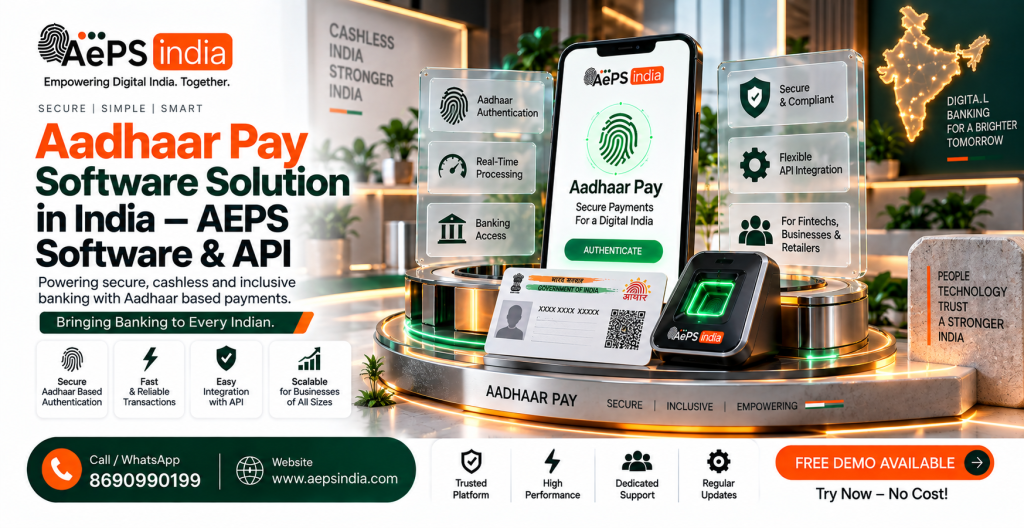
An Aadhaar Pay Software Solution helps businesses and merchants accept digital payments through Aadhaar-based authentication. It is designed for businesses that want to add Aadhaar-enabled payment functionality to their digital platform and provide customers with a simple way to make supported merchant payments.
Aadhaar-based payment services can be useful where customers may prefer assisted payment instead of using a debit card, remembering a card PIN, or depending on a smartphone-based payment process. In the BHIM Aadhaar Pay model, a customer can make a payment to an eligible merchant by using Aadhaar authentication, while the merchant uses a supported device and Aeps biometric scanner.
An Aadhaar Pay Software Solution is a digital platform that lets merchants and banking agents accept cardless, PIN-less payments and perform banking services using 12-digit Aadhaar numbers and biometric authentication.
A complete Aadhaar Pay Software Solution can connect the merchant application, supported biometric device, payment processing system, transaction management and reporting into one workflow. The exact authentication method, device requirements, participating bank support and transaction process depend on the applicable Aadhaar Pay implementation and banking arrangement.
For businesses, the software is not only about accepting a payment. A useful solution should make it easier to manage Aeps merchant onboarding, authentication, transaction processing, transaction status, receipts, reports, settlement information, user access and support from a centralized system. Security and correct handling of authentication and transaction data are also important parts of the implementation.
It is also important to understand the difference between Aadhaar Pay and AePS. AePS is a bank-led model that supports services such as cash withdrawal, cash deposit, fund transfer, balance enquiry and mini statement through authorised AePS touchpoints. Aadhaar Pay, on the other hand, is focused on Aadhaar-authenticated merchant payments.
An Aadhaar Pay Software Solution can be useful for merchants, digital service businesses, fintech companies, assisted-payment providers and other businesses that want to include Aadhaar-based payment acceptance within their service platform. It can also be considered alongside other financial services such as AEPS, BBPS, money transfer, recharge and digital banking services when the required integrations are available.
At Aeps India, businesses can explore an Aadhaar Pay solution according to their payment model, merchant requirements and technical setup. The solution can be planned around the required payment functionality, supported devices, merchant management, transaction reporting and integration requirements.
If you are planning to add Aadhaar-based payment acceptance to your business platform, choosing a solution that matches the applicable banking, authentication, device and integration requirements is an important first step.
In this complete guide, we will explain what Aadhaar Pay Software Solution is, how Aadhaar Pay works, how Aadhaar-based merchant payments are processed, Aadhaar Pay features, biometric device requirements, merchant onboarding, transaction flow, security considerations, settlement and reporting, Aadhaar Pay vs AEPS, business use cases, integration requirements, and how to choose the right Aadhaar Pay Software Solution in India.
What Is Aadhaar Pay Software Solution?
An Aadhaar Pay Software Solution is a digital payment and banking platform that enables merchants and financial agents to process cardless, PIN-less transactions using a customer’s 12-digit Aadhaar number and biometric verification (fingerprint or iris scan).
How Does Aadhaar Pay Software Work?
Aadhaar Pay Software enables cardless, PIN-less financial transactions and merchant payments through biometric authentication linked to the National Payments Corporation of India (NPCI).
How Aadhaar Pay Software Works
- Initiation: The merchant or agent enters the customer’s 12-digit Aadhaar number, selects the bank name, and inputs the payment amount into the Aadhaar Pay API system.
- Biometric Capture: The customer places their finger on a certified Aeps biometric scanner (fingerprint or iris) connected to a mobile, POS, or micro ATM device.
- Encryption & Routing: The Aeps software securely encrypts the biometric data and routes the request via backend Aeps API through the NPCI gateway.
- Verification: The data is matched against the UIDAI database and the customer’s linked bank account for identity and balance confirmation.
- Settlement: Upon successful verification, the money is instantly debited from the customer’s account and credited to the merchant’s business account.
Aadhaar Pay Software Services
Aadhaar Pay Software Services let merchants and businesses accept digital payments directly from a customer’s bank account using a 12-digit Aadhaar number and biometric fingerprint authentication.
Core Services Offered
- Cash Withdrawal: Allows customers to withdraw money from their Aadhaar-linked bank accounts using only their Aadhaar number and fingerprint scanner.
- Cash Deposit: Enables users to deposit cash directly into their bank accounts through authorized retail or agent touchpoints.
- Aadhaar Pay (Merchant Payments): A specialized merchant service allowing businesses to accept direct, cashless payments from customers via biometric authorization.
- Balance Enquiry: Provides real-time checks on available bank account balances.
- Mini Statement: Gives customers a quick summary of their most recent account transactions.
- Aadhaar-to-Aadhaar Fund Transfer: Facilitates direct peer-to-peer or account transfers between Aadhaar-linked accounts.
- Micro-ATM & POS Integration: Connects handheld biometric and card-reading hardware to process traditional debit/credit card transactions alongside Aadhaar authentication.
Aadhaar Pay Software Documents Required
To register for and activate Aadhaar Pay / AEPS (Aadhaar Enabled Payment System) software as a merchant or agent, you must submit basic KYC and business verification documents to an authorized Aeps india.
Personal & Business KYC Documents
- Aadhaar Card: Valid Aadhaar card for identity proof and e-KYC verification.
- PAN Card: Mandatory for financial and tax compliance.
- Bank Account Proof: A cancelled cheque, bank statement, or the first page of your passbook for fund settlements.
- Passport-Sized Photograph: Recent clear photo of the merchant or agent.
- Business/Shop Address Proof: Utility bill (electricity or telephone), rent agreement, or Udyam/Shop Act registration.
- Active Mobile Number & Email ID: Mobile number must be linked to your Aadhaar for OTP verification.
Hardware & Software Requirements
- Biometric Scanner: A STQC-certified Aeps fingerprint or Aeps iris scanner (such as Mantra).
- Device: An active smartphone, tablet, or computer with an internet connection.
Aadhaar Pay Software Modules
Aadhaar Pay software modules comprise a suite of digital tools that enable merchants and agents to process cardless, PIN-less financial transactions using the National Payments Corporation of India (NPCI) infrastructure.
Core Transaction Modules
- Aadhaar Pay Module: Enables merchants to accept direct digital payments from a customer’s bank account using biometric verification (fingerprint or iris) without requiring a debit card or PIN.
- Banking Services Module: Handles high-frequency operations including cash withdrawals, cash deposits, balance inquiries, and mini-statements.
- Fund Transfer Module: Facilitates peer-to-peer or Aadhaar-to-Aadhaar secure money transfers across linked accounts.
- Government Integration Module: Processes Direct Benefit Transfers (DBT) for subsidies, pensions, and welfare funds.
Backend and Management Modules
- Biometric Authentication Module: Integrates UIDAI-compliant encryption and device binding for secure Aeps fingerprint/secure Aeps iris scanner inputs (such as Mantra devices).
- Wallet, Commission, and Settlement Module: Manages retailer/distributor float balances, automated commission splits, ledger tracking, and real-time bank settlements.
- Admin and User Management Module: Provides role-based access control (RBAC) across a multi-tier hierarchy (Super Aeps Admin, Admin, Distributor, Retailer, and Customer Service Point).
- API and Integration Module: Aeps india offers white label Aeps web portals, Android applications, and secure AEPS API connecting to central NPCI switches.
Who Can Use Aadhaar Pay Software
Aadhaar Pay software can be used by merchants, shopkeepers, business correspondents, and banking agents to accept digital payments and provide basic financial services.
Key Users of Aadhaar Pay Software
- Merchants and Small Retailers: Shop owners like kirana store operators, chemists, and local vendors use Aadhaar Pay application to accept digital payments for goods and services directly from a customer’s bank account without needing a card or POS machine.
- Business Correspondents (BCs) and Agents: Authorized bank agents and micro ATM operators use the Aeps B2B software to deliver basic banking services (such as cash withdrawals, deposits, and balance checks) in rural or unbanked areas.
- Customers and Account Holders: Any individual with a bank account linked to their 12-digit Aadhaar number can make payments or do transactions using their Aeps fingerprint or Aeps iris scan for authentication.
- Fintech Companies and Banks: Financial institutions integrate Aadhaar Pay API and Aeps software platform into their own digital infrastructure to power agent networks and mobile Aeps apps.
Requirements to Use the System
- For Customers: A valid bank account linked to an Aadhaar number and biometric authentication (fingerprint/iris).
- For Merchants/Agents: An active merchant account with an enabled bank, a compatible smartphone or affordable micro ATM device, and a certified Aeps biometric scanner.
Aadhaar Pay Software Solution for Different Businesses
Aadhaar Pay software solutions enable businesses to accept cardless, PIN-less digital payments directly from a customer’s bank account using an Aadhaar number and a biometric Aeps fingerprint scanner.
Application Across Different Businesses
- Local Retail & Kirana Stores: Transforms neighborhood shops into micro-banking touchpoints where owners can accept payments or offer basic cash withdrawals.
- Fintech & B2B Service Providers: Companies use white label AEPS Software/Fast Aadhaar Pay API to launch their own branded payment applications and agent networks.
- Microfinance & Direct Benefit Distribution: Helps disburse or collect micro-loans, pensions, and welfare funds securely in rural and semi-urban markets.
Why Use Aadhaar Pay Software
Aadhaar Pay software lets users conduct cardless, biometric-secured financial and banking transactions using only an Aadhaar number and a Aeps fingerprint scan.
Key Benefits for Users
- No Cards or PINs: Eliminates physical debit/credit cards and secret PINs.
- High Security: Uses unique biometric fingerprint authentication to prevent fraud.
- Bank Interoperability: Works across any participating bank and micro ATM network.
- Doorstep Accessibility: Brings banking to local retail shops, removing long-distance travel.
- Financial Inclusion: Empowers unbanked, rural, and digitally illiterate populations.
- Everyday Services: Supports cash withdrawals, deposits, balance inquiries, and fund transfers.
Advantages for Merchants
- Smartphone Friendly: Runs easily on standard mobile devices without expensive POS hardware.
- Zero or Low Cost: Avoids heavy rental and transaction fees associated with traditional card machines.
- Business Growth: Attracts local cash-strapped customers who lack immediate access to bank branches.
Top Use cases of Aadhaar Pay Software
Aadhaar Pay software powers cardless, PIN-less financial and merchant transactions using biometric authentication linked to a user’s Aadhaar-seeded bank account.
Top Use Cases of Aadhaar Pay Software
Micro-Merchant Payments (BHIM Aadhaar Pay)
- Allows small businesses and local shop owners to accept digital payments.
- Customers pay directly using their Aadhaar number and a fingerprint or Aeps iris scan Device.
- Eliminates the need for traditional debit cards, credit cards, or POS (Point of Sale) swipe machines.
Cash Withdrawals and Deposits (Mini-ATM Services)
- Transforms local kirana stores and retail outlets into neighborhood micro-banks.
- Enables customers living in rural or unbanked areas to withdraw or deposit cash instantly without traveling to a physical bank branch.
Direct Benefit Transfer (DBT) Payouts
- Facilitates the rapid, transparent distribution of government subsidies, pensions, scholarships, and welfare funds.
- Allows beneficiaries to securely access and cash out government support through local business correspondents or agents.
Balance Inquiries and Mini-Statements
- Gives account holders real-time visibility into their bank account balances and recent transaction logs.
- Reduces operational burdens on crowded brick-and-mortar bank branches by pushing routine checks to local digital kiosks.
Aadhaar-to-Aadhaar Fund Transfers
- Supports peer-to-peer or customer-to-vendor money transfers securely across different partner banks.
- Relies entirely on centralized NPCI switching infrastructure using biometric verification instead of account numbers and IFSC codes.
Paperless eKYC Identity Verification
- Powers instant, digital Know Your Customer (KYC) onboarding for opening new bank accounts or registering for Aeps india.
- Cuts down processing time and removes the requirement for physical paperwork.
Key Aspects of Aadhaar Pay Software
Aadhaar Pay software enables cardless and PIN-free financial transactions by linking a 12-digit Aadhaar number with biometric verification.
Key Aspects and Features
- Biometric Authentication: Verifies user identity via Aeps fingerprint system or Aeps iris scan system using certified scanners linked to UIDAI records, removing the need for physical debit cards or secret PINs.
- Bank Interoperability: Allows customers to use any NPCI-backed micro-ATM or agent point, regardless of where their actual bank account is held.
- Core Transaction Services: Supports cash withdrawals, cash deposits, balance enquiries, mini statements, and Aadhaar-to-Aadhaar fund transfers.
- Merchant Payments (Aadhaar Pay): Permits small business owners to accept digital payments directly from a customer’s Aadhaar-linked account using a registered Aeps biometric device without needing a traditional POS machine.
- Real-Time Processing & Security: Executes transactions instantly through the central NPCI switch backed by end-to-end data encryption and AI-driven fraud detection.
Why Aadhaar Pay Software Fast Growing in india
Aadhaar Pay software is growing rapidly in India because it enables biometric-based cashless payments without needing traditional POS card machines.
Biometric Security
- Secured by fingerprint authentication.
- Eliminates forgotten passwords or PINs.
- Reduces transaction fraud significantly.
Low Infrastructure Cost
- Needs only a smartphone and a cheap Aeps biometric scanner.
- Removes merchant rental fees for POS hardware.
- Lowers entry barriers for small rural shopkeepers.
Financial Inclusion
- Connects unbanked and remote populations easily.
- Relies on universally seeded Aadhaar-bank accounts.
- Powers direct benefit transfers (DBT) and rural cashouts.
Ease of Use
- Requires only an Aadhaar number and bank name.
- Bypasses complex smartphone apps or OTP requirements.
- Delivers real-time direct bank settlements for merchants.
Aadhaar Pay Software for Retailers
Aadhaar Pay software for retailers turns a local shop into a mini-banking point by letting customers make cardless, PIN-less payments and transactions using their Aadhaar number and a buy Aeps fingerprint scan.
Key Features for Retailers
- Cardless & PIN-Less Payments: Allows customers to pay merchants directly from their Aadhaar-linked bank accounts without a debit card or UPI PIN.
- Biometric Authentication: Uses a fingerprint or iris scan linked with UIDAI/NPCI registered RD devices (like Mantra or Morpho) to verify customer identity securely.
- Instant Settlements: Credits the merchant’s or agent’s wallet immediately with real-time or 24×7 IMPS bank settlements.
- Interoperability: Accepts payments from customer accounts across almost all major Indian banks.
- Additional Banking Services: Aeps india bundle best Aadhaar Pay API with cash withdrawals, balance inquiries, and mini-statements.
- White-Label & API Solutions: Aeps india offers customizable Aeps platform or best Aeps API for fintech startups and enterprises to launch their own branded Aeps banking portal.
Why Aadhaar Pay Software Important for Business
Aadhaar Pay software turns local retail shops into mini-bank branches and acceptance terminals, letting businesses drive foot traffic and earn direct commissions.
Why It Matters for Business
- Extra Income: Earn Aeps commission or cash rewards on every transaction like cash withdrawals, balance checks, or merchant payments.
- More Customers: Acting as a local banking hub increases shop foot traffic, which helps sell regular retail products.
- Cardless & PIN-less: Customers pay or check balances using only their Aadhaar number and fingerprint scan, needing no debit cards or smartphones.
- Interoperable Access: Serve customers from any major bank in India from a single platform.
- Higher Limits for Merchants: B2B Aadhaar Pay software allows merchants to accept direct digital payments with daily limits extending up to ₹50,000.
- Secure Transactions: Biometric authentication blocks fraud and eliminates risky paper receipts.
Aadhaar Pay Software Dashboard & Admin Panel
An AEPS B2B Admin Panel is a centralized backend dashboard used by fintech operators and businesses to manage micro-banking networks, agent hierarchies, and Aadhaar-based transactions.
Core Dashboard Features
- Real-Time Transaction Monitoring: Track cash withdrawals, balance inquiries, mini-statements, and Aadhaar Pay merchant transactions live.
- Multi-Tier Role Management: Control permissions and workflows across Aeps Admins, Distributors, Retailers, and Merchants.
- Commission & Wallet Management: Configure automated commission structures, profit margins, and fund settlements.
- Biometric & OTP Authentication: Support secure UIDAI-compliant scans via integrated biometric devices (Mantra).
- Dispute & Fraud Resolution: Access automated logs and AI-driven tools to flag failed transactions or security anomalies.
Features Aadhaar Pay Software Solution
Aadhaar Pay software solutions enable cardless, PIN-free merchant payments and banking services using an individual’s Aadhaar number and biometric verification.
Core Features
- Biometric Authentication: Verifies identity securely via UIDAI-backed fingerprint or iris scans, eliminating the need for physical debit/credit cards, passwords, or PINs.
- Interoperable Network: Connects customers of any participating bank to micro-ATMs, business correspondents, or merchant Aeps b2b software managed by any other participating bank through the National Payments Corporation of India (NPCI) switch.
- Real-Time Processing: Delivers instant account-to-account fund transfers, transaction validations, and status updates.
- Multi-Service Access: Supports merchant retail collections (Aadhaar Pay), cash withdrawals, cash deposits, balance inquiries, and mini statements.
- Low Hardware Requirements: Allows small shop owners and merchants to run Aeps system using just an Android smartphone or tablet paired with a certified Aeps biometric fingerprint/Aeps iris scanner device.
- Regulatory Compliance: Integrates strict encryption and security frameworks adhering to guidelines set by the Reserve Bank of India (RBI), NPCI, and the Unique Identification Authority of India (UIDAI).
Benefits of Aadhaar Pay Software Solution
An Aadhaar Enabled Payment System (AePS) software solution lets users perform basic banking and digital transactions securely using only their Aadhaar number and biometric verification.
Financial Inclusion
- Reaches unbanked rural populations
- Connects remote regions to mainstream banking
- Empowers underprivileged communities
Enhanced Security
- Uses biometric authentication (fingerprint/iris)
- Eliminates PIN or password theft risks
- Prevents physical card fraud
Extreme Convenience
- No physical cards or cash needed
- No smartphones or memory PINs required
- Accessible at local micro ATM or agents
Comprehensive Services
- Supports cash withdrawals and deposits
- Allows instant balance inquiries
- Facilitates mini-statements and fund transfers
Cost-Effectiveness
- Reduces need for physical bank branches
- Cuts infrastructure costs for businesses
- Minimizes paper-based processing overhead
Aadhaar Pay API Integration
Integrating Aadhaar Pay API allows merchants to accept digital payments directly from a customer’s bank account using their Aadhaar number and Aeps biometric fingerprint authentication.
1. Choose an Aeps india
- Partner with a Aeps india approved by the multiple banks that offers Aadhaar Pay or Aadhaar Enabled Payment System API.
- Review their uptime, documentation quality, and sandbox environment availability.
2. Submit Business KYC Documents
- Provide personal identity and address proof, including your Aadhaar card (linked to an active mobile number) and PAN card.
- Submit business proof such as a GST certificate, Udyam Registration, or shop license.
- Provide financial details like a cancelled cheque or passbook copy for payout settlements.
3. Procure Certified Hardware
- Purchase an STQC-certified L1 Aeps biometric scanner (fingerprint or iris device). Older L0 devices are restricted.
- Register the device serial number on the manufacturer’s Registered Device (RD) Service portal and install the necessary drivers or mobile Aeps app.
4. Obtain API Credentials
- Complete merchant Aeps onboarding approval to receive your unique Aeps Merchant ID (MID), Aeps API keys, and Aeps developer console access.
- Request test credentials for the Aeps sandbox/simulation environment.
5. Technical Integration
- Frontend UI: Build input fields to collect the customer’s 12-digit Aadhaar number and select the Issuer Bank (IIN/Bank Code).
- Biometric Capture: Use the local RD Service SDK to capture the fingerprint and generate an encrypted XML
PidDatapayload. - Backend API Call: Send the transaction payload containing the amount, Aadhaar number, and encrypted biometric block to Aeps india endpoint for authentication via UIDAI and NPCI.
6. Testing and Going Live
- Run mock transactions in the sandbox to test success, timeout, and failure scenarios (like invalid biometrics).
- Complete security compliance checks ensuring raw biometric logs or Aadhaar numbers are never cached or stored in plain text.
- Switch Aeps application endpoints to the production environment to start processing live transactions.
Aadhaar Pay Software Cost in India
The cost structure of Aadhaar Pay and Aadhaar Enabled Payment System software generally ranges from ₹7,999 for secure Aeps API connectivity to over ₹4.5 lakh for fully customized, high-end Aeps solutions.
Setup & Development Cost Structure
- Basic API Integration: ₹7,500 – ₹10,000 (adds Aadhaar Pay to existing apps)
- One-Time Setup/API License: ₹15,000 – ₹35,000 (standalone gateway/software unit)
- White-Label Portal/Admin Panel: ₹50,000 – ₹1,20,000 (fully branded multi-merchant platform)
- Hardware (Biometric Scanner): ₹1,500 – ₹4,500 per STQC certified Aeps fingerprint device/iris device
Operational & Transaction Fees
- Per-Transaction API Charge: ₹3 to ₹5 per successful transaction charged by Aeps india.
- Retailer/Agent Commission (Withdrawals):
- ₹100 – ₹999: ₹2.00 commission
- ₹2,000 – ₹2,999: ₹5.00 – ₹7.00 commission
- ₹3,000 – ₹10,000: ₹13.00 – ₹15.00+ commission (highest slab)
- Aadhaar Pay Merchant Charge: Up to 1% commission/fee structure on high-value merchant collections.
Cost Breakdown Components
| Tier / Component | Price Range / Cost Structure | Description |
|---|---|---|
| Basic API Integration | ₹7,999 – ₹15,000 | Standard developer connectivity for existing platforms. |
| White-Label Portal / Setup | ₹15,000 – ₹35,000 | Ready-made branding, basic admin panel, and configuration. |
| B2B SaaS Models | ₹15,000 – ₹40,000/month | Recurring monthly fees or ~₹80,000+ annually for managed platforms. |
| Custom Enterprise Solutions | ₹1.5 lakh – ₹4.5+ lakh | Fully tailored API integration, compliance architecture, and high-end security. |
| Per-Transaction / Commission | ₹1.00 to ₹15.00 per txn | Slab-based fees or agent commission payouts depending on the volume and transaction type. |
Aadhaar Pay Software Development
Developing Aadhaar Pay or b2b AEPS software involves building a secure fintech application that connects users, merchants, and banking networks via biometric authentication.
The development and integration process follows these core steps:
1. Research and Compliance Planning
- Understand Regulations: Align the FAST Aeps software with guidelines set by the Reserve Bank of India (RBI), Unique Identification Authority of India (UIDAI), and National Payments Corporation of India (NPCI).
- Business Model Choice: Decide whether to build a custom platform from scratch (requires direct or Aeps bank API and high investment) or opt for a White Label AEPS B2B Software solution where a pre-built fast Aeps platform is rebranded.
2. Legal Documentation and Licensing
- Company Registration: Establish a registered legal entity with a GST number and business bank account.
- Partner with an Aeps india: Independent developers cannot connect directly to the NPCI switch. You must partner with a Aeps india to obtain staging credentials.
3. Architecture and Technology Stack
- Frontend Development: Build user interfaces for mobile (Android/iOS using Java, Kotlin, or Flutter) or web dashboards using React or Angular.
- Backend Development: Develop robust server-side logic using Node.js, Python, Java, or .NET to handle reliable Aeps API requests and encryption.
- Database & Hosting: Secure data storage using MongoDB or MySQL hosted on compliant cloud infrastructure like AWS or Google Cloud.
4. Biometric and API Integration
- RD Service Integration: Integrate Registered Device (RD) services to capture encrypted biometric fingerprint or iris data safely from UIDAI-certified scanners.
- API Endpoints: Implement Aeps Service API calls for Aadhaar verification, bank IIN (Issuer Identification Number) selection, and transaction routing.
- Sandbox Testing: Test transaction flows, error handling, and response callbacks in a restricted testing environment before going live.
5. Deployment, Security, and Maintenance
- Security Audits: Conduct vulnerability assessments and penetration testing (VAPT) to ensure data encryption meets strict financial safety rules.
- Go-Live & Monitoring: Launch Aeps platform, manage merchant/agent KYC workflows, and set up continuous monitoring for server uptime.
Biometric Device Integration in Aadhaar Pay Software
Integrating Aeps biometric hardware with best Aadhaar Pay software or top AEPS software lets you run cardless, PIN-less digital transactions using fingerprints or iris scans.
Hardware and Certification Requirements
- STQC Approval: Aeps Scanners must be Standardisation Testing and Quality Certification approved.
- L1/L2 Compliance: Use UIDAI-certified L1 or L2 Registered Devices for hardware-level encryption.
- Popular Models: Mantra MFS110/MFS100, Morpho and Startek devices.
Software Integration Steps
- Install RD Service: Download the specific manufacturer RD service app from the Play Store or Aeps portal.
- Driver Configuration: Bind the device serial number to the host application (Android/Windows).
- API Hooking: Integrate the payment gateway or low cost AEPS API to capture encrypted biometric blocks (
PID block). - Server Routing: Transmit the tokenized payload securely via NPCI switches for bank authorization.
Aadhaar Pay Software Architecture
Aadhaar Pay software architecture relies on a secure, multi-tiered model that connects biometric capture devices to the UIDAI and banking switches via NPCI.
Architectural Tiers
- Client / Frontend Layer: Mobile apps, web portals, or PoS/Micro-ATM terminals used by merchants or Business Correspondents (BCs) to input the Aadhaar number, bank IIN (Institute Identification Number), and transaction amount.
- Biometric Capture & RD Service: Integrates local Registered Device (RD) SDKs (such as Mantra) to capture and immediately encrypt fingerprint or iris biometrics using AES-256/PKI encryption before it leaves the physical device.
- Merchant / Aggregator Backend: Intermediary server that packages payloads, manages agent/merchant wallets, and handles compliance logging without ever storing raw biometric data.
- API Gateway: Manages rate limiting, Aeps API key validation, request routing, and payload auditing.
- Central Switching Layer: Routes transactions from the aggregator’s sponsor bank to the NPCI central switch, which forwards identity blocks to UIDAI and financial legs to the customer’s issuing bank.
Core Modules & Security
- Authentication Module: Transmits encrypted biometric data blocks to UIDAI for a binary yes/no match confirmation.
- Transaction Processing Engine: Executes real-time debits, credits, balance inquiries, or micro-atm settlements via bank pipes.
- Security & Compliance Layer: Enforces PCI-DSS, end-to-end encryption (E2EE), and UIDAI data privacy rules (using Virtual IDs instead of raw Aadhaar numbers where applicable).
- Admin & Reconciliation Dashboard: Monitors live transactions, track success/failure rates, manages merchant onboarding, and calculates daily settlements (T+0).
Aadhaar Pay Software Mobile App: Features & User Experience
The official Aadhaar App by UIDAI and associated Aadhaar/AEPS payment software allow users to manage digital identities and execute secure, cardless financial transactions.
Key Features of Aadhaar Identity & Pay Software
- Cardless Biometric Payments (BHIM Aadhaar Pay): Enables merchants to accept instant digital payments directly from a customer’s bank account using only an Aadhaar number and Aeps fingerprint scan device.
- Multi-Profile Management: Allows storage and management of up to five family member Aadhaar profiles on a single device.
- Selective Data Sharing: Lets users share masked Aadhaar numbers or specific verifiable credentials (like name and photo) while hiding sensitive demographic data.
- Offline Accessibility: Provides local encrypted storage so users can view their credentials and generated QR codes even in low-connectivity areas.
- Activity Logs & Security Controls: Features real-time tracking of when and where credentials are accessed, alongside biometric locking/unlocking and face authentication.
- Demographic Updates: Facilitates direct initiation of mobile number and address corrections inside the Aeps app interface.
User Experience & Interface
- Onboarding Process: Users select their preferred language, enter their Aadhaar number, complete a Face Authentication check, and set a secure 6-digit PIN.
- Availability: The official application is downloadable for Android via the Google Play Store and for iOS via the Apple App Store.
- Usability: Aeps Designed for high accessibility, eliminating the need for physical cards, debit PINs, or passwords during merchant checkouts or identity verifications.
Aadhaar Pay Software Scalability: How to Handle Thousands of Retailers
Handling thousands of concurrent retail agents processing biometric Aadhaar Pay transactions requires a robust, cloud-native infrastructure to prevent downtime and latency spikes.
Infrastructure & Load Balancing
- Horizontal Scaling: Dynamically add server nodes during festival traffic spikes.
- Asynchronous Queues: Use Kafka or RabbitMQ to buffer high-volume request bursts.
- Multi-Region Routing: Deploy microservices across availability zones to reduce network latency.
Database & API Optimization
- Database Indexing: Optimize table queries for instant ledger lookups and balance updates.
- Multi-Bank Failover: Route traffic dynamically across redundant multi bank Aeps API to maintain 99.9% uptime.
- Caching Layers: Cache non-transient agent profiles and static config data via Redis clusters.
Security & Compliance at Scale
- L1 Biometric Compliance: Ensure strict compatibility with STQC-certified L1 Aeps fingerprint and Aeps iris devices.
- AI Fraud Detection: Monitor behavioral anomalies and flag velocity-based multi-attempt fraud in real time.
- Tokenized Data: Encrypt raw biometric payloads instantly before routing to NPCI/UIDAI gateways.
Aadhaar Pay Software Database & API Architecture
An Aadhaar Pay software architecture is built for high-throughput, ultra-secure, and compliant financial transactions. In India, these systems interface with the National Payments Corporation of India (NPCI) and the Unique Identification Authority of India (UIDAI) via Certified Management Servers and Central Financial Institutions (Banks/MIPs).
Here is a comprehensive breakdown of the Database and Aeps API Architecture required for an Aadhaar Pay platform.
1. Database Architecture
To handle ACID compliance for financial ledgers alongside high-speed session caching, a hybrid database approach (Polyglot Persistence) is used.
                  ┌──────────────────────────────────────────┐
                  │            Aadhaar Pay System            │
                  └────────────────────┬─────────────────────┘
                                       │
         ┌─────────────────────────────┼─────────────────────────────┐
         ▼                             ▼                             ▼
┌─────────────────┐           ┌─────────────────┐           ┌─────────────────┐
│ Relational (DB) │           │   NoSQL (Log)   │           │ In-Memory Cache │
│ PostgreSQL/MySQL│           │  MongoDB/Elastic│           │      Redis      │
├─────────────────┤           ├─────────────────┤           ├─────────────────┤
│ • Core Ledgers  │           │ • Raw API Logs  │           │ • Device Session│
│ • User Profiles │           │ • Audit Trails  │           │ • Replay Attack │
│ • Wallet Bal.   │           │ • Device Logs   │           │   Prevention    │
└─────────────────┘           └─────────────────┘           └─────────────────┘
Core Database Schema Design (Relational)
- users_master: Stores Merchant/Agent profiles, BC (Business Correspondent) IDs, and terminal allocation details. Never store Aadhaar numbers in plain text. (Use Aadhaar Vaulting tokens).
- wallets: Tracks current balances, hold amounts, and currency configurations.
- transactions: The immutable ledger tracking transaction state.
- Fields:
tx_id(UUID), merchant_id, terminal_id, stan (System Trace Audit Number), rrn (Retrieval Reference Number), amount, status (PENDING, SUCCESS, FAILED, REVERSED), npci_response_code.
- Fields:
- aadhaar_vault: Fully isolated, highly encrypted lookup table matching a unique Token_ID to the heavily encrypted Aadhaar/Reference string. Strictly follows UIDAI compliance.
2. API & Microservices Architecture
The Aeps b2b platform is broken into decoupled, containerized microservices to guarantee that a failure in reporting or Aeps wallet settlement doesn’t bring down core transaction processing.
Key Microservices
- Auth & Session Service: Validates Merchant JWT tokens, coordinates device fingerprinting, and handles Aeps biometric device registration (L0/L1 Registered Device services).
- Switching & Routing Service: Translates internal JSON Aeps API payloads into ISO 8583 / AS2 messages or specialized XML payloads required by NPCI/Partner Banks.
- Ledger & Wallet Service: Executes double-entry bookkeeping. It updates merchant wallets immediately upon receiving an NPCI
SUCCESSstatus callback. - Reconciliation & Settlement Service: Runs asynchronous batch jobs to reconcile day-end files (MIP/NPCI settlement reports) against the internal DB ledger.
Core API Workflows & Endpoints
All external and internal communications must travel over HTTPS using mTLS (Mutual TLS) for banking switches, with payloads encrypted at the application layer using asymmetric keys (RSA-2048 / AES-256).
Micro-API Interface Specifications
| Endpoint | Method | Purpose | Payload Components |
|---|---|---|---|
/api/v1/device/validate | POST | Validates L0/L1 RD Service registration and readiness. | Device Serial, Model, Provider Info |
/api/v1/txn/balance-enquiry | POST | Checks customer bank balance via Aadhaar biometric. | IIN (Issuer Identification Number), Encrypted PID Block, Tokenized Aadhaar |
/api/v1/txn/pay | POST | Initiates the actual Aadhaar Pay merchant debit transaction. | Merchant ID, Amount, IIN, Encrypted PID Block, STAN |
/api/v1/txn/status | GET | Polls or checks current status of a transaction using reference keys. | tx_id or rrn |
The Aadhaar Pay Transaction Flow
- Capture: The merchant enters the transaction amount and the customer’s IIN (Bank Name). The customer places their finger on an L0/L1 Registered Device.
- PID Block Creation: The RD service captures biometric details, encrypts them securely inside the hardware layer, and generates a PID Block (Parameter Isolation Data).
- Gateway Submission: The Aeps software packages the PID block along with merchant metadata and sends it to the partner bank’s switch.
- NPCI & UIDAI Validation: The partner bank routes the request to NPCI (AePS central switch), which validates the biometric data with UIDAI and requests a debit from the customer’s linked bank account.
- Settlement: On success, the internal Ledger Service increments the merchant’s wallet balance.
Security & Compliance Requirements of Aadhaar Pay Software
Aadhaar Pay and best Aadhaar Enabled Payment System software must follow strict security and compliance standards set by the Reserve Bank of India (RBI), NPCI, and UIDAI to prevent fraud and protect user data.
Hardware & Device Security
- L1 Certification: All Aeps biometric scanners (fingerprint or iris) must be L1-certified Registered Devices (RD Service) to securely capture and encrypt biometric data at the hardware level.
- Liveness Detection: Aeps Scanners must include liveness detection to ensure a live human fingerprint or iris is being scanned rather than a silicone mold or fake copy.
Data Protection & Encryption
- End-to-End Encryption (E2EE): Strong encryption protocols like SSL/TLS and RSA encryption must be used for transmitting sensitive data across networks.
- No Biometric Storage: Reliable Aeps Software and servers are strictly forbidden from storing any biometric data, PINs, or raw Aadhaar numbers locally after transmission.
Operator Compliance & KYC Rules
- Full Operator KYC: Every Aadhaar Touchpoint Operator (ATO) must complete comprehensive KYC verification before onboarding.
- One Operator, One Bank: Operators are restricted to linking with only a single acquiring bank to improve accountability and reduce misuse.
- Mandatory Re-KYC: Agents who remain inactive for three consecutive months must complete a fresh re-KYC before reactivation.
Monitoring & Transaction Controls
- Real-Time Fraud Monitoring: Best Aeps System must integrate continuous fraud detection and monitoring tools (such as EFRMS or SIEM) to spot unusual transaction volumes, patterns, or locations.
- Transaction Limits: Cash withdrawals are generally capped at ₹10,000 per transaction and ₹50,000 daily per user.
Aadhaar Pay Software Transaction Management
Aadhaar Pay software transaction management refers to the digital tracking, processing, and settlement of biometric-authenticated merchant payments and banking services via the Aadhaar Enabled Payment System (AePS).
Core Features of Transaction Management
- Real-Time Tracking: View live transaction statuses including successful, failed, and pending entries instantly from a centralized dashboard.
- Detailed Reporting: Generate and filter logs by user, specific bank, or date range, with export options in Excel or PDF formats.
- Automated Settlement: Execute automated commission distribution and immediate wallet-to-bank settlements.
- Bank-Level Controls: Configure granular service restrictions and routing controls based on specific banking partners.
Aadhaar Pay Software Regulatory Considerations
Aadhaar Pay and AePS software must comply with strict Reserve Bank of India (RBI) and National Payments Corporation of India (NPCI) regulatory guidelines introduced for enhanced security and fraud prevention.
Operator Compliance & KYC
- Mandatory KYC: Full Customer Due Diligence (CDD) is required for all Touchpoint Operators (ATOs).
- Inactivity Re-KYC: Re-verification is mandatory for operators inactive for over 3 months.
- Single-Bank Rule: Operators are restricted to onboarding with a single acquiring bank (“One Operator, One Bank”).
Technical & Hardware Mandates
- L1 Certification: All biometric capture devices must use L1-certified Aeps Devices (RD service).
- No Local Storage: Biometric data and Aadhaar numbers must never be saved locally or on servers.
- Encrypted APIs: Data transmission must use secure cryptographic standards like RSA encryption.
- Exclusive Integration: Application Programming Interfaces (APIs) must be restricted exclusively to verified AePS/Aadhaar Pay processing.
Surveillance & Transaction Limits
- Transaction Caps: Cash withdrawals are typically capped at ₹10,000 per transaction.
- Step-Up Verification: Transactions or withdrawals exceeding ₹5,000 require an extra Aadhaar OTP verification.
- Real-Time Monitoring: Automated surveillance must flag abnormal spikes, multi-location scans, or terminal anomalies.
Aadhaar Pay Software Transaction Reconciliation & Settlement System
Top Aadhaar Pay software handles transaction reconciliation and settlement by matching biometric merchant logs,pushed via the National Payments Corporation of India (NPCI) switch against core banking settlement files.
Transaction Reconciliation Flow
- Data Logging: Captures terminal IDs, Aadhaar numbers (virtual IDs), transaction IDs, timestamps, and biometric success/failure responses.
- Switch Matching: Compares local merchant logs with central NPCI and issuer bank records to isolate mismatches, pending queries, or dropped packages.
- Dispute Handling: Flags failed or timeout states where customer accounts were debited but merchant accounts did not receive credit, routing them for automated chargeback or manual adjustment.
Settlement Process
- Clearing Channels: Relies on the IMPS network or direct bank routing to process fund movement.
- Settlement Timing: Operates on real-time (T+0) or end-of-day (T+1) cycles, mapping transaction values and deducting applicable merchant MDR or switching fees before final credit injection.
- Reporting: Generates automated MIS (Management Information System) files for merchants and partner banks to reconcile daily ledger balances.
Aadhaar Pay Software User Roles & Hierarchy
Aadhaar Pay software (merchant-assisted Aadhaar Enabled Payment System or AEPS) uses a multi-tier user hierarchy to distribute, manage, and process biometric-based financial transactions. This structured pyramid ensures secure cash flow, clear commission distribution, and effective risk management.
Here is the standard user roles and hierarchy breakdown used by Aeps india.
The Hierarchy Pyramid
[ Admin / Super Admin ]
          │
  [ Master Distributor ]
          │
     [ Distributor ]
          │
  [ Retailer / Merchant ]
          │
     [ End User ]
Core Roles & Responsibilities
1. Admin / Super Admin (White Label Owner / Fintech Company)
The Admin sits at the peak of the system. This role is typically held by the white label Aeps b2b software owner who holds the high speed Aeps API integration with the Aeps india.
- Key Responsibilities: Full Aeps system control, managing Aeps Cash Withdrawal API integrating, setting base commission structures, monitoring liquidity, managing risk/fraud alerts, and onboarding Master Distributors.
- Wallet Control: Controls the primary virtual wallet linked to the settlement bank account.
2. Master Distributor (MD)
Master Distributors act as regional or state-level heads. They purchase bulk wallet balance and Aeps software licenses directly from the Aeps Admin to build out a larger geographic network.
- Key Responsibilities: Appointing and managing a network of regular Distributors, allocating wallet balances down the chain, and resolving regional operational issues.
- Earnings: Earns a passive margin or override commission on every transaction processed by any retailer within their entire downline tree.
3. Distributor (Dist)
Distributors operate at a local or district level. They focus heavily on ground-level recruitment and Aeps onboarded of the actual shopkeepers who use the best Aeps app.
- Key Responsibilities: Appointing Retailers, verifying physical shop locations (frequently required for KYC), selling biometric scanners (Mantra etc.), and providing daily cash/wallet management support to merchants.
- Earnings: Earns a dedicated Aeps commission per transaction done by the retailers they Aeps onboard.
4. Retailer / Merchant (The Touchpoint)
The Retailer is the end-interface of the Aeps payment software. These are typically local grocery shops, pharmacies, mobile recharge stores, or dedicated Customer Service Points (CSPs).
- Key Responsibilities: Initiating Aadhaar Pay or AEPS transactions, capturing customer biometrics via a Aeps fingerprint scanner, handling cash payouts, and maintaining a physical transaction register.
- Earnings: Earns the highest direct commission per transaction (either flat or percentage-based) or charges a permissible convenience fee depending on whether it is an AEPS cash withdrawal or an Aadhaar Pay merchant payment.
5. End User / Customer
The End User is the citizen who walks into the retail shop to buy goods or withdraw money. They do not have access to the software interface itself. They only provide their Aadhaar Number, select their Bank Name, and place their finger on the biometric scanner to authorize the real-time fund transfer.
Key Workflow Features Across Roles
- Wallet Balance Flow (Top-Down): Fund allocation flows downward. Admin → Master Distributor → Distributor → Retailer.
- Commission Flow (Bottom-Up): When a transaction succeeds, the Aeps commission software automatically splits the commission instantly. The Retailer gets their cut, while the Distributor, Master Distributor, and Admin get their respective margins instantly credited to their separate wallets.
Aadhaar Pay Software vs AEPS Software
AEPS Service software is a comprehensive banking platform that turns local retail shops into mini-banks, while Aadhaar Pay software is a specialized merchant payment tool focused strictly on accepting direct cashless sales using biometric verification.
Core Comparison
| Feature / Attribute | AEPS Software | Aadhaar Pay Software |
|---|---|---|
| Primary Purpose | Full basic banking services (cash out, deposits, statements) | Direct retail sales and merchant collections |
| User Action | Accessing and managing personal funds via an agent | Paying a merchant for a purchase without cash or cards |
| Transaction Limit | Typically up to ₹10,000 per transaction (varies by bank/service) | Higher limits, often up to ₹50,000 per transaction |
| Agent / Merchant Role | Acts as a banking correspondent earning tiered withdrawal/inquiry commissions | Acts as a business owner receiving direct payments for goods sold |
AEPS Software Details
- Core Functions: Supports cash withdrawals, cash deposits, balance checks, mini-statements, and Aadhaar-to-Aadhaar fund transfers.
- Use Case: Ideal for rural and unbanked areas where physical bank branches or ATMs are scarce, letting customers withdraw cash using just their fingerprint.
- Setup & Earning: Retailers use a smartphone or buy micro ATM device paired with a biometric scanner, earning fixed or tiered commissions per transaction (e.g., ₹2 to over ₹20).
Aadhaar Pay Software Details
- Core Functions: Functions similarly to a POS (Point of Sale) machine, allowing customers to authorize payments directly from their bank accounts using biometric scans.
- Use Case: Built for merchants and storefronts to collect payments for commercial sales without needing traditional debit cards or UPI apps.
- Setup & Limits: Permits much larger transaction ceilings (often up to ₹50,000) compared to standard AEPS cash-out limits, helping businesses process high-value retail purchases.
Aadhaar Pay vs UPI vs Card Payments
Aadhaar Pay (AEPS-based merchant payment), Unified Payments Interface (UPI), and Card Payments offer distinct ways to pay, varying by required hardware, authentication methods, and target use cases.
Comparison of Payment Modes
| Feature | Aadhaar Pay (AEPS) | UPI | Card Payments |
|---|---|---|---|
| Primary Identifier | Aadhaar Number | Virtual ID / Mobile / QR | Card Number / Chip |
| Authentication | Biometric (Fingerprint/Iris) | UPI PIN / Biometric scan | PIN / OTP / Tap |
| Required Device | Merchant Micro-ATM / Biometric scanner | Smartphone with internet | PoS Terminal / Gateway |
| Internet Need | Required at terminal | Required for user | Required for online/PoS |
| Best Suited For | Unbanked/rural, cardless/phone-free | Daily peer-to-peer & retail | Premium/international & credit |
Deep Dive: Key Differences
Aadhaar Pay (AEPS Merchant Transactions)
- How it works: Customer enters Aadhaar number and authenticates via buy Aeps biometric scanner (fingerprint) connected to a merchant’s handheld device.
- Pros: Eliminates the need for smartphones, debit cards, or remembering PINs.
- Cons: Requires physical presence at a biometric-enabled merchant touchpoint.
UPI (Unified Payments Interface)
- How it works: Instant mobile-to-mobile or scan-and-pay transactions via Virtual Payment Addresses (VPAs) or QR codes.
- Pros: Highly interoperable, zero-to-low merchant friction, lightning-fast Aeps setup.
- Cons: Requires a functional smartphone and active data connectivity.
Card Payments (Debit/Credit/RuPay/Visa)
- How it works: Magnetic stripe, EMV chip, or contactless tap via Point of Sale (PoS) hardware or online gateways.
- Pros: Robust credit lines, reward programs, and global acceptance.
- Cons: Dependent on physical card carriage or secure tokenization; higher merchant processing fees (MDR).
White Label Aadhaar Pay Software Solution
A White Label AEPS Software solution is a ready-made, customizable digital Aeps platform that lets businesses launch Aadhaar-enabled banking services under their own brand name, logo, and domain.
Key Features Included
- Biometric Authentication: Secure Aeps fingerprint or iris verification via UIDAI-aligned systems.
- Core Banking Services: Cash withdrawals, balance inquiries, mini-statements, and Aadhaar-to-Aadhaar fund transfers.
- Admin Control Panel: Complete multi-level management to create and monitor super distributors, distributors, and retailers.
- Multi-Bank Routing: High-uptime routing with auto-failover and real-time transaction reconciliation.
Aeps india is an Aadhaar Pay Software Solution Provider in India
Aeps india is an Aadhaar Pay Software Solution Provider by verifying that they offer 99%+ uptime, strict UIDAI and NPCI security compliance, and transparent commission payouts.
Key Factors to Evaluate
- Security & Compliance: Ensure adherence to RBI, UIDAI, and National Payments Corporation of India (NPCI) guidelines with end-to-end encryption for biometric data.
- Uptime & Success Rate: Look for a stable infrastructure providing at least 99% uptime to minimize transaction failures.
- Commission & Settlement Speed: Compare per-transaction earnings (often ranging up to ₹15) and check for instant or T+0/T+1 fund settlement options to maintain cash flow.
- API Integration: Aeps india offering clear Aeps API developer documentation, sandbox testing environments, and Android SDK compatibility.
- Dashboard & Reporting: Require real-time tracking, transaction history logs, and analytics tools.
- Customer Support: Verify availability of 24/7 technical assistance for troubleshooting failed scans or network errors.
- Value-Added Services: Check for extra features like Micro ATM, BBPS Software (bill payments) integration.
Why Choose AEPS India for Aadhaar Pay Software Solution?
Aeps india is a reliable provider for an Aadhaar Pay and Aadhaar Enabled Payment System software solution is essential for running a secure, compliant, and profitable digital banking business.
Key Reasons to Choose a Aeps india
- Security & Regulatory Compliance: Aeps india ensure complete adherence to NPCI, RBI, and UIDAI guidelines, using high-level encryption to protect sensitive biometric data.
- High Uptime & Success Rates: Leading Aeps platform offer up to 99.9% uptime and transaction success rates exceeding 98%, which builds long-term customer trust.
- Fast Fund Settlements: Aeps india feature instant or same-day (T+0) settlements, keeping working capital and cash flow smooth for agents and merchants.
- Attractive Commission Margins: A robust Aeps platform provides competitive commission structures, helping retailers and business owners maximize their daily earnings.
- Seamless Scalability & Integration: Aeps india offer user-friendly white label Aeps portal or custom Aeps payment API that integrate easily into your existing business website or mobile Aeps application.
- Multi-Service Ecosystem: Good Aeps software packages extend beyond basic cash withdrawals and balance checks to include Micro ATMs, b2b BBPS software.
Conclusion
An Aadhaar Pay Software Solution can help businesses and merchants add Aadhaar-based payment functionality to their digital payment setup. It provides a software layer through which an eligible merchant can initiate supported Aadhaar-authenticated payment transactions and manage the transaction process through a Aeps Service platform.
A complete solution should be more than a simple payment application. Businesses should consider merchant onboarding, Aadhaar authentication, compatible biometric device support, acquiring-bank connectivity, transaction processing, real-time status, transaction reports, security, professional Aeps API integration, settlement and technical support before selecting an Aadhaar Pay software solution. NPCI states that BHIM Aadhaar Pay requires a supported device and certified biometric scanner, while both the customer and merchant have relevant Aadhaar-linked bank-account requirements.
An Aadhaar Pay Software Solution is a digital financial platform that allows merchants and banking agents to process secure, cardless, and PIN-less transactions using Aadhaar biometric authentication via the National Payments Corporation of India (NPCI).
For businesses, the right Aadhaar Pay Software Solution can make merchant payment operations easier to manage and can be integrated into a broader fintech or digital financial services platform. Depending on the supported Aeps setup, businesses may also combine Aadhaar Pay with other services such as AEPS cash withdrawal service, AEPS balance enquiry service, AEPS mini statement service, AEPS cash deposit service and other financial services. NPCI lists these as services within the broader AePS ecosystem, while Aadhaar Pay is specifically positioned for merchant payments.
Security should also be an important consideration. Aadhaar-based transactions involve sensitive identity and financial information, so businesses should select a Aeps india that follows the applicable technical, banking and regulatory requirements and handles authentication data appropriately. A reliable Aeps platform should also provide clear transaction responses, proper status handling and records that help merchants manage their daily operations.
With Aeps India, businesses can explore an Aadhaar Pay Software Solution according to their merchant-payment and digital-finance requirements. The solution can be considered by fintech businesses, merchants, retailers, digital service providers and entrepreneurs who want to add Aadhaar-enabled payment services to their Aeps business platform.
Before starting, it is important to understand your exact requirement whether you need Aadhaar Pay for merchant payments, best AEPS services, high volume Aeps API integration, a retailer Aeps application, a white label Aeps platform, or a complete digital payment solution. Choosing the correct technology and banking setup at the beginning can make the implementation and future expansion much easier.
If you are planning to launch or upgrade an Aadhaar-based payment service, contact Aeps India to discuss your Aadhaar Pay Software Solution requirements. Get information about the available features, merchant setup, biometric device requirements, integration options, onboarding process and pricing based on your business model.
Talk to Aeps India today and explore the right Aadhaar Pay Software Solution for your business.
FAQs – Aadhaar Pay Software Solution
Aadhaar Pay Software Solution is a digital payment platform that enables Aadhaar-based transactions using biometric authentication and connected banking/payment infrastructure. It can provide retailers, merchants, distributors, and fintech businesses with transaction management, reporting, settlement, commission, and user-management features from one platform.
Aadhaar Pay software connects the merchant or retailer application with the required payment and banking infrastructure. The customer provides the required Aadhaar details and biometric authentication, the transaction request is securely processed, and the software displays the transaction status to the merchant.
Aadhaar Pay software is used to enable and manage Aadhaar-based digital payment services for merchants and retailers. It can also help businesses manage users, transactions, commissions, settlements, reports, and other supported fintech services through a centralized platform.
No. Aadhaar Pay and AEPS are related Aadhaar-enabled payment services, but they serve different use cases. Aadhaar Pay designed for Aadhaar-based merchant payments, while best AEPS is commonly used for assisted banking services such as cash withdrawal, balance enquiry, and other supported transactions.
Aadhaar Pay software should include secure authentication, transaction processing, retailer and distributor management, an Aeps admin panel, transaction reports, commission management, settlement tracking, Aeps mini statement API integration, user access controls, and biometric-device integration where required.
Yes, Aadhaar Pay software may be offered as a White Label Aeps solution, depending on the Aeps india and underlying service arrangement. A White Label Aeps platform can include custom branding, a business domain, retailer and distributor panels, an admin dashboard, reports, and other configurable features.
Aadhaar Pay-related APIs can be integrated into a web or mobile application when the required Aeps API access and authorized service arrangement are available. Integration generally involves authentication, transaction requests, responses, status checks, callbacks, testing, and production deployment.
Biometric authentication is an important part of Aadhaar-based payment transactions where the applicable transaction flow requires Aadhaar biometric authentication. The exact authentication method and requirements depend on the service, participating institution, and applicable Aadhaar/payment ecosystem rules.
Compatible registered biometric devices that meet the applicable Aadhaar authentication and RD Service requirements may be used with supported Aadhaar Pay implementations. Device compatibility should always be confirmed with the Aeps india before deployment.
RD Service, or Registered Device Service, enables a registered biometric device to securely capture and process biometric data for Aadhaar authentication. It helps applications communicate with supported biometric devices according to the applicable authentication ecosystem requirements.
The cost Aadhaar Pay software in India varies according to the Aeps india, White Label Aeps or custom Aadhaar Pay software development model, Aeps API integrations, admin panel, mobile application, biometric integration, hosting, customization, maintenance, and support. Businesses should request a detailed quotation based on their required features.
Yes. Eligible and properly onboarded retailers or merchants can use Aadhaar Pay software when the required service access and infrastructure are available. Aeps Retailer software can provide transaction processing, transaction history, reports, commission details, and settlement information.
Fintech startups can build technology around Aadhaar-enabled payment services, but software alone is not sufficient to independently provide regulated payment services. They need the appropriate service relationships, onboarding, technical integrations, and compliance applicable to their business model.
White Label Aadhaar Pay software is a ready-to-customize Aeps payment platform that a business can operate under its own brand, subject to the Aeps india and service arrangements. It can include custom branding, admin controls, retailer management, distributor management, transaction reports, and Aeps commission management.
Aadhaar Pay uses Aadhaar-based authentication within the supported payment infrastructure, while UPI enables bank-to-bank digital payments using UPI-enabled applications and identifiers. Both facilitate digital payments, but their authentication methods, transaction flows, and typical use cases differ.
Yes. Aadhaar Pay software can be designed to manage multiple retailers, merchants, distributors, and other user levels from a centralized admin panel. Administrators can monitor transactions, manage users, configure supported services, view reports, and manage commissions according to the Aeps earning platform configuration.
A complete Aadhaar Pay software solution can include an admin panel for managing retailers, distributors, transactions, commissions, settlements, reports, user permissions, and other platform settings. Available admin features depend on the Aeps india and selected package.
Aadhaar Pay transactions can be tracked through transaction IDs, reference numbers, timestamps, status records, and reports available in the software dashboard. Administrators and authorized users can use these records for transaction monitoring and reconciliation.
Settlement refers to the process through which eligible transaction funds are settled according to the participating Aeps india arrangement. Aadhaar Pay software can display settlement records, transaction references, status, and reconciliation reports where these functions are supported.
Choose an Aeps india by checking its integration capabilities, underlying service arrangements, biometric compatibility, transaction management, security controls, admin panel, settlement and reconciliation features, technical documentation, scalability, pricing, and customer support.
Aadhaar Pay software should use appropriate security controls such as secure Aeps API authentication, encrypted communication, role-based access, transaction monitoring, audit logs, and secure biometric-device integration. Actual security depends on the Aeps business software implementation, infrastructure, and operational practices of the Aeps india involved.
Compliance requirements depend on the exact business and transaction model. Businesses should follow applicable requirements of relevant authorities and participating institutions, including requirements concerning Aadhaar authentication, payment operations, KYC, data protection, security, customer onboarding, and transaction processing.
Start by defining your business model and required services, selecting an appropriate Aeps india, completing required onboarding, integrating the necessary Aeps balance inquiry API, configuring the reputed Aeps software and biometric devices, testing transactions, and launching only after the applicable operational and compliance requirements are satisfied.
A Aeps commission platform can integrate Aadhaar Pay-related functionality with reputable AEPS API when the Aeps india and underlying infrastructure support both services. This can allow businesses to manage supported Aadhaar-enabled payment and banking services through a common retailer or Aeps bank platform.
Aadhaar Pay software primarily focuses on Aadhaar-enabled merchant payment use cases, while AEPS software is generally designed for assisted Aadhaar-enabled banking transactions such as cash withdrawal, balance enquiry, and other supported services. A Aeps fintech platform may integrate both when the required service access is available.
AePS App in India 2026: Features, Commission & Full Setup Guide

AEPS Service Company in India 2026 – Best AEPS Service Provider
Best AEPS API Providers in India for Startups and Retailers
About Author

