How to Become an AEPS Retailer in India: Complete Registration Guide
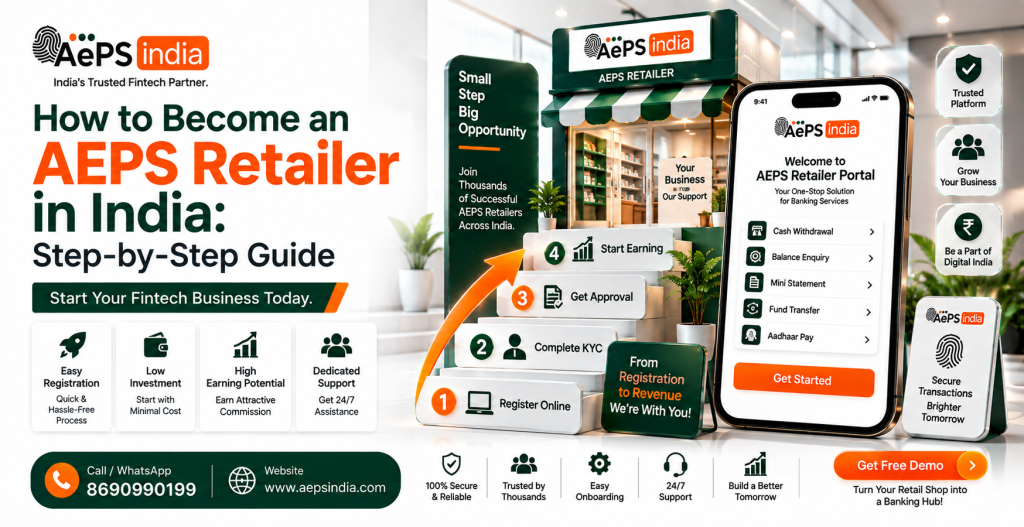
If you want to Become an AEPS Retailer in India, you can add Aadhaar-based banking services to your existing shop, digital service center, or financial services business. AEPS, or Aadhaar Enabled Payment System, allows customers to access supported banking services through Aadhaar-based authentication and biometric verification at an authorised AEPS retailer point.
Becoming an AEPS retailer can be useful for shop owners, Kirana store owners, mobile shop owners, digital service providers, CSPs, Business Correspondents, and entrepreneurs who want to provide basic banking services in their local area. Depending on the AEPS setup and participating bank, services can include cash withdrawal, balance enquiry, mini statement, and other supported Aadhaar-enabled banking services.
Becoming an AEPS (Aadhaar Enabled Payment System) retailer means operating as a mini-bank or authorized Business Correspondent (BC) from your local shop, allowing you to process cardless banking transactions using a customer’s Aadhaar number and fingerprint.
The process to become an AEPS retailer generally starts with choosing a suitable AEPS service provider or authorised Aeps india, completing the required registration and KYC process, submitting the necessary documents, and setting up a compatible biometric device. Common Aeps onboarding requirements may include Aadhaar, PAN, bank account details, contact information, business or shop details, a smartphone or computer, internet connectivity, and a supported biometric device. The exact requirements can vary by Aeps india arrangement.
Once your retailer account is approved and activated, you can use the AEPS platform to process eligible customer transactions from your shop or service point. This can help you add banking services to your existing business, serve customers who need convenient access to basic banking, and earn Aeps commission according to the applicable AEPS service and Aeps india terms.
However, choosing the Aeps india is an important part of starting this business. You should check the AEPS retailer registration process, KYC requirements, biometric device support, available banking services, transaction reliability, settlement process, commission structure, security measures, customer support, and applicable compliance requirements before getting started.
If you already operate a local shop or digital service business, becoming an AEPS retailer can be a practical way to add banking services to your existing business. The key is to complete the required onboarding correctly and work with a reliable and authorised AEPS india.
In this complete guide, you will learn how to Become an AEPS Retailer in India step by step, who can become an AEPS retailer, eligibility requirements, documents required, biometric device requirements, AEPS retailer registration process, KYC and onboarding, how to start AEPS services, available AEPS transactions, retailer benefits, commission factors, common registration problems, and how to choose the right AEPS service provider.
What Is an AEPS Retailer?
An AEPS retailer is a local shop owner or business operator who uses an Aadhaar Enabled Payment System platform to turn their store into a neighborhood mini-bank. They use a fingerprint scanner and a mobile or computer device to help people safely perform cardless banking transactions.
AEPS Retailer Work
An AEPS Retailer Platform turns a local shop into a neighborhood mini-bank, allowing merchants to process cardless and PIN-less financial transactions using Aadhaar numbers and fingerprint scans.
How AEPS Retailer Work Operates
- Registration and KYC: Retailers register with an approved AEPS india and complete identity verification.
- Device Setup: Shop owners connect a certified Aeps biometric scanner to an active Aeps agent app on a smartphone, tablet, or computer.
- Customer Authentication & Processing: Customers provide their Aadhaar number, bank name, and fingerprint scan, which is processed securely via NPCI to clear transactions instantly.
- Settlement: Funds are handled in real time, earning the retailer a direct commission.
What AEPS Services Can a Retailer Offer?
An Aadhaar Enabled Payment System (AEPS) retailer can offer card-free and PIN-less basic banking services using a customer’s Aadhaar number and biometric fingerprint authentication.
Key AEPS Services Offered by Retailers
- Cash Withdrawal: Allows customers to withdraw money directly from their Aadhaar-linked bank account without a debit card.
- Balance Inquiry: Provides customers with a real-time check of their bank account balance.
- Mini Statement: Displays recent transaction history and the updated account balance.
- Cash Deposit: Enables customers to deposit cash into an Aadhaar-linked account through authorized merchant portals (where supported by the Aeps india).
- Aadhaar-to-Aadhaar Fund Transfer: Facilitates direct money transfers between two Aadhaar-linked accounts.
AEPS Retailer Eligibility Criteria
To register as an AEPS India, you must meet basic age, identity, hardware, and compliance criteria.
Basic Eligibility Requirements
- Age Limit: You must be at least 18 years old.
- Citizenship: You must be an Indian citizen.
- Business Location: You should have a physical shop or dedicated place of business.
- Technical Skills: You need basic knowledge of using smartphones, computers, and digital banking.
Mandatory Documents & Accounts
- PAN Card: A valid PAN card for identity and financial verification.
- Aadhaar Card: A valid Aadhaar card tied to your identity.
- Linked Mobile Number: An active mobile number linked directly to both your Aadhaar and bank account.
- Bank Account: An active personal bank account for commission payouts and settlements.
Required Hardware
- Device: A working smartphone, tablet, laptop, or PC with an active internet connection.
- Biometric Scanner: A UIDAI/STQC-certified biometric fingerprint or Aeps iris scanner (such as Mantra).
- Indian citizen (18+ years)
- Valid Aadhaar card
- PAN card mandatory
- Active mobile number
- Basic computer knowledge
- Fixed shop/location
- Shop establishment license
- Electricity bill/address proof
- Bank account (savings/current)
- Good local reputation
- Smartphone or computer
- Stable internet connection
- Biometric scanner device
- Printer for receipts
- UPS/power backup preferred
What Equipment Is Required for an AEPS Retailer?
An Aadhaar Enabled Payment System (AEPS) retailer needs a smartphone or computer, a certified Aeps biometric fingerprint scanner, and an active internet connection to start operations.
Essential Equipment
- Biometric Fingerprint Scanner: A UIDAI or STQC-certified Level 1 L1 Aeps biometric device (such as the Mantra L1) is mandatory to capture and encrypt customer fingerprints securely.
- Computing Device: An Android smartphone or tablet (with USB OTG support) or a Windows PC/laptop running the Aeps retailer portal or AEPS mobile application.
- Internet Connection: A stable mobile data connection, broadband, or a dedicated internet dongle to process real-time authentication with the National Payments Corporation of India (NPCI).
- Micro ATM / POS Terminal (Optional): Used optionally by retailers who also want to offer physical card swiping or micro-ATM card-based cash withdrawals alongside biometric services.
- Power Backup (Recommended): A power bank or Uninterruptible Power Supply (UPS) to keep devices running smoothly during power outages.
AEPS Retailer for Kirana Shops, Mobile Shops and CSPs
You can turn your local business into a neighborhood mini-bank using the best AEPS Platform to offer cardless, PIN-less cash withdrawals, balance checks, and mini-statements.
How AEPS Works for Small Shops
An Aadhaar Enabled Payment System (AEPS) lets shop owners use biometric authentication via the National Payments Corporation of India (NPCI).
- Kirana & Grocery Stores: Add extra income by serving as a local cash point for customers who need quick withdrawals.
- Mobile & Recharge Shops: Attract more footfall and increase daily sales while earning a commission on every financial transaction.
- CSPs & E-Mitra Centers: Deliver essential financial inclusion services directly to the local community.
Who Can Become an AEPS Retailer in India?
An AePS agent registration can be completed by any Indian citizen aged 18 or older who owns a valid PAN card, an Aadhaar-linked bank account, and basic digital familiarity.
Who Typically Becomes an AEPS Retailer?
- Shop Owners: Local grocers, chemists, and general merchants looking to add extra revenue.
- Fintech Entrepreneurs: Individuals wanting to operate a mini-banking or micro ATM touchpoint in rural or underbanked areas.
- Service Providers: Existing digital service operators like travel agents, bill-payment kiosks, and mobile recharge stores.
Why Become an AEPS Retailer in India?
Becoming an AEPS Portal provider like Aeps india turns your local shop into an assisted banking point, allowing you to offer cash withdrawals, balance checks, and mini-statements using a customer’s Aadhaar number and fingerprint.
Key Benefits for Retailers
- Extra Income: Earn Aeps commission on every successful cash withdrawal, deposit, or balance inquiry transaction.
- More Footfall: Attract new customers to your physical store who are looking for quick banking services instead of traveling to a distant ATM or bank branch.
- Low Setup Cost: Start offering financial services with minimal investment by only needing a smartphone or computer and a certified biometric Aeps fingerprint scanner.
- No Banking Background Needed: Operate the system easily without any prior formal training in banking operations.
- High Interoperability: Serve customers from any bank across India as long as their account is linked to their Aadhaar number.
Top Use Cases of Become an AEPS Retailer in India?
Becoming an AEPS Retailer (Aadhaar Enabled Payment System) allows local shop owners to turn their storefronts into mini-banks that offer cardless and PIN-less financial services.
Top Use Cases for AEPS Retailers
- Micro-ATM Services (Cash Withdrawal & Deposit): Cash management lets local customers withdraw or deposit money from their Aadhaar-linked bank accounts using a simple Aeps biometric fingerprint or iris scan, removing the need to travel to a distant bank branch or physical ATM.
- Balance Inquiry & Mini-Statements: Account checking gives users a fast, secure way to view their current bank balance and recent transaction history right at the local counter.
- Aadhaar Pay (Merchant Payments): Digital sales enable small shopkeepers to accept direct payments for regular goods using customer biometric verification, avoiding expensive traditional POS card-swiping machines.
- Direct Benefit Transfers (DBT): Welfare payouts allow rural citizens to securely access government pensions, subsidies, and financial aid directly through trusted neighborhood retail shops.
- Aadhaar-to-Aadhaar Fund Transfers: Money transfers facilitate secure, interbank money transfers between two different Aadhaar-connected accounts using simple biometric confirmation.
- Paperless e-KYC Verification: Identity authentication helps businesses and banking correspondents instantly verify customer documents and onboard new users in a fully digital format.
Can I Become an AEPS Retailer Without a Shop?
No, you generally cannot become a standard commercial AEPS (Aadhaar Enabled Payment System) retailer without a fixed physical location or shop, because Aeps india and banks require a verified business address and physical verification during the Aeps india for fast Aeps onboard process.
Why a Shop or Fixed Address is Required
- Business Correspondent (BC) Norms: AEPS works through a bank-led financial inclusion model where agents act as official Aeps india mandate a fixed location for security, auditing, and regulatory compliance.
- Physical Verification: Aeps india conduct physical or geo-tagged verification of your operational address before activating full merchant payout capabilities.
- Customer Trust and Safety: Handling cash transactions requires a secure, recognizable physical space where customers can safely provide biometrics and collect cash.
Can I Become an AEPS Retailer From Home?
Yes, you can become an Aadhaar Enabled Payment System (AEPS) retailer from home, provided you have a smartphone or computer, an internet connection, and a certified Aeps biometric scanner. While many traditional Business Correspondent (BC) models prefer a physical shop, you can register online and operate out of a residential setup as long as you meet KYC and compliance requirements.
Steps to Register
- Choose a Provider: Select a trusted, RBI-compliant Aeps india.
- Submit KYC: Fill out the online registration form and upload your PAN, Aadhaar, and bank account details.
- Verification: Complete the video or physical verification process required by the top Aeps platform.
- Setup Hardware: Install the Aeps mobile app or desktop software and plug in your certified Aeps biometric device.
- Activation: Receive your Merchant/Agent ID to begin processing transactions like cash withdrawals and balance checks.
How to Become an AEPS Retailer in India – Step-by-Step Process
You can start your registration right away by visiting the Aeps Portal to submit your details and complete your onboarding.
Becoming an Aadhaar-Enabled Payment System (AePS) retailer in India allows your local shop to function as a mini-bank, offering cash withdrawals, balance inquiries, and mini-statements.
Step-by-Step Registration Process
- Choose a Service Provider: Partner with an NPCI-certified Aeps India.
- Submit Application and KYC: Fill out the online registration form and upload your scanned KYC documents, including your PAN, Aadhaar, photo, and shop/business proof.
- Hardware Setup: Procure a certified biometric device, install the required Registered Device (RD) service drivers on your phone or PC, and connect it.
- Verification and Activation: The Aeps india completes your Business Correspondent (BC) verification, which usually takes 24 to 48 hours.
- Start Transactions: Log in to your retailer Aeps dashboard or mobile Aeps app to process customer transactions and earn instant Aeps commission.
| Application ID | Applicant Name | State | Submitted | Current Stage | Status |
|---|---|---|---|---|---|
| APP-28421 | Rajesh Kumar | Uttar Pradesh | 10 Sep | Document Verification | Under Review |
| APP-28420 | Priya Sharma | Maharashtra | 10 Sep | Biometric Setup | Application Received |
| APP-28419 | Amit Singh | Punjab | 09 Sep | Training | Approved |
| APP-28418 | Sunita Devi | Bihar | 09 Sep | Document Verification | Under Review |
| APP-28417 | Mohammed Ali | Telangana | 08 Sep | — | Rejected |
Benefits of Becoming an AEPS Retailer
Becoming an AEPS Portal retailer allows shop owners to turn their local stores into mini-banking touchpoints, offering essential financial services through biometric authentication.
Key Benefits for Retailers
- Additional Commission Income: Retailers earn a direct commission (typically ₹5 to ₹20) on every successful transaction like a cash withdrawal or balance check.
- Increased Store Footfall: Aeps india offering banking services brings more people into your shop, which can boost your primary retail sales.
- Mini-ATM Conversion: You can provide cash withdrawals and mini-statements using a fingerprint scanner and Aadhaar number, eliminating the need for customers to carry debit cards.
- Real-Time Settlements: Earnings and transaction amounts are settled instantly or daily directly into the retailer's registered bank account.
- Low Setup Cost: Getting started requires minimal investment usually just a registered AEPS Agent Registration portal account, a smartphone or computer, and a buy Aeps biometric device.
- Community Trust and Reach: Acting as a local banking correspondent helps underserved or rural customers access money easily without traveling to distant bank branches.
Features of Becoming an AEPS Retailer
Becoming an AEPS (Aadhaar Enabled Payment System) retailer turns a local shop into a digital mini-bank that processes cardless and PIN-less transactions using biometric verification.
Key Features and Benefits
- Extra Earnings: Earn commissions ranging from ₹2 to ₹20 on every cash withdrawal, balance check, or mini-statement processed.
- More Footfall: Aeps india offering essential banking services brings new visitors to your store, which often leads to higher sales of your regular shop products.
- Easy Cash Management: Safely dispense cash to customers to cycle your shop's cash register without making frequent trips to deposit or withdraw at a bank branch.
- Low Setup Cost: Use your existing smartphone or computer paired with an affordable, STQC/L1 Aeps certified biometric fingerprint scanner.
- Safe and Secure: Transactions rely on Aadhaar biometric authentication, removing the risks of card skimming, lost debit cards, or forgotten PINs.
- Instant Settlements: Real-time or same-day (T+0) fund transfers allow you to track your earnings and cash flow easily on a digital Aeps dashboard.
How Does AEPS Retailer Registration Work Online?
AEPS (Aadhaar Enabled Payment System) retailer registration works online by partnering with an AEPS India to complete digital KYC verification and activate your micro-Aeps banking portal.
Step-by-Step Online Registration Process
- Choose a Provider: Select a trusted, approved Aeps india.
- Fill Out the Application: Visit the Aeps india official web portal or Aeps app to submit your personal, business, and settlement bank details.
- Complete KYC Verification: Upload digital copies of your PAN card and Aadhaar card, then complete live Aeps biometric or video verification.
- Setup Biometric Device: Plug your best Aeps fingerprint scanner into your device and install the required Registered Device (RD) service drivers.
- Receive Credentials: Once the Aeps india reviews and approves your application (usually within 24 to 48 hours), you will receive your unique merchant/agent login ID.
- Start Transacting: Log in to the Aeps b2b portal to offer cash withdrawals, balance checks, and mini-statements while earning commissions on each service.
| Application ID | Applicant | Registration Mode | e-KYC Status | Current Stage | Status |
|---|---|---|---|---|---|
| ORW-88421 | Vikram Patel | 📱 Mobile | ✓ Verified | Bank API Check | e-KYC Done |
| ORW-88420 | Neha Gupta | 💻 Desktop | ✓ Verified | Final Approval | Approved |
| ORW-88419 | Suresh Yadav | 📱 Mobile | ◉ Processing | e-KYC Verification | Verifying |
| ORW-88418 | Anita Singh | 💻 Desktop | ✓ Verified | Document Upload | Submitted |
| ORW-88417 | Ravi Kumar | 📱 Mobile | ✓ Verified | Activated | Go Live |
How Does an AEPS Transaction Work for a Retailer?
An AEPS transaction allows a local shop owner to act as a mini-bank by processing cardless and PIN-less banking operations using a customer's Aadhaar number and fingerprint.
Step-by-Step Transaction Process
- Setup and Input: The retailer connects a top Aeps biometric fingerprint scanner to a smartphone, computer, or POS terminal running an top AEPS Platform app. The customer provides their 12-digit Aadhaar number and selects their bank name.
- Service Selection: The retailer selects the requested service on the Fast Aeps app, such as a cash withdrawal, balance inquiry, mini statement, or cash deposit.
- Biometric Authentication: The customer places their finger on the scanner. The best Aeps system securely sends this data to the Unique Identification Authority of India (UIDAI) via the National Payments Corporation of India (NPCI) network to verify the customer's identity.
- Processing and Settlement: Once authenticated, the customer's linked bank account is debited or credited in real time. For cash withdrawals, the retailer hands physical cash to the customer from their own cash drawer, and the equivalent amount is instantly settled into the retailer's business bank account.
Retailer Benefits and Earnings
- Commissions: Retailers earn a small commission from the service provider or bank for every successful transaction, usually ranging from ₹7 to ₹13 depending on the transaction value.
- Customer Fees: For cash withdrawals, retailers can legally charge a nominal fee or a percentage of the amount from the customer based on prevailing market practices and company rules.
- Footfall: Offering basic financial services helps attract more local customers to the retail shop.
How Long Does It Take to Become an AEPS Retailer?
Becoming an AEPS retailer typically takes 24 to 48 hours for complete approval and activation, though it can sometimes extend to 2 to 5 business days if document verification takes longer.
Breakdown of the Timeline
- Application & Document Submission (10 to 30 minutes): Filling out online forms and uploading digital copies of your PAN card, Aadhaar card, bank passbook, and passport-sized photo.
- KYC & Background Verification (24 to 48 hours): The Aeps india team reviews and confirms your submitted details and compliance documents.
- Biometric Device Setup (A few minutes once hardware arrives): Connecting and registering a UIDAI/STQC-certified L1 Aeps fingerprint scanner via the RD service on your smartphone or PC.
AEPS Retailer Registration Fees and Setup Cost
You can register as an AEPS retailer through the AEPS Retailer Registration Guide with activation fees ranging from free to ₹1,250, plus an additional ₹1,500 to ₹3,000 for required biometric hardware.
Registration and Activation Fees
- Basic Agent ID: Free to ₹1,250 depending on the Aeps india choice. Aeps india offer free Aeps onboarding if you purchase Aeps biometric device directly through them.
- e-KYC Onboarding: Usually included in the basic registration fee.
Hardware and Setup Costs
- Biometric Fingerprint Scanner: ₹1,500 to ₹3,000 for an STQC/Aeps L1 certified device (such as Mantra) which is mandatory for secure authentication.
- Device: An existing Android smartphone, tablet, or PC with a stable internet connection (no extra cost if you already own one).
Working Capital
- Operating Wallet Liquidity: A variable amount of cash (e.g., ₹5,000 to ₹10,000+) kept in your business account or operating wallet to handle daily customer cash withdrawals.
AEPS Retailer Commission – How Much Can You Earn?
Retailers can earn an estimated ₹10,000 to ₹30,000+ per month through the best AEPS Portal by processing biometric banking transactions.
Commission Rates per Transaction
- Cash Withdrawals: Earn ₹2.00 to ₹15.00+ per transaction. Higher value slabs (₹3,000 to ₹10,000) yield the maximum commission of ₹10 to ₹15. Lower slabs (₹100 to ₹999) pay around ₹0.20 to ₹2.00.
- Balance Inquiries & Mini-Statements: Earn ₹0.50 to ₹5.00 per inquiry depending on the Aeps india.
- Aadhaar Pay & Fund Transfers: Earn percentage-based commissions around 0.3% to 1.0% on specific transfers or merchant payments.
Estimated Monthly Earnings Breakdown
- Cash Withdrawals: Processing 20 transactions daily at an average of ₹10 each yields about ₹6,000 per month.
- Balance Checks: Handling 30 inquiries daily at ₹2 to ₹5 each yields about ₹1,800 to ₹4,500 per month.
- Additional Services: Adding bill payments or micro ATM device options can push total earnings past ₹10,000 to ₹30,000+ monthly.
AEPS Retailer Login – How to Access Your Account
To access your retailer account, visit Aeps india to log in using your registered credentials.
Steps to Access Your Account
- Open Portal or App: Go to Aeps india official web login page or launch their merchant Aeps mobile app on your smartphone.
- Enter Credentials: Type in your registered User ID or mobile number and your secure Password or MPIN.
- Complete Verification: Enter the OTP sent to your registered mobile number if prompted for two-factor security.
- Connect Device: Plug in your STQC Aeps biometric fingerprint scanner or Aeps iris device before starting transactions.
| Retailer ID | Method | Device | Location | Time | Status |
|---|---|---|---|---|---|
| RET-88421 | 📱 OTP | Android | Lucknow | 10:42 AM | Success |
| RET-88420 | 🔑 Password | Web | Patna | 10:38 AM | OTP Sent |
| RET-88419 | 👆 Biometric | Desktop | Jaipur | 10:35 AM | Success |
| RET-88418 | 📱 OTP | Android | Unknown | 10:29 AM | Blocked |
| RET-88417 | 🔒 2FA | iOS | Delhi | 10:22 AM | Verifying |
How to Check AEPS Transaction Status?
You can check your transaction status immediately on the micro ATM system screen or receipt provided by the operator, or via an SMS alert sent to your registered mobile number by your bank.
How to Check AePS Transaction Status
- Immediate Receipt: The AePS service platform processes transactions in real time, and the micro ATM operator or banking correspondent terminal will display a success or failure message and print a receipt.
- SMS Confirmation: Your bank sends a confirmation SMS for successful or failed debits/credits if your mobile number is linked to your bank account.
- Bank Passbook or Mobile App: Log in to your bank's mobile Aeps application or update your passbook to see if the amount was settled.
AEPS Retailer Settlement – How Does It Work?
AEPS Payout for retailers is the process of transferring collected cash withdrawal amounts and earned commissions from an agent's operational fintech wallet to their personal bank account.
How AEPS Settlement Works
- Transaction Collection: When a customer performs a cash withdrawal at your shop, you hand over physical cash from your store reserves. That equivalent withdrawal amount, plus your commission (usually ₹2 to ₹15), is instantly credited to Aeps earning platform.
- Wallet Accumulation: The funds stay in your digital portal wallet until you choose to withdraw or settle them.
- Initiating Settlement: Retailers log into their Aeps business app or dashboard to move the accumulated balance into their linked bank account.
Modes of Settlement
- IMPS (Real-Time Payout): Transfers money instantly to your bank account 24/7, though a small service fee may apply per transfer.
- NEFT (Standard Settlement): Moves funds during standard banking hours or batches, and it is usually free of cost.
- T+1 Auto-Settlement: Aeps commission platform automatically clear the wallet balance into your registered bank account by the next working day.
| Batch ID | UTR | Amount | Bank | Cycle | Status |
|---|---|---|---|---|---|
| BTH-8842 | UTR240911001 | ₹8,450 | SBI | T+0 | Credited |
| BTH-8841 | UTR240911002 | ₹12,680 | PNB | T+1 | Processing |
| BTH-8840 | UTR240911003 | ₹6,240 | BOB | T+0 | Credited |
| BTH-8839 | UTR240911004 | ₹9,820 | HDFC | T+1 | Processing |
| BTH-8838 | UTR240911005 | ₹5,490 | Axis | T+2 | Scheduled |
AEPS Retailer Transaction Limit
The maximum AEPS limit set by the National Payments Corporation of India (NPCI) is ₹10,000 per transaction.
Transaction Limits Overview
- Per-Transaction Limit: Up to ₹10,000 for cash withdrawals as mandated by NPCI.
- Daily Cumulative Limit: Many issuing banks allow a total daily limit of up to ₹50,000 across multiple transactions, though individual bank rules can vary.
- Provider/Merchant Caps: Some retailer or specific bank terminals cap the number of daily transactions (e.g., up to 5 transactions per day or whichever limit hits first).
- Interoperability: You can process transactions for customers from different banks, but the individual customer's bank policies apply to their overall daily caps.
AEPS Retailer KYC and Compliance Requirements
Retailer KYC and compliance for the Aadhaar Enabled Payment System (AePS) require rigorous RBI Master Directions due diligence, mandatory UIDAI certified Aeps biometric devices, and adherence to latest 2026 security mandates.
Key Compliance & Regulatory Norms (2026 Updates)
- Single Acquiring Bank Rule: Operators (AePS Touchpoint Operators or ATOs) are restricted to fast Aeps onboard with a single acquiring bank to prevent multi-network misuse.
- Re-KYC for Inactivity: Agents who remain dormant or inactive for three continuous months must undergo complete re-KYC before reactivation.
- Step-Up Authentication: Cash withdrawals exceeding ₹5,000 mandate a two-factor step-up authentication combining both biometric verification and an OTP.
- Certified Hardware: Retailers must exclusively use STQC-certified and L1/RD-service-compliant fingerprint or Aeps iris scanner device.
AEPS Retailer Business – Is It Profitable?
Yes, an AEPS (Aadhaar Enabled Payment System) retailer business is profitable, offering a low-investment way to earn steady commission income while increasing shop footfall.
Why It Is Profitable
- Low Initial Investment: Aeps Setup costs range between ₹5,000 to ₹10,000, which covers a trusted Aeps biometric fingerprint scanner and Aeps portal registration.
- Commission Earnings: Retailers earn a direct commission ranging from ₹2 to ₹20 per successful transaction or balance inquiry, plus volume bonuses.
- More Store Visitors: Aeps india offering cash withdrawals and mini-statements turns your shop into a local mini-bank, attracting neighbors who often buy regular goods while visiting.
- High Customer Demand: Many people prefer local retail shops over distant bank branches or broken ATMs for quick cash.
How to Increase Your Income as an AEPS Retailer
You can increase your income as an Aadhaar Enabled Payment System (AEPS) retailer by expanding your service offerings, driving daily customer footfall, and optimizing transaction volumes.
Key Ways to Increase Income
- Maximize Higher-Value Transactions: Aim for cash withdrawals in the ₹3,000 to ₹10,000 bracket, as Aeps india typically offer higher tiered commissions for larger transaction values.
- Cross-Sell Additional Financial Services: Expand beyond basic cash withdrawals by offering Airtel Payments Bank or similar utility services like DTH/mobile recharges, bill payments, money transfers, and assisting with insurance or loans.
- Promote Aadhaar Pay: Use Aadhaar Pay API for merchant transactions exceeding daily AEPS limits to bypass caps, accept larger digital payments, and gain extra revenue.
- Build Local Trust and Visibility: Display clear signage outside your shop advertising cash availability and mini ATM services to turn your store into the neighborhood’s default banking point.
- Compare and Switch Providers: Regularly evaluate Aeps india to find b2b Aeps platform offering the best commission structures, fast settlements, and low downtime.
AEPS Retailer Security and Customer Safety
The Reserve Bank of India (RBI) and NPCI enforce strict security guidelines for the best AePS to protect retailers and customers from biometric spoofing and financial fraud.
Retailer Security Measures
- Mandatory Onboarding Due Diligence: Acquiring banks enforce strict KYC and background verifications for all top AePS touchpoint operators.
- L1-Certified Biometric Devices: Retailers must use registered, certified Aeps fingerprint or buy Aeps iris scanners to block fake or cloned silicone fingerprints.
- End-to-End Encryption: All data transmitted between the terminal, Business Correspondent (BC) network, and bank servers uses secure 256-bit encryption.
- App & Session Controls: High volume Aeps Platform utilize 2FA logins, active fraud detection, and auto-logout session timeouts.
Customer Safety Protocols
- Two-Factor Step-Up Authentication: Transactions above ₹5,000 require a mandatory Aadhaar OTP sent to the customer's linked mobile number alongside biometric verification.
- No Local Biometric Storage: Aeps Software is prohibited from storing raw biometric data locally, relying entirely on UIDAI licensed Aeps API.
- Real-Time Alerts: Customers receive instant SMS or email notifications for every completed financial or non-financial movement.
- Biometric Locking: Customers can lock or unlock their biometrics via the UIDAI portal or virtual IDs (VID) to prevent unauthorized access.
| Incident ID | Type | Source | Time | Action Taken | Status |
|---|---|---|---|---|---|
| SEC-88421 | Brute Force Attack | Unknown IP | 10:42 AM | IP Blocked + Alert | Blocked |
| SEC-88420 | Biometric Spoofing | Retailer RET-4821 | 10:38 AM | Liveness Check Failed | Rejected |
| SEC-88419 | Suspicious Transaction | Retailer RET-7732 | 10:35 AM | Under Review | Monitoring |
| SEC-88418 | Invalid Login Attempt | Mobile XXXX-XX-1198 | 10:29 AM | Account Locked | Blocked |
| SEC-88417 | Secure Transaction | Retailer RET-5540 | 10:22 AM | All Checks Passed | Secured |
Common Problems Faced by AEPS Retailers
AEPS retailers frequently struggle with frequent transaction failures, poor internet connectivity, and delayed dispute resolutions when customer accounts are debited without cash dispensing.
According to insights on AEPS Advantages and Disadvantages here are the most common problems faced by these retail agents:
Network and Power Issues
- Unreliable Internet: Poor network coverage in rural or semi-urban areas causes sudden drops during a transaction.
- Power Outages: Frequent electricity cuts disrupt business operations and shut down best micro ATM device or Aeps biometric hardware.
Technical and Server Failures
- Server Timeouts: Heavy traffic on bank servers or the NPCI switch leads to unresponsive systems and cancelled requests.
- High Failure Rates: Unpredictable bank-side rejections reduce daily earnings and frustrate waiting customers.
Biometric Authentication Errors
- Fingerprint Mismatch: Worn-out fingerprints, dry skin, or poor-quality sensor capture lead to repeated verification failures.
- Device Registration Issues: Uncertified or outdated biometric hardware fails to sync properly with the retailer software.
Customer Disputes and Trust Deficit
- Debited Accounts: Money leaves the customer's account, but cash is not handed out due to a network drop.
- Delayed Refunds: Banks take up to two weeks to reverse stuck funds, which damages the local reputation of the retailer.
Fraud and Compliance Pressure
- Biometric Spoofing: Scammers using cloned silicone fingerprints can trigger unauthorized withdrawals, putting agents under legal scrutiny.
- Strict Regulations: Managing multi-regulator compliance across the RBI, NPCI, and UIDAI creates operational burdens for small shop owners.
AEPS Retailer vs Other Digital Banking Services
An Aadhaar Enabled Payment System (AEPS) retailer acts as a physical mini-bank outlet using biometric verification, whereas other digital banking services like UPI, net banking, and mobile wallets are self-service applications operated directly by users via smartphones.
Key Differences
- Authentication Method: AEPS Retailer requires the customer's Aadhaar number and fingerprint/biometric scan, while Other Digital Banking Services (UPI, cards, net banking) rely on UPI PINs, passwords, OTPs, or debit/credit card chips.
- User Involvement: AEPS Retailer involves a local shopkeeper or Business Correspondent (BC) acting as an intermediary to process the cash or balance transaction, whereas Other Digital Banking Services are fully self-operated by the end-user on their personal device.
- Target Audience & Infrastructure: AEPS Retailer targets rural, unbanked, or elderly populations who lack smartphones, debit cards, or nearby bank branches, whereas Other Digital Banking Services require an active internet connection, a smartphone, or a traditional bank card.
- Business Opportunity: AEPS Retailer models allow local Kirana store owners and merchants to earn direct commissions on cash withdrawals and balance checks, whereas Other Digital Banking Services (like standard UPI apps) are consumer payment rails rather than income sources for neighborhood agents.
- Hardware Requirements: AEPS Retailer setup needs a registered Aeps biometric scanner (fingerprint device) linked to a smartphone or micro ATM terminal, whereas Other Digital Banking Services only need a standard smartphone or a Point-of-Sale (POS) card swipe machine.
AEPS Retailer vs. Other Digital Banking Services
| Feature | AEPS Retailer Services | Other Digital Banking (UPI, Net Banking, POS) |
|---|---|---|
| Primary Identifier | Aadhaar Number + Biometric (Fingerprint/Iris) | UPI ID, Account/IFSC, Debit/Credit Card, or Mobile Number |
| Authentication Type | Biometric scan (mandatory physical presence) | UPI PIN, OTP, password, or chip/PIN for cards |
| Hardware Required | Smartphone/PC + Certified Biometric Scanner (Morpho, Mantra, etc.) | Standard Smartphone, Computer, or traditional POS terminal |
| Customer Eligibility | Any bank account holder linked to an Aadhaar number | Smartphone users with active mobile banking or internet access |
| Retailer Earnings | Commission-based earning per successful cash withdrawal or balance check | Usually zero direct commission; focused on customer convenience or cashless sales |
| Core Use Case | Cash withdrawal, mini-statements, and cash deposits in rural/semi-urban areas | Instant merchant checkouts, peer-to-peer (P2P) transfers, online bill payments |
| Common Constraints | Fingerprint mismatch issues (worn out/faded fingerprints), reliance on local biometric device connectivity | High dependency on internet uptime, server/gateway failures during peak hours |
Aeps india One of the Best AEPS Service Provider in India
Aeps india one of the right AEPS Software Provider requires evaluating critical performance, security, and financial factors to ensure smooth daily operations for your retail shop or fintech business.
Key Factors to Consider
- Security & Compliance: Ensure the trusted Aeps platform follows NPCI guidelines and UIDAI mandates, featuring end-to-end encryption and multi-layered biometric security.
- Transaction Success Rate: Look for a high uptime of 98% to 99%+ and low failure rates to avoid losing customers at your counter.
- Commission Structure & Payouts: Compare per-transaction earnings, watch for hidden fees, and check if commission rates scale with your transaction volume.
- Settlement Speed: Aeps india offering instant (T+0) or same-day fund settlements to keep your business cash flow healthy.
- API & Integration Ease: If you need software integration, verify that the Aeps india offers clear developer documentation, sandbox testing, and Aeps device compatibility (fingerprint/iris scanners).
- Customer Support: Choose a Aeps india with responsive technical support to quickly resolve failed transactions or biometric errors.
Why Choose AEPS India to Become an AEPS Retailer?
Aeps india one of the best Aeps provider to become an Aadhaar Enabled Payment System (AEPS) retailer, evaluate Aeps platforms based on AEPS India for transaction success rates, Aeps commission structures, and settlement speeds.
Key Factors to Consider
- Transaction Success Rate: Look for Aeps india offering a success rate of 98% to 99.9% to prevent failed transactions and customer drop-offs.
- Commission Structure: Compare how much the Aeps india pays per cash withdrawal, balance check, or mini-statement to maximize your daily earnings.
- Settlement Speed: Choose modern Aeps platform that offer instant or fast T+0/T+1 settlements directly to your working bank account.
- Uptime and Reliability: Ensure the network has 99.9% uptime to avoid frequent server downtimes during peak business hours.
- Security and Compliance: Verify that the Aeps india follows strict NPCI, UIDAI, and RBI guidelines with high-level data encryption and buying Aeps biometric device support.
- Customer Support: Pick a Aeps india with 24/7 technical help to quickly resolve integration, server, or biometric authentication errors.
Conclusion
Knowing how to become an AEPS Retailer in India is the first step toward starting an Aadhaar-based banking service from your shop or digital service center. The process is straightforward when you choose the Aeps india, keep your documents ready, complete KYC verification, arrange a compatible biometric device, and complete the required retailer Aeps onboarding process.
Before applying for AEPS Retailer Registration, make sure you understand the requirements of the Aeps india you choose. Common requirements can include Aadhaar, PAN, bank account details, an active mobile number, business or address information, and a compatible Aeps biometric device. Exact requirements can vary by provider and onboarding model.
Becoming an AEPS (Aadhaar Enabled Payment System) retailer means registering as an authorized local banking agent who uses biometric fingerprint verification to offer cardless cash withdrawals, deposits, and balance checks directly from a neighborhood shop.
After successful Aeps onboarding and Aeps activation, an AEPS retailer can provide supported banking services such as cash withdrawal, balance enquiry, mini statement, cash deposit and fund transfer to customers through the professional AEPS platform. The services available can depend on the participating Aeps india.
For a new retailer, Aeps india is the right AEPS Service Provider is just as important as completing the registration. Check the provider's KYC process, biometric device support, transaction reliability, settlement process, retailer support, reporting features, security practices and applicable charges before starting AEPS business.
With Aeps India, retailers and digital service businesses can get AEPS platform to complete Aeps onboarding and offer Aadhaar-enabled banking services to customers. A simple Aeps platform, proper support and a reliable transaction system can make it easier to manage daily AEPS transactions and grow your digital banking business.
If you are ready to become an AEPS retailer, prepare your required documents, choose a suitable AEPS india, complete the Aeps KYC and registration process, set up the required biometric device, and activate your retailer account. Once your account is approved and Aeps active, you can start offering supported best AEPS services to customers from your business location.
The right AEPS setup can help a local retailer turn an existing shop or service center into a convenient banking point while creating an additional source of business income. The key is to follow the proper onboarding process, use approved technology and devices, protect customer information, and follow the applicable AEPS requirements.
Ready to Start Your Business? Becoming an AEPS Retailer is Easy! Contact Us Today.
Frequently Asked Questions About Becoming an AEPS Retailer
An AEPS Retailer is a person or business that provides Aadhaar Enabled Payment System (AEPS) banking services to customers through an authorized AEPS india. A retailer can offer services such as cash withdrawal, balance enquiry and mini statement using Aadhaar-based biometric authentication.
To become an AEPS Retailer in India, choose a Aeps india, complete the online registration form, submit the required KYC documents and complete verification. After approval, you receive an AEPS Retailer ID and can set up the required biometric device to start providing AEPS services.
Generally, an applicant should be at least 18 years old and have valid KYC documents, including Aadhaar and PAN, along with an active bank account. The exact eligibility requirements can vary depending on the Aeps india and its onboarding process.
Commonly required documents include Aadhaar Card, PAN Card, passport-size photograph, bank account proof, active mobile number and email address. Aeps india may also ask for shop, business or address proof during KYC verification.
Aadhaar is generally required for AEPS retailer KYC and identity verification. The Aadhaar details may also need to be linked with the required mobile or bank information, depending on the Aeps india verification process.
Yes, PAN is commonly required during AEPS retailer registration for KYC and financial verification. The PAN details should match the applicant's registration information.
A physical shop or business location may be required by Aeps india, especially when shop or address verification is part of their onboarding process. Requirements can differ between providers, so it is important to check the Aeps india current eligibility rules.
It may be possible with Aeps india if their onboarding rules allow home-based operations. However, you still need to complete KYC and meet the Aeps india technical, security and business requirements before starting AEPS services.
The total cost depends on the Aeps india and the setup you choose. Expenses may include registration or onboarding charges, a certified biometric device, internet connection and other applicable service costs. Many AEPS businesses can be started with relatively low initial investment.
Aeps india offer free Aeps registration, while others may charge onboarding, fast Aeps platform or device-related fees. Always check the Aeps india current pricing before completing registration.
AEPS transactions generally require a compatible, certified Aeps biometric device for customer authentication. An STQC certified L1 Aeps fingerprint scanner with an active Registered Device (RD) service is commonly used for AEPS transactions.
The registration time depends on document verification and KYC approval. If the submitted information is complete and correct, the process can often be completed within a few business days, but the exact timeline varies by Aeps india.
First, complete registration with an authorized Aeps india and submit the required KYC documents. After successful verification and approval, the Aeps india creates your AEPS account and issues a unique Retailer Aeps ID or login credentials.
An AEPS Retailer's commission depends on the service, transaction volume and commission structure offered by the Aeps india. Cash withdrawals, balance enquiries, mini statements and other supported services may have different commission rates. There is no single fixed earning amount for every retailer.
Depending on the Aeps india can offer services such as cash withdrawal, balance enquiry, mini statement and Aadhaar-based payment services. The exact services available may vary by Aeps india. AEPS India lists cash withdrawal, balance enquiry, mini statement and Aadhaar-to-Aadhaar fund transfer among its top AEPS services.
An AEPS Retailer generally earns commission on eligible AEPS transactions completed for customers. The earning depends on the type and number of transactions, applicable commission rates and the Aeps india payout structure.
If an AEPS transaction fails, first check the transaction status in the reliable AEPS portal or reliable Aeps app. A failed transaction may happen because of biometric authentication issues, bank server problems, network errors or other technical reasons. If the amount has been debited but the transaction is unsuccessful, the retailer should follow the Aeps india dispute or reversal process.
You can usually check an AEPS transaction through the retailer Aeps portal or fast AEPS b2b app using the transaction ID, reference number or available transaction history. If the status remains pending, contact the Aeps india support team with the transaction details.
AEPS can provide an additional income opportunity for retailers because they earn commission on eligible transactions. Actual profitability depends on customer footfall, transaction volume, commission rates, cash availability, operating costs and the Aeps india you choose.
Before choosing an Aeps india, compare its transaction success rate, commission structure, settlement process, supported services, biometric device compatibility, security measures, portal or app quality and customer support. Also check the Aeps KYC and onboarding requirements and make sure the terms are clear before registering.
Conclusion
AEPS Full Form – Meaning, Uses, Benefits & How It Works in Banking
AEPS Service Company in India – Best AEPS Service Provider for Retailers & Agents
How AEPS Software Works for Aadhaar Enabled Banking Services
About Author

