AEPS vs UPI: Complete Comparison of Differences, Charges, Limits, Security & Uses
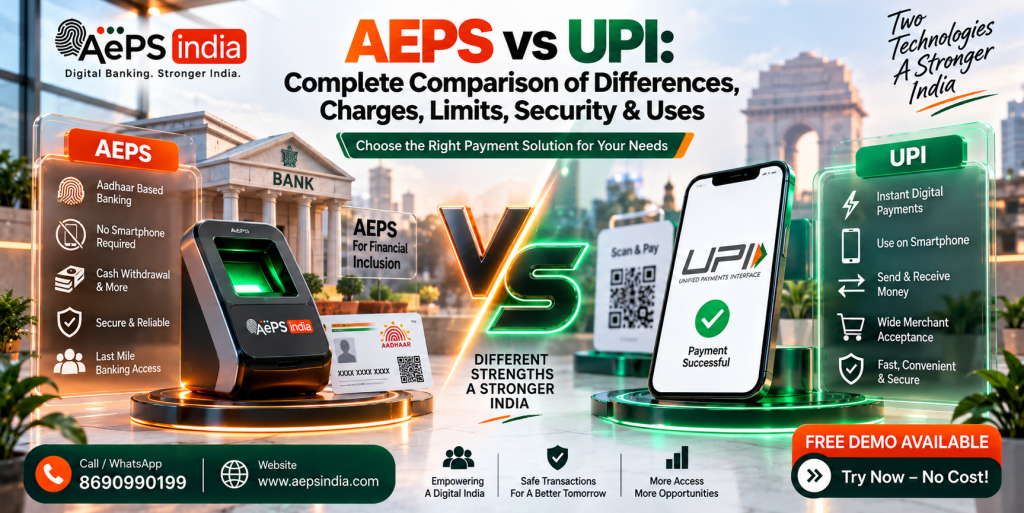
When comparing AEPS vs UPI, both are widely used digital payment and banking systems in India, but they work in different ways and are designed for different situations. AEPS stands for Aadhaar Enabled Payment System, while UPI stands for Unified Payments Interface. AEPS uses Aadhaar-based authentication through an authorised banking point, whereas UPI generally allows users to make payments and transfer money through a UPI-enabled mobile application.
The main difference between AEPS and UPI is the way a transaction is authenticated and completed. With AEPS, an eligible customer can access supported banking services using an Aadhaar-linked bank account and the required authentication, commonly through a biometric device at an authorised Business Correspondent or banking touchpoint. With UPI, customers normally use a mobile device and a UPI app to send or receive money using options such as a UPI ID, mobile number or QR code.
AEPS (Aadhaar Enabled Payment System) and UPI (Unified Payments Interface) are both revolutionary digital payment initiatives in India created by the National Payments Corporation of India, but they serve completely different purposes and user groups.
This difference makes AEPS useful for assisted banking, particularly for customers who may not have a smartphone, debit card or convenient access to a bank branch. AEPS can support services such as cash withdrawal, cash deposit, balance enquiry and mini statement, depending on the participating bank and service arrangement. UPI, on the other hand, is commonly used for everyday digital payments, merchant payments, QR payments and instant bank-to-bank transfers through supported applications.
For example, a customer visiting an AEPS retailer can use the supported Aadhaar-based authentication process to access eligible banking services. A UPI user can instead open a UPI-enabled application, select the payment or transfer option, and authenticate the transaction through the method supported by the application. So, although both systems can help people move money digitally, the AEPS vs UPI transaction process is not the same.
Understanding this difference is important for customers, retailers, Business Correspondents, fintech companies and digital service providers. A customer may prefer UPI for quick everyday digital payments, while an AEPS service point can provide assisted access to basic banking services for customers who need a local banking touchpoint.
By understanding how AEPS and UPI work, you can choose the appropriate payment or banking method based on your device access, banking needs, transaction type and available service point. The goal is not to treat AEPS and UPI as identical systems, but to understand where each one fits into India’s digital banking ecosystem.
In this complete guide, Aeps India explains AEPS vs UPI, the difference between AEPS and UPI, how AEPS fund transfers work, how UPI payments work, AEPS and UPI authentication, AEPS services, UPI payment methods, security, transaction process, use cases, and which situations each payment system is designed to support.
What Is AEPS?
AePS stands for the Aadhaar Enabled Payment System, a secure digital platform developed by the National Payments Corporation of India (NPCI) that allows you to perform basic banking tasks using only your Aadhaar number and fingerprint. It provides cardless and PIN-free banking access through authorized local agents, known as Business Correspondents (BCs) or micro-ATMs.
How Does AEPS Work?
The Aadhaar Enabled Payment System (AePS) is a bank-led model built by the National Payments Corporation of India (NPCI) that lets you handle basic banking tasks using just your Aadhaar number and your fingerprint. You do not need a debit card, a PIN, a smartphone, or a signature.
Step-by-Step Working Process
- Visit an Agent: Go to a local Business Correspondent (BC) or micro ATM operator.
- Provide Details: Give your 12-digit Aadhaar number and name your bank.
- Choose Service: Select what you want to do (like cash withdrawal or balance check).
- Scan Fingerprint: Place your finger on the Aeps biometric scanner.
- Verification: The system matches your fingerprint with the UIDAI database securely.
- Transaction Complete: The bank approves the request in real time and gives you a printed receipt.
What Is UPI?
Unified Payments Interface (UPI) is a real-time digital payment system developed by the National Payments Corporation of India (NPCI) that lets people transfer money instantly between bank accounts using a mobile phone.
How Does UPI Work?
Unified Payments Interface (UPI) is a real-time mobile payment system in India that lets you transfer money instantly between bank accounts. It was developed by the National Payments Corporation of India (NPCI).
How a Transaction Works
- Initiate: Scan a QR code, enter a UPI ID, or select a mobile contact.
- Enter Amount: Type in the money value you wish to send.
- Authenticate: Type your secret UPI PIN.
- Process: The network and NPCI route the secure request from your app to your bank.
- Settle: Money moves directly from your bank account to the receiver’s bank account within seconds.
What Is the Difference Between AEPS and UPI?
AEPS (Aadhaar Enabled Payment System) and UPI (Unified Payments Interface) are both digital payment platforms created by the National Payments Corporation of India, but they use different methods and serve different users.
Key Differences
| Feature | AEPS (Aadhaar Enabled Payment System) | UPI (Unified Payments Interface) |
|---|---|---|
| Primary Purpose | Basic banking services (cash withdrawals, balance checks) | Fast, everyday digital and peer-to-peer payments |
| Authentication | Biometrics (fingerprint or iris scan) + 12-digit Aadhaar number | UPI PIN + Virtual Payment Address (UPI ID) |
| Device Required | Micro-ATM or bank correspondent device operated by an agent | A personal smartphone with internet access |
| Cards or PIN Needed | No ATM card or PIN required | No card needed, but requires a mobile banking app and UPI PIN |
| Target Audience | Rural and unbanked populations | Urban, semi-urban, and tech-savvy smartphone users |
| Agent / Cash Role | Often used to withdraw physical cash through a local shop/agent | Completely cashless (though works with cash-like QR or soundboxes) |
AEPS vs UPI Requirements
AEPS (Aadhaar Enabled Payment System) and UPI (Unified Payments Interface) are both digital payment systems built by the National Payments Corporation of India (NPCI), but they have completely different user requirements, hardware needs, and use cases.
AEPS Requirements
AEPS designed for assisted-mode banking, cash withdrawals, and rural financial inclusion where smartphones and cards are not available.
- Aadhaar Number: A valid 12-digit Aadhaar number.
- Bank Account Linkage: Your bank account must be actively linked to your Aadhaar number.
- Biometric Authentication: Aeps Fingerprint or Aeps iris scan (authenticated via a micro ATM or a Banking Correspondent [BC] agent’s device).
- Physical Presence: You must visit a local micro-ATM, BC agent, or designated outlet in person.
- No Smartphone or Internet Needed: The customer does not need a smartphone, debit card, or internet connection; the agent’s device handles the network connectivity.
- Transaction Limit: Generally capped at ₹10,000 per day (depending on the bank’s rules).
UPI Requirements
UPI is designed for direct, self-served, instant digital and mobile-first transactions.
- Smartphone: A working smartphone with an active internet connection (4G/5G/Wi-Fi).
- Bank Account: An active bank account that supports UPI.
- Debit Card / Aadhaar for Setup: A valid debit card (or Aadhaar-based UPI onboarding, where available) to set up or reset your UPI PIN initially.
- UPI App: A supported payment application (such as Google Pay, PhonePe, Paytm, or BHIM).
- Virtual Payment Address (VPA / UPI ID): A unique identifier linked to your bank account (e.g.,
name@upi). - UPI PIN: A 4- or 6-digit personal identification number entered by you to authorize every transaction.
- Transaction Limit: Standard P2P/P2M limit is up to ₹1,00,000 per day (higher limits apply for specific categories like IPOs or hospitals).
AEPS vs UPI for Rural and Semi-Urban Banking
AEPS (Aadhaar Enabled Payment System) and UPI (Unified Payments Interface) serve different roles in India’s financial landscape, playing complementary parts in rural and semi-urban banking.
AEPS in Rural and Semi-Urban Banking
- Assisted Model: Relies on local shop owners, business correspondents, and Bank Mitras who act as human micro-ATMs.
- No Smartphone Needed: Customers only need their Aadhaar number and their thumbprint to withdraw cash or check balances.
- Government Subsidies: Crucial for Direct Benefit Transfers (DBT), allowing villagers to withdraw pension, MGNREGA wages, and welfare funds locally.
- Key Limitation: Vulnerable to occasional biometric scan failures, agent dependency, and local fraud risks.
UPI in Rural and Semi-Urban Banking
- Self-Service Convenience: Empowers users in semi-urban and growing rural pockets who own budget smartphones.
- Merchant Adoption: Ubiquitous QR codes and audio soundboxes make small-scale retail purchases fast and cashless.
- Zero Direct Fees: Free for consumers with no merchant discount rate (MDR) burdens on basic domestic transfers.
- Key Limitation: Completely locked out for citizens without a smartphone, mobile data network, or digital literacy.
Core Comparison
| Feature | AEPS (Aadhaar Enabled Payment System) | UPI (Unified Payments Interface) |
|---|---|---|
| Primary Target Audience | Rural, unbanked, or underbanked populations without smartphones | Urban, semi-urban, and tech-savvy smartphone users |
| Required Device | Biometric fingerprint/iris scanner (operated via a Bank Mitra / micro-ATM agent) | Smartphone with an active internet connection |
| Authentication | Aadhaar Number + Biometric scan (Fingerprint/Iris) | UPI PIN + 2-Factor Authentication |
| Core Services | Cash withdrawals, cash deposits, balance inquiries, mini-statements, fund transfers | Instant peer-to-peer (P2P) and person-to-merchant (P2M) digital payments |
| Internet Dependency | Agent terminal requires connectivity; customer needs no internet | Mandatory active internet on the user’s phone |
| Card / PIN Needed | No debit card or ATM PIN required | Linked bank account via UPI ID; no physical card needed, requires mobile PIN |
AEPS vs UPI for Different Users
AEPS (Aadhaar Enabled Payment System) and UPI (Unified Payments Interface) are both national payment rails in India, but they serve completely different types of users and infrastructure.
AEPS (Aadhaar Enabled Payment System)
- Target Users: Rural, unbanked, or elderly populations who do not have a smartphone, debit card, or remember a PIN.
- How It Works: You visit a Aeps india Website. You share your 12-digit Aadhaar number and authenticate the transaction using your Aeps fingerprint device or Aeps iris scan device.
- Requirements: An Aadhaar-linked bank account and a physical agent with a Aeps biometric device. No smartphone or internet needed by the user.
- Key Use Cases: Cash withdrawals at local shops, checking account balances, mini-statements, and receiving Direct Benefit Transfer (DBT) government subsidies.
- Limits: Usually capped around ₹10,000 per transaction (depending on the bank).
UPI (Unified Payments Interface)
- Target Users: Urban, semi-urban, and tech-savvy smartphone users who want fast, self-service digital payments.
- How It Works: You open a mobile app (like Google Pay, PhonePe, or Paytm), link your bank account, and pay by scanning a QR code or entering a Virtual Payment Address (VPA).
- Requirements: A smartphone, an active internet connection, a debit card (for initial setup), and a secret UPI PIN (MPIN).
- Key Use Cases: Instant peer-to-peer (P2P) transfers, online e-commerce shopping, bill payments, and merchant store QR checkouts.
- Limits: Typically up to ₹1,000,000 (₹1 lakh) per day for general peer-to-peer/merchant transactions (with higher limits for specific categories like hospitals or education).
AEPS vs UPI Benefits
AEPS (Aadhaar Enabled Payment System) and UPI (Unified Payments Interface) are two major digital financial tools in India, built for different audiences and use cases.
AEPS (Aadhaar Enabled Payment System) Benefits
AEPS allows users to perform basic banking services using only their 12-digit Aadhaar number and fingerprint/biometric authentication.
- No Smartphone or Card Needed: You do not need a debit card, credit card, ATM PIN, or smartphone to transact.
- Biometric Security: Aeps Fingerprint Machine or Aeps iris scan Machine prevent fraud and eliminate the risk of forgotten PINs.
- Rural Financial Inclusion: It brings essential banking services to remote and unbanked areas through best micro ATM and Business Correspondents (BCs).
- Cash Withdrawal & Deposits: Unlike standard digital-only wallets, AEPS lets users physically withdraw or deposit cash at local retail agent points.
- Government Subsidies: It makes it easy for beneficiaries to withdraw direct benefit transfers (DBT) and government welfare funds.
- Retailer Income: Local shopkeepers and micro ATM operators can earn direct commissions (₹2 to ₹10+) per transaction.
UPI (Unified Payments Interface) Benefits
UPI is a smartphone-first system that enables instant, real-time bank-to-bank transfers and digital payments.
- Instant 24/7 Transfers: Money moves between bank accounts within seconds at any time of day or night.
- No Bank Details Needed: Payments are made easily using a Virtual Payment Address (VPA / UPI ID), mobile number, or QR code scan.
- Higher Transaction Limits: Supports much higher daily limits (up to ₹1,00,000 or more depending on the bank) compared to AEPS.
- Zero or Low Cost for Users: Person-to-person and merchant UPI payments are generally free of charge for consumers.
- Versatile Use Cases: Ideal for online shopping, bill payments, peer-to-peer transfers, and scanning merchant QR codes in urban or semi-urban stores.
- No Physical Presence Required: You can pay anyone anywhere in India from your phone without visiting an agent or micro ATM Machine.
AEPS vs UPI Features
AEPS (Aadhaar Enabled Payment System) and UPI (Unified Payments Interface) are both national payment systems in India, but they are built for different users and use cases.
Key Feature Comparison
| Feature | AEPS (Aadhaar Enabled Payment System) | UPI (Unified Payments Interface) |
|---|---|---|
| Primary Device Needed | Biometric device or micro-ATM (no smartphone required) | Smartphone with an internet connection |
| Authentication Method | Aadhaar number + Biometric verification (fingerprint or iris) | Virtual Payment Address (VPA/UPI ID) + 4- or 6-digit MPIN |
| Internet Requirement | Not required for the customer (handled at the agent/micro-ATM) | Required for the user |
| Core Services | Cash withdrawals, cash deposits, balance checks, mini statements, and Direct Benefit Transfers (DBT) | Instant peer-to-peer (P2P) transfers, QR code scans, online shopping, and bill payments |
| Daily Transaction Limit | Typically ₹10,000 per day (varies by bank) | Up to ₹1,00,000 per day for standard fund transfers (higher for specialized categories like capital markets or education) |
| Target Audience | Rural, unbanked, or smartphone-free individuals | Urban, digital-savvy, and smartphone users |
| Access Point | Local Banking Correspondents (BCs), customer service points, or micro-ATMs | Mobile banking apps (e.g., Google Pay, PhonePe, Paytm, BHIM) |
Highlights of AEPS
- No Smartphone or Card Needed: Users only need their 12-digit Aadhaar number and a registered bank account.
- Financial Inclusion: Designed to bring basic banking services to rural and remote areas where bank branches and ATM infrastructure are sparse.
- Government Subsidies: Frequently used to withdraw pensions, MGNREGA wages, and direct government benefits.
- Biometric Security: Relies on unique fingerprint or iris scans, eliminating the risk of forgotten PINs or stolen debit cards.
Highlights of UPI
- Instant & Real-Time: Funds transfer directly between bank accounts 24/7 within seconds.
- High Convenience: Allows peer-to-peer transfers, merchant checkouts, and QR code scans straight from a phone.
- Higher Limits: Supports significantly larger daily transaction volumes (up to ₹1 lakh or more depending on the use case).
- Zero or Low Cost: Free for standard peer-to-peer transfers without requiring physical agent visits.
AEPS vs UPI Authentication
AEPS uses biometric scans and your Aadhaar number, while UPI uses a mobile app, Virtual Payment Address (VPA), and a secret MPIN.
Key Differences in Authentication
- AEPS (Aadhaar Enabled Payment System): Uses biometric authentication (fingerprint, iris scan, or face scan) paired with your 12-digit Aadhaar number and bank name. You do not need a smartphone, debit card, or PIN.
- UPI (Unified Payments Interface): Uses two-factor authentication via a smartphone app (like Google Pay or Paytm). It relies on your mobile number, a linked bank account, a Virtual Payment Address (VPA), and a secret MPIN (Mobile Personal Identification Number).
AEPS vs UPI Transaction Process
AEPS (Aadhaar Enabled Payment System) and UPI (Unified Payments Interface) are both national digital payment networks in India created by the National Payments Corporation of India (NPCI), but they use completely different transaction processes and target different users.
AEPS Transaction Process
AEPS design for rural, unbanked, or smartphone-free users who need cash or basic banking services through a local agent.
- Visit a Service Point: Go to an authorized Aeps india website.
- State Details: Inform the agent of your bank’s name and the type of service needed (cash withdrawal, balance inquiry, or fund transfer).
- Enter Aadhaar Number: Provide your 12-digit Aadhaar number into the agent’s micro ATM system or Point-of-Sale (PoS) terminal.
- Specify Amount: For cash withdrawals, tell the agent the exact amount required.
- Biometric Authentication: Place your buy Aeps biometric device to verify your identity.
- Backend Verification & Processing: The Aeps device sends your biometrics to UIDAI for matching, and NPCI routes the request to your linked bank account.
- Completion: The agent hands you the physical cash (if withdrawing) and gives you a printed or SMS receipt.
- Key Requirements: Aadhaar-linked bank account + Biometrics (no smartphone or debit card needed).
- Typical Limit: Around ₹10,000 per transaction.
UPI Transaction Process
UPI is a self-service mobile model designed for instant peer-to-peer (P2P) and merchant payments using a smartphone.
- Open a UPI App: Launch a payment app on your smartphone (such as Google Pay, PhonePe or BHIM).
- Select Action: Choose to send money, scan a QR code, or request a payment.
- Enter Recipient Details: Type in the recipient’s Virtual Payment Address (UPI ID), mobile number, or bank account/IFSC, or scan a physical/digital QR code.
- Enter Amount: Type in the amount you wish to transfer.
- Enter MPIN: Authenticate the transaction by entering your secret 4- or 6-digit Mobile Personal Identification Number (MPIN).
- Instant Processing: The money transfers in real time directly from your bank account to the receiver’s bank account via IMPS/UPI rails.
- Confirmation: An instant confirmation screen and notification appear on your phone.
- Key Requirements: Smartphone + Internet connection + Linked bank account + UPI ID/MPIN (Aadhaar is not mandatory).
- Typical Limit: Up to ₹1,000,000 (₹1 lakh) per day for general transactions (higher for specialized categories).
AEPS Services vs UPI Services
AEPS (Aadhaar Enabled Payment System) and UPI (Unified Payments Interface) are both national payment systems built by the National Payments Corporation of India (NPCI), but they are designed for completely different users, devices, and financial needs.
AEPS (Aadhaar Enabled Payment System)
- Primary Purpose: Basic banking and cash services (cash withdrawals, balance inquiries, mini-statements), acting as a “micro-ATM” for rural or unbanked areas.
- Authentication: Fingerprint or biometric scan via a Aadhaar-linked device.
- Required Equipment: Customer only needs a 12-digit Aadhaar number and bank name; the agent/merchant uses a biometric scanner and micro-ATM/terminal.
- Smartphone & Internet: Not needed by the customer (handled at the agent’s shop).
- Target Audience: Rural populations, senior citizens, or people without smartphones or debit cards.
- Earnings for Retailers: Retailers/agents earn a direct commission (e.g., ₹2 to ₹10) per transaction.
UPI (Unified Payments Interface)
- Primary Purpose: Instant, all-day digital P2P (person-to-person) and P2M (person-to-merchant) money transfers and QR code payments.
- Authentication: Two-factor authentication using a mobile app and a secret UPI PIN.
- Required Equipment: A smartphone with an active internet connection.
- Smartphone & Internet: Mandatory for both sender and receiver.
- Target Audience: Urban, semi-urban, and tech-savvy smartphone users.
- Earnings for Retailers: No direct per-transaction commission; merchants benefit from fast, low-friction digital sales and zero/low MDR.
Can You Withdraw Cash Through AEPS and UPI?
Yes, you can withdraw physical cash through both AEPS (Aadhaar Enabled Payment System) and UPI (Unified Payments Interface), though they use different methods and systems.
Withdrawing Cash via AEPS
- How it works: You visit a local retail shop, micro-ATM, or designated Business Correspondent (BC) outlet.
- Requirements: Your bank account must be linked to your Aadhaar number, and you need to provide biometric verification (fingerprint or iris scan). No debit card or PIN is required.
- Limits: Typically capped at ₹10,000 per transaction (with daily limits varying around ₹25,000 to ₹50,000 depending on the bank and guidelines).
- Services: Provided through Aeps platform like Aeps india Server networks.
Withdrawing Cash via UPI
- How it works: You can withdraw physical cash at select enabled merchant locations, micro-ATMs, or UPI Cash Points (such as specific micro-ATMs or retailer shops) without a traditional ATM card.
- Requirements: You need a smartphone with an active UPI app (like Google Pay or Paytm) to scan a dynamic QR code and enter your UPI PIN.
- Limits: Generally aligns with your standard daily UPI transaction limit (often up to ₹1,000,000 per day depending on your bank).
AEPS vs UPI for Fund Transfer
AEPS (Aadhaar Enabled Payment System) and UPI (Unified Payments Interface) are both national payment systems built by the NPCI, but they are designed for very different users, devices, and purposes.
AEPS for Fund Transfer
- How it works: You provide your 12-digit Aadhaar number and authenticate the transaction using your fingerprint or iris scan at a local micro ATM, bank branch, or authorized Aeps india.
- Who it is for: People living in rural or remote areas, senior citizens, or individuals who do not own a smartphone, do not have internet access, or lack a debit card.
- Core advantage: Brings banking to the doorstep without needing cards, mobile Aeps apps, or PINs.
UPI for Fund Transfer
- How it works: You use a smartphone app (like Google Pay or Paytm) and authorize money movement instantly using a 4- or 6-digit UPI PIN via Virtual Payment Addresses (VPAs) or QR codes.
- Who it is for: Urban, semi-urban, and smartphone-equipped users needing fast, round-the-clock peer-to-peer or merchant transactions.
- Core advantage: Real-time speed, massive merchant acceptance, and zero reliance on physical banking touchpoints.
AEPS vs UPI for Fund Transfer
LIVEAEPS
UPI
| Feature | AEPS | UPI | Winner |
|---|---|---|---|
| Authentication | Biometric | PIN/OTP | AEPS |
| Transaction Speed | 3.2s | 1.8s | UPI |
| Rural Coverage | 94% | 52% | AEPS |
| Urban Adoption | 45% | 88% | UPI |
| Success Rate | 96.8% | 98.4% | UPI |
| Offline Capability | Yes | No | AEPS |
| Bank Integration | All Banks | All Banks | Tie |
AEPS vs UPI for Merchant Payments
UPI is a smartphone-based digital payment system for instant transfers, while AEPS (or Aadhaar Pay) is a biometric- and Aadhaar-number-based system designed for assisted or cash-out transactions.
Core Comparison
Primary Use Case
- UPI: Everyday retail merchant billing, online checkouts, and peer-to-peer (P2P) transfers.
- AEPS: Basic banking services (Aeps cash withdrawal, Aeps balance inquiry) and rural/unbanked customer payments where smartphones or cards are absent.
Required Device / Setup
- UPI: A smartphone with an active internet connection and a linked bank account.
- AEPS: A micro-ATM or a smartphone/device paired with a Aeps biometric fingerprint/iris scanner.
Authentication Method
- UPI: A 4- or 6-digit UPI PIN.
- AEPS: The 12-digit Aadhaar number plus biometric scanning (fingerprint).
Transaction Limits
- UPI: Higher daily limits (up to ₹1,00,000 for standard P2M/P2P, with specific regulatory caps depending on the category).
- AEPS: Typically capped at ₹10,000 per single transaction (set by NPCI).
Internet Dependency
- UPI: Mandatory internet connection.
- AEPS: Requires network connectivity for real-time biometric validation, though it operates through agent/micro ATM networks.
Merchant Earnings & Fees
- UPI: Zero or low direct commission; grows business volume through fast checkout, though recent merchant fee frameworks apply tiered rates to specific large or specialized transactions (such as 0.40% for values over ₹2,000 in certain commercial segments).
- AEPS / Aadhaar Pay: Retailers and Business Correspondents (BCs) can earn direct per-transaction commissions (₹2 to ₹10) or provide cash-withdrawal services to earn a cut.
Which Should You Choose as a Merchant?
- Choose UPI if: You operate an urban, semi-urban, or general retail shop where customers carry smartphones, scan QR codes, and expect zero-friction, instant digital receipts.
- Choose AEPS / Aadhaar Pay if: You run a rural or remote touchpoint/CSP (Customer Service Point) where local customers lack smartphones, debit cards, or internet access, and you want to earn small service commissions.
AEPS vs UPI for Merchant Payments
LIVEAEPS Merchant
UPI Merchant
Merchant Performance Metrics
| Feature | AEPS | UPI | Best For |
|---|---|---|---|
| Authentication | Biometric | PIN/QR | AEPS |
| Setup Cost | ₹2,500 | Free | UPI |
| Hardware Needed | Biometric Device | Smartphone | UPI |
| Rural Reach | 89% | 47% | AEPS |
| Urban Adoption | 38% | 82% | UPI |
| Offline Capability | Yes | No | AEPS |
| Customer Trust | High | Very High | UPI |
AEPS vs UPI Security
AEPS (Aadhaar Enabled Payment System) and UPI (Unified Payments Interface) use very different authentication and security mechanisms, making each strong against specific types of fraud.
AEPS Security Mechanism
- Authentication Method: Relies strictly on 12-digit Aadhaar number plus biometric data (fingerprint or iris scan) captured via a certified micro-ATM or banking correspondent device.
- No Cards or PINs: Users do not need an ATM card, smartphone, internet connection, or secret PIN.
- Data Encryption: Biometric data is encrypted at the device level and sent directly to the Unique Identification Authority of India (UIDAI) for verification; raw biometric prints are never stored locally.
- Physical Presence Required: The user must be physically present at an authorized agent location to scan their finger or face.
- Security Risks: Vulnerable to “cloned fingerprints” or fake silicon/rubber fingerprints if rogue merchant terminals are compromised, and subject to daily/monthly withdrawal caps to curb misuse.
UPI Security Mechanism
- Authentication Method: Uses two-factor authentication (2FA) combining a device lock/app security with a secret numeric UPI PIN (and often a registered mobile number/UPI ID).
- Smartphone & App Dependent: Runs directly on personal mobile devices via apps like Google Pay or BHIM.
- Control & Alerts: Users manage their own PINs, receive instant SMS/app push notifications for every transfer, and can block or report handles immediately.
- Security Risks: Vulnerable to phishing scams, malicious remote-access screen-sharing apps, social engineering tricks, or someone accidentally sharing their UPI PIN.
AEPS vs UPI Security
LIVEAEPS Security Score
Biometric + Encryption
UPI Security Score
PIN + 2FA Protection
Security Strength Comparison
AEPS Security Features
UPI Security Features
| Security Aspect | AEPS | UPI | Stronger |
|---|---|---|---|
| Authentication Type | Biometric | PIN + OTP | AEPS |
| Encryption Level | AES-256 | AES-256 | Equal |
| Fraud Detection | 94% | 96% | UPI |
| Identity Theft Risk | Very Low | Low | AEPS |
| Phishing Protection | High | Medium | AEPS |
| Transaction Monitoring | Real-time | Real-time | Equal |
| Device Security | Bound | Bound | Equal |
AEPS vs UPI Transaction Limits
AEPS (Aadhaar Enabled Payment System) and UPI (Unified Payments Interface) have different transaction limits set by the National Payments Corporation of India (NPCI) and the Reserve Bank of India (RBI).
AEPS Transaction Limits
- Per Transaction Limit: ₹10,000 maximum for cash withdrawals.
- Daily Limit: Typically capped at ₹10,000 to ₹50,000 depending on the specific issuing bank’s risk policy (though single cash withdrawals stay capped at ₹10,000).
- Aadhaar Pay Limit: Up to ₹50,000 per transaction (for merchant payments via biometrics).
- Authentication: Requires a 12-digit Aadhaar number and best Aeps fingerprint/best Aeps iris biometric scan via a Business Correspondent (BC) or micro-ATM.
UPI Transaction Limits
- Standard P2P (Person-to-Person) Limit: ₹1,00,000 per day for regular transfers.
- P2M (Person-to-Merchant) Limit: Up to ₹10,000 to ₹5,00,000+ (and up to ₹10,00,000 for high-verification categories like tax payments, educational fees, hospitals, and IPO/investments).
- Authentication: Requires a smartphone, bank account linkage, and a UPI PIN (or two-factor app security).
Quick Comparison Table
| Feature | AEPS | UPI |
|---|---|---|
| Per-Transaction Limit | ₹10,000 | Up to ₹1,00,000 (higher for select categories) |
| Daily Limit | Generally ₹50,000 (bank-dependent) | ₹1,00,000 (standard) |
| Primary Use Case | Rural cash withdrawals, balance checks, basic banking via BCs | Digital fund transfers, online/offline merchant shopping, bills |
| Required Setup | Aadhaar linked to bank account + Biometrics | Smartphone + Bank account + Debit card for PIN |
AEPS vs UPI Charges
AEPS (Aadhaar Enabled Payment System) and UPI (Unified Payments Interface) have different fee structures for regular users and merchants.
AEPS Charges (For Customers & Retailers)
- Customer Charges: AEPS transactions (such as cash withdrawals, balance inquiries, and mini statements) are free of cost for end customers. However, individual banks or specific banking correspondents (BCs) may occasionally apply local or out-of-bank cash withdrawal limits/fees depending on the service model.
- Retailer / Agent Commission: Best AEPS is built for micro-ATMs and banking correspondents. Retailers earn a direct commission per transaction (ranging from about ₹2 to ₹10) depending on the volume and type of service.
- Backend Interbank Fees: Banks and payment networks handle backend interchange fees (such as ₹0.10 for authentication and ₹0.25 for settlement via NPCI, or interbank fees up to 1% / ₹5 to ₹15 for off-us transactions), which are absorbed by the institutions rather than charged directly to the retail user.
- Transaction Limit: Capped at ₹10,000 per transaction (with monthly caps depending on bank rules).
UPI Charges (For Customers & Merchants)
- Customer Charges: Person-to-person (P2P) transfers and person-to-merchant (P2M) payments are completely free for regular consumers, even for transactions above ₹2,000.
Merchant Discount Rate (MDR) for Merchants:
- Transactions up to ₹2,000: 0% fee (completely free for all merchants and small vendors).
- Transactions above ₹2,000 (Standard P2M): A 0.4% MDR applies to specific merchant categories for transactions between ₹2,001 and ₹74,999 (effective from October 15, 2026).
- High-Value Cap: Capped at a fixed ₹300 for transactions of ₹75,000 and above.
- Flat-Fee Categories: A flat ₹5 fee applies to essential/low-margin sectors like railway tickets, fuel, telecom, utility bills, and insurance premiums over ₹2,000.
- Capital Markets / Mutual Funds: Carries a lower 0.02% fee.
- Wallet (PPI) Transactions: UPI payments made via third-party digital wallets attract a 1.1% interchange fee paid by the merchant for amounts of ₹2,000 and above.
- Transaction Limit: Up to ₹1,00,000 per day for general use (higher limits apply for verified categories like tax or education).
Quick Comparison Summary
| Feature | AEPS | UPI |
|---|---|---|
| Customer Fee | Free | Free for all regular users |
| Merchant / Retailer Model | Retailers earn commissions (₹2–₹10) | Merchants may pay 0.4% MDR (for select P2M > ₹2,000) |
| Authentication | Aadhaar + Biometric (Fingerprint/Iris) | UPI PIN + VPA / Mobile number |
| Daily Limit | ₹10,000 per transaction | ₹1,00,000 per day |
| Primary Use Case | Cash withdrawal & basic banking in unbanked/rural areas | Instant digital P2P & P2M payments via smartphone |
UPI New Rules for September 2026
The National Payments Corporation of India (NPCI) has announced that everyday consumers will face no transaction charges for UPI payments, but a new Merchant Discount Rate (MDR) framework takes effect for specified merchant transactions starting October 15, 2026.
What Stays Free
- Consumer Payments: General users pay zero fees when buying items using UPI. Merchants cannot pass the fee to you or add a surcharge.
- P2P Transfers: Person-to-person money transfers remain free, regardless of the amount.
- Small Transactions: All payments up to ₹2,000 are completely free of any MDR.
- Small Vendors: Micro-merchants earning up to ₹1 lakh per month via QR codes are fully exempt.
New MDR Charges for Merchants
- September 2026 Notification: The government and NPCI issued guidelines clarifying that a 0.4% MDR applies to specified Person-to-Merchant (P2M) payments above ₹2,000.
- October 2026 Implementation: The new fee structure officially starts on October 15, 2026, giving banks and apps time to update.
- Transaction Caps: For high-value transactions of ₹75,000 and above, the MDR fee is capped at a maximum of ₹300 per transaction.
- Special Sectors: Essential sectors like fuel, railways, and telecom carry a flat fee of up to ₹5 for qualifying high-value transactions.
AEPS vs UPI Limitations
AEPS (Aadhaar Enabled Payment System) and UPI (Unified Payments Interface) are two major digital payment frameworks in India with very different use cases, designs, and limitations.
AEPS Limitations
- Transaction Limit: Restricted to a maximum of ₹10,000 per transaction (set by the NPCI), with typical daily or monthly caps enforced by individual banks.
- Biometric Failures: Relies heavily on Aeps fingerprint system or Aeps iris scan system, which frequently fail for elderly individuals, manual laborers, or people with worn or faded fingerprints.
- Agent & Hardware Dependency: Requires a physical visit to a Business Correspondent (BC) / Micro-ATM or a merchant with a Aeps biometric scanner device; users cannot transact independently on their own phones.
- Limited Service Scope: Restricted strictly to basic banking such as cash withdrawals, balance inquiries, and minor fund transfers—and cannot be used for online shopping, bill payments, or investments.
- Security & Privacy Risks: Involves sharing your 12-digit Aadhaar number and biometric imprint at agent points, which carries localized fraud or data misuse risks if the agent point is untrusted.
UPI Limitations
- Smartphone & Internet Required: Demands an active smartphone and internet connection (unlike AEPS, which does not require the end-user to own a smartphone), though offline options like UPI Lite/feature-phone UPI exist with lower reach.
- Digital Literacy Barrier: Requires basic digital and technical familiarity to navigate apps (like Google Pay, Paytm, BHIM), set a UPI PIN, and scan QR codes, making it hard for uneducated or elderly rural populations.
- Peak-Hour Payment Failures: Prone to occasional bank server timeouts, payment delays, or dropped transactions during high-traffic hours.
- No Cash Withdrawal (Direct): Cannot dispense physical cash directly from a local store or micro-agent the way AEPS cash withdrawals work (though specialized UPI ATMs exist in select urban locations).
- Transaction Caps by Category: While general P2P/P2M transfers have high limits (up to ₹1 lakh for normal accounts, higher for specific categories like taxes, hospitals, or IPOs), individual banks can enforce lower daily limits.
AEPS vs UPI Real-Life Examples
AEPS (Aadhaar Enabled Payment System) and UPI (Unified Payments Interface) are both digital payment tools in India, but they serve different users and real-life situations.
AEPS (Aadhaar Enabled Payment System)
- What it is: A system that lets you do basic banking using only your 12-digit Aadhaar number and your fingerprint (biometric scan). You do not need a smartphone, debit card, or bank account number.
- Where it happens: At a local Micro-ATM or with a Business Correspondent (BC)/banking agent (like a local kirana shop owner with a purchase Aeps biometric device).
Real-Life Example:
- A farmer in a remote village needs cash to buy seeds. He does not have an ATM card or a smartphone. He visits a local banking agent’s shop, gives his Aadhaar number, selects “Cash Withdrawal,” and places his thumb on a small fingerprint scanner. The agent hands him physical cash, and the money leaves the farmer’s bank account.
- An elderly person checks their pension balance or withdraws monthly welfare funds from a local micro-ATM point without remembering a PIN code.
UPI (Unified Payments Interface)
- What it is: A smartphone-based system that links your bank accounts to create an instant, 24/7 peer-to-peer or merchant payment method using a UPI ID and a secret PIN (MPIN).
- Where it happens: On mobile apps (like Google Pay, PhonePe, Paytm, or BHIM) by scanning a QR code or typing a phone number/UPI ID.
Real-Life Example:
- An urban shopper buys a cup of tea at a city stall. They open Google Pay on their smartphone, scan the shop’s QR code, type their 4- or 6-digit UPI PIN, and pay ₹20 instantly.
- A college student splits a restaurant bill by sending money straight from their bank account to a friend’s phone number using Paytm.
AEPS vs UPI for Fintech Businesses
For fintech businesses in India, AEPS (Aadhaar Enabled Payment System) is designed for assisted cash-out and rural financial inclusion, while UPI (Unified Payments Interface) is built for high-speed, self-serve digital commerce.
Core Comparison for Fintechs
| Feature | AEPS (Aadhaar Enabled Payment System) | UPI (Unified Payments Interface) |
|---|---|---|
| Primary Use Case | Cash withdrawal, balance inquiry, mini-statements | P2P transfers, retail QR payments, online checkouts |
| Target Audience | Rural, unbanked, or elderly populations needing cash | Urban, semi-urban, smartphone-literate users |
| Required Hardware | STQC-certified biometric/fingerprint scanner | User smartphone (no special hardware for merchant) |
| Authentication | Aadhaar Number + Biometric (Fingerprint/Iris) | UPI ID (VPA) + 4/6-digit MPIN |
| Internet / Connectivity | Required at the agent/micro-ATM terminal | Required on the user’s mobile device |
| Transaction Limits | Typically ₹10,000 per day (varies by bank) | Up to ₹1,000,000 (₹1 Lakh) or higher per day |
| Monetization / Revenue | Direct commission (₹2 to ₹10+ per transaction) | Zero-to-low MDR/commissions; scales via volume or value-add |
AEPS: What It Means for Fintechs
- Assisted Banking Model: Operates through a Business Correspondent (BC) network or micro-ATM agents where customers walk up to a local kirana/retailing point.
- Direct Earnings: Retailers and fintech partners earn a per-transaction commission or slab-based incentive from the bank/NPCI ecosystem.
- High-Compliance Burden: Subject to strict UIDAI device norms (L1/STQC certified Aeps scanners) and enhanced RBI/Digital KYC frameworks for Aeps agent onboarding.
- Risk Profile: Prone to fraud risks at the agent/biometric level, requiring strong backend monitoring.
UPI: What It Means for Fintechs
- Massive Scale & Frequency: Powers India’s primary consumer payment layer with instant peer-to-peer and merchant settlements.
- Low Direct Margins: Direct payment processing yields little or no direct commission per swipe/scan, forcing fintechs to monetize via value-added services (VAS) such as embedded credit (UPI EMI/BNPL), subscription billing, or soundboxes.
- User Friction Is Near Zero: No agents or biometric hardware needed; users pay via QR code, soundbox confirmation, or tap-to-pay.
- Expanding Monetization Rules: Tiered merchant fee structures apply depending on ticket size and category (e.g., standard merchant slabs and capital market rules).
Strategic Recommendation for Your Fintech
- Build / Deploy AEPS if: Your product strategy targets rural banking deserts, neo-banking services for migrant or unbanked laborers, or a strong BC agent network that makes money on cash-in/cash-out commissions.
- Build / Integrate UPI if: You are targeting digital commerce, mass-market retail, P2P app flows, or embedded financial products (like UPI credit lines, automated collections, or soundbox hardware) where transaction volume and data matter more than agent-led cash handling. Many modern full-stack fintechs actually combine both using UPI for urban/digital velocity and AEPS to cover last-mile rural cash touchpoints.
AEPS API vs UPI API
AEPS API (Aadhaar Enabled Payment System Application Programming Interface) and UPI API (Unified Payments Interface Application Programming Interface) are both national payment frameworks built by the NPCI, but they serve completely different use cases, users, and technical models.
Core Comparison
| Feature | AEPS API | UPI API |
|---|---|---|
| Authentication | Aadhaar Number + Biometric (Fingerprint/Iris scan via STQC device) | Virtual Payment Address (UPI ID) + Mobile PIN (MPIN) |
| Device Required | Smartphone/computer + Certified Aeps biometric scanner | Smartphone only |
| Internet Need | Mandatory for Aeps API requests, though offline/low-bandwidth rural paths exist via agents | Mandatory (active internet/data connection) |
| Primary Services | Cash withdrawal, cash deposit, balance inquiry, mini-statement, Aadhaar Pay | Instant peer-to-peer (P2P) transfers, merchant QR payments, bill payments |
| Daily Transaction Limit | Typically ₹10,000 per day (varies by bank) | Up to ₹1,00,000 per day (higher for specific categories) |
| Customer Target | Rural, unbanked, or elderly populations needing physical cash or basic banking | Urban, semi-urban, and digital-savvy smartphone users |
| Retailer / Developer Earnings | Commission-based (retailers earn ₹2 to ₹10 per transaction or cash-out) | Zero direct commission (focuses on business growth and low/zero MDR) |
| Settlement | Instant or same-day (T+0 / T+1) to agent wallet/ledger | Instant bank-to-bank settlement |
Key Differences for Developers & Businesses
AEPS API
- What it does: Turns a retail store, Kirana shop, or fintech portal into a micro-ATM.
- Use case: Ideal for rural banking correspondents, financial inclusion programs, and cash-in/cash-out services where customers do not carry debit cards or remember PINs.
- Integration constraint: Requires certified hardware (Aeps biometric fingerprint device/Aeps iris scanner device) and specific NPCI compliance approvals.
UPI API
- What it does: Powers direct, smartphone-based digital money movement, QR scanning, and app-to-app checkout flows.
- Use case: Ideal for e-commerce, retail billing, peer transfers, and modern automated apps.
- Integration constraint: No hardware required other than a standard software-to-software webhook/intent or collect-request flow.
AEPS + UPI: Can Businesses Offer Both?
Yes, businesses in India can legally and practically offer both AEPS (Aadhaar Enabled Payment System) and UPI (Unified Payments Interface) at the same time.
Many local kirana stores, micro-ATMs, and retail outlets use this dual strategy to serve different customer needs.
How the Two Systems Work Together for a Business
UPI (Unified Payments Interface):
- Purpose: Fast, cashless merchant sales and everyday customer checkout.
- How it helps: Customers scan a QR code using a smartphone app (like Google Pay or Paytm) and enter a UPI PIN.
- Business benefit: Increases sales convenience, has near-zero direct merchant cost (MDR), and speeds up urban or digital foot traffic.
AEPS (Aadhaar Enabled Payment System):
- Purpose: Acting as a Aeps india website.
- How it helps: Customers use their Aadhaar number and a Aeps biometric fingerprint system or Aeps biometric iris scanner to withdraw cash, check balances, or make payments (via Aadhaar Pay).
- Business benefit: Earns you direct commissions (ranging from ₹2 to ₹10 or more per transaction) and attracts rural or unbanked customers who rely on physical cash.
Requirements to Offer Both
- For UPI: You only need a standard business merchant account, a bank account, and a printed or digital UPI QR code.
- For AEPS: You must register as an authorized BC or merchant through a Aeps india, complete KYC (Aadhaar, PAN, business proof), and purchase a UIDAI-certified Aeps biometric fingerprint/certified Aeps iris scanner.
AEPS vs UPI — Which One Should You Use?
Use UPI for everyday digital shopping and fast person-to-person money transfers; use AEPS if you are in a rural or unbanked area and need to withdraw physical cash or check your bank balance using your fingerprint without a smartphone or debit card.
UPI (Unified Payments Interface)
- How it works: Uses a smartphone app (like Google Pay or Paytm) linked directly to your bank account via a UPI ID or QR code scan.
- Key Use Cases: Instant peer-to-peer (P2P) transfers, online shopping, bill payments, and merchant checkouts.
- Requirements: A smartphone, an active internet connection, a linked bank account, and a 4-to-6-digit UPI PIN.
- Transaction Speed: Instant (real-time).
- Best For: Urban and digitally active users looking for fast, zero-hassle daily transactions.
AEPS (Aadhaar Enabled Payment System)
- How it works: Uses your 12-digit Aadhaar number paired with biometric authentication (fingerprint or iris scan) at a local micro-ATM or Banking Correspondent (BC) outlet.
- Key Use Cases: Physical cash withdrawals, balance inquiries, mini-statements, and basic rural banking.
- Requirements: An Aadhaar card linked to your bank account and a physical visit to a designated agent.
- Transaction Speed: Moderate (depends on biometric scanning and local network connectivity).
- Best For: Rural populations, senior citizens, or individuals without smartphones, debit cards, or bank branches nearby.
Direct Comparison
| Feature | UPI | AEPS |
|---|---|---|
| Primary Device | Smartphone | Micro-ATM / Biometric Scanner |
| Authentication | UPI PIN / 2FA | Fingerprint / Biometric |
| Internet Required | Yes | Not mandatory for the user |
| Physical Cash Access | No (unless using specialized UPI ATMs) | Yes (cash withdrawals) |
| Target Audience | General public & merchants | Rural, unbanked, or non-tech-savvy users |
Conclusion
AEPS vs UPI comparison shows that both payment systems make banking and digital transactions easier, but they are designed around different user needs.
AEPS (Aadhaar Enabled Payment System) is mainly useful for Aadhaar-linked banking services through an authorised AEPS touchpoint. It can support services such as cash withdrawal, balance enquiry, mini statement and other eligible banking transactions, with authentication based on the applicable AEPS process. It can be especially useful for customers who prefer assisted banking services or may not have regular access to a smartphone, debit card or nearby bank branch.
AEPS (Aadhaar Enabled Payment System) and UPI (Unified Payments Interface) are both digital payment systems built by the National Payments Corporation of India, but they serve different users and purposes.
UPI (Unified Payments Interface) is designed for mobile-based digital payments. Users can send and receive money, make merchant payments, pay bills and use other supported services through a UPI-enabled application using the applicable authentication method.
The main difference between AEPS and UPI is therefore not simply which one is faster or safer. The two systems provide different ways to access payments and banking services. AEPS is built around Aadhaar-based, assisted banking access, while UPI is primarily designed for direct digital payments through a mobile application.
For a customer, the right option depends on the transaction and available resources. Someone who wants to make a QR payment or transfer money from a smartphone may use UPI, while someone who needs an Aadhaar-based banking service at an authorised service point may use trusted AEPS. In some situations, both systems can be useful as part of the wider digital payment ecosystem.
For businesses and retailers, understanding this difference is equally important. Adding AEPS services can help a digital service centre or retailer provide supported banking services to customers who prefer local, assisted access. UPI, on the other hand, can help businesses accept and make digital payments through mobile-based payment methods.
So, when comparing AEPS vs UPI, there is no single method that replaces the other. The better choice depends on the type of transaction, customer requirements, available device, authentication method, banking access and the service being used.
If you are planning to add Aadhaar-based banking services to your business, Aeps India provides AEPS solutions that can help businesses and retailers offer supported best AEPS services through a digital Aeps platform. Before choosing any AEPS solution, check the available services, onboarding requirements, supported devices, transaction process, security practices, settlement terms and applicable service conditions.
Understanding how AEPS and UPI work differently helps customers and businesses choose the appropriate payment method for each situation instead of treating them as identical payment systems.
If you want to understand which AEPS or UPI solution can fit your business requirements, contact Aeps India for more information about available services, integration options and business solutions.
Contact Aeps India today to discuss your AEPS and UPI requirements and get the right solution for your business.
AEPS vs UPI Integration
Confused between AEPS and UPI? Get a customized hybrid solution that allows you to provide both services to your customers for maximum reach and profit.
Frequently Asked Questions About AEPS vs UPI
AEPS is an Aadhaar-based banking service that uses Aadhaar authentication, commonly through an AEPS touchpoint. UPI is an instant digital payment system that enables fund transfers and merchant payments through UPI-enabled apps.
No. AEPS and UPI are different payment systems. AEPS mainly uses Aadhaar-based authentication for banking services, while UPI is designed for instant digital payments and fund transfers through UPI apps.
AEPS supports cash withdrawal through participating AEPS touchpoints. UPI can also support cash withdrawal through participating UPI Cash Points/Micro ATMs, so the available method depends on the participating bank and service.
Not completely. UPI and AEPS serve different use cases. AEPS supports Aadhaar-based assisted banking services such as cash withdrawal, balance enquiry and mini statement, while UPI focuses on app-based digital payments and fund transfers.
No. A customer does not necessarily need a smartphone to use AEPS. AEPS can be accessed through an authorized AEPS touchpoint using Aadhaar-based authentication.
No. Aadhaar is not generally required to make UPI transactions. UPI registration and authentication depend on the participating bank, UPI app and available onboarding method.
Yes. AEPS is based on Aadhaar authentication, and the customer generally needs an Aadhaar-enabled bank account to use top AEPS services.
No. AEPS designed provide banking services using Aadhaar authentication rather than requiring a debit card for the AEPS transaction.
Not necessarily. A debit card has traditionally been one method used to set or reset a UPI PIN, but NPCI also supports Aadhaar-based face authentication as an additional option for UPI PIN setup/reset where available.
AEPS transactions use Aadhaar authentication and biometric authentication is a key part of the AEPS transaction process. The exact authentication options can depend on the applicable trusted AEPS service and requirements.
Yes. UPI traditionally uses a 4–6 digit UPI PIN to authorize transactions. NPCI has also introduced optional additional authentication methods, including on-device biometric authentication for supported UPI transactions.
Yes. AEPS supports Aadhaar-to-Aadhaar fund transfer as one of its supported banking services.
Yes. UPI allows instant transfers between participating bank accounts and supports person-to-person and merchant payments.
Yes, AEPS includes supported services such as BHIM Aadhaar Pay. However, merchant payments are a major use case of UPI, including QR and other digital payment methods.
Standard UPI is primarily linked to participating bank accounts, although UPI also supports certain allowed accounts/products depending on the participating provider. So availability depends on the specific UPI service.
Both use authentication and security controls, but they use different authentication models. AEPS uses Aadhaar-based authentication, while UPI traditionally uses UPI PIN authentication and now also supports additional authentication methods in eligible implementations. Neither should be described as universally “safer.”
Both are designed for quick transaction processing, but the actual transaction time can depend on the bank, network, authentication and transaction type. UPI is designed for instant digital payments, while AEPS provides online banking transactions through AEPS touchpoints.
AEPS supports assisted banking through authorized touchpoints and Aadhaar authentication, which can be useful where customers need services such as cash withdrawal or balance enquiry. UPI provides app-based digital payments and can be useful where customers have access to a compatible mobile device and UPI service.
Yes. A fintech business can offer both services where it meets the applicable bank, network, regulatory and integration requirements. AEPS can support assisted banking services, while UPI can support digital payments and fund transfers.
Yes. A Best Aeps platform can integrate AEPS and UPI services where the required integrations and approvals are available. This allows businesses to provide Aadhaar-based assisted banking services alongside digital UPI payments.
About Author

