AePS Payment System Solution in India: Complete Guide, Features & Benefits
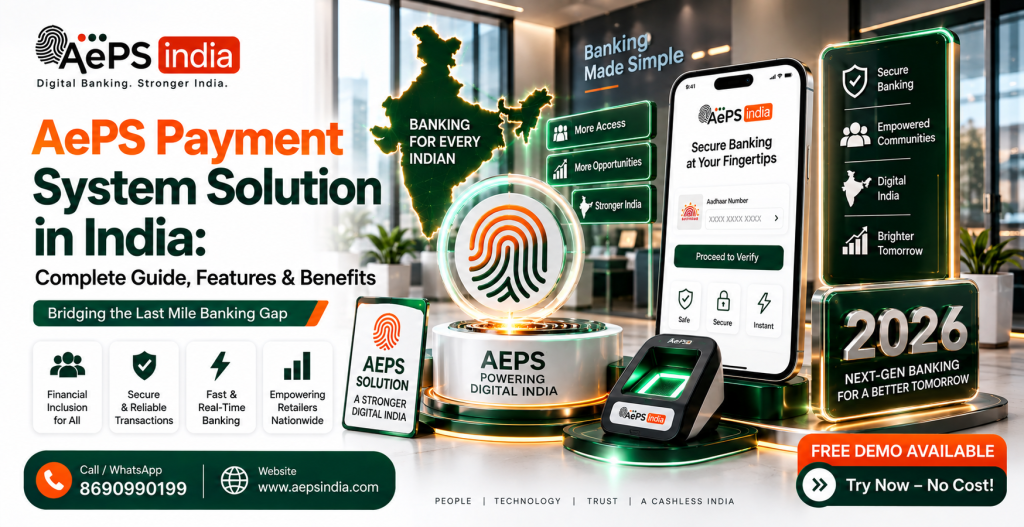
An AePS Payment System Solution helps businesses, retailers, digital service centers, and fintech companies provide Aadhaar Enabled Payment System services through a digital platform. It connects the AEPS transaction process with the required banking and payment infrastructure so customers can access supported banking services through an authorised AEPS service point.
AePS allows a customer to use Aadhaar as an identity to access an Aadhaar-linked bank account and perform basic banking transactions through an authorised Business Correspondent or service point. Common AePS services include cash withdrawal, balance enquiry, mini statement, and Aadhaar-to-Aadhaar fund transfer, depending on the services supported by the participating banking setup.
The Aadhaar Enabled Payment System (AePS) is a bank-led model developed by the National Payments Corporation of India (NPCI) that allows online interoperable financial transactions through micro ATM or point-of-sale (PoS) devices using Aadhaar authentication.
For an AEPS business, having the right AePS Payment System Solution is important because retailers need a simple way to process customer transactions, check transaction status, manage their services, and maintain transaction records. The customer generally needs an Aadhaar-linked bank account, and the transaction is completed using biometric authentication.
A good AEPS payment solution should provide more than basic transaction processing. Businesses should look for easy retailer Aeps onboarding, biometric device support, secure transaction processing, real-time transaction status, balance and transaction reports, settlement support, failed-transaction handling, multiple AEPS services, and reliable technical assistance.
An AePS Payment System Solution can be useful for retailers, distributors, fintech companies, banking service providers, CSC and digital service centers, and businesses that want to offer last-mile banking services in areas where customers may not have convenient access to a traditional bank branch. AePS designed to support interoperable banking access through participating banks and authorised service channels.
With Aeps India, businesses can explore an AEPS payment solution based on their business model and service requirements. The platform can be used as part of a wider digital financial services setup where trusted AEPS is offered along with other supported services.
If you are planning to start or expand an AEPS business, choosing a reliable payment system is an important step. The right Aeps solution can make daily AEPS operations easier for retailers while providing customers with convenient access to supported Aadhaar-enabled banking services.
In this complete guide, we will explain what an AePS Payment System Solution is, how AePS works, how an AEPS transaction is processed, available AEPS services, AEPS retailer requirements, biometric device support, benefits for businesses, security considerations, transaction management, settlement, common transaction issues, and how to choose the right AEPS Payment System Solution in India.
What Is an AePS Payment System Solution?
An Aadhaar Enabled Payment System (AePS) solution is a bank-led digital financial service model that allows customers to perform basic banking transactions using just their Aadhaar number and biometric authentication (fingerprint or iris scan). Developed by the National Payments Corporation of India (NPCI), it eliminates the need for physical debit cards, ATM PINs, or bank signatures.
How Does an AePS Payment System Solution Work?
The Aadhaar Enabled Payment System (AePS) lets users perform basic banking transactions using their 12-digit Aadhaar number and biometric verification via a micro-ATM or Business Correspondent (BC).
How the AePS Process Works
- Link Account: The customer’s bank account must be linked to their Aadhaar number.
- Visit Outlet: The user goes to an authorized Business Correspondent (BC), micro ATM device, or Point-of-Sale (PoS) terminal managed by an agent.
- Provide Details: The user gives their Aadhaar number, names their bank, and selects the required transaction type (like cash withdrawal or balance check).
- Biometric Scan: The user places their finger or thumb on a biometric scanner for fingerprint authentication.
- Real-Time Processing: The system matches the fingerprint with the UIDAI database, and the National Payments Corporation of India (NPCI) routes the request to the respective bank to complete the secure transaction instantly.
Key Services Available with an AePS Payment System
The Aadhaar Enabled Payment System (AePS) is a bank-led model by the National Payments Corporation of India (NPCI) that lets users perform basic financial transactions using just an Aadhaar number and biometric verification (fingerprint or iris scan) at micro-ATMs or Business Correspondent (BC) outlets.
Core Services Available
- Cash Withdrawal (CW): Withdraw money from an Aadhaar-linked bank account without needing a debit card, credit card, or PIN.
- Cash Deposit (CD): Add cash directly into an eligible bank account through an authorized BC or micro-ATM touchpoint.
- Balance Enquiry: Check real-time bank account balances instantly on the spot.
- Mini Statement: View a quick summary of recent account transactions, usually the last 5 to 10 entries.
- Aadhaar-to-Aadhaar Fund Transfer: Send money securely from one Aadhaar-linked account to another.
- BHIM Aadhaar Pay: Allow local merchants to accept direct digital payments from customers through biometric verification.
- e-KYC Verification: Complete fast, paperless electronic Know Your Customer checks for various services.
AEPS Payment System Requirements
To use the Aadhaar Enabled Payment System (AePS), a customer needs an active bank account linked to a valid Aadhaar number and a successful Aeps biometric scan.
Customer Requirements
- Aadhaar-Linked Bank Account: Your bank account must be connected to your Aadhaar number.
- Aadhaar Number: You must provide your 12-digit Aadhaar number at the transaction point.
- Biometric Authentication: Fingerprint or iris scan via a certified scanner.
- Bank Name: You must know the name of the specific bank where you hold your account.
- OTP Verification: For cash withdrawals exceeding ₹5,000, a mandatory mobile OTP sent to your Aadhaar-registered number is required.
- No Cards or PINs Needed: You do not need a debit card, credit card, ATM PIN, or smartphone.
Merchant/Agent Requirements
- Business Correspondent (BC) Registration: Authorized status via a participating bank or corporate BC.
- Certified Hardware: An STQC-certified L1 Aeps biometric scanning device (such as fingerprint or iris).
- Connected Device: A paired smartphone, tablet, or laptop with the AePS application.
- KYC & Verification: Completed merchant KYC, PAN card, address proof, and bank account proof.
Who Can Use AePS Payment System Solution
Any Indian resident with a valid Aadhaar card linked to a bank account can use the best Aeps.
Who Benefits Most from AePS
- Rural and Remote Residents: People who live far from traditional bank branches or physical ATMs.
- Senior Citizens: Users who find it hard to remember debit card PINs or navigate smartphone apps.
- Not Tech-Savvy Individuals: Those with limited exposure to digital banking, smartphones, or internet passwords.
- Daily Wage Workers and Small Earners: People who need quick, card-free cash withdrawals and basic account access.
- Migrant Workers: Individuals who need to access their home bank accounts from anywhere in India without visiting their home branch.
Why Use AePS Payment System Solution
The Aadhaar Enabled Payment System (AePS) is a bank-led model created by the NPCI that lets users perform basic financial transactions using just their Aadhaar number and biometric data (fingerprint or iris scan) at micro ATM system.
Key Reasons to Use AePS
- No Cards or PINs Needed: Users do not need to carry a debit or credit card, remember a secret PIN, or sign any physical paperwork.
- High Security via Biometrics: Fingerprint and iris authentications are unique to each individual, which greatly reduces the risk of fraud compared to stolen cards or guessed passwords.
- Financial Inclusion for All: The Aeps system brings essential banking services directly to rural, remote, and underserved regions where physical bank branches or standard ATMs are sparse.
- No Smartphone Required: Users do not need a mobile phone, an internet connection of their own, or mobile banking apps to complete a transaction.
- Interoperability Across Banks: Customers of any participating bank can use an authorized micro ATM system or agent of any other participating bank to complete transactions.
- Core Banking Services at Your Doorstep: Users can easily perform Cash Withdrawals, Balance Enquiries, Mini Statements, and Fund Transfers without traveling to a home branch.
Top Use Cases of AePS Payment System Solution
The Aadhaar-Enabled Payment System (AePS) transforms local neighborhood shops into mini-banks using biometric verification and an Aadhaar number.
Top Use Cases of AePS
- Cash Withdrawals & Deposits: Users withdraw cash or deposit money directly into bank accounts at local retail points without a debit card or PIN. A brand-new NPCI three-party service even allows cash deposits directly into someone else’s Aadhaar-linked account.
- Direct Benefit Transfer (DBT): Citizens collect government subsidies, pensions, and welfare wages (like MGNREGA funds) immediately at nearby local stores.
- Aadhaar Pay (Micro-Merchant Payments): Small shopkeepers accept digital payments straight from a customer’s bank account using fingerprint scans, avoiding high costs for card swipe machines.
- Balance Inquiries & Mini-Statements: Customers check account balances or view recent transaction logs on the spot via biometric verification.
- Aadhaar-to-Aadhaar Fund Transfers: Individuals transfer money securely between different Aadhaar-linked bank accounts via assisted agent terminals.
- Paperless eKYC Services: Businesses verify customer identities instantly and securely to open new accounts or onboard users.
How AePS Payment System Processes a Transaction
An Aadhaar Enabled Payment System (AePS) processes a transaction by securely linking a local Aeps biometric scan device to your bank account through a central digital switch in a few seconds. No debit card or PIN is required.
Step-by-Step Transaction Flow
Step 1: Initiation
- You visit a local banking agent, business correspondent, or micro-ATM touchpoint.
- You tell the agent what you want to do (such as withdraw cash or check your balance).
Step 2: Data Entry
- You type your 12-digit Aadhaar number into the agent’s machine.
- You select the name of your bank where your account is linked.
- You enter the transaction amount (if withdrawing or transferring money).
Step 3: Biometric Scan
- You place your finger or scan your iris on the certified Aeps biometric scanner connected to the device.
Step 4: Request Routing
- The agent’s device encrypts your details and sends the request to the National Payments Corporation of India (NPCI) central switch.
- NPCI spots your bank from your details and forwards the secure request to your specific bank.
Step 5: Identity Verification
- Your bank passes the biometric data to the Unique Identification Authority of India (UIDAI).
- UIDAI checks if your fingerprint or iris matches your Aadhaar record and sends a simple yes or no back to your bank.
Step 6: Completion and Settlement
- If the identity check passes, your bank processes the money transfer or withdrawal in real time.
- The agent hands you your cash (for withdrawals) and gives you a printed or digital receipt.
How AePS Payment System Processes a Transaction
LIVETransaction Processing Flow
Processing Stages
Transaction Types
| TXN ID | Amount | Stage | Time | Status |
|---|---|---|---|---|
| #PRC9921 | ₹5,400 | Confirmation | 3.8s | Complete |
| #PRC9922 | ₹3,200 | Processing | 2.9s | Processing |
| #PRC9923 | ₹8,600 | Verification | 2.1s | Verifying |
| #PRC9924 | ₹2,100 | Authentication | 1.4s | Authenticating |
| #PRC9925 | ₹4,800 | Initiation | 0.3s | Initiated |
Role of Aadhaar in the AEPS Payment System
Aadhaar serves as the foundational digital identity and authentication engine that makes the Aadhaar Enabled Payment System (AePS) work without physical cards, PINs, or smartphones.
Core Roles of Aadhaar in AePS
- Digital Identity: The 12-digit Aadhaar number acts as the primary identifier to locate the customer’s bank account on the NPCI central switch.
- Account Linking: It connects a resident’s bank account to their unique identity, creating an Aadhaar Enabled Bank Account (AEBA).
- Biometric Authentication: Fingerprint or Aeps iris scans captured at a micro ATM are verified against the UIDAI database to securely authorize transactions.
- Cardless Access: It removes the need for debit cards, credit cards, or secret PIN numbers for everyday banking.
- Interoperability: It allows any customer to access their bank account through any bank’s local Business Correspondent (BC) or best micro ATM anywhere in India.
Aadhaar Linking and Bank Account Requirements for AEPS Payment System
To use the Aadhaar Enabled Payment System (AEPS), your 12-digit Aadhaar number must be actively seeded and linked to a valid bank account with a participating bank.
How to Link Aadhaar to Your Bank Account
- Bank Branch: Submit a filled Aadhaar-linking form along with a self-attested copy of your Aadhaar card at your home branch.
- Net Banking/Mobile App: Log into your bank’s online portal and look for the “Update Aadhaar” or profile seeding option.
- ATM: Swipe your debit card at an ATM, navigate to services or registrations, and select Aadhaar registration.
Aadhaar Linking and Bank Account Requirements for AEPS Payment System
LIVEAadhaar Linking Requirements
Bank Account Requirements
Aadhaar-Bank Linking Process
| User ID | Aadhaar (Last 4) | Bank | Linking Status | Verification |
|---|---|---|---|---|
| #AL8821 | XXXX-4521 | SBI | NPCI Mapped | Verified |
| #AL8822 | XXXX-7834 | PNB | Aadhaar Seeded | Verified |
| #AL8823 | XXXX-2198 | BOB | Biometric Pending | Pending |
| #AL8824 | XXXX-6647 | HDFC | KYC Incomplete | Failed |
| #AL8825 | XXXX-9302 | Canara | Fully Linked | Verified |
AePS Payment System for Fintech Businesses
The Aadhaar Enabled Payment System (AePS) is a bank-led model by the NPCI that allows cardless, PIN-less financial transactions using an Aadhaar number and biometric authentication.
Benefits for Fintech Businesses
- Financial Inclusion: Reach unbanked and underserved rural populations lacking traditional Micro ATM infrastructure.
- Interoperability: Connect customers of any participating bank through a single micro ATM or agent network.
- High Security: Utilize UIDAI biometric verification to minimize transaction fraud.
- Monetization: Generate revenue through commission slabs and expand service portfolios for retail networks.
AePS Payment System – Fintech Dashboard
LIVEWeekly Transaction Volume
| TXN ID | Agent | Amount | Type | Status |
|---|---|---|---|---|
| #AEP88412 | RK Store | ₹2,500 | CW | Success |
| #AEP88413 | JS Point | ₹1,200 | BE | Success |
| #AEP88414 | MS Kirana | ₹3,800 | CW | Pending |
| #AEP88415 | AP Sewa | ₹950 | BS | Failed |
| #AEP88416 | VK Center | ₹5,000 | CW | Success |
AePS Payment System for Retailers and Agents
The AePS Platform for Retailers turns local retail shops into neighborhood mini-banks by letting customers use their Aadhaar number and fingerprints for cardless banking.
Key Services for Retailers and Agents
- Cash Withdrawal: Customers take out money from their bank accounts using biometric scans instead of a debit card or PIN.
- Cash Deposit: Agents accept physical cash and deposit it directly into an Aadhaar-linked bank account.
- Balance Inquiry & Mini Statement: Customers check their live account balance or view recent transaction logs instantly.
- Aadhaar Pay: Merchants accept digital, biometric-authenticated payments directly from customer bank accounts for goods and services.
- Fund Transfers: Agents facilitate money movement between Aadhaar-linked accounts.
AePS Payment System for Retailers and Agents
LIVEService-wise Performance
| ID | Retailer / Agent | Amount | Service | Status |
|---|---|---|---|---|
| #RT4021 | Sharma Retail | ₹3,000 | CW | Done |
| #AG0887 | Agent Priya | ₹1,500 | BE | Done |
| #RT4022 | Gupta Store | ₹4,200 | CW | Hold |
| #AG0888 | Agent Ravi | ₹800 | MS | Fail |
| #RT4023 | Patel Shop | ₹2,750 | CW | Done |
AePS Payment System for Rural and Semi-Urban Banking
The Aadhaar Enabled Payment System (AePS) is a bank-led model developed by the National Payments Corporation of India (NPCI) that enables cardless and PIN-less financial transactions using an individual’s 12-digit Aadhaar number and biometric authentication.
Importance for Rural and Semi-Urban Banking
- Bridges Infrastructure Gaps: Brings “doorstep banking” to unbanked remote villages lacking physical bank branches or ATM networks.
- Total Interoperability: Customers of any participating bank can transact at any bank’s micro ATM agent location.
- Financial Inclusion: Removes barriers for populations lacking smartphones, debit cards, or reading/writing fluency.
AePS Payment System for Rural and Semi-Urban Banking
LIVEService Distribution
| Location | Agent | Volume | Service | Status |
|---|---|---|---|---|
| Rampur Village | Ramesh K. | ₹8,500 | CW | Success |
| Semi-Urban Block | Sunita D. | ₹3,200 | BE | Success |
| Gopalpur | Mohan S. | ₹5,800 | CW | Pending |
| Lakshmi Nagar | Priya M. | ₹1,900 | MS | Failed |
| Kishangarh | Vijay R. | ₹6,400 | CW | Success |
Why Businesses Need an AePS Payment System Solution
Businesses need an AePS Payment System Solution because it turns local retail shops into mini ATM system, allowing merchants to offer cardless, PIN-less banking services using fingerprint verification.
Key Benefits for Businesses
- Increase Store Footfall: Offering basic banking draws more people to your shop.
- Earn Extra Income: Shop owners get attractive Aeps commissions on every cash withdrawal, balance check, or fund transfer they process.
- No Cards or PINs Needed: Customers only need their Aadhaar number and a fingerprint scan, making transactions work for everyone.
- Safe and Secure: Biometric verification stops fraud and unauthorized use much better than regular PINs or paper tickets.
- Real-Time Earnings: Aeps platforms offer instant wallet updates and fast commission settlements right after a successful scan.
Why Businesses Need an AePS Payment System Solution
LIVEMonthly Business Growth
| Business | Revenue Impact | Efficiency | Adoption | Status |
|---|---|---|---|---|
| Retail Chain | +₹18L | +45% | 92% | Active |
| FMCG Distributor | +₹24L | +52% | 88% | Active |
| Pharmacy Network | +₹12L | +38% | 76% | Scaling |
| Agri Services | +₹9.5L | +41% | 84% | Active |
| Logistics Firm | +₹15L | +49% | 71% | Review |
Features AePS Payment System Solution
Aadhaar Enabled Payment System (AePS) is a bank-led model that allows cardless, PIN-free financial and non-financial transactions using Aadhaar authentication and biometrics.
Core Features of AePS Solution
- Cardless and PIN-Free: Eliminates the need for physical debit cards, credit cards, or secret PINs/passwords.
- Biometric Authentication: Verifies user identity securely through unique fingerprint or iris scans matched via UIDAI records.
- Interoperability: Allows customers of any participating bank to access their accounts through a micro-ATM, kiosk, or Business Correspondent (BC) of any other participating bank.
- Multi-Service Access: Supports essential banking operations including cash withdrawals, cash deposits, balance inquiries, mini statements, and fund transfers.
- Financial Inclusion: Expands last-mile banking services to rural and underserved regions where traditional Micro ATM device and bank branch infrastructure is limited.
- Government Disbursement: Facilitates direct benefit transfers (DBT) and social security pensions from central or state governments using Aadhaar authentication.
Benifits of AePS Payment System Solution
The Aadhaar Enabled Payment System (AePS) is a bank-led model by the National Payments Corporation of India that allows users to perform basic financial operations using just an Aadhaar number and biometric authentication.
Key Benefits of AePS
- Cardless and PIN-less Banking: Eliminates the need to carry debit cards, credit cards, or remember secret PINs and passwords.
- High Security: Relies on unique biometric verification (fingerprint or iris scan), making unauthorized access or fraud extremely difficult.
- Financial Inclusion: Brings unbanked and remote populations into the formal banking sector without requiring a traditional bank branch nearby.
- Local Accessibility: Enables users to complete banking tasks at nearby micro ATM or Aeps india website.
- Interoperability: Allows customers of any participating bank to use an AePS-enabled micro ATM or point-of-sale machine from any other bank.
- Essential Banking Services: Supports cash withdrawals, cash deposits, balance checks, mini-statements, and Aadhaar-to-Aadhaar fund transfers.
- Government Benefit Transfers: Facilitates direct and instant disbursement of government welfare funds, MNREGA wages, and pensions.
AePS Payment System API Integration
Integrating an Aadhaar Enabled Payment System API requires partnering with an Aeps india, completing business KYC, setting up STQC-certified Aeps biometric hardware, and implementing secure backend communication.
Step-by-Step Integration Process
- Choose a Provider & Register: Sign up with an Aeps india.
- Setup Biometric Device: Install the manufacturer’s Registered Device (RD) service driver/app on your target Windows or Android platform to enable secure biometric capture.
- Obtain Credentials: Receive your Aeps API keys, Aeps Merchant ID (MID), and documentation after verification.
- Develop Frontend & Backend UI: Build client interfaces to collect the user’s Aadhaar number, bank IIN (Institution Identification Number), and transaction type (cash withdrawal, balance check, mini-statement).
- Handle Biometric Payload: Capture the encrypted
PidDataXML from the RD service and serialize it into the Aeps API request payload. - Test in Sandbox: Run test transactions on the Aeps india sandbox environment to verify encryption, response handling, and error codes.
- Go Live: Switch to production endpoints to process real-time authentication via UIDAI and NPCI switches.
AePS Payment System Cost Provide
The total cost to setup AePS varies from ₹1,500 for a basic agent kit to over ₹4.5 lakhs for custom, enterprise-level bank integrations.
1. Setup and Software Integration Costs
- Basic Agent Registration / ID: Free to ₹1,250 for basic Aeps portal access or Aeps retailer ID activation.
- Standard API Integration Setup: ₹12,000 to ₹35,000 as a one-time configuration fee for developers.
- White-Label / B2B Panels: ₹15,000 to ₹1,20,000 for pre-built, ready-to-use Aeps software branded with your company name.
- Custom Enterprise Architecture: ₹1,00,000 to ₹4,50,000+ for bespoke Aeps b2b software and direct bank integrations.
- Annual Maintenance (AMC): ₹10,000 to ₹40,000 per year for server uptime, security patches, and tech support.
2. Hardware and Infrastructure Costs
- Biometric Scanner (L1 Device): ₹1,500 to ₹3,000 for an STQC certified Aeps fingerprint or purchase Aeps iris scanner device (such as Mantra or Morpho) required for biometric authentication.
- Working Capital / Liquidity: ₹10,000 to ₹20,000 minimum cash float required at the touchpoint to manage day-to-day cash withdrawals by customers.
- Terminal: A basic smartphone, tablet, or PC with an active internet connection.
3. Per-Transaction and Operational Charges
- Transaction/API Fees: Aeps india typically charge ₹0.25 to ₹1.50 per successful transaction, or up to ₹5–₹15 for specific issuer bank routes.
- Failed Authentication Fee: Around ₹0.50 per failed attempt due to biometric mismatch or network drop.
- Customer Fees & Commissions: End-users usually pay zero to nominal fees (₹5–₹20) for standard withdrawals, while agents/retailers earn a commission of roughly ₹2 to ₹15+ per transaction depending on volume slabs.
AePS Payment System Transaction Limits
Aadhaar Enabled Payment System (AePS) transactions are typically capped at ₹10,000 per single financial transaction as set by the National Payments Corporation of India (NPCI).
Key Transaction Limits & Rules
- Per Transaction Limit: Maximum of ₹10,000 for cash withdrawals and standard financial requests.
- Daily / Cumulative Limits: Many individual issuing banks restrict daily aggregate limits to ₹50,000, or limit the total number of daily transactions (frequently 1 to 5 per day).
- Monthly Caps: Some institutions cap monthly usage around 10 transactions or up to ₹1,00,000 to ₹2,50,000 depending on internal bank risk profiles.
- Additional Security Rule: Transactions over ₹5,000 may require a step-up OTP verification on the Aadhaar-registered mobile number alongside biometric authentication.
AePS Payment System Charges
Aadhaar Enabled Payment System (AePS) transactions are typically free or carry very low fees for customers, though third-party operators or specific banks may levy nominal charges after crossing free monthly limits.
Standard Customer Charges
- Cash Withdrawal: Usually free at home bank touchpoints or up to a limit, but third-party Business Correspondent (BC) or micro ATM operators may charge between ₹5 to ₹15 per transaction. Some banks charge 0.5% to 1% of the transaction amount, capped at ₹15.
- Balance Enquiry & Mini Statement: Often free, though some third-party touchpoints may charge a nominal fee of ₹3 to ₹10 for extra requests.
- Cash Deposit: Varies by Aeps india, generally ranging from ₹15 to ₹25 per transaction when handled via assisted retail or BC outlets.
Transaction Limits
- Per Transaction Limit: Capped at ₹10,000 for cash withdrawals.
- Daily Limit: Generally up to ₹50,000 cumulative across transactions, depending on your specific bank’s internal guidelines.
AePS Payment System with Biometric Authentication
The Aadhaar Enabled Payment System (AePS) is a bank-led model managed by the National Payments Corporation of India (NPCI) that allows online interoperable financial transactions at point-of-sale (Micro-ATM) terminals using Aadhaar authentication.
Key Features
- No Cards or PINs Needed: Transactions require only your Aadhaar number and biometric scan.
- Accessible Banking: Brings basic financial services to rural or underserved regions via local Business Correspondents (BCs).
- Core Services: Supports cash withdrawals, balance checks, mini statements, and fund transfers.
AePS Payment System with Biometric Authentication
LIVELive Biometric Verification
Fingerprint Recognition: 99.4% Accuracy
Iris Authentication: 98.7% Success
Multi-Factor Security: Enabled
Authentication Performance
| Transaction ID | Auth Type | Match Score | Response | Status |
|---|---|---|---|---|
| #BIO8841 | Fingerprint | 99.2% | 1.4s | Verified |
| #BIO8842 | Iris Scan | 98.8% | 1.8s | Verified |
| #BIO8843 | Fingerprint | 87.5% | 2.9s | Retry |
| #BIO8844 | Multi-Factor | 99.6% | 2.1s | Verified |
| #BIO8845 | Fingerprint | 72.3% | 3.8s | Failed |
AePS Payment System Dashboard and Admin Panel
An AEPS dashboard and Aeps admin panel is a centralized backend software command center used by fintech companies, banks, and distributors to oversee biometric micro-banking networks, manage merchant hierarchies, and track real-time transactions.
Core Modules & Features
- Network Hierarchy Control: Manage multi-tier channels including Super Distributors, Master Distributors, and local Retail Agents/Merchants.
- Real-Time Transaction Tracking: Monitor live feeds for AEPS B2B Admin Panel services like Aeps cash withdrawal, Aeps balance inquiries, Aeps mini-statement and Aadhaar Pay software using unique Retrieval Reference Numbers (RRN).
- Automated Commission Slabs: Configure flexible, slab-wise payout margins and surcharges distributed instantly across different user tiers.
- KYC & Agent Onboarding: Digitally review, approve, or reject merchant identification documents and map UIDAI-certified biometric devices.
- Wallet & Liquidity Management: Handle multi-wallet architectures, ledger controls, and instant or automated bank payouts (T+0 / T+1).
- Multi-Bank API Switching: Route transaction traffic dynamically through primary banking partners to maximize system uptime and success rates.
AePS Payment System Dashboard and Admin Panel
LIVESystem Health Monitor
| Admin | Role | Action | Time | Status |
|---|---|---|---|---|
| R. Sharma | Super Admin | User Approval | 2 min ago | Active |
| P. Verma | Manager | Refund Process | 8 min ago | Review |
| S. Kumar | Operator | Settlement | 15 min ago | Active |
| A. Singh | Manager | Agent Onboard | 22 min ago | Pending |
| M. Gupta | Super Admin | Config Update | 35 min ago | Active |
AePS Retailer and Distributor Management
AePS Platform provides a multi-tier B2B Aeps framework that turns local shops into digital mini-banks using Aadhaar biometric authentication.
Hierarchy and Roles
- Super Admin / Provider: Controls NPCI/UIDAI routing, master Aeps commission rules, and core Aeps API integration.
- Master / Super Distributor: Manages regional expansion and mid-level distributor chains.
- Distributor: Onboards local merchants, handles regional KYC verification, and supplies wallet liquidity.
- Retailer (Agent): Uses a certified Aeps biometric scanner at a local shop to process cash withdrawals, deposits, and balance checks.
AePS Retailer and Distributor Management
LIVERetailer Network
Distributor Network
| Partner | Type | Volume | Commission | Status |
|---|---|---|---|---|
| Sharma Enterprises | Distributor | ₹12.4L | ₹48,200 | Active |
| Gupta Retail Chain | Retailer | ₹8.6L | ₹32,400 | Active |
| Patel Distribution | Distributor | ₹9.8L | ₹38,600 | Active |
| Singh Mart | Retailer | ₹5.2L | ₹19,800 | Pending |
| Verma Stores | Retailer | ₹3.4L | ₹12,600 | Review |
AePS Transaction Management and Settlement
AePS transaction management and Aeps settlement handles the secure, real-time routing, authorization, and fund clearing of biometric-based banking operations through the National Payments Corporation of India (NPCI) switch.
Transaction Management Process
- Initiation: Aeps india enters the customer’s 12-digit Aadhaar number, selects the bank, and chooses a service (like cash withdrawal or balance check) on a top micro ATM or point-of-sale device.
- Biometric Authentication: The customer provides a fingerprint or iris scan, which is verified against the Unique Identification Authority of India (UIDAI) database.
- Routing: The NPCI central payment switch routes the interbank request from the merchant’s acquiring bank to the customer’s issuing bank.
- Transaction Limits: NPCI caps standard cash withdrawals at ₹10,000 per transaction, with daily limits often reaching ₹50,000 depending on the bank.
Settlement and Wallet Mechanics
- Instant Settlement (T+0): Funds and earned Aeps commission are credited instantly in real-time to the retailer or agent digital wallet or bank account.
- Main Working Balance: Holds liquid funds that fast micro ATM operators use to disburse physical cash during customer withdrawals.
- Commission Ledger: Automatically credits per-transaction margins (ranging from ₹12 to ₹15) directly to the agent’s sub-wallet after a successful scan.
- Escrow Protection: Secures pooled merchant and customer funds to comply with Reserve Bank of India (RBI) and NPCI regulations.
AePS Transaction Management and Settlement
LIVETransaction Processing Flow
Settlement Summary
Transaction Types
| TXN ID | Amount | Time | Settlement | Status |
|---|---|---|---|---|
| #TS9021 | ₹5,400 | 10:23 AM | 12:45 PM | Settled |
| #TS9022 | ₹3,200 | 10:45 AM | 1:15 PM | Settled |
| #TS9023 | ₹8,600 | 11:02 AM | Pending | Processing |
| #TS9024 | ₹2,100 | 11:18 AM | 2:00 PM | Processing |
| #TS9025 | ₹4,800 | 11:34 AM | Failed | On Hold |
AePS Payment System Security and Authentication
Aadhaar Enabled Payment System (AePS) secures transactions through real-time biometric verification via UIDAI and multi-layer encryption managed by the National Payments Corporation of India (NPCI).
Core Security Layers
- Biometric Verification: Users must provide Aeps fingerprint or buy Aeps iris scan, matching data directly with UIDAI records in real time.
- L1 Certified Hardware: Terminals use mandatory STQC-certified L1 Aeps biometric devices that encrypt data at the device level during transmission to prevent spoofing.
- Network Encryption: The NPCI Network routes and protects transaction packets using multiple encryption layers, avoiding vulnerable traditional PINs or passwords.
Advanced Safety Mandates
- Step-Up OTP Verification: Transactions over ₹5,000 require a mandatory OTP sent to the Aadhaar-registered mobile number alongside the biometric scan.
- Operator Due Diligence: Reserve Bank of India (RBI) guidelines require strict background checks, enhanced KYC, and formal verification for all Touchpoint Operators and Business Correspondents (BCs).
- Cardless and PIN-less: Eliminating physical cards and static PINs protects the system against skimming and phishing attacks.
AePS Payment System Security and Authentication
LIVEOverall Security Score
Encryption Status: AES-256 Active
Threat Level: Low — Monitored
Last Audit: 15 Sep 2026, 09:42 AM
Live Security Alerts
| Event ID | Type | Source | Response | Status |
|---|---|---|---|---|
| #SEC4421 | Biometric Auth | Agent Portal | Verified | Secure |
| #SEC4422 | OTP Validation | Mobile App | Verified | Secure |
| #SEC4423 | Failed Login | Unknown IP | Blocked | Blocked |
| #SEC4424 | Device Check | Retailer App | Flagged | Review |
| #SEC4425 | Multi-Factor | Distributor | Verified | Secure |
AePS Payment System Failed Transaction, Refund and Dispute Process
For a failed Aadhaar Enabled Payment System (AePS) transaction where money is debited but cash is not dispensed, the refund usually processes automatically within 1 to 5 working days.
Immediate Steps
- Wait 24 Hours: Many server timeouts or network glitches fix themselves within one working day.
- Check Status: Look at your mobile banking app or ask the branded micro ATM operator to check their dashboard logs.
- Note Details: Keep your RRN (Retrieval Reference Number), transaction ID, date, time, and amount ready.
Refund & Dispute Process
If the money does not return to your account automatically within 5 days, take these actions:
- Contact the AePS Operator: Visit the customer service point or retail shop where you made the transaction to collect a transaction failure slip or receipt.
- Raise a Complaint with Your Bank: Go to your home bank branch or use their net banking portal. Submit a written refund request containing your account number, Aadhaar details, and RRN.
- NPCI Dispute Escalation: Your bank will file a chargeback or dispute via the National Payments Corporation of India (NPCI) Unified Dispute and Issue Resolution (UDIR) system.
- Timeframes: Banks generally resolve standard technical failures in 7 to 10 working days, while RBI guidelines allow a maximum limit of 30 days.
AePS Payment System Failed Transaction, Refund and Dispute Process
LIVEDispute Resolution Process
Failure Analysis
Refund Status
| TXN ID | Amount | Issue Type | Time | Status |
|---|---|---|---|---|
| #FRD7721 | ₹3,400 | Network Fail | 9:23 AM | Refunded |
| #FRD7722 | ₹5,200 | Biometric | 9:45 AM | Dispute |
| #FRD7723 | ₹2,800 | Timeout | 10:02 AM | Refunded |
| #FRD7724 | ₹4,600 | Balance | 10:18 AM | Resolved |
| #FRD7725 | ₹1,900 | Network Fail | 10:34 AM | Failed |
AePS Payment System Compliance and Banking Network
The Aadhaar Enabled Payment System (AePS) is a bank-led model developed by the National Payments Corporation of India (NPCI) that allows cardless, PIN-less financial and non-financial transactions using 12-digit Aadhaar numbers and biometric authentication at branded micro ATM system or Aeps india website.
Compliance and Regulatory Framework
- Reserve Bank of India (RBI) Mandates: Governed under the Payment and Settlement Systems Act, 2007, requiring strict onboarding protocols and ongoing due diligence for AePS touchpoint operators.
- Acquiring Bank Responsibilities: Acquiring banks must complete mandatory operator verification, background checks, and compliance guidelines within stipulated regulatory windows.
- Authentication Security: Relies on UIDAI Aeps biometric infrastructure (fingerprint or iris scans) to ensure two-factor authorization and fraud mitigation.
Banking Network & Interoperability
- Interoperable Infrastructure: Customers of any participating bank can access their Aadhaar-linked accounts through branded micro ATM or agents deployed by any other compliant acquiring bank.
- Core Services Supported: Aeps Cash withdrawal service, Aeps cash deposit service, Aeps balance enquiry service, Aeps mini statement service, and Aadhaar-to-Aadhaar fund transfers.
- Financial Inclusion: Extends last-mile banking access to remote or unbanked areas without requiring physical debit cards, credit cards, or smartphones.
AePS Payment System Compliance and Banking Network
LIVECompliance Checklist
Banking Network Status
NPCI Banking Network Chain
| Entity | Type | Uptime | Last Audit | Status |
|---|---|---|---|---|
| State Bank of India | Issuer Bank | 99.9% | 12 Sep 2026 | Compliant |
| HDFC Bank | Acquirer | 99.8% | 10 Sep 2026 | Compliant |
| NPCI Switch Node | Network | 99.97% | 14 Sep 2026 | Linked |
| Regional Grameen Bank | Issuer Bank | 94.2% | 08 Sep 2026 | Review |
| PayPoint Network | Agent Switch | 0% | 01 Sep 2026 | Offline |
Aeps india One Of The Best AePS Payment System Solution Provider in India
Aeps india one of the best AePS Payment System Solution Provider requires evaluating key technical, financial, and regulatory factors to ensure secure and profitable operations.
Core Factors to Consider
- Security and Compliance: Confirm the Aeps india is certified by the National Payments Corporation of India (NPCI) and adheres to Reserve Bank of India (RBI) and UIDAI mandates, featuring multi-layer biometric security and end-to-end data encryption.
- Transaction Success Rate: Look for a high Aeps system uptime of 98% to 99.9% to minimize failed authentication or drop-offs during cash withdrawals and balance inquiries.
- Settlement Speed: Opt for best Aeps platform offering instant (T+0) or next-day (T+1) automated settlements to maintain fluid working capital for your retail or agent network.
- Commission Structure: Compare per-transaction earnings (typically ranging from ₹5 to ₹15+ depending on transaction volume) and check for any hidden processing or setup fees.
- API Stability and Integration: Aeps india offers clear developer Aeps API documentation, a sandbox testing environment, and compatibility with standard biometric fingerprint or iris scanners.
- Customer and Technical Support: Prioritize 24/7 technical assistance via phone or chat to instantly resolve failed transactions or server downtime.
- Additional Services: Look for bundled offerings like Micro-ATMs, Bharat Bill Payment System (BBPS) to maximize revenue streams.
Why Choose AEPS India for an AePS Payment System Solution?
Aeps india is an reliable AePS Payment System Solution requires evaluating key performance, compliance, and financial factors to ensure secure and seamless transactions.
Key Factors to Consider
- Security & Regulatory Compliance: Ensure the Aeps india is certified by the National Payments Corporation of India (NPCI) and adheres strictly to RBI and UIDAI guidelines with end-to-end encryption for biometric data.
- Transaction Success Rate & Uptime: Look for a stable infrastructure delivering at least 99% uptime and automated failover systems to minimize transaction and biometric scan failures.
- Settlement Speed (T+0): Choose High volume Aeps platform offering real-time or instantaneous (T+0) fund settlements so your working capital or retailer liquidity is never blocked.
- Commission Structure: Look for transparent, competitive earning models typically ranging from ₹5 to ₹15+ per transaction—with zero hidden processing fees.
- API Integration & Ease of Use: Aeps india that supply clear documentation, developer-focused SDKs, and sandbox testing environments for quick deployment.
- Customer & Technical Support: 24/7 round-the-clock technical assistance is essential to immediately resolve integration errors, server downtimes, or stuck transactions.
- Additional Ecosystem Services: Opt for solutions that bundle AEPS with Micro ATM software, BBPS Software and to create multi-revenue streams.
Future of AePS Payment System in India
The Aadhaar Enabled Payment System (AePS) is rapidly evolving past basic cash withdrawals into a comprehensive rural financial hub driven by advanced security, regulatory tightening, and new service expansions.
Key Future Trends in AePS
- Advanced & Contactless Biometrics: The ecosystem is shifting to mandatory L1 Aeps certified biometric hardware with device-level encryption, alongside multi-modal authentication like iris and facial recognition to prevent spoofing.
- AI and Fraud Analytics: Artificial intelligence and machine learning are becoming standard for real-time transaction surveillance, anomaly detection, and liveness detection.
- Regulatory Tightening by RBI and NPCI: Strict mandates enforce a “one-operator, one-bank” rule, mandatory re-KYC for inactive agents, and step-up OTP authentication for large withdrawals (over ₹5,000) to curb identity fraud.
- Expansion Beyond Cash Withdrawals: Local touchpoints are transforming into multi-service financial centers offering micro-loans, insurance, and bill payments through advanced AEPS earning software.
- Mega-Integration with UPI: Bridging the gap between bank-centric biometric AePS and the Unified Payments Interface (UPI) is streamlining back-end interoperability and mobile-first accessibility.
Conclusion
An AePS Payment System Solution can help businesses provide Aadhaar-enabled banking services through a simple digital platform. It connects the customer, retailer or Business Correspondent, banking system, and transaction process so that supported banking services can be provided through an authorised AePS setup.
AePS is especially useful for customers who need convenient access to basic banking services. Depending on the participating bank and service setup, customers can use services such as cash withdrawal, balance enquiry, mini statement, and Aadhaar-to-Aadhaar fund transfer through biometric authentication. An Aadhaar-linked bank account is an important requirement for successful AePS transactions.
An Aadhaar Enabled Payment System (AePS) is a bank-led digital payment model that allows customers to access their bank accounts using just their Aadhaar number and biometric authentication. Developed by the National Payments Corporation of India (NPCI), an AePS payment system solution eliminates the need for physical debit cards, ATM PINs, or bank branch visits.
For retailers and businesses, the right AePS Payment System Solution should offer more than basic transaction processing. A reliable platform should provide easy Aeps retailer onboarding, purchase Aeps biometric device support, secure transaction processing, real-time transaction status, Aeps wallet or settlement management, transaction history, reports, dispute support, and a simple dashboard for managing daily AePS activities.
Security and reliability are also important when choosing an AePS Payment System. Every transaction should be handled through the appropriate authentication and banking process, with proper attention to customer data, transaction records, failed transactions, and applicable regulatory requirements. Customers should also understand that Aadhaar linkage with their bank account and successful biometric authentication are key parts of the AePS process.
For fintech companies, retailers, distributors, digital service centres, and entrepreneurs, an AePS Payment System Solution can be a useful way to add Aadhaar-enabled banking services to an existing business. The right solution can make transaction management easier while helping businesses serve customers who need accessible banking services in their local area.
With Aeps India, businesses can explore an AePS Payment System Solution according to their operational and integration requirements. Whether you need an reliable AePS platform for retailers, a business dashboard, Buying Aeps biometric device support, transaction management, or a scalable AEPS setup, the Aeps solution should be selected according to your business model, service requirements, security needs, and expected transaction volume.
Before choosing an AePS provider, compare the AePS Payment System features, retailer onboarding, biometric compatibility, transaction reliability, settlement process, support, security, reporting, integration options, pricing, and applicable compliance requirements. Choosing the right technology and service partner can make a significant difference to the day-to-day operation of an AEPS business.
In short, an AePS Payment System Solution is not only about processing a transaction. It is about creating a reliable Aeps system through which customers can access supported Aadhaar-enabled banking services while retailers and businesses can manage transactions efficiently from one platform.
If you are planning to start or expand an AEPS business, selecting a dependable AePS Payment System Solution can give you the technology foundation needed to offer digital banking services and build a more convenient customer experience.
AEPS Payment System Solution
Optimize your financial transactions with our secure and scalable AEPS Payment System. Ensure 100% success rates and instant settlements for your banking business.
Frequently Asked Questions About AePS Payment System Solution
An AePS Payment System Solution is a technology-based banking solution that enables customers to access basic banking services using Aadhaar-based authentication. It can support services such as cash withdrawal, balance enquiry, mini statement and other permitted AePS transactions through an authorized banking or Business Correspondent network.
The customer provides the required Aadhaar details, selects the linked bank and completes biometric authentication through an authorized AePS India. The transaction is then processed through the applicable banking and AePS network.
Common AePS services include:
Cash Withdrawal
Balance Enquiry
Mini Statement
Aadhaar-to-Aadhaar Fund Transfer, where supported
The exact services can depend on the participating Aeps india.
Yes. AePS transactions are based on Aadhaar authentication. The customer’s Aadhaar generally needs to be linked or seeded with the bank account used for the transaction. Carrying the physical Aadhaar card is not necessarily required for every transaction, but the required Aadhaar information and authentication must be available.
Yes. AePS financial transactions generally use biometric authentication to verify the customer’s identity before processing the transaction.
Yes. Cash withdrawal is one of the primary services supported by AePS. A customer can visit an authorized AePS India and request a cash withdrawal from an Aadhaar-linked bank account, subject to the applicable bank, network and transaction limits.
Yes. Balance enquiry is one of the basic AePS services. Customers can use an authorized AePS service point to check the available balance of their Aadhaar-linked bank account.
Yes. Mini statement is a commonly available best AePS service. It can provide recent transaction information from the customer’s linked bank account, subject to the participating bank and service availability.
A customer generally needs an account with a participating bank and an Aadhaar number linked with the bank account. The transaction must also pass the required authentication and other checks of the participating banks and AePS india.
Not always. Aadhaar linking with the bank account is an important requirement, while any additional registration depends on the procedures of the customer’s bank and the service being used. Customers should confirm the applicable requirements with their bank.
Yes, where supported, a customer can have Aadhaar linked with multiple banks. During an AePS transaction, the appropriate participating bank needs to be selected. If multiple accounts are linked within the same bank, the primary account may be used according to the bank’s applicable process.
If the selected bank does not have the customer’s Aadhaar-linked account, the transaction can be declined. The customer should select the bank where the Aadhaar-linked account is maintained.
RRN stands for Retrieval Reference Number. It is a transaction reference number used to identify and track an AePS transaction. IPPB’s AePS FAQ describes the RRN as a 12-digit number generated for uniquely identifying a transaction.
First, check the transaction status and keep the transaction reference or RRN. If the customer’s account has been debited but the transaction was not completed, the amount may be reversed according to the applicable banking process. For unresolved issues, the customer should raise a complaint with the bank holding the account.
If the account is debited but the cash transaction is unsuccessful, the transaction may be treated as failed and the amount can be returned according to the applicable reversal process. If the amount is not reversed within the expected period, the customer should contact the bank where the account is maintained and provide the transaction details.
Yes, transaction limits can apply. Limits may depend on the issuer bank, customer profile, risk controls and applicable AePS/network rules. IPPB’s FAQ notes a maximum of ₹10,000 for a single AePS financial transaction under the referenced rules, while the issuer bank may maintain its own limits. Always verify the current applicable limit before publishing a fixed amount on a commercial page.
An ON-US transaction refers to a transaction involving the same bank’s customer and its own AePS terminal, while an OFF-US transaction generally involves a customer of another bank using an top AePS terminal deployed by the acquiring bank. These terms describe how the issuing and acquiring banks are involved in the transaction.
For a fintech business, an AePS Payment System Solution can provide the technology and operational infrastructure required to offer permitted Aadhaar-enabled banking services through an authorized network. Depending on the Aeps india, the solution may include retailer management, transaction processing, reporting, Aeps API integrated, Aeps commission and Aeps administrative controls.
A business should first evaluate the Aeps onboarding requirements, supported services, best Aeps API or best Aeps portal capabilities, authentication process, settlement process, transaction limits, pricing, support and applicable compliance requirements. After completing the Aeps onboarding and verification process, the business can configure the permitted top AePS services for its retailer or agent network.
An AePS Payment System Solution can help fintech businesses and retailers offer assisted Aeps banking API services without requiring customers to visit a traditional bank branch for every basic transaction. It can support services such as cash withdrawal, balance enquiry and mini statement while helping businesses manage their AePS operations through a technology Aeps platform.
India’s No.1 AEPS Company: Complete Guide (2026) – Features, Benefits & Registration

Best AEPS Provider in India for Retailers and Business (2026 Guide)
Best AEPS Software for Agents in India
About Author

