Top 10 Challenges Faced by AEPS Agents in Rural India
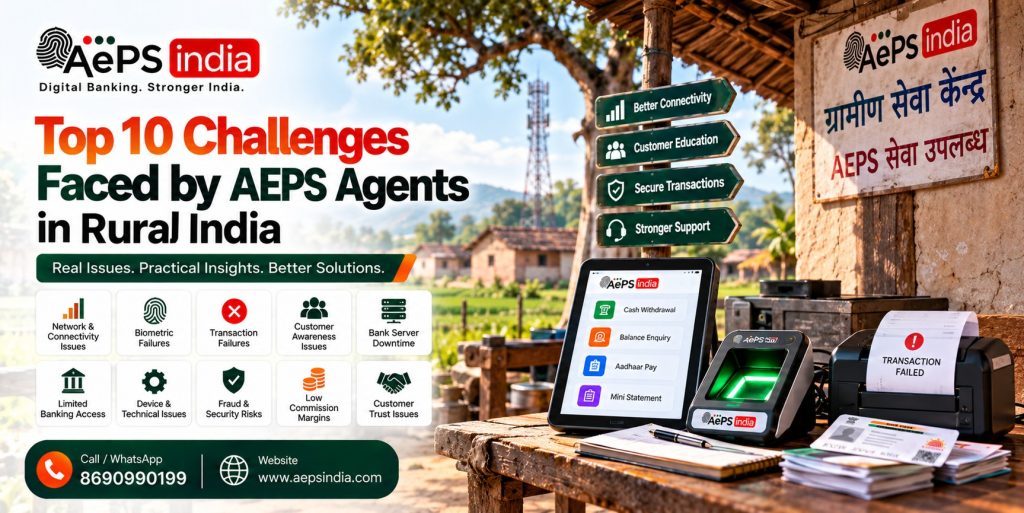
AEPS Agents play an important role in bringing essential banking services closer to customers in rural and semi-urban areas. Through the Aadhaar Enabled Payment System (AEPS), agents can help customers access supported banking services such as cash withdrawal, balance enquiry, mini statement, and other assisted banking services. However, operating an AEPS service point is not always easy. Challenges faced by AEPS agents can affect transaction success, customer trust, daily earnings, and the overall efficiency of the business.
The biggest Challenges AEPS Agents face are often connected with technology, biometric authentication, internet connectivity, transaction failures, security, customer awareness, and day-to-day cash management. These problems can become more noticeable in rural locations where internet coverage, electricity, technical support, and access to reliable banking infrastructure may be limited. AEPS India also identifies connectivity problems, biometric failures, security risks, transaction failures, and limited digital awareness among the key limitations of AEPS.
Aadhaar Enabled Payment System (AEPS) agents face major operational, technical, and security challenges while providing rural banking services.
Why Do AEPS Agents Face These Challenges?
An AEPS agent depends on several components working together during a transaction, including the customer’s Aadhaar-linked bank account, biometric authentication, registered biometric device, Aeps agent application, Aeps API or banking infrastructure, network connectivity, and the participating bank’s systems. AePS agent problems in any part of this process can result in a declined, delayed, or unsuccessful transaction.
Biometric authentication failure is one of the most common problems. Fingerprints may be difficult to authenticate because of worn-out fingerprints, dry or damaged skin, dirty sensors, device-quality issues, or incorrect finger placement. This can be particularly challenging when serving elderly customers and people whose work has affected their fingerprints.
Poor internet connectivity and technical failures can also interrupt AEPS transactions. Rural agents may operate in locations where mobile data coverage or electricity is inconsistent. Network timeouts, bank-side technical issues, or service interruptions can cause delays and failed transactions, making it difficult for agents to provide a smooth customer experience.
Security is another major concern. AEPS agents handle sensitive financial transactions, making fraud prevention, customer verification, secure biometric practices, data protection, and proper agent controls extremely important. Strong security processes and using authorized technology and devices can help reduce operational and fraud-related risks.
Agents can also face low customer awareness and digital literacy. Customers may not understand how AEPS works, why authentication fails, or how to identify suspicious transactions. As a result, agents often have to spend additional time explaining the process, resolving concerns, and helping customers use banking services safely.
Another important challenge is cash and operational management. An AEPS agent needs sufficient cash availability to serve withdrawal requests, while also managing transaction records, settlements, commissions, device maintenance, customer complaints, and daily business operations. Poor operational planning can affect both customer service and agent profitability.
A reliable AEPS Software Solution can help agents manage some of these operational difficulties through transaction monitoring, real-time status tracking, reports, wallet management, commission management, Aeps biometric device support, and technical assistance. However, technology should be combined with proper agent training, secure processes, customer awareness, and effective operational management.
In this guide, we will explain the Top 10 Challenges Faced by AEPS Agents in India, why these problems occur, how they affect daily AEPS operations, and practical ways agents and businesses can reduce their impact. Understanding these challenges can help AEPS agents choose better technology, improve transaction reliability, strengthen security, and provide a more dependable banking service to customers.
Top 10 Challenges Faced by AEPS Agents in Rural India
Aadhaar Enabled Payment System (AePS) agents in rural India face significant operational, technical, and security challenges while delivering last-mile banking services.
1. Frequent Network and Internet Outages
Rural areas suffer from erratic internet connectivity and low bandwidth, which disconnects real-time communication with NPCI and bank servers, causing frequent transaction failures.
2. Biometric Authentication Failures
Scanners often fail to match fingerprints due to dust, worn-out fingerprints among manual laborers, or poor device sensor quality, leading to high rejection rates.
3. High Rates of Cyber Fraud and Scams
Agents face rising threats from cybercriminals cloning fingerprints or exploiting system vulnerabilities, making agents legally and financially vulnerable to unauthorized withdrawals.
4. Hardware Malfunctions and Poor Device Support
Harsh rural conditions (dust, heat, and power surges) damage micro ATM and Aeps fingerprint devices quickly, while a lack of local, trained technicians delays repairs.
5. Low Digital and Financial Literacy
Many rural customers struggle to understand biometric security or follow troubleshooting prompts, shifting the burden of error handling entirely onto the agent.
6. Cash Liquidity Management Constraints
Agents often struggle to rebalance their cash reserves locally. Transporting physical cash from distant bank branches to service high-withdrawal rural demands is risky and expensive.
7. Transaction Limits and Functional Restrictions
AePS is restricted to basic services like cash withdrawals and balance inquiries, capping income potential. A single transaction limit of ₹10,000 also restricts high-value utility.
8. Complex and Delayed Dispute Resolution
When a transaction fails but a customer’s account gets debited, resolving the grievance through customer care takes days, straining the local trust between the agent and villagers.
9. Thin Margins and Operational Costs
Low commission rates per transaction combined with high electricity, device maintenance, and biometric RD (Registered Device) service renewal costs squeeze agent profits.
10. Regulatory and Tax Burdens
Deductions like Tax Collected at Source (TCS) and GST on AePS fees cut into the already thin earnings of rural business correspondent agents.
Conclusion
The challenges faced by AEPS agents in rural India are not limited to biometric authentication or internet connectivity. Rural AEPS agents also deal with security concerns, transaction failures, limited digital awareness, device and infrastructure problems, cash-flow requirements, operating expenses, commission pressure, and difficulties in getting timely support when transactions fail.
Among the most common Challenges AEPS Agents face are biometric authentication failures, poor network connectivity, transaction and bank-server issues, fraud and security risks, limited digital literacy, device-related problems, cash management difficulties, and increasing operating costs. These challenges can directly affect customer trust, transaction continuity, and the agent’s ability to operate sustainably.
Aadhaar Enabled Payment System (AePS) agents face major challenges including high rates of biometric authentication failures, recurring server and network downtimes, and severe cyber-fraud risks.
For rural agents, a failed transaction is more than a technical inconvenience. Customers may depend on a nearby AEPS point for essential cash access, while the agent must manage customer expectations, transaction status, reversals, and cash availability. Reliable technology, clear transaction tracking, responsive support, and effective grievance-resolution processes are therefore important for maintaining a dependable best AEPS service. Recent industry research also identifies weak grievance mechanisms as a significant AePS agents problems in rural India.
Security is another critical area. AEPS businesses should use authorized devices, follow applicable KYC and security requirements, protect sensitive customer information, and maintain proper transaction-monitoring processes. Agents should also receive regular training so they understand secure transaction practices and can educate customers about protecting their banking and biometric information.
Aeps india is right AEPS Software and Aeps Service Provider can help reduce several operational difficulties by providing reliable transaction processing, biometric-device compatibility, real-time transaction status, automated reporting, wallet and commission management, support mechanisms, and centralized monitoring. Technology cannot eliminate every rural infrastructure challenge, but the right Aeps platform can make many day-to-day problems easier to identify and manage.
Aeps India provides AEPS designed to support businesses and agent networks with capabilities such as AEPS API integration, retailer management, transaction management, biometric-device support, reporting, Aeps wallet management, commission management, and digital banking services. A well-structured best AEPS platform can help agents focus more on serving customers instead of managing disconnected operational processes.
Ultimately, solving the Challenges AEPS Agents face requires more than simply adding new features. It requires dependable technology, secure authentication, reliable connectivity, proper agent training, transparent commissions, adequate cash management, responsive support, and effective grievance resolution. Addressing these areas can improve the sustainability of rural AEPS agents while helping customers receive more reliable access to assisted banking services.
As AEPS continues to support last-mile banking, businesses and service providers that invest in secure AEPS technology, reliable infrastructure, agent support, and better transaction management can help create a more dependable digital banking ecosystem for rural India.
Frequently Asked Questions About AEPS Agent Challenges
AEPS agents in rural areas commonly face biometric authentication failures, poor network connectivity, fraud and security risks, limited digital awareness, device problems, and operational challenges such as maintaining sufficient cash for customer withdrawals.
Biometric authentication can fail because of worn or damaged fingerprints, poor-quality biometric capture, device issues, or authentication-service problems. Elderly people and customers who perform manual labour may be more likely to experience fingerprint-related difficulties.
Unstable internet connectivity can delay or interrupt AEPS transactions and make it difficult for agents to complete customer requests. Rural areas may also face power and infrastructure limitations, which can reduce service reliability.
AEPS agents and customers can face risks such as unauthorized transactions, misuse of customer information, biometric-related Aeps fraud challenges, and unsafe handling of Aadhaar or banking information. Secure devices, proper verification procedures, access controls, and customer awareness can help reduce these risks.
Agents should use authorized Aeps biometric devices, follow proper customer verification procedures, protect sensitive information, avoid storing biometric data improperly, maintain secure credentials, and educate customers about transaction alerts and suspicious activity.
Transactions can fail or remain pending because of connectivity problems, biometric authentication issues, incorrect transaction details, device problems, or temporary service interruptions. Agents should check the transaction status before attempting another transaction to avoid duplicate processing.
Faulty or incompatible best Aeps biometric devices can prevent authentication and interrupt transactions. Regular device maintenance, using supported registered devices, keeping required best Aeps software updated, and having access to technical support can help agents reduce downtime.
Limited digital and financial literacy can make customers more dependent on agents for completing transactions and understanding security practices. This increases the agent’s responsibility to explain best AEPS services, transaction procedures, and basic fraud-prevention measures.
Agents should plan cash availability according to local transaction demand, maintain accurate transaction records, monitor settlement and wallet balances, and keep reliable backup arrangements for technical or connectivity issues. Proper planning can help reduce service interruptions during periods of high withdrawal demand.
Aeps India can be evaluated based on the top AEPS services, authorized device support, transaction infrastructure, technical assistance, training, security controls, and other agent-support features it actually provides. Agents should verify the current services and support available before choosing a Aeps india.

AEPS App Solution in India: Features, Benefits, Cost & Development

AEPS Software Development Company in India 2026

Top AEPS Company in India: Complete Guide for Retailers & Businesses
About Author

