AEPS Provider in India – Secure & Reliable AEPS Service Provider
Are you looking for a reliable AEPS Provider in India to start, integrate, or expand your digital banking business? Choosing the right AEPS Provider is important because your Aeps API, best Aeps software, transaction processing, retailer network, settlement workflow, and customer experience all depend on the technology and support behind your AEPS service.
For businesses, an AEPS API Provider should offer more than simple Aeps API connectivity. You should evaluate best Aeps API integration, transaction-status handling, security, supported banking services, retailer and distributor management, commission management, wallet management, settlement, reporting, scalability, documentation, and technical support before choosing a provider. These factors are also highlighted across Aeps india comparisons and guides.
An Aadhaar Enabled Payment System (AePS) provider is a Aeps india company authorized by the National Payments Corporation of India (NPCI) to let customers perform cardless, PINless banking transactions such as cash withdrawals, balance checks, and mini-statements using Aadhaar biometric verification.
With the top AEPS Software Provider, you can build a centralized platform for managing your AEPS business, including AEPS Admin Panel, Retailer Panel, Distributor Panel, AEPS API Integration, transaction monitoring, commission management, wallet management, and business reports. This can make it easier to manage a growing B2B AEPS network from one system.
AEPS India is positioned as an AEPS Provider for businesses looking for high speed AEPS API, branded AEPS Software, B2B AEPS solution, and white label Aeps capabilities. Before purchasing, businesses should verify the provider’s applicable banking arrangements, current NPCI requirements, integration process, security controls, Aeps pricing, and support commitments rather than relying only on promotional claims.
If you are planning to starting AEPS business, integrating AEPS API, launch AEPS Software, or build a retailer and distributor network, this guide will help you understand how AEPS Providers work, what services and features to compare, AEPS API integration requirements, software capabilities, pricing factors, compliance considerations, and how to choose the right AEPS Provider for your business.
What is AEPS Provider
An AEPS Provider is a financial technology company or platform that offers infrastructure, software, and APIs to enable Aadhaar Enabled Payment System transactions.
They act as a bridge between local merchants/agents and the National Payments Corporation of India (NPCI) network, allowing everyday retail shops to function like mini-banks.

AEPS Provider Work
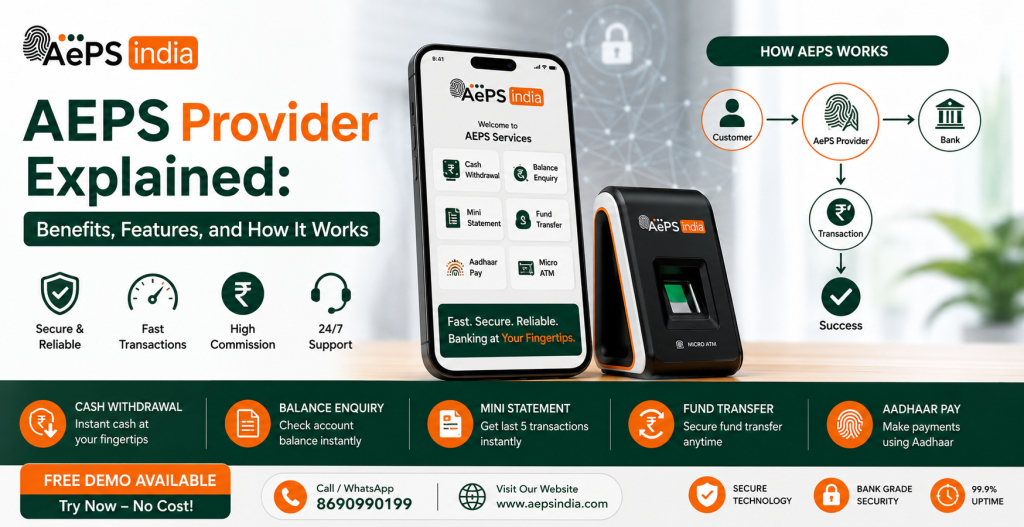
An AEPS Provider works by setting up a digital bridge through the NPCI network so local shops and micro-agents can act as mini-banks. They supply the technology, apps, and biometric scanners that let customers perform cardless and PIN-free cash withdrawals, deposits, and balance checks using only their Aadhaar number and fingerprint.
Key Aspects of AEPS Provider Work:
- Technology & Infrastructure: Provide secure mobile Android Aeps apps, web Aeps dashboard, or trusted Aeps API that connect certified Aeps fingerprint scanners to banking servers.
- Agent Onboarding: Register local shopkeepers and retailers as authorized Business Correspondents (BCs) after completing KYC.
- Transaction Routing: Securely encrypt biometric data and route it via UIDAI and NPCI for real-time bank verification.
- Commission Management: Handle instant commission payouts to agents for every successful cash withdrawal or balance check.
What Services Does an AEPS Provider Offer?
An Aadhaar Enabled Payment System (AePS) provider enables local merchants and business owners to act as “mini-banks”. They offer essential cardless and PIN-less financial transactions using a customer’s Aadhaar number and biometric fingerprint authentication.
Key Services Offered by Top AEPS Providers
- Cash Withdrawal: Allows customers to withdraw cash from their bank accounts using biometric authentication (fingerprint/iris) at a retail shop, reducing the need for bank visits.
- Balance Enquiry: Provides immediate, real-time access to check bank account balances.
- Mini Statement: Generates a summary of the most recent transactions from the customer’s account.
- Aadhaar to Aadhaar Fund Transfer: Enables money transfer between two Aadhaar-linked accounts securely.
- Aadhaar Pay (Merchant Payments): Enables small merchants to accept payments directly from a customer’s bank account via Aadhaar, bypassing the need for POS machines or debit cards.
- Cash Deposit: Aeps india facilitate depositing cash into Aadhaar-linked accounts.
Business and Merchant Features
- BHIM Aadhaar Pay: Allows small shop owners to accept digital payments from customers using biometric verification.
- API & Software Integration: We offers white label Aeps b2b software or reliable Aeps API for Aeps fintech platform and corporate business correspondents.
- Agent Onboarding & Training: Registers local shopkeepers as active Business Correspondents (BCs) and handles regulatory KYC compliance.
AEPS Eligibility: Who Can Become an AEPS Retailer?
To become an Aadhaar Enabled Payment System (AEPS) retailer in India, you must be an Indian citizen aged 18 or older with a valid PAN card, an Aadhaar-linked active bank account, a smartphone or PC, and a certified biometric fingerprint or iris scanner.
Basic Eligibility Criteria
- Age & Citizenship: Must be an adult Indian citizen (18 years or older).
- Identification: Must possess a valid PAN Card and Aadhaar Card.
- Linked Mobile Number: Must have a functional mobile number actively linked with your Aadhaar for OTP verifications.
- Active Bank Account: Must own a functional bank account (with passbook or cancelled cheque) to receive daily commission settlements.
- Business Location: Having an existing customer-facing retail shop (such as a Kirana store, mobile recharge shop, or pharmacy) is preferred to build local trust, though home-based setups are sometimes permitted.
Documents Required for AEPS Retailer Registration
To register as an AePS retailer in 2026, you will need to submit KYC documents primarily your Aadhaar card (linked to a bank account and mobile number), PAN card, and bank account details (passbook/cancelled cheque). Additional requirements include a photograph, business address proof (utility bill/rent agreement), and a certified Aeps biometric fingerprint scanner.
Essential Documents Checklist (2026)
- Aadhaar Card (Mandatory): Must be linked to your bank account for secure authentication.
- PAN Card (Mandatory): Essential for tax compliance and KYC.
- Proof of Address/Business Location: A utility bill (electricity, water, gas) or shop rent agreement.
- Bank Account Details: Cancelled cheque, bank statement, or the first page of your bank passbook to facilitate commission settlements.
- Passport-Sized Photograph: Recent photograph.
- Active Mobile Number & Email: For OTP and communication, preferably linked to Aadhaar.
Required Hardware & Software
- Biometric Scanner: A UIDAI-Aeps certified device (fingerprint or iris scanner) is mandatory for customer authentication.
- Smartphone or PC: With a stable internet connection to run the Aeps agent app/Aeps portal.
Key Considerations
- Active KYC: Ensure your PAN and Aadhaar are updated. According to 2026 regulations, a strict, full Aeps KYC is required to prevent fraud.
- Inactive Account Rules: If you are inactive for more than 3 months, you may need to undergo a fresh Aeps KYC process to reactivate your services.
- Age Restriction: You must be at least 18 years old.
AEPS Biometric Device Requirements
To set up an Aadhaar Enabled Payment System service, you must use a UIDAI Biometric Devices Guide that is officially certified by STQC and UIDAI. The hardware must feature active Level 1 (L1) security compliance, Registered Device (RD) Aeps service integration, and real-time liveness detection to prevent spoofing.
Certification & Compliance
- STQC/UIDAI Approval: Scanners must carry official government certification to ensure safe data capture.
- L1 Compliance: Level 1 biometric devices are mandatory for enhanced on-device encryption.
- RD Service: An active Registered Device subscription is required so the scanner can digitally sign data at the source before sending it to bank servers.
Supported Hardware Types
- Fingerprint Scanners: Single-finger capacitive or optical optical scanners (e.g., Mantra MFS110 L1).
- Iris Scanners: Eye-based biometric capture devices for alternative high-security verification.
- Integrated Terminals: Dedicated Micro ATM Software or POS hardware with built-in certified sensors.
Companion Setup Requirements
- Host Device: An Android smartphone, tablet, or Windows PC/laptop to plug in the discrete scanner.
- Connectivity: A stable high-speed mobile data or broadband internet connection for real-time NPCI/bank server communication.
- Driver Software: Correct RD Service app/drivers installed and mapped to your authorized top AePS service provider like Aeps india.

Who Can Use AEPS Provider
An Aadhaar Enabled Payment System (AePS) provider can be used by retail shop owners, Business Correspondents (BCs), Common Service Centers (CSCs), and fintech entrepreneurs to act as mini-bank touchpoints, enabling cardless cash withdrawals, deposits, and balance checks for any resident with an Aadhaar-linked bank account.
Who Can Become an AePS Agent or Merchant
- Local Retailers: Kirana, grocery, and medical shop owners can turn their storefronts into mini ATM to earn Aeps commission on transactions.
- CSC & E-Mitra Operators: Digital service center operators provide financial inclusion services in rural and semi-urban areas.
- Business Correspondents (BCs): Certified individuals or corporate agents appointed to deliver localized banking services.
- Fintech Entrepreneurs & Startups: We integrating AePS API software into their proprietary Aeps mobile application or Aeps b2b portal.
Who Can Use AePS as a Customer
- Any resident of India possessing a 12-digit Aadhaar number.
- Individuals whose bank account is actively linked (seeded) to their Aadhaar number.
- Customers seeking cardless and PIN-less transactions using biometric verification (fingerprint or iris scan).
Why Use AEPS Provider
Using Aeps india is an AEPS Provider enables retailers and businesses to turn their shops into “mini-banks.” It allows them to offer essential banking services such as Aeps cash withdrawal API, Aeps balance inquiry Api, and Aeps mini statement API using only a customer’s Aadhaar number and biometric authentication.
Partnering with a best AEPS service provider offers several key advantages:
- Earn Attractive Commissions: Agents earn a secure, reliable Aeps commission (often ranging from ₹10 to ₹15) on every successful transaction, driving a new revenue stream.
- Increase Customer Footfall: By providing accessible banking in local and rural areas, you attract more visitors to your store, increasing the likelihood of selling your primary products.
- Bank-Level Security: Transactions rely on biometric verification (fingerprint or iris scan), which minimizes fraud risks compared to traditional PIN-based systems.
- Instant Settlements: Top Aeps platform provide real-time or same-day (𝑇+0) fund settlements directly to your bank account, ensuring strong operational liquidity.
- Interoperable Services: Your customers can link and transact with any participating bank in India, regardless of your personal banking ties.
AEPS Provider for Different Business Models
An Aadhaar Enabled Payment System (AEPS) provider delivers the APIs, software, and banking connections that let businesses handle biometric cash withdrawals, balance checks, and deposits. Different business models from local kirana shops and rural service centers to large fintech apps use AEPS to fit their specific operational scale.
Retail & Neighborhood Store Model (Kirana, Pharmacy, Mobile Shops)
- How it works: Small local merchants use a basic B2B mobile app or portal connected to a fingerprint scanner to turn their shop into a local “mini-ATM”.
- Why it works: It increases customer footfall and brings in extra income through per-transaction commissions (ranging from ₹5 to ₹15 depending on the ticket size).
- Financial Focus: Low setup cost, immediate daily liquidity management, and high reliance on instant settlement (T+0) to keep shop cash drawers balanced.
Digital Service Center Model (CSC, E-Mitra, Common Service Centres)
- How it works: Operators bundle AEPS with wide-ranging digital utilities like government service access, bill payments (BBPS), and domestic money transfers (DMT).
- Why it works: Crucial for semi-urban and rural areas where physical bank branches are sparse, serving as an all-in-one financial hub for local citizens.
- Financial Focus: Diversified revenue streams per customer visit, balancing low-margin utility services with higher-margin cash-out services.
Fintech Startup & White-Label App Model
- How it works: Tech entrepreneurs integrate an AEPS API directly into their own custom mobile applications, offering cardless and PIN-less transactions under their own brand name.
- Why it works: Eliminates the need to build a banking infrastructure from scratch while enabling customized scale, sub-merchant management, and automated commission splits.
- Financial Focus: Higher upfront software integration costs, regulatory compliance tracking (NPCI standards), and revenue generation via platform volume rather than single-agent payouts.
Distributor & Multi-Tier Network Model
- How it works: Master distributors or regional providers onboard, train, and manage extensive networks of sub-agents and retail touchpoints.
- Why it works: Scales fast across districts by letting regional middlemen handle agent liquidity, device troubleshooting, and localized support.
- Financial Focus: Volume-based overrides and override commissions earned passively from the active transactions of downline retail agents.
Microfinance, NBFC & Rural Disbursal Model
- How it works: Lending institutions and field agents use biometric verification to disburse microloans or collect recurring loan EMIs directly at the borrower’s doorstep.
- Why it works: Prevents cash-handling friction, cuts down collection default rates, and secures verifiable, biometric-authenticated ledger entries in real time.
- Financial Focus: Operational risk reduction, faster cash turnaround times, and lower administrative overhead for rural collections.
Top Use Cases of AEPS Provider
Aeps india is an Aadhaar Enabled Payment System provider turns local retail shops into mini-banks. It allows customers to perform secure, biometric-based transactions using only their Aadhaar number and fingerprint, without needing physical debit cards or PINs.
Top use cases for AEPS providers include:
- Cash Withdrawal & Deposit: Customers can withdraw or deposit cash at local neighborhood stores, eliminating the need to travel long distances to physical bank branches.
- Balance Inquiry & Mini Statement: Users can instantly check their bank account balance and view recent transaction histories on an agent’s micro ATM or point-of-sale (POS) device.
- Aadhaar Pay (Merchant Payments): Merchants can accept cashless, PIN-less payments directly from a customer’s Aadhaar-linked bank account through biometric authentication.
- Direct Benefit Transfer (DBT): Facilitates the secure and direct disbursement of government subsidies, pensions, and welfare payments directly into the beneficiary’s bank account.
- Fund Transfers: Securely sends money directly between two Aadhaar-linked bank accounts without requiring mobile Aeps banking apps or complex routing details.
- eKYC Services: Provides instantaneous, paperless identity verification to quickly open bank accounts or activate new financial services.
- Utility Bill Payments: Integrate Aeps API solution to allow agents to process utility bills and mobile/DTH recharge API.

Key Aspects of AEPS Provider
Aeps india is an AEPS provider facilitates secure, cardless, and PIN-less banking transactions using Aadhaar biometric authentication. Key aspects to evaluate include strict regulatory compliance (RBI/NPCI mandates), high transaction success rates (98%+), instant fund settlements, interoperability across banks, and multi-layered biometric security.
Evaluating an Aeps india requires looking at a few core operational and technological pillars to ensure security and profitability:
1. Security and Regulatory Compliance
- Regulatory Adherence: Aeps india must strictly comply with guidelines established by the National Payments Corporation of India and Reserve Bank of India (RBI).
- Mandatory Biometric Devices: The Aeps platform must support L0/L1 security for registered Aeps biometric devices (fingerprint/iris scanners) to guarantee safe authentication.
2. Core Banking Capabilities
- Interoperability: Allows customers to perform transactions across various banks through any agent, regardless of their home bank.
- Core Services: The best Aeps platform should facilitate essential services, including best Aeps cash withdrawal service, best Aeps cash deposit service, best Aeps balance inquiry service, best Aeps mini statement service, and Aadhaar-to-Aadhaar fund transfers.
3. Reliability and Integration
- Uptime and Success Rates: The Aeps software should guarantee ≥99.9% system uptime and transaction success rates exceeding 98% to build customer trust.
- API Flexibility:Aeps india is a robust, easy-to-integrate AEPS API is essential for seamless embedding into existing web or Aeps app platforms.
4. Agent Empowerment and Economics
- Instant Settlements: Aeps india should offer instant (T+0) or same-day (T+1) settlement of funds to help retailers maintain healthy liquidity.
- Lucrative Commission Structures: Aeps india offers competitive, transparent commission margins for banking correspondents and retail agents.
5. Platform Management and UI
- User-Friendly Dashboard: Agents need intuitive mobile Aeps application or web portals featuring comprehensive transaction history, compliance monitoring and real-time alerts.
- Customer Support: Responsive and accessible backend support is vital to resolve failed transactions or biometric issues immediately.
Why AEPS Provider Are Growing in 2026
AEPS providers like Aeps india are growing rapidly in India due to their critical role in driving financial inclusion in rural areas, offering convenient cardless/PIN-less banking, and providing high Aeps commission income to agents. The boom is fueled by widespread Aadhaar adoption, government support for digital payments and high-security biometric authentication.
Key Factors Driving Growth:
- Financial Inclusion in Rural Areas: AEPS bridges the gap in remote, underbanked, and semi-urban regions where traditional bank branches and ATMs are scarce.
- Ease of Use & Security: Customers can perform transactions like cash withdrawal and balance enquiry using only their Aadhaar number and fingerprint, reducing reliance on smartphones or physical debit cards.
- Attractive Commissions for Agents: Local shopkeepers, such as kirana store owners, act as banking correspondents and earn Aeps commission-based income, typically ranging from ₹5 to ₹15+ per transaction.
- Government Support: The surge is partly due to government initiatives and the direct transfer of welfare payments/subsidies, which users withdraw via best AEPS.
- Technological Advancements: Secure Aeps biometric systems, iris scanning, and real-time transaction processing with high success rates have built trust and increased usage.
- Low Business Setup Cost: Retailers can easily become AEPS agents with minimal investment needing only a smartphone and a Aeps fingerprint scanner to start.
Why Retailers & Businesses Need AEPS Provider
An Aadhaar Enabled Payment System (AEPS) provider allows local retailers and small businesses to function as “mini-banks”. By integrating a secure Aeps biometric device and an top AEPS Portal, shop owners can process cardless cash withdrawals, balance checks, and mini-statements for customers while earning direct transaction commissions.
Key Business Benefits
- Extra Income: Retailers earn a reliable Aeps commission on every successful cash withdrawal, deposit, or balance inquiry.
- More Foot Traffic: Offering essential banking services brings more people into the shop, which naturally increases regular retail sales.
- Cardless & PIN-less System: Customers do not need debit cards or secret passwords; they only need their Aadhaar number and a quick fingerprint or iris scan.
- Customer Retention: Local residents prefer nearby shops over traveling long distances to crowded bank branches or distant ATMs.
- Digital Inclusion: Businesses can easily serve unbanked or underbanked populations, supporting the wider digital economy.
Operational Advantages
- Interoperability: Merchants can handle customers from nearly any major bank in the country through a single Aeps platform.
- Real-Time Settlement: Funds and commission payouts process instantly, ensuring smooth daily cash-flow management.
- High Security: Mandatory biometric authentication backed by NPCI guidelines keeps transactions safe and lowers the risk of fraud.

Why Businesses Need Best AEPS Provider
Businesses need the best AEPS provider like Aeps india to ensure secure, rapid, and compliant financial transactions, reducing failed payments while boosting customer trust and revenue. Aeps india those recommended in, offers 99.9% uptime, instant (T+0) settlement, and high Aeps commissions, which are critical for maximizing daily income for agents and enhancing rural banking access.
Key Reasons to Choose the Best AEPS Provider:
- Superior Security & Regulatory Compliance: Aeps India ensure all transactions adhere to NPCI and UIDAI guidelines, using encrypted biometric authentication to protect against fraud.
- High Transaction Success Rates: A reliable Aeps platform minimizes transaction failures, which is vital for building customer trust in retail and rural areas.
- Increased Profitability & Revenue: Businesses earn competitive Aeps commissions, often between ₹12–₹16 per transaction, and can expand their service portfolio to include top Micro ATM Software and BBPS software, increasing daily income.
- Instant Settlements (T+0): Aeps india offers real-time or same-day (T+0) settlement, ensuring businesses do not face liquidity bottlenecks.
- Robust Technical Support & Reliability: 24/7 technical assistance ensures high uptime (99.9%), preventing downtime that leads to lost customers.
- Scalability & Seamless Integration: Whether for a small shop or a large network, the Aeps india offer easy Aeps API integrate and scalable infrastructure.
Benefits of Using an AEPS Provider
Using an Aadhaar Enabled Payment System (AePS) provider helps customers perform basic banking tasks like cash withdrawals, deposits, and balance checks using just their Aadhaar number and fingerprint, while allowing local shop owners and businesses to earn extra income through transaction commissions.
Key Benefits for Customers
- No Cards or PINs Needed: Users do not need to carry a debit card or remember a secret code.
- Fingerprint Security: Biometric scans match unique physical traits, which stops thieves from stealing accounts.
- Local Access: People living far from big cities can visit nearby local micro-ATMs instead of traveling to a distant bank.
- Works with Any Bank: An account from one bank works on any NPCI-certified machine or agent device.
Key Benefits for Business Owners and Agents
- Extra Income: Local shops earn a commission on every cash withdrawal or balance check they process.
- More Foot Traffic: Offering banking services brings more people into local stores.
- Easy Setup: Small shops only need a basic biometric scanner and a smartphone or POS machine.
- Fast Money Flow: Top Aeps Admin platform offer instant payment settlements so agents keep enough cash on hand.
Features Offered by a Aeps Provider
An Aadhaar Enabled Payment System (AePS) provider offers core banking and financial services through biometric authentication, allowing local shops and merchants to act as mini-banks. Essential features include cardless cash withdrawals, balance checks, mini-statements, fund transfers, and merchant payment tools using fingerprint or iris scanners.
Merchant and Business Tools
- Aadhaar Pay: Enables small shops to accept digital cashless payments directly from customer bank accounts.
- API Integration: Offers developers and businesses technical infrastructure to embed banking features into their own software or apps.
- Micro ATM Services: Turns basic point-of-sale or mobile setups into card-swipe or cash-out terminals.
- Utility Bill Payments & Recharges: Integrated BBPS Software for mobile, DTH, and utility bills.
Platform and Management Features
- Agent Dashboard: Real-time tracking of transaction success rates, failures, and daily logs.
- Instant Settlements: Quick payout options to transfer earned money and commissions to an agent’s main bank account.
- Biometric Security: Advanced encryption and multi-factor authentication compliant with NPCI guidelines.
AEPS Provider Features at a Glance
| Feature | AEPS India |
|---|---|
| AEPS Services | Actual services |
| Retailer Onboarding | Actual process |
| Commission | Actual structure |
| Settlement | Actual timing |
| Biometric Support | Actual devices |
| API | Yes |
| Dashboard | Actual features |
| Support | Actual support |
| Additional Services | Actual services |
AEPS Transaction Process: Step-by-Step
An Aadhaar Enabled Payment System (AePS) transaction allows customers to perform basic banking services like cash withdrawals, balance checks, or mini statements at a local micro-ATM or banking correspondent outlet using just their 12-digit Aadhaar number and fingerprint biometric authentication, without needing a debit card or PIN.
Step-by-Step Transaction Process
- Visit a Service Point: Go to a local micro-ATM or an AePS-enabled retail store.
- Provide Aadhaar Details: Share your 12-digit Aadhaar card number with the banking agent or enter it into the terminal.
- Select Your Bank: Name or select the specific bank where your Aadhaar-linked account is hosted.
- Choose Transaction Type: Pick the desired service from options such as Cash Withdrawal, Balance Enquiry, Mini Statement, or Aadhaar-to-Aadhaar Fund Transfer.
- Enter Amount (if applicable): Specify the exact cash amount you wish to withdraw or transfer.
- Biometric Authentication: Place your finger or thumb on the certified biometric scanner device to verify your identity against the UIDAI database.
- Transaction Processing & Completion: Once authenticated, the system processes the request in real time. The agent hands over the cash (for withdrawals) and provides a printed or digital transaction receipt.
AEPS Transaction Process
A step-by-step visual guide to Aadhaar Enabled Payment System workflow
The customer provides their Aadhaar number and selects the transaction type, such as cash withdrawal or balance enquiry.
The Business Correspondent (BC) captures the customer’s fingerprint using a registered biometric scanner.
The request is routed through the AEPS network to the customer’s linked bank for processing.
The bank verifies the authentication request and checks the account conditions required for the selected transaction.
After successful validation, the bank processes the transaction and sends the response through the network.
The BC completes the service, such as handing over cash, and the customer receives a confirmation by SMS or receipt where available.

AEPS API Integration for Apps and Websites
AEPS API integration allows your platform to facilitate banking services like cash withdrawals, balance inquiries, and mini-statements using a customer’s Aadhaar and fingerprint. The process requires selecting an certified Aeps india, completing strict KYC, setting up biometric hardware and building technical endpoints.
Step-by-Step Integration Process
1. Choose an NPCI-Certified Provider
- Partner with an authorized Aeps India. Evaluate them based on transaction success rates, settlement times, and Aeps commission structures.
2. Register and Complete KYC
Sign up on the Aeps merchant portal and complete the mandatory KYC process. You will need to submit your business proof, PAN card, Aadhaar card, and bank account details for settlement.
3. Acquire and Register Biometric Devices
Purchase Aeps biometric device (e.g.,Mantra). You must register the device with the manufacturer’s RD (Registered Device) Aeps service portal so it securely captures and encrypts fingerprint data before sending it to the server.
4. Obtain API Credentials & Documentation
Once your business is approved, the Aeps india will issue Aeps API credentials. This typically includes a Aeps Merchant ID (MID), Client Secret/Key, and detailed Aeps API documentation with endpoints for services like cash-out and Aadhaar pay software.
5. Technical Integration (Frontend & Backend)
- Frontend: Build your user interface to securely capture customer details (Aadhaar number, Bank IIN) and trigger the biometric RD service to scan the customer’s finger.
- Backend: Integrated Aeps API endpoints using JSON or XML payloads. Your payload must include the customer’s Aadhaar data, the BEST Aeps API credentials, transaction type, and an encrypted biometric block (PID data).
6. Sandbox Testing
Before going Aeps API live, thoroughly test all transaction types in the Aeps india sandbox environment using dummy data and test Aadhaar numbers. Ensure that your system correctly handles error codes, failed transactions, and response parameters.
7. Go Live
After successfully testing and passing compliance checks by the Aeps india, Aeps application will be moved to the production environment. You can then set up a secure HTTPS callback URL to receive real-time, encrypted transaction statuses.
AEPS Retailer Onboarding Process
The Aadhaar Enabled Payment System (AePS) retailer onboarding process requires registering with an authorized Aeps india, submitting identity and business KYC documents, completing biometric verification, and setting up an STQC-certified fingerprint or iris scanner device to start processing banking transactions.
Step-by-Step Onboarding Process
- Select a Provider: Choose a registered AEPS Service Provider in india like Aeps india.
- Register Online: Sign up on the Aeps portal or B2B mobile Aeps application by providing basic personal and shop details.
- Submit KYC: Upload digital copies of your PAN card, Aadhaar card, and bank account proofs.
- Biometric Verification: Complete your own agent e-KYC verification using a fingerprint scanner linked to the Aeps earning platform.
- Device Integration: Install the specific Registered Device (RD) service driver for your fingerprint scanner.
- Account Activation: Receive your Aeps retailer dashboard credentials, Aeps ID and password once background verification passes (typically within 24 to 48 hours).
Aeps Provider Cost Structure
Aeps india is an AEPS provider cost structure for businesses launching Aeps portal or real time Aeps API involves one-time setup fees ranging from ₹12,000 to ₹35,000, white label Aeps software package costing ₹15,000 to ₹1.2 lakh+, annual maintenance charges of ₹10,000 to ₹40,000, and hardware like biometric scanners around ₹2,000 to ₹3,000.
1. Initial Business Setup & Integration Costs
For businesses or agents looking to offer AePS as a service, Aeps setup involves integration with a Aeps india.
- API Integration Setup: Ranges from ₹12,000 to ₹35,000 for basic Aeps API keys and documentation.
- White-Label Software Solutions: If you need a fully branded Aeps B2B portal or an Aeps admiAeps Aeps admin dashboard, costs generally scale from ₹25,000 to over ₹1,20,000.
2. Hardware Costs
Physical devices are required to capture Aadhaar details and biometric data.
- Biometric Scanners: Buy Aeps Fingerprint scanners (e.g., Mantra MFS100) cost between ₹1,500 and ₹3,000.
- Micro ATMs: If you also want to support physical debit card swipes alongside AePS devices cost between ₹10,000 and ₹15,000.
3. Recurring Maintenance Fees
Aeps india often charge ongoing operational or maintenance fees to keep your servers and compliance Aeps API live.
- Annual Maintenance (AMC): Typically ranges from ₹10,000 to ₹40,000 per year depending on the tier of support.
- Transaction Fees: For processing the transaction, banks and master providers may deduct a fee of 0.5% to 1% (or ₹0.25 to ₹10) per transaction.
4. End-Customer Charges & Agent Commissions
End-customers performing basic AePS services (cash withdrawal, balance inquiry, mini-statements) are generally not charged by banks or retailers. If a third-party agent does charge, it is typically between ₹5 and ₹20.
- Agent Payouts: Retailers are incentivized to provide these services through commission structures, earning ₹2 to ₹15+ per withdrawal depending on the transaction tier and the Aeps india.
AEPS Provider Commission: How Much Can Retailers Earn?
Retailers using an AEPS earn tiered commissions ranging from ₹2 to ₹20+ per transaction. Payouts peak at ₹13 to ₹15+ for high-value cash withdrawals between ₹3,000 and ₹10,000. Active shop owners handling steady daily volumes can make ₹10,000 to ₹30,000+ per month.
Typical Commission Slab Structure
- ₹3,000 – ₹10,000 Withdrawal: ₹13 to ₹15+ per transaction
- ₹2,500 – ₹2,999 Withdrawal: ₹5 to ₹7 per transaction
- ₹1,000 – ₹1,999 Withdrawal: ₹3 to ₹4.50 per transaction
- ₹100 – ₹999 Withdrawal: ₹2 per transaction
- Mini-Statements / Balance Inquiry: ₹1 to ₹7 (varies by provider and activity)
Additional Earning Factors
- Volume Bonuses: Extra monthly rewards or slabs up to ₹2,000 for completing high daily transaction counts (150–200+ scans).
- Cross-Selling Services: Bundling AEPS with bbps b2b software and mobile recharge.
- Investment Costs: Minimal initial setup, typically requiring a biometric fingerprint scanner (₹2,000–₹5,000) and minor portal registration fees (₹500–₹1,000).
Industry-Highest Slab Structure
Payouts are typically highest for transactions between ₹3,000 and ₹10,000. Aeps india operate on the following model:
| Transaction Slab (₹) | Retailer Commission Range | Super Prime/Premium Rate |
|---|---|---|
| ₹1 to ₹499 | ₹1.00 – ₹2.00 | ₹2.00 – ₹3.00 |
| ₹500 to ₹999 | ₹2.00 – ₹3.50 | ₹4.00 |
| ₹1,000 to ₹1,499 | ₹3.00 – ₹4.50 | ₹5.50 |
| ₹1,500 to ₹1,999 | ₹4.00 – ₹5.50 | ₹6.50 |
| ₹2,000 to ₹2,499 | ₹5.00 – ₹8.50 | ₹9.50 |
| ₹3,000 to ₹10,000 | ₹10.00 – ₹13.00 | Up to ₹15.00 – ₹16.00 |
How to Earn Daily Income with AEPS Services
To earn a daily income with top AePS, you turn your retail shop into a “mini-bank”. You process customer transactions (such as cash withdrawals, balance inquiries, and mini-statements) using an Aeps Android device, a Aeps biometric scanner, and a registered fintech/banking platform. You earn a set Highest Aeps commission on every successful transaction.
1. How the Earnings Model Works
Your income comes from fixed commissions or percentage-based cuts on different banking services:
- Cash Withdrawals: This is your primary earner. You earn Aeps commissions (typically \(₹10\) to \(₹25+\) per transaction) depending on the withdrawn amount.
- Mini-Statements & Balance Inquiries: You can charge customers a small nominal fee (\(₹1\) to \(₹5\)) for checking their bank balance or printing out a statement.
- Aadhaar Pay: Useful for allowing customers to make higher-value transactions or purchases. You earn Aeps commission (usually around 1%) for transaction amounts exceeding standard daily caps.
2. Steps to Start
- Get Certified Equipment: You will need a registered Aeps biometric fingerprint scanner (like Morpho) and an Android smartphone or computer.
- Partner with an AePS india: Register as a Business Correspondent (BC) or retail agent with established, trusted Aeps India.
- Complete Your KYC: Submit your official documents including your Aadhaar card, PAN card, and bank account details.
3. Tips to Maximize Your Daily Income
- Focus on High-Value Withdrawals: You earn highest Aeps commission slabs on withdrawals between \(₹3,000\) and \(₹10,000\).
- Offer Value-Added Services: Cross-sell services like BBPS API, and Mobile recharge API to boost earnings off the same footfall.
- Choose Instant Settlement Providers: Aeps india offers instant settlements (T+0 or same-day) so your cash flow is never tied up.
- Visually Attract Customers: Place clear signage outside your storefront (e.g., “Aadhaar Banking & Cash Withdrawals Available Here”).

How Retailers Earn Through AEPS Services
Retailers earn money through an Aadhaar Enabled Payment System (AEPS) provider by turning their shops into local mini-banks. They receive a fixed or slab-based commission from the AEPS Service Company in India like Aeps india for every successful biometric-authenticated customer transaction like cash withdrawals, balance checks, and mini-statements.
How the Earning Process Works
- Cash Withdrawal Commission: Retailers get paid per successful cash payout. Commissions usually scale between ₹2 to ₹16 per transaction, with higher payouts generally tied to larger withdrawal slabs (e.g., ₹3,000 to ₹10,000).
- Balance Inquiry & Mini Statements: Customers checking bank balances or requesting recent transaction logs generate small, incremental micro-commissions for the shop owner.
- Aadhaar Pay & Merchant Acceptance: Accepting direct digital storefront payments through customer biometric authentication can unlock extra merchant incentives.
- Indirect Store Sales: Providing banking brings higher footfall to local kirana, medical, or general stores, driving extra retail product sales as customers use the cash they just withdrew inside the shop.
Setup Requirements
- Basic Hardware: A smartphone or PC paired with an STQC-certified L1 biometric fingerprint scanner.
- Agent Registration: Completing KYC (Aadhaar, PAN, and bank details) through an authorized Aeps india.
How Secure is an AEPS Provider?
An Aadhaar Enabled Payment System (AEPS) provider is highly secure because it uses unique biometric scans and strict encryption managed through the National Payments Corporation of India (NPCI).
Core Security Features
- Biometric Verification: Transactions require your fingerprint or iris scan. This is harder to steal or copy than a standard password.
- No Data Storage: Agents and local shops are legally forbidden from saving your biometric or bank data.
- Certified Hardware: Trusted providers must use L1-certified biometric devices that prevent fake or copied fingerprints.
- Strong Encryption: Data is locked using secure codes (like RSA and SSL) from the moment the agent types it in until it reaches the bank.
- Strict Rules: Regulators enforce rules like “one operator, one bank” mapping and mandatory agent background checks.
Potential Risks and How to Stay Safe
- Fraudulent Agents: Always use verified, trustworthy local banking touchpoints.
- Exposed Aadhaar: Never share your Aadhaar number or details with strangers.
- Lock Biometrics: You can lock your biometric data using the official mAadhaar app when you do not need to make payments.
- Turn on Alerts: Keep SMS or email notifications active on your phone so you know immediately if money moves out of your account.
AEPS Portal and Retailer Dashboard
An Aadhaar Enabled Payment System (AEPS) portal and retailer dashboard provide local shop owners and micro-ATM operators a secure interface to process cardless, PIN-less banking transactions such as cash withdrawals, balance inquiries, and mini-statements using a customer’s Aadhaar number and fingerprint biometric scan.
Core Dashboard Features
- Live Transaction Ledger: Real-time tracking of successful, pending, or failed cash withdrawals and balance checks.
- Wallet & Settlement Management: Instant view of working capital, operational cash limits, and automated payout requests (T+0 or T+1 bank settlements).
- Commission Tracker: Transparent slab-wise tracking of earnings accrued per successful micro-banking interaction.
- Biometric Device Integration: Plug-and-play setup for certified fingerprint or iris scanners (Mantra, etc.).
Retailer Benefits & Business Impact
- New Revenue Streams: Earn recurring, slab-based commissions on everyday local financial transactions.
- Increased Footfall: Transforming your storefront into a neighborhood “human ATM” attracts more foot traffic, boosting primary retail sales.
- Simplified Reconciliation: Automated ledger systems eliminate the need for error-prone manual paper tracking.
Operational Requirements & Setup
- KYC & Registration: Complete mandatory merchant verification using valid identity proofs and business PAN/GST details.
- Hardware Compliance: Procure an NPCI/UIDAI-certified biometric capture device mapped securely to your assigned retailer ID.
Recent Transactions
Latest activity from the retailer wallet
| Txn ID | Customer | Amount | Status |
|---|---|---|---|
| #AEPS9921 | Rahul S. | ₹ 2,000 | Success |
| #AEPS9922 | Priya P. | ₹ 5,000 | Success |
| #AEPS9923 | Amit V. | ₹ 1,000 | Pending |
AEPS Transaction Limits and Settlement
The Aadhaar Enabled Payment System (National Payments Corporation of India (NPCI)) caps a single financial cash withdrawal transaction at ₹10,000. Daily limits typically reach up to ₹50,000 depending on the issuer bank’s risk assessment, while daily settlement cut-off timing occurs at 11:00 PM IST.
Transaction Limits
- Per Transaction: Maximum of ₹10,000 for cash withdrawals.
- Aadhaar Pay Limit: Up to ₹50,000 per transaction for merchant payments.
- Frequency: Capped generally at 5 to 10 transactions per day per user biometric profile, varying by specific bank policy.
- Monthly Caps: Frequently limited to ₹1,00,000 or a specific count of monthly transactions depending on the individual issuer bank.
Settlement Process
- Cut-off Time: The daily transaction cut-off and reconciliation cycle for AePS closes at 11:00 PM IST.
- Inclusion: Any successful financial transaction completed prior to 11:00 PM IST is bundled into that specific day’s settlement file.
- Merchant Payouts: For business correspondents and micro ATM operators, settlement to main operating accounts typically happens on an automated T+1 or instant/same-day cycle based on the Aeps india.
AEPS Provider vs Other Digital Payment Services
An Aadhaar Enabled Payment System (AePS) provider enables cardless, PIN-less banking (cash withdrawal, balance check) via biometric fingerprint/iris authentication at assisted local retailer touchpoints. In contrast, other digital payment services like UPI, mobile wallets, and cards are self-operated via smartphones or POS machines, prioritizing peer-to-peer or merchant retail checkout over last-mile cash delivery.
Key Differences in Operation & Access
- Authentication: AePS uses biometric scans (fingerprints) tied to Aadhaar; other modes use UPI PINs, passwords, OTPs, or card chips.
- User Requirement: AePS requires only an Aadhaar number and bank name (no smartphone needed for the customer); UPI/Wallets require a personal smartphone and active internet.
- Intermediation: AePS mandates an assisted agent/micro-ATM operator; other services are self-service digital applications.
Core Feature Comparison
- AePS Services: Focuses on last-mile cash-in/cash-out, mini-statements, and balance inquiries.
- Other Services (UPI/Wallets/Cards): Focuses on e-commerce, merchant shopping bills, peer transfers, and utility payments without physical cash handling.
- Target Demographics: AePS targets unbanked or rural populations lacking debit cards; UPI and wallets target digitally literate or urban smartphone users.
AEPS Security and Authentication
The Aadhaar Enabled Payment System (AePS) secures cardless banking via the National Payments Corporation of India (NPCI) and UIDAI databases. Transactions require an Aadhaar number, bank identifier, and live biometric verification (fingerprint, iris, or face scan), removing the need for physical debit cards, PINs, or passwords.
Core Authentication Layers
- Biometric Validation: Live capture of fingerprints or iris data matches directly against centralized UIDAI servers via encrypted channels.
- Two-Factor Authentication (2FA): Mandatory agent authentication secures business correspondent terminals before any customer transaction session begins.
- End-to-End Encryption: Data packets are digitally signed and encrypted at the point of capture on micro ATMs or Point of Sale (PoS) devices.
Modern Security Updates
- L1 Device Mandate: Biometric scanners must utilize STQC-certified Level 1 (L1) devices to process internal encryption and prevent spoofing.
- Agent Restrictions: Merchant/agent profiles are limited to single-bank connectivity with mandatory re-KYC protocols for extended inactivity.
AEPS Provider Compliance and Regulatory Considerations
Aadhaar Enabled Payment System (AePS) providers must adhere to strict regulatory frameworks governed by the Reserve Bank of India (RBI), National Payments Corporation of India (NPCI), and the Unique Identification Authority of India (UIDAI). Core mandates include rigorous operator KYC, mandatory use of STQC-certified L1 Aeps biometric hardware, the “One Operator, One Bank” rule, and enforced re-KYC for agents inactive for over three months.
Operator Onboarding and KYC
- Identity Verification: Comprehensive KYC using valid PAN and Aadhaar documents linked to an active mobile number is required before activating any agent.
- Business Proof: Submission of valid establishment proof such as a GST registration, Udyam certificate, or Shop License.
- Inactivity Re-KYC: Agents who remain inactive for three consecutive months must undergo complete re-validation before transaction rights are restored.
Security and Hardware Mandates
- L1 Biometric Devices: Legacy L0 biometric hardware is obsolete; providers must exclusively use STQC-certified L1 devices featuring hardware encryption and liveness detection.
- Zero Raw Data Storage: Capturing biometrics must happen via registered device (RD) services, and raw biometric blocks or Aadhaar numbers must never be stored locally on agent software or apps.
- Step-Up Authentication: Cash withdrawals and transactions exceeding ₹5,000 mandate a secondary Aadhaar-linked mobile OTP in addition to biometric confirmation.
Operational and Architectural Rules
- One Operator, One Bank: Retailers and touchpoint operators are strictly restricted to processing transactions through a single mapped acquiring bank.
- Isolated API Architecture: Application programming interfaces dedicated to AePS must remain completely segregated and restricted from unregulated cross-services.
- Surveillance and Fraud Control: Real-time transaction monitoring must flag anomalies in velocity, geographical drift, or volume spikes.
Common AEPS Problems and Their Solutions
Common Aadhaar Enabled Payment System (AePS) issues include biometric authentication failures, bank server downtime, and incorrect Aadhaar-to-bank linking. Solutions involve cleaning fingerprint scanners, re-entering details carefully, checking account balances prior, or waiting out server outages with the help of the National Payments Corporation of India (NPCI) guidelines.
Biometric Authentication Failures
- Cause: Worn out fingerprints, dry or dirty fingers, or dusty scanner glass.
- Solution: Clean the scanner surface, wipe or moisten the user’s finger, and reposition it flatly on the center of the sensor.
Transaction Declined by Bank
- Cause: Insufficient funds in the account, wrong bank selection, or unmapped Aadhaar number.
- Solution: Confirm the correct bank name/IIN number, verify the account balance first, and ensure the Aadhaar card is actively linked to that specific bank account.
Server Timeout or Network Error
- Cause: Poor local internet connectivity or heavy traffic on the UIDAI or issuer bank server.
- Solution: Wait a few minutes before retrying, switch to an Aeps india Server, or perform transactions during non-peak hours.
Locked Biometrics
- Cause: The user previously locked their biometric data via the UIDAI official portal or mAadhaar App for security.
- Solution: Temporarily unlock the biometrics using the mAadhaar App or Aeps portal service before attempting the transaction again.
AEPS Provider vs AEPS Software Provider vs AEPS API Provider
An AEPS Provider, an AEPS Software Provider, and an AEPS API Provider differ based on whether they deliver the end-user banking service, the readymade user interface, or the backend technical connection.
Comparison Table
| Parameter | AEPS Provider (Service/Business Provider) | AEPS Software Provider | AEPS API Provider |
|---|---|---|---|
| Primary Role | Delivers end-to-end Aadhaar banking services and manages retail merchant/agent networks. | Supplies readymade application interfaces, web portals, and merchant panels (often white-labeled). | Offers programmatic endpoints (Application Programming Interfaces) to integrate AEPS into custom software. |
| Target Audience | Retailers, local shop owners, and individual Business Correspondents (BCs). | Fintech startups, enterprises, and master distributors wanting their own Aeps branded portal. | Aeps App developer and tech companies building or scaling custom digital banking platforms. |
| What You Get | An agent ID/login to start doing cash withdrawals or balance checks immediately. | A complete white-label website or mobile Aeps app with user management and commission settings. | Secure JSON/XML request-response documentation to connect to banking servers via Aeps india. |
| NPCI / Bank Tie-up | Direct or tightly managed partnership with sponsor banks and the NPCI network. | Usually acts as an aggregator or reseller using a primary AEPS API Provider backend. | Directly links biometric data streams to NPCI, UIDAI, and banking switches with encryption. |
| Customization | None; you use their standard operational framework and dashboard. | High; allows custom branding, logos, and localized commission configurations. | Maximum; complete control over front-end user experience and workflow design. |
| Typical Cost | Low setup cost or security deposit for an agent ID/retailer ID. | Moderate (₹35,000 to ₹50,000+) for web/app portal setup. | Variable setup fees (₹12,000 to ₹35,000+) plus per-transaction or maintenance costs. |
White Label Aeps Provider in India
Aeps india is an white label AePS provider in India gives you ready made Aeps, customizable Aeps banking software. You can launch Aeps branded portal, Fast mobile Aeps app, and b2b Aeps admin panel with your company logo, domain name, and color scheme. Popular Aeps platform provider include Aeps india with Aeps setup cost typically ranging from ₹8,000 to ₹25,000.
Key Features Provided
- Admin Dashboard: Control and create unlimited super-distributors, distributors, and retail agents.
- Core Banking Services: Offer cash withdrawals, balance inquiries, mini-statements, and fund transfers.
- Commission Management: Set custom commission slabs that auto-split and credit in real-time.
- Biometric Integration: Support for standard fingerprint and Iris scanners for secure Aadhaar authentication.
How to Choose the Best AEPS Provider in India
Aeps india one of the best Aadhaar Enabled Payment System (AEPS) provider, evaluate key factors like regulatory compliance with NPCI, transaction success rates above 98%, instant T+0 fund settlements, competitive commission margins, robust 24/7 technical support, and an easy-to-use Aeps platform interface.
1. Security & Regulatory Compliance
- NPCI Certification: Aeps india is authorized by the National Payments Corporation of India (NPCI) and strictly adheres to UIDAI and RBI guidelines.
- Biometric Security: The top Aeps platform must support secure, encrypted buy Aeps biometric device authentication (Mantra) to protect against fraud.
2. Transaction Success Rate & Uptime
- Low Downtime: Aeps india guaranteeing at least (99.9%) uptime to minimize “server down” issues and preserve customer trust.
- High Success Rate: Aim for a reputed Aeps platform consistently delivering a (99%) or higher transaction success rate for cash withdrawals and balance inquiries.
3. Settlement Speed (Liquidity)
- Instant Settlements (T+0): Choose a Aeps india that offers same-day or instant (T+0) settlement. This ensures your working capital is never blocked and you can easily cycle cash into your business.
4. Commission & Pricing Structure
- Competitive Payouts: Look for transparent Higher Aeps commission structures, which typically range from (₹20) to (₹16+) per high-value transaction (usually on amounts between (₹3,000) and (₹10,000).
- Setup Fees: Check if the Aeps india offers a free AEPS ID or charges a joining fee, particularly if you are just starting.
5. Technical Support & App Usability
- 24/7 Assistance: Reliable support via phone or WhatsApp is vital for resolving stuck or failed transactions immediately, especially in semi-urban and rural areas.
- Fast Issue Resolution: Aeps india with a proven track record of resolving bank-side settlement disputes quickly.
- User-Friendly Portal: Aeps dashboard should be easy to navigate for both desktop and mobile Aeps app to track real-time transactions and reports.
6. Additional Services for Scalability
- Aeps india offer a comprehensive suite of digital banking services. Aeps india often bundle AEPS with Micro ATM, BEST BBPS API (Bill Payments), and Best mobile recharge api to diversify and grow your income streams.
Why Choose AEPS India as Your AEPS Provider?
Aeps india one of the AEPS Provider, prioritize Aeps india companies offering bank-grade security, high transaction success rates (99%+ uptime), instant T+0 settlements, transparent commission structures, and responsive 24/7 technical support. Direct top-tier options range from direct banking partners like Aeps India.
Selecting an established, authorized Aeps india is essential for your business and customers for the following reasons:
Security and Compliance
- NPCI & UIDAI Guidelines: Ensure the Aeps india strictly follows official regulatory and data protection rules.
- Data Encryption: Look for end-to-end encryption to protect sensitive biometric and Aadhaar data.
Performance and Reliability
- Success Rate: Choose Aeps commission platform with 98% to 99%+ uptime to avoid transaction drops during peak hours.
- Fast Processing: Biometric scans and server responses should complete within 2 to 3 seconds.
Financials and Payouts
- Commission Margins: Compare per-transaction earnings, typically ranging from ₹10 to ₹15 based on volume.
- Settlement Speed: Opt for instant (T+0) or same-day fund settlements to maintain smooth cash flow.
Integration and Support
- Developer Tools: Clear Aeps API documentation, developer support, and sandbox testing environments make Aeps setup easy.
- Customer Care: 24/7 technical help is essential for resolving failed transactions or biometric device errors immediately.

Start Your AEPS Business With AEPS India
Choosing the right AEPS Provider in India is an important decision for fintech companies, retailers, distributors, and businesses planning to start or expand an Aadhaar-enabled banking service. Aeps india should offer more than basic AEPS transactions it should support secure AEPS API integration, AEPS earning software, retailer and distributor management, transaction monitoring, wallet and commission management, reporting, scalability, and technical support.
The top AEPS providers in India Aeps india offer a mix of high commissions, secure biometric authentication, and instant settlements. Leading platforms for retailers and businesses include Aeps india.
The demand for advanced AEPS services in India is growing rapidly because customers prefer quick and convenient banking solutions near their location. Retailers and businesses are also using AEPS platforms to increase customer traffic and earn regular commission income through digital banking services.
One of the biggest advantages of Aeps india is a reliable AEPS API provider is secure biometric authentication, high transaction success rate, instant settlement, and real-time transaction tracking. These features help businesses provide smooth banking services while improving customer trust and satisfaction.
The best AEPS provider in India should offer features like powerfull AEPS API integration, fast onboarding, real-time dashboard, detailed transaction reports, instant settlement system, easy activation process, and dedicated technical support. These features help retailers and fintech businesses manage secure banking operations efficiently.
A most Aeps platform like AEPS India provides best AEPS solution with secure technology, instant support, user-friendly dashboard, and strong technical assistance. This helps businesses build customer trust and expand their digital payment services successfully.
Aeps India provides a secure and scalable AEPS platform in India designed for retailers, distributors, and fintech businesses. With features like smooth Aeps API integration, secure Aadhaar verification, real-time transaction monitoring, high transaction success rate, easy onboarding, and reliable technical support, businesses can efficiently manage digital banking services and grow faster in the fintech industry.
Looking for the Best AEPS Provider in India 2026 for your retail shop or fintech business? AEPS India provides top AEPS API integration, fast transaction processing, high commission opportunities, and trusted digital banking solutions for retailers and businesses across India. Contact us today and start AEPS business with low investment and high earning potential.
FAQ – Best AEPS Provider in India 2026
An AEPS provider is a company or fintech platform that enables retailers, agents and businesses to offer Aadhaar Enabled Payment System (AePS) services to customers. Through an professional AEPS platform, customers can access supported banking services such as cash withdrawal, balance enquiry and mini statement using Aadhaar-based authentication. The exact services available depend on the provider, participating banks and the AEPS network.
An AEPS India connects the retailer or Aeps business platform with the AEPS ecosystem so that eligible customers can perform supported banking transactions. Generally, the retailer selects the customer’s bank and transaction type, enters the required Aadhaar details and processes biometric authentication with the customer’s consent. The transaction is then processed through the relevant banking and AEPS network, and the retailer receives the transaction status. NPCI describes AePS as a bank-led model using Aadhaar authentication at AePS touchpoints.
Before choosing an AEPS India, compare the services offered, transaction reliability, retailer onboarding process, commission structure, settlement process, biometric device support, dashboard features, API availability, technical support and security practices. It is also important to check whether the provider supports your business model, such as retail, distributor, B2B or fintech Aeps API integrating. Choose a Aeps india based on transparent information and actual business requirements rather than commission claims alone.
To become an AEPS retailer, you generally need to register with an Aeps india, complete the required KYC and verification process, obtain retailer credentials and configure the supported biometric device. Once your account is activated and the required setup is complete, you can start offering eligible best AEPS services to customers. The exact Aeps onboarding requirements and approval process can vary between providers.
AEPS retailer onboarding commonly requires identity and business-related information such as PAN, Aadhaar or another accepted identity/address document, bank account details and a photograph. Some providers may also request shop or business information during verification. The final document list depends on the Aeps KYC and onboarding requirements, so applicants should confirm the current requirements before registration.
The cost of starting AEPS business depends on the Aeps india, Aeps onboard terms, biometric device, Aeps b2b software or Aeps platform charges and any applicable wallet or service requirements. Aeps india may offer registration or onboarding without a separate Aeps platform fee, while hardware and other services can have their own charges. Always check the Aeps india current pricing before making a payment rather than relying on a fixed industry-wide amount.
AEPS retailer commission is not a single fixed amount for every transaction Aeps india. It can depend on the transaction type, amount, Aeps commission plan, retailer category and other commercial terms. A retailer should check the current commission slab and settlement terms provided by the AEPS company before starting the business. Actual earnings also depend on transaction volume and customer demand.
The transaction limit can depend on the participating bank, customer account, transaction type, risk controls and applicable AEPS rules. AEPS India currently states a maximum of ₹10,000 for a single AEPS financial transaction, while individual bank or account-level limits may also apply. Because limits can change, retailers should verify the current limit before processing high-value transactions.
AEPS transactions generally use a supported biometric device for customer authentication. The exact device model depends on the Aeps admin platform and its supported authentication setup. Before purchasing Aeps biometric device, confirm that the device is supported by your selected AEPS india and is compatible with the required trusted Aeps software, application or fast Aeps API environment.
AEPS settlement timing depends on the provider’s settlement cycle, participating banks, transaction status and the applicable business arrangement. Some transactions may be reflected quickly, while settlement or reconciliation can follow a defined cycle. Retailers should check the Aeps india current settlement policy and understand how successful, pending, failed and reversed transactions are handled.
If an AEPS transaction fails, the customer should first check whether the account was debited and whether a successful transaction message was received. If the account was debited but the transaction was not completed, the amount may be reversed according to the applicable banking and dispute-resolution process. AEPS India notes that a failed transaction may take time to be refunded and advises raising the issue with the customer’s account-holding bank when required.
Yes, fintech businesses can use reliable AEPS API when the selected Aeps india offers low cost Aeps API based integration and the business meets the Aeps onboarding and technical requirements. An fastest AEPS API can allow a Aeps fintech platform to connect AEPS functionality with its own application, portal or payment ecosystem. Before integration, businesses should review Aeps API documentation, authentication requirements, sandbox access, supported services, transaction callbacks, error handling and production onboarding.
An AEPS provider generally offers AEPS services and infrastructure for retailers, agents or businesses, while an AEPS India focuses on giving businesses a technical interface to integrate AEPS functionality into their own secure Aeps software or Aeps admin platform. In some cases, the same company can provide both retailer services and Aeps API integrated. The right option depends on whether you need a ready-to-use AEPS platform or want to integrated AEPS into your own Aeps b2b application.
AEPS uses Aadhaar-based customer authentication to provide supported banking services through an AePS touchpoint, while a Micro ATM is a device-based banking solution used by an agent or merchant for supported transactions. AEPS typically relies on Aadhaar authentication and a compatible biometric setup, whereas Micro ATM transactions can use card, PIN or other supported authentication methods depending on the device and service. Both can help extend banking access through assisted digital channels.
AEPS and UPI cash withdrawal provide different ways to access cash through assisted banking or merchant touchpoints. AEPS primarily uses Aadhaar-linked banking access and biometric authentication, while UPI cash withdrawal uses a UPI-based transaction flow. AEPS can be particularly useful for customers who prefer Aadhaar-based authentication, whereas UPI cash withdrawal is designed around the customer’s UPI-enabled payment account and supported transaction process. The availability, limits and charges can vary by Aeps india.
Depending on the participating bank and top AEPS setup, services can include cash withdrawal, cash deposit, fund transfer, balance enquiry, mini statement, authentication services and BHIM Aadhaar Pay. NPCI currently lists these services under AePS, although availability can vary by implementation.
Yes, Aadhaar-based authentication is a core part of AePS. The customer generally needs an Aadhaar-enabled bank account and must provide the required transaction information and biometric authentication with consent. NPCI identifies Aadhaar number, bank name, transaction type, biometrics and amount for financial transactions among the required inputs for the AePS flow.
Check the Aeps onboarding requirements, supported services, commission terms, settlement process, biometric compatibility, transaction support, dashboard, Aeps API availability, security practices and customer support. Also review the Aeps terms carefully and avoid choosing a service only because it advertises a high Aeps commission. A reliable AEPS setup should be suitable for your transaction volume and business model.
Yes. AEPS can be used through eligible retail or assisted-service touchpoints to provide supported banking services to customers. Retailers can use an Trusted AEPS platform to offer services such as cash withdrawal and balance enquiry, subject to Aeps onboarding, bank participation and applicable transaction requirements.
AEPS can be suitable for fintech and B2B businesses that want to add assisted banking services to their existing Aeps b2b platform. Businesses looking for integration should evaluate API documentation, supported transactions, onboarding requirements, transaction handling, settlement, reporting and technical support before selecting an Aeps india.
AEPS Business Profit: Monthly Earning & Commission Guide 2026

Best AEPS B2B Software Provider for Your Business in 2026
AEPS Debit Service: Complete Guide to AEPS Debit Transactions
About Author

