AePS Project in India: Features, Architecture, API Integration & Development
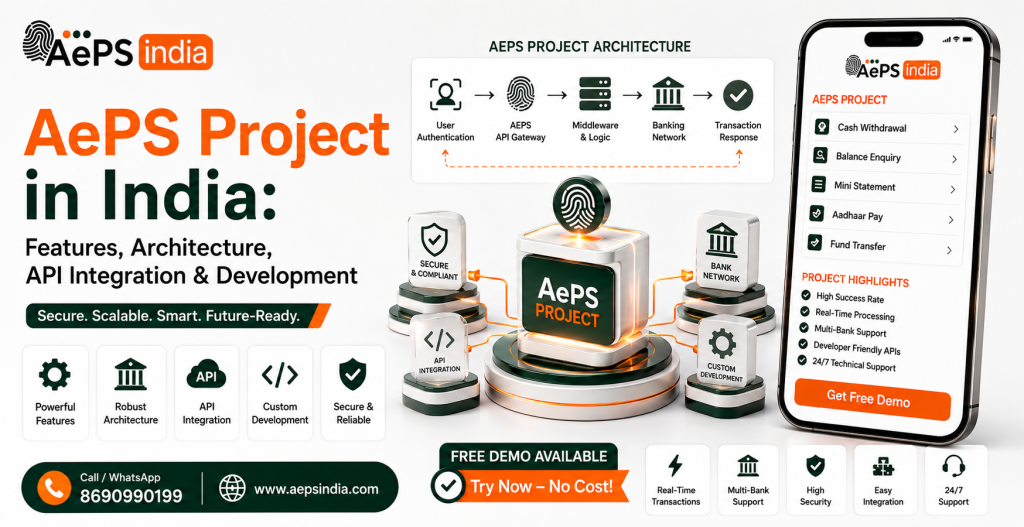
Are you looking to start an AePS Project and build your own AEPS Software, AEPS Admin Portal, or B2B AEPS platform? For fintech companies, digital payment businesses, retailers, distributors, and entrepreneurs, launching an AEPS business requires more than a basic website. You need a properly planned solution that brings together the required AEPS API integration, user management, transaction monitoring, retailer and distributor management, reporting, and business controls in one system.
An AePS Project is designed to help businesses create a platform for offering supported Aadhaar-enabled banking services through an organized Aeps software workflow. Depending on the project requirements and connected services, the Aeps platform can include functions such as cash withdrawal, balance enquiry, mini statement, Aeps agent onboarding, biometric transaction workflows, and transaction-status management.
The Aadhaar Enabled Payment System (AePS) is an India-centric, bank-led digital financial inclusion Aeps project developed by the National Payments Corporation of India (NPCI). It allows users to execute basic, secure banking operations using just their 12-digit Aadhaar number and biometric fingerprint authentication via local micro ATM or business correspondent operators.
The main challenge for many businesses is deciding whether to build everything from scratch or start with a ready made AEPS Software solution. A custom Aeps project designed around a specific business model, while a ready made Aeps platform may help businesses launch with pre-built modules and then add required customization. A complete Aeps solution can also include an AEPS Admin Panel for managing users, retailers, distributors, transactions, Aeps commission, wallets, reports, and other operational activities from a centralized dashboard.
AEPS India provides AEPS Project solution for businesses looking for AEPS Software, AEPS API Integration, AEPS Admin Software, and B2B AEPS platform development. The project can be planned according to your business requirements, existing best Aeps software, user hierarchy, required modules, and technical integration needs.
A well-planned AEPS Project should also focus on the complete implementation process not just the Aeps software interface. This includes understanding the business workflow, completing applicable Aeps onboarding requirements, integrating the required Aeps API, handling secure authentication and transaction responses, configuring callbacks where applicable, testing the integration, and preparing the best Aeps platform for deployment.
Whether you want to develop a custom AEPS Project, launch a B2B AEPS Software platform, integrate AEPS API into existing top Aeps software, or start with a ready made AEPS Software solution, choosing the right technology and Aeps software development approach is essential.
In this complete guide, you will learn what an AePS Project is, how AEPS Project works, what features are required, how AEPS API integrated is implemented, the role of an AEPS Admin Portal, the difference between ready-made and custom development, and how to choose the right AEPS solution for your business.
What is an AePS Project?
An AePS project refers to the implementation and deployment of the Aadhaar Enabled Payment System, a bank-led financial inclusion model developed by the National Payments Corporation of India (NPCI). It allows users to perform basic, cardless banking transactions using their Aadhaar number and biometric authentication (fingerprint or iris scan) via micro ATM device or business correspondents.
How Does an AePS Project Work?
An Aadhaar Enabled Payment System (AePS) project explores a bank-led model created by the National Payments Corporation of India (NPCI) that allows users to do basic banking tasks using their Aadhaar number and fingerprint biometrics through a micro-ATM or banking agent, without needing a physical debit card, pin, or signature.
What Services Can Be Included in an AePS Project?
An Aadhaar Enabled Payment System project includes core cardless, PIN-less banking services driven by biometric verification. Primary transaction offerings include cash withdrawals, balance inquiries, cash deposits, mini statements, and Aadhaar-to-Aadhaar fund transfers.
Core Financial Services
- Cash Withdrawal: Get money from an Aadhaar-linked bank account via a local business correspondent or micro ATM system.
- Cash Deposit: Add cash funds directly into an active, verified bank account.
- Balance Enquiry: Check available bank account balances instantly.
- Mini Statement: View recent transaction logs and short account histories.
- Fund Transfer: Move money securely between two Aadhaar-enabled bank accounts.
Merchant & Authentication Features
- BHIM Aadhaar Pay: Allow small shops and merchants to accept digital payments biometrically using the customer’s Aadhaar profile.
- eKYC Services: Run electronic Know Your Customer verifications for onboarding users to other financial products.
- Aadhaar Seeding Status: Check whether a bank account maps correctly to a specific Aadhaar identification number.
Types of AePS Projects
Aadhaar Enabled Payment System (AePS) projects are financial inclusion initiatives managed by the National Payments Corporation of India (NPCI). They allow users to do basic banking tasks using only their Aadhaar number and a fingerprint scan at local best micro ATM device or via banking agents.
Types of AePS Project Deployments and Use Cases
- Rural Cash Withdrawal & Deposit Projects: Let people in remote villages take out or put money into their bank accounts locally without traveling to a city bank.
- Direct Benefit Transfer (DBT) Schemes: Deliver government funds like MGNREGA wages, old-age pensions, and subsidies straight to citizen accounts.
- Micro-ATM and Banking Correspondent (BC) Projects: Turn local corner shops and rural kiosks into mini-banks using a smartphone and a fingerprint scanner.
- Micro Merchant Payment Projects: Help small rural business owners accept digital payments from customers using simple biometric scans instead of credit cards.
- Micro-Insurance & Loan Collection Projects: Enable field agents to collect insurance premiums and loan EMIs safely at a customer’s doorstep.
Documents Required for an AePS Project
To start an Aadhaar Enabled Payment System (AePS) project or register as an AePS merchant/agent, you need core KYC documents, business verification papers, and specific biometric hardware. The primary items required include your Aadhaar card, PAN card, bank settlement details, and a certified Aeps fingerprint scanner.
Personal & Identity KYC
- Aadhaar Card: Must be active and linked to your current mobile number for OTP validations.
- PAN Card: Mandatory for financial identification, tax tracking, and commission payouts.
- Passport-sized Photograph: Recent clear photo with a neutral background.
- Active Mobile Number & Email: Must be functional and linked with your Aadhaar profile.
Business & Address Proof
- Bank Account Details: First page of your bank passbook, a canceled cheque, or a recent bank statement for commission settlements.
- Shop or Business Proof: Utility bill (electricity or water), rent agreement, GST registration, or a Udyam/Shop & Establishment certificate.
Mandatory Technical Hardware
- Biometric Scanner: STQC-certified Aeps fingerprint or Aeps iris scanner (such as Mantra) compliant with Registered Device (RD) services.
- Computing Device: A working smartphone, tablet, or desktop/laptop with stable internet connectivity.
Who Needs an AePS Project?
An Aadhaar Enabled Payment System (AePS) project is needed by fintech companies, retail networks, microfinance institutions, and local service operators to provide cardless, biometric banking services like cash withdrawals and balance checks. It bridges financial gaps for rural and unbanked populations who lack standard debit cards or smartphones.
Who Benefits and Uses an AePS Project
- Fintech and Digital Banking Firms: Companies building custom financial best Aeps application need AePS system integration to offer secure, interoperable, cardless transaction services via mobile or terminal branded Aeps software.
- Local Retailers and Kirana Shops: Small shop owners use micro ATM hardware and top AePS software to turn their local stores into functional “mini-banks,” earning commissions on every cash withdrawal or balance inquiry.
- Microfinance Institutions (MFIs) and NBFCs: Non-banking lenders deploy AePS infrastructure to seamlessly disburse small loans and collect repayments directly in remote areas without physical bank branches.
- Common Service Centers (CSCs) and E-Mitra Outlets: Rural digital kiosk operators rely on Aadhaar authentication systems to deliver basic government and financial utilities to local citizens.
- Rural and Unbanked End-Users: Everyday residents without access to nearby brick-and-mortar bank branches, standard debit cards, or mobile banking tech use AePS touchpoints for basic financial access.
Why Need AePS Project
The Aadhaar Enabled Payment System (AePS) project is needed to drive financial inclusion by allowing people in rural or remote areas to perform cardless and PIN-free banking transactions such as cash withdrawals, deposits, and balance checks using only their Aadhaar number and fingerprint verification via local micro ATM and banking correspondents.
Key Reasons for the AePS Project
- Financial Inclusion: Brings essential banking services to unbanked and underserved rural populations without needing a physical bank branch nearby.
- Cardless and PIN-Free: Eliminates the need to carry debit cards, credit cards, or remember complex passwords/PINs.
- Biometric Security: Relies on unique fingerprint or iris authentication via the UIDAI database, making transactions highly secure and reducing fraud.
- Bank Interoperability: Allows any bank customer to use a top micro ATM or Business Correspondent (BC) operated by any participating member bank.
- Direct Benefit Transfers (DBT): Enables citizens to easily withdraw government subsidies, pensions, or welfare funds straight from their Aadhaar-linked accounts locally.
- Empowering Local Retailers: Turns regular neighborhood shops into top micro ATM software, helping local store owners earn extra Aeps commission income while serving their community.
What Is Included in an AePS Project?
An Aadhaar Enabled Payment System (AePS) software or portal project includes core banking transaction APIs, biometric scanner integration, multi-level user dashboards, and secure NPCI-compliant routing. It enables cardless, PIN-free financial services like cash withdrawals and balance checks using Aadhaar verification.
Technical & Software Components
- AePS API Integration: High-uptime payment gateways connecting securely with the National Payments Corporation of India (NPCI) and UIDAI.
- Biometric Device SDK: Support for certified fingerprint and iris scanners (RD Service integration).
- Multi-Tier User Dashboards: Separate interfaces for Aeps Admin, Distributors, Retailers, and Merchants to track volumes.
- Wallet & Commission Management: Automated calculation and credit of commissions per transaction.
Security & Compliance
- End-to-End Encryption: Securing sensitive data during transmission to prevent fraud.
- KYC & Regulatory Compliance: Adherence to statutory guidelines for Aeps agent onboard and audit trails.
AePS Project Integration With Other Fintech Services
Aadhaar Enabled Payment System (AePS) integration lets Aeps fintech platform bundle biometric, cardless cash withdrawals, balance checks, and mini-statements directly with services like BBPS utility bills, and micro-ATMs. This unified approach allows local retail networks to function as neighborhood banking hubs.
Key Fintech Services Integrated with AePS
- Domestic Money Transfer (DMT): Allows cash withdrawn via AePS fingerprint verification to be instantly routed into a digital wallet or transferred to any third-party bank account.
- Bharat Bill Payment System (BBPS): Enables customers to use cash-in-hand from an AePS withdrawal to immediately pay utility bills, mobile recharges, and insurance premiums at the same counter.
- Micro-ATM & Aadhaar Pay: Combines biometric Aadhaar authentication with debit card swipe options, giving agents backup rails if fingerprint matching fails.
- Neo-Banking & Prepaid Wallets: Automatically credits customer or agent wallets on a real-time T+0 settlement basis, powering instant liquidity management.
Core Technical & Compliance Architecture
- API & SDK Bridge: Employs RESTful JSON/XML endpoints over secure HTTPS channels to link merchant apps with the National Payments Corporation of India (NPCI) switch.
- Registered Device (RD) Services: Requires UIDAI-compliant, STQC-certified L1 biometric fingerprint or iris scanners to securely encrypt the PID data block at the hardware level.
- Centralized KYC: Enforces enhanced Aeps video KYC and biometric agent onboarding protocols to satisfy regulatory mandates.
Key Aspects of AePS Project
The Aadhaar Enabled Payment System (AePS) is a bank-led model managed by the National Payments Corporation of India (NPCI). It allows users to perform cardless, PIN-free financial transactions at local best micro ATM software or Business Correspondent (BC) touchpoints using only their 12-digit Aadhaar number and biometric verification.
Security & Technology
- Biometric Authentication: Uses unique Aeps fingerprint or Aeps iris scan device verified securely through UIDAI records.
- No Cards or PINs Needed: Completely eliminates physical debit/credit cards, passwords, or memory-based PINs.
- Real-Time Routing: Centralized switching via NPCI ensures fast validation and immediate transaction feedback.
Accessibility & Inclusion
- Interoperable Network: Allows customers of any participating bank to use an agent or branded micro ATM terminal belonging to a completely different bank.
- Rural Empowerment: Turns local mom-and-pop shops into neighborhood micro-banks, bridging gaps in remote areas lacking traditional brick-and-mortar infrastructure.
- Government Subsidies: Simplifies direct receipt and withdrawal of welfare payouts and social security benefits (like MGNREGA) at the grassroots level.
AePS Project for B2B Businesses
A B2B AePS Portal project allows Aeps india to offer cardless, biometric-based banking services such as cash withdrawals, balance checks, and mini-statements via the NPCI network by connecting local retailers and best micro ATM system using Aadhaar authentication.
Key Features
- Admin & White-Label Panels: Complete structural hierarchy to run master distributor, super distributor, and retailer networks under custom branding.
- Biometric Integration: Secure STQC-certified fingerprint or iris scanner SDK compatibility (Mantra).
- Real-Time Settlement: Instant wallet credit and automated commission splits for every transaction.
- Multi-Service API: Unified access layer linking best AePS API alongside best BBPS.
Core Business Benefits
- New Revenue Streams: Earn per-transaction commissions and service fees.
- Expanded Footfall: Attract walk-in customers to local shop networks for essential banking.
- Financial Inclusion: Bring basic micro-banking services to underserved and rural regions.
How to Start Your AePS Project With Aeps india
To start Aadhaar Enabled Payment System project or business, you need a registered business identity, an Android smartphone or PC, a certified L1 Aeps biometric fingerprint scanner, and an official tie-up with an Aeps india to integrated AePS API and complete your KYC.
Setup Steps
- Choose a AEPS India: Register with an authorized AEPS India to obtain your agent credentials or Aeps API documentation.
- Complete Verification: Submit your KYC documents online or via video verification to activate your unique merchant or agent login ID.
- Install Hardware & Software: Download the partner’s official mobile Aeps app or Aeps portal software. Install the required Registered Device (RD) service driver for your Aeps fingerprint scanner.
- Go Live: Log in, map your settlement bank account following current regulatory guidelines, perform an initial biometric self-authentication, and begin processing cash withdrawals, balance checks, and mini-statements for customers.
AePS Project Architecture
AEPS Project System Architecture
Comprehensive End-to-End Technical Framework for Aadhaar Payments
Features of AePS Project
The Aadhaar Enabled Payment System (AePS), built by the National Payments Corporation of India, is a bank-led model that allows cardless, PIN-free financial transactions. It uses a 12-digit Aadhaar number and biometric verification (fingerprint or iris scan) via local trusted micro ATM or business correspondents.
Core Transaction Features
- Cardless and PIN-free: No physical debit cards, credit cards, or passwords are required to complete a transaction.
- Biometric Verification: Uses secure fingerprint or iris scans matched with UIDAI data to confirm identity.
- Multiple Banking Services: Supports cash withdrawals, cash deposits, balance checks, mini statements, and Aadhaar-to-Aadhaar fund transfers.
- Interoperable Network: Allows customers of any participating bank to use micro ATM machines or banking kiosks managed by any other bank.
Strategic & System Features
- Financial Inclusion: Extends basic financial access to rural, remote, and unbanked populations who lack traditional banking infrastructure.
- Assisted Model: Operates through authorized local operators, Business Correspondents (BCs), and small shopkeepers turned into micro ATM Machine.
- Real-Time Processing: Validates and executes every request instantly through secure data encryption and central routing systems.
Benefits of AePS Project
The Aadhaar Enabled Payment System (AePS) is a bank-led model that lets people perform basic banking tasks such as cash withdrawals, deposits, and balance checks using just their 12-digit Aadhaar number and fingerprint scan at local micro ATMs or micro-banking touchpoints. It completely removes the need for physical debit cards, smartphones, or secret PINs.
Key Benefits of AePS
- Cardless and PIN-Free: Users do not need to memorize a PIN, password, or carry a debit card. A simple fingerprint scan verifies the transaction.
- Financial Inclusion: It brings essential banking services directly to rural, unbanked, and underserved areas where physical bank branches are far away.
- High Security: Biometric authentication (fingerprint or iris) matches data safely through UIDAI, making it very difficult for strangers to commit fraud or steal identities.
- Bank Interoperability: Customers of any participating bank can use an AePS-enabled micro-ATM or banking correspondent, no matter which bank manages their account.
- Easy Government Disbursements: It simplifies receiving government benefits, pensions, and subsidies directly into the correct bank account without middlemen.
- No Smartphone Needed: People who do not own smart devices or have internet skills can still securely complete financial tasks through local neighborhood shop agents.
AePS API Integration in an AePS Project
Aadhaar Enabled Payment System API integration connects your software platform to the National Payments Corporation of India (NPCI) network. This allows users to run cardless cash withdrawals, mini-statements, and balance checks using biometric authentication.
Choose a Certified AEPS India
- Select an NPCI-certified Aeps india.
- Review uptime records, multi-bank support, and Aeps commission structures.
Complete Business Verification and KYC
- Submit business proofs, PAN card, and Aadhaar details for Aeps merchant onboarding.
- Finish the Business Correspondent (BC) registration and sign the legal agreement.
Set Up Biometric Hardware
- Buy Aeps fingerprint or buy Aeps iris scanner (such as Mantra).
- Register the hardware online and install the official Registered Device (RD) service driver.
Obtain API Credentials
- Receive your Aeps Merchant ID (MID), secret tokens, and Aeps API endpoint URLs from Aeps india.
- Whitelist your static production server IP address with the Aeps india.
Technical Development
- Frontend: Build a user interface to capture the customer’s 12-digit Aadhaar number, bank IIN (Institution Identification Number), and transaction type.
- Biometric Capture: Trigger the RD service to get encrypted
PidDatafrom the hardware. - Backend: Send the payload via a secure REST/JSON or SOAP endpoint and configure an HTTPS callback URL for real-time status.
Sandbox Testing and Go-Live
- Run test scenarios for successful transactions, invalid biometrics, and bank-downtime errors in the sandbox.
- Switch to Aeps API live production endpoints to launch the service.
AePS Project Development Process
The AePS project development process involves partnering with an Aeps india, completing business KYC, integrating secure RESTful Aeps API connecting STQC-certified Aeps biometric hardware, and testing transaction flows (cash withdrawal, balance inquiry, mini-statements) in a sandbox environment before production go-live.
1. Planning and Vendor Selection
- Choose an Aeps india.
- Define target use cases (cash withdrawal, balance check, mini-statement, or fund transfer).
- Outline the infrastructure, including secure dedicated servers and network protocols.
2. Compliance and Onboarding
- Submit company PAN, Aadhaar, address proof, and settlement bank account details.
- Clear the required business correspondent (BC) verification and due diligence checks.
- Sign commercial and service-level agreements (SLAs) with the Aeps india.
3. Hardware Procurement and Integration
- Procure STQC-certified L1 Aeps biometric fingerprint or L1 Aeps iris scanners.
- Install and configure Registered Device (RD) services to capture raw biometric impressions securely.
- Link device drivers with mobile or web frontends.
4. Software and API Development
- Build or update the user interface (UI) to capture the 12-digit Aadhaar number, bank IIN (Institution Identification Number), and transaction type.
- Implement backend logic via the AEPS API Integrating Layer to encrypt biometric data securely.
- Connect endpoints to route requests through the sponsor bank, NPCI switch, and UIDAI.
5. Testing and Deployment
- Test transaction requests and responses in a restricted sandbox environment.
- Perform security audits for PCI-DSS and UIDAI data compliance.
- Move Aeps API credential to the live production environment for real-time transaction processing.
AePS Retailer Onboarding Process
The AePS retailer onboarding process requires registering with an authorized Aeps india, completing full Aeps KYC verification with your PAN and Aadhaar cards, and linking a purchase Aeps biometric fingerprint or purchase Aeps iris scanner to start processing safe customer transactions.
Registration and KYC Submission
Choose a registered Aeps india.
Sign up on their mobile app or web portal using your basic details and shop address.
Upload digital copies of your PAN card, Aadhaar card, and bank account proofs.
Verification and Compliance
- Complete your own agent e-KYC using a fingerprint scan via the Aeps b2b portal.
- Pass background security checks as mandated by current regulatory rules.
- Await account approval, which generally takes 24 to 48 hours to generate your official retailer login credentials.
Verification and Compliance
- Complete your own agent e-KYC using a fingerprint scan via the Aeps admin portal.
- Pass background security checks as mandated by current regulatory rules.
- Await account approval, which generally takes 24 to 48 hours to generate your official retailer login credentials.
Device Setup and Activation
- Purchase Aeps biometric scanner (such as a fingerprint or iris device).
- Install the respective Registered Device (RD Service) driver on your smartphone or computer.
- Log into your Aeps dashboard and test a small transaction to activate cash withdrawal and balance check services.
How Much Does an AePS Project Cost?
The total cost of developing Aadhaar Enabled Payment System project generally ranges from ₹12,000 to over ₹4,500,000, heavily depending on whether you choose a turnkey ready-made solution or build a custom architecture linked directly to a bank.
Cost Breakdown by Project Type
The Aeps projects development path you choose dictates the vast majority of your initial financial layout:
- Standard API Integration (₹12,000 – ₹35,000): A one-time Aeps API setup fee to integrate standard AePS functionalities (cash withdrawals, balance inquiries, mini-statements) into your existing website or Aeps B2B application.
- White-Label / Ready-Made Portal (₹15,000 – ₹120,000): Ideal for businesses wanting an immediate, pre-built Aeps B2B admin panel outfitted with their own brand name and logo. This configuration allows you to immediately manage and distribute sub-distributor and retailer Aeps ID.
- Custom / Direct Bank Integration (₹250,000 – ₹450,000+): Tailored, premium enterprise Aeps API setup designed to interface directly with authorized settlement banks (such as ICICI Bank or Yes Bank) for higher transaction success rates and complete Aeps b2b platform control.
Core Cost Components
| Cost Component | Pricing Range (Estimated) | Frequency | Description |
|---|---|---|---|
| API Setup / License | ₹12,000 – ₹120,000 | One-time | Core software licensing, branding, and Aeps API documentation integration. |
| Annual Maintenance (AMC) | ₹9,999 – ₹40,000 | Recurring (Annual) | Covers server upkeep, 24/7 technical support, and critical security compliance updates. |
| Biometric Scanners (L1) | ₹1,500 – ₹3,000 per unit | One-time per agent | Required hardware for Aadhaar fingerprint verification (e.g., Mantra devices). |
| Micro ATM Hardware | ₹10,000 – ₹15,000 per unit | Optional | Handheld hardware extensions for debit card transactions alongside AePS. |
Transaction and Operational Fees
Running an AePS platform introduces minor variable costs alongside standard profit structures:
- Per-Hit Costs: Aeps Service Platform owners face structural charges of ₹0.50 to ₹1.50 per cash withdrawal or nominal charges of ₹0.10 to ₹0.30 for mini-statements and balance queries.
- Failed Transactions: Aeps india levy a flat charge of roughly ₹0.50 for un-authenticated biometric matches or failed network timeouts.
- Working Capital: If you plan on operating your own retail or agent network points, a minimum liquid balance of ₹10,000 to ₹20,000 must be kept accessible daily per active location to handle physical cash-outs.
AePS Project Commission and Revenue Model
An AePS project operates on an incentive-based, tiered revenue model Aeps india split transaction interchange fees. Retailers earn a direct Aeps commission of ₹2 to ₹20+ per cash withdrawal, with highest earnings on slabs between ₹3,000 and ₹10,000.
Commission Structure
- Cash Withdrawals (Slab-based):
- ₹100 – ₹999: ~₹2.00 commission
- ₹1,000 – ₹1,499: ~₹3.00 commission
- ₹2,000 – ₹2,499: ~₹5.50 commission
- ₹3,000 – ₹10,000: ₹13.00 to ₹15.00+ commission (Highest Slab)
- Balance Inquiry & Mini-Statements: Fixed nominal payouts ranging from ₹0.50 to ₹5.00 per successful request.
- Aadhaar Pay: Earn up to roughly 1% on merchant transactions or high-value limits up to ₹50,000.
- Volume Incentives: Monthly performance bonuses (e.g., ₹2,000 extra) for completing high transaction targets like 150–200+ scans.
Revenue Flow & Business Model
- Value Chain Share: Funds originate from NPCI interchange configurations, flowing downstream from the Acquirer Bank → API Service Provider → Master Distributor → Retailer/Agent.
- Cross-Selling & Footfall: Local shops act as a digital mini-bank, increasing storefront traffic which yields a 20%+ secondary increase in core retail sales.
- Settlement Dynamics: Income relies heavily on fast liquidity turnover via instant cash-out mechanisms like T+0 (same day) or T+1 (next day) wallet settlements.
AePS Transaction Flow
AEPS Transaction Flow Process
The Customer provides their Aadhaar number and selects the service (Withdrawal/Balance Inquiry) to the Business Correspondent (BC).
The BC Agent captures the fingerprint using a certified biometric device. This data is encrypted and sent to the portal.
The request is forwarded to NPCI (National Payments Corporation of India), which identifies and routes the request to the correct linked bank.
The Bank sends the biometric data to UIDAI for verification. Once matched, the identity is confirmed.
The Bank Server (CBS) checks for sufficient funds and debits the account, sending a success response back to the BC.
The BC Agent provides the cash to the Customer, and a digital receipt is generated.
AePS Project Transaction Limits and Settlement
The National Payments Corporation of India (NPCI) caps standard Aadhaar Enabled Payment System (AePS) cash withdrawals at ₹10,000 per transaction, with daily customer limits around ₹50,000. Daily cut-off for operational settlement happens at 11:00 PM IST, and agent fund payouts occur via immediate (T+0) or scheduled banking cycles.
Transaction Limits
- Cash Withdrawal: Maximum ₹10,000 per single transaction.
- Aadhaar Pay (Merchant): Up to ₹50,000 per transaction.
- Daily Frequency: Generally capped at 3 to 5 biometric authentication attempts per user/day.
- Issuing Bank Caps: Individual banks may apply lower cumulative daily or monthly thresholds based on customer risk profiles.
Settlement Process
- Daily Cut-off: Daily transaction balancing cuts off at 11:00 PM IST; entries recorded prior are processed in that day’s cycle.
- Agent Payouts (T+0 / IMPS / NEFT): Aeps india is an micro ATM provider receive funds through instant IMPS/UPI-based T+0 settlements or deferred institutional T+1/T+2 bank transfers depending on their Aeps commission platform configuration.
- Working Capital Cycle: Faster real-time (T+0) settlements reduce liquidity crunch for retail operators handling continuous cash-out demands.
AePS Project Admin Panel and Dashboard
An Aadhaar Enabled Payment System Admin Panel and Dashboard is a centralized web and mobile backend system used by Aeps india to manage micro-banking networks, track biometric transactions, and configure tiered commission structures.
Core Dashboard Features
- Real-Time Monitoring: View live transaction logs for cash withdrawals, balance inquiries, mini-statements, and Aadhaar Pay.
- User Hierarchy Management: Control multi-level networks including Super Distributors, Distributors, and Retailers/Agents.
- KYC & Onboarding: Approve or reject agent document submissions and map biometric devices.
- Commission Slabs: Set customized, tiered commission and surcharge rules for every user tier.
- Wallet & Settlements: Monitor master wallet balances, credit limits, and automated bank settlements.
Key Modules
- Transaction Reports: Trace failures and check unique Retrieval Reference Numbers (RRN).
- Role-Based Access (RBAC): Assign restricted views for support staff, accountants, or regional managers.
- API Management: Integrate banking APIs (like ICICI, YES Bank, or NSDL) and supplementary services like BBPS or money transfers.
Security and Compliance Considerations for an AePS Project
An Aadhaar Enabled Payment System (AePS) project requires strict adherence to regulations from the Reserve Bank of India (RBI) and the National Payments Corporation of India (NPCI). Key protocols involve mandatory full KYC for touchpoint operators, the “One Operator, One Bank” mapping rule, and the exclusive use of STQC-certified L1 Aeps biometric hardware with end-to-end data encryption.
Regulatory and Operator Compliance
- Full Operator KYC: Conduct rigorous verification and background checks for all Aadhaar Touchpoint Operators (ATOs) prior to onboarding.
- One Operator, One Bank: Enforce strict mapping where each agent operates under a single designated acquiring bank to minimize distributed fraud exposure.
- Reactivation Re-KYC: Automatically deactivate agent profiles and require fresh, full KYC verification if an operator remains inactive for three consecutive months.
- Step-Up Authentication: Implement secondary Aadhaar-based OTP verification alongside biometric scans for cash withdrawals or high-risk requests exceeding ₹5,000.
Hardware and Data Security
- L1 Biometric Devices: Ban legacy L0 scanners and mandate STQC-certified L1 Registered Devices featuring built-in liveness detection to prevent spoofing.
- Zero Data Retention: Ensure raw biometric templates, full Aadhaar numbers, and PIN blocks are never stored locally on merchant terminals or Aeps app caches.
- End-to-End Encryption: Encrypt capture blocks at the hardware level using advanced protocols (AES-256/RSA) directly routed through secure SSL/TLS channels.
Transaction Monitoring & Risk Management
- Step-Up Authentication: Enforce mandatory secondary Aadhaar-based OTP verification alongside fingerprints for cash withdrawals over ₹5,000.
- API Isolation: Design Aeps API endpoints exclusively for AePS workflows, preventing unregulated cross-use with other services
- Real-Time Surveillance: Implement automated risk profiling to flag anomalous transaction velocity, volume, or location drifts.
White Label AePS Project
A White Label AePS project is a ready-made, customizable digital Aeps banking platform. It lets you launch biometric cash withdrawals, balance checks, and mini-statements under your own company brand, logo, and domain name without building the complex backend technology from scratch.
Core Services Included
- Cash Withdrawals: Customers use Aadhaar and a fingerprint scan to withdraw money.
- Balance & Mini Statements: Quick bank account checks.
- Aadhaar Pay / Fund Transfers: Moving money between accounts.
- Value-Added Services: Often bundled with BBPS Software, mobile recharge.
AePS Project vs AePS Software vs AePS API
An AePS Project refers to a comprehensive business plan or deployment strategy for rolling out Aadhaar banking services. An Trusted AePS Software is a ready-made or custom web/app portal equipped with a user interface, best Aeps admin panel, and agent management. An top AePS API is the backend code bridge that connects that Aeps earning software to banking switches for biometric verification.
Key Differences
| Feature / Aspect | AePS Project | AePS Software | AePS API |
|---|---|---|---|
| Definition | End-to-end business implementation plan and operational framework. | Turnkey application, web portal, or mobile app with dashboards. | Backend endpoint set (JSON/REST) for direct code connection. |
| Primary Use | Strategic planning, budgeting, legal compliance, and agent hiring. | Retail operations, managing retailer/distributor ledgers and commissions. | Transmitting encrypted biometric/Aadhaar data to the server. |
| Target User | Business founders, bank partners, and corporate strategists. | Retailers, distributors, and field agents (BCs). | Software developers and technical teams. |
| Components | Licensing, vendor selection, marketing, cash logistics. | UI/UX, wallet systems, report generation, multi-device support. | Request payloads, response codes, RD-service integrations. |
| Cost Scope | High (Total capital investment, staffing, and setup). | Medium (White-label licensing fees: ₹15,000 to ₹1.2 Lakhs). | Lower or bundled (Setup fees: ₹12,000 to ₹35,000). |
How to Choose an AePS Project Development Company
Aeps india is an AEPS project development company, prioritize compliance with NPCI and UIDAI guidelines, a high transaction success rate (99%+), strong L0/L1 biometric device integration, instant (T+0) settlement mechanisms, and robust 24/7 technical support.
Security and Compliance
- Regulatory Approval: Ensure the Aeps developer builds on infrastructure that aligns with NPCI and RBI Authorization mandates.
- Biometric Standards: The Aeps system must support L0 and L1 certified fingerprint and iris scanners.
- Data Encryption: Look for end-to-end TLS/SSL data packet encryption to prevent transaction fraud.
Performance and Reliability
- Uptime Stability: Aeps india who promise at least 99.9% system uptime to prevent local shop downtime.
- Failover Routing: Multi-bank routing features automatically bypass single-bank server outages.
- Fast Processing: Best Aeps System responses must process within 2 to 3 seconds for retail efficiency.
Business and Financial Features
- Commission Margins: Check the profitability and transparency of per-transaction Aeps commission structures.
- Settlement Speed: Real-time or same-day (T+0) fund settlements protect merchant liquidity.
- Panel Management: Look for comprehensive best Aeps admin, distributor, and Aeps retailer dashboard hierarchies.
Why Choose AEPS India for Your AePS Project?
Aeps india one of the best AEPS provider for your project, prioritize bank-grade security and compliance with NPCI and UIDAI guidelines, high transaction uptime (99%+), instant T+0 fund settlements, competitive agent commission margins, and robust developer Aeps API documentation.
Security and Regulatory Compliance
- NPCI certification: Ensure the Aeps commission platform complies with official safety protocols.
- Data protection: Look for end-to-end encryption for biometric data transfers.
- Device support: Verify compatibility with STQC-certified L1/L2 Aeps biometric scanners.
Performance and Reliability
- Uptime guarantee: Aeps india providing 98% to 99.9% uptime to prevent transaction drops.
- Multi-bank routing: Switch automatically between banking pipes to maintain transaction success rates.
- Fast processing: Keep transaction times down to a few seconds.
Financial and Operational Terms
- Settlement speed: Opt for real-time or T+0 settlements to keep cash flow active.
- Commission structures: Compare per-transaction earnings versus hidden Aeps platform fees.
- Technical support: Confirm the availability of round-the-clock technical assistance.
Conclusion – Build the Right AePS Project for Your Business
An AePS Project can help fintech companies, digital payment businesses, distributors, and entrepreneur-led networks build a centralized platform for managing supported Aadhaar-enabled banking services. However, the real value of an AePS project depends on choosing the right combination of best AePS API integration, Aeps software architecture, Aeps admin control, retailer management, transaction monitoring, reporting, and technical support.
For businesses planning to launch or expand an AePS project, the best approach is to start with the actual business model and technical requirements. A complete solution may include top AePS API integration, latest AePS software, an branded Aeps admin panel, retailer and distributor management, wallet management, commission configuration, transaction monitoring, reports, and white label Aeps customization. A multi-level structure can help businesses manage different users and operational workflows from a centralized platform.
The Aadhaar Enabled Payment System (AePS) is a bank-led digital service project in India. Developed by the National Payments Corporation of India (NPCI), it lets people use their 12-digit Aadhaar number and fingerprint to do basic banking tasks without cards, PINs, or smartphones.
Before choosing an AePS project, evaluate important factors such as secure Aeps API integration capability, retailer and distributor management, transaction-status handling, Aeps wallet and Aeps commission management, reporting, security controls, scalability, customization, testing, and technical support. A structured integration and testing process is important before deploying the Aeps platform live operations.
AEPS India provides AePS Project development and AePS Software solutions for businesses looking for either a ready-to-use Trusted Aeps platform or a solution configured around their specific requirements. Whether you want to integrating AePS API into existing Aeps commission software, launch AePS B2B Portal, build AePS Admin Panel, or create a branded White Label AePS Software platform, the right Aeps setup should be selected according to your business workflow and technical needs.
Ready to start your AePS Project? Contact AEPS India to discuss your requirements, explore ready made AePS Software, plan a custom AePS project, or get guidance for AePS API integration and a suitable admin management solution.
Start Your AePS Project With AEPS India
Ready to start your AePS project? Discuss your requirements with the AEPS India team and explore a suitable AePS solution for your business. Get project guidance, development support, and assistance based on your business requirements.
Frequently Asked Questions About AePS Project
An AePS Project is a software-based solution developed for businesses that want to offer Aadhaar Enabled Payment System services through their own platform. Depending on the business model and authorized service arrangements, an AePS project can include AePS API integration, an top Aeps admin panel, retailer and distributor management, transaction monitoring, wallet management, commission management, reports, and white label Aeps branding.
A complete AePS Software Project can be developed according to your business requirements. Common modules include:
AePS API integration
AEPS Admin Panel
Retailer and distributor portal
User and role management
Transaction monitoring
Wallet and ledger management
Commission management
Settlement and reconciliation workflows
Reports and analytics
Security and access controls
The exact modules should be defined based on the business model, technical requirements, and applicable partner requirements.
Yes. A business may choose a ready-made AePS software solution when it needs a faster starting point instead of building every module from scratch. A ready made Aeps solution can then be configured or customized according to supported business requirements, such as branding, user hierarchy, admin controls, and additional software modules.
Yes. AEPS India can provide an AePS project based on specific business requirements. A custom project may include a tailored AEPS Admin Portal, retailer and distributor hierarchy, AEPS API integration, wallet and commission modules, reports, and business-specific workflows.
Yes, if your existing website, mobile Aeps application, or secure Aeps software is technically compatible with the required integration. The process generally involves top Aeps API documentation, authentication, request and response handling, transaction-status management, testing, and production deployment according to the Aeps india.
The services available depend on the Aeps india and the specific integration. NPCI currently lists services including cash withdrawal, cash deposit, fund transfer, balance inquiry, mini statement, authentication services, and BHIM Aadhaar Pay API, subject to the applicable operating model and availability.
Yes. An AEPS Admin Panel can be a central part of an AePS project. It can help authorized administrators manage users, retailers, distributors, transactions, commissions, wallets, reports, and other operational settings from one dashboard.
Yes. A B2B-focused AePS Management Software can support a multi-level hierarchy, allowing the business to manage retailers, distributors, master distributors, or other authorized user levels. Features may include Aeps onboard workflows, access controls, transaction visibility, commission configuration, and reporting.
Depending on the selected solution, White Label AePS Software can support your own business branding, such as your company name, logo, domain, and supported interface customization. The exact branding and customization scope should be confirmed before best Aeps software development or purchase.
A professional AePS Project should be designed with appropriate security controls, such as secure authentication, role-based access, protected Aeps API communication, activity logging, transaction monitoring, and controlled access to sensitive functions. The final implementation must also follow the applicable requirements of the relevant banks, authorized partners, and the AePS ecosystem.
The cost of an AePS Project depends on several factors, including whether you choose ready-made AePS software or custom Aeps software development, the required modules, reliable Aeps API integration requirements, Aeps admin panel features, user hierarchy, white-label customization, hosting, support, and maintenance. A requirement-based quotation is generally more useful than a single fixed price.
An AePS project can be suitable for fintech startups, B2B payment businesses, digital service providers, retailer networks, distributors, and businesses planning to build a digital banking platform. Before starting, the business should assess its technical requirements, target users, operating model, and applicable onboarding and compliance obligations.
Development time depends on the project scope. A ready-made AePS software solution may require less implementation time, while a custom project can take longer because of requirement analysis, top Aeps software development, fast Aeps API integration, testing, customization, and deployment.
Depending on your business requirements and available integrations, an high volume AePS platform may also be designed to manage additional fintech services, such as Best BBPS Software, mobile recharge, payout, or other supported digital payment modules from a centralized Aeps platform.
Start by sharing your requirements with AEPS India, including your business model, preferred user hierarchy, required software modules, existing platform details, Aeps API requirements, and branding needs. Based on these requirements, you can discuss whether a ready-made AePS solution, custom AePS software, AEPS Admin Panel, or AEPS API integration is the right option for your business.
AEPS in Banking in India – Complete Guide
AePS App in India 2026: Features, Commission & Full Setup Guide
Aadhaar Enabled Payment System API Explained: Complete Guide
About Author

