AEPS API Transaction Status Check: Pending, Success & Failed Transactions
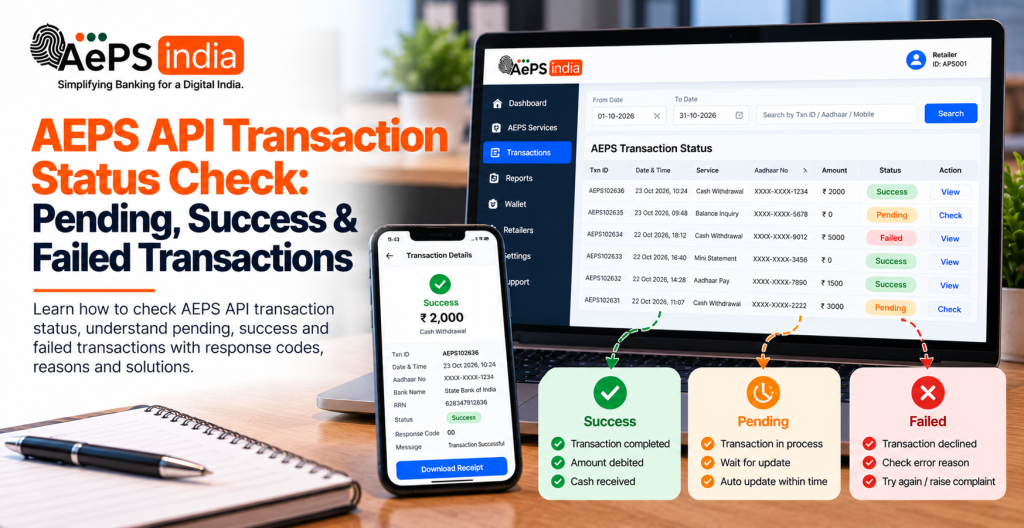
AEPS API Transaction Status Check helps businesses verify the outcome of Aadhaar Enabled Payment System (AEPS) transactions when an initial request does not return a clear final response. For AEPS retailers, distributors, fintech platforms, and software providers, checking transaction status is important for identifying successful, failed, pending, or unresolved transactions and maintaining accurate transaction records.
An AEPS transaction may remain pending because of a network interruption, delayed response, or a problem during transaction processing. In such cases, a status enquiry can help retrieve the available transaction result using the required reference details. Businesses should verify the existing transaction before attempting it again, as blindly repeating a request can create duplicate-processing risks or customer disputes.
An AEPS API Transaction Status Check allows Aeps developers and fintech platforms to query the final status of an Aadhaar Enabled Payment System (AePS) transaction using its unique transaction ID or reference number.
When integrating an AEPS API Transaction Status Check feature, businesses should understand the Aeps API documentation, required transaction identifiers, response codes, error-handling process, and security requirements. A well-planned workflow can help applications update transaction records, investigate failures, reconcile retailer accounts, and handle cases where the reported status differs from the customer’s experience.
AEPS India provides a relevant starting point for businesses exploring AEPS services and transaction workflows. Before implementing a status-enquiry feature, confirm the Best Aeps API availability, supported request parameters, response fields, and integration requirements for your specific project.
In this guide, you will learn how AEPS transaction status enquiry works, which details are needed to check a transaction, how to handle pending or failed responses, and what to consider when integrating transaction-status functionality into an AEPS platform.
What Is AEPS API Transaction Status Check?
An AEPS API Transaction Status Check is a specialized function (endpoint) in an Aadhaar Enabled Payment System Application Programming Interface that allows Aeps fintech platforms, banks, or merchants to query the real-time status of a previously initiated AEPS transaction (such as a cash withdrawal, balance enquiry, or mini statement).
AEPS API Transaction Status Check Work?
An AEPS (Aadhaar Enabled Payment System) API transaction status check allows fintech applications and merchants to verify whether a cash withdrawal, balance inquiry, or mini-statement request succeeded, failed, or timed out.
How AEPS Transaction Status Check Works
- Trigger/Request: The merchant or Aeps developer platform calls the Aeps india status inquiry endpoint using unique parameters such as the transaction ID, customer Aadhaar number, or timestamp.
- NPCI & Bank Routing: The query passes through the Aeps india to the National Payments Corporation of India (NPCI) switch and the issuer bank’s core banking system to check the latest ledger status.
- Response Parameters: The top Aeps API returns standard response fields:
- status: Indicates SUCCESS, FAILED, or PENDING.
- statusDesc: Descriptive error or success message (e.g., Invalid merchant code or Transaction Approved).
- txnType: Type of operation (e.g., AEPS_BALANCE_ENQUIRY, AEPS_CASH_WITHDRAWAL).
- txnDateTime / createdDate: Timestamp of the transaction.
Types of AEPS Transaction Status
An Aadhaar Enabled Payment System (AePS) transaction status indicates the real-time processing and completion state of a request through the Transaction Status Enquiry or banking terminal.
Main Types of AEPS Transaction Statuses
- Success (SUCCESS /
0): The biometric authentication via UIDAI and the bank-side core banking system (CBS) cleared the request. The financial or non-financial action (such as cash withdrawal, balance enquiry, or mini statement) completed successfully, and an SMS confirmation is typically triggered. - Failed (FAILED): The transaction could not be processed due to reasons such as biometric mismatch, invalid Aadhaar/bank mapping, insufficient funds, or technical timeouts. If an amount was debited during a failed transaction, it is typically auto-reversed by the NPCI/issuer bank guidelines (usually within 5 working days).
- Pending / In-Process: The transaction request was logged and transmitted through the NPCI central switch, but the final response from the issuer bank or UIDAI is delayed or awaiting reconciliation.
- Declined / Rejected: The transaction was explicitly blocked or denied by the switch or issuer bank for instance, if top AePS service is disabled on the account due to inactivity over 12 months or security flags.
When Should You Use an AEPS Transaction Status Check API?
You should use an Aadhaar Enabled Payment System (AEPS) Transaction Status Check API whenever a transaction response times out, drops due to network connectivity issues, or returns an ambiguous/pending state instead of a clear success or failure confirmation.
When to Use the Status Check API
- After a Network Timeout or Drop: When the connection breaks between the micro-ATM/merchant terminal, Aeps india, the National Payments Corporation of India (NPCI), and the customer’s issuer bank before a final response is received.
- Handling Pending or Indeterminate Responses: When the core banking system or switch returns a PENDING or IN-PROGRESS status code, requiring verification before dispensing cash or reversing funds.
- Reconciliation and Settlement Audits: During end-of-day (EOD) matching or automated reconciliation scripts to verify whether borderline or disputed transactions actually debited the customer’s account or failed.
- Resolving Customer Disputes: When a customer claims their account was debited (via SMS or bank alert) but the retailer terminal did not print a receipt or complete the cash payout.
Key Information Required for AEPS API Transaction Status Check
An AEPS API transaction status check requires specific authentication credentials, tracking identifiers, and request parameters to query the server.
Key Information Required in the Request
Merchant / Partner Credentials:
- Merchant ID (MID) / Agent ID: Unique identifier assigned to the Aeps india.
- API Key / Client Secret: Cryptographic key or token used to authenticate the API request.
Transaction Identifiers (At least one is usually mandatory):
- Order ID / Request ID: The internal tracking or reference ID generated by your system when the transaction was first initiated.
- RRN (Retrieval Reference Number) / UTR: The unique bank or NPCI reference number generated during the transaction switch.
Optional / Contextual Filters:
- Transaction Date / Timestamp: Date or date range of the transaction to narrow down server logs.
- Customer Identification (Masked Aadhaar): Aeps Service API, the masked 12-digit Aadhaar number (xxxx-xxxx-xxxx) is required for verification.
- Product / Operation Type: Specifying whether it is an fast AEPS service, AEPS_BALANCE_ENQUIRY, or AEPS_CASH_WITHDRAWAL.
How to Integrate an AEPS Transaction Status Check API
Integrating an AePS Transaction Status Check API allows your B2B Aeps platform to query the real-time status of a financial transaction (such as a cash withdrawal, balance inquiry, or mini-statement) using identifiers like your internal order ID, transaction reference number (RRN/UTR), or original timestamp.
Step 1: Prerequisites & Compliance
Before writing code, ensure your system meets NPCI and regulatory requirements:
- API Partner / Aggregator: Partner with an Aeps india to receive your production/sandbox credentials.
- Authentication Headers: Most gateways require OAuth 2.0, JWT tokens, or HMAC SHA-256 signatures with whitelisted static IPs.
- Merchant Onboarding: Ensure the specific retailer or merchant ID (user_code / merchant_id) is active and KYC-verified.
Step 2: Understand the Request Structure
When a transaction hangs, drops, or times out, your backend calls the status inquiry endpoint. You typically send a POST or GET request containing your unique reference parameters:
- Endpoint Example: Provided by your Aeps india.
- Request Body Parameters (JSON):json{ “partnerId”: “YOUR_PARTNER_ID”, “orderId”: “INTERNAL_ORDER_12345”, “clientTxnId”: “TXN_20261026_9982”, “txnDate”: “2026-10-26” } Use code with caution.
Step 3: Handle the API Response
The gateway returns a JSON payload detailing the transaction state. Parse key response identifiers:
status / status_id:
1or SUCCESS: The transaction completed; update your ledger and trigger customer confirmation.2or FAILED: The transaction failed; read statusDesc or error_message (e.g., “Invalid biometric data”, “Bank server down”).- PENDING / Timeout: Schedule an automated polling job or webhook listener rather than immediately reversing funds.
utr/ rrn: The Unique Transaction Reference provided by the destination bank.- balance: Remaining account balance (if a balance inquiry or withdrawal was processed).
Step 4: Sandbox & Production Testing
- Sandbox Phase: Test edge cases using mock Aadhaar numbers and test response codes provided in your developer portal. Simulate network drops, duplicate status checks, and invalid token responses.
- Webhook Integration: Set up an asynchronous webhook callback alongside your polling mechanism so the bank/aggregator can push status changes (from PENDING to SUCCESS/
FAILED) directly to your server. - Go-Live: Switch your base URL to the production environment and update your Aeps API keys and static IP whitelist.
AEPS Transaction Status API Request and Response
An Aadhaar Enabled Payment System (AEPS) Transaction Status API is used by Aeps service platforms, NPCI business correspondents, and merchant Aeps applications to check the real-time status of a previously executed AEPS transaction (such as a cash withdrawal, balance enquiry, or mini-statement). It acts as a reconciliation and verification tool to confirm whether a transaction was a success, failure, or is still pending in the banking network.
API Request Structure
The status check request typically uses the POST method and requires an internal merchant transaction ID or the bank’s Unique Transaction Reference (UTR/RRN) to fetch the details.
Endpoint Example:POST AEPS API transaction-status
{
  "merchant_id": "M0129482",
  "client_id": "CL99824",
  "client_txn_id": "TXN20261026001",
  "utr_number": "610269384712",
  "product_code": "AEPS",
  "timestamp": 1792994040
}
Key Request Fields:
- merchant_id / client_id: Unique identifiers provided by the Aeps india to authenticate the business application.
- client_txn_id: The unique reference number generated by the merchant system when the transaction was initiated.
- utr_number (Optional/Conditional): The Retrieval Reference Number (RRN) or UTR returned by the customer’s bank if available.
- product_code: Explicit identifier indicating the service type (e.g., “AEPS”).
API Response Structure
The response returns data explaining the final state of the transaction, along with critical banking reference numbers for ledger updates.
Successful Inquiry Response (Transaction Succeeded)
{
  "status": 1,
  "status_message": "SUCCESS",
  "response_code": "00",
  "data": {
    "client_txn_id": "TXN20261026001",
    "utr": "610269384712",
    "txn_type": "AEPS_CASH_WITHDRAWAL",
    "amount": 2000.00,
    "remaining_balance": 4350.50,
    "customer_aadhaar": "XXXX-XXXX-8921",
    "bank_name": "State Bank of India",
    "bank_response_message": "Approved or completed successfully",
    "transaction_date": "2026-10-26 10:34:12"
  }
}
Failed Inquiry Response (Transaction Failed)
{
  "status": 2,
  "status_message": "FAILED",
  "response_code": "51",
  "error_message": "Insufficient funds in customer account",
  "data": {
    "client_txn_id": "TXN20261026002",
    "utr": "610269384899",
    "txn_type": "AEPS_CASH_WITHDRAWAL",
    "amount": 5000.00,
    "customer_aadhaar": "XXXX-XXXX-4311",
    "bank_name": "Punjab National Bank",
    "transaction_date": "2026-10-26 09:15:00"
  }
}
Key Response Parameters Explained
- status / status_id: A binary numerical state where
1represents a successful inquiry processing and2indicates a failure. - response_code: The standard NPCI / ISO 8583 response code mapping the exact state (e.g., “00” for Success, “51” for Insufficient Funds, “91” for Bank Station Down).
- utr / rrn: The definitive Unique Transaction Reference from the acquiring bank, critical for customer dispute resolutions.
- remaining_balance: The remaining ledger balance of the customer’s bank account, which is returned by the bank post-transaction.
- customer_aadhaar: The masked version of the customer’s 12-digit Aadhaar number to comply with regulatory security guidelines.
How to Check a Pending AEPS Transaction
To check the status of a pending Aadhaar Enabled Payment System (AePS) transaction, you can use several methods depending on whether you are a customer or a merchant/agent:
1. Check as a Bank Customer
- Review Bank Passbook or Mini Statement: Visit a local micro-ATM, bank branch, or use the India Post Payments Bank or your respective bank’s mobile Aeps app to pull a mini statement using your Aadhaar number and fingerprint.
- Check SMS / Email Alerts: Look for transaction confirmation or reversal texts sent to your registered mobile number.
- Check the RRN (Retrieval Reference Number): Every AePS transaction generates a unique 12-digit RRN. Keep the receipt or RRN handy if you need to raise a dispute.
2. Check as a Merchant or Business Correspondent
- AEPS Provider App / Portal: Log in to your Aeps merchant dashboard, distributor panel, or app (such as the Aeps portal provided by your AePS India) and navigate to the Transaction History or Ledger section.
- Status Codes to Look For:
00: Success01: Insufficient Balance06: Timeout / Pending09: Invalid Aadhaar
What to Do if an Amount is Debited but Pending/Failed
- Auto-Refund Timeline: Failed or stuck AePS debits typically auto-reverse to the customer’s account within 5 days (as per NPCI guidelines).
- Raise a Dispute: If the amount is not credited or reversed automatically, contact your account-holding bank or call the helpline. You can also register a complaint directly on the National Payments Corporation of India (NPCI) Complaint Portal or dial 1930 for cyber/financial fraud assistance via the National Cybercrime Reporting Portal.
How to Handle Failed AEPS Transactions
When an Aadhaar Enabled Payment System (AePS) transaction fails or money is debited from your account without cash being dispensed, follow these immediate and follow-up steps to recover your funds.
Immediate Actions at the Center
- Stay calm and remain at the location: Do not leave the micro ATM or banking correspondent (BC) outlet immediately.
- Collect the transaction receipt: Ask the agent for the printed or digital transaction slip containing the Transaction ID, Timestamp, Terminal/Agent ID, Bank names, and Amount.
- Verify your bank balance: Check your account balance via mobile banking, SMS alert, or a balance inquiry at the terminal to confirm if the money was actually debited.
- Wait for auto-reversal: Most failed AePS transactions are automatically reversed by the bank within up to 5 days (as per RBI Turn Around Time or TAT guidelines).
How to File a Bank Complaint
If the amount is not automatically credited back within 5 days, file a formal complaint:
- Contact the Issuing Bank (Your Bank): Reach out to the customer care, visit your home branch, or use the bank’s net/mobile banking portal.
- Provide Details: Share your account number, transaction ID, date, amount, and the transaction receipt.
- Get a Complaint Reference Number: Always note down the ticket or complaint number provided by the bank.
- Bank Resolution Period: The bank is required to resolve standard complaints within 7 to 10 days (and up to a maximum of 30 days).
How to Escalate Unresolved Issues
If the bank does not resolve the issue or respond within the stipulated window:
- NPCI Consumer Portal: Escalate the matter through the National Payments Corporation of India (NPCI) portal or check details via the Aeps india Blog guidance.
- RBI Banking Ombudsman: If the complaint remains unresolved past 30 days, file a free complaint with the Reserve Bank of India (RBI) through the RBI Ombudsman mechanism.
What to Do If an AEPS Transaction Is Debited but Cash Is Not Received
If an Aadhaar Enabled Payment System (AePS) transaction is debited from your bank account but cash is not dispensed, the amount is usually auto-reversed back to your account within T+5 business days (where T is the transaction date) as per RBI guidelines.
Immediate Action Plan
- Collect Transaction Proof: Obtain the transaction slip or note down the RRN (Retrieval Reference Number), Transaction ID, date, and terminal details.
- Wait for Auto-Reversal: Allow 1 to 5 business days for the amount to be auto-credited, and avoid repeating the transaction immediately.
- Contact the AePS Operator: Inform the micro ATM operator right away to check the terminal’s daily transaction log.
How to File a Formal Complaint (If Not Re-credited Within 5 Days)
If unresolved after 5 working days, proceed with these escalation steps:
- Contact Your Issuing Bank: Raise a dispute with your bank using your account details and RRN for logging through the NPCI UDIR system (resolution usually takes 7 to 30 days).
- Escalate to Operator Helpdesks: Reach out to specific support desks such as the B2B Aeps Portal (9636900702) for CSC transactions or call for IPPB terminals.
- NPCI / RBI Ombudsman: Escalate unresolved issues past 30 days via the NPCI Consumer Complaints Portal or the RBI Integrated Ombudsman.
(Note: Delays beyond T+5 days may attract a penalty of ₹100 per day from the issuing bank under RBI rules).
How to Prevent Duplicate AEPS Transactions
To prevent duplicate AePS (Aadhaar Enabled Payment System) transactions whether you are a Aeps developer, a Business Correspondent (BC), or an agent you must implement strict software controls, unique identifiers, and network safeguards.
1. Implement Idempotency Keys (API & Backend Level)
- Use Unique Request IDs: Generate a distinct, non-repeating
TxnIDor Idempotency Key for every single Aeps API push or payment request. - Same Request ID = Same Result: Program your backend switch so that if a network glitch or a double-click causes the exact same request ID to be re-transmitted, the best Aeps system returns the original transaction status instead of triggering a second financial debit.
2. Enforce Mandatory Transaction Status Inquiry
- Never Retry Blindly: If a network timeout, drop, or server error occurs during a biometric pull, do not immediately re-execute the withdrawal.
- Call Status Inquiry First: Query the Aeps india server switch via a Transaction Status Inquiry API to verify whether the previous packet succeeded or failed before allowing an agent to try again.
3. Handle Asynchronous Webhooks and Timeouts Properly
- Parse Delayed Payloads: Banks and switches often send asynchronous response payloads if traffic is congested.
- Lock State Transitions: Mark a transaction in a PENDING or PROCESSING state in your local database and lock the UI button on the Aeps app to prevent duplicate physical taps or retries while waiting for the bank switch confirmation.
4. Agent and Operator Workflow Controls
- Disable Double-Tapping: Add client-side debounce logic to disable the submit/fingerprint trigger button for a cool-down period (e.g., 5 to 10 seconds) immediately after a scan is initiated.
- Daily BC Authentication: Ensure agents complete their mandatory daily biometric authentication and keep their Registered Device (RD) Service updated to avoid dropped handshakes that force manual re-entries.
AEPS Transaction Reconciliation Using Status Enquiry
An Aadhaar Enabled Payment System (AePS) transaction status enquiry is used to verify real-time transaction states, resolve stuck or disputed records, and reconcile general ledger (GL) or bank settlement files.
Steps for AePS Transaction Status Enquiry & Reconciliation
- Capture Transaction Details: Note down the 12-digit Retrieval Reference Number (RRN), transaction ID, Aadhaar seed/masked number, timestamp, and transaction amount.
- Run Status Enquiry: Aeps india or switch endpoint using the transaction reference or status enquiry API (which returns fields like status, statusDesc, txnType, and txnDateTime).
Cross-Verify Response Codes:
00/SUCCESS: Transaction confirmed across the central switch, acquiring bank, and issuer bank.01/FAILED: Failed due to reasons such as insufficient balance.06/TIMEOUT: Network or switch delay requiring mandatory status enquiry or auto-reversal tracking.09: Invalid Aadhaar number or unlinked account.- Reconcile Settlement Files: Match daily NPCI switch files, bank settlement/SOR (Statement of Reconciliation) reports, and your internal GL logs to verify that debits, credits, and merchant/BC commissions align on a T+1 cycle.
- Handle Disputed or Stuck Transactions: If an account is debited but cash is not dispensed, monitor for an automatic reversal within T+5 working days, or escalate via the NPCI Consumer Complaints Portal or issuer bank helpline (such as Aeps india at 9636900702) if unresolved.
Essential Features of an AEPS API Transaction Status Check Solution
An AEPS API Transaction Status Check Solution allows businesses and fintech platforms to verify the real-time state of Aadhaar Enabled Payment System (AePS) transactions via the NPCI central switch.
Key Features of AEPS API Transaction Status Check
- Real-Time Inquiry Endpoints: Dedicated trusted Aeps API methods (such as Withdrawal Transaction Status or status-check queries) to query whether a transaction succeeded, failed, or is pending.
- Reference & Receipt Tracking: Tracks unique transaction reference numbers, bank RRN (Retrieval Reference Numbers), and merchant/agent IDs.
- Automated Reconciliation Logs: Generates real-time logs and settlement reports (T+1 daily settlement tracking) to flag stuck or hanging requests.
- Auto-Reversal & Dispute Flags: Identifies failed/stuck transactions eligible for automated or manual reversals (typically processed via T+5 windows or UDIR-based NPCI escalation).
- Multi-Bank Interoperability Support: Queries status across multiple participating issuer and acquirer banks connected through the NPCI network.
- Security & Compliance Validation: Uses tokenized requests, encryption, and UIDAI/NPCI-compliant authentication data to protect status-checking payloads.
Security Requirements for AEPS Transaction Status API Integration
Integrating an Aadhaar Enabled Payment System (AEPS) Transaction Status API requires stringent security mechanisms. Because this endpoint reveals financial data and the resolution of cash movements, it must adhere strictly to guidelines set by the National Payments Corporation of India (NPCI), UIDAI, and the Reserve Bank of India (RBI).
Below is the technical and regulatory security blueprint for an AEPS Transaction Status API implementation.
1. Transport & Network Security
- Enforce TLS 1.3: All transit data must be encrypted using TLS 1.3. Legacy protocols (TLS 1.0, 1.1) must be disabled at the load balancer or API gateway level.
- Mutual TLS (mTLS): Require two-way cryptographic authentication between your server and the AEPS india to verify both identities before any payload transfers.
- Static IP Whitelisting: The production environment must restrict inbound and outbound Aadhaar Enabled Payment System API requests to a predefined list of static Indian IP addresses.
2. Authentication & Data Integrity
- Asymmetric Signature (Payload Signing): Every Modern Aeps API request and response status payload must be signed using asymmetric cryptography (e.g., RSA-2048 with SHA-256). The sender signs with their private key, and the receiver verifies with the corresponding public key to ensure non-repudiation.
- HMAC Request Verification: Implement a Hash-based Message Authentication Code (HMAC-SHA256) generated over critical payload parameters (e.g., transactionId, amount, terminalId, timestamp) to prevent data tampering during transit.
- Dynamic API Keys & Tokenization: Do not hardcode authorization credentials. Use rolling, automated JSON Web Tokens (JWT) with short expiration windows (e.g., 5 to 15 minutes) for session authorization.
3. Data Minimization & Privacy Protection
- PID Block and Raw Biometric Ban: Never pass, store, or log raw biometric data or the encrypted PID (Personal Identity Data) block within the status inquiry payload. Biometric matching is handled exclusively during the transaction initiation step using certified UIDAI L1 devices.
- Masking Sensitive Fields: The Transaction Status Aeps API response must enforce data minimization. Mask the customer’s Aadhaar number (e.g., showing only the last 4 digits
XXXXXXXX1234) and bank account details by default. - Data Localization: All logs, data structures, and transaction history references must reside exclusively on servers located physically within India, complying with RBI storage mandates.
4. API Business Logic & Anti-Fraud Controls
- Strict Replay Protection: Include a cryptographically strong, unique
Nonceand a precise Timestamp in every transaction status request header. Reject requests if the timestamp differs from the server clock by more than 60 seconds to neutralize replay attacks. - Rate Limiting & Throttling: Protect the status checking route from automated brute-force scripts using token-bucket rate limiting (e.g., limiting an agent terminal or client application to a maximum of 5 status requests per minute per unique transaction ID).
- Idempotency Execution: Enforce strict backend idempotency checks using the original transaction’s unique tracker key to ensure multiple status lookups cannot accidentally alter state or trigger double-settlements.
Security Audit Checklist for Integration
| Requirement | Implementation Target | Focus Area |
|---|---|---|
| Encryption | TLS 1.3 + RSA-2048 signing | Data-in-transit security |
| Whitelisting | Pre-approved Production IPs only | Network-level barrier |
| Storage Restrictions | Zero storage of raw PII/Biometrics | UIDAI & NPCI Compliance |
| Tokenization | Ephemeral JWT session keys | API Authentication Access |
| Audit Logging | Read-only tamper-proof ledgering | Forensic analysis & compliance |
Common AEPS Transaction Status Check Errors and Their Solutions
Common Aadhaar Enabled Payment System (AePS) transaction status check errors, their causes, and solutions are categorized below.
Biometric & Authentication Errors
Biometric Authentication Failed (Fingerprint Mismatch)
- Cause: Worn-out fingerprints, dry or wet skin, dirty scanner glass, or low-quality scan.
- Solution: Clean the user’s fingers and the scanner surface, try scanning an alternate finger, or re-enroll biometrics at an official center if prints are worn.
UIDAI / Biometric Lock
- Cause: The Aadhaar number is temporarily or permanently locked via the UIDAI portal.
- Solution: Temporarily unlock the Aadhaar biometrics online through the official UIDAI Portal before retrying.
Step-Up OTP Failure
- Cause: Missing, unlinked, or outdated mobile numbers for transactions requiring mandatory OTP verification.
- Solution: Ensure the Aadhaar-linked mobile number is active and linked properly at the bank branch.
Account & Bank Errors
Aadhaar Not Linked, Balance, and Account Status Errors
- Cause: Issues such as unlinked Aadhaar (Code 52), insufficient funds (Code 51), dormant or frozen accounts (Code 57), or exceeding transaction limits/invalid amounts.
- Solution: Complete Aadhaar seeding at your home branch, perform a balance check beforehand, submit KYC updates for inactive accounts, and adhere to daily caps and clean denominations.
Technical & Network Errors
System Outages, Device Malfunctions, and Debited Transactions
- Cause: Switch downtime (Code 96), biometric device issues (Code 22), or synchronization lags leading to debited accounts without cash delivery.
- Solution: Retry after a brief wait during server outages, restart RD services/drivers for device errors, and avoid immediate re-attempts if debited; instead, check history or raise a complaint via the NPCI Consumer Complaints Portal.
Aeps india One of The AEPS API Transaction Status Check Provider
Aeps india one of the right Aadhaar Enabled Payment System (AEPS) API Transaction Status Check Provider is critical for maintaining user trust, minimizing operational friction, and ensuring financial compliance. When a transaction goes into a “pending” or “ambiguous” state, how Aeps india handles the status check directly impacts your bottom line.
Here are the key factors you must evaluate when choosing a Aeps india:
1. Real-Time Status Updates and Webhooks
Aeps india must offer real-time transaction status queries and automated webhook notifications.
- Instant Decisiveness: The high speed Aeps API should instantly clarify whether a transaction is a SUCCESS, FAILURE, or PENDING.
- Webhook Re-polling: The top Aeps system should automatically push status updates to your server the moment a pending transaction resolves on the Aeps india Server side, preventing your system from being stuck in limbo.
2. Bank & NPCI Switch Alignment
AEPS relies heavily on banking infrastructure. The Aeps india status check mechanism must align tightly with core banking rails.
- Multi-Bank Coverage: Aeps india has robust, direct connections to multiple sponsor banks rather than relying on a single gatekeeper. If one banking switch goes down, the status check Aeps API should still reliably query the alternative route.
- Error Code Mapping: Aeps india should map complex NPCI response codes into clear, actionable status logs (e.g., distinguishing between “Biometric Mismatch”, “Insufficient Funds”, or “Bank Server Down”) so your retailers know exactly what happened.
3. Auto-Reconciliation and Refund Workflows
When status checks confirm a failed or stuck transaction after money has been debited, the Aeps india settlement workflow becomes paramount.
- T+0 Settlement Speed: Check how quickly funds are reversed back into the customer’s account or your retail agent’s digital wallet once a failure status is confirmed.
- Automated Disputes: Look for Aeps india that offer built-in chargeback and dispute status checks so you can track the lifecycle of a refund without manual ticketing.
4. API Reliability, Uptime, and Speed
A status check tool is useless if it times out during peak transaction hours.
- 99.9% Server Uptime: The Aeps india must guarantee high uptime for their checking endpoints to prevent delayed responses.
- Low Latency: Status responses should return within milliseconds. Slow API force agents to double-click or retry transactions, leading to accidental double-debits.
5. Regulatory Compliance and Security Standards
Because AEPS involves biometric authentication and direct bank routing, data integrity cannot be compromised.
- Certified Frameworks: Ensure the Aeps india fully complies with UIDAI and Reserve Bank of India (RBI) security protocols.
- End-to-End Encryption: Transaction payloads, logs, and status check history must be encrypted both in transit and at rest to protect sensitive customer data.
6. Developer-Friendly Documentation and Testing Environment
Your integration timeline depends entirely on the Aeps india technical transparency.
- Comprehensive SDKs & Sandbox: Aeps india will grant access to a simulated sandbox environment. Aeps india developers must be able to test how the fast Aeps app reacts to simulated SUCCESS, FAIL, and TIMEOUT responses before going live.
- Clear Documentation: Code snippets should be readily available for common languages (Python, Node.js, PHP) to implement fast status loops.
AEPS API Transaction Status Check with AEPS India
Choosing a reliable AePS API (Aadhaar Enabled Payment System Application Programming Interface) for checking transaction status ensures real-time visibility, reduces customer disputes, and prevents financial discrepancies during cardless, biometric-based banking.
Key Benefits of Using an API for AEPS Transaction Status
- Real-Time Tracking & Instant Feedback: Replaces manual guessing or delays by returning immediate confirmation codes (success, failure, or pending) directly from the NPCI (National Payments Corporation of India) and issuer bank switches.
- Reduction in Customer Support Load: Allows merchants, retailers, and Aeps b2b platform to automatically check transaction reference numbers and display accurate statuses on-screen, cutting down customer panic or repeat debit claims.
- Handling Network & Server Timeouts: Automatically flags intermediate issues such as UIDAI authentication delays, issuer bank server timeouts, or dropped packets so systems can trigger safe retries or reverse stuck funds.
- Seamless Reconciliation and Auditing: Aeps india Provides structured response parameters (such as unique transaction IDs, RRNs Retrieval Reference Numbers, and clear error codes) that sync effortlessly with internal ledgers and agent wallets.
- Regulatory Compliance & Security: Operates strictly under NPCI, RBI, and UIDAI security protocols, ensuring encrypted data transit and safe verification logs for every status check.
Conclusion
An AEPS API Transaction Status Check helps businesses verify transaction outcomes when an AEPS request returns an unclear response, remains pending, or encounters a network interruption. By checking the available transaction status and reference details, businesses can improve transaction tracking, investigate failures, and maintain more accurate records across their retailer and distributor operations.
A reliable status-enquiry workflow should distinguish between successful, failed, pending, and unresolved transactions. It should also support appropriate error handling, transaction reconciliation, secure Aeps API communication, and clear procedures for cases where an account is debited but cash is not received. Before retrying a transaction, always check its existing status to reduce the risk of duplicate processing.
An AEPS API Transaction Status Check allows Aeps platforms and banking correspondents to verify the final outcome of an Aadhaar Enabled Payment System (AePS) transaction when a real-time response fails or drops due to network or technical issues.
AEPS India focuses on AEPS-related services and solutions for businesses exploring Aadhaar-enabled banking workflows. If you are planning an reliable AEPS platform or integrating transaction-status enquiry into your existing Aeps b2b software, define your technical requirements, required transaction references, response-handling process, and reporting needs before implementation. Contact AEPS India to discuss your requirements and confirm the Aeps API features, documentation, and integration options available for your project.
Ultimately, choosing the right AEPS API Transaction Status Check approach can help your business manage transaction exceptions more effectively and provide clearer operational records. Prioritise accurate status verification, secure handling of transaction data, and a documented process for resolving pending or disputed transactions.
AEPS API Transaction Status Check with Aeps india
Looking for a reliable way to check AEPS API transaction status? Contact our team to discuss transaction verification, pending or failed transaction handling, API integration, and software requirements for your business.
Frequently Asked Questions About AEPS API Transaction Status Check
AEPS API Transaction Status Check is a process used to retrieve the available status of an Aadhaar Enabled Payment System (AEPS) transaction. It helps businesses determine whether a transaction is successful, failed, pending, or unresolved when the original response does not provide a clear outcome. This is useful for AEPS retailers, distributors, Aeps service platform and businesses managing digital banking transactions.
The application sends a status-enquiry request to the relevant faster Aeps API using the transaction reference details required by the Aeps india. The Aeps Cash Withdrawal API processes the enquiry and returns the available transaction status and related response information. The Best Aeps application can then update its transaction records based on the response and the AEPS Transaction API documented status-handling rules.
You should consider a status enquiry when the original request times out, the application receives an unclear response, a transaction remains pending, or the Aeps retailer dashboard does not show a final result. You can also use status enquiries as part of transaction reconciliation and customer-dispute investigation, where supported by the top performance Aeps API.
The required parameters depend on the Aeps Balance Enquiry API documentation. They may include a client reference ID, transaction ID, RRN where available, transaction date, transaction type, or other identifiers. Use the exact parameter names and formats specified in the official documentation to avoid invalid requests or incorrect transaction matching.
Common transaction states include:
Success: The transaction is reported as completed.
Failed: The transaction is reported as unsuccessful.
Pending: The final outcome has not yet been confirmed.
Unknown or unresolved: The available response does not establish a definitive outcome.
The exact status names and codes vary by Aeps india. Always follow the Aeps documented response mapping rather than assuming that every Aeps Mini Statement API uses the same codes.
An AEPS transaction may remain pending because of network interruptions, delayed responses, connectivity issues, or delays in receiving the final transaction result. A pending status does not automatically mean that the transaction has failed. Check the transaction using the authorised status-enquiry process and follow the Aeps india instructions for unresolved transactions.
First, record the original request’s reference ID and check whether the transaction was processed. Use the supported status-enquiry endpoint, if available, to retrieve the latest result. Do not immediately submit another financial transaction simply because the first request timed out. Follow the Aeps india documented retry procedure to reduce the risk of duplicate processing.
You may be able to make another status enquiry, depending on the Aeps API rules and the transaction’s availability in the Aeps business system. However, checking a status is different from initiating a new withdrawal. Verify the original transaction’s final outcome before starting a new financial transaction, and follow the Aeps india team instructions if the result remains unresolved.
An API response indicates how the system handled the enquiry request, while the transaction status describes the reported outcome of the underlying AEPS transaction. For example, an Aeps Fund Transfer API request may be accepted successfully even though the transaction itself is still pending. Applications should validate the business-level transaction status rather than treating every successful Aeps API response as proof of a completed withdrawal.
RRN stands for Retrieval Reference Number. It is a transaction reference that may be used to identify or trace a financial transaction. Whether the RRN is required for an AEPS status enquiry depends on the standard Aeps API specification. Retain the reference details returned for a transaction and use the identifiers required by the relevant enquiry process.
Record the transaction reference, date, amount, and response details. Check the latest transaction status through the authorised Aeps india process and raise a complaint with the appropriate Aeps india if the debit is not resolved. Keep the complaint reference and monitor the case until the final outcome is confirmed. Do not promise an immediate reversal unless it has been confirmed by the responsible institution.
An AEPS platform should assign a unique reference to each transaction, preserve the original request and response, and check the original status before retrying an uncertain request. It should also follow the Aeps india rules for idempotency, retry handling, and duplicate detection. These controls help reduce duplicate-processing risks and make transaction investigations easier.
Status enquiry can help businesses compare transaction outcomes with their internal transaction records, retailer ledgers, and wallet or settlement records where applicable. By matching transaction references, dates, amounts, and final statuses, businesses can identify missing records, unresolved transactions, and possible mismatches that require further investigation.
An invalid-reference error may occur when the supplied identifier is incorrect, incomplete, formatted improperly, or not recognised by the trusted Aeps system. It can also occur when a transaction is not available for enquiry through that endpoint. Check the original transaction record and online Aeps API documentation before submitting the status request again.
The response time and availability depend on the Aeps india, connected systems, network conditions, and transaction-processing workflow. A status enquiry may return an available result quickly, but it cannot guarantee that every pending transaction will receive an immediate final outcome. Confirm the Aeps india documented response behaviour and service commitments before implementation.
Use secure communication, protect Aeps API credential, restrict access to authorised systems, and validate incoming and outgoing data. Avoid exposing Aadhaar information, authentication data, or other sensitive customer details in application logs. Store only the information required for transaction processing, reconciliation, and legitimate support needs, in accordance with applicable security and data-protection requirements.
Review the Scalable Aeps API documentation, required request parameters, response fields, transaction-status definitions, error handling, security controls, integration support, pricing, and service terms. Also confirm how pending and unresolved transactions are handled and whether the Aeps india offers the testing resources needed for implementation. Choose a Aeps india based on documented capabilities rather than unverified performance claims.
Yes, a compatible status-enquiry API can be integrated into a Aeps retailer portal or Aeps distributor portal if the Aeps india supports the required access and the Aeps software developed accordingly. Depending on the project scope, the Aeps banking portal may display transaction references, status descriptions, timestamps, and transaction history. Confirm the available Aadhaar Enabled Payment System API features and user-access requirements before development.
Businesses interested in AEPS India can discuss their transaction-status enquiry and AEPS integration requirements with the team. Before proceeding, confirm whether the required status-enquiry endpoint is available, which request parameters it accepts, what response fields it returns, and what onboarding or technical requirements apply to your project.
Start by defining your use case, such as checking pending withdrawals, tracking transaction outcomes, or reconciling retailer records. Prepare your software requirements and expected transaction workflow, then contact AEPS India to confirm Aeps business API availability, documentation, access requirements, integration scope, and pricing. Test success, failure, pending, timeout, and invalid-reference scenarios before deploying the integration in a live environment.
It helps fintech businesses investigate unclear transaction outcomes, maintain more accurate records, reduce avoidable repeat requests, and support customer queries. When combined with appropriate reconciliation and error-handling procedures, status enquiry can improve operational visibility across AEPS-related workflows.
Keep the original transaction reference and response details, then follow the Aeps india documented enquiry and escalation process. If the result remains unresolved, contact the relevant Aeps india for further investigation. Avoid treating an unknown status as either a confirmed success or a confirmed failure until the outcome has been established.

Best AEPS Platform for B2B Businesses, Retailers & Distributors

Best Aadhaar Pay API in india : Complete Guide

AEPS Onboarding: Complete Step-by-Step Guide for New Businesses
About Author

