AEPS in Banking in India – Complete Guide
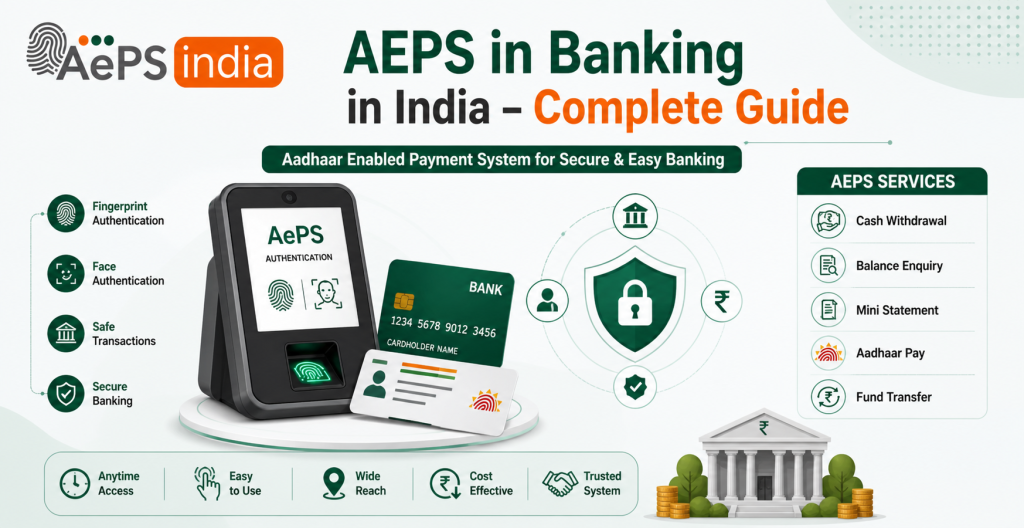
The AEPS in banking system has become one of the most important digital payment solutions in India. The Aadhaar Enabled Payment System (AEPS) allows customers to access basic banking services like cash withdrawal, balance enquiry, and mini statement using their Aadhaar number and fingerprint authentication. This simple process has made banking easy, secure, and accessible, especially in rural and semi-urban areas.
Aadhaar Enabled Payment System (AEPS) is a bank-led model developed by the NPCI allowing secure, real-time, cardless banking transactions cash withdrawal, deposits, balance inquiries, and mini-statements using only an Aadhaar number and biometric authentication (fingerprint/iris) at Micro-ATMs or Business Correspondent (BC) outlets. It promotes financial inclusion, especially in rural areas, requiring only that the bank account be linked to Aadhaar.
AEPS is a secure banking system developed by NPCI (National Payments Corporation of India) that allows customers to perform basic banking transactions using their Aadhaar number and biometric authentication. With AEPS, customers can easily access services like cash withdrawal, balance enquiry, mini statement, and fund transfer without visiting a bank branch or ATM. This makes AEPS one of the most powerful digital Aeps banking services in rural and semi-urban India.
The main purpose of AEPS in banking is to promote financial inclusion and provide easy banking access to everyone. Through AEPS service providers like AEPS India, retailers and CSP operators can offer Aadhaar-based banking services and earn commission on every transaction. It is a low-investment and high-demand business opportunity in 2026.
With increasing demand for AEPS cash withdrawal services, high commission AEPS provider, and fast settlement AEPS platform, choosing the Aeps india is very important. A reliable AEPS platform ensures secure transactions, high success rate, quick settlement, and full compliance with NPCI and UIDAI guidelines.
In this complete guide, we will explain everything about AEPS in banking, its benefits, working process, security features, and how you can start your own AEPS business successfully in India.
What is AEPS in Banking
Aadhaar Enabled Payment System (AEPS) is a bank-led model developed by the National Payments Corporation of India (NPCI) that enables secure, cardless, and PIN-less transactions using Aadhaar authentication. It allows customers to access their Aadhaar-linked bank accounts to perform services like cash withdrawals, deposits, and balance inquiries through a Business Correspondent (BC) at micro-ATMs or via POS devices.

AEPS in Banking Service Work
Aadhaar Enabled Payment System (AEPS) is a National Payments Corporation of India (NPCI) initiative allowing bank customers to access accounts and perform transactions (cash withdrawal, balance inquiry, mini-statement) using their Aadhaar number and biometric authentication (fingerprint/iris) at a Micro ATM or Business Correspondent (BC). It enables secure, cardless, and PIN-less transactions, driving financial inclusion in rural areas.
How AEPS Banking Services Work
- Customer Requirement: The bank account must be linked with the Aadhaar card.
- Authentication: The customer provides their 12-digit Aadhaar number and selects a transaction type.
- Biometric Scan: The user scans their fingerprint or iris on a Aeps biometric device attached to a smartphone or Micro-ATM.
- Verification: The Aeps system securely verifies the biometric data against the Aadhaar database.
- Transaction Processing: Upon successful authentication, the transaction is processed in real-time, and a receipt is generated.
Key Services Offered by AEPS in Banking
The Aadhaar Enabled Payment System (AEPS) offers critical,, cardless banking services in India by allowing users to securely access their Aadhaar-linked accounts via Aeps biometric authentication (fingerprint or iris scan) at micro-ATMs or with Business Correspondents. Key Aeps services include Aeps cash withdrawals, Aeps cash deposit, Aeps balance enquiries, Aeps mini statements, and Aadhaar-to-Aadhaar fund transfers.
Key Services Offered by AEPS:
- Cash Withdrawal: Enables customers to withdraw cash from their bank account without a debit card or PIN.
- Cash Deposit: Allows instant cash deposits into an Aadhaar-linked bank account, often available via micro-ATMs.
- Balance Enquiry: Provides real-time, on-the-spot checking of the available account balance.
- Mini Statement: Allows users to view a record of their last few transactions.
- Aadhaar to Aadhaar Fund Transfer: Facilitates immediate, secure money transfers between two Aadhaar-linked bank accounts.
- BHIM Aadhaar Pay: Allows merchants to accept payments directly from customers’ bank accounts using biometric authentication.
- eKYC: Facilitates instant, paperless electronic Know Your Customer verification for account opening.
- Government Benefit Disbursal: Enables receipt of direct benefit transfers (DBT) like MGNREGA, social security pensions, and other government subsidies.
These best Aeps services are interoperable across different banks, bringing essential, secure banking to rural and underbanked populations.
Who Can Use AEPS in Banking in India
Any Indian resident with an Aadhaar-linked bank account can use the AEPS in banking, particularly designed for financial inclusion in rural and underserved areas. It allows users to perform transactions like cash withdrawals, deposits, and balance inquiries using only their Aadhaar number and biometric authentication (fingerprint/iris) at Micro-ATMs or via Business Correspondents (BC).
Key Requirements to Use AEPS:
- Aadhaar Linking: The user’s bank account must be linked with their Aadhaar number.
- Biometric Authentication: Access is granted through fingerprint or iris scan, eliminating the need for a debit card or PIN.
- Participating Bank: The user’s bank must be part of the NPCI (National Payments Corporation of India) AEPS network.
- Resident Status: Any Indian resident, including those in remote areas, can use this service.
Who Uses AEPS and Where?
- Customers: Anyone looking for basic, cardless banking, especially in areas lacking bank branches.
- Beneficiaries: Individuals receiving government benefits (pensions, subsidies) can withdraw funds from local agents.
- Locations: Transactions can be conducted at any bank-authorised BC/Agent outlet (e.g., local kirana shops).
- Limit: The maximum transaction amount for a single AEPS financial transaction is typically Rs.
 10,000.

Who Can Offer AEPS Banking Services in India?
AEPS in banking services in India can be offered by verified, legitimate, and authorized individuals and entities. Primarily, this includes registered banking correspondent agents, CSPs (Customer Service Points), Micro ATM operators, Kirana store owners, and mobile shop owners, usually partnering with fintech Aeps platforms to provide these services to customers.
Who Can Offer AEPS Services?
- Business Correspondents (BCs)/Agents: Authorized by banks to facilitate banking in rural/urban areas.
- Small Business Owners: Kirana store owners, mobile shops, and general store owners.
- Fintech/Service Providers: Aeps india and Noble web studio providing Aeps API services.
- CSC Operators: Common Service Centre operators.
Requirements for Becoming an AEPS Agent:
- Age and Citizenship: Must be an adult (18+) citizen of India.
- Documents: A valid Aadhaar card and a bank account linked to it.
- Infrastructure: A shop or kiosk location.
- Device: Aeps Biometric device (fingerprint scanner) and a smartphone or PC.
The Aeps system designed by the National Payments Corporation of India (NPCI) and allows agents to offer services like cash withdrawal, balance inquiry, and Aadhaar-to-Aadhaar fund transfers.
Key Aspects of AEPS in Banking
The Aadhaar Enabled Payment System (AEPS) is a bank-led model allowing online, interoperable financial transactions at Micro ATMs using Aadhaar authentication. It enables secure, cardless access to cash withdrawals, deposits, balance inquiries, and fund transfers. Key aspects include biometric security (fingerprint/iris), high accessibility for rural areas, and direct linkage to bank accounts.
- Core Components: Requires a 12-digit Aadhaar number, bank account, and biometric authentication (fingerprint/iris) to function.
- Key Services Provided:
- Cash Withdrawal & Deposit: Basic banking services.
- Balance Enquiry & Mini Statement: Real-time account information.
- Fund Transfer: Aadhaar-to-Aadhaar or bank-to-bank transfers.
- Requirements: A bank account linked to Aadhaar is mandatory.
- Authentication: Aeps Fingerprint or Aeps iris scan, making it highly secure.
- Transaction Limits: Generally, a maximum of ₹10,000 per transaction is permitted, with some banks having specific daily limits.
- Security & Safety: Transactions are secured by biometric authentication, significantly reducing fraud risks.
- Interoperability: Customers can use any bank’s Business Correspondent (BC) to access their account, regardless of which bank they have an account with.
- Financial Inclusion: It provides crucial banking services in rural and underserved areas, reducing dependence on physical cards or cash.
- Charges: Generally, there are no transaction fees, although some banks may impose charges depending on their policy.
AEPS operates through a network of Business Correspondents (BCs) or agents, bringing banking services directly to the customer’s doorstep.
Documents Required to Start AEPS Banking Service
To start AEPS in banking services as an agent, you primarily need your Aadhaar card, PAN card, bank account details (passbook/cancelled cheque), a linked mobile number, and passport-sized photographs. Additionally, a biometric device (fingerprint/iris scanner) and shop/business address proof are mandatory for activation.
Here is the detailed list of required documents for AEPS registration:
Essential Documents for Agent Registration
- Aadhaar Card: Mandatory for identity verification and linking.
- PAN Card: Required for tax compliance and identity verification.
- Bank Account Details: A cancelled cheque, passbook, or bank statement of the agent for commission settlement.
- Active Mobile Number: Must be linked with the Aadhaar card for OTP verification.
- Passport-sized Photograph: Recent photograph for the application.
- Proof of Address/Business: Such as a electricity bill, rent agreement, shop act license, or Udyam registration.
- Email Address: For communication and registration purposes.
Required Hardware & Setup
- Biometric Device: A certified fingerprint or iris scanner for customer authentication.
- Smartphone/Computer: To run the AEPS portal or Aeps software.
For partnership firms or companies, additional documents like a partnership deed, Certificate of Incorporation, and Board Resolution may be required.

AEPS Banking Service Work in the Indian Banking System
The Aadhaar Enabled Payment System (AEPS) is a bank-led model developed by the National Payments Corporation of India (NPCI) that allows customers to perform basic Aeps banking services including cash withdrawals, deposits, fund transfers, and balance inquiries using their Aadhaar number and biometric authentication (fingerprint or iris scan) at Micro-ATMs or Business Correspondent (BC) outlets. It enables secure, cardless, and pinless transactions, promoting financial inclusion, especially in rural areas, by allowing access to any bank account from a single, authorized, local agent.
How AEPS Works Step-by-Step:
- Initiation: A customer visits a Business Correspondent (BC)/Agent, such as a local kirana shop or bank agent, and provides their 12-digit Aadhaar number.
- Bank Selection: The customer selects the bank name and the type of transaction (e.g., cash withdrawal, balance enquiry) on the Micro-ATM.
- Authentication: The customer scans their fingerprint or iris on a biometric device.
- Verification: The Aeps system verifies the biometric data against the UIDAI database.
- Completion: Upon successful Aeps authentication, the transaction is processed, and the bank account is debited or credited, with a receipt generated.
How AEPS Banking Service Helps Financial Inclusion in Rural and Urban India
The AEPS drives financial inclusion across India by enabling secure, cardless, and PIN-less banking transactions cash withdrawals, deposits, and balance checks using only biometric authentication (fingerprint/iris) at local agent-operated micro-ATMs. It acts as a bridge for unbanked, rural, and semi-urban populations, allowing access Aeps banking services, Direct Benefit Transfers (DBT) for government schemes, and digital financial services without traveling to distant branches.
Key Aspects of AEPS for Financial Inclusion
- Empowering Rural Banking: By leveraging local banking correspondents, AEPS provides “doorstep banking” in remote areas, significantly reducing the cost and time involved in accessing banking services.
- Secure Transactions: The best Aeps system relies on biometric data, which minimizes fraud risks associated with traditional PIN-based transactions, enhancing trust among users.
- Government Benefit Access: Rural residents can easily access subsidies, pensions, and wages (e.g., MGNREGA) through 100% Aadhaar-linked accounts.
- Interoperability: Customers can use any bank’s service at any BC (Business Correspondent) location, providing flexibility and convenience.
- Supporting Digital Economy: It bridges the urban-rural digital divide and encourages small business owners to act as “Aadhaar ATMs,” boosting local economies and fostering financial literacy.
AEPS Impact in Urban and Rural Areas
- Rural: Focuses on accessibility, enabling, for instance, users to withdraw cash without needing to own a smartphone or a debit card.
- Urban/Semi-Urban: Provides convenience for quick, in-person transactions and acts as an alternative to ATMs, particularly for the elderly or technology-challenged.
By allowing instant, paperless account verification and access, AEPS plays a critical role in bringing millions of underserved people into the formal financial ecosystem, enhancing economic participation across India.
AEPS in Banking Services: Cash Withdrawal, Balance Inquiry & Mini Statement
The Aadhaar Enabled Payment System (AEPS) allows bank customers to perform secure, interoperable banking transactions specifically cash withdrawals, balance inquiries, and mini statements using only their Aadhaar number and biometric authentication at authorized agent outlets. Managed by the NPCI, this Aeps banking software enables real-time, 24/7 banking without debit cards or PINs, with a maximum withdrawal limit of ₹10,000 per transaction.
Core AEPS Services
- Cash Withdrawal: Users can withdraw cash from their linked bank accounts instantly through a Business Correspondent (BC) or micro-ATM.
- Balance Inquiry: Aeps Balance Inquiry provides real-time information about the available balance in the Aadhaar-linked account.
- Mini Statement: Aeps Mini Statement Allows users to view the last few transactions, providing a brief overview of recent account activity.
- Cash Deposit: Aeps Cash Deposit Enables depositing cash directly into the bank account using biometric authentication.
- Fund Transfer: Aeps Fund Transfer Facilitates transfers between Aadhaar-linked accounts.
Key Features & Benefits
- Biometric Security: Transactions are secured using fingerprint or iris scans, minimizing fraud.
- No Card Needed: Users only require their 12-digit Aadhaar number, eliminating the need for debit/credit cards or PINs.
- Interoperability: Customers of one bank can use the top AEPS service at any other bank’s micro-ATM.
- Financial Inclusion: Aeps Designed to provide banking access, especially in rural and underserved areas.
Transaction Process
- Locate Agent: Find a local agent or retailer with an AEPS enabled micro ATM.
- Enter Credentials: Provide the 12-digit Aadhaar number and select the bank name.
- Select Service: Choose between cash withdrawal, balance inquiry, or mini statement.
- Authentication: Use fingerprint or iris scan to verify identity.
- Completion: The transaction is processed, and a receipt may be provided.
Limits and Requirements
- Limits: The maximum, single transaction limit for AEPS is set at ₹10,000, with some banks setting daily limits up to ₹50,000.
- Requirements: A bank account must be linked to the Aadhaar number for the service to function.

Role of AEPS Banking API in Digital Transactions
The AEPS Banking API acts as a secure, real-time bridge enabling bank-agnostic, cardless, and PIN-less transactions using Aadhaar authentication. It allows merchants to function as micro-ATMs for cash withdrawals, deposits, balance inquiries, and mini-statements. This best Aeps API fosters financial inclusion by connecting rural users to banking services, supporting Direct Benefit Transfer (DBT) and Aadhaar Pay.
Key Roles and Functions of AEPS Banking API:
- Financial Inclusion & Accessibility: Acts as a, critical tool for rural and underbanked populations, offering, services through Business Correspondents (BCs) and, local retailers.
- Secure Authentication: Utilizes biometric data (fingerprint or iris scan) matched against, the UIDAI database to ensure high security and, prevent fraud.
- Core Banking Services: Facilitates immediate cash withdrawals, cash deposits, and, mini-statement generation without requiring, a physical debit card or ATM.
- Interoperability: Enables customers to transact using their Aadhaar-linked account at any bank’s, micro-ATM or agent location, regardless of their own bank.
- Aadhaar Pay & Digital Payments: Powers merchant payments, (BHIM Aadhaar Pay), enabling small businesses to accept, digital payments, and reducing reliance on cash.
- Direct Benefit Transfer (DBT): Facilitates direct, government subsidies, pensions, and welfare payments to, beneficiaries’ bank accounts.
AEPS in Banking for Distributors, Retailers & CSP Operators
Aadhaar Enabled Payment System (AEPS) has transformed local retail shops, Customer Service Points (CSPs), and distributors into “mini-banks,” enabling secure, cardless, and PIN-less transactions in India. By using a customer’s Aadhaar number and fingerprint/iris scan, these operators can facilitate essential banking services, earning daily commission income.
Key Services Offered by AEPS Agents
- Cash Withdrawal: Customers can withdraw up to ₹10,000 per transaction, with daily limits typically up to ₹50,000.
- Balance Enquiry: Instant, real-time checking of bank account balances.
- Mini Statement: Access to the last 5 to 10 transactions.
- Cash Deposit: Direct deposit of cash into Aadhaar-linked accounts.
- Aadhaar-to-Aadhaar Fund Transfer: Secure, immediate, interbank money transfers.
- Aadhaar Pay (Merchant Payments): Allows merchants to accept payments up to ₹50,000, often charging a small fee.
Benefits for Different Stakeholders
- Retailers/Shopkeepers: Increased customer footfall, additional income through commissions (approx. ₹2–₹15+ per transaction), and reduced cash handling risks.
- Distributors/Master Distributors: Earn commissions on the total transaction volume of their network, with potential for higher, fixed Aeps commission rates (e.g., ₹10–₹15 per transaction).
- CSP Operators: Enable last-mile Aeps banking in remote areas, facilitating government Direct Benefit Transfers (DBT) and reducing reliance on distant bank branches.
- Users: Convenient, secure access to money without debit cards or PINs, especially for elderly or rural populations.
High Commission AEPS in Banking How Retailers Earn Profit
Retailers earn significant profits through high commission AEPS by acting as local, digital banking agents, earning ₹2 to ₹15+ per transaction (cash withdrawals, balance checks, mini-statements). Aeps India confirm the Aeps commission structure is often tiered, with higher withdrawals (e.g., ₹3,000+) yielding the highest rewards.
How Retailers Earn High Commission via AEPS
Retailers, such as kirana store owners, CSC centers, or small business owners, become “mini-banks” by registering with an AEPS service provider like Aeps india, which requires minimal investment only a smartphone/PC and a biometric device.
- Cash Withdrawals: This is the primary income source, often providing a tiered commission structure where higher withdrawal amounts result in higher, “high-commission” payments (e.g., up to ₹13-₹15+ for ₹3,000+).
- Balance Inquiries & Mini Statements: These provide smaller, consistent, “fixed commissions” (e.g., ~₹2-₹7 per service).
- Transaction-Based Earnings: Retailers earn on every Aeps transaction, “boosting income” through, “increased footfall”.
- Bonus & Referral Commissions: Aeps one of the top Aeps service provider in india offer higher, {Link: “industry-leading payouts, industry-leading payouts (up to ₹15) for special, “Super Prime” retailers, , “Super Prime” , a key differentiator from normal retail agents” ,.
Typical High-Commission Structure (2026)
- ₹100 – ₹999: ~₹2 per transaction
- ₹1,000 – ₹1,499: ~₹3 per transaction
- ₹2,500 and above: High commission Aeps, potentially up to ₹13-₹15 or 0.40%–1% of the value

Benefits AEPS in Banking
The Aadhaar-enabled Payment System in banking provides secure, cardless, and PIN-less transactions using Aadhaar biometric authentication. Key benefits include increased financial inclusion in rural areas, 24/7 access to services like cash withdrawals and deposits via local agents, and direct, secure receipt of government subsidies (DBT).
Key Benefits of AePS in Banking:
- Enhanced Security: Transactions are authenticated via unique fingerprints or iris scans, minimizing fraud risks compared to card-based systems.
- Financial Inclusion: Enables Aeps banking services, such as cash withdrawals, deposits, and balance inquiries, in remote, unbanked areas.
- Convenience for Users: No need for physical cards, PINs, or bank branches; transactions are conducted through local Micro-ATMs or Business Correspondents.
- Direct Benefit Transfers (DBT): Facilitates direct transfer of government subsidies, pensions, and welfare payments to beneficiaries’ accounts.
- Interoperability: Allows customers of one bank to access their accounts through any bank’s, or agent’s, AePS terminal.
- Empowerment: Supports the cashless economy while providing easier access for senior citizens and, “Jan Dhan,” account holders.
Benefits for Retailers/Agents:
- Extra Income: Retailers earn commissions on each successful transaction.
- Increased Footfall: Provides essential services that attract more, “customers,” to local, “shops,”.
The system primarily requires that the bank account is linked to an, “Aadhaar number to function, securely.
Features AEPS in Banking
The Aadhaar Enabled Payment System (AEPS) is an NPCI-launched, secure, bank-led model allowing instant financial transactions using Aadhaar authentication (fingerprint/iris) at Micro ATMs or Business Correspondents. Key features include cardless, interoperable banking cash withdrawal, deposits, balance inquiries, and mini-statements without needing a smartphone, promoting financial inclusion.
Key Features of AEPS in Banking:
- Authentication & Security: Uses Aadhaar-linked biometric verification (fingerprint or iris scan), eliminating the need for PINs or debit cards.
- Core Banking Transactions: Enables cash withdrawal, cash deposit, balance enquiry, and mini-statement generation.
- Interoperability: Allows customers to access their account via a Business Correspondent (Bank Mitra) of any bank, regardless of where they hold their account.
- Fund Transfers: Facilitates instant, secure money transfers between Aadhaar-linked accounts.
- Financial Inclusion & Accessibility: Crucial for rural/semi-urban areas, enabling access to banking without smartphones or internet, as transactions occur through agents.
- Government Benefit Disbursements: Facilitates the receipt of government entitlements (e.g., MGNREGA, pensions) directly at the doorstep.
- Ease of Use: Requires only the Aadhaar number, bank name, and biometric data, making it simple for users.
AEPS acts as a, enabling secure, real-time banking at the last mile.
Steps AEPS Banking API Integration Process
AEPS API integration enables secure, Aadhaar-based banking transactions (cash withdrawal, balance inquiry) via certified Aeps india. The process involves partnering with an NPCI-certified Aeps india, completing KYC, acquiring UIDAI-compliant biometric devices, integrating Aeps API (endpoints, callback URLs), testing in a sandbox, and moving to Aeps Api live production.
Steps for AEPS Banking API Integration
- Select a Certified AEPS API Provider: Partner with an NPCI-authorized Aeps India based on reliability, security, and Aeps commission structures.
- Registration and KYC: Sign up on the Aeps india provide Aeps platform and submit business/personal Aeps KYC documents, including Aadhaar card, PAN card, and bank account details.
- Obtain API Credentials: Receive Aeps API keys, Aeps Merchant ID (MID), and technical documentation after document verification (usually 24-48 hours).
- Acquire and Register Biometric Devices: Buy Aeps biometric devices (fingerprint/iris scanner) and install the required Aeps Registered Device (RD) Aeps service software.
- Technical Integration:
- Backend Integration: Implement Aeps API endpoints for services (e.g., Cash Withdrawal, Mini Statement) as per the provided technical Aeps Api documentation.
- Frontend Integration: Configure the user interface to capture Aadhaar numbers and biometric data.
- Callback URL: Set up a callback secure Aeps API on your server to handle transaction status notifications (success/failure).
- Testing in Sandbox Environment: Thoroughly test all transaction scenarios in the Aeps india test environment to ensure secure data encryption and correct Aeps API responses.
- Go Live: Move to the production environment using live Aeps API credentials to begin processing real-time transactions.
Key Requirements:
- Security: HTTPS compliance and data encryption are mandatory for handling biometric data.
- Agent Training: Ensure staff are trained on handling transactions and error codes.
- Bank Linking: Customers must have their bank account linked to their Aadhaar number.

AEPS Banking Charges and Commission Structure (2026)
AEPS banking allows customers to perform secure, biometric-based transactions, with agents earning commissions typically ranging from ₹2 to ₹15+ per cash withdrawal based on transaction slabs. High-value withdrawals (₹3,000–₹10,000) offer the highest commissions, while, mini statements and balance inquiries usually earn smaller, fixed fees.
AEPS (Aadhaar Enabled Payment System) transactions in India are generally free for customers, but banks charge Business Correspondents (BCs) or agents fees typically ranging from ₹5 to ₹20+ per transaction for cash withdrawals/deposits, often with a 1% limit. While UIDAI imposes no fees, banks, agents, or service providers may apply charges after a few free monthly transactions.
AEPS Commission Structure for Retailers (Approximate)
Aeps Commissions are often structured in a tiered format based on the transaction amount:
- ₹100 – ₹999: ~₹2 per transaction.
- ₹1,000 – ₹1,499: ~₹3 per transaction.
- ₹1,500 – ₹1,999: ~₹4.5 per transaction.
- ₹2,000 – ₹2,499: ~₹5.5 per transaction.
- ₹2,500 – ₹2,999: ~₹7 per transaction.
- ₹3,000 – ₹10,000: Up to ₹13 or more (0.40%–1%).
- Balance Inquiry/Mini Statement: ~₹1 to ₹5 per transaction.
Key Aspects of AEPS Charges
- Retailer Earnings: Agents can earn up to ₹15+ on high-value cash withdrawals.
- Service Charges: Some banks may charge ₹5+GST for balance inquiries and, mini-statements and up to ₹20+GST for cash withdrawals.
- Variability: Commissions vary by, Aeps india and, white label Aeps platforms.
- Incentives: Extra bonuses are often provided for high Aeps transaction volume.
Registration and Requirements
- KYC: A mandatory, Know Your Customer (KYC) process is required to register with Aeps india taking 24-72 hours.
- Documentation: PAN card, Aadhaar card, bank account proof, and a photograph are generally required.
- Device: A Best Aeps biometric device must be connected and registered.
AEPS Banking Service Cost In India
AEPS banking services in India generally cost consumers ₹5–₹20 + 18% GST for financial transactions (cash withdrawal/deposit) beyond free monthly limits, while balance inquiries often cost ~₹5 + GST. While individual bank policies vary, many allow 3-4 free transactions monthly. The maximum withdrawal limit per transaction is typically ₹10,000.
Common AEPS Charges for Customers
- Cash Withdrawal/Deposit: Often ₹20 + 18% GST per transaction after free limits.
- Balance Enquiry/Mini Statement: Roughly ₹5 + 18% GST per transaction.
- Fund Transfer: Approximately ₹20 + 18% GST per transaction.
- Free Limits: Some banks (e.g., India Post Payments Bank) offer 1-3 free transactions per month.
Key AEPS Cost Structures & Fees (As of late 2025/early 2026):
- Customer Charges: Generally Nil for basic banking (cash withdrawal/deposit).
- Agent/BC Charges (Cash Withdrawal): Usually ₹5 to ₹15 per transaction, with some potentially higher.
- Bank-Specific Fees: Some banks, like India Post Payments Bank, charge up to ₹20 + GST per transaction after free limits are exceeded.
- Free Limits: Often limited to 3-5 free transactions per month, after which fees apply.
- Commission Structure for Agents: Retailers earn commissions based on transaction volume, typically ranging from ₹2 to ₹15+ per transaction.
- Limits: Maximum withdrawal is generally ₹10,000 per transaction, with a daily cap often around ₹50,000.
Factors Influencing Costs:
- Transaction Type: Financial transactions (cash withdrawal/deposit) have higher fees than non-financial ones (balance inquiry, mini statement).
- Bank Policies: Individual banks set their own fee structures for BCs, which can vary.
- API Provider: White label AEPS API setups for businesses can cost between ₹15,000 and ₹1.2 Lakhs.
- GST: 18% GST is applicable to transaction fees.
Key Considerations
- Transaction Limits: Maximum withdrawal is usually ₹10,000 per transaction, with daily limits often around ₹50,000.
- Bank Variation: Charges depend heavily on the specific bank (e.g., Kerala Grameena Bank charges ₹30+GST for off-us transactions) and the Business Correspondent (BC) agent.
- Merchant Costs: For businesses, setting up top AEPS API can range from ₹12,000 to ₹35,000, with additional Aeps software cost.
Disclaimer: AEPS charges are subject to change by banks and the NPCI. It is advised to check with your specific bank for the most up-to-date fees.
How to Start AEPS Banking Service in India
Starting an AEPS service in India requires registering with a certified Aeps india, completing Aeps KYC (Aadhaar, PAN, Bank details), and acquiring a UIDAI-certified Aeps biometric scanner. After setting up the Aeps app or web portal and undergoing training, agents can offer services like cash withdrawals, deposits, and balance inquiries.
Steps to Start AEPS Banking Service in India
- Preparation & Eligibility: Ensure you are 18+ years old with a shop or business, an Aadhaar-linked bank account, and a smartphone/PC with internet access.
- Select an AEPS Provider: Choose a reliable NPCI-approved Aeps india to access their Aeps portal.
- Registration and KYC: Register on the Aeps india provide best Aeps platform by submitting your KYC documents, including PAN card, Aadhaar card, and bank account proof (cancelled cheque).
- Acquire Biometric Device: Purchase Aeps fingerprint or Buy Aeps iris scanner (e.g., Mantra) and ensure it is registered (RD service).
- App Installation and Training: Install the Aeps india provide AEPS application, connect the device, and complete the mandatory training on transaction security, compliance, and agent mapping.
- Service Activation: Once verified (usually within 24-48 hours), log in to start providing Aeps services.
Key 2026 Compliance Rules
- One Operator, One Bank: Agents can now typically be mapped to only one acquiring bank.
- Re-KYC: Agents inactive for three consecutive months must complete re-KYC to resume services.
- Real-time Monitoring: Transactions are strictly monitored to prevent fraud.

Security and Biometric Authentication in AEPS Banking
AEPS in banking offers high-security, branchless banking by using Aadhaar-linked biometric authentication (fingerprint or iris scan) to verify transactions in real-time. By eliminating PINs and physical cards, it ensures that only the account holder can authorize transactions, significantly reducing fraud, particularly in rural areas, while enabling secure, traceable, and instant financial services via verified banking correspondents.
Key Security and Biometric Features in AEPS
- Unique Biometric Verification: AEPS relies on unique biometric data (fingerprint or iris scan) to verify the user’s identity, making it extremely difficult for fraudulent access compared to traditional PIN-based systems.
- Real-time Authentication: Transactions are processed in real-time, matching the biometric data against the UIDAI central database to instantly confirm the user’s identity before proceeding.
- No Physical Card Requirement: Because it relies on “who you are” rather than “what you have,” AEPS removes the risks associated with lost cards or stolen PINs.
- Secure Digital Templates: The Top Aeps system does not store actual finger images. Instead, it converts biometrics into secure digital templates or codes, enhancing data security during the verification process.
- Auditability & Traceability: Every transaction creates a digital log, which strengthens security through better monitoring, regulatory oversight, and accountability.
Important Safety Tips for Users
- Verify Before Scanning: Always check the transaction amount and type on the Micro ATM device before placing your finger or scanning your iris.
- Authorized Agents Only: Use authorized banking correspondents or official micro-ATMs to avoid fraudulent, tampered devices.
- Secure Your Biometrics: Never allow others to use your biometric signature and be cautious of unsolicited requests to scan your finger.
AEPS, backed by NPCI guidelines and UIDAI authentication, remains a highly secure, reliable method for rural and urban financial inclusion.
AEPS in Banking with Fast Settlement System
The Aadhaar Enabled Payment System (AEPS) is a National Payments Corporation of India (NPCI) initiative allowing secure, biometric-based,, and interoperable banking transactions (cash withdrawals, balance inquiries, mini-statements) at remote locations via Micro-ATMs. Fast settlement systems enable immediate transfer of funds, often allowing agents to earn commissions, with transaction limits generally up to ₹10,000 per transaction and ₹50,000 daily.
Key Features and Benefits of AEPS with Fast Settlement:
- Instant Transactions: Funds are settled quickly, often in real-time, allowing agents/merchants to offer immediate cash dispensing.
- Biometric Security: Uses Aadhaar-linked fingerprint or iris scans, minimizing fraud risks associated with PIN-based systems.
- Interoperability: Allows customers to access services from any bank, regardless of where their account is held.
- Accessibility: Bridges the gap for rural or underserved areas, acting as a “mini-bank”.
- No Card Needed: Eliminates the need for debit/credit cards or remembering PINs.
Transaction Details:
- Maximum Limit: Generally ₹10,000 per transaction, with daily limits often around ₹50,000.
- Required Information: 12-digit Aadhaar number, Issuer Identification Number (IIN), and biometric authentication.
- Agent Commissions: Retailers can earn commissions based on transaction volume, sometimes up to ₹109 for a ₹10,000 transaction.
How it Works:
- Customer visits a Business Correspondent (agent) with a micro-ATM.
- Provides 12-digit Aadhaar number and selects transaction type.
- Performs biometric authentication (fingerprint/iris).
- Transaction is processed securely, and funds are settled quickly to the agent’s account.
Technical Requirements for AEPS in Banking
AEPS (Aadhaar Enabled Payment System) requires an Aadhaar-linked bank account, UIDAI-certified biometric device (fingerprint/iris), and a smartphone/PC with internet connectivity. Key technical components include secure Aeps API integration with the NPCI, biometric authentication (RD service), and adherence to RBI security guidelines, such as liveness detection and mandatory transaction reporting.
Technical Requirements for AEPS
- Authentication Mechanism: Biometric data (fingerprint or iris scan) is mandatory for user authentication, ensuring secure transactions.
Hardware/Software:
- Agent/Merchant: A smartphone (Android/iOS), tablet, or desktop computer.
- Biometric Scanner: A Registered Device (RD) certified Aeps scanner (e.g. Mantra) is required for capturing biometric data, which is then encrypted and sent to UIDAI.
- Internet Connectivity: Stable internet access is essential to connect to the banking Aeps portal.
Connectivity:
- Aadhaar Linking: The customer’s bank account must be mapped to their Aadhaar number.
- IIN (Issuer Identification Number): The system must support the identification of the bank using the IIN.
API and Backend Integration:
- NPCI Interface: The Aeps application integrate with the National Payments Corporation of India (NPCI) for real-time transaction processing.
- API Services: Support for Aeps API calls for services like cash withdrawal, balance inquiry, and mini statement.
Security Standards (RBI/NPCI Mandates):
- Liveness Detection: Enhanced security features to detect if the biometric input is from a live person.
- Data Encryption: All data transmitted must be encrypted to ensure security.
- Secure Storage: No biometric data is allowed to be stored on the Aeps agent device.
User Account Status:
- The account must be active and not frozen.
- The mobile number should be linked to the Aadhaar to receive transaction alerts.
Operational Requirements
- Registration: Agents must complete Aeps KYC with an authorized Best AEPS service provider Company in india like Aeps india.
- Daily Limits: Transactions are subject to limits, often up to ₹10,000 for a single withdrawal and ₹25,000–₹50,000 daily per customer.

High-Volume Transaction Handling with AEPS in Banking
High-volume transaction handling within the Aadhaar Enabled Payment System banking service is a critical requirement in 2026, driven by the rapid adoption of digital, biometrically authenticated transactions in India’s rural and semi-urban areas. Trusted AEPS API service providers, such as Aeps India and Noble Web Studio, facilitate these highest volume Aeps Api, secure transactions by offering robust, NPCI-compliant best Aeps platforms.
Key Aspects for Handling High-Volume AEPS Transactions
- High Performance and Scalability: Specialized AEPS service API and cloud-based infrastructures are designed to manage thousands of transactions per day, with Aeps systems supporting over 600+ transactions per second.
- High Success Rates: Aeps india aim for a 98% to 99% or higher transaction success rate to minimize failures during peak usage.
- Fast Processing and Instant Settlement (T+0): Transactions are processed in real-time, typically within 2-3 seconds, ensuring immediate cash liquidity for agents.
- Multi-Bank Support: Robust backends connect to multiple banks to reduce downtime and improve reliability.
- Security Features: Aeps Systems use AI-driven fraud detection, behavioral biometrics, and end-to-end encryption for data in transit and at rest.
- Advanced Infrastructure: Techniques like intelligent load balancing, asynchronous processing, and automated failover mechanisms prevent system bottlenecks.
Operational & Regulatory Requirements (2026)
- Mandatory KYC: As of January 1, 2026, strict KYC is required for all AEPS Touchpoint Operators (ATOs).
- “One Operator, One Bank” Rule: To reduce fraud, operators are linked to a single bank.
- Transaction Limits: NPCI caps, which are generally ₹10,000 per transaction, are enforced to manage risk.
- Inactive Agent Rule: Agents with no transactions for three consecutive months must undergo a new Aeps KYC process.
Earning Opportunities for High-Volume Agents
Retailers and agents can earn substantial daily income through high-volume transactions:
- Commission Structure: Retailers earn ₹2 to ₹15+ per transaction, with higher amounts for transactions over ₹3,000.
- “Super Prime” Rewards: Enhanced commissions are offered for high-volume, “Super Prime” retailers.
- Additional Services: Bundling other services such as Domestic Money Transfer (DMT), BBPS (Bill Payments), and Micro ATM services increases revenue.
Choosing the Best Provider
When selecting a Aeps india for high volume Aeps transactions, it is recommended to prioritize NPCI/RBI certification, 99.9% uptime guarantees, 24/7 technical support, and transparent commission structures.
Security Standards: NPCI & UIDAI Guidelines for AEPS in Banking
The Aadhaar Enabled Payment System in India is governed by strict, multi-layered security guidelines issued by the National Payments Corporation of India (NPCI), the Unique Identification Authority of India (UIDAI), and the Reserve Bank of India (RBI). These standards are designed to protect customer financial data and ensure secure, biometric-based transactions, with significant updates taking effect from January 1, 2026, to combat rising fraud.
1. Key NPCI & RBI Security Guidelines
NPCI mandates that AEPS transactions use secure, encrypted channels. Key requirements include:
- Enhanced Verification: For cash withdrawals, two-factor authentication (e.g., biometric scan followed by an OTP) is introduced to prevent unauthorized access.
- Liveness Detection: Aeps india must use technology that ensures the biometric input is from a live person, preventing the use of cloned fingerprints or fake impressions.
- Transaction Monitoring: Banks must deploy real-time monitoring systems to detect unusual patterns, such as high-volume transactions, and act on fraudulent activities.
- Agent Onboarding (Effective Jan 1, 2026): Acquiring banks must conduct full Know Your Customer (KYC) due diligence on all AePS Touchpoint Operators (ATOs) before allowing them to operate.
- Inactive Agent Policy: If an operator does not conduct any transaction for 3 consecutive months, they are deemed inactive and must undergo re-KYC.
2. UIDAI Data Privacy & Security Standards
UIDAI requires that all entities (Banks, Business Correspondents) accessing Aadhaar authentication must comply with strict, secure protocols:
- Registered Devices (RD) Only: Only certified, Registered Devices that use encryption for biometrics are allowed. Public devices that store biometrics are prohibited.
- No Data Storage: Regulations strictly prohibit the storing, sharing, or publishing of fingerprints or biometric data by any entity (bank, agent, or app).
- Encrypted PID Block: The Personal Identity Data (PID) block must be encrypted at the time of capture (at the device level) and never transmitted in the clear.
- Aadhaar Data Vault (ADV): If any Aadhaar-related data is stored for compliance, it must be in a secure, tokenized, and UIDAI-compliant Aadhaar Data Vault.
3. Operational Security Measures
To maintain integrity at the ground level, the following is required:
- Unique Agent IDs: Banks must map every transaction to a unique Terminal ID and Aeps Agent ID to ensure accountability.
- Mandatory Receipt: Every transaction must generate a receipt, ensuring a digital or physical record for the customer.
- Security Audits: Regular audits are conducted to ensure that agents and banks are in compliance with security protocols, including ISO 27001.
Summary of Major Changes (Jan 1, 2026)
- Stricter ATO Due Diligence: Rigorous Aeps KYC for agents.
- Re-KYC for Inactive Agents: 3-month inactive limit.
- Advanced Fraud Monitoring: Real-time analysis of operator behavior.
These measures together ensure that AEPS remains a secure, trusted, and efficient system for financial inclusion in India.
Transaction Success Rate & Server Stability in AEPS in Banking
In 2025-2026, the Aadhaar Enabled Payment System (AEPS) is a critical pillar of rural banking in India, with Aeps india aiming for a >98% transaction success rate and 99.9% or higher server uptime. As AEPS moves towards a, unified, identity-based, framework, server stability has become paramount, particularly during peak, rural transaction periods,, with Aeps systems designed to, handle 600+ transactions per second.
AEPS Transaction Success Rate (2025-2026 Outlook)
- Industry Standard: >98% success rate is the benchmark for high performance AEPS API providers like Aeps india to ensure reliability and customer trust.
- Performance Metrics: Top Aeps platforms, such as those utilized by Aeps India,, offer near-instant, real-time, processing within 2–3 seconds.
- Impact of Failures: While 98%+ is the goal, failures can occur, causing customer frustration and reduced agent earnings.
- Causes of Failure: Major factors include biometric mismatches (10–15% failure rate), poor internet connectivity, and, bank-level, downtime.
Server Stability & Infrastructure
- High Uptime: 99.9% uptime is expected, with, 24/7, availability, crucial for rural areas with limited banking access.
- Multi-Bank Routing: To guarantee high success rates, advanced platforms use multi-bank, connectivity, allowing transactions to be routed through, alternative servers if one bank is down.
- Cloud-Based Security: Modern AEPS infrastructure leverages, cloud-based,, servers (e.g., AWS) with automatic, failover, mechanisms to minimize downtime.
- Security Upgrades: Following, RBI, directives, in 2025, systems are integrating, enhanced, KYC, and,, mandatory, liveness, detection, to improve safety.
Key Factors Enhancing Performance
- NPCI Compliance: All top Aeps b2b platforms, must adhere to NPCI/RBI, standards for, secure,, and, stable, operations.
- Direct Benefit Transfer (DBT): The, rise, in, DBT, payments, (pensions, NREGA) has increased the, need, for reliable, server, performance.
- White Label Solutions: Aeps india provide customize Aeps software and, scalable, infrastructure for, faster, transactions.
Troubleshooting & Best Practices
- TAT & Compensation: RBI, mandates, for failed transactions, (where money is debited but not credited) require, reversal, within 5 days, or compensation of ₹100 per day.
- Biometric Maintenance: Users, are, encouraged, to, update, fingerprints, if, they are, worn-out, (common for, laborers, and, the, elderly) to avoid, authentication, failures.
- Agent Responsibility: Authorized, agents, must, ensure, proper, equipment, and, stable, connectivity.
AEPS is evolving from a simple, cash, withdrawal, tool to a complex fintech ecosystem that demands high technical reliability to, support India’s growing digital economy.

Role of NPCI and UIDAI in AEPS in Banking
The National Payments Corporation of India (NPCI) and the Unique Identification Authority of India (UIDAI) are the two core pillars of the Aadhaar Enabled Payment System (AePS). NPCI develops and manages the secure AePS platform, interoperable banking transactions, while UIDAI provides real-time biometric authentication to verify user identity, enabling cardless and PIN-less transactions.
Role of NPCI in AePS
- System Developer & Operator: NPCI built and manages the fast AePS platform, ensuring it acts as a secure, interoperable bridge connecting different banks and service points.
- Transaction Routing & Settlement: NPCI processes transactions, including cash withdrawals, deposits, and balance inquiries, ensuring they are securely routed between the customer’s bank and the agent.
- Setting Standards: NPCI establishes technical and operational guidelines that all banks and Business Correspondents (BCs) must follow.
- Aadhaar Mapper: NPCI operates the Aadhaar Payment Bridge System (APBS) or “Aadhaar Mapper,” which links a user’s Aadhaar number to their bank account, ensuring funds reach the correct account.
- Transaction Limits: NPCI sets transaction limits (e.g., maximum withdrawal) to ensure system safety.
Role of UIDAI in AePS
- Authentication Authority: UIDAI performs real-time biometric authentication (fingerprint or iris scan) to confirm the user’s identity before any transaction is executed.
- Security & Verification: UIDAI verifies the biometric credentials against their stored database, eliminating the need for physical cards or PINs.
- Identity Management: UIDAI provides the foundational database (Aadhaar) that allows secure, remote identification, facilitating financial inclusion in rural areas.
How They Work Together
When a user initiates an AePS transaction at a Micro-ATM:
- Authentication: The agent enters the Aadhaar number, and the user provides biometric input, which is sent to UIDAI for verification.
- Processing: Once UIDAI confirms the identity, the transaction details are sent to NPCI.
- Settlement: NPCI acts as the central switch, securely communicating with the user’s bank (Issuer Bank) to complete the transaction.
Aeps India – Best AEPS in Banking Provider in India
Aeps India is a leading Aeps banking service Provider of AEPS services in India, offering secure, high-uptime, and fast banking transactions. As a Aeps india it enables cash withdrawals, balance inquiries, and mini-statements with high commissions.
Key features and benefits of Aeps India include:
- High Commission Structure: Aeps india offers competitive payouts for retailers, sometimes up to ₹12-₹15 per transaction, Aeps software designed for maximum profit.
- Secure & Compliant: Provides NPCI/RBI-certified, secure, and smooth AEPS APi, and Aeps software solutions for businesses.
- Comprehensive Services: Beyond AEPS, it facilitates Aadhaar Pay, micro ATM service, and instant settlement to bank accounts.
- Advanced Platform: Known for user-friendly interfaces, high transaction success rates (>98%), and 24/7 technical support.
- White Label & API Solutions: Aeps india offers white label Aeps Api solution and Aeps API integrate for startups and existing businesses to launch their own Aeps banking services.
Aeps India focuses on empowering businesses, especially in rural and semi-urban areas, with efficient digital Aeps banking solutions.
How to Choose the Best AEPS Banking Service Provider in India
Aeps india is the best AEPS Banking Service Provider in India requires evaluating NPCI/RBI compliance, high transaction success rates (98%), instant (T+0) settlements, and competitive commissions (₹5–₹15). Aeps india and Noble web studio offering high commission Aeps software.
Key Factors for Selecting the Best AEPS Provider:
- Security & Compliance: Aeps india is certified by NPCI/RBI and follows strict data protection guidelines.
- Transaction Success Rate: Look for a reliable Aeps portal with 99.9% uptime and high transaction success rates to avoid customer frustration.
- Settlement Speed: Aeps india offering instant (T+0) or same-day (T+1) settlements to ensure smooth working capital management.
- Commission Structure: Look for transparent and competitive commissions (often ₹5–₹15 per transaction).
- Customer Support: Reliable 24/7 support via phone or WhatsApp is essential for quick resolution of failed transactions.
- User Experience: Choose an best Aeps app or web portal that is easy to navigate, with fast processing and real-time reports.
- Additional Services: Select secure Aeps platform offering supplementary services like Mini ATM, BBPS (bill payments), and DMT (Money Transfer) to increase revenue.
Top AEPS Service Providers in India (2026)
According to recent 2026 industry reports, Best AEPS Service Provider in India include Aeps india and Noble web studio.
Why AEPS India is the Trusted AEPS Banking Service Provider
Trusted AEPS banking service providers, such as Aeps India and Noble web studio, are chosen for their high-security standards (NPCI/RBI compliance), 99.9% uptime, 98%+ transaction success rates, and real-time settlements. They enable secure, biometric-based banking, offering 24/7 support and high commissions, crucial for financial inclusion and empowering rural, unbanked populations.
Key Reasons Why Trusted AEPS Providers Stand Out:
- Security & Regulatory Compliance: Aeps India follow strict guidelines from the National Payments Corporation of India (NPCI) and the Reserve Bank of India (RBI), using biometric authentication (fingerprint/iris) and data encryption to prevent fraud.
- High Success Rates & Reliability: Aeps India offer robust technology ensuring high transaction success rates (98%+) and minimal downtime (99.9% uptime), which is essential for maintaining customer trust.
- Real-Time Settlement & High Commission: Aeps India provide fast, real-time, or same-day (T+0/T+1) settlement of funds, along with Aeps competitive commissions for agents, boosting profitability.
- Comprehensive Services: Beyond just cash withdrawals, they offer a, one-stop shop, including balance inquiry, mini-statements, Aadhaar-to-Aadhaar fund transfers, and additional services like Bill Payments (BBPS) and best Micro ATM services.
- User-Friendly & Scalable Platform: The High commission Aeps platform are easy to use for agents, with simple, user friendly Aadhaar Enabled Payment System API, and are scalable to support business growth from small shops to large enterprises.
- 24/7 Support: Aeps india provide dedicated, round-the-clock technical support via phone or WhatsApp to quickly resolve transaction issues.
By offering secure, reliable, and easy-to-use services, these Aeps india bridge the gap between formal banking and remote, underserved areas, making them Aeps india digital economy.
Future Trends AEPS in Banking
Future Aadhaar Enabled Payment System (AEPS) trends focus on enhancing security, speed, and accessibility through AI-driven fraud detection, multi-modal biometrics (iris/facial recognition), and blockchain technology. By 2026, AEPS will evolve into a comprehensive, mobile-first financial hub, integrating with UPI and offering services like insurance in rural areas.
Key future trends in AEPS for banking include:
- Hyper-Security & Advanced Biometrics: Moving beyond standard fingerprints, future systems will mandate liveness detection (ensuring the user is physically present) and utilize iris or face scanning to eliminate spoofing.
- AI & Machine Learning for Fraud Detection: Real-time AI monitoring will analyze transaction patterns to instantly detect anomalies and block fraudulent attempts, such as unauthorized, high-value transfers.
- Blockchain Integration: Utilization of blockchain for, superior transaction transparency, immutable record-keeping, and, increased trust in, the digital ecosystem.
- Multi-Modal Biometrics: The adoption of face and iris authentication alongside, or instead of, fingerprints to reduce, transaction failures caused by, worn fingerprints.
- Stricter RBI Compliance: New, rigorous regulations require full KYC for all AEPS Touchpoint Operators (ATOs), including, PAN verification, “one-operator-one-bank” linking, and mandatory re-KYC for inactive agents.
- Mobile-First & Cloud-Based Infrastructure: Top AEPS API services will move towards cloud-native platforms for 99.9% uptime, offering better scalability and easier integration for banks and fintechs.
- Rural Financial Hub Expansion: AEPS integrated is evolving beyond basic cash, withdrawals to include a full suite of services, such as, micro-loans, insurance, and UPI, turning local agents into comprehensive, “mini-banks”.
- Real-Time Settlement: The push for faster, instantaneous settlement will improve cash flow for banking agents and merchants.
- Mobile-First, User-Friendly Interfaces: Aeps software Development of more intuitive, app-based interfaces tailored for users with varying digital literacy, improving the overall, user experience (UX).
These trends are designed to solidify AEPS as a secure and indispensable tool for financial inclusion, bringing banking services directly to rural doorsteps. l, secure, and technologically advanced financial hubs for rural India.

Conclusion: Growing Your Business with AEPS Banking Services
AEPS in banking has become one of the most powerful and reliable digital payment systems in India. The Aadhaar Enabled Payment System (AEPS) has made banking services simple, fast, and accessible for millions of people, especially in rural and semi-urban areas. With just an Aadhaar number and biometric authentication, customers can easily access essential services like AEPS cash withdrawal, balance enquiry, and mini statement without visiting a bank branch.
Aadhaar Enabled Payment System (AEPS) is a National Payments Corporation of India (NPCI)-developed model that allows bank customers to perform instant, interoperable financial transactions cash withdrawal, balance inquiry, and mini-statement using only their Aadhaar number and biometric authentication (fingerprint/iris scan) through a Business Correspondent (BC) or micro-ATM. It enables secure, cardless, and PIN-less banking, bridging the rural-urban financial gap.
For retailers and CSP operators, AEPS is not just a service it is a strong earning opportunity. Aeps india is the best AEPS service provider in India, retailers can benefit from a high transaction success rate, transparent AEPS commission structure, and fast settlement system. A smooth AEPS platform ensures smooth operations, secure transactions, and consistent daily income.
As digital payments continue to grow in 2026 and beyond, the role of AEPS in banking will become even more important for financial inclusion and secure Aadhaar-based transactions. Aeps in dia is an reliable AEPS service provider ensures better performance, customer trust, and long-term business growth.
Digital banking and financial inclusion are growing rapidly in 2026, and AEPS banking services play a key role in connecting people to the formal banking system. Aeps india is the right AEPS API provider and high Aeps commission plan, retailers can build a stable and profitable business while helping customers access easy banking facilities.
If you want to start or grow AEPS business, focus on selecting a secure, high commission, and fast Aeps settlement platform. The right choice will not only increase your earnings but also build long-term trust with your customers in the growing digital India ecosystem.
If you are planning to start AEPS business or integrated AEPS into your fintech platform, choosing a trusted Aeps service provider company in india like AEPS India can help you grow faster in the competitive digital banking market. With increasing demand for Aadhaar-based banking services, AEPS will continue to expand and remain a powerful Aeps solution for both customers and service providers in the future.
FAQs – AEPS in Banking: Complete Guide to Aadhaar Enabled Payment System
AEPS in banking stands for Aadhaar Enabled Payment System. It is a secure digital payment system that allows customers to perform basic banking transactions using their Aadhaar number and biometric authentication. It helps people access banking services without visiting a bank branch.
The Aadhaar Enabled Payment System works through biometric verification. A customer provides their Aadhaar number and fingerprint at a retailer or banking correspondent point. The system verifies the details and completes the transaction instantly through the bank network.
Under AEPS banking services in India, customers can access:
AEPS cash withdrawal
Balance enquiry
Mini statement
Aadhaar to Aadhaar fund transfer (if supported)
These services make banking easy and accessible in rural and remote areas.
Yes, AEPS is highly secure. Transactions are completed using biometric authentication and secure banking servers. Aeps india is the top AEPS service provider company in India, you get encrypted and protected transactions with high security standards.
Retail shop owners, CSC operators, banking correspondents, and digital service providers can start AEPS service. With basic Aeps KYC documents and a biometric device, anyone can begin offering AEPS cash withdrawal service and earn commission.
The AEPS commission structure depends on the transaction volume. Retailers earn commission on every successful Aeps transaction. With high transaction count, many retailers generate stable daily income using high commission AEPS service.
AEPS fast settlement service means that transaction amounts and commissions are settled instantly or on the same day in the retailer’s wallet or bank account. Fast settlement improves cash flow and helps retailers serve more customers without delay.
Before selecting a Aeps india, check for:
High Aeps commission rates
Instant or same-day settlement
Secure AEPS API integration
High transaction success rate
24/7 customer support
Aeps india one of the india trusted AEPS API provider ensures smooth performance and better income opportunities.
Generally required documents include:
Aadhaar Card
PAN Card
Bank account details
Shop details
Biometric device
After verification, your AEPS banking service can be activated.
In 2026, digital banking is growing rapidly across India. AEPS in banking plays a major role in financial inclusion by providing easy access to Aeps banking services in villages and small towns. It supports Digital India and creates earning opportunities for retailers.
Yes, AEPS operate under NPCI guidelines and follows RBI regulations. It is a legally approved system for Aadhaar-based banking transactions in India.
Aeps India provides secure and reliable AEPS solutions with high transaction success rates, fast settlement, and technical support. It helps retailers and fintech companies offer smooth AEPS in banking services.
In 2026, AEPS plays a major role in expanding digital banking across India. It provides easy access to cash and banking services using Aadhaar authentication, especially in areas where traditional banking is limited.

Best AEPS Online Payment System for Business in India

Top AEPS Company in India: Complete Guide for Retailers & Businesses

Aadhaar Pay Software Solution in India – AEPS Software & API
About Author

