Top Features of an AEPS Portal You Should Know
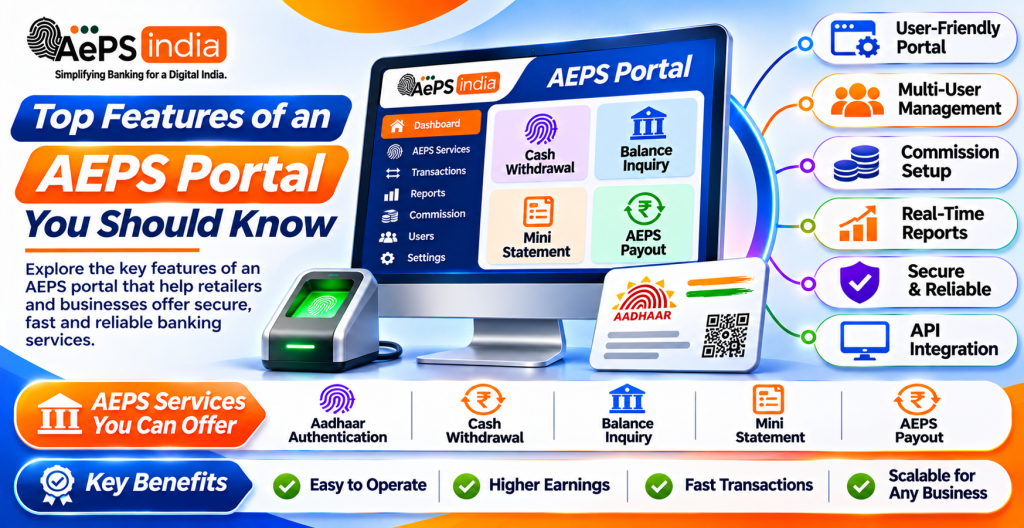
The Features AEPS Portal offers a convenient way for retailers, banking agents, and digital service providers to manage Aadhaar Enabled Payment System (AEPS) services through a digital platform. In India, AEPS plays an important role in making basic banking services accessible to customers, particularly in rural and semi-urban areas where access to traditional bank branches may be limited.
An AEPS portal can help retailers provide essential banking services such as cash withdrawal, cash deposit, balance enquiry, and mini statements through Aadhaar-based authentication. Depending on the Aeps india, additional features may include Aeps biometric device integration, retailer dashboards, transaction history, commission management, wallet management, and detailed reports.
An Aadhaar Enabled Payment System portal enables cardless, PIN-free banking and merchant payments using a customer’s Aadhaar number and biometric verification (fingerprint or iris scan). Regulated under the NPCI framework, portals combine customer banking transactions with agent and business management tools.
One of the biggest advantages of an AEPS portal is that it brings multiple banking service options together in one place. Retailers can manage daily transactions, monitor their activity, and serve customers more efficiently without switching between different platforms.
Whether you are a retailer planning to offer Aadhaar-based banking services, a distributor managing a retailer network, or a fintech business exploring digital banking solutions, understanding the Features AEPS Portal provides can help you choose a suitable Aeps platform for your business requirements.
In this guide, we will explore the important AEPS portal features, banking services, security aspects, retailer benefits, and how an AEPS platform supports digital banking services across India.
What is a AEPS Portal
An AEPS portal (Aadhaar Enabled Payment System portal) is a digital platform used by authorized agents or business correspondents to process basic banking transactions using a customer’s Aadhaar number and biometric verification instead of a debit card or PIN. Built on the NPCI AePS framework, it connects local retail or service touchpoints to participating banks for interoperable banking.
How Does AEPS Portal Work
An AEPS (Aadhaar Enabled Payment System) portal lets Business Correspondents (BCs) or retail agents offer cardless, PIN-free banking services using a customer’s Aadhaar number and biometric authentication. The system runs on the NPCI AePS overview framework and verifies identities against UIDAI biometric records.
How an AEPS Portal Works
- Customer details: The agent enters the customer’s 12-digit Aadhaar number, selects the customer’s bank, chooses the transaction type, and enters the amount (if applicable).
- Biometric capture: The customer scans their fingerprint or iris on a certified biometric scanner connected to the portal’s mobile app, tablet, or desktop.
- Authentication & routing: The b2b Aeps portal routes the request through the partner bank and NPCI switch to UIDAI for biometric verification.
- Settlement & receipt: Once approved, the transaction completes in real time, generating a unique reference number. For cash withdrawals, the agent hands over physical cash from their liquidity balance; for cash deposits, cash moves from the agent to the customer’s account.
Top 10 AEPS Portal Features Every Retailer Should Know
A strong Aadhaar Enabled Payment System (AEPS) portal helps retailers run smooth biometric banking while protecting margins and compliance.
- Core AEPS Banking Services: Support for cash withdrawal, balance enquiry, mini statements, and cash deposit (where enabled) using an Aadhaar number and biometrics.
- Aadhaar Pay Acceptance: Ability to collect merchant payments via Aadhaar authentication when customers exceed standard cash withdrawal limits.
- NPCI & L1 Security Compliance: Adherence to current NPCI guidelines, including support for secure L1 biometric devices and liveness detection to prevent spoofing.
- High Uptime & Multi-Bank Routing: Reliable switching and fallback routing across partner banks so peak-hour or DBT payout rushes do not cause timeouts.
- Real-Time Wallet & Instant Settlement: Live wallet balance updates with instant payouts to a bank account via IMPS or NEFT.
- Transparent Commission Tracking: Clear slab-wise commission visibility and automated ledger entries for every completed transaction.
- Easy E-KYC & Onboarding: Streamlined digital Aeps onboarding and bank authorization without unnecessary paperwork delays.
- Transaction Status & Dispute Logs: Real-time status tracking, failed-transaction refunds, and structured complaint/chargeback handling.
- Reconciliation & Accounting Reports: Downloadable daily ledgers, settlement reports, and audit trails to match shop cash with portal balances.
- Bundled Add-On Services: Built-in Domestic Money Transfer (DMT), mobile/DTH recharge, utility bill payments, or UPI QR collection to drive repeat footfall.
AEPS Portal Wallet and Balance Management
An AEPS portal wallet tracks agent commissions, cash-out payouts, and service balances across Aadhaar-based transactions.
How Wallet & Balance Flow Works
- Cash withdrawals & Aadhaar Pay: Customer funds debit from their Aadhaar-linked bank account and credit the agent’s portal wallet balance, while the agent hands out physical cash.
- Cash deposits & money transfers (DMT): Funds move from the agent’s wallet balance to the customer’s target account, requiring sufficient wallet liquidity.
- Commissions & charges: Portals credit earned commissions on eligible transactions and deduct applicable service or payout fees.
- Balance inquiries & mini statements: Non-financial checks fetch account balances or recent transactions without moving wallet funds.
Core Balance Management Tasks
- Wallet top-up / load: Add funds to your portal wallet via bank transfer, UPI/QR, or payment gateways to run DMT, bill payments, or recharges.
- Settlement / payout: Move available wallet balance to your linked bank account using IMPS, NEFT, or RTGS.
- Ledger & reconciliation: Track credits, debits, commissions, and transaction reference numbers (such as the 12-digit RRN) to match physical cash with digital balances.
- Network & role controls (B2B/Admin): Distributors and admins manage sub-agent wallets, commission splits, and KYC status.
AEPS Portal Commission in india
An AEPS portal commission structure pays agents, distributors, and master distributors based on transaction type and cash withdrawal amount slabs, typically ranging from a few rupees on small/non-cash transactions up to around ₹10–₹15+ on higher cash withdrawals.
1. Cash Withdrawal Slabs (Typical Examples)
Exact rates vary by Aeps india and promotional scheme:
- Low / Mid Slabs (e.g., ₹100–₹2,999): Often paid as a percentage (such as ~0.21%–0.25% depending on the slab and provider) or fixed slab amounts.
- High Slabs (e.g., ₹3,001–₹10,000): Commonly paid as a flat commission (often around ₹10.00 for retailers, with smaller flat or percentage overrides for distributors and master distributors).
2. Other AEPS & Related Services
- Balance Enquiry: Typically low fixed payouts (often around ₹1–₹5 per transaction).
- Mini Statement: Typically slightly higher than balance enquiry (often around ₹2–₹7 per transaction).
- Aadhaar Pay: Often has no standard bank commission, though top Aeps portal allow optional customer charges (up to ~1% depending on policy).
- Add-on Services (e.g., DMT, Recharge, Bills): Paid separately via their own commission or surcharge slabs.
3. Hierarchy & Settlement
- Multi-Tier Splits: Commissions are usually split across Retailer, Distributor, Master Distributor, and White Label Aeps Portal levels.
- Settlement: Payouts are typically credited to the portal wallet (instant or daily/scheduled batch settlements) and can be moved to a bank account via IMPS/NEFT.
AEPS Portal Security and Fraud Prevention Features
Securing an Aadhaar Enabled Payment System (AePS) portal requires strict authentication controls, biometric and data protection, continuous monitoring, and clear fraud-reporting workflows. Because AePS transactions rely on Aadhaar numbers and biometric verification without requiring a card or OTP, both portal operators and account holders face specific risks.
Common AePS Fraud Vectors
- Fingerprint Cloning & Spoofing: Fraudsters use silicone or synthetic fingerprint replicas paired with harvested Aadhaar numbers to authorize withdrawals at micro-ATMs or reliable Aeps portal.
- Biometric & Data Harvesting: Attackers collect Aadhaar numbers and biometric scans under false pretenses, such as fake subsidy updates, land/property records, or untrusted scanners.
- Agent / Credential Compromise: Unauthorized access to Aeps agent portal, leaked TPINs/passwords, or unverified devices can enable fraudulent transactions.
Portal & Operator Security Controls
- Strong Authentication & Access Control: Enforce multi-factor authentication, role-based access, and strict protection of agent TPINs, passwords, and session tokens.
- Certified Biometric Devices & Liveness Checks: Use certified Aeps biometric scanners and support modern authentication features (such as liveness/best-finger detection and dual/demographic authentication where applicable) to block spoofed inputs.
- Transaction Monitoring & Audits: Run real-time anomaly detection, velocity/amount checks, and regular security audits to flag unusual withdrawal patterns early.
- NPCI Compliance & Partner Vetting: Follow National Payments Corporation of India (NPCI) guidelines and work only with vetted, compliant Aeps india.
Customer & Account-Level Safeguards
- Lock Biometrics: Lock biometric authentication via UIDAI or the Aeps app when not actively needed.
- Disable Unused AePS Access: Ask your bank to keep AePS disabled if you do not use Aadhaar-based cash withdrawals; many banks keep AePS inactive by default or after periods of inactivity under NPCI rules.
- Limit Aadhaar Exposure: Avoid sharing your full Aadhaar number unnecessarily; use Masked Aadhaar when possible and avoid scanning fingerprints on unknown devices.
- Track Alerts & Statements: Keep SMS and email alerts active and review bank statements regularly for unauthorized debits.
What to Do If Fraud Happens
- Call 1930 Immediately: Contact the National Cyber Crime Helpline (1930) as quickly as possible to help freeze fraudulent fund flows.
- File an Official Complaint: Submit a report on the National Cyber Crime Reporting Portal.
- Notify Your Bank & NPCI: Report the unauthorized transaction to your bank immediately (and within applicable reporting windows) and escalate through your bank’s/NPCI’s dispute channels.
AEPS Portal Wallet and Fund Management
An Best AEPS portal wallet is a digital ledger used by agents, retailers, and distributors to manage working balances, settle cash-in/cash-out transactions, and track commissions on Aadhaar-authenticated banking services.
How Wallet & Fund Flow Works
- Cash Withdrawal: When a customer withdraws cash via biometric authentication, the amount is debited from the customer’s bank account and credited to the agent’s portal wallet. The agent hands physical cash to the customer.
- Liquidity & Cash-In: Agents maintain sufficient wallet balance to offer services like Domestic Money Transfer (DMT), bill payments, or cash deposits, topping up via bank transfer or UPI/payment gateways.
- Settlement (Payout): Agents move accumulated wallet funds to a linked bank account through instant payout rails (such as IMPS or NEFT), often supporting real-time or T+0 settlement.
- Commission Tracking: Portals automatically calculate and credit per-transaction commissions to agent and distributor wallets.
Key Fund Management Features
- Multi-Tier Ledgers: Separate balances or sub-wallets for main working funds, commissions, and distributor/retailer hierarchies.
- Reconciliation & Audit Logs: Transaction tracking using unique identifiers (such as the 12-digit Request Reference Number / RRN) to handle failed or pending settlements.
- Limits & Compliance: Transaction caps set by NPCI/banks (such as single-transaction limits) alongside KYC and escrow/settlement controls. For more details on how wallet operations fit into agent workflows, see AePS Wallet and NPCI AePS.
AEPS Portal Transaction Reports and Settlement Management
An branded AePS portal enables agents, distributors, and administrators to track transaction logs, reconcile statuses, and manage fund settlements. You can review core clearing details on the NPCI settlement lifecycle page.
Transaction Reports
- Key Log Fields: Reports typically track the 12-digit Retrieval Reference Number (RRN), transaction type (cash withdrawal, balance enquiry, mini statement, or fund transfer), amount, timestamp, customer/agent identifiers, and status.
- Status & Failure Tracking: Portals separate successful transactions from failed or pending ones, such as biometric mismatches or issuer bank/cardholder restrictions.
- Reconciliation: Aeps Admin and distributors use filtered logs to match terminal activity against wallet balances, commission credits, and bank payouts.
Settlement Management
- Settlement Flows: Funds move through portal wallets or direct bank payouts depending on the Aeps setup, including same-day or real-time settlement options offered by Aeps service platform.
- Network Cutoffs: At the underlying network level, AePS settlement batches use a daily cutover (historically 23:00 hours for transactions included in that day’s cycle).
- Commission & Payout Controls: Modern Aeps Portal track agent and distributor commission slabs alongside principal settlement amounts, while also logging disputes or chargebacks through complaint workflows.
Benefits of AEPS Portal for Retailers in India
An Aadhaar Enabled Payment System (AePS) portal lets authorized agents and retailers offer basic banking services like cash withdrawals, balance inquiries, mini statements, and fund transfers using just a customer’s Aadhaar number and biometric authentication. Managed at the network level by the NPCI, AePS portals benefit both business operators and customers.
Benefits for Agents & Retailers
- Commission income: Earn per-transaction commissions on cash withdrawals and supported banking services.
- Low setup cost: Operates with a compatible biometric scanner, smartphone or PC, and an active portal account rather than heavy branch infrastructure.
- Higher footfall: Brings regular customers into a shop or service point for everyday banking, creating cross-selling opportunities for other retail or digital services.
- Interoperable reach: Serves customers across multiple participating banks from a single portal.
Benefits for Customers
- Cardless and PIN-free access: Uses Aadhaar details and biometrics (such as fingerprint, iris, or supported authentication modes) instead of a debit card or PIN.
- Local convenience: Enables cash withdrawals, balance checks, mini statements, and Aadhaar-linked transactions at nearby neighborhood touchpoints instead of traveling to a distant bank branch or ATM.
- Supports financial inclusion: Helps reach rural, semi-urban, and elderly users who rely on Aadhaar-seeded accounts, including for government benefits and transfers.
AEPS Portal vs AEPS App: Which Is Better for Retailers?
For most retailers, an AEPS app is better for day-to-day counter convenience and quick biometric transactions, while an AEPS portal is better for desktop accounting, bulk reporting, and multi-user or back-office management. Many providers offer both synced to the same account.
AEPS Portal vs. AEPS App Comparison
| Feature | AEPS Portal (Web / Desktop) | AEPS App (Mobile) |
|---|---|---|
| Primary Device | Desktop or laptop with web browser | Smartphone (Android/iOS) |
| Setup & Portability | Fixed to a desk or counter; requires computer setup | Portable; easy to use anywhere at the shop or counter |
| Biometric Scanner | Connects via USB biometric device | Connects via OTG/USB or supported mobile biometric setup |
| Reporting & Accounting | Larger screen for detailed ledgers, statements, and exports | Quick real-time transaction status and commission tracking on the go |
| Best Fit | Dedicated service counters, billing desks, and record-heavy workflows | Busy retail counters, small shops, and fast customer queues |
Aeps india One of The Best AEPS Portal Provider in India?
Aeps india is an AEPS portal provider in India depends on compliance, transaction reliability, commission structure, and scalability. Official guidelines and ecosystem details are available through NPCI.
Key Factors to Evaluate
- Regulatory Compliance & Security: Confirm alignment with NPCI, RBI, and UIDAI rules, along with end-to-end encryption and secure biometric authentication.
- Uptime & Success Rate: Look for high uptime (such as 99% or higher) and low transaction failure rates so customers do not face delays during cash withdrawals or balance checks.
- Commission & Fee Transparency: Compare per-transaction commissions, payout/settlement speed, onboarding or white-label costs, and any hidden charges.
- Bank Connectivity: Check how many participating banks are supported for smooth cash withdrawals, balance enquiries, and mini statements.
- Extra Services & Scalability: Consider whether the Aeps india offers domestic money transfer (DMT), Micro ATM, bill payments, recharges, and distributor/retailer dashboards for growth.
- Customer Support: Verify that fast technical and grievance support is available to resolve failed transactions or reconciliation issues quickly.
Why Choose Aeps india for AEPS Portal Solution
Aeps india is a reliable AEPS portal solution provider ensures high transaction success rates, regulatory compliance, and steady revenue for your retail or agent network. Aeps india helps you deliver cash withdrawals, balance enquiries, mini statements, and fund transfers smoothly using Aadhaar and biometric authentication.
Key Reasons to Choose the Right AEPS Provider
- High Uptime and Low Failure Rates: Reliable infrastructure prevents downtime, latency, and reconciliation errors during peak transaction hours.
- Security and Compliance: Biometric and Aadhaar data require strong encryption, two-factor authentication, and adherence to NPCI and banking rules.
- Commission Structure and Settlements: Transparent, competitive commissions and timely wallet or payout settlements support steady cash flow for agents and distributors.
- Multi-Service Expansion: B2B Aeps Platform that also support DMT (money transfer), micro-ATM, BBPS, recharges, or UPI help turn your Aeps banking portal into a one-stop service point.
- Usability and Network Management: A clear dashboard for agents along with distributor and reporting tools simplifies daily operations.
- Onboarding and Support: Fast KYC/onboarding, biometric device compatibility, and responsive technical support keep agents running without delays.
Conclusion
Understanding the Features AEPS Portal offers is important for retailers, banking agents, distributors, and fintech businesses looking to provide reliable Aadhaar-based banking services in India. From cash withdrawal and balance enquiry to mini statements, biometric authentication, and transaction management, each feature plays an important role in making everyday banking services more accessible and convenient.
A well-designed AEPS portal should offer more than basic banking transactions. Features such as a user-friendly retailer dashboard, real-time transaction status, detailed reports, commission management, wallet monitoring, and distributor administration can help businesses manage their daily operations more efficiently. However, the availability of these facilities depends on the AEPS service provider like Aeps india and its technology Aeps platform.
An Aadhaar Enabled Payment System (AePS) portal enables cardless, PIN-free banking using a customer’s Aadhaar number and biometric verification (fingerprint or iris scan). It connects local agents or retail touchpoints through NPCI to Aadhaar-linked bank accounts for basic banking and agent management.
Before choosing an AEPS portal, businesses should carefully evaluate its security standards, biometric device compatibility, transaction processing capabilities, technical support, transparency in commission structure, and applicable banking compliance requirements. Selecting a suitable Aeps platform can make it easier to manage retailer activities, monitor transactions, and build a more organized AEPS service network.
As India’s digital banking ecosystem continues to evolve, AEPS remains an important part of last-mile financial inclusion, particularly in rural and semi-urban communities. By understanding the essential Features AEPS Portal solutions should provide, businesses can make informed decisions and deliver accessible, efficient, and customer-focused banking services across India.
Launch Your AEPS Portal with Aeps India
Looking to start or expand your Aadhaar Enabled Payment System business? Get an AEPS Portal with essential features for managing retailers, distributors, transactions and digital banking services. Contact Aeps India to discuss your requirements and get the right solution for your business.
Frequently Asked Questions About Feature AEPS Portal
A Feature AEPS Portal is a digital Aeps platform that provides access to supported Aadhaar Enabled Payment System services and business management tools. Depending on the Aeps india, it may include cash withdrawal, balance enquiry, mini statement, transaction history, retailer management and commission tracking.
The main features may include a retailer dashboard, cash withdrawal, balance enquiry, mini statement, supported cash deposit, Aadhaar-to-Aadhaar fund transfer, biometric authentication, transaction tracking, reports, user management and customer support.
NPCI’s AePS documentation lists services such as cash withdrawal, balance enquiry, cash deposit, mini statement, Aadhaar-to-Aadhaar fund transfer, Aadhaar Pay API and Self-Help Group transactions. Actual availability depends on participating banks and service arrangements.
Yes. NPCI operates the AePS payment software, while an fast AEPS portal is generally a software interface provided by a service provider for authorized users to access supported services and manage transactions.
Authorized retailers, banking correspondents, distributors and other eligible operators may use an AEPS portal, subject to the applicable onboarding, KYC and Aeps india requirements.
A customer generally needs an Aadhaar number or supported Virtual ID, the relevant bank identification and an accepted authentication method. The bank account must be Aadhaar-enabled for the service.
Eligible customers can withdraw cash through an authorized AePS touchpoint if the participating bank and service arrangement support the service.
Many AEPS portal provide transaction history with details such as transaction date, amount, reference number and status. The exact reporting features depend on the Aeps india.
No. Cash deposit availability depends on participating banks and the supported service configuration. Retailers should verify availability before offering this service.
AePS transactions use Aadhaar-based authentication. The accepted authentication method depends on the applicable service and banking arrangements.
Retailers can generally log in to their authorized Aeps portal, open the transaction history or report section, and check the relevant transaction reference and status.
Retailers should check authorized banking arrangements, KYC procedures, transaction transparency, security controls, device compatibility, commission policies, settlement arrangements and customer support.
AePS is a bank-led payment system using Aadhaar authentication. A Micro ATM is a device or touchpoint through which banking services can be accessed. A Micro ATM may support AePS transactions depending on its configuration.
AePS is designed as an interoperable banking system across participating banks. Actual access depends on participating institutions, authorized touchpoints, technical availability and applicable service conditions.
The RBI directions dated June 27, 2025, became effective on January 1, 2026. They address operator due diligence, KYC, inactive operator re-verification and ongoing transaction risk monitoring.
Transaction tracking helps retailers identify successful, failed, pending and reversed transactions. It also supports record-keeping, reconciliation and customer complaint resolution.
Aeps platform provide distributor and retailer management features. Their availability depends on the Aeps business model, user permissions and authorized Aeps onboard arrangements.
AePS uses Aadhaar-based authentication, but users and operators must still follow security precautions. They should use authorized touchpoints, protect customer information, verify transaction responses and report suspicious activity promptly.
UIDAI provides Aadhaar authentication infrastructure. NPCI operates the AePS software and facilitates transaction routing, clearing and settlement through the participating banking ecosystem.
Evaluating Aeps portal features helps businesses understand the available services, transaction reporting, retailer management, security, commissions and support arrangements before choosing a Aeps india.
Start AEPS Service in India and Earn High Commission
AEPS Services for Business Growth: A Step-by-Step Guide
Complete AEPS Setup Guide for Retailers in India
About Author

