What is AEPS? Full Form, Meaning, Services & How AEPS Works in India
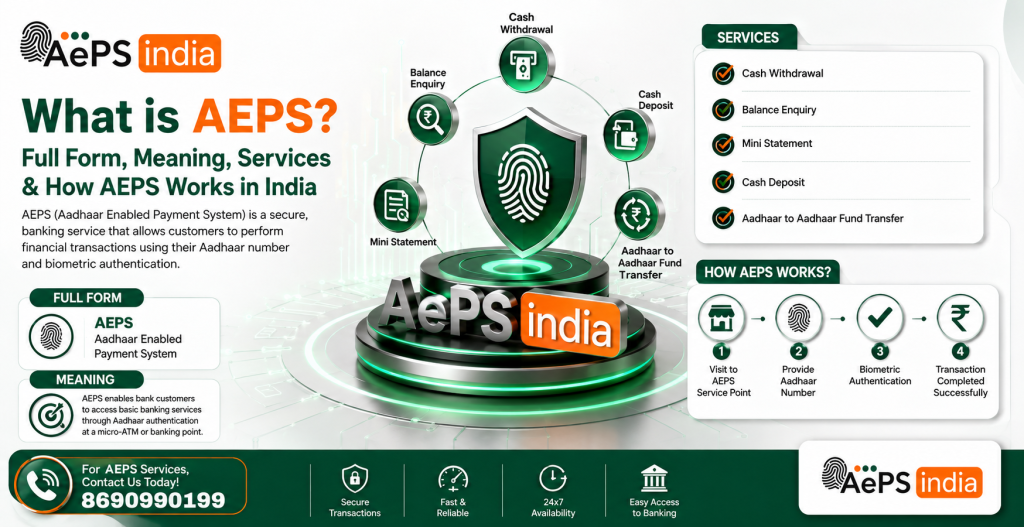
Are you looking to understand What is AEPS and how it works? The Aadhaar Enabled Payment System (AEPS) is one of India’s most trusted digital banking services that allows customers to perform basic banking transactions using their Aadhaar number and biometric authentication. It makes banking simple, secure, and accessible, especially for people living in rural and semi-urban areas.
With AEPS, customers can easily access services such as cash withdrawal, balance enquiry, mini statement, and Aadhaar-based banking transactions without visiting a bank branch or ATM. This system is designed to promote financial inclusion by making essential banking services available through authorized AEPS retailers and banking agents across India.
Aadhaar Enabled Payment System (AEPS) is a cutting-edge banking payment system that enables Aadhaar cardholders to conduct easy, safe, and accessible financial transactions. This initiative has been incorporated by the National Payments Corporation of India (NPCI). You can take advantage of seamless financial services without going to the bank by simply providing your fingerprint and Aadhaar number.
Aadhaar Enabled Payment System allows bank customers who have linked their Aadhaar to their bank account to perform basic banking transactions, such as checking balance, withdrawing cash, and making necessary and immediate payments through a business correspondent. All of this can be done at point-of-sale machines or micro ATMs. This is a straightforward, safe, user-friendly payment platform for financial transactions.
One of the biggest advantages of the Aadhaar Enabled Payment System is convenience. Customers only need their Aadhaar number and fingerprint authentication to complete transactions securely. This makes AEPS a trusted solution for individuals, retailers, business owners, and financial service providers who want to offer simple and reliable banking services.
For retailers and fintech businesses, AEPS Software creates an excellent opportunity to expand digital banking services and earn commission on every successful transaction. With a reliable AEPS API, businesses can provide cash withdrawal, balance enquiry, mini statement, Aadhaar Pay, and other banking services through a secure and user-friendly platform.
Aeps India offers advanced AEPS Software Solutions designed for retailers, distributors, master distributors, and fintech companies. With secure AEPS API Integration, real-time transaction processing, wallet management, retailer management, and dedicated technical support, businesses can build a scalable digital banking network and deliver a seamless customer experience.
In this complete guide, you will learn what AEPS is, how the Aadhaar Enabled Payment System works, its benefits, features, transaction process, eligibility, business opportunities, and why AEPS has become an important part of digital banking in India.
What is Aadhaar Enabled Payment System (AEPS)?
The Aadhaar Enabled Payment System (AePS) is a bank-led model by the National Payments Corporation of India (NPCI) that allows users to perform basic banking transactions (like cash withdrawals, deposits, and balance inquiries) using just their Aadhaar number and biometric authentication at authorized point-of-sale or micro-ATM terminals.
Developed by the National Payments Corporation of India (NPCI), the system is designed to bring formal banking to remote and rural areas, making it easier for citizens to access funds without traveling long distances to a bank branch.
Key Notes
- AEPS Full Form: Aadhaar Enabled Payment System
- Meaning: A secure banking service that enables customers to perform financial transactions using their Aadhaar number and biometric authentication.
- Used For: Cash withdrawal, balance enquiry, fund transfer, and other basic banking services.
- Requirement: The customer’s Aadhaar number must be linked to their bank account to use AEPS services.

How AEPS Work (Step-by-Step)
The Aadhaar Enabled Payment System (AePS) lets you access bank accounts and perform basic banking operations using just your Aadhaar number and biometric authentication (fingerprint or iris scan) at local merchant terminals. For comprehensive details on participating banks and guidelines, you can visit the Aeps India portals.
AEPS is designed to make banking services accessible to everyone, including people who are not tech-savvy. Its simple, user-friendly process eliminates the need for complex technology, making digital banking easy and convenient. Below is the step-by-step process of how AEPS works.
- Initiation: You visit a local Business Correspondent (BC) or micro-ATM and provide your 12-digit Aadhaar number and bank name.
- Transaction Selection: The agent selects the desired service (e.g., cash withdrawal or balance check) and enters the amount if applicable.
- Biometric Verification: You verify your identity by placing your finger on a biometric scanner.
- Processing: The system encrypts and securely routes the data to the Unique Identification Authority of India (UIDAI) for authentication.
- Completion: Upon successful validation, the bank processes the transaction in real time and provides a physical or digital confirmation receipt.
AEPS Services Explained
The Aadhaar Enabled Payment System (AePS) is a bank-led model developed by the NPCI that allows citizens to perform basic financial transactions using just their Aadhaar number and biometric authentication at local Business Correspondents (BC) or micro-ATMs. It is entirely cardless and PIN-free.
Any individual in India whose Aadhaar number is linked with an eligible bank account can use Aadhaar Enabled Payment System (AePS) services. This Aadhaar-linked account is commonly known as an Aadhaar Enabled Bank Account (AEBA). Customers can visit an authorized Business Correspondent (BC), banking agent, or AePS service point of participating banks to securely access essential banking services such as cash withdrawal, balance inquiry, mini statement, fund transfer (where available), and other supported transactions using Aadhaar authentication.
Core Services Offered
Users linked to an Aadhaar-Enabled Bank Account can access several services through an AePS:
- Cash Withdrawal: Withdraw money from your bank account locally.
- Cash Deposit: Deposit cash securely without visiting a physical bank branch.
- Balance Inquiry: Check your current account balance.
- Mini Statement: Get a brief summary of recent transactions.
- Fund Transfer: Send money directly from one Aadhaar number to another.
Types of AEPS Transactions (Transactions You Can Do)
Aadhaar Enabled Payment System (AePS) is a bank-led model allowing transactions via Aadhaar authentication at Micro ATM system or Business Correspondent (BC) outlets. Key types include Aeps cash withdrawal, Aeps cash deposit, Aeps balance enquiry, Aeps mini statement, Aadhaar-to-Aadhaar fund transfers and Aadhaar Pay for merchant transactions.
Main Types of AePS Services:
- Cash Withdrawal: Allows users to withdraw cash from their Aadhaar-linked bank account without a debit card or PIN.
- Cash Deposit: Enables real-time, instantaneous deposit of cash into an Aadhaar-linked account at a BC outlet.
- Balance Enquiry: Enables users to instantly check their current account balance.
- Mini Statement: Provides a summary of the last few transactions (usually 5-10) in the bank account.
- Aadhaar to Aadhaar Fund Transfer: Facilitates immediate money transfers between two bank accounts linked with different Aadhaar numbers.
- BHIM Aadhaar Pay: A merchant-focused Aeps service allowing businesses to accept payments from customers via biometric authentication.
- Direct Benefit Transfer (DBT) Access: Allows beneficiaries to withdraw government subsidies (pensions, scholarships, wages) directly.
- Dual Authentication: A secure transaction mode requiring two-factor authentication, often used for higher security in sensitive transactions.
AEPS Eligibility
AePS eligibility differs based on whether you are using the system to access your own money (Customer) or setting up a kiosk/shop to offer banking services (Agent). To ensure a seamless transaction or agent setup, familiarize yourself with the requirements provided by the Aeps india.
1. Customer Eligibility
To make a transaction at any Micro-ATM or Business Correspondent (BC) point, you only need to meet three criteria:
- Aadhaar-Linked Account: Your bank account must be actively linked (seeded) with your Aadhaar number.
- Biometric Authentication: You must provide either a fingerprint or iris scan and be physically present.
- Single Account Rule: You can only transact using one bank account at a time (your primary account).
2. AEPS Agent/Retailer Eligibility
If you are looking to become an AePS Service Provider and operate a Customer Service Point (CSP), you must fulfill the following criteria:
- Age & Nationality: You must be an Indian citizen aged 18 years or older.
- Documentation: You need a valid PAN card, proof of address, and an Aadhaar-linked bank account to receive your commissions.
- Hardware Setup: You must have a smartphone, tablet, or PC with an active internet connection, alongside a UIDAI-certified, registered biometric (fingerprint or iris) scanner.
- Registration: You must register with an authorized Aeps india to obtain access to the banking portal.
Documents Required for AEPS
The documents required to start an AEPS (Aadhaar Enabled Payment System) business include your Aadhaar Card, PAN Card, a bank account (passbook or cancelled cheque), and address proof. Agents also need a registered biometric device (fingerprint/iris scanner) to facilitate customer transactions.
The specific documents and hardware required to register as an AEPS agent include:
1. Mandatory KYC Documents
- Aadhaar Card: Proof of identity; it must be linked to your mobile number and bank account for OTP verification.
- PAN Card: Mandatory for identity verification and tax settlement tracking.
- Bank Account Details: A cancelled cheque, the first page of your bank passbook, or a bank statement for commission and fund settlement.
- Passport-sized Photographs: Recent photos with a neutral background.
- Proof of Address/Business: A utility bill (electricity or water not older than 2-3 months), rent agreement, or official business registration (e.g., Shop & Establishment, GST, or Udyam certificate).
- Contact Information: An active mobile number and email address.
2. Essential Hardware
- Smartphone or Computer: For operating the AEPS app or portal.
- Biometric Scanner: A UIDAI-certified, registered (RD) device (such as Mantra, Morpho, or Startek) to capture customers’ fingerprint or iris scans.
AEPS Transaction Flow Diagram
Key Components of AEPS
The Aadhaar Enabled Payment System (AEPS) is an NPCI-developed bank-led model that allows users to perform basic banking tasks securely using only their Aadhaar number and biometrics. It eliminates the need for physical debit cards, PINs, or passwords.
Essential Technical Components
- Aadhaar Number: The user’s unique 12-digit identification number linked to their bank account.
- Biometric Authentication: Fingerprint scans or iris verification captured via STQC-certified biometric devices.
- Business Correspondent (BC) / Micro-ATM: Local agents or shopkeepers equipped with a smartphone/computer and internet who process transactions on behalf of the customer.
- NPCI Switching Platform: The routing and settlement system that instantly processes transaction requests between different banks.

Who Can Use AEPS?
AEPS (Aadhaar Enabled Payment System) is especially beneficial for people who have limited access to traditional banking services. It provides a simple, secure, and convenient way to perform essential banking transactions such as cash withdrawals, balance enquiries, and Direct Benefit Transfers (DBT) through biometric (fingerprint) authentication at nearby Business Correspondent (BC) points. This makes banking more accessible, particularly in rural and remote areas where bank branches and ATMs are not easily available.
- People Living in Rural or Remote Areas : AEPS is highly beneficial for individuals who have limited access to bank branches or ATMs. Instead of travelling long distances, they can conveniently withdraw cash and access other banking services through nearby Business Correspondents.
- Individuals Without Access to the Digital World: AEPS is an ideal banking solution for people who have limited access to smartphones, mobile apps, or internet banking. It also supports those who find PIN-based or digital transactions difficult to understand or use.
- Senior Citizens: For senior citizens, AEPS offers a simple and hassle-free banking experience. Since transactions are authenticated using Aadhaar and fingerprint verification, there is no need to remember PINs, passwords, or use complicated mobile applications.
- Daily Wage Workers and Small Earners: AEPS enables daily wage workers and small earners to withdraw cash quickly whenever required. It also provides a convenient way to receive wages, government benefits, and other payments directly into their bank accounts.
- People Who Are Not Tech-Savvy: Individuals who are not familiar with digital banking can easily use AEPS without any special technical knowledge. The system is simple, user-friendly, and does not require extensive digital skills.
- Migrant Workers: AEPS is particularly useful for migrant workers who live away from their hometown or home bank branch. They can securely access their bank accounts and perform banking transactions from anywhere in India without visiting their original bank branch.
Why AEPS is Growing Fast in India
The Aadhaar Enabled Payment System (AEPS) is growing rapidly in India surging from INR 5 billion in 2019 to over INR 51 billion in 2024 driven by its role in rural financial inclusion, high security and extreme convenience. By enabling doorstep banking via biometric authentication and supporting government direct benefit transfers (DBT), it has bridged the gap for unbanked populations while offering high-revenue opportunities for agents.
Key drivers of AEPS growth include:
- Financial Inclusion in Rural Areas: Best AEPS acts as a “mini-bank” for remote villages where traditional bank branches are scarce. It provides vital services like cash withdrawal, deposit, and balance inquiry right at local retail outlets.
- Convenience & Security: The top Aeps system is cardless and PIN-less, utilizing Aadhaar-linked fingerprint or iris scanning. This ensures high safety and trust, particularly among elderly and rural users who find it easier to use than traditional ATMs.
- Direct Benefit Transfer (DBT) Support: The government relies heavily on fast AEPS to disburse subsidies, scholarships and pensions (e.g., MGNREGA) directly into Aadhaar-linked accounts.
- Low-Cost Banking Model for Agents: Small shopkeepers (Business Correspondents or “Bank Mitras”) can set up an AEPS business with minimal investment just a smartphone and a buy Aeps biometric device. This allows them to earn commissions while attracting higher footfall.
- Interoperability: Customers can use any bank account at any authorized AEPS device, removing the barrier of finding a specific bank’s ATM or branch.
- Rapid Adoption of Technology: The proliferation of smartphones, internet access in rural areas, and the reliability of biometric identification have accelerated its adoption.
As a result, AEPS has become a critical pillar of India’s digital economy, catering to both the underbanked and those seeking convenient, local, 24/7 banking services.
How AEPS Helps in Financial Inclusion in Rural Areas
The Aadhaar Enabled Payment System (AEPS) fosters financial inclusion in rural areas by enabling doorstep banking via biometric authentication, eliminating the need for bank branches or debit cards. It empowers rural populations to perform secure transactions cash withdrawal api, cash deposit api, and balance inquiry api at local shops, ensuring access to government benefits (DBT) and reducing dependence on distant banks.
How AEPS Enhances Rural Financial Inclusion:
- Doorstep Banking Accessibility: Top AEPS transforms local Kirana stores, small businesses, and village agents into banking points. This brings essential financial services to the doorstep, reducing travel time and costs for rural residents.
- Direct Benefit Transfer (DBT): It streamlines the delivery of government welfare payments, such as NREGA wages and pensions, directly to beneficiaries’ bank accounts. This reduces corruption and ensures timely access to funds.
- Aadhaar-Based Authentication: Eliminates the need for debit/credit cards or PINs, reducing the fear of forgetting credentials, as only a bank-linked Aadhaar number and fingerprint scan are required.
- Secure Transactions for All: Utilizing biometric verification (fingerprints) instead of PINs or signatures, High volume AEPS offers a secure, user-friendly system for illiterate or digitally hesitant residents, thereby increasing trust in digital transactions.
- Interoperability Across Banks: A user can access their account with any bank through the same local agent, eliminating the need to search for a specific bank’s ATM or branch.
- Low Cost and Convenience: The Aeps setup is inexpensive for agents (requiring just a smartphone and scanner), making it sustainable to offer low cost Aeps services in remote areas.
- Driving Economic Participation: By facilitating easy savings and transactions, AEPS empowers rural families to manage their finances, enabling them to move away from cash-only dependency and join the formal economy.
Through these mechanisms, High commission AEPS has transformed rural banking, significantly reducing dependency on physical bank branches and increasing economic participation.
Uses of AEPS for Customers and Businesses
Aadhaar Enabled Payment System (AEPS) is a bank-led model enabling secure, cardless, and PIN-less transactions using Aadhaar biometric authentication. It allows customers to perform basic banking, such as Aeps cash withdrawal services, Aeps balance inquiry services, and Aeps fund transfer services at local BC/Agent outlets. For businesses, it serves as a high-footfall, Aeps commission-generating “mini-bank service that improves digital inclusion.
Uses of AEPS for Customers (Individuals):
- Cash Withdrawal: Customers can withdraw money from their Aadhaar-linked account at any nearby micro-ATM/retailer, which is crucial for rural areas lacking banks.
- Balance Enquiry: Quick access to check account balances without visiting a bank branch.
- Mini Statement: Customers can obtain a mini-statement to review their last few transactions.
- Aadhaar to Aadhaar Fund Transfer: Enables instant transfer of funds between two Aadhaar-linked bank accounts.
- Cash Deposit: Allows beneficiaries to deposit cash into their accounts.
- Convenience & Security: Cardless and PIN-less, making it secure through biometric (fingerprint/iris) authentication, ideal for the elderly or illiterate.
Uses of AEPS for Businesses (Merchants/Retailers/BCs):
- Commission Income: Retailers earn Aeps commissions on every successful transaction (e.g., cash withdrawals, balance checks), creating a new revenue stream.
- Increased Footfall: Providing Aeps banking services like cash withdrawal turns a shop into a “mini-bank,” attracting more customers and increasing sales.
- Secure Transactions: Reduces the risks associated with carrying large amounts of cash, as transactions are secured via biometric verification.
- Instant Settlement: Business owners often receive quick or same-day (T+0) settlement, maintaining cash flow.
- Broadening Services: Enables merchants to offer additional financial services, including bill payments.
- Competitive Edge: Helps local shops compete with larger stores by acting as a local banking point.
AEPS for Retailers & Agents – Business Opportunity
Aadhaar Enabled Payment System (AEPS) offers a lucrative business opportunity for retailers to act as banking correspondents, earning ₹10,000–₹30,000+ monthly via commissions (up to ₹15–₹20 per transaction) by facilitating Aeps cash withdrawal api service, Aeps deposit api service and Aeps balance inquiry api service. Requiring only a smartphone and a biometric device, this low-investment model suits rural/semi-urban areas, increasing customer footfall and loyalty.
Why AEPS is a Top Business Opportunity
- High Revenue Potential: Earn Aeps commissions on every transaction, with higher payouts (up to ₹15–₹20) for high-value withdrawals (3,000–10,000).
- Low Investment & Setup: Requires only a smartphone (or PC), internet, and a UIDAI-Aeps biometric device (fingerprint scanner).
- Increased Footfall & Sales: Acting as a “mini-bank” brings in more customers, driving 15-20% higher footfall and potential cross-selling of other products.
- Instant Settlement: Retailers benefit from instant (𝑇+0) or same-day (𝑇+1) settlement, ensuring high cash liquidity.
- Targeted Services: Essential for rural areas to facilitate Direct Benefit Transfers (DBT), pensions, and salary withdrawals.

Benefits of AEPS
The Aadhaar-Enabled Payment System (AePS) allows bank customers to access basic financial services using just their Aadhaar number and fingerprint. It drives rural financial inclusion and enables cardless transactions, fund transfers, cash withdrawals, and mini-statements at local micro-ATMs without needing a PIN or debit card.
Top Benefits of AePS
- Cardless & PIN-less Transactions: You don’t need to carry a physical debit/credit card or memorize complex PINs. Your unique biometric data (fingerprint or iris scan) and Aadhaar number are all that’s required.
- Financial Inclusion for Rural Areas: AePS brings banking directly to underrepresented and remote areas through local Business Correspondents (BCs). This saves citizens from traveling long distances to a physical bank branch
- High Security: Biometric authentication ensures that only the actual account holder can authorize a transaction, highly reducing the risk of fraud or PIN theft.
- Interoperability: You can conduct transactions at any AePS-enabled micro-ATM or banking point, regardless of which bank holds your account.
- Government Scheme Disbursements: It simplifies receiving government subsidies (like pensions, NREGA wages, etc.) as funds are securely and directly credited to your Aadhaar-linked bank account.
- Multiple Banking Services: Beyond cash withdrawals, you can easily perform cash deposits, check your account balance, and generate mini-statements.
Features of AEPS
The Aadhaar Enabled Payment System (AePS) is a secure, cardless banking model that allows users to perform basic financial transactions like cash withdrawals, deposits, and balance inquiries using only their Aadhaar number and biometric authentication (fingerprint or iris scan) at localized micro-ATMs or with banking correspondents.
Key features of AePS include:
- Cardless & PIN-less Banking: Eliminates the need to carry physical debit/credit cards or memorize ATM PINs, relying strictly on your Aadhaar number and registered biometrics.
- Interoperability:
- Customers can access their bank accounts through any authorized Business Correspondent (Bank Mitra) using any bank’s micro-ATM, regardless of where they hold their account.
- Core Banking Services: Supports multiple day-to-day services such as cash withdrawal, cash deposit, balance enquiry, mini-statement generation, and fund transfers.
- Government Benefit Distribution: Seamlessly facilitates the receipt of Direct Benefit Transfers (DBT), such as MGNREGA wages and pensions, directly into Aadhaar-linked accounts.
- Financial Inclusion: Extends formal banking services to remote and rural areas, bringing door-step banking to the unbanked and underserved populations without requiring smartphones.
AEPS Architecture Diagram
Gateway
AEPS Registration Process
AePS (Aadhaar Enabled Payment System) allows customers to perform basic banking like cash withdrawals, balance inquiries, and fund transfers using just their Aadhaar number and biometrics. If you want to use AePS as a customer, you don’t need to register; you just need to link your Aadhaar to your bank account.
If you want to become an AePS Agent/Merchant to offer banking services at your shop and earn commissions, follow these steps:
How to Register as an AePS Agent
- Choose a Service Provider: Select an multi bank certified Aeps india.
- Submit Documents: Fill out the agent registration form and provide your KYC details, including your Aadhaar card, PAN card, and bank account details
- Verify and Setup: After your account is verified and approved, you will receive your Agent Login ID.
- Hardware Required: Purchase and install an NPCI-certified biometric fingerprint scanner (like Mantra or Morpho) to connect to your smartphone or laptop.
- Start Transacting: Log in to your Aeps dashboard to process transactions, such as cash withdrawals, directly from customer bank accounts.
AEPS API Integration for Website and Mobile App
AEPS API integration enables businesses to offer banking services like cash withdrawal and balance inquiry via biometric authentication. The process involves selecting an NPCI-certified Aeps india, completing KYC, purchasing Aeps device and integrating Aeps API into a best Aeps platform.
Key Steps for AEPS API Integration:
- Select a Certified API Provider: Partner with an Aeps India, that ensures high success rates and secure, compliant technology.
- Complete Registration and KYC: Register your business and submit mandatory KYC documents (PAN card, Aadhaar card, bank account details for settlement).
- Acquire & Register Biometric Device: Purchase Aeps biometric device (e.g., Mantra) and register it with the Aeps india Registered Device (RD) service.
- Obtain API Credentials and Docs: Receive Aeps API keys, Aeps Merchant ID (MID), and technical documentation, which usually includes JSON/XML protocols and SDKs, typically within 24-48 hours.
- Technical Integration (Backend & Frontend): Develop Aeps the frontend user interface to capture biometric data and backend Aeps API for transactions, ensuring a secure HTTPS callback URL for transaction statuses.
- Sandbox Testing: Test the best Aeps API in a sandbox environment to ensure functionality of cash withdrawals, mini statements and balance inquiries using dummy data.
- Go Live (Production): After successful testing, switch from test credentials to Aeps api live production keys to start live Aeps API transactions.
Technical & Compliance Requirements:
- RD Service: Mandatory installation of the manufacturer’s RD service Aeps app on Windows or Android to capture encrypted fingerprint data.
- Compliance: Adhere to the “one operator, one bank” rule and perform re-KYC for accounts inactive for three months.
AEPS API Workflow

Aeps Commission Structure in india
AePS commission in India typically ranges from ₹3–₹15 per transaction per successful cash withdrawal, with the highest earnings on transactions between ₹3,000 and ₹10,000. Retailers also earn ₹0.50–₹5 per balance inquiry or mini-statement, while Aadhaar Pay api can offer up to 1% commission on high-value transactions.
Common AePS Commission Slab (Retailer)
- ₹100 – ₹999: ₹2.00 commission
- ₹1,000 – ₹1,499: ~₹3.00 commission
- ₹1,500 – ₹1,999: ~₹4.50 commission
- ₹2,000 – ₹2,499: ~₹5.50 commission
- ₹2,500 – ₹2,999: ₹5 – ₹7 commission
- ₹3,000 – ₹10,000: ₹10 – ₹15+ commission
Cash Withdrawal Commission
| Customer Withdrawal Amount | Your Commission Per Transaction |
|---|---|
| ₹100 – ₹500 | ₹3 – ₹5 |
| ₹500 – ₹1,000 | ₹5 – ₹8 |
| ₹1,000 – ₹2,000 | ₹8 – ₹12 |
| ₹2,000 – ₹3,000 | ₹12 – ₹15 |
| ₹3,000 and above | Up to ₹15 – ₹18 per transaction |
Other Service Commissions
| Service | Commission |
|---|---|
| Balance Inquiry | ₹1 – ₹3 per inquiry |
| Mini Statement | ₹2 – ₹5 per statement |
| Aadhaar Fund Transfer | ₹5 – ₹10 per transfer |
| Cash Deposit | ₹3 – ₹8 per deposit |
Monthly Aeps Bonus Incentives
AEPS India also offers monthly performance bonuses of ₹2,000 and above for agents who consistently meet transaction volume targets.
Real Income Calculation
Scenario 1 — Part-time Retailer
- 30 transactions daily × ₹8 average commission
- Daily income: ₹240
- Monthly income: ₹7,200
Scenario 2 — Active Kirana Store
- 70 transactions daily × ₹10 average commission
- Daily income: ₹700
- Monthly income: ₹21,000
Scenario 3 — High-Volume CSP Agent
- 150 transactions daily × ₹12 average commission
- Daily income: ₹1,800
- Monthly income: ₹54,000
Scenario 4 — Distributor with 20 Retailers
- 20 retailers × 70 transactions × ₹5 network commission
- Daily income: ₹7,000
- Monthly income: ₹2,10,000
These are real numbers based on actual 2026 AEPS agent performance data across India.
Key Aspects of AePS Commission
- Highest Commission Slabs: The highest Aeps commission (often up to ₹15-₹20) are generally provided for high-value transactions (₹3,000–₹10,000).
- Provider Variation: Aeps Commission rates differ by Aeps India.
- Top Earning Provider: Aeps India are major players.
- Settlement: High commission Aeps platform offer instant (T+0) or same-day (T+1) settlement.
- Types of Services: Cash withdrawal, balance inquiry, mini-statement, and best Aadhaar Pay api are the primary services.
- Best Time to Earn: Highest volume Aeps, rural/unbanked areas offer the best potential for consistent income.
How Retailers Earn Money Using AEPS
Retailers earn money through AePS by acting as mini-bank branches, earning Aeps commissions on cash withdrawals, balance inquiries, and mini-statements using Aadhaar biometrics. Active retailers can earn ₹10,000–₹40,000+ monthly through commissions (up to ₹15+ per transaction) and increased footfall that boosts core product sales.
How Retailers Earn Money Using AePS:
- Cash Withdrawal Commission: Retailers earn Aeps commission, typically ₹2–₹15 per transaction, for helping customers withdraw cash using Aadhaar and fingerprints. Higher Aeps commission rates (roughly 0.25% – 0.50%) often apply to higher-value transactions, particularly within the ₹3,000–₹10,000 range.
- Balance Enquiry & Mini-Statements: Retailers earn small, consistent fees often ₹0.50 to ₹5 for checking customer account balances or printing mini-statements.
- Aadhaar Pay Services: For transactions exceeding daily withdrawal limits, retailers can use Aadhaar Pay, often earning approximately 1% commission on these high-value transactions.
- Increased Footfall & Cross-Selling: Providing best Aeps banking services attracts more customers, increasing the likelihood of selling regular shop items.
- Cash Management Optimization: Retailers can use cash received from sales to service withdrawal requests, reducing the risk and cost of banking their own cash.
- Monthly Bonuses: Top performing Aeps agents can earn additional bonuses, sometimes exceeding ₹2,000 per month, for achieving high transaction volumes (e.g., 150–200+ transactions per month).
Key Revenue Drivers:
- Tiered Commission Structure: Earnings are usually calculated based on the transaction amount slab, with the highest payouts often occurring in the ₹3,000–₹10,000 range.
- Instant Settlement: Aeps india offer instant or same-day (T+0) settlement, allowing quick access to earnings.
- High-Volume Areas: Retailers in rural, unbanked, or underbanked areas, where access to traditional banking is limited, often generate higher income.

Aeps Transaction Limits & Charges
Aadhaar-Enabled Payment System (AePS) transactions are capped at ₹10,000 per transaction and generally have a daily limit of ₹50,000. While basic transactions (balance inquiries) are free, cash withdrawals typically incur a charge of ₹5 to ₹25, depending on your bank and the service provider.
Reviewing standard regulations reveals exactly how these limits and fees are structured:
Transaction Limits
- Per Transaction: The National Payments Corporation of India (NPCI) and RBI guidelines set a maximum cash withdrawal limit of ₹10,000 per transaction.
- Daily Limit: Total cumulative cash withdrawals using the same Aadhaar number are generally capped at ₹50,000 per day.
- Monthly Limits: Monthly transaction values vary by bank, but often range between ₹50,000 and ₹1,00,000 based on your issuing bank’s risk management policies.
Transaction Charges
While AePS is heavily promoted as a free banking service for rural and underbanked areas, banking correspondents, micro-ATM operators, and banks may apply processing or doorstep service fees.
- Customer Fees: For standard bank accounts, charges typically range from ₹5 to ₹25 per transaction based on the Aeps india.
- Free Quotas: Many public and private sector banks offer a set number of free transactions per month (e.g., SBI permits four free withdrawals a month). Once the free limit is exhausted, charges like ₹15 + GST per transaction are applied.
- For Operators: Retailers, agents, and AePS touchpoint operators usually receive a commission from the bank rather than paying transaction charges, with varying commission slabs provided by distributors.
Why Choose Aeps India for AEPS Services
Aeps india one of the reliable AEPS service provider is crucial for ensuring secure, fast Aeps api, and compliant digital Aeps banking services. Key advantages include 99.9% uptime for high transaction success rates, instant (𝑇+0) settlements for improved cash flow, high Aeps commission structures (e.g., ₹12–₹16), and 24/7 technical support to minimize downtime.
Key Reasons to Choose a Aeps India:
- High Security & Compliance: Aeps india one of the Trusted Aeps provider adhere to RBI/NPCI regulations and use encrypted, Aadhaar-based biometric authentication (fingerprint/iris) to prevent fraud.
- Reliability & High Success Rates: Aeps india one of the best Aeps service provider offers 99.9% uptime, which is vital for customer trust and reducing transaction failures in rural or semi-urban areas.
- Maximum Earnings & Commissions: Reputable Aeps platform provide competitive, transparent commission structures, allowing agents to earn up to ₹15+ per transaction.
- Instant Settlements (T+0): Choose a Aeps india offering immediate (T+0) or same-day (T+1) settlement to prevent working capital from being blocked.
- Comprehensive Services: Beyond cash withdrawals, Aeps india offer additional services like Mini ATM machine, BBPS api service (bill payments) on a single, user-friendly platform.
- 24/7 Technical Support: Immediate, round-the-clock support via phone or WhatsApp ensures technical issues are resolved quickly to avoid revenue loss.
By partnering with a trusted AEPS provider like Aeps india, retailers can act as “mini-banks,” increasing customer footfall and maximizing business revenue.
Future Trends of AEPS in India
The future of the Aadhaar Enabled Payment System (AEPS) is centered on enhanced AI-driven security, mandatory biometric device upgrades (L1 compliance), and expanded, “phygital” rural banking services. By 2026, it will move beyond simple cash withdrawals to include advanced, multi-modal authentication (iris/face) and secure, real-time transaction monitoring, aiming to surpass 3.5 billion annual transactions.
Key Future Trends of AEPS (2026 and Beyond)
- Enhanced Security Standards (L1 Compliance): As of January 2026, all biometric devices must be STQC-certified Level 1 (L1) compliant to ensure secure and encrypted data transmission, replacing older L0 devices.
- AI and Machine Learning Integration: Artificial Intelligence (AI) and Machine Learning (ML) will be used for real-time fraud detection by analyzing user behavior patterns, such as unusual location changes or attempted fraudulent transactions.
- Multi-Modal Biometrics & Liveness Detection: Moving beyond single fingerprints, future AEPS will use facial recognition, iris scanning, and AI-driven liveness detection to ensure the user is physically present, eliminating spoofing and fake biometric attempts.
- Expansion of Rural Financial Services: AEPS will transform small rural shops into comprehensive digital banks, offering services beyond cash withdrawals, including balance inquiries, mini statements, insurance premiums, and, in some cases, micro-loans.
- “Phygital” Banking & Agent Security: The “One Operator, One Bank” rule strengthens security, ensuring one retailer is mapped to only one bank to reduce fraud. This makes the banking ecosystem more trustworthy for rural, elderly, or new digital users.
- Blockchain Technology: Investigation into blockchain is underway to ensure data integrity and create tamper-proof, transparent transaction records.
Impact of Trends
- Higher Transaction Limits: While security is rising, smarter monitoring allows for better handling of larger transaction volumes.
- Financial Inclusion: AEPS remains a critical tool for promoting financial inclusion, allowing rural, elderly, and first-time users to easily access bank services without ATM cards.
- Rise in Digital Adoption: As rural infrastructure grows, the reliance on, and trust in, digital payments will grow significantly, with a projected 37% increase in transaction volume by 2026.
These advancements, heavily influenced by RBI and UIDAI guidelines, aim to make AEPS a safer and more robust platform for digital transactions in India.

Conclusion
The Aadhaar Enabled Payment System (AEPS) is one of the most important digital banking services in India, designed to provide simple, secure, and accessible banking to every citizen. With AEPS, customers can perform essential transactions such as cash withdrawal, balance enquiry, mini statement, and fund transfer using only their Aadhaar number and biometric authentication.
AEPS plays a major role in India’s financial inclusion mission by bringing banking services to rural and semi-urban areas where traditional banking access is limited. It allows retailers and business correspondents to act as mini bank outlets, helping customers complete transactions without visiting a bank branch.
AEPS has changed the way people access basic banking services by making them simple, secure, and easily available. With the help of Aadhaar and biometric verification, it eliminates the need for debit cards, PINs, or even smartphones, making financial services more accessible—especially in rural and underserved regions.
Whether it is cash withdrawal, balance enquiry, or receiving government subsidies, AEPS enables fast and smooth transactions without any hassle. Overall, it plays an important role in strengthening financial inclusion and making everyday banking more convenient and accessible for everyone.
A modern AEPS API Integration helps businesses automate transactions, improve speed, reduce manual errors, and ensure secure banking operations. Features like real-time processing, wallet management, retailer-distributor management, and advanced reporting help businesses operate efficiently and scale faster.
For retailers, distributors, and fintech businesses, AEPS has become a powerful income source. By using a secure AEPS API or AEPS software platform, businesses can offer banking services to customers and earn commission on every successful transaction. This makes AEPS one of the fastest-growing business opportunities in the digital payment industry.
A reliable AEPS service provider ensures secure transactions, high success rates, real-time processing, and seamless API integration. It also helps businesses scale operations and serve customers efficiently, especially in rural and semi-urban areas where banking access is limited.
AEPS India provides advanced and secure AEPS solutions designed for retailers, agents, and fintech companies. With strong technology infrastructure, fast integration, and dedicated support, businesses can easily start and grow their AEPS service network with confidence.
As India continues to move toward a cashless economy, the demand for AEPS services will keep increasing. Businesses that adopt AEPS technology today can build a strong customer base, increase monthly income, and stay ahead in the growing fintech industry.
Contact AEPS India today to start your AEPS business with a secure, reliable, and high-performance AEPS solution and grow your digital banking earnings.
FAQ – AEPS Explained: How It Works, Uses & Future in India
Aadhaar Enabled Payment System (AEPS) is a secure banking service developed by the National Payments Corporation of India (NPCI). It allows customers to perform basic banking transactions such as cash withdrawal, balance enquiry, mini statement, and cash deposit using their Aadhaar number and biometric authentication. AEPS enables banking services without the need for a debit card, ATM PIN, or smartphone.
Customers can access several banking services through AEPS, including:
Cash Withdrawal
Cash Deposit (supported by participating banks)
Balance Enquiry
Mini Statement
Aadhaar to Aadhaar Fund Transfer (where available)
Bank Account Authentication
eKYC-based Banking Services (bank-specific)
To use AEPS successfully, a customer must have:
A valid Aadhaar number
Aadhaar linked with an active bank account
Biometric authentication (fingerprint or iris)
Access to an AEPS-enabled banking outlet, Micro ATM, or Banking Correspondent (BC)
A Remote On-Us transaction occurs when the customer and the Banking Correspondent (BC) belong to the same bank but are located at different branches or service locations. The transaction is processed through the same bank’s network.
An On-Us transaction takes place when both the customer’s bank account and the acquiring bank belong to the same bank. Since the issuing and acquiring banks are identical, the transaction is processed internally without involving another bank.
An Off-Us transaction occurs when the acquiring bank and the customer’s bank are different. The transaction is routed through NPCI, which securely connects both banks to complete the authentication and settlement process.
The acquiring bank is the bank that provides AEPS services through its Banking Correspondents (BCs), Micro ATMs, or merchant network. It initiates the transaction request and forwards it to NPCI for authentication and processing.
RRN (Retrieval Reference Number) is a unique transaction reference number generated for every AEPS transaction. It helps banks and customers track, verify, and resolve transaction-related queries or disputes.
If the Aadhaar number is incorrect or the selected bank is not linked to the customer’s Aadhaar, the transaction will fail during authentication. No funds will be debited, and the customer can retry using the correct Aadhaar number and linked bank.
If multiple bank accounts are linked to the same Aadhaar across different banks, the customer must select the correct bank name during the AEPS transaction. The transaction will be processed only from the selected bank account.
In most cases, AEPS transactions are processed using the account mapped as the primary or default Aadhaar-linked account by the bank. Customers cannot manually choose between multiple accounts during an AEPS transaction. They should contact their bank if they wish to change the default mapped account.
No. Customers generally do not need to carry the physical Aadhaar card. They only need to provide their Aadhaar number and complete biometric authentication. However, some Banking Correspondents may request Aadhaar as an identity reference if required by bank policy.
Charges for AEPS transactions depend on the policies of the customer’s bank and the service provider. Many banks offer services such as balance enquiry and mini statement free of cost, while charges for cash withdrawal or cash deposit may vary. Customers should check the latest fee structure with their Aeps india.
If an AEPS transaction fails or the amount is debited without successful completion, the customer should first contact the bank that holds their account. They may also approach the Banking Correspondent (BC), the acquiring bank, or the AEPS service provider with the transaction details and RRN number for assistance.
For On-Us or Remote On-Us transaction disputes, the customer should:
Note the RRN (Retrieval Reference Number).
Contact the bank’s customer support or visit the nearest branch.
Submit the transaction details, Aadhaar number, date, time, and amount.
The bank will investigate the issue and process the dispute according to NPCI guidelines.

AEPS Software Company in India
Best AEPS Software for Agents in India

Best AEPS Portal Provider in India – Complete Guide 2026
About Author

