AEPS KYC: Complete Guide for Businesses in India
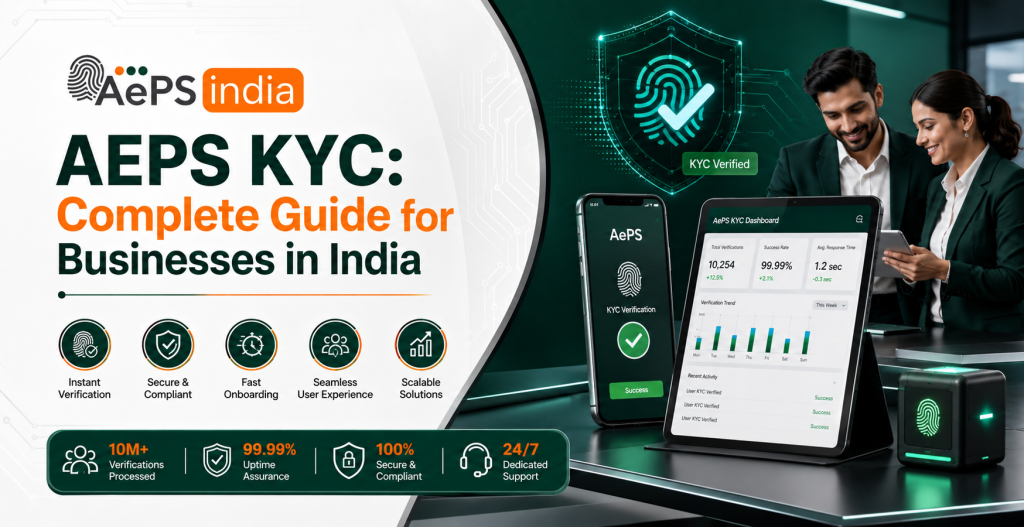
Are you planning to start an AEPS business in India but confused about the KYC process? Don’t worry – you’re in the right place! Understanding AEPS KYC for businesses is crucial for anyone who wants to offer Aadhaar-enabled payment services to customers.
AePS KYC (Aadhaar Enabled Payment System Know Your Customer) is a secure, paperless verification process that uses a customer’s 12-digit Aadhaar number and biometric data (fingerprint or iris scan) to authenticate their identity for banking transactions. It allows individuals to access bank services, such as cash withdrawals and balance inquiries, through a Business Correspondent (BC) or micro-ATM without needing a physical card or PIN.
AEPS KYC for businesses has become a key requirement in India for offering secure Aadhaar-based banking services. With the growing use of AEPS cash withdrawal, balance enquiry, and mini statement services, proper KYC verification helps businesses stay compliant, reduce fraud, and build customer trust. AEPS KYC ensures that every transaction is done with verified Aadhaar details and biometric authentication, making the system safe and reliable.
With Aadhaar-based biometric KYC, businesses can verify customers instantly, reduce fake transactions, and provide seamless services like cash withdrawal, balance enquiry, and mini statements. A reliable AEPS KYC solution in India ensures faster approvals, paperless verification, and higher transaction success rates. This is especially important for businesses targeting rural banking and financial inclusion.
Aeps India provides a smooth and compliant AEPS KYC solution for businesses, retailers, and fintech companies. The process is simple, fast, and fully aligned with guidelines, allowing businesses to onboard agents quickly and start AEPS services without delays. With secure data handling, real-time verification, and easy onboarding, businesses can scale their AEPS operations with confidence.
In this guide, we will explain what is AEPS KYC is, why it is important, the documents required, step-by-step verification process, and best practices to help businesses operate confidently and grow in India’s digital banking space.
What is AEPS KYC
Aadhaar Enabled Payment System KYC is a secure, paperless verification process that uses a customer’s Aadhaar number and biometrics (fingerprint or iris) to authenticate transactions at micro ATM or with business correspondents. Developed by the NPCI, it enables financial inclusion by allowing users to access their linked bank accounts without a physical card or signature.

Aadhaar KYC Work
Aadhaar e-KYC is a paperless, secure, digital process for instant identity verification using Aadhaar-registered mobile OTP, face, or fingerprint authentication, eliminating physical document submission. It involves validating user data against the UIDAI database for services like bank accounts, loans, and SIM cards.
Key Aspects of Aadhaar KYC Work:
- Process: The user provides their Aadhaar number to a Aeps india. An OTP is sent to the registered mobile number, which is entered to authenticate identity.
Types of Authentication:
- OTP-based e-KYC: Quick, remote verification for services.
- Biometric/Face Authentication: Uses fingerprints or facial recognition for secure, in-person verification.
- Offline XML/QR Code: Users can download a digitally signed, password-protected XML file for offline KYC.
Types of KYC Verification in AEPS
KYC verification in AEPS (Aadhaar Enabled Payment System) ensures secure, authorized transactions using Aadhaar data. The primary types are Biometric-based (FP, IRIS), OTP-based (Aadhaar-linked mobile), and Aadhaar Paperless Offline eKYC, often complemented by Digital/Video KYC for agent or customer onboarding.
Key Types of KYC in AEPS:
- Biometric-based KYC (Fingerprint/IRIS): The most common AEPS method, where a user scans their finger or iris on a UIDAI-certified scanner to authenticate against Aadhaar data.
- OTP-based eKYC: A secure method requiring the user’s Aadhaar-linked mobile number to receive a one-time password for verification.
- Aadhaar Paperless Offline eKYC: Users download a signed, machine-readable XML file from the UIDAI website to authenticate their identity offline.
- Digital/Video KYC: Involves capturing live, geotagged photos or conducting a video call to verify the customer, often used for BC agent onboarding.
- Central KYC (CKYC): Uses a 14-digit CKYC number to access already verified documents from a central repository, avoiding repetitive processes.
These methods ensure compliance with RBI/UIDAI guidelines for secure, paperless transactions.
Two Types of KYC in the Financial World
AePS KYC relies on two primary types of authentication for secure, bank-led transactions: Aadhaar-based e-KYC (electronic, paperless) and Offline/Physical KYC. These methods facilitate financial inclusion by verifying identity via biometrics (fingerprint/iris) or OTP, linking accounts for, e.g., cash withdrawals and balance inquiries.
1. Aadhaar-based e-KYC (Electronic KYC)
- Process: This is a digital, paperless process where user demographic data (name, address, photo) is fetched directly from the UIDAI database via Aadhaar authentication.
- Authentication Methods: Uses fingerprints (fingerprint/iris scans) or OTP via {Link: OTP Micro-ATMs/Point of Sale (PoS) devices.
- Usage: Instantaneous verification to open accounts or authenticate, e.g., cash withdrawals or balance inquiries.
- Modern Variant: Face authentication AePS (touchless, using face scanning).
2. Offline/Physical KYC
- Process: A traditional method involving physical documents to verify identity.
- Documents: Utilizes documents such as a passport, Voter ID, or driver’s license, along with utility bills for address proof.
- Application: While AePS is primarily digital, physical verification is still used for, e.g., onboarding Business Correspondents (BCs) or for specific, non-instantaneous account setups.

Documents Required for AEPS KYC Registration
AEPS agent KYC registration requires mandatory submission of an Aadhaar card (linked to a bank account), PAN card, active bank account details (passbook or cancelled cheque), a recent passport-sized photograph, and a functional mobile number. A compatible biometric device (fingerprint/iris scanner) is also essential for agent activation.
Required Documents for AEPS Agent Registration
- Aadhaar Card: Must be linked to the bank account for identity verification.
- PAN Card: Mandatory for income tax and identity purposes.
- Bank Account Proof: Cancelled cheque, bank statement, or the first page of the passbook.
- Photograph: Recent passport-sized photo.
- Registered Mobile Number: Must be linked with the Aadhaar number for OTP authentication.
- Optional/Recommended: Shop or business address proof.
Technical Requirements
- Biometric Device: A registered fingerprint or iris scanner (e.g., Mantra).
- Hardware: A smartphone, tablet, or desktop computer.
Key Considerations
- Age: The applicant must be 18 years or older.
- Bank Linking: The Aadhaar must be mapped to the bank account for processing transactions.
- Registration Process: The registration can typically be completed online through an authorized Aeps portal.
Why is KYC for AEPS So Important?
KYC (Know Your Customer) for AEPS (Aadhaar Enabled Payment System) is critical to ensure secure, fraud-free, and authorized financial transactions for rural and last-mile banking. By using Aeps biometric authentication, it prevents identity theft, ensures only legitimate users access accounts, and complies with regulatory guidelines to stop fraud.
Key Reasons for KYC in AEPS:
- Fraud Prevention & Security: AEPS relies on biometric data (fingerprints or iris scans), making it nearly impossible for unauthorized persons to forge transactions. It protects against account takeovers, especially for customers who may not be tech-savvy.
- Regulatory Compliance: Banks and financial institutions are mandated by regulatory authorities to conduct KYC to prevent money laundering and, and to comply with anti-money laundering (AML) laws.
- Financial Inclusion & Trust: It enables secure banking for residents in remote areas without needing PINs or cards. This strengthens trust in the digital banking ecosystem.
- Trust and Reliability: Thorough verification builds confidence among users that their money is safe, encouraging the adoption of digital payments.
- Accurate Identity Verification: KYC validates the user’s identity, ensuring that money transfers, deposits, or withdrawals are accurate and associated with the correct, authorized bank account.
- Reduced Risk: Regular, updated KYC ensures that the bank has up-to-date information, reducing the risk of unauthorized access or fraudulent activity.
- Account Protection: Re-KYC (periodic updating) helps in updating records for older accounts, ensuring that user data remains accurate and secure.
Important Update: As of January 1, 2026, new RBI security norms require stricter, periodic, or enhanced KYC for AEPS to combat rising fraud.
Who needs AEPS KYC in India?
In India, AEPS KYC is needed by agents/operators (Retailers, CSPs, Entrepreneurs) who provide Aadhaar-enabled banking services, requiring their own Aadhaar, PAN, and bank details for verification before banks onboard them, while customers (any Indian resident with an Aadhaar-linked bank account) use their Aadhaar and biometrics for basic transactions, not separate KYC for each use, but must ensure their account is Aadhaar-linked for the system to work.
Who needs to complete AEPS KYC (Operators/Agents)
- Business Correspondents (BCs) & Agents: Individuals or merchants wanting to offer AEPS service (cash withdrawal, deposit, fund transfer) must register and complete KYC with Aeps india is an AEPS company.
- Required Documents: Aadhaar, PAN, a functional mobile number linked to Aadhaar, bank proof, and a photo.
- Biometric Device: A UIDAI-certified biometric scanner is essential for these operators to authenticate transactions.
- RBI Mandate: Banks must conduct thorough KYC and due diligence on these operators and update records periodically, especially if an operator becomes inactive.
Who uses AEPS KYC in India
AEPS KYC in India is primarily used by rural and semi-urban populations, unbanked individuals, and beneficiaries of government welfare schemes to access banking services without needing a physical debit card, PIN, or smartphone.
It is a bank-led model designed for secure, biometric-based,, and interoperable financial transactions, often used for:
1. Key Users (Customers)
- Rural Population: Individuals residing in areas with limited access to traditional bank branches or ATMs.
- Government Beneficiaries: Recipients of social security pensions, MGNREGA wages, and other Direct Benefit Transfers (DBT) from both Central and State governments.
- Unbanked/Underbanked Individuals: People who rely on local agents for basic banking rather than, visiting a branch.
- Users with Limited Literacy: Those who find biometric authentication (fingerprint/iris scan) easier than remembering passwords or PINs.
2. Service Providers and Intermediaries (Using AEPS for KYC/Operations)
- Business Correspondents (BCs) & Agents: Local agents, including shopkeepers and Banking Correspondents (CSPs), use AEPS to offer “doorstep banking” services, serving as mini-ATMs.
- Fintech Companies & Apps: Platforms like Aeps india provide the technology for AEPS transactions.
- Banks: Public and private sector banks (e.g., SBI, Union Bank) leverage AEPS to extend their reach into remote locations.
- Merchant Establishments: Small merchants use “BHIM Aadhaar Pay” to accept payments directly from a customer’s Aadhaar-linked account.
3. Primary Use Cases
- Cash Withdrawal & Deposit: Basic banking transactions without a card.
- Balance Inquiry & Mini Statement: Checking account details instantly.
- Fund Transfer: Aadhaar-to-Aadhaar money transfers.
- e-KYC: Digital identity verification for opening accounts or accessing services.
As of 2026, the Reserve Bank of India (RBI) has mandated stricter,, mandatory Aeps e-KYC/re-KYC for AePS Touchpoint Operators (ATOs) to prevent fraud, particularly if they have been inactive for three months.
Top Use Cases of AePS KYC
AePS KYC has emerged as a crucial tool for financial inclusion in India, particularly in rural and underserved areas, by enabling secure, paperless, and cardless transactions. It leverages Aeps biometric authentication to verify the identity of individuals, connecting them directly to their Aadhaar-linked bank accounts.
The top use cases of AePS KYC are:
1. Assisted Banking at Doorstep (Micro-ATMs)
- Cash Withdrawals & Deposits: Local Kirana stores or Business Correspondents (BCs) act as “mini-banks,” allowing customers to withdraw or deposit cash using their Aadhaar number and fingerprint/iris scan, removing the need for physical bank visits.
- Balance Enquiry & Mini Statement: Instant, real-time checking of account balances and recent transaction history, ensuring transparency for the customer.
2. Government Benefit Transfers (DBT)
- Direct Benefit Transfer (DBT): Efficient and secure disbursement of government subsidies, pensions, and wages (e.g., MGNREGA) directly into the beneficiaries’ accounts, minimizing leakage and delays.
3. Merchant Payments (Aadhaar Pay)
- BHIM Aadhaar Pay: Enables merchants to accept cashless payments from customers using Aadhaar authentication. This allows for higher daily transaction limits compared to standard cash withdrawals and is especially useful in areas with low smartphone penetration.
4. Instant e-KYC for Customer Onboarding
- Paperless Verification: Banks and financial institutions use AePS to perform real-time, paperless KYC for opening new accounts, issuing SIM cards, or accessing financial services, which is faster and more secure than paper-based verification.
5. Remittances and Fund Transfers
- Aadhaar-to-Aadhaar Transfers: Securely moving money between two bank accounts that are linked to different Aadhaar numbers, facilitating quick and easy interbank transfers without needing to know the beneficiary’s IFSC code or account number.
6. Microfinance and Loan Repayments
- Doorstep Collection: Microfinance institutions utilize local agents to collect loan repayments or distribute loans, simplifying operations for borrowers in remote regions.
7. New Agent Onboarding (Agent KYC)
- Secure Agent Registration: Before allowing agents to start AePS business, they must undergo a rigorous Aeps KYC process, often using Aeps video KYC or Aeps biometric verification to ensure security, compliance with RBI guidelines, and to prevent fraud in the network.
These use cases are essential for bridging the urban-rural banking gap, reducing reliance on cash, and providing easy, secure financial access to the last mile.
Key Aspects of AePS KYC
AePS (Aadhaar Enabled Payment System) KYC is a critical, RBI-mandated, and NPCI-regulated process that ensures secure, paperless, and cardless banking transactions. It bridges the gap for rural and underbanked populations by enabling transactions directly via Aadhaar authentication (biometrics).
Here are the key aspects of AePS KYC, divided into agent and customer perspectives:
1. Key Aspects for Agents/Merchants (BCs)
- Mandatory Due Diligence: Banks must perform thorough KYC for all AePS Touchpoint Operators (ATOs) to prevent fraud.
- RBI 2026 Mandate: Effective January 1, 2026, new rules require stricter KYC, including background checks for agents.
- Re-KYC Policy: Agents inactive for three consecutive months must undergo a fresh KYC process before resuming service.
- One Operator, One Bank: To enhance accountability, each operator is linked to only one acquiring bank.
- Documentation: Required documents include Aadhaar Card, PAN Card, bank account proof (cancelled cheque/passbook), and a photograph.
- Device Requirement: Must use UIDAI/STQC-certified biometric devices (fingerprint or iris scanner) with active RD (Registered Device) services.
2. Key Aspects for Customers (Users)
- Aadhaar-Bank Seeding: The customer’s bank account must be linked (seeded) with their Aadhaar number.
- Biometric Authentication: Transactions (cash withdrawal, balance check, etc.) are authenticated using fingerprints or iris scans, not PINs or passwords.
- Real-time Verification: The KYC is not a separate step; it is an instantaneous “digital handshake” with the UIDAI database at the moment of the transaction.
- No Data Storage: To protect privacy, raw biometric data is never stored locally on micro-ATMs or agent devices.
- Transaction Limits: NPCI caps AePS withdrawals at ₹10,000 per transaction, with monthly limits typically set by banks.
3. Key Features of AePS E-KYC
- Paperless and Instant: Uses digital, real-time data verification rather than physical documents.
- Interoperability: Customers can access their bank account through any AEPS-enabled agent, regardless of the bank.
- Best Finger Detection (BFD): Technology designed to identify the best finger for authentication, improving success rates for manual laborers.
- Security & Fraud Prevention: Combines Aeps biometric verification with real-time SMS alerts to prevent identity theft and unauthorized withdrawals.
4. Recent Regulatory Changes (Effective 2026)
- Enhanced Monitoring: Banks must use transaction surveillance systems to monitor agent behavior.
- Risk-Based Controls: Limits are now set based on operator risk profiles (geography, volume).
- Stricter API Controls: Ensuring that Aeps API integrated are used exclusively for legitimate AePS transactions.
These, taken together, ensure that the AePS system remains a secure, trusted, and efficient tool for financial inclusion in India.

Role of AEPS KYC in Financial Inclusion Across India
Aadhaar Enabled Payment System (AEPS) with e-KYC is a cornerstone of India’s financial inclusion, enabling secure, cardless, and paperless banking for rural and underserved populations. Using Aadhaar and Aeps biometrics (fingerprint/iris) through local agents, it enables basic banking services like withdrawals, deposits, and fund transfers, facilitating over 15 billion transactions for last-mile access.
Key Roles in Financial Inclusion:
- Last-Mile Access: AEPS bridges the gap in financial services for rural communities by providing banking services through micro-ATMs or local Business Correspondents (BCs), reducing the need for travel to bank branches.
- Simplified KYC & Onboarding: Aadhaar e-KYC allows instant, paperless verification, enabling rapid customer onboarding and reducing the documentation burden for, says this, {Link: PIBI.
- Direct Benefit Transfer (DBT): AEPS ensures transparent, secure delivery of government subsidies and pensions directly into Aadhaar-linked bank accounts, minimizing corruption and delay.
- Interoperability: It is a bank-led system that allows users to access their accounts from any bank at any, says this, Aeps India.
- Security & Trust: Biometric authentication mitigates risks of fraud associated with lost cards or PINs, fostering trust among new or less literate digital users.
- Digital Empowerment: AEPS encourages digital literacy by introducing rural users to simple, technology-driven financial transactions.
How to Update AEPS KYC Details Safely
Updating your AePS (Aadhaar Enabled Payment System) KYC details safely involves using secure, official channels to ensure your personal information remains protected against fraud. The process primarily involves updating your Aadhaar information with your bank, as AePS is a bank-led model that uses Aadhaar authentication.
Here is how to update your AePS KYC details safely, based on official, secure procedures:
1. Update Aadhaar Details with Your Bank (Most Secure Method)
Since AePS links directly to your bank account, your bank is the primary point for updating KYC.
- Visit Your Home Branch: Visit your bank branch and request an Aadhaar-linking/KYC update form.
- Submit Documents: Provide a self-attested copy of your Aadhaar card and, if required, your PAN card or other identification.
- Bank Verification: The bank will verify your details and update them in their records, which in turn updates your AePS status.
2. Update via Internet Banking/Mobile App
Many banks offer the option to update Aeps KYC online without visiting a branch.
- Log in to Aeps india mobile app.
- Find the “Update KYC” or “Update Aadhaar” section under your Profile or Services.
- Enter your Aadhaar number and verify it using an OTP sent to your registered mobile number.
3. Update via Aadhaar Enrollment Center (For Data Changes)
If your biometric data (fingerprints/iris) or phone number registered with Aadhaar is outdated, you must update it with UIDAI.
- Visit the nearest Aadhaar Enrollment Centre to update your biometric data.
- Once updated, this information will automatically sync with your bank for future AePS transactions.
4. Safety Tips for AEPS KYC & Transactions
- Use Only Trusted Agents: Only use authorized Banking Correspondents (BCs) or agents with verified Aeps ID and micro ATM devices.
- Verify the Biometric Device: Inspect the fingerprint scanner to ensure it is clean and untampered, as a damaged sensor could be used to capture data illicitly.
- Use Virtual ID (VID): Generate a 16-digit Virtual ID via the UIDAI website or mAadhaar app instead of sharing your 12-digit Aadhaar number for added security.
- Lock Biometrics: Lock your biometrics via the mAadhaar app or UIDAI website when not using them to prevent unauthorized transactions.
- Keep Mobile Number Updated: Ensure your active mobile number is linked to your Aadhaar to receive, instant OTPs, and transaction alerts.
- Collect Receipts: Always ask for a printed or SMS receipt for any transaction or Aeps KYC update.
5. Check Your Updated Status
After submission, verify that your KYC is updated.
- Bank Records: Check your banking app or inquire at the branch.
- UIDAI Website: Visit the official UIDAI website, select “My Aadhaar,” and then choose “Bank Seeding Status” to confirm that your account is linked.
By following these, you can securely update your AePS KYC and ensure uninterrupted, safe digital transactions.
Why AEPS KYC Important for Businesses
AEPS (Aadhaar Enabled Payment System) KYC (Know Your Customer) is critical for businesses particularly fintechs, banking correspondents, and local retailers to ensure legal compliance, security, and trust when acting as “mini-banks” for the public. As of January 1, 2026, RBI guidelines necessitate rigorous KYC for AEPS operators to curb fraud and ensure that only legitimate agents provide services.
Here is why AEPS KYC is important for businesses:
1. Regulatory Compliance and Legal Safety
- RBI Mandate: The Reserve Bank of India (RBI) has mandated strict KYC and ongoing monitoring for all AEPS Touchpoint Operators (ATOs) to combat money laundering and fraud.
- Preventing Fraud: Proper KYC prevents unauthorized individuals from becoming agents and using the system for illegal activities like money laundering or operating “ghost” accounts.
- Re-KYC for Inactivity: Agents inactive for three consecutive months must undergo a fresh KYC process before reactivation, ensuring only active, legitimate agents operate.
2. Enhanced Security and Trust
- Secure Transactions: AEPS uses biometric authentication (fingerprint/iris) linked to Aadhaar. Proper agent KYC ensures that the person operating the Aeps device is legitimate, reducing the risk of fraud.
- Building Customer Trust: When a local shop is verified and authorized, customers feel safer conducting transactions, which increases footfall and business reliability.
- Data Integrity: Validated agents are more likely to adhere to security protocols, such as not storing sensitive user biometric data.
3. Business Growth and Efficiency
- Credibility: A fully compliant AEPS business is more credible, attracting more customers, especially in rural areas where trusted financial services are scarce.
- Access to High-Commission Services: Registered agents can offer cash withdrawals, balance inquiries, and mini-statements, earning Aeps commissions on each.
- Operational Efficiency: Digital Aeps KYC (eKYC) allows for faster, paperless onboarding of agents and customers, reducing Aeps administrative costs and manual errors.
4. Supporting Digital India and Financial Inclusion
- Last-Mile Banking: By becoming a verified AEPS agent, businesses help in bringing banking to unbanked, rural areas, supporting the government’s financial inclusion goals.
- DBT Distribution: Verified agents are crucial for the direct disbursement of government subsidies (Direct Benefit Transfer), boosting their reputation and utility in the community.

Benefits AEPS KYC
AEPS KYC provides a secure, paperless, and instantaneous method for agents and customers to access banking services without physical debit cards, PINs, or bank branches. It leverages Aadhaar-based biometric authentication (fingerprint or iris scan) to ensure high security and to promote financial inclusion, particularly in rural and semi-urban areas.
Key Benefits of AEPS for Customers
- Cardless & PIN-less Transactions: Eliminates the need to carry physical debit/credit cards or remember complex PINs.
- High Security: Transactions are authorized via biometric verification (fingerprint/iris) linked to the UIDAI database, significantly reducing fraud.
- Doorstep Banking: Services like cash withdrawal, balance inquiry, and mini-statements can be accessed at local, authorized retail shops (Business Correspondents).
- Interoperability: Allows customers of any bank to use AEPS-enabled micro-ATMs of any other bank.
- Government Benefits (DBT): Facilitates direct, transparent, and immediate receipt of government subsidies, pensions, and wages (e.g., MNREGA).
- Instant Access: Real-time, instant processing of transactions.
Key Benefits of AEPS for Retailers/Agents
- Increased Revenue: Earn commissions on every successful transaction (cash withdrawal, balance inquiry, etc.).
- Increased Customer Footfall: Offers essential banking services, turning a local shop into a one-stop-shop, driving up traffic and potential sales.
- Low Investment: Requires only a smartphone/PC, internet, and a certified Aeps biometric scanner to start.
- Diversified Portfolio: Allows retailers to offer additional services like bill payments, money transfers, and recharges.
- Enhanced Trust: Builds trust and reputation in the local community by providing reliable financial services.
Key Benefits for the Financial Ecosystem
- Financial Inclusion: Connects unbanked and underbanked populations to formal banking.
- Reduced Cash Dependency: Promotes digital transactions and a cashless economy.
- Cost-Effective for Banks: Reduces the operational costs of building physical branches in remote areas.
Important Information
- Transaction Limit: The maximum cash withdrawal limit per transaction is generally ₹10,000, with daily, cumulative limits up to ₹50,000.
- Requirement: The customer’s bank account must be linked to their Aadhaar number.
- Security Tip: Users can lock their Aadhaar biometrics via the mAadhaar app or UIDAI portal to prevent unauthorized transactions.
Features AEPS KYC
The Aeps developed by the National Payments Corporation of India (NPCI), allows bank customers to perform basic banking transactions using their Aadhaar card and biometric authentication at micro-ATMs or point-of-sale terminals.
Key Features of AEPS
- Biometric Authentication: Uses fingerprints or iris scans for secure verification.
- Interoperability: Allows access to Aadhaar-linked accounts from any bank using an AEPS-compliant device.
- Core Banking Services: Includes cash withdrawal, cash deposit, balance enquiry, mini statement, and Aadhaar-to-Aadhaar fund transfers.
- Direct Benefit Transfer (DBT): Facilitates the distribution of government scheme benefits.
- BHIM Aadhaar Pay: Allows merchants to accept payments through Aadhaar authentication.
- 24/7 Availability: Banking services are accessible at all times.
- Accessibility: Beneficial for areas with limited banking infrastructure.
AEPS KYC (Know Your Customer) and Registration
Both customers and agents must meet KYC requirements to use the AEPS system.
For Customers (To Use the Service):
- Requirements: A bank account linked to an Aadhaar number, registered biometric data with UIDAI, and the 12-digit Aadhaar number for transactions.
For Agents/Retailers (To Offer the Service):
- Requirements: Registration with an authorized Aeps india, Aadhaar Card, PAN Card, bank account details, recent photo, and an STQC-certified biometric scanner.
- Verification: E-KYC is mandatory, with new regulations requiring stricter checks and Re-KYC for inactive agents.
Security and Regulations
- Data Protection: Biometric data is used only for authentication with UIDAI and is not stored on Aeps agent devices.
- Transaction Limits: Typically a maximum of ₹10,000 per transaction, with some banks setting daily limits up to ₹50,000.
- RBI Compliance (2026): New rules will require “one-operator-one-bank” linking and enhanced transaction monitoring to prevent fraud.
Integrate AEPS KYC Api Process
Integrating AEPS (Aadhaar Enabled Payment System) with KYC involves partnering with an NPCI-certified Aeps india, submitting business/personal KYC (Aadhaar, PAN, bank details), installing certified biometric hardware, and integrating Aeps API for biometric authentication. The process activates secure, real-time banking transactions like cash withdrawals, balance inquiries, and mini-statements.
Step-by-Step AEPS Integration & KYC Process
- Choose a Aeps india: Select an RBI/NPCI-compliant AEPS service provider like Aeps india, Aeps API aggregator, or Business Correspondent (BC).
Complete Agent KYC Registration:
- Fill out the registration Aeps application form.
- Submit personal and business documents: PAN Card, Aadhaar Card, Bank Account Details, and photos.
- Undergo verification (physical or video) to complete the onboarding process.
Acquire and Register Biometric Devices:
- Purchase a UIDAI-certified Aeps biometric device (fingerprint scanner/iris scanner).
- Install the Registered Device (RD) Aeps service software provided by the Aeps india.
- Register the hardware with the Aeps india.
Technical Integration (API/Software):
- Obtain Aeps API keys, Aeps documentation, and SDKs from the Aeps india.
- Integrate AEPS functionality into your existing aeps app, web portal, or POS system.
- Sandbox Testing: Conduct thorough testing in a sandbox environment to ensure seamless transaction flows and data security.
- Go Live: Move from the sandbox to the production environment using live Aeps API keys to start providing Aeps services.
Customer KYC (Transaction Flow):
- Initiation: Enter the customer’s 12-digit Aadhaar number and select the bank.
- Authentication: The customer places their finger on the biometric scanner to authorize the transaction via UIDAI.
- Completion: The encrypted data is verified via NPCI, and the transaction is completed.

AEPS KYC Api Commissions Provide
AEPS KYC API providers like Aeps india offer commission-based income on cash withdrawals, typically ranging from ₹2 to ₹15+ per transaction depending on volume and amount. Retailers earn up to ₹13–₹15 per transaction, with high-value transactions (≥≥₹3,000) paying the most, while balance inquiries and mini-statements often provide ₹1–₹2 per transaction.
AEPS Commission Structure (Typical for Retailers)
- ₹100 – ₹999: ₹2 per transaction
- ₹1,000 – ₹1,499: ₹3 per transaction
- ₹1,500 – ₹1,999: ₹4.5 per transaction
- ₹2,000 – ₹2,499: ₹5.5 per transaction
- ₹3,000+: ₹9 – ₹13+ per transaction
Key Features of AEPS API Providers
- Services Covered: Cash withdrawal, balance inquiry, mini-statement, and Aadhaar-based authentication.
- KYC Process: Mandatory digital KYC (Aadhaar/PAN) for agents to ensure compliance.
- Income Model: High-volume agents can earn substantial monthly commissions.
- API Cost: White label Aeps API setups generally Aeps api cost between ₹15,000 and ₹1.2 Lakhs.
AEPS KYC Api Cost Provide
AEPS KYC API costs involve one-time setup fees (₹12k-₹35k+) and ongoing charges, varying from basic Aeps API access to white label Aeps solutions with transaction commissions (₹12-₹13 or 0.5-1%) plus potential annual/monthly Aeps platform fees, with costs depend on Aeps india, features (biometric, Aeps portals), and bank integrations. For Aadhaar verification specifically, UIDAI mandates ₹20 per e-KYC, though Aeps india offer lower rates (around ₹5) with bulk discounts.
Typical Cost Breakdown
- One-Time Setup/Integration: ₹12,000 – ₹35,000+ for standard Aeps API integrate; higher for complex B2B/white-label Aeps solutions.
- Software/Platform (Optional): ₹15,000 – ₹1.2 Lakhs+ for white label Aeps portals or B2B Aeps admin panels.
Transaction Fees:
- e-KYC: UIDAI rate is ₹20 per successful e-KYC, but Aeps india might charge ₹5–₹20 depending on volume.
- AEPS Transactions (Withdrawal, Balance): Per-transaction fees around ₹12–₹13 or 0.5%–1% of the amount.
- Monthly/Annual Fees: Aeps india have best Aeps platform charges, while others rely solely on transaction commissions.
Cost Variations & Providers
- White-Label Solutions: Lower Aeps setup (~₹15k-₹30k) but with higher per-transaction costs.
- Proper/B2B APIs: Higher Aeps setup (₹40k-₹4.5L+) but potentially lower transaction fees.
- Providers: Aeps India offer best packages.
Factors Influencing Cost
- Integration Type: Proper Aeps B2B vs. White Label Aeps software.
- Features: Basic vs. advanced services (cash withdrawal, balance inquiry, mini statement, etc.).
- Volume: Higher transaction volumes often unlock better per-transaction rates.
- Included Services: Hardware (biometric devices), support, and bank tie-ups affect pricing.
- Provider: Aeps india offer best pricing structures.
AEPS KYC Api Provider
Aeps india is one of the top AEPS KYC API providers in India for secure, compliant integration include Aeps india platforms offering features like multi-bank support, easy Aeps onboarding, high transaction success rates, and commission models for retailers, while also providing Aeps software or best Aeps API for businesses to offer services like cash withdrawal, balance inquiry, and fund transfers via Aadhaar authentication. Aeps india focus on regulatory compliance (UIDAI certified), performance, and support for agents and distributors to build digital banking networks.
What to Look For in an AEPS API Provider:
- Regulatory Compliance: Ensure they adhere to UIDAI guidelines for security and data privacy.
- Performance: High transaction success rates and low latency are crucial.
- Multi-Bank Support: Ability to connect with multiple banks for broader customer reach.
- Support: 24/7 technical assistance for agents and distributors.
- Features: Offerings like agent onboarding, Aeps admin panel, and white label Aeps solution options.
- Commission Structure: Competitive payouts for retailers.

How AEPS KYC Helps Earn Commissions
AEPS (Aadhaar Enabled Payment System) KYC is the mandatory verification process that authorizes retailers to act as banking correspondents, enabling them to earn commissions often ₹2 to ₹15+ per transaction by facilitating cash withdrawals, balance inquiries, and mini-statements using biometric authentication. KYC legitimizes the agent, building trust for high-volume transactions and securing access to various fintech, banking, and government-supported financial services, resulting in consistent monthly income.
How AEPS KYC Converts to Commission Earnings
- Legitimacy and Access: Completing KYC (Aadhaar, PAN, and biometrics) with authorized Aeps india enables, or registers, the agent as a valid banking correspondent. This authorizes them to use Aadhaar-based banking services.
- Transaction-Based Income: Once KYC is verified, agents can process cash withdrawals, deposits, and balance inquiries. They receive Aeps commissions on each transaction, with higher-value transactions (e.g., ₹3,000+) often yielding higher commissions (e.g., ₹13 or more).
- Increased Customer Trust: A verified Aeps KYC status increases customer trust, which in turn leads to higher footfall for services like cash withdrawals and mini-statements.
- Diverse Revenue Streams: KYC allows access to multiple services beyond basic withdrawals, including money transfers, bill payments, and recharges, which increase overall earning opportunities.
- High-Volume Earning Potential: Active agents who have completed Aeps KYC can earn significant income, with some reporting, or suggesting, 30 transactions daily can yield ₹6,000–₹10,000+ per month.
Importance of AEPS KYC for Transactions
The Aadhaar Enabled Payment System (AEPS) relies entirely on biometric authentication linked to an individual’s Aadhaar number. Consequently, KYC (Know Your Customer) compliance is not just a regulatory requirement but the foundational security mechanism for ensuring that transactions are safe, accurate, and authorized by the legitimate account holder.
AEPS KYC is critical for the following reasons:
1. Enhanced Security and Fraud Prevention
- Biometric Authentication: AEPS replaces traditional PINs and signatures with biometric scans (fingerprint or iris), which are unique to each individual, making unauthorized access extremely difficult.
- Anti-Money Laundering (AML): Proper KYC ensures compliance with RBI guidelines, preventing the misuse of bank accounts for illegal financial activities or money laundering.
- Mitigation of Identity Theft: By verifying the user’s identity against the UIDAI database, KYC prevents fraudsters from using stolen Aadhaar data to initiate transactions.
2. Ensuring Secure Transactions and Data Privacy
- Real-time Authentication: KYC verifies the user’s identity in real-time, reducing the risk of unauthorized withdrawals.
- Data Protection: The process requires using secure, NPCI-certified devices that protect customer data and privacy during transactions.
3. Enabling Financial Inclusion and Access
- Support for Rural Population: By relying on KYC rather than bank cards or smartphones, AEPS allows unbanked or underbanked individuals, especially in rural areas, to access banking services.
- Access to Government Schemes: KYC enables the direct, secure transfer of government benefits, such as pensions and subsidies (DBT), directly to the rightful beneficiary’s account.
4. Regulatory Compliance and Trust
- Regulatory Adherence: Periodic KYC updates ensure that customer information remains accurate, compliant with RBI guidelines, and up-to-date.
- Building Consumer Trust: Secure, KYC-compliant transactions increase public confidence in digital banking, promoting a shift towards a cashless economy.
5. Benefits for Retailers and Agents
- Safe Business Operations: For agents and retailers, KYC verification for customers reduces the risk of being involved in fraudulent transactions.
- Account Verification: The process helps in validating that the customer’s Aadhaar is linked to an active bank account, reducing failed transactions.
Potential Risks Without Strict KYC
- Biometric Spoofing: Fraudsters can use cloned fingerprints to perform unauthorized withdrawals if security measures are weak.
- Agent Fraud: Unscrupulous agents might misuse customer data if proper oversight is not in place.
For the AEPS ecosystem to be effective, stringent KYC (both initial and periodic) is vital to ensure that the convenience of “doorstep banking” does not compromise security. It is a necessary safeguard that protects both the user and the financial institution.
Role of Aadhaar in AEPS KYC Compliance
Aadhaar is the foundation of the Aadhaar Enabled Payment System (AEPS), acting as the primary identifier for e-KYC compliance to facilitate secure, cardless banking transactions like cash withdrawals, deposits, and fund transfers. It validates user identity in real-time via biometric (fingerprint/iris) or OTP authentication through the UIDAI database, enabling immediate, secure access to bank accounts.
Role of Aadhaar in AEPS KYC Compliance:
- Instant Identification: Replaces physical documents by using the 12-digit Aadhaar number for instant identity verification.
- Biometric Authentication: Ensures high security by mapping transactions to a user’s unique fingerprint or iris scan, reducing fraud in remote areas.
- Direct Benefit Transfer (DBT): Facilitates seamless, secure, and direct transfer of government subsidies into Aadhaar-linked bank accounts.
- Bank-Led Security: Enables secure, interoperable, and real-time validation across different banks for transactions, reducing dependency on physical cards or PINs.
- Data Protection: Adheres to regulations by allowing only necessary data retrieval for Aeps KYC verification, minimizing the risk of identity theft.
- Financial Inclusion: Allows individuals in remote areas to access banking services through Business Correspondents (BCs) using only their biometric data.
AEPS operates through a network of Micro-ATMs, which act as authorized agents checking the identity of the user against their Aadhaar-linked account.

AEPS KYC NPCI and RBI Guidelines
Effective January 1, 2026, the RBI and NPCI have mandated stricter guidelines for the Aadhaar Enabled Payment System (AePS) to combat fraud. Key regulations include mandatory full KYC for AePS Touchpoint Operators (ATOs), re-KYC for agents inactive for 3 months, “One Operator, One Bank” binding, and continuous, risk-based transaction monitoring by banks.
Key RBI & NPCI Guidelines (Effective Jan 1, 2026)
- Mandatory Full KYC & Due Diligence: Banks must perform rigorous due diligence on all ATOs (agents) before onboarding, adhering to the RBI’s Master Direction – KYC Direction, 2016.
- Re-KYC for Inactive Agents: If an ATO does not perform any financial or non-financial transactions for a continuous period of 3 months, the bank must conduct a fresh, mandatory KYC verification before allowing them to resume services.
- One Operator, One Bank Limit: To prevent misuse, each ATO can only be linked to a single acquiring bank.
- Enhanced Risk Management: Banks are required to implement continuous monitoring of ATO activities, assessing risk factors such as transaction volume, velocity, and location.
- System Integrity & APIs: Only authorized systems with secure, audited fast Aeps API can access AePS services, aiming to prevent unauthorized access and data breaches.
- Customer Grievance Redressal: Strengthened frameworks for resolving customer disputes in a timely manner.
These regulations are designed to bolster security and maintain trust in the NPCI-managed AEPS system, which allows interoperable transactions using Aadhaar authentication.
AEPS KYC Compliance
AEPS (Aadhaar Enabled Payment System) KYC compliance requires Aadhaar-linked bank accounts, PAN cards, and biometric authentication (fingerprint/iris/face) for agents and users to ensure secure transactions. Effective Jan 1, 2026, the RBI mandates full, rigorous KYC for agents (ATOs), including periodic revalidation, monitoring of transactions, and mandatory re-KYC for accounts inactive for three months.
Key AEPS Agent (ATO) KYC Compliance Requirements:
- Mandatory Documents: Valid Aadhaar Card, PAN Card, and a bank account (with cancelled cheque/passbook) are mandatory for agent registration.
- Active Linking: The mobile number must be linked to both the Aadhaar and the bank account.
- Biometric Verification: Fingerprint or facial recognition, with RBI updated digital KYC frameworks emphasizing enhanced, real-time biometric checks to prevent fraud.
- Agent Onboarding: Acquiring banks must conduct full KYC of all AePS agents as per the RBI Master Direction on KYC, 2016.
- Inactivity Rule: If an agent remains inactive for 3 months, they must undergo a fresh KYC process before resuming services.
- Ongoing Monitoring: Banks are required to implement risk-based monitoring systems for all agent activities to prevent fraudulent transactions.
Customer (User) Requirements:
- Aadhaar-Linked Account: Customers must have their Aadhaar seeded into their bank account (AEBA).
- Authentication: Transactions require biometric verification (fingerprint or face).
Common Fraud Risks Addressed by Updated Compliance:
- Biometric Spoofing: Use of fake fingerprints or unauthorized clones.
- Unauthorized Access: Misuse of credentials by agents or unauthorized personnel.
Compliance with these standards is essential to maintain agent, agency, or corporate BC (Business Correspondent) status, particularly with the new, tighter regulations implemented in 2026.
How AEPS India Supports Secure KYC Integration
AEPS India supports secure KYC integration by providing Aeps API solutions that enable real-time, Aadhaar-based biometric authentication (fingerprint/iris) through UIDAI-certified channels. These systems, compliant with NPCI and RBI guidelines, ensure secure, paperless verification, reducing fraud and enabling instant, encrypted, and compliant digital onboarding for merchants and customers.
Key Aspects of Secure KYC Integration via AEPS India
- Real-Time Aadhaar Authentication: The system connects directly with the Unique Identification Authority of India (UIDAI) database for instant verification, removing the need for physical document handling.
- Biometric and Multi-Factor Security: KYC involves Aadhaar-based biometric (fingerprint/iris scan) or OTP authentication, ensuring that only the actual account holder can initiate a transaction.
- Robust API Integration: Aeps india is a certified AEPS API providers in India offer secure, encrypted channels that facilitate safe data transmission between retailers, the Aeps india, NPCI, and the bank.
- Mandatory Agent Onboarding KYC: Before activating services, AEPS providers like Aeps india conduct thorough KYC on agents, including PAN card, bank account, and Aadhaar verification to ensure regulatory compliance.
- Advanced Security Measures: Features like liveness detection (to ensure the user is physically present) and high-level data encryption are used to prevent fraudulent activity.
- Secure Offline e-KYC (XML): Allows verification using a secured, encrypted XML file from UIDAI, which is particularly useful for secure, non-real-time verification scenarios.
These mechanisms, including KYC for agents and customers, are designed to build a secure, fraud-resistant environment for financial transactions.

AEPS KYC and Its Impact on Cash Withdrawal, Fund Transfer, and Balance Inquiry
Aadhaar Enabled Payment System KYC enables secure, cardless banking by using Aadhaar authentication (biometrics/IRIS) to link a user’s identity directly to their bank account. It facilitates instant, real-time cash withdrawals, fund transfers, and balance inquiries via Business Correspondents (BCs) or micro-ATMs, crucial for rural financial inclusion and reducing dependency on traditional banking, with a maximum transaction limit of ₹10,000.
Impact of AEPS KYC on Banking Services
- Cash Withdrawal: Users can withdraw cash from their Aadhaar-linked accounts at local shops or BCs, without a physical ATM card or PIN. Authentication requires a fingerprint or iris scan.
- Fund Transfer: Enables secure, instant interbank or intrabank money transfers using only the Aadhaar number, significantly easing transactions for users in remote areas.
- Balance Inquiry: Provides real-time account balance updates through biometric verification at authorized service points.
- Security & Accessibility: By replacing physical cards and PINs with biometric, real-time verification through UIDAI, AEPS enhances security, reducing fraud risks and facilitating access to Direct Benefit Transfers (DBT).
Key Aspects of AEPS
- Interoperability: Customers can use any bank’s AEPS-enabled services at any agent’s device, regardless of the bank, as long as it’s linked.
- Transaction Limit: The National Payments Corporation of India (NPCI) has set a maximum per-transaction limit of ₹10,000.
- Requirements: A 12-digit Aadhaar number, bank-linked Aadhaar, and biometric authentication (fingerprint/IRIS) are required for every transaction.
AEPS acts as a “micro-ATM,” transforming local kirana shops into banking hubs, thereby promoting a cashless economy and providing essential financial services to unbanked, rural populations.
Best AEPS KYC Solution Provider in India
Aeps india is the best AEPS KYC provider in India, prioritize NPCI/RBI certification, strong security (E2E encryption, RD Service), high transaction success rates, and transparent, competitive commissions, while also evaluating fast settlements, user-friendly aeps apps, 24/7 support, and value-added services like bill payments for a profitable and reliable Aeps platform.
Key Factors to Consider:
Compliance & Security
- NPCI/RBI Certification: Mandatory for legitimacy and adherence to regulations.
- Data Security: Look for end-to-end encryption and no storage of sensitive biometric/Aadhaar data.
- RD Service: Ensures secure biometric authentication.
Performance & Reliability:
- High Success Rate: Aim for 98%+ transaction success rates and minimal app downtime.
- Fast Settlements: Instant or same-day settlements keep your working capital liquid.
Profitability & Costs:
- Competitive Commissions: Higher per-transaction payouts (e.g., ₹15/withdrawal) and bonus structures.
- Transparent Fees: Check for hidden charges or setup fees.
User Experience & Support:
- User-Friendly App: Intuitive interface for agents.
- 24/7 Support: Responsive customer and technical assistance is crucial for issue resolution.
Features & Scalability:
- Multi-Bank Support: Essential for wider customer reach.
- Value-Added Services: Bill payments, recharges, DMT, and insurance create multiple income streams.
- Growth Options: Aeps india that support white label Aeps and business expansion.
Why AEPS India is a Trusted Partner for AEPS KYC Solutions
Aeps india is considered a trusted partner for AEPS KYC solutions because they ensure compliance, security, and operational efficiency, acting as a crucial link between local agents and the National Payments Corporation of India (NPCI). Aeps india are NPCI/RBI certified, enable secure, cardless, and PIN-less transactions using biometric authentication, significantly boosting financial inclusion.
Here is why a Aeps india is a trusted partner for AEPS KYC solutions:
1. Robust Security and Regulatory Compliance
- NPCI/RBI Certification: Aeps india are authorized by the National Payments Corporation of India and adhere to strict Reserve Bank of India guidelines, ensuring legal and secure operations.
- Secure Data Handling: They use end-to-end encryption to protect sensitive customer financial data, with biometric data processed instantly and never stored on the Aeps india server.
- Stricter Due Diligence (New 2026 Rules): They conduct thorough KYC for agents (touchpoint operators) and implement continuous monitoring to prevent fraud, including re-verification for inactive agents.
- Biometric Integrity: They support STQC-certified Aeps biometric devices, ensuring secure, high-accuracy authentication (fingerprint/iris scan).
2. High Reliability and Performance
- High Success Rates: Aeps india boast high transaction success rates (often 98%+) and minimal downtime, ensuring that agents can process, cash withdrawals, balance inquiries, and mini-statements without interruption.
- Real-time Processing & Settlement: They provide instant transaction confirmation and fast, often same-day (T+0 or T+1) settlement of funds into the agent’s wallet.
3. Comprehensive Agent & Technical Support
- Easy Onboarding: They offer quick, often digital, KYC processes for agents to start operating within 1-3 business days.
- 24/7 Technical Assistance: They provide round-the-clock support to resolve transaction failures, device troubleshooting, and Aeps portal management issues.
- Comprehensive Training: They educate agents on proper device usage, transaction security, and regulatory compliance to minimize risk.
4. Efficient Technology and Infrastructure
- Interoperability: They connect agents to a wide network of banks, allowing customers of any bank to transact at any AEPS-enabled shop.
- User-Friendly Interfaces: They provide intuitive mobile aeps app and web portals for seamless operation, even in rural, low-connectivity areas.
- White-Label Options: They offer customizable platforms, allowing businesses to launch their own branded AEPS services with secure, pre-built backend technology.
By leveraging a Aeps india, businesses, such as Kirana stores or fintechs, can transform their locations into “mini-banks,” ensuring secure transactions while building trust with customers in underserved, rural communities.
Future Trends AEPS KYC
Based on recent regulatory directives and Aeps india aeps software development, the future of the Aadhaar Enabled Payment System (AePS) is heavily focused on enhanced security, stricter regulatory compliance, and deeper integration with digital financial ecosystems. The Reserve Bank of India (RBI) has mandated stringent new guidelines effective January 1, 2026, which will significantly transform how AePS operators (ATOs) are vetted and monitored.
Here are the key future trends for AePS KYC and operations:
1. Stricter Regulatory and KYC Norms (Post-Jan 2026)
- Mandatory Full KYC for Agents: Acquiring banks must conduct full KYC on all AePS Touchpoint Operators (ATOs) in accordance with the 2016 Master Directions.
- Re-KYC for Inactivity: Agents who are inactive for three consecutive months must undergo a fresh KYC process before their service can be reactivated.
- “One Agent, One Bank” Rule: To prevent misuse, an operator can only be linked to a single acquiring bank.
- Risk-Based Monitoring: Banks are required to implement real-time surveillance of transactions, focusing on geographic location, volume, and velocity to detect anomalies.
2. Advanced Security Technologies
- Mandatory Liveness Detection: To combat spoofing and the use of cloned fingerprints, future AePS systems will require “liveness detection” to ensure the user is physically present.
- Multi-Modal Biometrics: Moving beyond just fingerprints, the system is evolving to incorporate iris and facial recognition for higher authentication accuracy.
- AI and Machine Learning (AI/ML): AI will be used for real-time risk assessment, behavioral analysis of agents, and fraud detection.
- Blockchain for Transparency: There is increasing interest in using blockchain for secure, immutable transaction records to increase trust.
3. Deeper Integration and Expanded Services
- API-First Approach: Stricter, more secure Aeps API will be used, limiting access to core banking functions.
- Unified Financial Hubs: AePS will move beyond basic cash withdrawal/deposit to become a hub for services like micro-loans, insurance premium collections, and UPI-ATM transactions.
- Offline Functionality: To overcome poor connectivity in rural areas, there is a push towards developing offline transaction models.
4. Improved User Experience and Trust
- Mobile-First Design: Enhanced mobile aeps application for agents to make the onboarding and transaction process faster and more intuitive.
- Instant Settlements: Same-day or real-time settlement for agents to improve liquidity.
- Improved Grievance Redressal: A stronger framework for resolving customer disputes to increase trust in digital, non-card payments.
These trends are designed to transform AePS into a more secure, reliable pillar of India’s financial inclusion, particularly in rural areas, while mitigating the rising incidence of fraud.

Conclusion
Completing AEPS KYC for businesses is a critical step to start and scale a secure AEPS operation in India. Proper KYC ensures NPCI compliance, fraud prevention, smooth transactions, and uninterrupted AEPS services. Whether you are a retailer, fintech startup, or service provider, having a verified AEPS KYC process builds trust with banks, customers, and regulatory authorities.
AePS (Aadhaar Enabled Payment System) KYC is a secure, paperless verification process using biometric data (fingerprint or IRIS scan) linked to a user’s Aadhaar card. It allows customers to verify their identity instantly for banking services like cash withdrawals, deposits, and balance inquiries through business correspondents (agents) without physical cards.
For retailers, fintech startups, BC agents, and service providers, AEPS KYC verification ensures secure Aeps onboarding, prevents fraud, and allows smooth services like cash withdrawal, balance enquiry, and mini statements. Aadhaar-based biometric authentication makes the process quick, paperless, and reliable, even in rural and semi-urban areas.
With increasing demand for Aadhaar Enabled Payment System services, businesses that follow the correct AEPS KYC guidelines gain faster approvals, higher transaction limits, and long-term operational stability. Aeps india simplifies the entire AEPS KYC process in India by offering end-to-end support, document verification, and compliance assistance, helping businesses go live faster without delays or errors.
Choosing the right AEPS KYC solution in India gives businesses a competitive edge. It reduces operational risk, improves transaction success rates, and supports scalable growth. With a trusted AEPS KYC platform, businesses can expand their reach, increase revenue, and deliver seamless financial services to every customer.
If you want to run a secure, scalable, and compliant AEPS business, choosing the Aeps india for AEPS KYC and onboarding is essential. With Aeps india, businesses can confidently complete AEPS KYC, meet all regulatory requirements, and deliver safe, reliable digital banking services across India.
FAQ – AEPS KYC for Businesses
AEPS KYC for businesses is the process of verifying a business with Aadhaar Enabled Payment System. It allows businesses to accept digital payments, make fund transfers, and provide banking services using a customer’s Aadhaar number. Completing KYC ensures your business is compliant and secure.
Aeps india wants to offer AEPS-based transactions must complete KYC. It is mandatory for AEPS registration in India.
Typically, you need:
Aadhaar Card of the business owner/agent
Bank account details linked with Aadhaar
Mobile number registered with Aadhaar
Completing AEPS KYC allows your business to:
Offer secure and trusted Aadhaar-based banking services
Serve more customers in urban and rural areas
Increase daily transactions and commissions
Comply with RBI and NPCI regulations
The process is simple:
Fill the AEPS registration form.
Submit Aadhaar and business documents.
Link your Aadhaar with the business bank account.
Complete biometric verification.
Once approved, your business can start using AEPS for transactions.
Usually, AEPS KYC for businesses is approved within 1–3 working days after submitting all documents and biometric verification.
Yes. Aeps India provides an easy and fast online AEPS KYC process, making it simple for businesses to start offering services immediately.
With a trusted provider like Aeps India, AEPS KYC verification can be completed within a few hours to 1 business day, depending on the verification method and bank approval.
Absolutely. AEPS KYC from Aeps India is fully encrypted, RBI-compliant, and fraud-protected, ensuring safe transactions for both businesses and customers.
Yes. AEPS platforms like Aeps India allow multiple agents to operate with unique logins, commission tracking, and detailed reporting.
No. Each location usually requires separate AEPS KYC to ensure secure and accurate transactions.
Yes, any business using Aadhaar-based banking or payments must complete AEPS KYC. It is required to prevent fraud and maintain regulatory compliance.
Yes. Businesses can update owner details, Aadhaar information, or bank account details through AEPS India’s secure Aeps KYC update process.
Absolutely. AEPS India follows NPCI-compliant protocols, uses secure encryption, and ensures that all customer and business data remain confidential and safe.
Yes. AEPS India makes it easy for startups, small retailers, and fintech companies to complete KYC and start offering AEPS services without complex procedures.
Absolutely. Aeps India’s AEPS KYC follows RBI guidelines and Aadhaar authentication standards, ensuring complete compliance.
The process is instant or real-time, allowing businesses to start offering AEPS services immediately after verification.
Yes, all user data is encrypted and securely stored, preventing unauthorized access and ensuring transaction safety.
Once verified, businesses can offer cash withdrawals, balance enquiries, mini statements, and Aadhaar-based fund transfers.
Aeps India provides a reliable, fast, and secure AEPS KYC solution for businesses, helping them grow safely in the digital banking and payments sector.
Real-Time AEPS API Integration for Fintech, Banks & B2B Platforms
Free AEPS Registration Online in India
Aadhaar Pay API for Secure Biometric Payments & Fast Banking Agent Onboarding
About Author

