Aadhaar Verification API in India – Secure Aadhaar eKYC & OTP Verification
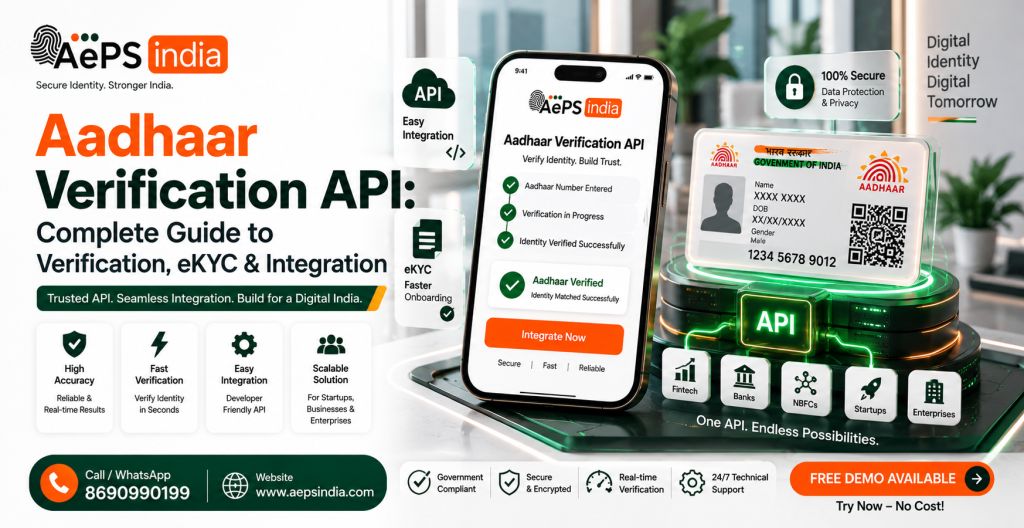
An Aadhaar Verification API is a technology solution that helps businesses verify a customer’s Aadhaar-based identity through a digital verification process. Instead of checking identity details manually, businesses can connect an Aadhaar verification service with their website, mobile app, fintech platform, KYC system, or customer onboarding process.
Today, fast and reliable identity verification is important for businesses that onboard customers online. A manual KYC process can involve document collection, data entry, repeated checks, and additional verification work. An Aadhaar Verification API can help businesses automate eligible verification workflows and receive verification results through an API-based system.
Depending on the authorised verification method and service being used, Aadhaar-related verification can involve OTP, demographic details, biometric authentication, QR-based verification, or other supported Aadhaar authentication and eKYC methods. The exact method available to a business depends on the Aeps india, applicable regulations, and the authorised Aadhaar ecosystem.
An Aadhaar Verification API is an online service that lets businesses confirm a person’s identity using India’s Aadhaar system managed by the Unique Identification Authority of India (UIDAI).
The basic idea is simple. A customer starts the verification process, provides the required information and consent, completes the applicable verification step, and the system processes the request. The business application then receives the verification response and can use the result as part of its permitted KYC or onboarding workflow.
For businesses, an Aadhaar Verification API can reduce manual verification work, speed up customer onboarding, improve the digital KYC experience, and make it easier to manage verification at scale. It can be useful for fintech companies, banks and financial service businesses, lending platforms, insurance companies, telecom businesses, digital service platforms, and other organisations that need reliable identity verification.
However, Aadhaar verification is not simply about entering an Aadhaar number and receiving personal information. A business must use an authorised and compliant verification method, obtain the required user consent, protect sensitive information, and follow the rules applicable to the specific Aadhaar authentication or eKYC service being used.
This is why choosing Aeps india is the right Aadhaar Verification API provider matters. A business should look beyond a basic API connection and evaluate the verification method, security, consent flow, API documentation, response format, integration process, reliability, scalability, data handling practices, compliance requirements, and technical support.
If your business is planning to automate KYC, customer identity verification, or digital onboarding, understanding how Aadhaar Verification API works can help you select the right verification approach and build a smoother verification experience for your customers.
In this complete guide, we will explain what Aadhaar Verification API is, how Aadhaar verification works, different Aadhaar verification methods, Aadhaar OTP verification, Aadhaar biometric verification, Aadhaar eKYC, API integration, verification response, required parameters, security and consent, compliance considerations, use cases, benefits, common errors, API pricing, and how to choose the Aeps india one of the right Aadhaar Verification API provider in India.
What Is Aadhaar Verification API?
An Aadhaar Verification API is a secure digital tool that lets businesses connect to India’s UIDAI database to instantly verify a person’s identity using their Aadhaar number, biometrics, or registered mobile number (OTP), enabling real-time KYC, fraud prevention, and seamless digital onboarding for services like banking, telecom, and government processes. It acts as a bridge, allowing applications to request and receive authenticated user data (name, DOB, address, photo) directly from the central system, ensuring accuracy and compliance.
Aadhaar Verification API Work
An Aadhaar Verification API is a secure bridge that allows businesses and financial institutions to instantly check a customer’s identity against the Unique Identification Authority of India (UIDAI) database. Instead of relying on manual paperwork, this digital tool completes identity validation in seconds to comply with Know Your Customer (KYC) rules.
How the API Workflow Works
The backend technical process typically follows these sequential steps:
- User Consent & Input: The user initiates verification by providing their 12-digit Aadhaar number (or Virtual ID) and grants explicit legal consent to authenticate their details.
- Secure Encryption: The integrating business’s system packages the data and sends it over an encrypted channel using an authorized Authentication User Agency (AUA) license.
- UIDAI Ping: The API calls the UIDAI’s Central Identities Data Repository (CIDR) to cross-check the information.
- Validation Check: Depending on the method, UIDAI verifies the OTP, biometric data, or demographic strings.
- Encrypted Response: UIDAI sends back a quick response. Pure verification APIs return a simple “Yes/No” status to protect user privacy, while explicit e-KYC APIs return signed details like name, DOB, and photograph.
Read blog: How AePS API Service Is Transforming Rural Banking in India
Aadhaar Verification API Service Offered
An Aadhaar Verification API is a secure, real-time identity authentication service that enables businesses to cross-reference an individual’s identity details directly against the Unique Identification Authority of India (UIDAI) database. Widely utilized across fintech, banking, telecom, and e-commerce sectors, it streamlines digital customer onboarding (eKYC), eliminates identity fraud, and ensures legal compliance with RBI, SEBI, and IRDAI regulations.
Core Verification Methods Available
Depending on whether your workflow requires remote user participation or strictly backend validation, Aeps india usually split their offerings into several API types:
- OTP-Based Authentication (eKYC API): Triggers a One-Time Password to the user’s registered mobile number. Upon validation, it returns the customer’s full demographic dataset and official photograph.
- Demographic Verification API: A completely OTP-less method. It cross-references basic text inputs (Full Name, Date of Birth, Gender, State) against the database to confirm existence and validity without disturbing the user.
- Biometric & Face Authentication API: Matches physical traits (fingerprints, iris scans, or live selfie photo matching via AI liveness detection) against records. It is heavily used in physical branches or micro-ATMs.
- Offline XML & QR Code API: Allows businesses to register as an Offline Verification Seeking Entity (OVSE). It extracts and reads digitally signed data embedded in a customer’s e-Aadhaar PDF or physical card QR code.
- DigiLocker Integration API: Following tighter direct-OTP regulations, platforms frequently route automated Aadhaar verification through secure government-backed DigiLocker Platform Authentication.
Types of Aadhaar Verification API
Aadhaar Verification APIs enable businesses, financial institutions, and government bodies to securely validate an individual’s identity in real time against the Unique Identification Authority of India (UIDAI) database. Depending on the level of security required, user journey, and whether a direct internet connection to UIDAI is needed, businesses implement different types of verification APIs.
The main types of Aadhaar Verification APIs are categorized below by their operational methods:
Online & Real-Time Authentication APIs
- Aadhaar OTP-Based Verification (OKYC) API: This is the most common consent-based method. The API sends a One-Time Password to the user’s Aadhaar-linked mobile number to pull verified data like name, address, gender, and photograph.
- Aadhaar Biometric Authentication API: Uses hardware-scanned fingerprints or iris scans to verify identity against the central database. It is heavily used for high-security, in-person setups like banking and telecom onboarding.
- Aadhaar Face Authentication API: Captures a live face scan of the individual and matches it against the official photo in the database using AI-driven liveness detection. It is highly useful for contactless remote onboarding and elderly users. ]
- Aadhaar Demographic Verification API: Cross-checks basic plaintext parameters like name, gender, address, and date of birth against the UIDAI database. It returns a simple “Yes/No” status without exposing biometric data or requiring OTPs.
Privacy & Offline-Compliant Verification APIs
- Aadhaar Offline XML (eKYC) API: Verifies identity using a digitally-signed, password-protected XML file downloaded by the resident from the UIDAI portal. This allows paperless eKYC without sharing the core database credentials.
- Aadhaar QR Code Verification API: Decodes and reads the digitally signed secure QR code printed on physical Aadhaar cards or e-Aadhaar letters. It fetches data instantly offline, mitigating data tampering without requiring an OTP round-trip.
- Aadhaar Masked / VID Verification API: Verifies identity by utilizing a temporary, 16-digit Virtual ID (VID) instead of the actual 12-digit Aadhaar number. This aligns closely with strict user data privacy norms.
Alternate Integration APIs
- DigiLocker-Based Aadhaar API: Verifies identity documents fetched directly from a customer’s government-approved DigiLocker account through an authorized user consent loop.
- Aadhaar OCR Verification API: Uses Optical Character Recognition technology to scan a physical image of an Aadhaar card, extracting textual details and validating the formatting/authenticity instantly.
Who Can Use Aadhaar Verification API
Authorized entities, including financial institutions, telecom operators, and government bodies, can legally use the UIDAI Developer Section and approved Aeps india for real-time identity verification.
Eligible Sectors and Entities
- Financial Institutions: Banks, NBFCs, and fintech companies use it for instant digital KYC and loan processing.
- Telecom Providers: Mobile network operators use it for fast SIM activation and customer onboarding.
- Insurance Companies: Insurers use it for policyholder verification and claims processing.
- Government Bodies: Public sector agencies use it to distribute subsidies and manage welfare benefits.
- E-commerce and Marketplaces: Platforms use it to verify merchants, gig workers, and high-value buyers.
- HR and Recruitment: Companies use it for employee and vendor background verification (BGV).
Aadhaar Verification API Benefits Across Industries
The Aadhaar Verification API connects businesses directly to the Unique Identification Authority of India (UIDAI) database, enabling real-time identity verification via OTP, biometrics, or demographic data. By automating the electronic Know Your Customer (eKYC) workflow, this technology eliminates manual friction, drastically cuts customer acquisition costs by up to 90%, and ensures foolproof fraud prevention.
The API provides cross-industry advantages by accelerating onboarding speeds while strengthening regulatory compliance.
Core Cross-Industry Benefits
- Instant, Paperless Onboarding: Reduces identity checks from days to seconds, preventing customer drop-offs during digital registration.
- Robust Fraud Prevention: Mitigates risk by checking live data directly against UIDAI records, blocking tampered documents or forged IDs.
- Significant Cost Reductions: Minimizes operational and logistical overheads by entirely eliminating physical paperwork and manual validation.
- Strict Regulatory Compliance: Automatically satisfies strict Know Your Customer (KYC) and Anti-Money Laundering (AML) standards.
Industry-Specific Advantages
Financial Services (Banking, Fintech, & Insurance)
- Accelerated Account Opening: Enables banks and digital lending platforms to set up accounts and approve loans in minutes through rapid e-KYC processes.
- Seamless Insurance Issuance: Streamlines client policy underwriting and accelerates claim processing by verifying claimant identities instantly.
- Mass Financial Inclusion: Allows financial providers to safely extend services to previously unbanked populations in remote areas.
Telecommunications
- Instant SIM Activation: Facilitates paperless, real-time activation for new SIM cards and swift Mobile Number Portability (MNP) processing.
- Regulatory Adherence: Ensures complete alignment with Telecom Regulatory Authority of India (TRAI) directives to ensure connections only go to verified individuals.
E-Commerce & Retail
- Vendor & Buyer Trust: Authenticates the true identities of platform merchants and high-value buyers, preventing marketplace scams.
- Instant Credit Approval: Powers checkout financing and “Buy Now, Pay Later” (BNPL) platforms by instantly running credit eligibility KYC checks.
HRTech & Corporate Recruitment
- Efficient Background Checks: Automates background screening workflows for full-time employees, remote contract staff, and blue-collar gig workers.
- Digital Contract Signing: Works alongside digital signatures via tools Aadhaar eSign to safely execute binding employment letters and internal policy approvals.
E-Governance & Healthcare
- Targeted Subsidy Leakage Prevention: Helps public agencies systematically verify beneficiaries, removing “ghost” profiles so government aid hits the correct citizen.
- Unified Health Identification: Facilitates secure patient onboarding and supports national digital initiatives like the Ayushman Bharat Health Account (ABHA) creation.
Why Use Aadhaar Verification API
Businesses use an Aadhaar Verification API to instantly and securely authenticate customer identities against the official database of the Unique Identification Authority of India (UIDAI). By integrating this tool into their applications, organizations can completely replace slow, paper-based verification workflows with an automated, real-time system.
Key Benefits of Using an Aadhaar Verification API
- Instant Digital Onboarding: It enables real-time e-KYC that takes only 2 to 3 seconds. This significantly reduces user drop-off rates during account creation.
- Fraud and Identity Theft Prevention: It eliminates forged physical documents. By cross-referencing information directly with the centralized government registry, companies can flag fake IDs, synthetic identities, and duplicate accounts.
- Automated Form Accuracy: The API securely fetches verified demographic fields (such as full name, date of birth, gender, and address). This data can auto-fill application forms, completely cutting out human data-entry errors.
- Regulatory Compliance: It helps regulated entities effortlessly adhere to Know Your Customer (KYC) mandates and anti-money laundering regulations.
- Lower Operational Costs: Moving to a fully digital pipeline removes the need for physical document handling, courier tracking, manual review teams, and paper storage.
Use Cases of Aadhaar Verification API in India
The Aadhaar Verification API serves as the backbone of digital identity infrastructure in India, enabling businesses and government bodies to securely validate user credentials in real-time. By directly connecting to the Unique Identification Authority of India (UIDAI) database, it eliminates manual paperwork, checks for data tampering, and reduces fraud instantly.
The primary use cases of the Aadhaar Verification API span across multiple industry sectors:
Banking, Financial Services & Fintech
- Digital Onboarding & KYC: Banks and neobanks use the API to streamline account opening, digital wallets setup, and fixed deposit creations.
- Digital Lending & Risk Assessment: Micro-lenders and NBFCs verify the applicant’s identity and address immediately to process instant loans, mitigating synthetic-identity fraud.
- Securities & Capital Markets: Stockbrokers and wealth management platforms use Aadhaar e-KYC alongside Aadhaar-based eSign to onboard investors and authorize trading accounts legally.
Insurance & Healthcare
- Policy Issuance: Insurance providers automate customer verification to accelerate life, health, and auto policy issuance.
- Claims Automation: In compliance with IRDAI mandates, insurance companies utilize the API for high-value claims (above ₹1 lakh) to authenticate beneficiaries and eliminate fraudulent submissions.
- Telemedicine & Health Records: Medical platforms confirm patient identities to link digital health IDs and secure remote consultations.
E-Commerce, Gig Economy & Marketplaces
- Merchant & Seller Onboarding: Online marketplaces verify the identities of independent sellers to prevent counterfeit shops and financial scams.
- Gig Worker Background Checks: Delivery networks, ride-hailing applications, and home services platforms cross-verify the profiles of delivery agents, drivers, and freelance contractors before activation.
Corporate HR & Operations
- Employee Vendor BGV: Enterprises deploy the API to conduct rapid background verification (BGV) for new recruits, third-party vendors, and contractors.
Real Estate & PropTech
- Tenant & Buyer Verification: Property tech applications verify the credentials of tenants and buyers before generating digital rental agreements or facilitating property sales.
Government Services & Subsidies
- Direct Benefit Transfer (DBT): Government departments employ biometric and OTP APIs to ensure social welfare benefits, pensions, and subsidies go directly to the verified recipient, cutting out duplicates or ghosts.
Read blog: Best White Label AEPS API Provider in India: Complete Guide
Verify Aadhaar in seconds
An Aadhaar Verification API lets businesses securely authenticate user identities in real-time directly against the UIDAI central database, completing the process in just 2 to 3 seconds. This API is widely used by fintech companies, banks, and corporate platforms to automate customer onboarding, fulfill digital KYC compliance, and eliminate identity fraud.
Key Features of the API
- Instant Verification: Validates the active status of a 12-digit Aadhaar number within seconds.
- Multiple Verification Modes: Supports mobile OTP-based eKYC, biometric scans (fingerprint/iris), demographic cross-checking (name, DoB, gender), and secure offline e-KYC (XML/QR codes).
- No Data Storage: Follows strict zero-storage policies to comply with UIDAI privacy standards, meaning biometric or sensitive data is never saved on external servers.
- Developer Friendly: Provides standardized JSON/XML responses and a sandbox environment with test credits for effortless integration into existing software apps.
Complete Verification Suite
You can activate and explore the Aadhaar Verification and complete identity verification tools to secure user onboarding and transactions.
Verification Suite Features
- Aadhaar Verification: While Aadhaar Verification APIs handle digital e-KYC (identifying the user via UIDAI records), the companion Bank Account Verification API specifically handles beneficiary validation across 600+ banks including public, private, regional rural, and cooperative banks.
- Bank Account Verification: Check active bank status and match beneficiary names across 600+ banks using penny-drop testing.
- UPI ID Verification: Enter the UPI ID to verify its validity. If the UPI ID exists, the system will instantly fetch and display the registered customer name as per bank records.
- IFSC Verification: Verify IFSC codes against our exhaustive database, updated weekly for absolute accuracy.
- PAN Verification: Verify the validity of any PAN instantly. Retrieve the cardholder’s registered name and entity category seamlessly. Run a single query or perform a bulk verification of up to 10,000 PAN numbers simultaneously via our high-speed API.
- One-Click Onboarding SDKs: Automatically verify user credentials—including PAN, Aadhaar, bank accounts, and UPI IDs the moment they sign up on your app. [Optimized for mobile applications]
Importantance of Aadhaar Verification API
The Aadhaar Verification API provides real-time, secure identity and demographic validation by connecting directly to the UIDAI centralized database.
Key Importance of Aadhaar Verification API
- Instant Fraud Prevention: Blocks fake identities, forged physical documents, and synthetic fraud by validating data directly at the source.
- Paperless & Fast Onboarding: Replaces slow manual verification workflows with instant OTP, biometric, or face authentication.
- Regulatory Compliance: Helps financial institutions, telecom operators, and enterprises meet mandatory Know Your Customer (KYC) guidelines.
- Operational Cost Efficiency: Cuts down expenses tied to physical document handling, manual data entry, and field verification agents.
- Seamless e-Governance: Powers public distribution systems and welfare schemes to ensure subsidies reach authentic beneficiaries without leakage.
Aadhaar Verification API for Fintech
An Aadhaar Verification API lets fintech apps securely check customer identities against the Unique Identification Authority of India (UIDAI) database. It powers instant digital Know Your Customer (KYC) checks, prevents fraud, and keeps platforms legal.
Benefits for Fintech
- Speed: Completes real-time verification in 2 to 3 seconds.
- Compliance: Adheres strictly to UIDAI, RBI, and data privacy regulations.
- Zero Storage: Follows strict guidelines by not storing raw Aadhaar numbers or biometric data.
Read blog: AEPS API Solution: Complete Guide to Choosing the Right API Provider
Features Aadhaar Verification API
An Aadhaar Verification API enables businesses and authorized entities to perform real-time identity authentication and paperless e-KYC directly against the UIDAI database.
Key Features
- Real-Time Validation: Instantly confirms the validity and active status of a 12-digit Aadhaar number or Virtual ID (VID).
- OTP-Based Authentication: Sends a One-Time Password to the user’s registered mobile number for secure, consent-based verification.
- Demographic Matching: Cross-references input details like name, gender, date of birth, and address against official records.
- Biometric Verification: Supports fingerprint and iris scan authentication via registered physical devices for high-security use cases.
- Offline XML & QR Processing: Processes digitally signed Aadhaar XML files and secure QR codes for paperless verification without live UIDAI round-trips.
- Mobile Link Check: Verifies whether a specific mobile number is actively linked to the provided Aadhaar number.
- Data Privacy & Compliance: Adheres to strict zero-storage policies for biometrics and aligns with regulatory requirements like the DPDPA through explicit user consent mechanisms.
Read blog: AePS Advantages and Disadvantages: Complete Guide
Benefits Aadhaar Verification API
An Aadhaar Verification API acts as a secure digital bridge connecting a business’s internal systems directly to the central database of the Unique Identification Authority of India (UIDAI). By automating identity checks, it serves as the foundational trust layer for digital onboarding and risk management.
Integrating an Aadhaar Verification API offers several critical operational, financial, and strategic benefits for businesses:
Rapid Speed & Efficiency
- Instant Verification: It slashes customer registration and identity validation time from days to seconds.
- Reduced Turnaround Time: Businesses experience a lower Turnaround Time (TAT) for approving loans, opening accounts, or issuing services.
- Minimized Human Error: Automated workflows replace manual data entry, eliminating mistakes associated with physical document reviews.
Enhanced Fraud Prevention & Security
- Direct Authenticity Checks: The API validates demographic details, biometrics, or OTPs directly against official government records.
- Anti-Tampering Measures: Advanced APIs feature Smart OCR and QR code scanning to detect forged, modified, or digitally manipulated Aadhaar documents.
- Spoofing Detection: Aeps india integrate face-matching algorithms that ensure a live user scan matches the repository photo, mitigating identity theft.
Significant Cost Savings
- Paperless Workflows: Eliminates the logistics, physical handling, courier needs, and storage fees of paper KYC files.
- 90% Lower Acquisition Costs: Automating customer onboarding can reduce total customer acquisition expenses by up to 90% compared to traditional manual registration pipelines.
Seamless Regulatory Compliance
- Regulatory Alignment: It guarantees strict adherence to Know Your Customer (KYC) and Anti-Money Laundering (AML) standards mandated by bodies like the RBI, SEBI, and IRDAI.
- Zero-Storage Data Security: Compliant APIs adhere to zero-permanent-storage guidelines, protecting consumer privacy by preventing sensitive biometric or Aadhaar numbers from being housed on local company servers.
Scalability & Customer Experience
- High-Volume Capability: The API easily scales to process thousands of simultaneous verification requests, making it ideal for mass recruitment or rapid app adoption.
- Frictionless Onboarding: Providing a swift, remote verification flow significantly reduces user drop-off rates during the initial signup phase.
How to Integrate Aadhaar verification API
Integrating an Aadhaar Verification API into your system requires careful compliance with the Unique Identification Authority of India (UIDAI) and a secure technical workflow.
Here is the step-by-step procedure to execute the integration process smoothly:
1. Select a Aeps india
You must choose between partnering with an authorized Aeps india. Direct access to UIDAI is typically restricted to government entities or highly regulated financial institutions.
2. Register and Get Sandbox Access
Sign up using your verified Aeps india credentials to create a developer account. Once approved, you will generate your API Client ID, Secret Keys, and Bearer Tokens inside a secure developer portal. Aeps india offer free credits to test their endpoints inside a isolated sandbox sandbox environment.
3. Build the Frontend Consent UI
Per UIDAI regulations and data privacy frameworks like the Digital Personal Data Protection Act (DPDPA), you must capture explicit user consent before invoking any identity checks. Design a UI modal that clearly informs the user how their Aadhaar details will be handled, and ensure your system securely timestamps and logs this digital agreement.
4. Configure Your Secure Backend Environment
Ensure your backend forces communication over HTTPS using TLS 1.2 or higher. Store your API credentials in protected environment variables. Make sure your system architecture masking strategies ensure raw Aadhaar numbers are never written to standard application logs to avoid severe audit gaps.
5. Code the Verification Workflows
Implement the REST endpoints based on the chosen authentication method:
- Aadhaar Number Verification (Demographics): Send a
POSTrequest containing the 12-digit Aadhaar number to verify if the card exists and retrieve basic demographic data.
OTP-based e-KYC (Offline XML):
- Trigger a
POSTcall to request an OTP, which UIDAI delivers to the customer’s linked mobile number. - Provide an input field on your app to capture the code.
- Send a secondary POST containing the OTP to decrypt the secure, digitally-signed Aadhaar XML file and extract their full profile (Name, DOB, Address, Gender, and Photo).
6. Process Responses and Handle Errors
Parse the returned JSON payload to populate your internal user onboarding profiles. Design strong error-handling modules to gracefully process API responses like INVALID_OTP, AADHAAR_SUSPENDED, or NETWORK_TIMEOUT so your clients receive constructive feedback.
7. Run Sandbox Tests and Go Live
Simulate edge cases inside the staging environment such as expired OTPs, bad network requests, and incorrect Aadhaar formats. Once everything functions without throwing exceptions, swap out your test headers for production environment keys, execute a live test transaction, and officially deploy the pipeline.
Read blog: Best AEPS Service Provider Company in India: Complete Guide
Pricing for Aadhaar Verification API
Aadhaar verification API pricing generally ranges from ₹3 to ₹15 per successful verification, depending heavily on your monthly transaction volume and the specific type of check performed.
Cost Models
- Pay-Per-Use (Prepaid/Postpaid): Most vendors charge per successful API call with no setup or monthly maintenance fees for standard tiers. Prices range from ₹10 to ₹15 per check for basic or photo-based verification.
- Setup & Implementation Fees: One-time integration or gateway setup costs typically range from ₹3,000 to ₹10,000 if customized enterprise portals or dedicated infrastructure are required.
- One-Time Setup/Implementation: Software or custom B2B integration packages from third-party gateway vendors can range from ₹3,000 to ₹10,000 upfront.
- Volume Tiers: High-volume enterprises processing over 10,000 to 50,000+ requests monthly receive discounted per-query rates, sometimes dropping lower through custom enterprise agreements.
- Sandbox Access: Most aggregators provide free sandbox testing environments (often including 10,000 test credits) before moving to production.
Commission Structure Aadhaar Verification API
The Aadhaar Verification API commission and pricing structure is set by Aeps india rather than directly by UIDAI.
UIDAI Base Rates
- e-KYC Transaction: ₹20 (inclusive of taxes) per successful pull.
- Yes/No Authentication: ₹0.50 (inclusive of taxes) per hit, charged regardless of success or failure.
Aeps india Fees & Margins
- Per-Verification Cost: Businesses typically pay aggregators between ₹5 to ₹20 per check, depending on volume and whether it is basic authentication or full e-KYC.
- Setup Fees: One-time integration or white-label setup costs range from ₹12,000 to over ₹35,000.
Retailer / Agent Commissions (AEPS context)
- Per-Transaction Payout: Retailers earn between ₹1 to ₹15+ per successful cash withdrawal or micro-ATM transaction.
- Cash Withdrawals (₹3,000 – ₹10,000): Highest margins ranging from ₹2 to ₹15+ per transaction.
- Mini-Statements: Earn ₹2 to ₹7 per transaction.
- Balance Inquiries: Earn ₹1 to ₹5 per transaction.
- Setup Fees: Often zero setup fee with Aeps india, though an 18% GST applies to service fees.
- Slab Benefit: Highest commissions apply to transactions valued above ₹3,000.
Aadhaar Verification API Documentation
An Aadhaar Verification API connects businesses securely to the central database of the Unique Identification Authority of India (UIDAI) to authenticate identity in real time. Because direct connectivity to the UIDAI infrastructure requires strict government licensing (as an AUA/KUA), most organizations use unified compliance platforms or API aggregators (such as Aeps india to integrate these capabilities.
Available Verification Methods
Depending on your user experience flow and compliance requirements, you can build your integration using one of three primary methods:
- OTP-Based eKYC: The user provides their 12-digit Aadhaar number. The system triggers a One-Time Password (OTP) to their UIDAI-registered mobile number. Validating this OTP unpacks digitally signed identity data.
- Offline XML Upload: The user shares an encrypted XML file or ZIP file generated from the government portal. Your backend locally parses the document and checks its digital signature without hitting government servers live.
- Demographic Matching: The API evaluates submitted data string properties (like full name and date of birth) directly against the database to return an algorithmic match score.
Standard Two-Step API Reference (OTP Flow)
In a typical RESTful API integration, handling an OTP-based verification relies on sequential workflow calls:
1. Generate OTP
- Endpoint: POST /v3/aadhaar/otp/generate
- Purpose: Triggers a time-limited verification code to the active mobile number linked with the target Aadhaar.
- Request Header: Authorization: Bearer <your_token>
- Request Body (JSON):json{ “aadhaar_number”: “123456789012” } Use code with caution.
- Response Output: Returns a unique transaction or reference ID needed for the next step.
2. Verify OTP & Fetch Data
- Endpoint: POST /v3/aadhaar/otp/verify
- Purpose: Submits the code received by the client to decrypt and securely retrieve user profile data.
- Request Body (JSON):json{ “reference_id”: “ref_abc123xyz”, “otp”: “654321” } Use code with caution.
Expected Data Response Schema
Upon successful validation, aggregate endpoints return a structured data payload following a strict zero-storage, compliance-friendly schema:
{
  "status": "success",
  "verification_status": "COMPLETED",
  "reference_id": "ref_abc123xyz",
  "extracted_data": {
    "full_name": "Rohan Sharma",
    "gender": "M",
    "date_of_birth": "1994-08-15",
    "image_base64": "iVBORw0KGgoAAAANSUhEUgAA...",
    "address_details": {
      "house_number": "42-B",
      "street": "MG Road",
      "landmark": "Near Metro Station",
      "vtc": "Jaipur",
      "district": "Jaipur",
      "state": "Rajasthan",
      "pin_code": "302020",
      "country": "IND"
    },
    "hashed_contact": {
      "mobile": "e3b0c44298fc1c149afbf4c8996fb92427ae41e4649b934ca495991b7852b855",
      "email": "8f42a7c492723653158c541571206d2a7596ff524e9ad60959828e674996412c"
    }
  }
}
Common Technical Error Handling
When designing your client error states, ensure your application accurately catches standard HTTP interface behaviors:
| HTTP Status | Error String | Core Root Cause |
|---|---|---|
| 400 Bad Request | INVALID_AADHAAR_NUMBER | Provided parameter string structure is not a valid 12-digit format. |
| 401 Unauthorized | AUTH_TOKEN_EXPIRED | The active Bearer token is missing, malformed, or has expired. |
| 422 Unprocessable | OTP_EXPIRED | The user timed out before submitting the code; requires calling the generator again. |
| 429 Too Many Requests | RATE_LIMIT_EXCEEDED | Volume spikes over allowed staging or production infrastructure quotas. |
| 503 Service Unavailable | UIDAI_SERVER_DOWN | Central registry downtime; the request should safely retry without duplicate billing. |
Aadhaar Verification API Request & Response
An Aadhaar Verification API connects businesses (acting through authorized Authentication User Agencies) directly to the UIDAI database to safely validate identities during digital customer onboarding.
Because live verification requires a two-step handshake first triggering a One-Time Password (OTP) and then validating it—the integration involves two main API request and response structures.
Step 1: Generate OTP API
This endpoint sends a secure, time-limited verification OTP to the user’s active, Aadhaar-linked mobile phone number.
Request Example
- Method: POST
- Endpoint: /api/v1/kyc/aadhaar/generate-otp
- Headers:
- Content-Type: application/json
- Authorization: Bearer YOUR_API_KEY
Response Example (Success)
The system returns a reference_id (or transaction ID) to temporarily tie the outgoing OTP to your application’s active session.
Step 2: Verify OTP API (Submit & Fetch Details)
Once the user receives the OTP on their mobile phone, you submit that dynamic code alongside the reference_id gathered in Step 1.
Request Example
Response Example (Success / OKYC Details)
Upon entering the correct OTP, the API decrypts the UIDAI secure file and returns standard, pre-validated JSON demographic fields.
Typical API Error Responses
If the data entered is faulty or a backend connection times out, the API generally surfaces standardized response errors:
| Error Case | HTTP Status Code | Example JSON Error Block |
|---|---|---|
| Invalid Aadhaar Number | 400 Bad Request | {"status": "failed", "error_code": "INVALID_AADHAAR", "message": "The provided Aadhaar number is malformed or invalid."} |
| Incorrect / Expired OTP | 422 Unprocessable Entity | {"status": "failed", "error_code": "OTP_MISMATCH", "message": "The entered OTP is incorrect or has expired."} |
| UIDAI Downtime | 503 Service Unavailable | {"status": "failed", "error_code": "UIDAI_SERVER_DOWN", "message": "UIDAI Central servers are experiencing a timeout. Please retry."} |
Aadhaar Verification API Security Requirements
Implementing an Aadhaar Verification API requires adherence to strict regulatory guidelines mandated by the Unique Identification Authority of India (UIDAI) and India’s Digital Personal Data Protection Act (DPDPA). Because Aadhaar data is considered highly sensitive, organizations utilizing these APIs must establish strict security frameworks.
Below are the mandatory security, structural, and data-handling requirements for integrating an Aadhaar Verification API:
1. Data Minimization & “Zero-Storage” Policy
- No Raw Storage: You are strictly prohibited from storing raw 12-digit Aadhaar numbers, biometric data, or core OTPs in any permanent database or server log.
- Aadhaar Masking: If you capture or collect physical images of Aadhaar cards (e.g., via OCR workflows), you must deploy an automated Aadhaar Masking API to permanently redact the first 8 digits of the Aadhaar number.
- Virtual IDs (VIDs) & Tokens: Instead of using the literal Aadhaar number as a database identifier, utilize UIDAI-generated 16-digit Virtual IDs (VIDs) or unique tokenized hashes returned by authorized Aeps india.
2. Network & Transport Layer Security
- Protocol Enforcement: All backend and outbound endpoints interacting with the API must enforce HTTPS utilizing TLS 1.2 or higher encryption protocols.
- PID Block Encryption: For biometric and live authentication inputs, the Personal Identity Data (PID) block must be completely encrypted at the time of capture using Public Key Infrastructure (PKI) guidelines. Cleartext transmission over any internal or external network is forbidden.
- Credentials Management: Environment access tokens, license keys, and cryptographic secrets must be injected via secure server-side environment variables and never hardcoded into software codebases.
3. User Consent & Compliance Tiers
- Explicit Legal Consent: Every API transaction must begin with obtaining explicit, logged, and timestamped consent from the individual owner.
- Purpose Limitation: Under DPDPA compliance guidelines, the consent framework must specify exactly what the extracted identity or demographic verification parameters will be used for.
- Audit Logs: You must maintain continuous, tamper-proof logs of metadata (such as response success codes, transaction IDs, and consent confirmations) to facilitate regular compliance audits.
Quick Comparison: Security Profiles by API Method
| Authentication Method | Security Level | Core Infrastructure Used | Data Captured / Handled |
|---|---|---|---|
| OTP-Based eKYC | Moderate to High | Centralized UIDAI Server via API Gateway | Aadhaar number / VID + temporary OTP |
| Biometric Verification | Maximum Security | Registered Hardware Devices (Fingerprint/Iris) | Encrypted PID Block (stored max 24 hours) |
| Offline XML / QR | High Privacy (Offline) | Client-side decryption via secure User Share Code | Digitally signed secure XML structural file |
Aadhaar Verification API Compliance & Regulatory Requirements
Aadhaar Verification APIs must comply with strict legal, architectural, and regulatory rules set by the Unique Identification Authority of India (UIDAI) and financial watchdogs like the RBI.
Key Regulatory Requirements
- Explicit User Consent: You must capture informed, documented consent before initiating any verification request, logging timestamps and transaction IDs.
- Zero-Storage Policy: Businesses cannot store raw Aadhaar numbers or biometric data in their local databases post-verification.
- Authorized Partnerships: Direct API access requires operating as or partnering through a licensed Authentication User Agency (AUA) or KYC User Agency (KUA).
- Data Privacy Acts: Workflows must align with the Digital Personal Data Protection Act (DPDPA), ensuring data minimization and secure end-to-end encryption.
Mandatory Compliance Audits
- Empanelled Auditors: Periodic and initial technical audits must be conducted by UIDAI or CERT-In empanelled auditors.
- Security Controls: Systems undergo rigorous checks for hardware security module (HSM) usage, vulnerability assessment and penetration testing (VAPT), and proper masking of Aadhaar numbers.
Aadhaar Verification API for KYC
An Aadhaar Verification API helps businesses confirm a customer’s identity in real time for Know Your Customer (KYC) processes. It connects with official databases or secure offline files to validate a 12-digit Aadhaar number.
Common Types of Verification
- OTP-Based: Sends a code to the registered mobile number for quick remote checks.
- Biometric: Uses fingerprint or iris scanners for high-security environments.
- Offline XML / QR: Reads secure XML files or QR codes without full online database calls.
- DigiLocker Integration: Pulls verified identity documents from government storage.
Improving Customer Experience with Aadhaar Verification API
An Aadhaar Verification API improves customer experience by cutting onboarding times from days to seconds through instant, paperless digital verification.
How It Improves Experience
- Zero Paperwork: Eliminates physical document submission, manual form filling, and scanning.
- Instant Auto-Fill: Uses OCR (Optical Character Recognition) and XML data parsing to instantly populate user names, addresses, and dates of birth.
- Lower Drop-Offs: Streamlines remote authentication via OTP or DigiLocker integration, preventing user frustration.
- Built-in Trust: Operates on explicit user consent and secure encryption, assuring customers their data remains protected.
Facilitating Seamless Identity Verification with Aadhaar API
In today’s digital landscape, the Aadhaar Verification API serves as the backbone of identity verification in India, connecting organizations directly with the central database of the Unique Identification Authority of India (UIDAI). It enables businesses, fintech companies, and government entities to perform real-time, secure, and paperless Know Your Customer (KYC) checks to prevent fraud and streamline onboarding.
Core Verification Methods Supported by the API
The Aadhaar API ecosystem offers several flexible authentication modes to suit different security levels, operational environments, and privacy needs:
- OTP-Based Authentication: A One-Time Password is generated and sent to the user’s registered mobile number. This provides a highly secure, remote, and completely digital onboarding flow.
- Biometric Authentication: Uses specialized, UIDAI-registered devices to capture physical traits—such as fingerprints, iris scans, or live facial recognition. The captured data is matched directly against UIDAI’s centralized data for high-security, in-person checks.
- Demographic Authentication: Verifies textual data points provided by the user (such as full name, date of birth, gender, and address) against the government records. This is ideal for low-risk, rapid cross-checking.
Offline e-KYC (XML & Secure QR Code):
- Aadhaar XML: The user shares a digitally signed, encrypted XML file downloaded from the UIDAI portal along with a 4-digit share code.
- Secure QR Code: A business scans the QR code printed on the physical or electronic Aadhaar card. Platforms like Perfios’s Aadhaar Verification APIs process this to instantly pull demographics and photos. Both offline options function smoothly during live server outages and enhance privacy by masking the actual Aadhaar number.
Aadhaar Verification API Legal Considerations
Legal use of an Aadhaar Verification API requires strict adherence to rules set out in the Authentication/e-KYC User Agency Agreement managed by the Unique Identification Authority of India (UIDAI).
Eligibility and Licensing
- Restricted Access: Direct e-KYC and authentication APIs are legally limited to authorized entities like banks, financial institutions, and telecom operators.
- Sub-AUA Models: Private businesses often must partner with authorized intermediary agencies under strict contractual compliance.
User Consent Framework
- Explicit Consent: You must capture clear, informed consent from the user before starting any verification.
- Audit Trail: Log the exact timestamp and link it to a unique transaction ID for compliance records.
Data Storage and Minimization
- No Biometric Storage: Never store fingerprints, iris scans, or OTP data on permanent databases.
- Aadhaar Data Vault: Permitted entities must store restricted demographic numbers inside an encrypted, isolated vault system.
- Data Limits: Collect only the minimum data needed for your specific business operation.
Data Security and Encryption
- Encrypted Transit: The Personal Identity Data (PID) block must be encrypted during capture and never sent as clear text over a network.
- Zero Retention: Encrypted blocks cannot be stored beyond short-term buffering needs (currently limited to 24 hours).
Auditing and Governance
- System Auds: Aeps india must have their systems audited regularly by certified information systems auditors.
- Incident Reporting: Report any security breaches or data leaks immediately to UIDAI.
Read blog: Best AEPS Portals in India for Retailers and Startups
Security and Data Privacy in Aadhaar Verification API
Aadhaar verification APIs secure user data through end-to-end encryption, strict access controls, and decentralized storage mandates by the Unique Identification Authority of India (UIDAI).
Core Security Measures
- Encryption in Transit and Rest: All data payloads transferred between the client/requesting entity and UIDAI’s Central Identities Data Repository (CIDR) use advanced AES-256 and TLS encryption protocols.
- Biometric Anonymization: Biometric data like fingerprints or iris scans are hashed or captured with liveness detection; raw biometric templates are never stored or shared by user-facing apps.
- Tokenization and Virtual IDs (VID): Systems can use a temporary 16-digit Virtual ID API instead of the permanent 12-digit Aadhaar number to conceal core identity strings.
- Audit Trails: APIs maintain immutable, comprehensive logs of all transaction requests, response codes, and timestamps for accountability.
Data Privacy & Compliance
- Explicit User Consent: Regulations strictly require capturing clear, informed consent from the individual before initiating any authentication or data fetch request.
- Aadhaar Data Vault: Under UIDAI Guidelines, requesting entities are barred from storing raw Aadhaar numbers in standard business operational databases and must isolate them inside a secured, encrypted “Aadhaar Data Vault”.
- Minimal Data Disclosure: Standard match queries return a binary “Yes/No” verification status rather than full personal records unless explicit eKYC authorization is granted.
Supported Transactions and Services via Aadhaar API
The Aadhaar API via the Aadhaar Enabled Payment System (AePS) and UIDAI framework supports a wide variety of real-time financial transactions, identity verifications, and digital banking services.
Merchant and Welfare Services
- Aadhaar Pay (Merchant Payments): Enables small businesses and shops to accept digital payments from customers using only biometric verification without cards or PINs.
- Direct Benefit Transfer (DBT): Routes government subsidies, pensions, and welfare wages (such as MGNREGA funds) straight to beneficiary accounts.
- Micro Insurance Collections: Allows insurance agents to collect regular policy premium payments at a customer’s doorstep via biometric authentication.
Identity and Verification Services
- Aadhaar Demographics API: Validates basic individual identity details such as name, gender, date of birth, and address against the central database using the Aadhaar number.
- e-KYC Services: Provides paperless, electronic Know Your Customer verification via biometric or OTP consent for opening bank accounts, mutual funds, and other regulated services.
Common Challenges in Aadhaar Verification API and Solutions
Common challenges in using an Aadhaar Verification API include network latency, unlinked mobile numbers, and incomplete data.
Using an Aadhaar API Verification service requires navigating technical and compliance hurdles. Here are the primary obstacles and their practical fixes.
Major Challenges and Solutions
1. API Latency and Timeout Cascades
- The Problem: Slow response times from central servers or heavy traffic can cause delays, dropping user completion rates during onboarding.
- The Solution: Build asynchronous timeout handling and use Aadhaar Verification APIs via authorized aggregators that cache or optimize routing layers.
2. Unlinked or Inactive Mobile Numbers
- The Problem: OTP-based verification fails if the user’s current mobile number is not updated or linked in the central database.
- The Solution: Implement fallback verification mechanisms such as Face Authentication, Smart OCR document parsing, or government-backed DigiLocker integration.
3. Partial or Outdated Data Return
- The Problem: An “active” status only means the number exists; it does not confirm biometric locks or full regulatory compliance.
- The Solution: Layer your verification process by combining basic number checks with secondary validation steps like liveness or face matching.
4. Demographic Mismatches
- The Problem: Minor spelling variations or format errors between user input and official records trigger automated rejections.
- The Solution: Use AI-powered OCR tools to extract and pre-validate data fields correctly from uploaded documents before making the final API call.
Aadhaar Verification API vs Aadhaar Authentication API
While Aadhaar Verification and Aadhaar Authentication sound nearly identical, they serve two distinct technical and compliance roles in India’s digital ecosystem. The core difference lies in what you get back: Aadhaar Verification simply confirms whether an Aadhaar number exists and matches basic data, whereas Aadhaar Authentication actively validates a live factor (like an OTP or biometric scan) against the Unique Identification Authority of India (UIDAI) database to legally prove a user’s identity.
Here is a direct comparison between the two:
Direct Comparison
| Feature | Aadhaar Verification API | Aadhaar Authentication API |
|---|---|---|
| Primary Goal | Validates if the Aadhaar data/card is genuine and exists. | Proves that the person presenting the ID is the true owner. |
| Data Returned | Match/Mismatch status; may extract text from a card image via OCR. | Confirms a Yes/No match from UIDAI; fetches eKYC data if authorized. |
| Methods Used | Demographic check, QR code scanning, or OCR document validation. | OTP, Biometrics (fingerprint/iris), or Face Auth. |
| Access Level | Available to most businesses via third-party API providers. | Heavily restricted; requires registering as an AUA/KUA with UIDAI. |
| Core Use Case | Initial lead filtering, data entry automation, and low-risk vendor onboarding. | Formal eKYC compliance, bank account opening, and digital lending. |
Deep Dive: Aadhaar Verification API
This API acts as an entrance gate check. It verifies text-based parameters or the physical card itself without triggering a live security protocol with the user.
- How it Works: The API can ingest an image of an Aadhaar card, use Optical Character Recognition (OCR) to extract text, and check the UIDAI database to ensure that specific Aadhaar number is active and matches the provided name, gender, or state.
- Key Benefit: It prevents users from onboarding with completely fabricated or inactive Aadhaar numbers. It does not require the user to have their registered mobile phone handy.
Common Sub-types:
- Demographic API: Checks text strings (Name, DOB) straight against the registry.
- QR Code API: Reads the secure, digitally signed QR code on physical cards offline.
Deep Dive: Aadhaar Authentication API
This is a secure, real-time identity validation process managed through the government’s central identity repository.
- How it Works: The user provides their Aadhaar number alongside a live factor—such as entering a One-Time Password (OTP) sent to their registered mobile number, or providing a fingerprint/iris scan. The system submits this package to UIDAI, which returns a binary “Yes” or “No” match.
- Key Benefit: It provides cryptographic proof of identity and satisfies legal eKYC framework mandates for regulated entities like banks and fintech platforms.
Common Sub-types:
- Aadhaar OTP API: The most popular method for remote, digital customer onboarding.
- Biometric/Face Auth API: High-security options used for physical counters or mobile apps with face-liveness detection.
Aadhaar Verification API vs Other KYC APIs
The Aadhaar Verification API connects directly to government databases for real-time authentication, whereas other KYC APIs rely on alternative financial, tax, or document databases.
Aadhaar Verification API
- Data Source: Direct connection to the UIDAI central database.
- Methods: Uses OTP, biometrics, face authentication, or offline XML/DigiLocker files.
- Output: Fetches verified demographic details, photos, and legal proof of identity or address (POI/POA).
- Cost: Higher per-call cost (typically ₹15–₹25 for live OTP eKYC; ₹3–₹8 for offline XML).
- Compliance: Subject to strict UIDAI and RBI/IRDAI regulations requiring explicit user consent.
Other KYC APIs (PAN, GST, Bank, CKYC)
- Data Sources: Connected via respective authorities like NSDL/Income Tax Department (PAN), GSTN (GST), NPCI (Bank penny-drop), or Central KYC Registry (CKYC).
- Methods: Text matching, status verification, or micro-transactions (penny drop).
- Output: Validates financial legitimacy, tax compliance, or pre-existing centralized KYC records rather than issuing primary identity proof.
- Cost: Generally lower per-call pricing (₹2–₹8 per call, except for complex workflows like Video KYC / V-CIP).
- Compliance: Required for layered risk intelligence, financial validation, and anti-money laundering (AML) checks.
Aeps india one of the Right Aadhaar Verification API solution
Aeps india one of the right Aadhaar Verification API solution is critical for businesses in India to ensure seamless digital onboarding, mitigate identity fraud, and remain compliant with strict regulatory frameworks. Aeps india balances security controls, data privacy, and a low-friction customer experience.
When evaluating an Aadhaar Verification API solution, consider these key operational, technical, and regulatory factors:
1. Supported Verification Methods
Different business workflows require different verification modalities. Ensure the Aeps india supports the methods relevant to your customer journey:
- OTP-Based eKYC: Sends a One-Time Password to the user’s Aadhaar-linked mobile number. Ideal for remote, self-assisted digital onboarding.
- Offline XML & QR Code Scanning: Extracts signed demographic details directly from an e-Aadhaar PDF or physical card. It is robust against government server outages and provides a low-friction user experience.
- Biometric Verification: Uses fingerprint or iris scans via UIDAI-registered devices. Crucial for high-security, in-person KYC (e.g., banking sectors or telecom agents).
- Face Authentication: Matches a live selfie against the UIDAI database using certified Liveness Detection to prevent deepfakes, spoofing, and photo replays.
2. Regulatory Compliance & Licensing
- AUA/KUA Licensing: Ensure the Aeps india possesses an active Authentication User Agency (AUA) or e-KYC User Agency (KUA) license from the UIDAI. Aeps india without this license often rely purely on OCR text extraction, which serves as a weak check rather than a definitive government database verification.
- Sector-Specific Directives: The Aeps india must align with guidelines issued by regulatory bodies governing your industry, such as RBI, SEBI, IRDAI, or UIDAI.
3. Data Privacy & Security Controls
- Aadhaar Masking & Vaulting: To comply with Indian data privacy rules, the Aadhaar Verification API must automatically mask the first 8 digits of the Aadhaar number on captured document images. The Aeps india should offer an Aadhaar Data Vault solution to tokenize and store sensitive strings if long-term storage is necessary.
- Zero-Storage Policy: Aeps india enforce a strict zero-storage architecture for raw biometrics and unmasked identity numbers to insulate businesses from compliance liability.
- Infrastructure Security: Look for enterprise-grade protocols including HTTPS TLS 1.2+ encryption and PCI DSS compliance.
4. Technical Performance & Developer Experience
- Uptime & SLA: Evaluate the Aadhaar Verification API uptime SLA history. Direct government database links or intelligent failovers to cached workflows prevent onboarding drops during core UIDAI downtime.
- Response Latency (TAT): For instant onboarding, the turnaround time for basic or QR-based checks should range under 200ms to 2 seconds.
- Integration Features: The platform should offer clean REST Aadhaar Verification API documentation, comprehensive SDKs, webhooks for async status updates, and testing environments (sandboxes).
5. Fraud Detection Overlays
- A basic “verified” flag from an identity database check is no longer sufficient to stop modern identity theft. Select a Aeps india that layers AI-driven fraud detection such as tampered document recognition, digital image manipulation checks, and device intelligence on top of the base verification call.
Read blog: Best AEPS API Providers in India for Startups and Retailers
Why Choose Aeps India Aadhaar Verification API
Aeps india one of the right Aadhaar Verification API provider requires careful evaluation of technical, security, and regulatory capabilities.
Key Factors to Consider
- Regulatory Compliance & Licensing: Ensure the Aeps india follows UIDAI guidelines and holds proper authorization (such as AUA/KUA licensing or partnerships with certified entities) rather than relying solely on basic OCR.
- Data Security & Zero-Storage: Check that the Aeps india adheres to a strict zero-storage policy, meaning raw biometric data or unmasked Aadhaar numbers are never stored on their servers.
- Verification Methods Supported: Look for flexibility across verification types, including OTP-based validation, biometric checks, face authentication, and offline XML e-KYC.
- Uptime and Latency (SLA): Verify that the system delivers real-time performance, typically completing transactions within 2 to 3 seconds with a high success rate (99%+).
- Integration & Documentation: Look for clean RESTful APIs, clear developer documentation, robust SDKs, and sandbox testing environments.
- Transparent Pricing: Review the cost per transaction and watch out for hidden setup or maintenance fees.
Future Trends Aadhaar Verification API
Future trends for Aadhaar verification APIs center on AI-driven anti-fraud tools, privacy-first offline methods, and multi-modal biometric authentication.
Key Future Trends
- AI-Powered Fraud Detection: Simple optical character recognition (OCR) is no longer enough. Advanced APIs use artificial intelligence to spot edited cards, fake fonts, screenshot uploads, and tampered QR codes. Machine learning also enables real-time liveness detection to stop deepfakes and spoofing during face scans.
- Privacy-Centric Solutions: Systems are shifting toward data masking and privacy. More platforms now use Virtual IDs (VIDs)—temporary 16-digit numbers instead of the actual 12-digit Aadhaar number.
- Offline e-KYC Expansion: Reliance on secure, digitally signed XML files and QR codes is growing. This allows instant verification without needing a live connection to the central UIDAI database.
- Multi-Modal Biometrics: APIs increasingly combine multiple checks, such as face authentication, fingerprint scans, and OTP confirmation. Face recognition is becoming a popular, non-intrusive option for remote and in-person onboarding.
- Stricter Compliance Rules: Regulatory bodies enforce stricter security measures. Aeps india must support encrypted data transfers, mandatory periodic device audits, and proper user consent workflows.
Conclusion: Choose the Right Aadhaar Verification API for Your Business
An Aadhaar Verification API can make identity verification easier for businesses that need a reliable digital KYC and customer onboarding process. Instead of depending on lengthy manual verification, businesses can connect Aadhaar verification with their website, mobile application, fintech platform, or internal system and manage the verification process through an API.
The right solution should do more than simply return a verification status. Businesses should look at the complete verification experience, including user consent, OTP-based verification where applicable, secure API authentication, accurate response handling, data protection, verification status, error handling, transaction records, and integration support.
A well-planned Aadhaar Verification API integration can be useful for fintech companies, lending platforms, banks and NBFCs, insurance businesses, digital service platforms, e-commerce businesses, and other organisations that need identity verification during customer onboarding. It can help reduce manual work, improve the onboarding experience, and make verification easier to manage at scale.
An Aadhaar Verification API is a secure digital tool that allows businesses and organizations to instantly confirm a person’s identity against the UIDAI central database in real time.
At the same time, Aadhaar verification should always be implemented according to the applicable regulatory and data-protection requirements. Businesses should clearly understand what type of Aadhaar verification or authentication service they are using, what information is returned, how user consent is obtained, and how sensitive information is handled.
For businesses choose an Aeps india is an Aadhaar Verification API provider in India, important factors include API reliability, integration documentation, verification flow, security practices, response speed, scalability, support, pricing, and the Aeps india ability to meet the business’s actual verification requirements.
With the right Aadhaar Verification API, businesses can build a smoother and more dependable digital identity verification process instead of treating KYC as a separate manual step. The goal should be simple: verify the right customer, collect only the information that is required, protect sensitive data, and make the onboarding process easier for both the business and the user.
If you are planning to add Aadhaar verification to your website, application, fintech platform, or KYC workflow, Aeps india can help you explore an Aadhaar Verification API solution based on your business and integration requirements.
Aadhaar Verification API
Get a secure, fast, and reliable Aadhaar verification system for your business. Contact our experts today to integrate the best API solution and grow your scale.
Frequently Asked Questions (FAQs) – Aadhaar Verification API
An Aadhaar Verification API is an application programming interface that enables eligible businesses and organisations to integrate Aadhaar-based identity verification into their digital applications, websites, and KYC workflows. Depending on the use case and authorised verification method, the process can involve authentication, document-based verification, DigiLocker, offline verification, or other permitted mechanisms. The exact service available depends on the Aeps india and applicable UIDAI requirements.
An Aadhaar Verification API connects a business application with an appropriate verification service through secure API requests. A typical workflow involves obtaining user consent, collecting the information required for the selected verification method, sending the request securely, processing the verification, and receiving the verification result. For UIDAI authentication, the requesting entity and authentication Aeps india follow the applicable UIDAI technical and regulatory framework.
Yes, Aadhaar-based authentication services can be available to eligible private entities, but a business cannot simply connect directly to the UIDAI database. UIDAI defines requesting entities such as Authentication User Agencies (AUAs) and KYC User Agencies (KUAs), along with the applicable appointment, onboarding, and compliance requirements. Businesses may also use authorised Aeps india for permitted verification workflows.
Aadhaar authentication is a specific UIDAI process in which submitted information is matched against information available in the Aadhaar system and an authentication response is generated. Aadhaar verification is a broader term commonly used for processes that establish or check an individual’s identity or Aadhaar-related information. Therefore, authentication is one form of identity verification, while every Aadhaar verification workflow is not necessarily UIDAI authentication.
The available method depends on the use case, Aeps india, and applicable UIDAI framework. Aadhaar-related workflows may include OTP-based authentication, biometric authentication, face authentication, offline verification, QR-based verification, and document or DigiLocker-based verification. These methods have different technical, regulatory, and user-consent requirements, so businesses should select the method appropriate for their specific workflow.
Yes, Aadhaar-based verification can be incorporated into eligible digital KYC and customer onboarding workflows. However, the exact KYC process depends on the business, applicable regulations, verification method, and authorised ecosystem arrangement. For UIDAI authentication and e-KYC use cases, businesses must follow the relevant UIDAI requirements rather than treating a generic third-party API as unrestricted access to UIDAI services.
There is no single standard price for an Aadhaar Verification API. Pricing can depend on the verification method, Aeps india, transaction volume, API features, onboarding requirements, and whether the Aeps india charges per successful verification, per request, or under a prepaid/postpaid model. Businesses should compare the total cost per verification along with API reliability, compliance support, technical documentation, and available verification methods.
To integrate an Aadhaar Verification API, first select a Aeps india and verification method suitable for your business use case. Complete the required onboarding and obtain API credentials, review the Aeps india documentation, configure the sandbox or testing environment, implement consent and security controls, test successful and failed responses, and then move the integration to production. Many modern verification APIs provide REST endpoints, SDKs, webhooks, and separate testing and production environments.
Not exactly. OTP is an authentication factor or method, whereas Aadhaar authentication is the broader UIDAI process through which the submitted authentication information is matched and an authentication response is returned. Therefore, OTP-based Aadhaar authentication is one possible authentication mode, but Aadhaar authentication is not limited to OTP. UIDAI’s framework also provides for other authentication modes such as demographic and biometric authentication.
The exact onboarding documents depend on the Aeps india, business type, use case, and regulatory arrangement. Businesses may be asked for organisation or incorporation details, PAN, GST information where applicable, authorised signatory details, bank details, business-use information, and compliance or agreement documentation. If the integration involves UIDAI authentication as a requesting entity, additional eligibility and onboarding requirements may apply.
Aadhaar-based verification can provide strong identity assurance when implemented through an appropriate authorised workflow with proper consent, encryption, access controls, secure API credentials, data minimisation, logging, and other required safeguards. UIDAI’s authentication framework specifies secure handling of authentication inputs and requires authentication requests to follow prescribed technical specifications. Businesses should also avoid collecting or retaining Aadhaar-related information beyond what is necessary and permitted for the intended purpose.
A failed verification can occur because of incorrect information, an invalid or expired verification session, unsuccessful OTP or biometric authentication, lack of consent, document-quality problems, technical issues, or service/network downtime. The application should handle the Aeps india response or error code, show the user an appropriate message, allow a permitted retry where applicable, and provide a suitable fallback verification method when available. Cashfree’s current documentation, for example, describes different failure scenarios for DigiLocker and OCR workflows and recommends appropriate retry or alternative-method handling.

AEPS Software: Complete Guide for Retailers & Fintech Businesses (2026)

Live AEPS API Provider in India (2026): Complete Guide

AePS Portal Service Provider in India (2026 Complete Guide)
About Author

