AEPS – Aadhaar Enabled Payment System: Benefits, Services & Future
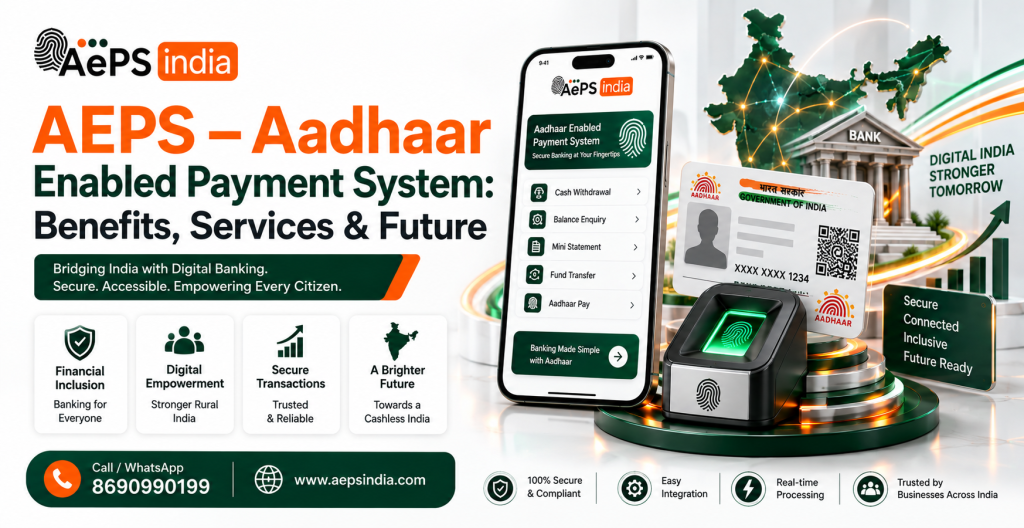
AEPS (Aadhaar Enabled Payment System) has changed the way people access basic banking services, especially in rural and semi-urban areas of India. Instead of depending only on a bank branch, ATM card or traditional banking channel, customers can access supported banking services through an AEPS touchpoint or Business Correspondent (BC) using Aadhaar-based authentication.
The role of AEPS goes beyond cash withdrawal. Depending on the participating bank and available services, customers can use AEPS for cash withdrawal, cash deposit, balance enquiry, mini statement and fund transfer. Its interoperable model also helps customers access banking services through participating AEPS touchpoints, making last-mile banking more accessible.
AePS (Aadhaar Enabled Payment System) is a cardless, PIN-free digital banking service that lets you perform basic financial transactions using only your Aadhaar number and biometric fingerprint authentication.
Developed by the Aeps india, AePS allows customers to access their bank accounts through local Business Correspondents (BCs) or Micro ATM/Kiosk touchpoints.
For India, AEPS plays an important role in financial inclusion because it brings banking closer to people who may have limited access to branches or ATMs. It can also support the delivery and access of government benefits through Aadhaar-enabled banking channels.
For retailers, fintech businesses, BCs and digital service providers, AEPS has also created an opportunity to provide assisted banking services at the local level. However, a successful AEPS ecosystem depends on secure authentication, compliant devices, reliable transaction processing, proper customer consent and adherence to applicable NPCI, UIDAI, RBI and bank requirements.
The future will also depend on secure authentication, reliable transaction processing, better technology Aeps integration, strong data protection, and compliance with applicable banking and AEPS requirements. Businesses looking to enter or expand in this segment should therefore focus on building a secure and scalable AEPS operation rather than looking only at transaction processing.
With AEPS India, businesses interested in AEPS can explore technology solutions for managing AEPS-related operations and building a more organized digital Aeps banking platform. A suitable AEPS solution can help businesses manage transaction activity, users, retailers, distributors, Aeps commission, reports, and other Aeps platform requirements according to their business model.
In this guide, you will learn about the role of AEPS, benefits of AEPS, AEPS services, how AEPS works, the importance of AEPS for financial inclusion, AEPS business opportunities, AEPS platform solutions, and the future of AEPS in India.
What Is AEPS (Aadhaar Enabled Payment System)?
Aadhaar Enabled Payment System (AEPS) is a bank-led digital payment service that lets you perform basic banking transactions using your 12-digit Aadhaar number and biometric authentication (like a fingerprint), without needing a debit card, credit card, or PIN. Developed by the National Payments Corporation of India (NPCI), it allows interoperable transactions across different banks through micro-ATMs or authorized Business Correspondents (BCs).
Aeps full form
Aadhaar Enabled Payment System
How Does AEPS Work?
Requirements for Aeps The Aadhaar Enabled Payment System (AePS) works by letting you perform basic banking tasks using just your 12-digit Aadhaar number and your fingerprint at a local micro-ATM or banking agent. You do not need a debit card, a bank PIN, or a smartphone.
The system was developed by the National Payments Corporation of India (NPCI) to make banking easy for everyone, especially in rural areas.
Step-by-Step Working Process
- Visit an Agent: Go to a nearby micro ATM, point-of-sale (PoS) machine, or a authorized Aeps india.
- Share Details: Tell the agent your bank name, your Aadhaar number, and the type of service you want (like cash withdrawal or balance check).
- Provide Biometrics: Place your finger on the biometric scanner connected to the micro ATM machine.
- Verification: The system sends your fingerprint data to the Unique Identification Authority of India (UIDAI) central database to match your identity.
- Transaction Processing: Once your identity matches, your bank processes the request in real time.
- Confirmation: The agent hands you the cash (if withdrawing) and a printed or digital receipt confirming the transaction.
What Banking Services Are Available Through AEPS?
Aeps Service offers essential financial and non-financial banking services using just an Aadhaar number and biometric authentication (Aeps fingerprint or Aeps iris scan) at Aeps india Website.
Aeps Service Means
- Cash Withdrawal: Withdraw money from an Aadhaar-linked bank account without using a debit card or PIN.
- Cash Deposit: Deposit cash directly into an Aadhaar-linked bank account via supported best micro ATM device.
- Balance Enquiry: Check the current available balance in real time.
- Mini Statement: View a quick summary of recent transactions.
- Fund Transfer: Transfer money from one Aadhaar-linked account to another Aadhaar-linked account.
- BHIM Aadhaar Pay: Enable merchants to accept digital payments from customers using biometric verification.
- Aadhaar Authentication (Yes/No): Verify demographic or biometric identity for various services.
What Is Required to Use AEPS?
To use or provide the Aadhaar Enabled Payment System (AEPS), the required documents depend on whether you are a customer doing a transaction or a merchant/agent setting up a business point.
For Customers (Doing a Transaction)
If you want to withdraw cash or check your balance at a micro ATM or bank kiosk, you only need:
- Aadhaar Number: Your 12-digit unique identity number.
- Linked Bank Account: Your bank account must be seeded (connected) to your Aadhaar.
- Biometric Authentication: Your Aeps fingerprint device or Aeps iris scan device for verification.
For Merchants / BC Agents (Registering to Offer Services)
If you want to register as an AEPS Agent, you must complete a Know Your Customer (KYC) verification and provide these documents:
- Identity Proof: Aadhaar Card and PAN Card (mandatory for tax and financial compliance).
- Bank Account Details: A cancelled cheque, bank passbook, or recent bank statement to receive your commission settlements.
- Business/Address Proof: A utility bill (electricity or water), rent agreement, or business registration (like GST, Udyam, or a Shop & Establishment Certificate).
- Contact Information: An active mobile number (linked to your Aadhaar for OTPs) and a working email address.
- Photographs: Recent passport-sized photos.
- Hardware Requirement: A certified Aeps biometric device (such as a fingerprint or iris scanner) to process customer scans.
What Is an AEPS Touchpoint?
An AEPS Touchpoint is a physical or mobile terminal deployed by an acquiring bank to let customers perform banking transactions using their Aadhaar number and biometric or OTP authentication.
Key Features
- Services Provided: Enables cash withdrawals, deposits, balance inquiries, mini statements, and fund transfers.
- Form Factor: Operates via fixed or mobile terminals (such as micro-ATMs) managed by an AEPS Touchpoint Operator (ATO), who is typically a local shopkeeper or business correspondent.
- Security & Regulations: Subject to strict Reserve Bank of India (RBI) due-diligence rules requiring customer-grade KYC for operators and regular activity monitoring to prevent fraud.
Who Can Use AEPS
Any Indian resident with a bank account linked to their 12-digit Aadhaar number can use the Aadhaar Enabled Payment System (AEPS).
Who Benefits Most?
- Rural and Remote Populations: People who live far from physical bank branches or ATMs.
- Cardless Users: Individuals who do not own or wish to carry debit cards, credit cards, or remember secret PINs.
- Government Beneficiaries: Citizens receiving direct benefit transfers like NREGA wages or social security pensions.
- Micro-Merchants: Small local shop owners who want to accept digital payments using basic Aeps biometric devices.
Why Use AEPS
You should use the Aadhaar Enabled Payment System (AEPS) because it lets you perform basic banking transactions using just your 12-digit Aadhaar number and your fingerprint, completely eliminating the need for debit cards, bank PINs, or smartphones.
Key Reasons to Use AEPS
- No Cards or PINs Needed: You do not have to carry a physical debit card or remember a secret PIN code. Your unique fingerprint acts as your secure digital signature.
- Doorstep Banking in Rural Areas: It solves the travel problem by bringing banking services right to your local village shop or Aeps india website equipped with a buy micro ATM device.
- Bank Interoperability: You can visit any AEPS-enabled touchpoint or agent, regardless of which specific bank your account is held with.
- Essential Everyday Services: You can easily check your account balance, withdraw cash, deposit money, get mini statements, and transfer funds.
- High Security: Aeps Biometric fingerprint authentication prevents fraud because your biometric data is unique and cannot be easily guessed or stolen like a traditional password or PIN.
Top Use Cases of AEPS
The top use case of the Aadhaar Enabled Payment System (AePS) is enabling cardless and PIN-free cash withdrawals and micro ATM services at local retail shops using biometric authentication.
Key Use Cases of AePS
- Micro-ATM Services: Facilitates local cash withdrawals and deposits via agent-assisted Aeps fingerprint scan device.
- Direct Benefit Transfer (DBT): Allows beneficiaries to access government funds and subsidies locally.
- Balance & Mini-Statement: Enables instant, biometric-secured account balance checks.
- Aadhaar Pay: Empowers merchants to accept direct digital payments without traditional POS hardware.
- Fund Transfers & eKYC: Supports secure Aadhaar-to-Aadhaar money transfers and paperless identity verification.
How to Become an AEPS Agent: Big Profit with Low Investment
Becoming an AEPS (Aadhaar Enabled Payment System) Agent is one of the most accessible ways to start a high-yield retail banking business with minimal capital investment (around ₹5,000 to ₹10,000). By turning your local shop, home, or kiosk into a mini-bank, you can provide essential financial services to your community and earn a steady commission of ₹7 to ₹10 per transaction.
Low Investment Setup: Hardware & Cost Breakdown
You do not need a fancy brick-and-mortar setup to start. The entire investment goes into basic hardware and a working cash float:
- An Android Smartphone or Laptop: You likely already own this. It needs a stable internet connection.
- Biometric Fingerprint Scanner: You must purchase an STQC/L1-certified biometric device (such as Mantra). Under current guidelines, older L0 devices are phased out for L1 devices to secure transactions. These cost roughly ₹2,500 to ₹4,500.
- Working Capital Float: You will need a small rolling cash balance (typically ₹5,000–₹10,000) to distribute as cash to customers before the funds settle back into your digital wallet.
Step-by-Step Registration Process
The entire onboarding framework is digital and usually takes 24 to 48 hours for activation:
- Step 1: Choose a Reliable Service Provider: Pick an NPCI-authorized Aeps india.
- Step 2: Sign Up Online: Visit Aeps india website and fill out the AEPS agent registration form.
- Step 3: Upload KYC Documents: Digitally submit your PAN, Aadhaar, and bank documents.
- Step 4: Complete Biometric eKYC: Connect your fingerprint scanner and scan your own thumb/iris to authenticate your identity as the authorized merchant.
- Step 5: Receive Login Credentials: Once approved, your Merchant Agent ID and portal access link will be delivered via SMS/Email.
Maximizing Profit: Revenue & Services Offered
Your profit relies entirely on transaction volumes. By serving as a local financial hub, you can maximize your earnings through multiple services:
| Service Type | How it Works | Your Profit Source |
|---|---|---|
| Cash Withdrawal | Customer authenticates via Aadhaar and thumbprint; you hand them physical cash up to ₹10,000. | Direct Commission (typically ₹7–₹10 per transaction) |
| Mini Statements | Check the last few bank transactions for customers who don’t have smartphones. | Small flat commission/fee per check |
| Balance Enquiry | Real-time balance check for rural or less tech-savvy customers. | Attracts footfall / Cross-sell services |
| Value-Added Services | Offer utility bill payments, mobile recharges, and PAN card applications via the same wallet. | Secondary commission layers |
Why AEPS Will Remain Important for India’s Last-Mile Banking
The Aadhaar Enabled Payment System (AePS) remains vital for India’s last-mile banking because it allows rural and unbanked populations to perform cardless, PIN-less financial transactions using only their Aadhaar number and biometric verification at local micro ATM or Kirana shops.
Key Reasons for Importance
- No Cards or PINs Needed: Eliminates physical debit cards and memory-based PINs, relying entirely on secure fingerprint or iris scans.
- Brings Banks to Villages: Turns local small shops into mini-banks, so users do not travel long distances to distant city branches or ATMs.
- Direct Benefit Transfers (DBT): Makes it easy for citizens to withdraw government subsidies, pensions, and welfare funds right where they live.
- Assisted and Inclusive: Unlike smartphone-heavy apps like UPI, AePS uses local agents to help people with low digital literacy complete transactions.
- Interoperable Network: Supports transactions across multiple banks through the National Payments Corporation of India (NPCI) rails, meaning any customer can use any enabled local touchpoint.
AEPS Service
Aadhaar
Withdraw
Withdraw
Aadhaar
Payment
Payment
Balance
Enquiry
Enquiry
Mini
Statement
Statement
Available Here
Aadhar
ATM
ATM
☀️
AADHAAR
AEPS Market Trends and Growth in India
Aadhaar Enabled Payment System (AePS) adoption in India is projected to exceed 3.5 billion annual transactions, driven by deep rural micro-ATM expansion and last-mile financial inclusion.
Market Growth and Scale
- Surge in Volume: Transaction volumes have scaled massively from 345 million in FY 2017 to over 4.86 billion in recent fiscal years, proving vital for underserved populations.
- Last-Mile Reach: Powered by local business correspondents and micro-ATMs at neighborhood retail touchpoints, best AePS bridges the gap for unbanked communities.
- Macroeconomic Impact: Aadhaar authentication and AePS transaction values significantly contribute to India’s digital public infrastructure (DPI) economic footprint.
Key Market Trends
- Advanced Security: Deployment of AI-driven fraud analytics, real-time risk monitoring, and biometric liveness detection to reduce authentication errors.
- Face Authentication: Transitioning beyond basic fingerprint scanning toward multi-factor biometrics and face authentication.
- Service Diversification: Expansion from basic cash withdrawals and balance checks into micro-loans, insurance, bill payments (BBPS), and government disbursements.
- Agent Empowerment: Adoption of instant T+0 settlements and mobile-first applications to improve liquidity and working capital for local retailers.
AEPS Market Growth Trend
Value of Transactions in Billion Indian Rupees
0 2,000 4,000 6,000 8,000 10,000 12,000
Market Analysis & Insights
The above chart demonstrates the exponential growth of the Aadhaar Enabled Payment System (AEPS). The steady increase in transaction value indicates a shift toward digital banking in rural India, reducing the dependency on physical bank branches and enhancing financial inclusion.
Aeps Monthly Volume Jenerated
The Aadhaar Enabled Payment System (AePS), managed by the National Payments Corporation of India (NPCI), processes approximately 95 million to 105 million transactions monthly, generating a transaction value of ₹25,000 crore to ₹27,500 crore.
While digital payment modes like UPI continue to grow at record-breaking speeds, AePS remains a foundational tool for rural and semi-urban banking access by allowing biometric-based cash withdrawals through micro-ATMs and banking correspondents.
Recent Monthly Performance Breakdowns
The NPCI’s latest retail payment reports highlight steady month-on-month volume progression alongside compressed overall values:
| Month | Total Transaction Volume (Count) | Total Transaction Value (Amount) | Average Daily Volume |
|---|---|---|---|
| August 2026 | 104 million | ₹26,035 crore | 3.35 million |
| July 2026 | 100 million | ₹27,539 crore | 3.24 million |
| June 2026 | 97 million | N/A | 3.23 million |
| April 2026 | 89.93 million | ₹26,049 crore | 3.00 million |
Key Macro Trends Impacting AePS Volumes
- Year-on-Year Declinement: Current transaction volumes and values reflect an approximate 19% decline compared to the same periods last year. This trajectory stems from an escalating shift of semi-urban consumers migrating toward UPI QR codes.
- Regulatory & Security Tightening: Volume velocities have adjusted under the weight of strict risk compliance measures rolled out by the RBI and NPCI. New implementations include step-up OTP requirements for cash withdrawals exceeding ₹5,000 and mandatory transition to upgraded L1 biometric scanners to suppress financial fraud.
- Predominance of Cash Withdrawals: Roughly 98% of the entire financial volume processed through AePS remains tied directly to biometric cash withdrawals rather than funds transfers or deposits.
AEPS Monthly Volumes
AEPS Monthly Volumes
Aadhaar based interoperable transactions.
August 2026
August 2026
Total Transaction Volume
104 mn
Total Transaction Value
₹26,035 Crore
3.35 mn Average Daily Volume
2026 Transaction Month
July 2026
Total Transaction Volume
100 mn
Total Transaction Value
₹27,539 Crore
Average Daily Volume
3.24 mn
June 2026
Total Transaction Volume
97 mn
Total Transaction Value
N/A
Average Daily Volume
3.23 mn
April 2026
Total Transaction Volume
89.93 mn
Total Transaction Value
₹26,049 Crore
Average Daily Volume
3.00 mn
What Is the Role of AEPS in Digital Banking?
The Aadhaar Enabled Payment System (AEPS) acts as a cardless, PIN-less digital banking service that uses a person’s fingerprint or iris scan and an Aadhaar number to let them complete basic financial tasks through local banking agents. Aeps Developed by the Aeps india, AEPS bridges the gap between traditional bank branches and remote communities.
Key Roles of AEPS in Digital Banking
Driving Financial Inclusion
- Reaches remote areas: Brings banking to villages and unbanked regions without physical bank branches or regular ATMs.
- Bypasses digital hurdles: Removes the need for a smartphone, internet connection, debit card, or secret PIN.
- Empowers all users: Helps daily wage workers, the elderly, and rural citizens handle money easily using local shopkeepers or Business Correspondents (BCs) as helpers.
Supporting Government Schemes
- Direct Benefit Transfer (DBT): Delivers government pensions, subsidies, and wages straight into bank accounts safely.
- Reduces fraud: Stops middlemen from blocking or stealing funds meant for citizens.
Ensuring High Security
- Biometric verification: Uses unique fingerprint or iris scans matched with central databases to prove identity.
- No card risks: Eliminates lost cards or stolen PIN numbers because your body is your key.
AEPS Banking & Support Services
Banking Services via AePS:
- Cash Deposit
- Cash Withdrawal
- Balance Enquiry
- Mini Statement
- Aadhaar to Aadhaar Fund Transfer
- Dual Authentication
- BHIM Aadhaar Pay
Other Services Offered:
- eKYC
- Best Finger Detection
- Demo Authentication
- Tokenization
- Aadhaar Seeding Status
- Authentication
Role of AEPS in Financial Inclusion in India
The Aadhaar Enabled Payment System (AEPS) acts as a cornerstone for financial inclusion in India by letting people perform basic banking tasks using just their Aadhaar number and fingerprint, without needing a debit card, credit card, or PIN.
Key Roles of AEPS in Financial Inclusion
- Last-Mile Banking: Brings formal banking services directly to rural and remote villages through local Business Correspondents (BCs) and micro-ATMs, removing the barrier of long travel distances to city bank branches.
- No Cards or PINs Needed: Eliminates the need for technical literacy, smartphones, or remembering secret PINs, making it easy for anyone to access their money safely.
- Direct Benefit Transfers (DBT): Speeds up the delivery of government pensions, subsidies, and welfare funds straight to the correct bank accounts with zero middlemen or delays.
- Interoperable Services: Allows users to access their bank accounts at any top micro ATM terminal, regardless of which bank holds their actual account.
- Essential Transactions: Supports core banking operations like cash withdrawals, cash deposits, balance checks, mini statements, and fund transfers at the local level.
Benefits of Using The AePS
Easy
To Use
To Use
👆
Safe and
Secure Method
Secure Method
🛡️
Promotes
Financial Inclusion
Financial Inclusion
🏦
Simple
Requirement
Requirement
📝
Need
Minimal Information
Minimal Information
📋
Role of AEPS in Cash Withdrawal and Balance Inquiry
The Aadhaar Enabled Payment System (AePS) lets users perform cardless cash withdrawals and real-time balance checks using only an Aadhaar number and biometric verification at authorized micro ATM device or banking correspondent touchpoints.
Role in Cash Withdrawal
- Cardless Access: Eliminates the need for a physical debit/credit card or a PIN.
- Local Availability: Allows villagers and underserved populations to withdraw cash locally via a Business Correspondent (BC) instead of traveling to distant bank branches or ATMs.
- Secure Authentication: Uses fingerprint or iris scans to verify the account holder’s identity instantly.
- Transaction Limits: Restricts single-transaction payouts (typically up to ₹10,000) to maintain security.
Role in Balance Inquiry
- Real-Time Tracking: Provides instant updates on available bank account funds directly at local retail or agent outlets.
- Interoperability: Works across different banks, meaning a customer of any participating bank can check their balance at any AePS-enabled device.
- Enhanced Privacy: Confirms account standing securely without requiring passwords or Aeps banking app.
AEPS Role-Based Statements
Cash Withdrawal Statement
| Date | Amount | Txn ID | Status |
|---|---|---|---|
| 04 Sep 2026 | – ₹2,000 | #CW8821 | Success |
| 03 Sep 2026 | – ₹1,000 | #CW8845 | Success |
| 02 Sep 2026 | – ₹5,000 | #CW8890 | Failed |
Balance Inquiry Statement
| Date | Account | Balance | Status |
|---|---|---|---|
| 04 Sep 2026 | XXXX1234 | ₹12,450 | Success |
| 01 Sep 2026 | XXXX1234 | ₹14,450 | Success |
Role of AEPS in Mini Statement and Fund Transfer
The Aadhaar Enabled Payment System (AePS) lets users perform cardless banking services like mini statements and fund transfers using only their Aadhaar number and biometric authentication at affordable micro ATM or via business correspondents.
Role of AePS in Mini Statement
- Transaction History: Provides a quick, real-time snapshot of the last 5 to 10 recent transactions on the account.
- Cardless Access: Eliminates the need for a physical debit card, passbook update machine, or secret PIN.
- Financial Tracking: Helps rural or unbanked users verify recent credits (such as government subsidies or wages) and debits right at their local neighborhood store or banking agent.
- Non-Financial Simplicity: Acts as a non-financial request processed securely via fingerprint or iris scan verification.
Role of AePS in Fund Transfer
- Aadhaar-to-Aadhaar Transfers: Facilitates direct peer-to-peer or account-to-account money transfers using recipient and sender Aadhaar details.
- Interbank & Intrabank Support: Operates across different participating banks (interbank) or within the same bank (intrabank).
- Last-Mile Remittances: Enables people in remote locations to send money home or transfer funds without needing a smartphone, internet pack, or bank application.
- Biometric Security: Replaces traditional beneficiary account numbers and IFSC codes in specific Micro ATM in India workflows, lowering fraud risks via instant biometric validation.
AEPS Transaction Statement
Mini Statement Last 5 Txns
| Date | Type | Amount | Status |
|---|---|---|---|
| 04 Sep 2026 | Withdrawal | – ₹2,000 | Success |
| 03 Sep 2026 | Deposit | + ₹5,000 | Success |
| 02 Sep 2026 | Withdrawal | – ₹1,500 | Success |
| 01 Sep 2026 | Transfer | – ₹500 | Pending |
| 31 Aug 2026 | Deposit | + ₹1,200 | Success |
Fund Transfer History
| Ref ID | Recipient | Amount | Status |
|---|---|---|---|
| #TXN9921 | S. Kumar | ₹1,000 | Done |
| #TXN8842 | A. Sharma | ₹2,500 | Done |
Role of AEPS in Direct Benefit Transfer (DBT)
The Aadhaar Enabled Payment System (AePS) acts as the crucial last-mile cash-out and transactional backbone for India’s Direct Benefit Transfer (DBT) framework.
Key Roles of AePS in DBT
- Last-Mile Cash Delivery: Enables beneficiaries in remote or unbanked rural areas to withdraw government subsidies, pensions, and MGNREGA wages locally.
- Cardless and PIN-less Access: Replaces physical debit cards and ATM PINs with biometric authentication (fingerprint or iris scan) via Aeps india website and fast Micro ATM device.
- Interoperability: Connects multi-bank users to a central switch managed by the National Payments Corporation of India (NPCI), allowing individuals to access funds regardless of where their specific bank account is hosted.
- Fraud Prevention and Transparency: Eliminates ghost beneficiaries and middleman leakages by tying every payout directly to real-time Aadhaar biometric verification.
- Instant Account Services: Provides immediate Aeps balance inqury service, Aeps mini statement service and transactional tracking at village-level retail touchpoints.
️ AEPS in Direct Benefit Transfer (DBT)
Complete Transaction Flow & Settlement Process
Sponsor Bank
Transaction Initiation

Government Department / OMC
NPCI Mapper
NPCI
Central Switch
AEPS Processing
📄 Presentation
Settlement File
Settlement File
📄 Return
Settlement File
Settlement File

Settlement Agent
Destination Bank
Funds Made Available
💰
Beneficiary
Intimation Sent
Transaction Origination
Transaction Response
Fund Transfer
Notification
🔄 How DBT Works Through AEPS:
Step 1: Government Department initiates subsidy/benefit payment through Sponsor Bank
Step 2: NPCI Mapper validates beneficiary Aadhaar and bank account details
Step 3: NPCI Central Switch processes the transaction and routes to Destination Bank
Step 4: Settlement Agent (RBI) handles fund settlement between banks
Step 5: Funds credited to beneficiary’s account with instant notification
How AEPS Supports Rural and Semi-Urban India
The Aadhaar Enabled Payment System (AePS) supports rural and semi-urban India by turning local shops into neighborhood banks that process cardless, PIN-less transactions using only best Aeps biometric fingerprint authentication.
Overcoming Infrastructure Gaps
- Doorstep Banking: Villagers complete cash withdrawals, balance inquiries, and mini-statements at local micro ATM system managed by Aeps india instead of traveling miles to town.
- No Cards or PINs Needed: Eliminates physical debit cards and secret PINs that users might lose or forget, relying instead on unique fingerprint or iris scans.
- Interoperability: Customers use any bank’s system at any local agent location regardless of which specific bank holds their account.
Streamlining Government Support
- Direct Benefit Transfers (DBT): Subsidies, pensions, and rural employment wages (such as MGNREGA) flow directly into Aadhaar-linked accounts for instant local cash access.
- Reduced Intermediaries: Cuts out middlemen and delays in welfare distribution, ensuring funds reach recipients securely and transparently.
Boosting Local Commerce
- Micro-Merchants: Small shop owners act as “Aadhaar ATMs,” earning extra income from transaction commissions while drawing more foot traffic to their stores.
- Cashless Transition: Encourages small businesses in semi-urban and rural areas to accept digital payments without investing in expensive Point-of-Sale (PoS) hardware.
AEPS for Fintech Companies and Retail Businesses
AEPS software turns local retail shops and fintech applications into cardless, biometric-driven mini-banks.
Core Benefits for Businesses
- Extra Income: Earn Aeps commission ranging from ₹2 to ₹20 per successful cash withdrawal or balance inquiry.
- More Footfall: Attract neighborhood customers who need quick, card-free banking services.
- Low Setup Cost: Turn a smartphone, tablet, or PC paired with an STQC certified Aeps biometric scanner into a payment terminal.
Key Features for Fintech Companies
- AEPS API Integration: Connect custom Aeps apps or white label Aeps portal directly to the Aeps india network.
- Real-Time Settlements: Access instant (T+0) fund settlements to maintain smooth working capital and agent cash flow.
- Multi-Tier Management: Utilize centralized Aeps dashboard to manage distributor and retailer hierarchies, track logs, and monitor uptime.
U
User Name
Welcome Back
Total Balance
₹ 1,25,450.00
AEPS
Aadhaar Enabled Payment System
Quick Services
Cash Withdrawal
Balance Check
Mini Statement
Money Transfer
Banking
Recharge
Bill Payment
Shopping
Banking Services
AEPS
Aadhaar Pay
DMT
Micro ATM
🏠
Home
Chats
+
👛
Wallet
⚙️
Settings
Benefits of AEPS
The Aadhaar Enabled Payment System (AePS) offers cardless banking, financial inclusion, and secure biometric authentication for basic transactions at micro-ATMs.
Key Benefits
- Enhanced Security: Biometric verification ensures that only the actual account holder can authorize a transaction, which minimizes the risk of fraud or PIN theft.
- Financial Inclusion: The Aeps system brings formal banking and financial services to unbanked, rural, and underserved populations who lack traditional bank branches.
- Banking at Your Doorstep: Aeps india carrying micro-ATMs can provide cash withdrawals, deposits, and balance checks within local communities.
- High Security: Biometric verification prevents strangers from stealing or guessing your password, which makes the best Aeps system very safe.
- Interoperability: Customers of any participating bank can use an AePS enabled micro ATM or point-of-sale machine hosted by any other bank’s agent.
- Works with Any Bank: You can use any AePS micro-machine or local agent, even if your account is with a different bank.
- Government Benefit Transfers: Citizens can easily receive and withdraw funds from government schemes like MNREGA or social security pensions directly through biometric validation.
- Easy for Everyone: People who do not know how to use complex smartphone apps or remember numbers can use it easily.
Features of AEPS
The Aadhaar Enabled Payment System (AePS) is a bank-led model managed by the National Payments Corporation of India that allows cardless and PIN-free financial transactions through biometric verification.
Key Features of AePS
- Cardless and PIN-Free: No debit card, credit card, or secret password is required to complete a transaction.
- Biometric Authentication: Identity is verified securely using a unique fingerprint or iris scan via UIDAI-backed data.
- Interoperable Network: Customers of any participating bank can use micro ATM machines, kiosks, or Business Correspondents (Bank Mitras) of any other participating bank.
- Multiple Banking Services: Supports core financial actions like cash withdrawals, cash deposits, balance inquiries, mini-statements, and Aadhaar-to-Aadhaar fund transfers.
- Financial Inclusion: Aeps Designed to bridge the banking gap for rural and underserved communities where traditional brick-and-mortar branches or digital devices are scarce.
- Government Disbursements: Facilitates direct receipt of government entitlements and welfare benefits like pensions and MGNREGA wages at the doorstep.
Aeps API Integration
The AePS API integration process allows businesses and fintech networks to offer core banking services like cash withdrawals, balance inquiries, and mini-statements directly through their web or mobile Aeps apps. The integration typically takes 1 to 3 weeks for pre-built white label Aeps solutions, or 3 to 8 weeks for customized systems requiring full compliance auditing.
Phase 1: Business Onboarding & Hardware Setup
1. Choose an NPCI-Certified Provider
Partner with a Aeps india compliant with the UIDAI regulations. Aeps india offer ready-made SDKs and sandbox Aeps portal for developer Aeps onboarding.
2. Complete Merchant KYC Verification
Submit required legal Aeps API documentation to activate Aeps india. This step typically requires:
- Business Registration Certificate (Pvt. Ltd., LLP, Sole Proprietorship)
- Business and personal PAN card
- Aadhaar card
- Corporate bank account details
3. Procure & Register Biometric Hardware
Purchase Aeps fingerprint or Purchase Aeps iris scanners (e.g., Mantra). You must register the hardware on the manufacturer’s Registered Device (RD) Service portal to enable data encryption. Download the respective RD service drivers for Windows or Android Aeps platform.
Phase 2: Technical & API Integration
4. Acquire API Credentials
Once your KYC is approved, Aeps india will supply your technical infrastructure:
- Developer API Keys / Access Tokens
- Merchant ID (MID)
- REST/SOAP API Documentation containing JSON/XML endpoint structures.
5. Frontend & Backend Development
- Frontend UI: Build input fields to safely capture the customer’s 12-digit Aadhaar number, transaction type, and home bank selection using its Issuer Identification Number (IIN).
- Biometric Capture (Client App): Program your client-side application to trigger a capture request to the local RD Service server running on the user’s mobile or desktop. The RD service securely captures the biometrics and passes back an encrypted block of data called
PidData. - Backend API Call: Your backend server maps the structured transaction payload including the serialized XML PidData string and transmits it to your provider’s endpoint using HTTPS.
- Callback Hook: Configure a secure HTTPS callback URL on your server to handle asynchronous transaction responses, real-time status logging, and error codes.
Phase 3: Testing & Launch
6. Sandbox Environment Testing
Before dealing with live capital, execute dummy scenarios inside the Aeps india sandbox system. Thoroughly test:
- Valid and invalid biometric capture
- Successful cash withdrawals and balance checks
- Edge cases (e.g., insufficient bank funds, bank server downtime)
7. Server Whitelisting & Go-Live
Submit your server’s static IP address to Aeps india for whitelisting. Once verified, switch your staging environment tokens to production Aeps API keys to handle live Aadhaar-authenticated banking settlements.
Aeps Cost Provide
The cost structure for setting up and running AEPS in India typically spans Aeps developer integration fees, best Aeps software or best Aeps portal, hardware, and transaction charges.
Integration and Setup Costs
- Standard API Setup: One-time Aeps developer integration fees range from ₹12,000 to ₹35,000.
- White-Label Portals: Pre-branded web and mobile Aeps application cost between ₹15,000 and ₹1,20,000.
- Direct Bank Integration: Custom enterprise bank setups (like ICICI or Yes Bank) range from ₹2,50,000 to ₹4,50,000.
- Annual Maintenance (AMC): Server uptime and technical support run about ₹10,000 to ₹40,000 per year.
Hardware and Operational Expenses
- Biometric Device: L1 Aeps certified fingerprint scanners (such as Mantra) cost ₹1,500 to ₹3,000.
- Working Capital: Retailers need ₹10,000 to ₹20,000 in liquid cash to manage daily customer cash-out demands.
- Retailer/Agent ID: Registration fees range from free to ₹3,000 depending on the Aeps india.
Aeps Commission Structure
An Highest AEPS commission chart outlines the slab-based payout structure that retail agents earn for processing biometric cash withdrawals, balance inquiries, and mini-statements.
Typical AEPS Agent Commission Slabs
- ₹100 – ₹999: ₹2.00 per transaction.
- ₹1,000 – ₹1,499: ~₹3.00 per transaction.
- ₹1,500 – ₹1,999: ~₹4.50 per transaction.
- ₹2,000 – ₹2,999: ₹5.00 to ₹7.00 per transaction.
- ₹3,000 – ₹10,000: ₹13.00 to ₹15.00+ per transaction (highest tier).
- Balance Inquiry / Mini Statement: ₹1.00 to ₹5.00 per transaction.
- Aadhaar Pay: Up to 1% commission on high-value merchant transactions (up to ₹50,000).
AEPS Commission Calculator
Calculate your earnings accurately and professionally
Total Commission ₹ 0.00
How AEPS Can Improve Customer Banking Experience
Aadhaar Enabled Payment System (AePS) improves the customer banking experience by making financial transactions completely cardless, paperless, and accessible through simple biometric authentication.
Key Ways AePS Improves Banking
- No Cards or PINs Needed: Customers only need their Aadhaar number and fingerprint or iris scan to complete transactions, eliminating the risk of forgotten PINs or lost debit cards.
- Local Accessibility: Through Aeps india, rural and remote users can perform transactions nearby instead of traveling long distances to a bank branch.
- Interoperable Services: Customers of any participating bank can use any AePS-enabled touchpoint, giving them universal freedom of access regardless of their home bank.
- Simple for Low-Digital Literacy: The intuitive biometric process removes complex smartphone apps or multi-step banking menus, making it easy for senior citizens and first-time users.
- Essential Services on the Spot: Users can instantly check their balance, get mini-statements, withdraw cash, or transfer funds in real time.
- Direct Subsidies: It simplifies Direct Benefit Transfers (DBT), allowing users to safely access government pensions and welfare funds locally.
AEPS Banking
How AEPS Can Improve Customer Banking Experience
Simple and convenient banking access
Fast and reliable cash withdrawal services
Consistent banking support in rural areas
Digital banking with human assistance
Trust, transparency and secure transactions
AEPS Transaction Limits, Charges and Important Rules
The maximum cash withdrawal limit for a single Aadhaar Enabled Payment System (AEPS) transaction is ₹10,000, as set by the National Payments Corporation of India (NPCI).
Transaction Limits
- Single Transaction: Capped at ₹10,000 for cash withdrawals.
- Daily Cumulative Cap: Generally up to ₹50,000 per day, depending on your bank’s risk policies.
- Aadhaar Pay Limit: Up to ₹50,000 per transaction for merchant payments.
Charges and Fees
- Customer Fees: Basic transactions like cash withdrawals and balance checks are usually free for the first 3 to 5 transactions each month.
- Post-Free Limit Charges: Banks may charge around ₹15 to ₹20 plus GST per transaction after crossing the free monthly limit.
- Agent Rules on Fees: Authorized agents or Business Correspondents are strictly prohibited from charging extra hidden fees directly to customers for standard AEPS services. You can verify service terms directly through Aeps provider like Aeps india.
Important Rules
- Biometric Authentication: Every transaction requires a fingerprint or iris scan matched with UIDAI records.
- Primary Account: Transactions automatically route to the primary bank account linked to your Aadhaar number.
- No Cards Needed: You do not need a physical debit card, credit card, or ATM PIN to complete a transaction.
- Operator KYC: Retailers and touchpoint operators must complete mandatory KYC verification and compliance checks before offering top AEPS services.
AEPS CASH
AEPS
Aadhaar Enabled
Payment System
Aadhaar Enabled
Payment System
1
Aadhaar Biometric Verification
(Fingerprint / Iris)
(Fingerprint / Iris)
+
2
OTP Verification
sent to the mobile number registered with Aadhaar (UIDAI)
sent to the mobile number registered with Aadhaar (UIDAI)
₹5,000 OR LESS
BIOMETRIC ONLY No change in the process. Continue as before.
ABOVE ₹5,000
BIOMETRIC + OTP REQUIRED Both biometric and OTP verification are mandatory to complete the transaction.
Challenges and Limitations of AEPS
The Aadhaar Enabled Payment System (AePS) faces primary challenges related to biometric authentication failures, technical infrastructure gaps, and rising cyber fraud risks.
Technical and Infrastructure Limitations
- Network Dependency: AePS requires continuous internet connectivity and server uptime; poor network coverage in rural or remote regions frequently leads to failed or delayed transactions.
- Biometric Failures: Fingerprint scanning errors occur due to worn-out fingerprints, aging, dry skin, or poor device calibration.
- Restricted Services: The trusted Aeps system only supports basic banking tasks such as Aeps cash withdrawal API, Aeps balance check API, and Aeps mini statement API, excluding complex financial needs like loans or investments.
Security and Fraud Challenges
- Cloned Biometrics: Cybercriminals exploit systemic gaps by using fake silicone thumbs or leaked biometric data harvested during initial Aadhaar enrollments to clear unauthorized withdrawals.
- Lack of Real-Time Alerts: Many affected users fail to receive immediate SMS notifications due to delayed banking updates or poor mobile connectivity, leaving fraud undetected.
- Intermediary Reliance: Users depend heavily on local micro ATM operators and business correspondents, which can expose vulnerable customers to overcharging or data misuse.
AEPS Security: Is AEPS Safe?
Yes, the Aadhaar Enabled Payment System (AePS) is generally safe and secure because it relies on encrypted biometric verification rather than vulnerable passwords or PINs.
Key Security Features
- Biometric Authentication: Transactions require your unique fingerprint or iris scan, meaning accounts cannot be accessed without your physical presence.
- No PIN or OTP Required: You do not need to share a debit card PIN or a one-time password (OTP), which eliminates traditional phishing risks.
- Regulated Network: The Aeps system operates under guidelines set by the Reserve Bank of India (RBI) and is managed via the National Payments Corporation of India (NPCI).
Potential Risks and Frauds
- Cloned Biometrics: Sophisticated fraudsters have occasionally used copied or leaked fingerprints (sometimes captured from rubber stamps or land registry documents) to spoof systems at rogue merchant points.
- Untrusted Agents: Risks increase when using unverified or shady Aeps india.
Safety Tips
- Lock Biometrics: Use the Aeps india Official Website to lock your biometric data when you are not using it.
- Verify Agents: Only perform transactions at trusted bank branches or authorized, reputable micro ATM service points.
- Track Alerts: Turn on real-time SMS and email notifications from your bank so you immediately notice any irregular account activity.
AEPS Transaction Types: On-Us, Off-Us and Remote On-Us
An On-Us transaction in the Aadhaar Enabled Payment System (AePS) occurs when a customer conducts a transaction using a Aeps india or terminal belonging to the exact same bank where they hold their account.
Key AePS Transaction Types
On-Us Transaction:
- Definition: The customer and the terminal/BC belong to the same bank.
- Process: The issuing bank and acquiring bank are identical, meaning internal systems handle the verification and routing directly without routing through external network switches.
Off-Us Transaction:
- Definition: The customer uses an AePS terminal or BC deployed by a different bank than the one where their account is held.
- Process: Also known as an inter-bank transaction, this relies on interoperability via a central switch like the National Payments Corporation of India (NPCI) to connect the acquirer terminal to the issuer bank.
Remote On-Us Transaction:
- Definition: A specific scenario where a customer initiates a transaction on a shared, external, or white-label AePS terminal/BC network, but the underlying account is processed as an internal or specific host transaction, or where the terminal behaves relative to a host network context. (In standard banking definitions, it often describes a transaction where the issuer and acquirer end up being the same, but it routes through a remote or third-party access point).
AEPS Transaction Flow: Step-by-Step Process
Biometric and
Encryption standards are
prescribed by UIDAI
Encryption standards are
prescribed by UIDAI
Secure authentication
through Aadhaar
enabled services
through Aadhaar
enabled services
AADHAAR
AUTHENTICATION
AUTHENTICATION
Acquirer Bank’s
F1 Switch
F1 Switch
NPCI Central
Switch (AEPS)
Switch (AEPS)
Issuer Bank’s
F1 Switch
F1 Switch
BIOMETRIC
DEVICE
DEVICE
CUSTOMER INPUTS:
- Aadhaar Number
- Bank Name
- Amount
- Biometric (FPR/IRIS)
Authentication is done by UIDAI and switching, clearing and settlement is performed by NPCI.
AEPS Transaction Failed? Common Reasons and Solutions
An AEPS (Aadhaar Enabled Payment System) transaction usually fails due to biometric authentication errors, unlinked Aadhaar accounts, or bank server timeouts.
Common Reasons and Solutions
1. Biometric Authentication Failure
- Reason: Fingerprints do not match because of dry, wet, dirty, or worn-out fingers, or a dusty scanner.
- Solution: Clean the Aeps scanner and the user’s finger with a clean cloth, apply lotion if fingers are too dry, or try scanning an alternative finger.
2. Aadhaar Not Linked or Mapped to Bank
- Reason: The Aadhaar number is not seeded with the specific bank account or updated in the NPCI mapper.
- Solution: Visit the home bank branch to complete Aadhaar seeding and link the account properly.
3. Insufficient Account Balance
- Reason: The customer’s bank account does not have enough money for the requested withdrawal amount.
- Solution: Perform a balance inquiry first to verify available funds before attempting a cash withdrawal.
4. Bank or NPCI Server Timeout
- Reason: Technical glitches, maintenance, or high traffic on the issuer bank’s server or the national switch.
- Solution: Wait for a few minutes and retry the transaction, or use a different bank option if available.
5. Account Blocked or Daily Limit Reached
- Reason: The account is frozen, inactive, or has exceeded the maximum daily AEPS transaction limit set by the bank.
- Solution: Contact the respective bank branch to verify the account status or check if daily limits are exhausted.
AEPS and Government Schemes
The Aadhaar Enabled Payment System (AePS) connects government welfare schemes directly to citizens using biometric fingerprint or iris authentication.
How AePS Supports Government Schemes
- Direct Benefit Transfers (DBT): Funds from welfare programs flow directly into Aadhaar-linked bank accounts without physical passbooks.
- No Middlemen: Direct transfers remove intermediaries, reducing delays and leakage of funds.
Supported Schemes:
- MGNREGA: Daily wage payments for rural work programs.
- Social Security Pensions: Old-age, widow, and disability pensions.
- Subsidies: LPG and other direct government relief funds.
Key Benefits for Beneficiaries
- Last-Mile Access: Local Business Correspondents (BCs) use handheld micro-ATMs in remote villages where formal banks are absent.
- No Cards or PINs Needed: Transactions rely entirely on the 12-digit Aadhaar number and unique biometric scans.
- Real-Time Processing: Payments clear instantly, and users receive immediate transaction confirmations.
Latest AEPS Regulatory Developments
Recent regulatory updates for the Aadhaar Enabled Payment System (AePS) introduce strict security measures and mandatory two-factor authentication to curb rising last-mile financial frauds.
High-Value Step-Up Authentication
- Threshold & OTP: Transactions over ₹5,000 require an additional Aadhaar-registered mobile OTP alongside biometric verification, while transactions of ₹5,000 or less rely solely on biometrics.
Stricter Rules for Touchpoint Operators (ATOs)
- KYC & Operations: Acquiring banks must complete comprehensive KYC before onboarding operators, re-verify KYC after three months of inactivity, mandate certified L1 biometric scanners for cash-out services, and restrict operators to a single acquiring bank linkage.
AEPS Security and Safe Banking Transactions
The Aadhaar Enabled Payment System (AePS) is a secure, cardless banking model regulated by the National Payments Corporation of India (NPCI) that allows users to perform basic financial transactions using only their Aadhaar number and biometric authentication.
Core Security Features
- Biometric Verification: Transactions require unique Aeps fingerprint or unique Aeps iris scans verified via the UIDAI database, making identity theft extremely difficult.
- No Cards or PINs: Eliminates risks tied to lost debit cards, stolen ATM pins, or forgotten passwords.
- Data Encryption: All sensitive transaction details are fully encrypted during data transmission.
- Real-Time Alerts: Immediate SMS or email notifications let users track account activities instantly.
Best Practices for Safe Transactions
- Keep Aadhaar Private: Never share your Aadhaar number or biometric details with unauthorized individuals.
- Use Trusted Touchpoints: Conduct transactions only at authorized bank branches, reliable micro ATM, or verified Business Correspondents (Bank Mitras).
- Check the Device: Ensure the biometric scanner used by the operator looks clean, untampered, and STQC-certified.
- Monitor History: Regularly check your passbook or mobile banking app to review your transaction logs.
Is It Safe to Transfer Money
Through AEPS?
The Aadhaar Enabled Payment System (AEPS) offers a convenient way to access banking services in India. But is it safe? According to experts, the answer is yes — if users follow essential safety practices.
♧ Fingerprint &
Aadhaar Authentication
Aadhaar Authentication
♙ Secure & Encrypted
Transactions
Transactions
Security Layers
- Authentication methods with fingerprint and Aadhaar
- Secure, encrypted transactions
- Monitoring and fraud detection
Expert Analysis
AEPS is considered secure if essential safety practices are followed:
- Protect Aadhaar number
- Use fingerprints securely
- Be vigilant for scams
!
Potential Risks
Despite strong security measures, threats like unauthorized access and fraud remain possible.
Common AEPS Transaction Problems and Their Solutions
Common Aadhaar Enabled Payment System (AePS) transaction failures usually stem from biometric mismatches, unlinked accounts, or server timeouts.
Common Problems & Solutions
1. Biometric Authentication Failed
- Cause: Dirty scanners, dry/worn-out fingerprints, or unregistered biometric devices.
- Solution: Clean the scanner surface and the user’s finger. Try an alternate finger, or ensure the device’s Registered Device (RD) service is active. You can check device registration guidelines via the Unique Identification Authority of India (UIDAI) portal.
2. Transaction Declined by Bank
- Cause: Insufficient account balance, temporary bank server downtime, or incorrect bank mapping.
- Solution: Confirm available funds before retrying. Verify that the correct bank is selected and that the Aadhaar number is properly seeded to that specific account.
3. Aadhaar Not Linked to Bank
- Cause: The customer’s 12-digit Aadhaar number is not mapped to their active bank account.
- Solution: Direct the customer to visit their bank branch or use net banking to complete Aadhaar seeding.
4. Server Timeout or Network Error
- Cause: Poor internet connectivity at the micro-ATM terminal or congestion on the National Payments Corporation of India (NPCI) switch.
- Solution: Re-attempt the transaction after a few seconds using a stable network connection. Restart the micro-ATM device if connection errors persist.
How to Choose an AEPS Solution for Your Business?
Aeps india only one of the right AEPS solution for your business requires evaluating security compliance, transaction uptime, and commission payouts.
When reviewing AEPS India focus on these core factors:
Security and Regulatory Compliance
- Official Certifications: Ensure the top Aeps platform follows guidelines from NPCI (National Payments Corporation of India), RBI (Reserve Bank of India), and UIDAI (Unique Identification Authority of India).
- Data Encryption: Look for end-to-end encryption to protect sensitive biometric fingerprint or iris data during transfers.
Transaction Reliability
- High Uptime: Choose a Aeps india that offers at least 99% to 99.9% uptime to prevent failed cash withdrawals or balance checks.
- Fast Processing: Quick server response times build customer trust and keep lines moving at your shop.
Commission and Settlement Speed
- Transparent Payouts: Compare how much you earn per transaction, which often ranges from ₹12 to ₹15 depending on volume.
- Instant Settlements: Trusted Aeps service with fast or same-day (T+0) settlements so your working capital stays active.
Integration and Ease of Use
- Simple APIs: A good Aeps system offers clear developer documentation and sandbox testing if you are building custom Aeps software.
- User Dashboards: A clear, real-time analytics dashboard helps you track transaction history, retailer networks, and daily earnings easily.
Customer Support
- 24/7 Availability: Round-the-clock technical support is critical to fix sudden network errors or failed transaction amounts immediately.
Future of AEPS in India
Aadhaar Enabled Payment System (AEPS) trends in 2026 focus on advanced security mandates, multi-modal biometrics, and the transformation of local retail shops into rural financial hubs.
Active Current State & Recent Mandates (2026)
- Mandatory L1 Devices: All biometric scanners require STQC-certified Level 1 (L1) compliance for secure encrypted transmission, replacing older L0 devices. a single acquiring bank mapping to tighten fraud tracking.
- Strict KYC & Re-KYC: Regular agent KYC updates are enforced, with automatic re-KYC triggered after three months of platform inactivity.
- Step-Up Authentication: High-value transactions or specific cash withdrawals require an OTP sent directly to the Aadhaar-linked mobile number.
Scheduled Future State & Emerging Trends
- Multi-Modal Biometrics: Systems are expanding beyond fingerprints to include iris scanning and facial recognition to assist elderly or rural users with worn-out fingerprints.
- AI & Liveness Detection: Artificial intelligence and liveness checks are standard for detecting fake fingerprint molds or mask spoofing in real time.
- Rural Financial Hubs: AEPS portals are moving past basic cash withdrawals to offer embedded finance, including micro-loans, insurance, and digital gold.
- Instant Settlements: Real-time (T+0) financial settlements are standard, improving liquidity for local micro-ATM operators.
Conclusion: Role and Future of AEPS in India
AEPS has become an important part of digital banking and financial inclusion in India by making essential banking services available through Aadhaar authentication and Business Correspondent or AEPS touchpoints. Customers can use services such as cash withdrawal, cash deposit, balance enquiry, fund transfer and mini statement without depending entirely on traditional bank branches or debit cards.
The biggest role of AEPS is its ability to bring banking services closer to customers, especially in rural and underserved areas. It supports assisted banking through local banking points and helps customers access their bank accounts in a simple way. AEPS can also support the delivery of government benefits and other financial services, making it an important tool for India’s wider financial inclusion goals.
AePS stands for Aadhaar Enabled Payment System. It is a digital financial service in India developed by the National Payments Corporation of India (NPCI).
AePS lets bank customers access their bank accounts and perform basic banking tasks using only their 12-digit Aadhaar number and biometric authentication (such as a fingerprint scan). It removes the need for physical debit cards, credit cards, bank PINs, or signatures.
The growing scale of the AEPS ecosystem also shows its importance. According to UIDAI’s 2024–25 Annual Report, more than 2,157.55 crore successful AEPS transactions had been completed by 31 March 2025 through nearly 44.34 lakh micro-ATMs operated across 144 banks and the Department of Posts.
For retailers, Business Correspondents, fintech businesses, and AEPS service provider, AEPS also creates an opportunity to bring banking services closer to customers. A reliable AEPS platform or reliable AEPS software can help businesses manage supported transactions, users, reports, commissions, wallets, and other operational activities more efficiently.
The future of AEPS will depend on secure authentication, stronger transaction controls, reliable technology, wider banking participation, and continued improvements in the AEPS ecosystem. NPCI’s recent AEPS circulars show that authentication and security requirements continue to evolve, including the introduction of step-up authentication for certain AEPS transactions.
With AEPS India, businesses can explore AEPS-focused technology solutions for building and managing their AEPS operations. The right Aeps solution should focus not only on transaction processing but also on security, reliability, Aadhaar Enabled Payment System API integrate, retailer management, transaction monitoring, reporting, and scalability.
Overall, AEPS continues to play an important role in India’s financial inclusion ecosystem. As technology and security standards continue to develop, businesses that choose a top AEPS solution, fast AEPS platform, or b2b AEPS software can be better positioned to serve customers and build sustainable AEPS operations.
If you are planning to start AEPS business, launch AEPS platform, integrated AEPS API, or expand an existing AEPS retailer network, selecting the Aeps india is an important step for long-term growth.
Start Your Own AEPS Banking Business Today!
Provide Cash Withdrawal, Balance Inquiry, and Mini Statements to your customers. Join India’s most trusted AEPS network.
✔ Instant Settlement
✔ 24/7 Support
✔ Low Commission
✔ Secure Portal
Frequently Asked Questions About AEPS
What is AEPS?
AEPS stands for Aadhaar Enabled Payment System. It is a bank-led digital banking service that allows customers to access an Aadhaar-linked bank account through an authorised AEPS touchpoint using Aadhaar authentication and biometrics. Customers can use AEPS for services such as cash withdrawal, balance enquiry, mini statement and other supported banking transactions.
What does AEPS stand for?
AEPS stands for Aadhaar Enabled Payment System. It is designed to provide interoperable banking services through Aadhaar authentication, making basic banking services accessible through authorised AEPS touchpoints without requiring a debit card.
How does AEPS work?
To use AEPS, the customer provides their Aadhaar number, selects the bank, chooses the required transaction and provides biometric authentication after giving consent. The transaction is then authenticated and processed through the AEPS network. For financial transactions, the amount is also entered.
What services are available through AEPS?
AEPS supports several banking services, including cash withdrawal, cash deposit, fund transfer, balance enquiry and mini statement. NPCI also lists services such as Yes/No Authentication, BHIM Aadhaar Pay and Dual Authentication within the AEPS ecosystem. Availability can depend on the participating bank and service configuration.
Is Aadhaar linking with a bank account mandatory for AEPS?
Yes, an Aadhaar-linked bank account is generally required to use AEPS successfully. The customer must have an account with an AEPS-participating bank and the Aadhaar details need to be linked or seeded with the relevant bank account. The exact onboarding or registration process may vary by the issuing bank.
Is AEPS safe to use?
AEPS uses Aadhaar authentication and biometric verification to authenticate transactions, providing a secure way to access supported banking services. However, customers should use authorised AEPS touchpoints, verify transaction details and never share sensitive banking information unnecessarily. NPCI also maintains security and fraud-awareness resources for its payment systems.
What is the AEPS withdrawal limit?
The AEPS withdrawal limit can depend on the issuing bank’s rules, customer profile and applicable network or regulatory limits. For example, IPPB states that NPCI has set a maximum transaction amount of ₹10,000 for a single AEPS financial transaction, while the issuing bank may maintain its own applicable limits. Customers should therefore check the latest limit with their bank before making a transaction.
Can I withdraw money without an ATM card using AEPS?
Yes. AEPS allows eligible customers to access supported banking services without using a debit or ATM card. The customer generally provides Aadhaar details, selects the bank and completes biometric authentication at an authorised AEPS touchpoint or Business Correspondent outlet.
Can I use AEPS from another bank’s AEPS outlet?
Yes, AEPS is designed as an interoperable Aeps banking system, so eligible customers can use an AEPS touchpoint of another participating bank for supported transactions. The bank holding the customer’s Aadhaar-linked account acts as the issuer, while the bank operating the transaction touchpoint can act as the acquirer.
What is the difference between On-Us and Off-Us AEPS?
On-Us AEPS refers to a transaction where the customer and the AEPS touchpoint are associated with the same bank. Off-Us AEPS refers to an inter-bank transaction where the customer’s account is with a different bank from the bank operating the AEPS touchpoint. These transaction modes support AEPS interoperability between participating banks.
What is Remote On-Us in AEPS?
Remote On-Us is a transaction where a customer’s AEPS transaction is performed on another bank’s AEPS terminal or touchpoint, according to the applicable AEPS transaction setup. It allows eligible customers to access AEPS services outside their own bank’s touchpoint network.
What is an AEPS transaction?
An AEPS transaction is a banking transaction performed through the Aadhaar Enabled Payment System using Aadhaar-based identification and authentication. Depending on the service supported, it may include cash withdrawal, cash deposit, fund transfer, balance enquiry or mini statement.
Why does an AEPS transaction fail?
An AEPS transaction can fail because of incorrect Aadhaar details, selecting the wrong bank, Aadhaar not being properly linked with the account, biometric authentication failure, network or technical problems, bank-side restrictions or other transaction-processing issues. For example, IPPB notes that selecting a bank where the customer’s Aadhaar is not linked can result in a declined transaction.
What should I do if my account is debited but cash is not received?
If the account is debited but the AEPS cash transaction is not completed, first keep the transaction receipt or RRN and check the transaction status with the bank. The amount may be reversed automatically depending on the transaction outcome. If the amount is not returned within the applicable reversal period, the customer should raise a complaint with the bank where the account is held.
How can I raise an AEPS complaint?
For a failed or disputed AEPS transaction, customers should generally contact the bank where their Aadhaar-linked account is held and provide transaction details such as the date, amount and RRN. NPCI’s complaint system also requires relevant transaction information and routes the complaint to the appropriate member bank for resolution.
Can retailers earn commission through AEPS?
Yes, AEPS can provide an additional earning opportunity for eligible retailers or Business Correspondent agents who offer authorised AEPS services. Commission structures are not universal and can vary according to the Aeps india, transaction type and applicable commercial terms. Retailers should check the current commission and settlement terms before starting the service.
What is AEPS software?
AEPS software is a technology platform used by businesses, fintech companies or authorised agents to manage AEPS-based banking services. Depending on the solution, it can include retailer management, transaction processing, biometric-device connectivity, commission management, settlement, transaction history, reporting and support for multiple banking services.
What is an AEPS API?
An AEPS API is an application programming interface that allows a software application or fintech platform to connect with an AEPS service provider or supported banking infrastructure. It can help businesses integrate AEPS services such as cash withdrawal, balance enquiry and mini statement into their own Aeps applications or digital Aeps platform, subject to the required approvals and compliance.
How can I start an AEPS business in India?
To start an AEPS business, a retailer generally needs to work with an authorised Aeps india, complete the required KYC and onboarding process, and use supported biometric hardware and Aeps b2b software. The exact requirements, eligibility, documentation, commission and settlement process depend on the Aeps india and applicable regulatory requirements.
What is the future of AEPS in India?
The future of AEPS is closely connected with financial inclusion, rural banking and secure last-mile digital banking. As the AEPS ecosystem evolves, improvements in authentication, fraud prevention, transaction security and banking infrastructure can make the service more reliable and accessible. NPCI continues to publish AEPS updates and product developments, including recent work around step-up authentication for certain AEPS transactions.

AEPS Business with Biometric & Face Authentication: Earn More Commission

Online AEPS API for Fintech Startups: Everything You Need to Know

B2B AEPS API: A Complete Guide for Businesses
About Author

