AEPS Full Form – Meaning, Uses, Benefits & How It Works in Banking
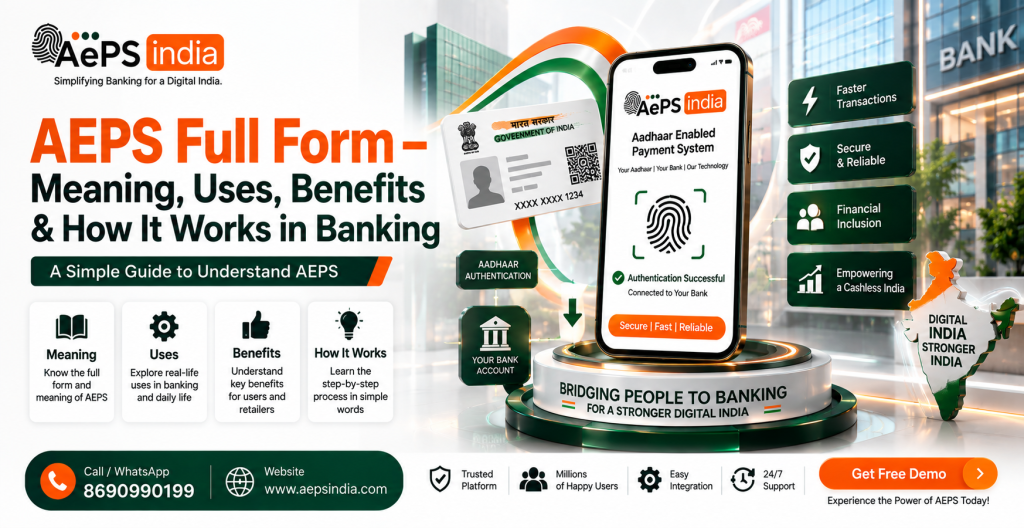
If you are searching for AEPS Full Form, AEPS stands for Aadhaar Enabled Payment System. It is a bank-led payment system that allows eligible customers to access supported banking services through Aadhaar-based authentication at an authorised AEPS touchpoint. AEPS is designed to make basic banking services easier to access, especially where customers may not have convenient access to a bank branch or ATM.
In simple words, AEPS connects a customer’s Aadhaar-linked bank account with supported banking services through an authorised banking point. Depending on the service and participating bank, customers can use AEPS for services such as cash withdrawal, cash deposit, balance enquiry, mini statement and Aadhaar-to-Aadhaar fund transfer.
The full form of AEPS is Aadhaar Enabled Payment System.
It is a bank-led model built by the National Payments Corporation of India (NPCI) that lets users perform basic financial transactions securely using their Aadhaar number and biometric authentication (such as a fingerprint) at micro-ATMs or through business correspondents.
An AEPS transaction generally requires the customer’s Aadhaar details or Virtual ID, the relevant bank information and biometric authentication. The transaction is processed through the AEPS ecosystem after the required authentication and checks are completed. This means customers can access supported banking services without relying on a traditional debit card for every transaction.
AEPS also plays an important role in financial inclusion. Local banking points and Business Correspondents can help customers access basic banking services closer to where they live and work. This is particularly useful for customers in rural and semi-urban areas where a bank branch or ATM may not always be nearby.
For businesses, retailers and digital service providers, AEPS can be added as a banking service through an appropriate AEPS platform or authorised arrangement. A reliable AEPS setup can provide transaction processing, service management, transaction status and reporting through a digital Aeps platform.
Whether you are a customer trying to understand what AEPS means, a retailer planning to offer AEPS services, or a business looking for an AEPS solution, this guide will help you understand the Aadhaar Enabled Payment System in simple and easy language.
In this complete guide, Aeps India explains the AEPS Full Form, AEPS meaning in banking, what AEPS is, how AEPS works, AEPS services, AEPS transaction process, benefits of AEPS, who can use AEPS, AEPS retailer services, biometric authentication, AEPS requirements and important points to know before using or offering AEPS services.
AEPS Full Form in Banking
AEPS stands for Aadhaar Enabled Payment System. It is a bank-led model developed by the National Payments Corporation of India (NPCI).
AEPS Full Form in Hindi (एईपीएस का फुल फॉर्म)
AEPS का फुल फॉर्म अंग्रेजी में Aadhaar Enabled Payment System और हिंदी में आधार सक्षम भुगतान प्रणाली (या आधार इनेबल्ड पेमेंट सिस्टम) होता है।
यह National Payments Corporation of India (NPCI) द्वारा विकसित एक बैंक-आधारित डिजिटल भुगतान प्रणाली है। इसकी मदद से कोई भी ग्राहक बिना किसी डेबिट कार्ड, पिन या बैंक जाए, केवल अपने आधार नंबर और बायोमेट्रिक (फिंगरप्रिंट या आँख की पुतली) प्रमाणीकरण से बैंकिंग कार्य कर सकता है।
How Does AEPS Work?
The Aadhaar Enabled Payment System (AePS) is a bank-led model developed by the National Payments Corporation of India (NPCI) that allows users to perform basic financial transactions using just their 12-digit Aadhaar number and biometric authentication at a micro ATM or banking correspondent outlet. It eliminates the need for a physical debit card, credit card, or bank PIN.
How the Process Works
- Link Account: Your bank account must be linked to your Aadhaar number.
- Visit Touchpoint: Go to a local micro-ATM, banking correspondent (BC), or designated shop with an AePS machine.
- Provide Details: Give your Aadhaar number and select your bank’s name.
- Choose Service: Pick the transaction type you want (such as cash withdrawal or balance check).
- Biometric Scan: Place your finger or scan your iris on the biometric scanner for identity verification.
- Real-Time Processing: The Aeps system matches your fingerprint with the UIDAI Aadhaar database and routes the request securely through your bank’s server to complete the transaction.
What Does AEPS Mean in Simple Language?
AEPS stands for Aadhaar Enabled Payment System, which is a simple and secure banking service that lets you use your Aadhaar number and your fingerprint instead of a debit card, PIN, or smartphone to do basic banking.
What Are the Main Uses of AEPS?
The main use of the Aadhaar Enabled Payment System (AEPS) is to let people perform basic banking tasks using only their Aadhaar number and a fingerprint scan, without needing a debit card, PIN, or smartphone.
Available Services
- Cash Withdrawal: Get money from your bank account without a debit card or PIN.
- Cash Deposit: Add money directly into an Aadhaar-linked bank account.
- Balance Enquiry: Check your current bank account balance in real time.
- Mini Statement: View a summary of your recent transactions.
- Fund Transfer: Send money from one Aadhaar-linked account to another.
- BHIM Aadhaar Pay: Make digital payments to merchants using biometric verification.
- Government Subsidies: Receive Direct Benefit Transfers (DBT) like pensions and welfare funds.
- eKYC Services: Complete paperless identity verification for opening new accounts.
Who Can Use AEPS?
Any Indian resident with an Aadhaar number linked to a bank account that participates in the National Payments Corporation of India (NPCI) network can use the Aadhaar Enabled Payment System (AEPS).
Who Benefits Most From AEPS?
- Rural and Underserved Communities: People living in remote areas without nearby traditional bank branches or ATMs.
- Non-Tech Savvy Users: Individuals who do not own a smartphone, use internet banking, or remember debit card PINs.
- Cardless Customers: Anyone who needs to withdraw cash or check a balance without carrying physical debit cards.
Why Use AEPS?
The Aadhaar Enabled Payment System (AePS) enables basic banking transactions using your Aadhaar number and fingerprint verification, eliminating the need for physical debit cards, PINs, or smartphones.
Key Reasons to Use AePS
- Cardless & PIN-less: Uses secure biometric fingerprint authentication instead of passwords or physical cards.
- Accessibility: Facilitates banking near your location through local Business Correspondents (Bank Mitras) and micro-ATMs.
- Interoperability & Services: Allows account holders to access various banks via any interoperable micro ATM or PoS terminal for balance checks, cash withdrawals, deposits, and fund transfers.
- Direct Benefits: Simplifies the receipt and withdrawal of government direct benefit transfers and welfare funds.
Types of AEPS Transactions
The National Payments Corporation of India (NPCI) supports several core financial and non-financial transaction types through the Aadhaar Enabled Payment System (AePS).
Financial Transactions
- Cash Withdrawal (CW): Withdraw money from your bank account using just your Aadhaar number and fingerprint or iris scan.
- Cash Deposit (CD): Deposit cash directly into an Aadhaar-linked bank account through an authorized banking correspondent or micro-ATM.
- Aadhaar to Aadhaar Fund Transfer: Send money immediately from one Aadhaar-linked account to another.
- BHIM Aadhaar Pay: Allow merchants to collect digital payments from customers using biometric authentication.
Non-Financial Transactions
- Balance Enquiry (BE): Check the real-time available balance of your linked bank account.
- Mini Statement (MS): View a summary of your last 5 to 10 recent transactions.
- Yes/No Authentication: Verify if an Aadhaar number matches the provided biometric details without performing a transfer.
Documents Required for AEPS
To register as an AEPS (Aadhaar Enabled Payment System) agent, you need identification, address proof, and banking credentials as listed on AEPS India.
Personal and Identity Documents
- Aadhaar Card: Mandatory for identity verification and biometric mapping.
- PAN Card: Required for tax compliance, financial verification, and KYC.
- Passport-Sized Photograph: Recent photo for profile setup.
Banking Details
- Bank Account Details: Active savings or current account in your name for commission settlements.
- Proof of Account: Bank passbook, statement, or a cancelled cheque.
- Registered Mobile Number: Must be active and linked to your Aadhaar card for OTP verification.
- Email Address: Functional email for Aeps b2b platform login credentials and alerts.
Business Proof and Equipment
- Proof of Business Address: Utility bill (electricity, water) or shop rental agreement/trade license.
- Biometric Device: STQC-certified Aeps fingerprint scanner or Aeps iris scanner (such as Mantra).
What Is Required to Use AEPS?
To use the Aadhaar Enabled Payment System (AEPS), you need a bank account linked to your Aadhaar number and a biometric scan for verification. You do not need a debit card, PIN, smartphone, or internet connection.
Core Requirements for Customers
- Bank Account: An active account with any bank participating in the Aeps india.
- Aadhaar Number: A valid 12-digit Unique Identification number issued by UIDAI.
- Aadhaar-Bank Seeding: Your bank account must be officially linked (seeded) with your Aadhaar number.
- Biometric Authentication: The ability to provide a Aeps fingerprint or Aeps iris scan device at the point of transaction for identity verification.
AEPS Biometric Authentication
Aadhaar Enabled Payment System (AePS) biometric authentication is a cardless, PIN-less digital banking service that lets users verify transactions using their fingerprint or iris scan matched against the UIDAI database.
How Biometric Authentication Works
- Input Capture: The user places their finger on a certified L1 Aeps biometric scanner or uses an iris/face scan at a micro-ATM, banking correspondent, or retail touchpoint.
- UIDAI Verification: The captured biometric data is encrypted and sent in real time to the Unique Identification Authority of India (UIDAI) for matching.
- Response & Settlement: UIDAI returns a simple “Yes/No” response, and upon success, the National Payments Corporation of India (NPCI) processes the financial transaction instantly.
AEPS Issuer Bank and Acquirer Bank
An Issuer Bank in AEPS is the customer’s home bank where their Aadhaar-seeded account is held, while an Acquirer Bank is the bank that deploys and manages the micro ATM device, PoS terminal, or Business Correspondent (BC) touchpoint where the transaction takes place.
Key Differences
- Issuer Bank
- Definition: The financial institution holding the customer’s actual bank account linked with their Aadhaar number.
- Role: Authenticates the account details via NPCI routing, approves or declines the fund request, and debits or credits the customer’s account.
- Responsibility: Bears the final financial settlement of the transaction and handles interchange fees for off-us (inter-bank) operations.
Acquirer Bank
- Definition: The bank that provides the infrastructure, Aeps software, or Aeps merchant onboarding network (Business Correspondents/Touchpoint Operators).
- Role: Captures the customer’s Aadhaar number, transaction choice, and biometric scan at the micro-ATM/terminal.
- Responsibility: Forwards the encrypted authentication request through the central switch and manages the physical or digital touchpoint operator (ATO).
AEPS Transaction Process With a Real Example
An Aadhaar Enabled Payment System (AEPS) transaction allows customers to perform basic banking services using their 12-digit Aadhaar number and fingerprint biometrics at a micro-ATM or banking correspondent outlet without a debit card or PIN.
Real-World Example
Imagine Rakesh, a farmer living in a rural area, who needs ₹2,000 in cash but the nearest traditional bank ATM is 20 kilometers away. Instead of traveling, Rakesh walks to a local kirana shop that acts as an authorized Aadhaar Enabled Payment System (AePS) banking correspondent.
Step-by-Step Transaction Process
- Visit and Details Submission: Rakesh visits the local shop, provides his 12-digit Aadhaar number, and names his bank (State Bank of India) to the agent.
- Transaction Selection: The shopkeeper selects “Cash Withdrawal” on the AEPS Service Platform micro-ATM device and enters the amount of ₹2,000.
- Biometric Authentication: Rakesh places his thumb on the attached Aeps biometric fingerprint scanner. The device captures and encrypts his fingerprint data.
- UIDAI Verification: The encrypted biometric data is sent securely to the UIDAI database to verify Rakesh’s identity in real time.
- Bank Authorization: Once authenticated, the request passes through the NPCI network to Rakesh’s bank to authorize the debit of ₹2,000 from his linked account.
- Cash Handover & Completion: The bank approves the transaction, the shopkeeper hands over ₹2,000 in physical cash to Rakesh, and a printed or digital confirmation receipt is issued.
AEPS Transaction Status
You can check your transaction status immediately on the micro ATM screen or receipt provided by the operator, or via an SMS alert sent to your registered mobile number by your bank.
How to Check AePS Transaction Status
- Immediate Receipt: The National Payments Corporation of India (NPCI) AePS platform processes transactions in real time, and the micro-ATM or banking correspondent terminal will display a success or failure message and print a receipt.
- SMS Confirmation: Your bank sends a confirmation SMS for successful or failed debits/credits if your mobile number is linked to your bank account.
- Bank Passbook or Mobile App: Log in to your bank's mobile application or update your passbook to see if the amount was settled.
AEPS CW TXN Full Form Explained
AEPS CW TXN stands for Aadhaar Enabled Payment System Cash Withdrawal Transaction.
Breakdown of Terms
- AEPS: Aadhaar Enabled Payment System (a service managed by the National Payments Corporation of India that lets you do banking using your Aadhaar number).
- CW: Cash Withdrawal (taking physical money out of your bank account).
- TXN: Transaction (a record of a financial operation or activity).
How an AEPS CW TXN Works
- Visit an Agent: Go to a local micro-ATM, banking correspondent, or authorized retail shop with an AEPS device.
- Provide Details: Give your 12-digit Aadhaar number and the name of your bank.
- Select Service: Tell the agent you want a cash withdrawal.
- Biometric Scan: Place your finger on the biometric scanner to verify your identity against the UIDAI database.
- Cash Dispensation: Once your fingerprint is verified successfully, the agent hands you the cash and hands or texts you a receipt showing the CW TXN.
AEPS for Retailers and Business
The Aadhaar Enabled Payment System (AePS) is a bank-led model managed by the NPCI (National Payments Corporation of India) that turns local retail shops into mini-bank branches. It allows customers to complete cardless and PIN-less transactions using only their Aadhaar number and biometric verification (fingerprint or iris scan).
Benefits for Business and Retailers
- Extra Income & Commissions: Retailers earn an attractive AEPS commission on every successful cash withdrawal or balance check.
- More Footfall: Offering banking services brings more people into the physical shop, which helps increase regular retail sales.
- Low Investment: Small shop owners can start offering financial services with minimal Aeps setup costs just a biometric device and an Aeps app connection.
- Safe and Secure: Transactions rely on strict biometric verification, which heavily reduces the risk of fraud or fake currency compared to traditional ledger or manual credit systems.
AEPS and Financial Inclusion in India
Aadhaar Enabled Payment System (AePS) is a bank-led model operated by the National Payments Corporation of India that allows interoperable online financial transactions at micro-ATMs using Aadhaar authentication.
Role in Financial Inclusion
- Last-Mile Access: Extends banking services to remote and rural areas lacking physical bank branches and traditional ATMs.
- Cardless & PIN-less: Eliminates the need for physical debit cards, credit cards, or secret passwords by relying entirely on Aadhaar numbers and Aeps biometric scans (fingerprints or iris).
- Business Correspondents: Empowers local shop owners and banking agents (Bank Mitras) to act as live micro-ATMs for local cash deposits, withdrawals, and balance checks.
- Direct Benefit Transfers (DBT): Streamlines the direct deposit of government subsidies, pensions, and welfare funds straight into beneficiary accounts without middlemen.
Benefits of AEPS
The Aadhaar Enabled Payment System (AePS) offers cardless banking, financial inclusion, and secure biometric authentication for basic transactions at micro-ATMs.
Key Benefits of AePS
- No Cards or PINs Needed: Users do not need a debit card, credit card, or secret PIN. Transactions require only an Aadhaar number and a fingerprint or iris scan.
- Enhanced Security: Biometric verification ensures that only the actual account holder can authorize a transaction, which minimizes the risk of fraud or PIN theft.
- Financial Inclusion: The best Aeps system brings formal banking and financial services to unbanked, rural, and underserved populations who lack traditional bank branches.
- Banking at Your Doorstep: Local shop owners and Business Correspondents (BCs) carrying micro-ATMs can provide cash withdrawals, deposits, and balance checks within local communities.
- Interoperability: Customers of any participating bank can use an AePS-enabled micro-ATM or point-of-sale machine hosted by any other bank's agent.
- Government Benefit Transfers: Citizens can easily receive and withdraw funds from government schemes like MNREGA or social security pensions directly through biometric validation.
Features of the AEPS System
The Aadhaar Enabled Payment System (AePS) is a bank-led model by the National Payments Corporation of India (NPCI) that lets users perform basic banking tasks using an Aadhaar number and biometric data instead of a card or PIN.
Core Features of AePS
- Cardless and PIN-Free: You do not need a physical debit card, credit card, or secret password to complete a transaction.
- Biometric Authentication: Identity is verified securely through unique fingerprint, iris, or face scans matched with UIDAI records.
- Interoperability: The top Aeps system allows customers of any participating bank to use micro-ATMs or banking kiosks managed by any other participating bank.
- Assisted Banking: Transactions happen at local retail outlets or point-of-sale (PoS) terminals through authorized Business Correspondents (BCs) or agents.
- Financial Inclusion: It helps bridge the banking gap in rural and underserved areas where traditional bank branches are rare.
How AEPS Retailers Earn Commission
AEPS (Aadhaar Enabled Payment System) retailers earn a commission on every successful cardless, biometric-authenticated banking transaction processed through their AEPS Portal.
Commission Structure
- Cash Withdrawals: Retailers earn a tiered commission from ₹2.00 to ₹15.00+ per transaction based on the cash amount slab.
- High-Value Slabs: Transactions between ₹3,000 and ₹10,000 yield the highest payouts, usually ranging from ₹10.00 to ₹15.00+ per transaction.
- Low-Value Slabs: Smaller withdrawals between ₹100 and ₹999 pay lower rates, around ₹0.20 to ₹2.00.
- Balance Inquiries & Mini-Statements: Retailers earn between ₹0.50 and ₹7.00 per inquiry, depending on the Aeps india.
- Aadhaar Pay & Transfers: Earn percentage-based commissions roughly ranging from 0.3% to 1.0% on specific merchant payments or fund transfers.
How the Payout Works
- Revenue Split: When a transaction occurs, the interchange fee collected by the system is split hierarchically among banks, fintech platforms, distributors, and the local retailer.
- Instant Wallet Credit: The earned commission, along with withdrawn cash value, is credited directly to the retailer's digital wallet in real time upon successful completion.
- Settlement Options: Retailers can choose instant settlements (T+0) or next-day settlements (T+1) to manage their daily shop cash flow.
Additional Earning Benefits
- Increased Footfall: Offering banking services brings more people into the local shop, which boosts regular retail sales.
- Cash Rotation: Shop owners can recycle the physical cash collected from daily retail sales to fulfill customer cash withdrawals, improving overall cash management.
What Is an AEPS Transaction?
An AePS transaction (Aadhaar Enabled Payment System) is a cardless banking service that lets you perform basic financial and non-financial operations using only your 12-digit Aadhaar number and your biometric data (like a fingerprint) through a Business Correspondent or Micro ATM.
Developed by the National Payments Corporation of India (NPCI), this system makes banking easy for people without debit cards, PINs, or smartphones.
AEPS Transaction Limits and Charges
Aadhaar Enabled Payment System (AePS) transactions have a maximum cash withdrawal limit of ₹10,000 per transaction, regulated by the National Payments Corporation of India (NPCI).
Transaction Limits
- Per Transaction: Maximum ₹10,000 for cash withdrawals.
- Daily Limit: Cumulative withdrawals using the same Aadhaar are generally capped at ₹50,000 per day.
- Monthly Limit: Varies by bank policies, typically ranging from ₹50,000 to ₹1,00,000.
- Aadhaar Pay Limit: Up to ₹50,000 per transaction for merchant payments.
Transaction Charges for Customers
- Basic Quota: Aeps india offer a set number of free transactions (usually 3 to 5 free cash withdrawals or balance checks per month).
- Post-Free Limit Charges: After exhausting free quotas, banks or touchpoint operators may charge around ₹15 + GST per cash withdrawal and ₹5 + GST for mini-statements or balance inquiries.
- Doorstep Services: Extra fees may apply if you request cash delivery at home rather than visiting an access point.
Advantages and Limitations of AEPS
The Aadhaar Enabled Payment System (AePS) is a bank-led model that allows online interoperable financial transactions at micro-ATMs or business correspondents using Aadhaar authentication.
Advantages of AePS
- No Cards or PINs: Users do not need to carry debit/credit cards or remember secret PINs; your fingerprint acts as your password.
- Financial Inclusion: Extends basic financial services to unbanked and remote populations where traditional banks or ATMs are absent.
- High Security: Biometric verification (fingerprint or iris scan) ensures that only the rightful account holder can execute a transaction.
- Interoperability: Customers of any participating bank can use micro-ATM terminals managed by authorized agents of any other bank.
- Government Subsidies: Simplifies the direct disbursement of welfare funds, pensions, and subsidies.
Why Does an AEPS Transaction Fail?
An Aadhaar Enabled Payment System (AEPS) transaction fails mostly due to biometric mismatches, incorrect Aadhaar-to-bank account seeding, or technical server timeouts.
Biometric Authentication Failures
- Fingerprint Issues: Faded or rough fingerprints from physical labor/aging, as well as dirty, wet, or injured fingers, hinder sensor accuracy.
- Data and Hardware: Outdated enrollment data can cause a mismatch with UIDAI records, while faulty or uncalibrated agent scanners also cause errors.
Bank and Account-Level Restrictions
- Account Linkage: Unlinked or incorrectly seeded Aadhaar numbers and NPCI mapper mismatches prevent successful debits.
- Balance and Limits: Transactions fail due to insufficient funds, exceeding daily/per-transaction caps, or using dormant/frozen accounts.
Technical and Network Issues
- Connectivity: Bank or NPCI server downtime and weak rural internet signals at micro-ATM locations disrupt communication.
What to Do If It Fails
- Troubleshooting: Clean your hands and the scanner, or try another finger, and verify your Aadhaar-to-bank seeding status.
- Failed Debits: If an account is debited without cash dispensing, automatic reversals usually occur within 24 to 72 hours, taking up to 5 business days.
How to Check AEPS Transaction Status
You can check your transaction status immediately on the micro-ATM screen or receipt provided by the operator, or via an SMS alert sent to your registered mobile number by your bank.
How to Check AePS Transaction Status
- Immediate Receipt: The AePS commission platform processes transactions in real time, and the micro-ATM or banking correspondent terminal will display a success or failure message and print a receipt.
- SMS Confirmation: Your bank sends a confirmation SMS for successful or failed debits/credits if your mobile number is linked to your bank account.
- Bank Passbook or Mobile App: Log in to your bank's mobile application or update your passbook to see if the amount was settled.
Difference Between AEPS and Other Payment Systems
Aadhaar Enabled Payment System (AEPS) differs from other payment systems like UPI, debit cards, and traditional ATMs by using a 12-digit Aadhaar number and biometric fingerprint or iris authentication instead of PINs, passwords, or physical cards.
AEPS vs. Other Payment Systems
| Feature | AEPS (Aadhaar Enabled Payment System) | UPI (Unified Payments Interface) | Debit / Credit Cards | Traditional ATMs |
|---|---|---|---|---|
| Authentication | Biometric (Fingerprint/Iris scan) | MPIN and Virtual Payment Address (VPA) | PIN or Chip/Signature | ATM PIN and physical card |
| Required Tools | Aadhaar number + Bank name | Smartphone + Internet + Mobile number | Plastic Card + POS machine | ATM Card + ATM Machine |
| Where to Use | Micro-ATMs or Bank Correspondents (BCs) | Mobile apps (Google Pay, PhonePe, etc.) | Online or swiped at merchant POS | Physical ATM kiosks |
| Primary Audience | Rural areas or people without smartphones or debit cards | Smartphone users needing fast peer-to-peer or merchant transfers | General retail shoppers and online buyers | General public for cash withdrawal |
| Need for Internet | Terminal requires connectivity; user doesn't need personal phone/internet | Requires active smartphone internet connection | POS/Online gateway requires internet | ATM terminal requires connectivity |
AEPS for Business (Retailers & BC Agents)
An Aadhaar Enabled Payment System (AePS) platform like AEPS India turns a local retail shop into a neighborhood mini-bank, enabling cardless and PIN-less transactions using Aadhaar biometric verification.
What is AEPS for Retailers & BC Agents?
- Mini-Banking Point: Local store owners act as human ATMs to process financial requests.
- Core Services: Cash withdrawals, balance inquiries, and mini-statements via biometric scans.
- Financial Inclusion: Bridges banking gaps in rural and semi-urban communities.
Key Benefits for Business Owners
- Extra Income: Earn a tiered commission (typically ₹2 to ₹20) per successful transaction.
- Increased Footfall: Essential banking services attract new visitors who often buy regular store goods.
- Easy Cash Management: Safely dispense cash to cycle your store register without frequent bank trips.
- Instant Payouts: Real-time or same-day (T+0) wallet crediting and commission updates.
| Partner | Type | Location | Txns | Earnings |
|---|---|---|---|---|
| Sharma Kirana Store | Retailer | Lucknow, UP | 142 | ₹4,280 |
| Rajesh Kumar BC | BC Agent | Patna, BR | 128 | ₹3,852 |
| Gupta General Store | Retailer | Jaipur, RJ | 98 | ₹2,946 |
| Village BC Point | BC Agent | Varanasi, UP | 86 | ₹2,583 |
| Singh Medical Store | Retailer | Amritsar, PB | 74 | ₹2,229 |
Is AEPS Safe?
Yes, the Aadhaar Enabled Payment System (AePS) is generally secure because it uses unique biometric authentication, but it carries specific fraud risks if fingerprints are cloned or leaked.
How AePS Works Securely
- Biometric verification: Transactions need your fingerprint or iris scan, meaning a stolen debit card or PIN cannot give someone access.
- Regulated network: The National Payments Corporation of India (NPCI) monitors and secures the transaction network.
- No OTP needed: While convenient for rural cash withdrawals, the absence of an SMS OTP also means a stolen fingerprint can bypass secondary alerts.
The Security Risks
- Cloned fingerprints: Fraudsters can capture leaked fingerprints (sometimes from public land records or registrar offices) and make silicone clones to drain accounts.
- Default activation: Many bank accounts have AePS enabled by default, making accounts vulnerable unless locked.
How to Stay Safe
- Lock biometrics: Use the mAadhaar app or the UIDAI portal to lock your biometric data when you are not using it.
- Share carefully: Never give your Aadhaar number or biometric imprint to untrusted local operators or strangers.
- Monitor accounts: Turn on real-time SMS or email alerts for every bank transaction.
Common Issues in AEPS & Solutions
Common issues in the Aadhaar Enabled Payment System (AePS) include biometric failures, server timeouts, and unlinked accounts, which can be resolved through simple troubleshooting and bank verification steps.
Common Transaction Errors and Solutions
- Biometric Authentication Failed: Caused by poor fingerprint quality or dirty scanners. Clean the user's finger and the scanner glass, or switch to a proper Aeps india certified biometric device.
- Aadhaar Not Linked to Bank: Occurs when the Aadhaar number is not mapped to the specific bank account. Ask the customer to link their Aadhaar via their bank branch or mobile banking.
- Device Not Registered: Happens when the best Aeps biometric scanner lacks active RD (Registered Device) service. Install the correct RD service application and re-register the device.
- Server Timeout / Unable to Connect: Triggered by Aeps API delays or weak routing. Restart the best micro ATM device, wait a few seconds, and retry the transaction using a stable network.
- Exceeds Withdrawal Frequency / Amount Limit: The daily or frequency limit set by the issuer bank has been reached. Re-attempt the transaction on the next day or enter a smaller amount.
- AePS Facility Disabled: The bank has temporarily blocked Aadhaar-based debit access for security reasons. Contact the respective bank branch to unblock or re-verify customer consent.
AEPS vs UPI: What Is the Difference?
AEPS (Aadhaar Enabled Payment System) and UPI (Unified Payments Interface) are both digital financial services in India created by the NPCI, but they serve different users and needs.
Comparison Table
| Feature | AEPS (Aadhaar Enabled Payment System) | UPI (Unified Payments Interface) |
|---|---|---|
| Primary Use | Basic banking (cash withdrawal, balance check, mini statements) via agents. | Instant digital payments, P2P transfers, and merchant checkout. |
| Required Device | No smartphone or card needed; runs on micro-ATM/biometric scanner operated by a banking correspondent. | Smartphone with an internet connection and a supported mobile app. |
| Authentication | Biometric scan (fingerprint or iris) and 12-digit Aadhaar number. | Virtual Payment Address (VPA/UPI ID) and a secret 4- or 6-digit UPI PIN. |
| Target Audience | Rural and unbanked populations who lack smartphones, debit cards, or internet access. | Urban, semi-urban, and tech-savvy users with personal smartphones. |
| Where Used | Authorized micro-ATM locations, local Kirana shop agents, or banking correspondents. | Online apps, local retail QR codes, and peer mobile transfers anywhere. |
| Transaction Fees | Often free or low cost, though micro-ATM agents may charge minor service/withdrawal fees. | Generally free for standard person-to-person (P2P) transfers. |
Future Trends AEPS in India
The future of the Aadhaar Enabled Payment System (AePS) focuses on advanced security, multi-modal biometrics, and expanding local retail shops into comprehensive rural banking hubs.
Key Future Trends in AePS
- Multi-Modal Biometrics: Moving beyond basic Aeps fingerprints to include iris scanning and facial recognition, which improves transaction success rates for elderly users or manual laborers with worn-out fingerprints.
- Mandatory L1 Certified Devices: Strict security rules require STQC-certified Level 1 L1 Aeps biometric devices for encrypted data transmission and fraud prevention.
- AI and Liveness Detection: Artificial intelligence and machine learning analyze transactions in real-time, detecting fake fingerprints or facial masks to stop fraud.
- Instant T+0 Settlements: Real-time, same-day fund settlements replace delayed processing, helping local business agents keep their working capital liquid.
- Two-Factor Authentication (2FA): Mandatory Aadhaar OTP step-up authentication is introduced alongside biometric checks for high-value transactions exceeding ₹5,000.
- Beyond Cash Withdrawals: Local retail touchpoints are evolving into financial hubs offering micro-loans, insurance, and bill payments instead of just basic cash withdrawals.
- Regulatory Tightening: Implementation of the "One Agent, One Bank" rule to increase tracking accountability and security across platforms.
Conclusion
The AEPS Full Form is Aadhaar Enabled Payment System. It is an Aadhaar-based banking system that helps customers access supported banking services through an authorised best AEPS service point and the required authentication process.
AEPS makes basic banking services more accessible through Aadhaar-based authentication. Depending on the participating bank and available service, customers can use AEPS for services such as cash withdrawal, balance enquiry, mini statement, cash deposit, fund transfer and Aadhaar Pay Software.
The AEPS full form is Aadhaar Enabled Payment System. It is a bank-led model built by the National Payments Corporation of India (NPCI).
The main benefit of AEPS is convenience. Customers do not always need to visit a bank branch for basic banking requirements. Top AEPS service points can bring banking services closer to customers, particularly in areas where access to traditional banking facilities may be limited.
For retailers and digital service businesses, AEPS also provides an opportunity to offer useful banking services from a local outlet. A suitable trusted AEPS platform can help retailers manage transactions, check transaction status, provide customer receipts and handle supported banking services through a single Aeps system.
Understanding the AEPS meaning, AEPS full form in banking, AEPS services, AEPS transaction process and benefits of AEPS is important for anyone who wants to use or offer Aadhaar-enabled banking services. At the same time, users and businesses should choose an authorised and reliable service setup and follow the applicable banking, authentication and data-security requirements.
With Aeps India, businesses can explore AEPS designed to help retailers and digital service providers offer Aadhaar-enabled banking services to customers. The right AEPS solution can make day-to-day transactions easier to manage while helping extend basic banking access to more customers.
So, when someone searches for “AEPS Full Form,” the simple answer is Aadhaar Enabled Payment System. But AEPS is more than just a full form it is a banking service designed to make supported financial services more accessible through Aadhaar-based authentication.
If you are planning to start AEPS services for your business, retailer outlet, or digital service center, choosing the right AEPS platform and understanding the complete transaction process can help you provide a smoother and more reliable customer experience.
Start Your AEPS Business Today
Now that you understand how AEPS works, it's time to implement it in your business. Get the most secure and fastest AEPS setup with our expert guidance and support.
Frequently Asked Questions About AEPS
AEPS stands for Aadhaar Enabled Payment System. It allows customers to access basic banking services using Aadhaar authentication.
AEPS is an Aadhaar-based banking service that allows customers to perform basic transactions such as cash withdrawal, balance enquiry, and mini statement through an authorized AEPS service point.
AEPS का फुल फॉर्म Aadhaar Enabled Payment System (आधार इनेबल्ड पेमेंट सिस्टम) है। यह आधार के जरिए बैंकिंग सेवाओं का उपयोग करने की सुविधा देता है।
AEPS means Aadhaar Enabled Payment System. It is a bank-led payment system that enables basic banking transactions through Aadhaar authentication.
To use AEPS, the customer provides their Aadhaar number, selects their bank and service, and completes biometric authentication. After successful verification, the requested banking transaction is processed.
AEPS can provide services such as cash withdrawal, cash deposit, balance enquiry, mini statement, and fund transfer, depending on the participating Aeps india.
Yes. Customers can withdraw cash from their Aadhaar-linked bank account through an authorized AEPS retailer or banking point using biometric authentication.
Yes. Aadhaar authentication is an important part of AEPS transactions. The customer generally needs an Aadhaar number linked with the bank account to use AEPS services.
Yes. The Aadhaar number generally needs to be linked with the customer's bank account for successful AEPS transactions.
AEPS uses Aadhaar-based authentication and biometric verification for transactions. Customers should use AEPS only through authorized service points and avoid sharing their banking information unnecessarily.
The AEPS transaction limit can vary depending on the bank, service provider, transaction type and applicable rules. Customers should check the current limit with their Aeps india.
AEPS charges depend on the Aeps india and type of transaction. Top AEPS services may be available at no direct customer charge, while applicable fees or service charges can vary.
An AEPS transaction may fail because of biometric authentication issues, incorrect details, Aadhaar-bank linking problems, bank server issues, transaction limits, network problems or other technical reasons.
An AEPS retailer is an authorized service point that helps customers access AEPS banking services such as cash withdrawal, balance enquiry and mini statement using Aadhaar authentication.
To become an AEPS retailer, you generally need to register with an AEPS india, complete KYC and provide the required documents. After approval, you can start offering supported reputed AEPS services.
AEPS agents or retailers can earn commission on eligible transactions processed through their modern AEPS service. The commission depends on the Aeps india, transaction type and applicable commission structure.
AEPS cash withdrawal allows a customer to withdraw money from an Aadhaar-linked bank account through an authorized AEPS point after successful biometric authentication.
AEPS balance enquiry is a service that allows customers to check the available balance of their bank account through an authorized AEPS service point using Aadhaar authentication.
An AEPS mini statement provides a short record of recent transactions in the customer's bank account through an authorized AEPS service point.
First, check the transaction status and reference number. If the amount was debited but the transaction was not completed, contact the AEPS india or concerned bank for transaction verification and resolution.
AEPS Debit Facility: What It Means, Why It Is Disabled & How to Enable It
Best AEPS Portal in India for Retailers and Startups
Trusted AEPS Software Provider Company in India – Full Business Guide 2026
About Author

