Micro ATM Machine in India: Price, AEPS, Features & Benefits
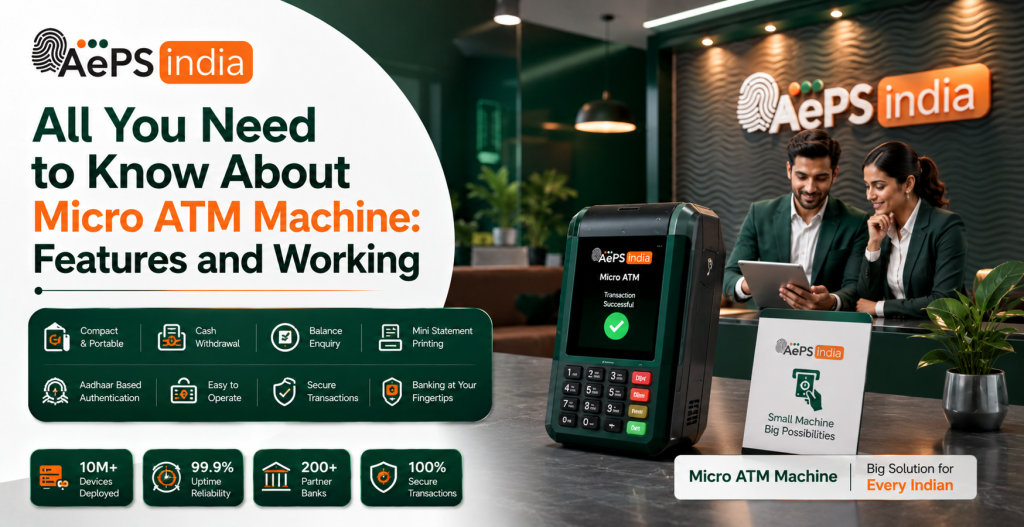
A Micro ATM Machine is a compact banking device that allows authorised banking agents, retailers, and service points to provide supported banking and cash withdrawal services to customers. It is designed to bring basic banking facilities closer to customers, especially in locations where accessing a traditional ATM or bank branch may not always be convenient.
Unlike a large traditional ATM, a Micro ATM is a small, portable device that can be operated from a shop, digital service center, banking point, or other authorised location. Depending on the device, banking arrangement, and Aeps india, a Micro ATM can support transactions such as cash withdrawal, balance enquiry, mini statement, and card-based banking services.
A Micro ATM generally works by connecting the device to the required banking or payment network. The customer provides the required card or authentication details, the retailer enters the transaction information, and the transaction is processed through the connected banking system. The exact authentication method, supported services, transaction limits, and operating process can vary according to the Aeps india, and device configuration. For example, some mATM services use a debit card and PIN for authentication.
A micro ATM is a small, portable card-swipe device operated by a local store merchant or authorized banking agent to provide basic banking services.You can buy a micro ATM machine online through platforms like the Aeps india.
For retailers and digital service businesses, a Micro ATM Machine can be useful for providing banking services from a local point. A suitable device can make it easier to serve customers who need access to cash withdrawal and other supported banking facilities without requiring a full-size ATM installation.
Micro ATM devices are available in different models and configurations. Some are designed mainly for card-based transactions, while other devices used in digital banking environments may support additional capabilities such as biometric authentication, receipt printing, Bluetooth connectivity, or integration AEPS and other financial services. Therefore, businesses should check the actual device specifications and supported banking services before purchasing or activating a machine. Current Micro ATM marketplaces also show a range of Micro ATM, Mini ATM, mPOS and biometric-device categories rather than one universal device type.
A Micro ATM Machine for AEPS and banking services can be particularly useful for retailers, Business Correspondents, CSPs, fintech businesses, and digital service centers that want to expand their financial service offerings. However, the machine itself is only one part of the complete setup. The retailer also needs the appropriate service connection, compatible software or application, account activation, supported device configuration, and access to the relevant banking or payment services.
Before choosing a Micro ATM, it is important to check device compatibility, supported transactions, authentication method, connectivity, receipt facility, transaction limits, security features, service availability, warranty, technical support, and the Aeps india behind the solution. These factors can directly affect how easily the device can be used in day-to-day operations.
At Aeps India, businesses can explore Micro ATM solution for adding convenient banking and financial services to their existing operations. The right setup can help retailers and digital service centers provide supported banking transactions through a compact device while managing their services through a connected digital platform.
In this complete guide, we will explain what a Micro ATM Machine is, how a Micro ATM works, how to use a Micro ATM, Micro ATM services, Micro ATM for AEPS, Micro ATM for cash withdrawal, Micro ATM machine requirements, biometric and card-based transactions, Micro ATM vs Mini ATM, device features, transaction limits, security, pricing factors, retailer requirements, and how to choose the right Micro ATM Machine in India.
If you are planning to add banking services to your shop or digital service center, understanding the complete Micro ATM setup not just the device price is important. The right combination of hardware, banking connectivity, software, service support, and transaction facilities can make the solution more useful for your business and your customers.
What Is a Micro ATM Machine?
A micro ATM machine is a portable, handheld device used by authorized banking agents or merchants to provide basic financial services in remote, rural, or unbanked areas.
How Does a Micro ATM Machine Work?
A Micro ATM is a portable, handheld point-of-sale (PoS) terminal operated by a local banking agent or merchant to provide doorstep financial services.
How a Micro ATM Works
- Connection: The portable device connects securely to the core banking network using GPRS or mobile internet.
- Customer Verification: The user inserts or swipes their debit/credit card or provides an Aadhaar number for biometric fingerprint scanning.
- Authentication: The customer enters their secret 4-digit PIN or completes a biometric scan to verify identity.
- Cash Delivery: Because the compact device doesn’t store physical cash, the human operator hands physical cash out of their store’s register, while an equal digital amount transfers from the customer’s account to the agent’s account.
Micro ATM Machine Services
A micro ATM is a portable handheld device used by authorized business correspondents or local shop owners to deliver essential banking services. You can explore service setups via providers like Aeps india.
Core Services Offered
- Cash Withdrawal: Customers can swipe or insert domestic debit/credit cards to withdraw cash directly through the merchant’s physical cash reserve.
- Balance Enquiry: Real-time checking of account balances using a card and PIN.
- Mini Statement: Printing or viewing recent transaction logs and summaries.
- Aadhaar Authentication (AEPS): Biometric fingerprint verification linked to Aadhaar for financial inclusion transactions in remote or semi-urban zones.
- Fund Transfers & Deposits: Domestic money transfers and deposits depending on the specific bank or fintech network capability.
Types of Micro ATM Machines
Micro ATM machines are portable, handheld Point of Sale (PoS) terminals operated by authorized Business Correspondents (BCs) to facilitate basic banking operations in remote or unbanked areas.
Unlike traditional cash-dispensing kiosks, Micro ATMs are categorized based on their technology, authentication method, and functional capabilities.
Main Types of Micro ATM Machines
- Card-Based Micro ATMs (PoS Terminals): These handheld devices feature a magnetic stripe and chip card reader. Users swipe or insert a standard debit, credit, or RuPay card and enter their PIN to conduct transactions like cash withdrawals and balance inquiries.
- Biometric / Aadhaar-Enabled (AEPS) Micro ATMs: These units come integrated with or attached to a fingerprint scanner. They utilize the Aadhaar Enabled Payment System (AEPS), allowing customers to perform banking transactions using their Aadhaar number and fingerprint verification instead of a physical card or PIN.
- Hybrid / Multi-Modal Micro ATMs: These advanced portable terminals support both traditional debit/credit card swiping/insertion and biometric fingerprint scanning. They provide maximum interoperability across multiple banking networks and payment types.
- mPOS (Mobile POS) Integrated Units: Smaller, smartphone-connected Bluetooth or wireless dongle devices (such as mini card-swipe readers) paired with mobile applications. They are lightweight and often used by small merchants and local kirana shop agents for basic collections, mini-statements, and micro-withdrawals.
Documents Required for Micro ATM Machine
To set up a micro ATM machine as a merchant or Business Correspondent (BC) in India, you need personal KYC documents, business identity proof, and active banking details.
Personal Identity and Address Proof
- PAN Card: Mandatory identification proof for financial onboarding.
- Aadhaar Card: Required for biometric and identity verification.
- Passport-size Photographs: Recent photos for registration.
- Alternative ID Proof: Voter ID card, Passport, or Driving License (if needed).
Business and Shop Proof
- Shop Address Proof: Utility bill (electricity or landline) or a valid rent agreement for your business location.
- Business Registration: GST registration, MSME/Udyam certificate, or local trade license.
Banking and Technical Requirements
- Active Bank Account: A functional current or savings account linked to your profile for daily transaction settlements and commission payouts.
- Smartphone or Tablet: An active Android device to pair with the micro ATM machine and run the banking/merchant application.
- BC/Merchant Registration: Approval or onboarding confirmation through a registered Aeps india.
Micro ATM Machine Support Cards
Micro ATMs support all domestic and international EMV chip, magnetic stripe, and Aadhaar-enabled debit or ATM cards issued by any major bank network. You can access services through platforms like BLS Micro ATM Services.
Supported Card Types
- Domestic Debit Cards: All RuPay, Visa, MasterCard, and Maestro debit cards issued by public, private, or cooperative banks in India.
- Credit Cards: Select micro ATM and mPOS terminals support credit card swipe/chip transactions depending on the merchant acquiring bank.
- Aadhaar Authentication: Biometric-based Aadhaar authentication is supported for Aadhaar Pay or AEPS (Aadhaar Enabled Payment System) transactions instead of a physical card.
Who Can Use Micro ATM Machine
A Micro ATM machine is used by authorized banking agents, business correspondents (BCs), and local small business owners to provide basic financial services to customers.
Who Operates the Machine (The Agents)
- Business Correspondents (BCs): Representatives appointed by banks to extend banking services to underserved regions.
- Local Kirana & Retail Shop Owners: Neighborhood merchants who host the portable device to process transactions and earn commissions.
- Authorized Bank Agents: Field agents who travel to remote, rural, or semi-urban areas where regular ATMs are unavailable.
Who Uses the Service (The Customers)
- Rural and Semi-Urban Residents: People living in areas with limited access to traditional brick-and-mortar bank branches or large ATMs.
- Debit Card Holders: Any individual with a domestic or international bank card (Visa, RuPay, Mastercard) looking to withdraw cash or check their balance using their PIN.
- Aadhaar-Linked Account Holders: Individuals using biometric authentication (fingerprint scanning via Aadhaar Enabled Payment System) to carry out transactions without needing a physical debit card.
Why Use Micro ATM Machine
A micro ATM machine is a small, portable device used by local shop owners to offer basic banking services like cash withdrawals and balance checks without needing a large, expensive ATM kiosk.
Why Use a Micro ATM?
- Easy to set up: It only needs a small handheld device, a smartphone, and mobile data, making it simple to fit on any store counter.
- Low cost: It avoids the heavy infrastructure, space requirements, and high maintenance of traditional ATMs.
- Brings banking to remote areas: It helps people in rural, semi-urban, or unbanked regions access cash and check balances without traveling long distances to a bank branch.
- Extra income for shop owners: Merchants earn an instant commission on every successful transaction they process for customers.
- More store visitors: Offering cash services brings more people into the local shop, which often leads to extra retail purchases.
- Secure transactions: It uses two-factor authentication, such as a debit card PIN or Aadhaar biometric fingerprint verification, to keep user funds safe.
Top Use Cases of Micro ATM Machine
Micro ATMs serve as portable, bank-led point-of-sale (POS) devices that bring last-mile banking services directly to local storefronts and underserved areas.
Top Use Cases
- Last-Mile Cash Withdrawals: Residents in rural or remote areas can withdraw cash using their debit cards or Aadhaar biometric verification at local kirana stores without traveling to a city branch.
- Aadhaar-Enabled Payment System (AePS): Facilitates secure, cardless transactions where customers authenticate withdrawals and transfers using only their Aadhaar number and fingerprint scanner.
- Balance Enquiries and Mini-Statements: Allows account holders to check their real-time bank balances and transaction histories quickly on the spot.
- Dual Function POS Payments: Operates simultaneously as a standard POS terminal to accept routine credit or debit card purchases for local merchants.
- Domestic Money Transfers (DMT): Enables walk-in customers to transfer funds safely between different bank accounts through the agent’s assisted network.
- Government Disbursement and PDS Integration: Supports Direct Benefit Transfers (DBT) and Public Distribution System (PDS) operations to distribute welfare funds or rations efficiently at local service points.
Key Aspects of Micro ATM Machine
A Micro ATM is a small, portable card-swipe or biometric device operated by a certified banking agent to deliver essential financial services in remote or unbanked areas.
Key Features and Aspects
- Portability and Size: Built as compact handheld hardware similar to Point of Sale (POS) terminals, requiring no heavy infrastructure or dedicated kiosks.
- No Cash Dispenser: They do not store or physically dispense cash; instead, the human operator hands physical cash from their till while the core banking system settles the transfer.
- Connectivity: Connects wirelessly to central bank servers in real time using GPRS, 3G, 4G, or mobile data.
- Interoperability & Authentication: Works across all domestic banks using debit cards paired with a PIN, or Aadhaar numbers verified via integrated biometric fingerprint scanners.
- Core Services: Supports cash withdrawals, balance checks, fund transfers, and mini-statements.
- Economic Model: Gives local shop owners and business correspondents an extra revenue stream through transaction commissions while expanding rural financial inclusion.
Why high Demand for Micro ATM Machine
The high demand for micro ATM machines is driven by their low cost, high portability, and ability to deliver essential banking services to rural and underserved areas where traditional ATMs are absent.
Key Reasons for High Demand
- Low Cost and Easy Setup: Traditional ATMs cost lakhs to install and maintain, whereas micro ATM devices require minimal investment, making them affordable for local shop owners and small businesses.
- Reaching Rural and Underserved Areas: Many villages lack physical bank branches. Micro ATMs turn local kirana shops into banking touchpoints, bridging the financial inclusion gap.
- Extra Income for Merchants: Shopkeepers who host micro ATMs earn a commission on every transaction while boosting daily customer footfall and sales in their stores.
- Portability and Reliability: Unlike bulky traditional ATMs that suffer from cash shortages or heavy power needs, micro ATMs are compact, battery-friendly, and run smoothly with cellular connectivity.
- Secure Biometric and Card Support: They support standard debit cards and Aadhaar-based biometric authentication (AePS), making banking safe and simple even for users with limited digital literacy.
How to Get Micro ATM Machine With Aeps India
You can get a micro ATM machine by registering as a merchant with a registered Aeps india.
Steps to Get a Micro ATM Machine
- Choose a Aeps india: Select a trusted Aeps india that offers micro ATM services.
- Register Online: Visit the official website or download the mobile app of your chosen Aeps india to sign up.
- Complete KYC: Submit your basic Know Your Customer (KYC) documents, such as your PAN card, Aadhaar card, and address proof.
- Pay Device Fees: Pay the registration and device charges, which usually range from ₹2,000 to ₹3,500 depending on the Aeps india.
- Device Delivery and Activation: Once your verification and physical KYC are complete, you will receive your unique agent ID and the micro ATM device will be shipped to your shop for activation.
Micro ATM Machine Price in India
Standard handheld Micro ATM machines in India generally cost between ₹1,500 and ₹5,000 upfront, depending on the brand and model.
Upfront Hardware Costs
- Basic Handheld mPOS / Micro ATM: Devices like the mantra device cost around ₹1,5000 to ₹2,499.
- Advanced Biometric / POS Hybrids: Devices like the Airtel Payments Bank Micro ATM (FEITIAN ePayPOS600) or Spice Money models range between ₹2,399 and ₹3,500.
- All-in-One Commercial WPOS / Heavy Duty Units: Premium or integrated countertop systems can range from ₹15,000 to ₹20,000+.
Ongoing Operational Costs & Fees
- Onboarding / Activation Fees: Aeps india charge nominal or zero activation fees if you register as a merchant/agent (CSP).
- Maintenance & Connectivity: Minimal ongoing costs, relying primarily on a smartphone Bluetooth tethering or a built-in SIM card data plan.
- Transaction Charges / MDR: Merchant Discount Rate or switching fees may apply per transaction depending on the acquiring bank and network (RuPay, Visa, etc.).
Micro ATM Machine Specifications to Check Before Buying
Before buying a micro ATM machine, check specifications like Buy Micro ATM Online guidelines, ensuring hardware certification, connectivity, and battery reliability.
Key Specifications to Check
- Biometric Scanner Quality: Ensure the fingerprint or iris sensor has STQC certification and meets UIDAI (L1/RD) standards for secure AePS authentication.
- Card Interoperability: Confirm the card reader supports all major domestic networks like RuPay, Visa, and Mastercard via chip, pin, and NFC.
- Network Connectivity: Look for built-in dual SIM slots with 4G/3G support and Wi-Fi capability so transactions process smoothly without a wired line.
- Battery Capacity: Check for a high-capacity battery (such as 3,250 mAh or higher) to ensure long hours of field or rural use without frequent charging.
- Built-in Printer: Verify whether the device features an integrated high-speed thermal printer for instant physical receipt generation.
- Regulatory Compliance: Make sure the device is fully compliant with RBI, NPCI, and UIDAI security guidelines.
Micro ATM Machine for Retailers
Retailers can turn their shops into mini-banking points using portable devices like the Micro ATM, allowing customers to withdraw cash and check balances while earning commission.
How Micro ATMs Work for Retailers
- Device Setup: A handheld terminal connects via Bluetooth or GPRS to a smartphone app.
- Transactions: Customers swipe their debit cards or use Aadhaar verification (AEPS) to withdraw cash from the retailer’s cash drawer.
- Settlement: The withdrawn amount transfers digitally from the customer’s account to the retailer’s business account.
Micro ATM Machine for Retailers
Portable biometric banking device for cash withdrawal, deposit and AEPS services
| Txn ID | Type | Aadhaar | Bank | Amount | Commission | Time | Status |
|---|---|---|---|---|---|---|---|
| #MT24091801 | ↓ Cash Withdrawal | XXXX 4829 | SBI | ₹2,000 | ₹12.50 | 10:24 AM | Success |
| #MT24091802 | ◉ Balance Enquiry | XXXX 7214 | PNB | ₹0 | ₹2.00 | 10:18 AM | Success |
| #MT24091803 | ≡ Mini Statement | XXXX 1156 | BOB | ₹0 | ₹3.00 | 10:12 AM | Success |
| #MT24091804 | ↓ Cash Withdrawal | XXXX 9038 | SBI | ₹5,000 | ₹18.00 | 10:05 AM | Success |
| #MT24091805 | ⇄ Fund Transfer | XXXX 3347 | HDFC | ₹3,500 | ₹15.00 | 09:58 AM | Pending |
| #MT24091806 | ↓ Cash Withdrawal | XXXX 6682 | ICICI | ₹1,500 | ₹0.00 | 09:47 AM | Failed |
Micro ATM Machine for CSP, BC & Banking Agents
A Micro ATM is a small, portable, battery-powered card-swipe and biometric device used by Customer Service Points (CSPs), Business Correspondents (BCs), and banking agents to deliver basic financial services in semi-urban and rural areas.
Benefits for CSP, BC & Banking Agents
- Extra Income: Agents earn a commission on every successful transaction (withdrawal, balance check, etc.).
- Low Setup Cost: It is highly affordable compared to setting up a traditional, infrastructure-heavy ATM kiosk.
- Portability: Pocket-sized and lightweight design allows agents to carry it easily or run micro-banking services right from a local kirana or retail shop.
- Financial Inclusion: Helps bridge the banking gap in remote locations where physical bank branches are unavailable.
Micro ATM Machine for Rural & Semi-Urban Banking
A Micro ATM is a small, portable card-swipe device operated by local merchants or authorized Business Correspondents (BCs) to deliver basic banking services in rural and semi-urban areas where full-scale bank branches or traditional ATMs are rare.
Benefits for Rural & Semi-Urban Banking
- Financial Inclusion: Brings last-mile banking directly to unbanked or remote villages without high infrastructure costs.
- Low Cost: Eliminates the need for expensive real estate, heavy security, and constant power maintenance required by traditional ATMs.
- Extra Income for Locals: Local merchants earn a small commission on every successful transaction, boosting local business footfall.
- Interoperability: Most domestic debit cards and bank accounts connect seamlessly through national networks like NPCI.
Micro ATM Machine for AEPS Business
A Micro ATM is a small, portable card-swipe and biometric device used by local shop owners and Business Correspondents (agents) to act as a mobile mini-bank for basic financial transactions.
How It Works in an AEPS / Micro ATM Business
- Dual Authentication: Customers can use a debit card with a PIN or use an Aadhaar Enabled Payment System (AePS) via fingerprint biometric scanning.
- Network Routing: The handheld terminal connects to bank servers through mobile data (GPRS/4G) via the NPCI network.
- Cash Handover: Because the portable machine does not store physical cash, the merchant dispenses the requested cash from their own shop drawer after the bank approves the transaction.
Features Micro ATM Machine
A Micro ATM is a small, portable, handheld device operated by a local merchant or banking agent to provide basic banking and financial services in remote or unbanked areas.
Key Features of a Micro ATM
- Compact and Portable: Small design that sits easily on a shop counter or can be carried by a business correspondent without requiring heavy setup.
- Wireless Connectivity: Connects to core banking servers through mobile data networks like GPRS, 3G, or 4G using a SIM card.
- Card and Biometric Support: Includes a card reader for debit/credit cards and an integrated fingerprint scanner for Aadhaar-enabled biometric authentication (AEPS).
- Interoperability: Works across multiple banks, allowing customers from any institution to complete transactions.
- Two-Factor Security: Uses secure encryption, customer PIN entry, or biometric verification to authorize transactions safely.
- Dual Functionality: Often doubles as a standard Point of Sale (POS) terminal so merchants can accept digital payments alongside banking services.
Benefits Micro ATM Machine
A Micro ATM is a small, portable device operated by a local agent or merchant that acts as a mobile banking kiosk for basic financial transactions.
Key Benefits for Customers
- Easy Access: Brings essential banking services to rural and remote areas where traditional bank branches or ATMs are scarce.
- Interoperability: Works with debit cards and bank accounts from most major nationalized and regional banks.
- Convenience: Saves travel time and avoids long queues at traditional urban ATM centers.
- Secure Transactions: Uses two-factor authentication, such as a debit card with a PIN or Aadhaar biometric verification.
Key Benefits for Small Business Owners & Merchants
- Extra Income for Merchants: Enables local shopkeepers and kirana store owners acting as business correspondents to earn commissions on every transaction while increasing customer footfall.
- Dual Function: Many devices double as standard Point of Sale (POS) terminals to accept regular digital card payments from shoppers.
- Connectivity Flexibility: Connects easily through mobile data networks like GPRS, 3G, or 4G without needing dedicated leased communication lines.
- Low Setup Cost: Far cheaper and easier to install than a large, expensive traditional ATM kiosk.
- More Foot Traffic: Draws more local customers into the shop, helping build trust and boost primary retail sales.
How to Buy a Micro ATM Machine Online in India
You can buy a micro ATM machine online in India through specialized Aeps india.
Steps to Buy and Set Up a Micro ATM
- Choose a Aeps india: Pick a certified Aeps India.
- Register as an agent: Visit the Aeps india Website and sign up as a merchant, retailer, or BC agent.
- Complete KYC verification: Submit required documents, including your PAN card, passport-size photograph, address proof, and bank account details.
- Select and purchase the device: Choose a compatible mini ATM/mPOS model (such as mantra MFS110 L1 Fingerprint Scanner), which typically costs between ₹1,500 and ₹4,000 online.
- Sign the agreement: Complete the merchant service agreement to link the device to the banking network for activations and commission payouts.
Micro ATM Machine Setup Process
Setting up a micro ATM machine involves registering as a merchant with a Aeps india, completing KYC, purchasing a portable card-swipe device, and pairing it via Bluetooth to your smartphone app.
Steps to Set Up a Micro ATM
- Register as an Agent: Sign up with an authorized Aeps india
- Complete KYC Verification: Submit your identity and business proofs, including your Aadhaar card, PAN card, shop address, and bank account details.
- Buy the Device: Purchase a certified handheld micro ATM terminal that supports card swipes, chip reads, and PIN or biometric verification.
- Install the Application: Download your Aeps india provide merchant app on an Android or smartphone device.
- Pair the Machine: Turn on the micro ATM, enable Bluetooth on your phone, select the Bluetooth pairing option in the app, enter the matching secure PIN code, and connect the device.
- Start Transacting: Log into the app, select cash withdrawal or balance inquiry, insert the customer’s debit card, and process transactions to earn commissions.
Micro ATM Machine Setup Cost
Setting up a basic micro ATM machine in India costs between ₹1,500 and ₹10,000 for the hardware device, plus minimal or zero registration fees.
Breakdown of Setup Costs
- Basic Handheld / mPOS Devices: Costs range from ₹1,500 to ₹3,000 for standard Bluetooth or Wi-Fi card swipe and mini-ATM units (such as basic Spice Money or Roinet models).
- Mid-Range / Branded Terminals: Costs range from ₹3,500 to ₹4,000 for devices tied to specific banking networks or featuring multi-network capabilities (like the PAX D180).
- All-in-One Biometric POS Machines: Costs are around ₹9,999 for advanced terminals that include an attached printer and AePS fingerprint scanner.
- Registration & Franchise Fees: Aeps india charge nominal onboarding fees between ₹0 and ₹500.
Additional Requirements
- No Real Estate Needed: The compact device fits directly on an existing shop counter.
- Connectivity: Uses standard mobile data (GPRS/4G) from a smartphone or built-in SIM slot.
- KYC Proofs: Requires a PAN card, Aadhaar card, passport-size photo, and address proof during agent registration.
Micro ATM Machine Commission & Earnings
Micro ATM agent commissions in India typically range from ₹1 to ₹10 for cash withdrawals based on the transaction amount slab, and ₹2 to ₹5 for non-financial transactions like balance inquiries.
Typical Commission Slabs
Micro ATM Machine Commissions depend heavily on the amount withdrawn and your specific Aeps india:
- ₹500 – ₹999: ₹0.20 to ₹1 per transaction
- ₹1,000 – ₹1,999: ₹2 per transaction
- ₹2,000 – ₹2,999: ₹4 per transaction
- ₹3,000 – ₹7,999: ₹7 per transaction
- ₹8,000 – ₹10,000: ₹10 per transaction
Commission by Transaction Type
- Cash Withdrawals: Usually offer a tiered or slab-based commission. Larger withdrawal amounts (e.g., above ₹3,000) often yield higher fixed payouts or percentage-based shares (up to ₹10–₹12 per transaction), while smaller amounts yield lower commissions.
- Balance Inquiries: Generally carry a very small fixed reward or are free-of-cost for agents, typically ranging from ₹2 to ₹5 per check.
- Mini Statements / Value-Added Services: Often range around ₹2 to ₹3 per transaction depending on the fintech or bank partner.
- Fund Transfer: ₹5 to ₹15 (varies by interbank fees)
- Monthly Earning Potential: Small shop owners and Customer Service Point (CSP) agents handling regular footfall report average monthly earnings between ₹5,000 to ₹30,000+, heavily driven by overall transaction volume.
Key Factors Affecting Earnings
- Transaction Volume: Higher monthly tier slabs (e.g., processing over 1,000 to 3,000+ transactions) often unlock bonus incentive payouts from Aeps india.
- Aeps india Policies: Aeps india set their own distinct distributor/agent margins.
- Working Capital: Micro ATMs do not hold cash inside; you must use your own revolving physical cash float to hand out money to customers when they swipe their debit cards.
- Setup Costs: Agents generally incur a one-time hardware investment of ₹2,500 to ₹8,000 to purchase the Micro ATM/mPOS device alongside maintaining working capital for cash rotations.
Micro ATM Machine Transaction Limits
Micro ATM transactions typically have a limit of ₹10,000 per single transaction, though overall daily and monthly caps depend on the specific card-issuing bank and network policies.
Key Transaction Limits
- Per Transaction Limit: Maximum of ₹10,000 for standard debit card and Aadhaar-based (AePS) withdrawals.
- Minimum Transaction Amount: Generally set at ₹100 per day per customer.
- Daily and Overall Limits: Subject to the specific daily cash withdrawal ceiling of your debit card or issuing bank account.
- Restricted Services: Supports only basic operations like withdrawals, balance checks, and mini-statements, lacking advanced services like cash deposits or PIN changes.
- Operator Dependency: Requires an authorized human agent to complete the transaction rather than offering independent, 24/7 self-service access.
Micro ATM Machine Limitations
Micro ATM machines have strict transaction limits, limited cash availability, and dependence on a physical agent or network.
Key Limitations
- Transaction Limits: Single cash withdrawals are typically capped at ₹10,000 per transaction or day depending on the bank and device configuration.
- Cash Availability: Unlike traditional ATMs that store cash inside a vault, micro ATMs do not hold physical cash. The local agent or merchant must provide the cash from their own shop till, meaning cash can run out.
- Agent Dependence: You can only use a micro ATM when the human operator or merchant is present and open for business.
- Limited Services: Functionality is restricted to basic tasks like cash withdrawals, balance checks, and mini-statements, lacking advanced services like major deposits or loan requests.
- Connectivity Issues: These portable devices rely on GPRS or mobile network signals, so poor coverage can delay or fail transactions.
- Bank Restrictions: Some major banks place monthly limits or extra rules on micro-ATM usage at terminals operated by other banks or third parties.
Micro ATM Machine Security and Troubleshooting
A Micro ATM is a handheld or portable Point of Sale (PoS) terminal used by bank agents to deliver basic financial services like cash withdrawals and balance inquiries using debit cards and biometric authentication.
Security Best Practices
- Two-Factor Authentication: Require both the physical debit card/biometric data and the secret PIN for every transaction.
- Device Integrity: Ensure the terminal locks automatically after periods of inactivity and uses end-to-end encryption (SSL/TLS) for data transmission.
- Data Encryption: Ensure all transaction details transmit via encrypted networks (SSL/TLS) and never in plain text.
- Software Maintenance: Keep the operating system, payment application, and built-in antivirus definitions fully updated.
- User Vigilance: Never write down or share your PIN, shield the keypad during entry, and do not hand your debit card to unauthorized individuals.
- Device Lockouts: Program the terminal to log out operators automatically during periods of inactivity.
- Physical Vigilance: Inspect card slots for tampering or skimming attachments, and shield the keypad when entering PINs.
Common Troubleshooting Steps
- Connectivity Failures (GPRS/Network Error): Check the SIM card signal strength or restart the wireless module, as micro ATMs rely heavily on stable cellular networks.
- Biometric Scan Errors: Clean the fingerprint scanner glass gently and ensure the customer’s finger is clean and dry.
- Card Read Errors: Clean the chip/swipe reader slot gently to remove dust or debris, and ensure the card is inserted in the correct orientation.
- Transaction Timeouts: Verify that the bank server or Aadhaar Bridge (AEPS) is online; if a transaction fails after an account debit, wait for automatic reversal as per bank guidelines (usually 3–5 working days).
Micro ATM Machine Connectivity & Network Requirements
Micro ATM machines connect to banking networks via cellular data (GPRS, 3G, 4G, or 5G) and Wi-Fi using secure APIs, requiring no dedicated or wired landline infrastructure.
Connectivity and Network Specifications
- Cellular Data: Built-in dual-SIM or single-SIM modules supporting 2G, 3G, 4G, and LTE networks. Many operators prefer multi-carrier SIM flexibility to prevent downtime in remote areas.
- Wi-Fi Support: Inbuilt Wi-Fi (typically 802.11 b/g/n or Wi-Fi 5.0 and above) for local internet routing when available.
- GPS Integration: A-GPS support for real-time location tracking and verification required during financial transactions.
Security and Protocol Requirements
- Encryption: End-to-end encryption protocols (such as AES-256) to protect data moving between the portable terminal and central bank servers.
- Interoperability: Compliant with National Payments Corporation of India (NPCI) guidelines and the Interoperable Authentication Framework to support all major domestic debit cards and Aadhaar-enabled routing.
- Authentication: Dual-factor verification utilizing card/biometric inputs and a secure PIN pad.
Micro ATM Machine Settlement & Transaction Reconciliation
Micro ATM settlement and transaction reconciliation is the foundational process of verifying authorized cash withdrawals, matching logs across payment switches, and moving actual funds between bank accounts.
What is Micro ATM Settlement?
Settlement is the operational and financial process where net positions are calculated and actual funds are transferred between the acquirer bank, the Common ATM Switch, and the issuer bank.
- Batch-Based Processing: Transactions are typically grouped into daily or scheduled batches rather than moving instantly per swipe.
- Network Rules & Cutoffs: End-of-day cutoffs determine the timing of fund movements based on network guidelines (such as NPCI frameworks for Micro ATM using UPI or AEPS).
- Instant vs. Back-End: While an agent portal may show an instant credit or commission update, actual interbank settlement follows clearing cycles.
What is Transaction Reconciliation?
Reconciliation acts as the validation and matching layer to ensure that what was authorized matches what was requested, dispensed, and settled.
- Data Sources Matched: Compares Electronic Journal (EJ) logs, micro ATM transaction slips, switch logs, and core banking entries.
- Exception Identification: Flags mismatches like authorized-but-undispensed cash, duplicate charges, or timed-out responses.
- Dispute Management: Provides audit trails and TAT (Turnaround Time) guidelines to handle failed transactions or customer chargebacks.
Micro ATM vs Traditional ATM
A Micro ATM is a portable, handheld device operated by a local agent, whereas a traditional ATM is a large, standalone self-service machine.
Comparison Table
| Feature | Micro ATM | Traditional ATM |
|---|---|---|
| Size & Portability | Compact, handheld, and portable | Large, heavy, and fixed in one place |
| Operation Model | Operated by a trained agent or shopkeeper | Self-service used independently by the customer |
| Authentication | Debit card with PIN or Aadhaar Biometrics (fingerprint) | Debit/Credit card and a 4-digit PIN |
| Cash Handling | No internal cash vault; cash is handed out by the local agent | Stores and dispenses physical cash automatically |
| Internet & Power | Uses mobile data (GPRS/cellular) and battery power | Requires dedicated high-speed wired lines and continuous power |
| Deployment Cost | Extremely low (under ₹5,000) | Extremely high (lakhs of rupees for setup and maintenance) |
| Location Focus | Rural, unbanked, and remote regions | Urban centers, bank branches, and commercial areas |
Micro ATM vs POS Machine
A Point of Sale (PoS) terminal is used by merchants to accept card and digital payments for goods and services, while a micro ATM is a portable handheld device used by banking agents to deliver core banking services like cash withdrawals and balance checks.
Core Differences
| Feature | Point of Sale (PoS) | Micro ATM |
|---|---|---|
| Primary Purpose | Merchant billing and processing customer purchases. | Providing basic banking/ATM services at doorsteps or rural locations. |
| Cash Handling | Customers pay the merchant; cash out is generally not supported. | The operating agent physically disburses or accepts cash. |
| Authentication | Chip, PIN, swipe, or contactless card reader. | Debit card with PIN or Aadhaar biometric scanning (fingerprint/iris). |
| Services Offered | Sales transactions, refunds, and digital merchant payouts. | Cash withdrawal, cash deposit, balance inquiry, mini-statements, and fund transfers. |
| User vs. Operator | Operated directly by the customer or store cashier for a purchase. | Operated by a designated Business Correspondent (BC) or local shopkeeper acting as a mini-bank. |
Micro ATM vs Mini ATM
A micro ATM and a mini ATM are actually the exact same thing: portable, handheld card-swipe devices used by local shopkeepers or banking agents to provide basic banking services.
Key Similarities (Micro ATM / Mini ATM)
- Portability: Small, lightweight, handheld machines that run on mobile data or GPRS.
- Operator-Assisted: Operated by a merchant or business correspondent at local kirana stores rather than used independently.
- Core Services: Limited to basic tasks like cash withdrawals, balance inquiries, and mini-statements using a debit card and PIN or Aadhaar biometric authentication.
- No Cash Storage: The device itself does not store or dispense cash; the human agent hands out physical cash from their store till after the electronic transaction succeeds.
Micro/Mini ATM vs. Traditional ATM
| Feature | Micro ATM / Mini ATM | Traditional ATM |
|---|---|---|
| Type | Portable, handheld terminal | Large, fixed kiosk/machine |
| Operation | Operated by an agent/merchant | Self-service by the customer |
| Cash Source | Provided directly from the store owner’s cash drawer | Dispensed mechanically from the machine’s internal cash vault |
| Location | Rural or unbanked areas | Urban centers and bank branches |
Aeps india One of the Right Micro ATM Machine provider in india
Aeps india one of the right Micro ATM machine provider requires evaluating compliance, hardware reliability, commission structures, and ongoing customer support to ensure seamless banking services.
Key Factors to Consider
- Regulatory Approvals & Security: Aeps india offers devices approved by the Reserve Bank of India (RBI) and National Payments Corporation of India (NPCI) standards, ensuring safe Aadhaar Enabled Payment System (AePS) and card-based transactions.
- Device Quality & Features: Look for durable, portable hardware with robust biometric authentication (fingerprint/iris) and stable network connectivity (4G, Wi-Fi, GPRS) suitable for your operational area.
- Transparent Pricing & Commissions: Compare transaction costs, device acquisition prices, and the commission structure per cash withdrawal or balance inquiry to maximize your business earnings.
- Settlement Speed: Aeps india that offer instant or same-day transaction settlements to maintain healthy cash flow for your shop or outlet.
- Customer Support & Training: Aeps india provides responsive multi-channel technical assistance, hardware replacement policies, and initial training for smooth daily operations.
Why Choose Aeps India for Micro ATM Machine?
Aeps india is a reliable Micro ATM Machine provider, you need to evaluate transaction commissions, device quality, and customer support standards.
Key Factors to Consider
- Commission Structure: Compare the per-transaction payout rates for cash withdrawals, balance inquiries, and mini statements to maximize your retail shop’s income.
- Device Quality and Features: Ensure the hardware supports fast card swipes, chip reading, and secure biometric authentication (fingerprint/Aadhaar integration).
- Network Connectivity: Pick a machine that connects smoothly via 4G and Wi-Fi to prevent transaction failures and network downtime.
- Regulatory Compliance: Verify that the Aeps india is fully compliant with RBI guidelines and standard digital payment security protocols.
- Customer Support and Training: Aeps india offering active technical assistance, device replacement warranties, and onboarding training for your staff.
How to Get a Micro ATM Machine from Aeps India
A Micro ATM Machine is a compact banking device that can help authorised retailers, Business Correspondents, and service points provide supported banking transactions to customers without requiring a traditional ATM at every location. Depending on the device and banking setup, Micro ATM services can support card-based transactions and other assisted banking services. For example, describes its mATM as a handheld solution where customers can use supported debit cards and PIN authentication for transactions.
For a retailer or digital service business, choosing a Micro ATM Machine should not be based only on the device price. You should also check device compatibility, supported payment services, connectivity, transaction support, security, receipt options, battery performance, service availability, warranty, software compatibility, and the Aeps india network connected with the device.
A micro ATM is a small, portable card-swipe device used by authorized banking agents to provide basic, door-to-door financial services in areas without regular ATM access.
It is also important to understand the difference between a Micro ATM and AEPS. A Micro ATM can be used for assisted card-based banking transactions, while AEPS uses Aadhaar-based authentication for supported banking transactions. In some business setups, Micro ATM and best AEPS can be offered together to provide customers with more than one way to access banking services. Aeps india itself presents Micro ATM and AePS as separate merchant services.
A Micro ATM can be particularly useful for Kirana shops, mobile shops, pharmacies, government service centers, digital service centers, and other retail outlets that want to provide assisted financial services to customers. Aeps india lists several such outlet types in its merchant network.
If you are planning to buy or deploy a Micro ATM Machine, first understand your business requirement and the type of transactions you want to provide. You should then select a compatible device and a reliable service arrangement rather than choosing a machine only because it is inexpensive. Product marketplaces currently offer different Micro ATM, Mini ATM, mPOS and biometric device options, so specifications and compatibility can vary from one model to another.
With Aeps India, businesses can explore Micro ATM and digital banking solutions according to their service requirements. A suitable setup can help retailers add assisted banking services to their existing business and provide customers with convenient access to supported financial transactions.
Whether you are looking for a Micro ATM Machine for a retailer shop, AEPS business, CSP, digital service center, or fintech platform, the Aeps india can make daily transactions easier to manage. Always verify the current transaction limits, supported cards or services, device compatibility, charges, and applicable banking requirements before starting operations.
Contact Aeps India today to discuss your Micro ATM Machine and AEPS requirements. Get information about the suitable device, AEPS setup, service options, Aeps onboarding, and pricing based on your business needs.
Micro ATM Machine Solution
Start your own banking point with our certified, high-performance Micro ATM machines. Reliable hardware, easy setup, and full technical support to ensure your business never stops.
Micro ATM Machine FAQs
A Micro ATM Machine is a portable banking device that allows customers to perform supported banking transactions through an authorized retailer or banking agent.
A Micro ATM is mainly used for services such as cash withdrawal and other supported banking transactions, depending on the Aeps india.
A Micro ATM connects to the banking network through a handheld device. The customer authenticates the transaction using a supported card, PIN or other approved authentication method, depending on the service.
The price varies by device model, features, connectivity, Micro ATM software. The total cost should be checked before purchasing or onboarding.
Micro ATM and Mini ATM are often used interchangeably in the market, but the actual features and services can differ by Aeps india.
Yes, a Micro ATM solution can support AEPS when the device and Aeps india are enabled for AEPS transactions.
Yes. Cash withdrawal is one of the main services supported by Micro ATM solutions. Transaction limits depend on the Aeps india Server.
Yes, balance enquiry can be available through a Micro ATM when supported by the connected banking service.
For card-based Micro ATM transactions, a debit card is required. Some Micro ATM solutions may support other authentication methods, depending on the service.
Aadhaar is not necessarily required for every Micro ATM transaction. Its requirement depends on whether the transaction is being performed through an Aadhaar-based service such as top AEPS.
Not every Micro ATM transaction requires biometrics. Card-based transactions can use a card and PIN, while AEPS transactions may use biometric authentication.
The Aeps biometric device depends on the Aeps india. Compatible Aeps fingerprint or other approved Aeps biometric devices may be used where biometric authentication is required.
Documents depend on the Aeps india. Typically, KYC and business-related details may be required for retailer or agent onboarding.
You can become a Micro ATM retailer by choosing a Aeps india, completing the required KYC and onboarding process, obtaining the supported device and activating the service.
Yes. An eligible shopkeeper can use a Micro ATM to provide supported banking services to customers after completing the required retailer onboarding.
Yes. CSPs and other authorized banking agents can use Micro ATM solutions where the device and banking service support their required transactions.
A Micro ATM is generally designed for assisted banking transactions, while a POS machine is primarily used for card-based payment acceptance. Features can vary by Aeps india.
Transaction limits vary by bank, service, device and Aeps india. For example, Aeps india mATM page currently states a ₹100 minimum and ₹10,000 maximum for its specific mATM service. These figures should not be treated as universal Micro ATM limits.
Yes. Micro ATM solutions can support last-mile and assisted banking services, including in rural and semi-urban areas where supported by the service network.
The cost depends on the model, hardware, best Micro ATM software, connectivity and Aeps india. Current market listings show different prices across Micro ATM and Mini ATM devices, so the final cost should be checked before purchase.
Yes. Micro ATM and Mini ATM devices are available through Aeps india. Before purchasing, check device compatibility, supported services and onboarding requirements.
Activation normally requires retailer or agent onboarding, KYC verification, device configuration and Aeps india activation. The exact process depends on the Aeps india.
If a transaction fails, check the transaction status before attempting it again. If the customer’s account is debited but cash is not received, the transaction should be reported to the relevant Aeps india for resolution.
Micro ATM transactions use authentication and banking-network processes, but users should follow the security instructions of the Aeps india and never share their PIN or authentication credentials.
You can get Micro ATM service through an authorized Aeps india. With Aeps India, businesses and retailers can explore Micro ATM and AEPS solutions according to their service requirements.
Micro ATM Software Development Company in India – Features, Cost & Benefits
Micro ATM: What Is It, How It Works, Benefits, Uses & Cash Withdrawal
Buy Micro ATM Online in India – Best Price, Features, Benefits & Complete Guide
About Author

