Affordable Aadhaar Verification API in India for AEPS & KYC
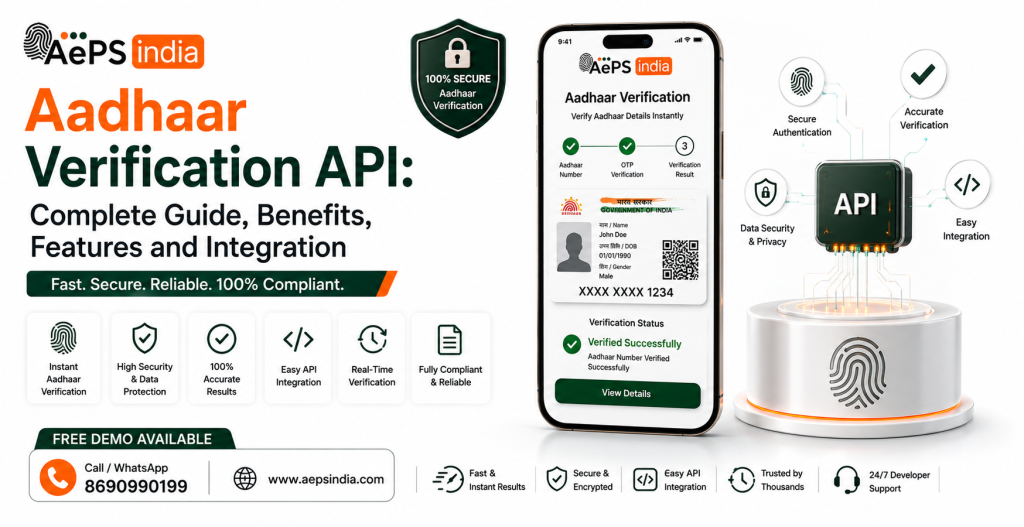
Businesses across fintech, banking, lending, insurance, e-commerce, telecom, and digital services need a reliable way to verify customer identities during onboarding and KYC. Manual Aadhaar verification can involve additional steps, document handling, and operational effort. An Aadhaar Verification API helps businesses connect Aadhaar-based verification into their digital workflows and make the identity verification process faster and easier for users.
An Aadhaar Verification API is an application programming interface that enables a business application to initiate an Aadhaar verification workflow through an authorized verification service. Depending on the Aeps india and supported verification method, the process may use OTP-based verification, offline eKYC, QR-based verification, or other permitted Aadhaar verification methods. For example, current solutions from Setu and Cashfree describe OTP-based Aadhaar/eKYC flows, while Surepass also describes consent-based QR verification workflows.
The role of an Aadhaar Verification API in digital KYC goes beyond simply checking an Aadhaar number. It can help automate customer onboarding, reduce repetitive manual verification work, return verification results to a business application, and create a smoother KYC experience. API-based workflows can also provide businesses with structured verification responses and integration options such as webhooks, depending on the Aeps india.
For businesses, choosing the right Aadhaar Card Verification API requires more than looking at verification speed. It is important to evaluate the supported verification method, user-consent flow, data handling, security controls, Aadhaar Card Verification API documentation, response format, reliability, scalability, and applicable regulatory requirements. Aadhaar-related verification must be implemented according to the permissions and rules applicable to the business and the chosen verification method.
In this complete guide, Aeps india explains what an Aadhaar Verification API is, how Aadhaar verification works, the different verification methods, key features and benefits, API integration, use cases, security and compliance considerations, pricing factors, and how businesses can choose the right Aadhaar verification solution for their digital KYC requirements.
What Is an Aadhaar Verification API?
An Aadhaar Verification API is a secure software interface that lets businesses and government bodies confirm an individual’s identity in real time using their 12-digit Aadhaar number against the central database of the Unique Identification Authority of India (UIDAI).
How Does an Aadhaar Verification API Work?
An Aadhaar Verification API is a secure, cloud-based software interface that enables registered businesses to check the validity of an individual’s 12-digit Aadhaar national identity in real time. It acts as a bridge between a company’s onboarding application and the Unique Identification Authority of India (UIDAI) database to complete digital Know Your Customer (eKYC) compliance.
How the Aadhaar Verification API Works
The system operates using a secure, real-time data flow that adheres strictly to Indian regulatory guidelines:
- User Input & Consent: The customer inputs their 12-digit Aadhaar number and gives explicit, legally required consent to use their profile data.
- API Gating & Verification Request: The business’s front-end application sends a
POSTrequest containing the identification string over a secure, encrypted HTTPS protocol. - Database Validation: The backend Aadhaar Card Verification API connects directly to the UIDAI repository to check if the record exists and matches the provided parameters.
- UIDAI Response Routing: The government platform returns a binary verification status (
Yes/No). If using authorized eKYC modes, it also supplies structured, digitally-signed data fields. - System Resolution: The client application parses the JSON response to instantly grant system access, flag the record for review, or reject a fraudulent application.
How Aadhaar Verification API Works?
Seamless, secure, and instant identity verification process
Verify with Aadhaar
Scan Aadhaar QR Code
or
Enter Aadhaar Number
Verification Successful
Name
Date of Birth
Year of Birth (where available)
Gender
Photograph
Full Address
Masked Mobile & Email
Reference ID
Verification Status
Aadhaar Verification API Service Offered
An Aadhaar Verification API is a secure, digital interface that allows businesses to instantly authenticate an individual’s identity by connecting directly to the Unique Identification Authority of India (UIDAI) central database. It is a critical component for digital onboarding, enabling automated, real-time electronic Know Your Customer (eKYC) compliance for industries like banking, fintech, insurance, and recruitment.
Types of Aadhaar Verification APIs
- OTP-Based Authentication (OKYC): Triggers a One-Time Password to the user’s registered mobile number. It provides detailed demographic profiles and photos without requiring biometric hardware.
- Biometric & Face Authentication: Utilizes fingerprint scans, iris scans, or AI-driven face recognition. This is ideal for high-security environments and in-person branch Aadhaar Card Verification API onboarding.
- Demographic Verification: Cross-checks basic text inputs like full name, date of birth, gender, and address against the registry to verify credentials without retrieving full profiles.
- Offline eKYC (XML / QR Code): Validates secure, digitally signed XML files or reads encrypted QR codes on the physical card, eliminating live database dependencies.
Types of Aadhaar Verification API
Aadhaar Verification APIs enable businesses to instantly validate an individual’s identity against the Unique Identification Authority of India (UIDAI) database. These Aadhaar Card Verification API are categorized into online (live server query) and offline (privacy-focused / document-based) methods.
Online Aadhaar Verification APIs
These APIs connect directly to the UIDAI central database in real time to match user inputs.
- OTP-Based Authentication API (eKYC): Triggers a One-Time Password to the user’s registered mobile number. It retrieves full demographic data and a photograph upon successful entry, making it the standard for remote digital onboarding.
- Biometric Authentication API: Validates fingerprint or iris scans using physical biometric scanner hardware. It offers high-security, tamper-proof verification for in-person branch operations.
- Face Authentication API: Utilizes AI-driven liveness detection to match a live image capture against the official photo stored in UIDAI records. It provides a contactless, high-security alternative to physical biometrics.
- Demographic Verification API: Cross-references text-based parameters such as full name, date of birth, gender, and address—against the database without requiring an OTP or biometrics.
- Virtual ID (VID) API: Allows users to substitute their 12-digit Aadhaar number with a temporary 16-digit VID. This API verifies identity while safeguarding core user privacy.
Offline Aadhaar Verification APIs
These Aadhaar Card Verification API function without pinging the central UIDAI database for every transaction, using digitally signed data packages instead.
- Secure QR Code API: Decodes the encrypted, digitally signed QR code printed on the physical or electronic Aadhaar card. It extracts name, photograph, and address details completely offline.
- Offline XML (Paperless eKYC) API: Verifies a zip file containing a digitally signed XML document downloaded by the citizen. It ensures data integrity and user consent without needing live network connectivity.
- DigiLocker Integration API: Fetches the officially issued digital Aadhaar document from a user’s government-approved DigiLocker account via an authenticated consent flow.
- Optical Character Recognition (OCR) API: Scans a physical uploaded image of the card to automatically extract text fields. It acts as a primary check before submitting details to database Aadhaar Card Verification APIs.
Documents Required for Aadhaar Verification API
An Aadhaar Verification API requires a valid 12-digit Aadhaar number (or Virtual ID) and a registered mobile number to receive an OTP, or an offline XML file with a share code.
Depending on the specific verification method chosen, the required inputs and documents vary:
Key Inputs & Data Requirements
- 12-Digit Aadhaar Number / VID: Mandatory base input to initiate any authentication or demographic query.
- Registered Mobile Number: Required for sending and validating the One-Time Password (OTP) for live verification.
- Aadhaar Offline XML File: A secure, digitally signed paperless e-KYC file downloaded directly from the UIDAI portal.
- Share Code: A 4-digit password set by the user to decrypt and secure the offline XML file.
- Biometric Data: Fingerprint scans or iris impressions captured via UIDAI-registered physical devices (for biometric authentication).
- User Consent: Explicit, documented user consent as mandated by UIDAI and privacy regulations like the DPDPA.
Who Can Use Aadhaar Verification API
Authorized businesses, financial institutions, and government agencies registered under UIDAI regulations can use the Aadhaar KYC API for secure, real-time identity authentication and paperless KYC.
Key Sectors and Eligible Entities
- Financial Institutions: Banks, non-banking financial companies (NBFCs), and fintech platforms use it for digital onboarding, instant loan processing, and credit risk assessments.
- Telecom Providers: Used for rapid, paperless customer onboarding and instant SIM card activation.
- Insurance Companies: Applied for policyholder verification, fraud detection, and streamlining digital claims processing.
- Government & Public Sector: Utilized for transparent distribution of public welfare subsidies, LPG, and PDS benefits under the Aadhaar Act.
- E-Commerce & Marketplaces: Employed for merchant onboarding and verifying delivery partners or gig economy workers.
- HR & Recruitment: Used for lawful employee and vendor background screening (BGV) with explicit user consent.
- Healthcare Platforms: Integrated for patient identity verification and linking ABHA (Ayushman Bharat Health Account) IDs.
Why Use Aadhaar Verification API
An Aadhaar Verification API is used to securely connect a business’s system directly to the Unique Identification Authority of India (UIDAI) database. It allows you to verify a person’s identity in real time using biometric, OTP, or demographic data, which effectively prevents identity fraud and ensures automated regulatory compliance.
Key Reasons to Use an Aadhaar Verification API
Eliminate Identity Fraud
- Authoritative Check: A physical or digital document copy can be forged. A government registry record cannot.
- Real-time Validation: Instantly confirms whether an Aadhaar number exists and belongs to the person providing it.
- Tamper-proof Checks: Detects synthetic identities and deepfakes during digital onboarding.
Lightning-Fast User Onboarding
- Instant Verification: Database checks return results within a few seconds.
- Zero Paperwork: Eliminates manual scanning, physical form submission, and manual data entry errors.
- High Conversion: Lowers user drop-off rates by minimizing onboarding friction.
Seamless Regulatory Compliance
- Mandatory Norms: Easily helps fulfill strict Know Your Customer (KYC) and Anti-Money Laundering (AML) mandates.
- Defensible Auditing: Generates an official, digitally signed trail showing identity was verified directly at the source.
- Consent-focused Security: Aligns with legal guidelines by operating on explicit user consent.
Versatile Verification Modes
- Aadhaar OTP: Instantly sends a One-Time Password to the user’s linked mobile number for remote onboarding.
- Biometrics: Authenticates individuals through high-security fingerprint or iris scans for high-value operations.
- Demographics: Matches basic parameters like legal name, gender, date of birth, and address.
- Secure QR / XML: Leverages digitally signed QR codes or offline XML extraction for alternate verification flows.
Aadhaar Verification API for Different Business Models
Integrating an Aadhaar Verification API allows businesses to securely validate identities in real-time by linking directly or indirectly to the Unique Identification Authority of India (UIDAI) centralized database. Depending on regulatory requirements, user experience preferences, and the nature of the industry, different business models require distinct verification technical flows.
1. Fintech, Banking, and NBFCs
Financial institutions operate under strict Reserve Bank of India (RBI) compliance rules requiring rigorous Know Your Customer (KYC) processes.
- API Choice: OTP-Based Aadhaar eKYC API & Biometric Authentication API.
- Why It Fits: High-security models require foolproof verification. Remote loan processing or instant bank account opening relies heavily on OTP authentication sent to a registered mobile number. For branch-based banking or high-risk accounts, businesses deploy fingerprint or iris scanners linked to a biometric Aadhaar based KYC API.
- Data Returned: Full demographic details (name, date of birth, address) and the user’s official registered photograph.
2. On-Demand Gig Economy (Delivery, Ride-Hailing, House Services)
Platforms matching independent service providers (like drivers, delivery partners, plumbers, or house cleaners) with consumers need to establish trust swiftly during rapid, high-volume Aadhaar based KYC API onboarding.
- API Choice: Aadhaar Demographic Verification API or Aadhaar Card Number Check.
- Why It Fits: Businesses in this sector do not necessarily need a complete eKYC profile, but they must confirm that the background-checked applicant is utilizing a real government identity. The Aadhaar Demographic API cross-references the background-check records against the UIDAI system to confirm structural alignment.
- Data Returned: A binary success/fail confirmation of whether the provided name, DOB, and address match the specific Aadhaar number.
3. E-commerce and Rental Business Platforms
Platforms facilitating peer-to-peer sales, high-value electronics rentals, vehicle rentals, or merchants boarding an online marketplace must mitigate the risk of fraud, theft, and fake accounts.
- API Choice: Offline e-KYC (XML / Secure QR Code) API.
- Why It Fits: It balances strong fraud prevention with low barrier-to-entry friction and privacy compliance. The consumer uploads a digitally signed XML zip file or scans their Aadhaar secure QR code. It operates efficiently without needing complex AUA/KUA enterprise server architectures or live biometric infrastructure.
- Data Returned: Securely extracted name, address, and profile picture, hiding the actual raw 12-digit Aadhaar number for privacy protection.
4. HR Operations, CRM, & Enterprise Legal Tech
Corporate business environments automating vendor onboarding, employee background verification, and formal contract executions require structured legal proof.
- API Choice: Aadhaar-based eSign API.
- Why It Fits: It merges document execution and identity checks into a single step. Users can legally sign employment contracts, vendor NDAs, or rental agreements remotely by verifying their identity with an OTP. It completely eliminates physical paper storage, printing, and scanning workflows.
- Data Returned: A legally binding, cryptographically signed PDF document authenticated by government-recognized certifying authorities.
Complete Aadhaar Verification API Suite
An Aadhaar Verification API Suite is a collection of programmatic interfaces that allows businesses to validate Indian citizens’ identities using the Unique Identification Authority of India (UIDAI) ecosystem. These suites enable real-time, paperless, and compliance-ready customer onboarding (KYC) across fintech, banking, insurance, and HR sectors.
Core APIs in a Complete Suite
A robust corporate suite combines multiple verification modalities to balance user experience with regulatory requirements:
1. Real-Time Aadhaar Verification (Basic Check)
- What it does: Validates if an Aadhaar number exists in the UIDAI registry without needing a user OTP.
- Data Returned: Age band (e.g., 20-30), gender, state, and the last 3-4 digits of the registered mobile number.
- Primary Use: Initial screening, vendor validation, and data scrubbing.
2. OTP-Based Aadhaar eKYC (Online OKYC)
- What it does: Triggers a secure one-time password to the resident’s registered mobile number.
- Data Returned: Pulls full demographic details including verified name, exact date of birth, photo, address, and a digitally signed ZIP archive.
- Primary Use: Secure digital onboarding for regulated financial institutions.
3. Offline Aadhaar XML / Secure QR Code API
- What it does: Decodes the encrypted QR code on physical/e-Aadhaar cards or uploads a secure offline XML file.
- Primary Use: Compliant identity checks that avoid hitting live UIDAI servers, lowering transaction costs and ensuring zero tracking data remains behind.
4. DigiLocker Aadhaar Retrieval API
- What it does: Integrates directly with the government’s DigiLocker system via a consent-driven authorization flow.
- Primary Use: Fulfilling stringent digital onboarding frameworks mandated by SEBI, RBI, and IRDAI.
5. Aadhaar Masking & Compliance API
- What it does: Automatically redacts the first 8 digits of the Aadhaar number from uploaded document images.
- Primary Use: Meeting mandatory privacy requirements to prevent unauthorized storage of raw identity numbers.
Workflow Matrix Comparison
| Feature / Metric | Basic Verification | OTP eKYC | Offline XML / QR | DigiLocker Fetch |
|---|---|---|---|---|
| UIDAI Live Call | Yes | Yes | No | Indirectly |
| User Friction | Zero (No OTP) | Moderate (Requires OTP) | Low (Scan/Upload) | Moderate (Consent App) |
| Data Richness | Minimal (Demographic info) | Maximum (Full Profile + Photo) | Full Profile | Full Profile |
| Avg. Response Time | ~200ms | Depends on OTP entry | < 500ms | Depends on user login |
| Compliance Tier | Low Validation | Premium KYC | Offline KYC | High Enterprise KYC |
Aadhaar Verification API
Verify Aadhaar Number and get real-time identity verification details instantly.
Verify Aadhaar Number
Verified
Successfully
Aadhaar Card Details
Rakesh Kumar
Aadhaar Verification API provides:
Secure & Reliable
Verification
Real-time
Response
Detailed Identity
Information
Data
Security
Easy API
Integration
What Information Can Aadhaar Verification API Verify?
An Aadhaar Verification API confirms a person’s identity and demographic details directly against the official Unique Identification Authority of India (UIDAI) database.
Information Verified
- Identity Status: Confirms if a 12-digit Aadhaar number or Virtual ID (VID) is active and valid.
- Demographic Details: Matches and retrieves the registered full name, date of birth (DOB), gender, and residential address.
- Contact Information: Verifies the state and checks if a mobile number or email address is linked to the Aadhaar profile.
- Family Details: Retrieves the registered father’s name or guardian details (depending on the specific KYC flow used).
- Visual Data: Accesses the registered profile photograph via secure e-KYC XML responses.
- Mobile-Aadhaar Linking: Confirms whether a specific mobile number matches the one registered in the UIDAI database.
Aadhaar Verification API Use Cases
The Aadhaar Verification API serves as the digital backbone for real-time identity verification in India, enabling businesses and government entities to instantly authenticate users through biometric, OTP, or demographic checks directly against the UIDAI centralized database.
Banking and Financial Services (Fintech)
- Instant e-KYC Compliance: Banks and NBFCs automate paperless onboarding for savings accounts, credit cards, and wallets.
- Loan Disbursal Validation: Lending platforms check data against the government registry to mitigate first-party and synthetic identity fraud.
- Investment & Wealth Management: Neo-banks and mutual fund platforms satisfy strict Anti-Money Laundering (AML) and regulatory onboarding rules.
- High-Value Insurance Processing: Insurance firms use Aadhaar API validation to legally clear claims exceeding ₹1 lakh.
Telecommunications
- Instant SIM Card Issuance: Telecom operators instantly verify customer profiles during sign-ups to ensure regulatory compliance.
- Identity Fraud Reduction: Restricts the generation of fraudulent, duplicate, or unverified mobile connections.
Corporate HR and Operations
- Employee Background Verification: HR departments cross-reference submitted identities against official registry records during employee onboarding.
- Vendor & Gig-Worker Onboarding: Logistics, ride-sharing, and marketplace platforms run identity checks on contractors to secure their delivery network.
E-Governance and Public Services
- Subsidy and Welfare Distribution: Ensures direct benefit transfers (DBT) reach legitimate beneficiaries without duplication or leaks.
- Digital Document Extraction: Works alongside services like Aeps india to match credentials for university tracking or GST registration.
E-Commerce and Digital Marketplaces
- Merchant Authentication: Validates business owners and vendors before allowing them to list products on commercial platforms.
- Age Verification: Employs zero-knowledge proofs via the digital Aadhaar KYC API to confirm age-restricted compliance (e.g., “age over 18”) without exposing sensitive demographic fields.
Online Gaming (iGaming)
- User Eligibility Mapping: Verifies player location and identity to comply with state-wise gaming regulations across India.
- Auditable Trail Generation: Builds automated logs for platform security and regulatory reporting.
Aadhaar Verification API for KYC and eKYC
An Aadhaar Verification API is a digital tool that lets businesses instantly confirm a user’s identity and pull verified details directly from UIDAI systems or secure offline documents.
What is KYC vs. eKYC?
- KYC (Know Your Customer): Confirms that a person is who they claim to be by validating basic demographic inputs (like name, address, or date of birth) or checking if an Aadhaar number is active.
- eKYC (Electronic Know Your Customer): A fully paperless process where, with the user’s explicit consent, the system fetches official demographic data and a photo from government databases.
Aadhaar Verification API for KYC and eKYC
Secure, instant, and UIDAI-compliant identity verification
Enter OTP
Secure & Simple
Instant Verification
No Paperwork
UIDAI Secure
Single-Step Process
Why Is Aadhaar Verification API Important for Digital Identity Verification?
The Aadhaar Verification API is critical for digital identity verification because it enables businesses to instantly validate an individual’s identity, address, and biometric data in real-time against the centralized database of the Unique Identification Authority of India (UIDAI). Backed by a database of over 1.3 billion citizens, it serves as the foundational trust layer for India’s digital economy.
Key Benefits of Aadhaar Verification API
- Fraud Elimination: Detects forged physical cards, ghost identities, and deepfakes.
- Real-time Processing: Finishes identity checks within seconds via lightweight RESTful Aadhaar identity verification API.
- Paperless Onboarding: Replaces slow manual submission workflows with fully digital data flows.
- Regulatory Compliance: Satisfies mandatory Know Your Customer (KYC) requirements for regulated entities.
- Reduced Errors: Drops manual data-entry typos by pulling verified fields programmatically.
- Cost Efficiency: Slashes overall operational overhead relative to field agent identity checks.
Why Do Businesses Use Aadhaar Verification API?
Businesses use the Aadhaar Verification API to instantly, securely, and digitally confirm a customer’s or partner’s identity and address against the official UIDAI database.
Key Reasons Businesses Use Aadhaar Verification API
- Instant Digital Onboarding: Replaces slow, paper-based manual KYC (Know Your Customer) with real-time verification via OTP, biometrics, or offline XML.
- Fraud and Identity Theft Prevention: Eliminates fake documents, detects duplicate accounts, and confirms that the live user owns the registered mobile number.
- Regulatory Compliance: Helps banks, financial institutions, and telecom companies meet legal and government mandates efficiently.
- Lower Operational Costs: Removes the need for physical paperwork storage, manual data entry, and human verification errors.
- Auto-Fill Form Accuracy: Pulls verified demographic details directly to pre-fill customer application fields safely.
Businesses Use Aadhaar Verification API
Secure, instant, and UIDAI-compliant identity verification for your business
Details Verified
Identity Verified
Aadhaar Verification API for Fintech and Digital Businesses
An Aadhaar Verification API is a digital tool that lets fintech and digital businesses check a customer’s identity instantly against the official database of the Unique Identification Authority of India (UIDAI).
Instead of collecting physical paper documents, companies use this Aadhaar authentication API to verify names, dates of birth, addresses, and photos within seconds.
Why Fintechs Use It
- Instant Onboarding: Cuts down customer registration time from days to seconds, reducing drop-offs.
- Fraud Prevention: Stops fake identities and lowers the risk of financial crime.
- Regulatory Compliance: Helps businesses meet Know Your Customer (KYC) and Anti-Money Laundering (AML) rules set by authorities like the RBI and SEBI.
- Data Security: Follows strict zero-storage guidelines where full Aadhaar numbers are not saved on company servers.
Features Aadhaar Verification API
An Best Aadhaar Verification API enables businesses to authenticate individuals in real-time by securely connecting to the Unique Identification Authority of India (UIDAI) database. It streamlines digital onboarding, ensures regulatory compliance, and prevents fraud with zero permanent storage of sensitive biometric data.
Core Authentication Methods
- OTP-Based Validation: Sends a One-Time Password to the user’s registered mobile number to confirm identity and consent.
- Demographic Cross-Checking: Instantly validates a user’s name, Date of Birth (DoB), gender, and address against centralized records.
- Biometric Verification: Employs fingerprint or iris scans for high-security, physical identity confirmation.
- Facial Recognition Matching: Complements standard flows by comparing a live face scan with the official photo on record.
Technical & Operational Features
- Real-Time Responses: Delivers instantaneous validation statuses, typically completing the round-trip check in under 3 seconds.
- Multiple Verification Modes: Supports OTP-based authentication, biometric scans (fingerprints and iris), and demographic cross-checking.
- Offline e-KYC Support: Uses digitally signed Aadhaar XML files or secure QR codes to fetch data locally without live database dependencies.
- Masked Aadhaar & VID: Supports 16-digit Virtual IDs (VID) and outputs masked numbers to maximize user privacy.
- Zero Data Storage: Adheres to strict security compliance by not saving numbers or biometrics on external developer servers.
- Standardized Format Outputs: Delivers authenticated data strings in clean, developer-friendly JSON or XML formats.
Benefits Aadhaar Verification API
An Aadhaar Verification API enables businesses to instantly validate an individual’s identity by directly querying the Unique Identification Authority of India (UIDAI) database. The primary benefits of integrating Aadhaar Verification API into operational workflows include:
Integrating Aadhaar Verification API delivers several critical operational, legal, and security benefits:
Accelerated Onboarding and Operational Efficiency
- Instant verification: Reduces identity validation time from days to seconds, allowing for real-time customer onboarding.
- Paperless workflows: Replaces physical document submission and manual data entry with digital extraction via OCR or QR code scanning.
- Lower acquisition costs: Automating the KYC process can reduce overall customer acquisition expenses by up to 90% compared to traditional paper-based methods.
- High scalability: Effortlessly processes bulk or high-volume verification requests during mass recruitment or peak user registration phases.
Advanced Fraud Prevention and Security
- Direct validation: Authenticates parameters straight against the centralized government repository.
- Multi-factor checks: Employs OTP, facial verification, and biometric matching (fingerprint/iris).
- Tamper detection: Smart OCR technology identifies physical card alterations and digital screen spoofing.
- Secure QR scanning: Decodes secure government QR codes to extract authenticated user photos and text offline.
Significant Operational Cost Reductions
Acquisition drop: Lowers overall customer acquisition and onboarding expenses by up to 90%.
Resource optimization: Eradicates the logistical overhead of courier services, physical document scanning, and manual reviews.
Seamless Regulatory Compliance
- Institutional alignment: Keeps businesses fully compliant with RBI (Reserve Bank of India), SEBI, and IRDAI mandates.
- Audit readiness: Provides clear, automated logs for Anti-Money Laundering (AML) checks.
Enhanced Privacy and Security Options
- Data masking: Utilizes 16-digit Virtual IDs (VIDs) to authenticate users without exposing actual Aadhaar numbers.
- Secure pipelines: Transmits all information using enterprise-grade encryption protocols.
Aadhaar Verification API Integration Process
Integrating Aadhaar Verification API allows businesses to validate user identities in real time against the Unique Identification Authority of India (UIDAI) database. The integration process follows a strict regulatory and technical workflow to ensure security, data compliance, and high availability.
Integration Workflow
1. Registration & Use Case Selection
- Select Aeps india: Partner with a UIDAI-approved Aeps india.
- Define Use Case: Map required attributes before coding to build appropriate UI consent structures.
- Obtain Credentials: Request Aadhaar Verification API keys, access tokens, and sandbox credentials.
2. Environment Setup & Data Privacy
- Enforce HTTPS: Secure all backend endpoints using TLS 1.2 or higher.
- Secure Environment: Store credentials via environment variables rather than hardcoding.
- Zero-Storage Policy: Avoid saving full Aadhaar numbers or raw biometrics to prevent regulatory gaps.
- Mask Content: Store only masked versions or Virtual IDs (VIDs) returned by the Aeps india.
3. Building the Frontend Consent UI
- Mandatory Consent: Collect explicit user consent for compliance prior to launching any verification flow.
- Log Meta-Data: Programmatically record the approval transaction ID, session ID, and timestamp.
4. API Endpoint Technical Execution
The typical automated programmatic sequence uses an exchange pattern:
5. Handling Response Payloads
- Process JSON/XML: Read the structured callback parameters within seconds.
- Extract Valid Data: Extract verified fields including full name, date of birth, gender, and complete address.
- Handle Errors: Set up fallback logic or automatic retries for server timeouts or downtime.
6. Testing & Deployment
- Sandbox Verification: Validate edge cases using mock numbers inside the Aeps india test sandbox.
- Go-Live: Switch endpoint domains to production, and monitor initial user completion rates.
Aadhaar Verification API Pricing
Aadhaar Verification API costs generally range from ₹3 to ₹10 per successful verification, depending on your chosen Aeps india, monthly volume, and required features.
Typical Pricing Models
- Pay-Per-Use (Prepaid/Postpaid): Flat fee per successful check, usually between ₹5 and ₹8 for standard OTP eKYC or offline QR verification. Volume discounts apply for higher tiers.
- Advanced / Photo-Based Verification: ₹15 to ₹20 per check if it includes photo extraction or document matching.
- Monthly Minimum Commitments: Aeps india enforce a minimum monthly retainer (e.g., ₹3,000 to ₹7,500) which may bundle a set number of verification journeys.
- Add-On Features: Advanced security layers like Face Match or biometric verification typically add an extra ₹8 per check.
- Sandbox Access: Aeps india offer a free sandbox environment with limited free test credits to trial the real time Aadhaar verification API before committing to production.
Aadhaar Verification API Response: What Does It Look Like?
An Aadhaar Verification API response returns a structured, machine-readable data payload typically formatted in JSON or XML confirming whether a submitted Aadhaar number is genuine and providing the associated user details.
Depending on the specific automated Aadhaar verification API endpoint utilized (such as an OTP-based eKYC, a demographic check, or a QR code scan), the response object will differ. Below are the primary response structures you will encounter when integrating with typical Aeps india.
1. Success Response (Full eKYC / OTP Verification)
When a user successfully authenticates using a One-Time Password (OTP), the secure Aadhaar verification API returns a comprehensive payload containing the individual’s legally verified demographic profile.
1. Full eKYC Verification Response
2. Basic Validity / Status Check Response
If you are only verifying whether an Aadhaar number exists and is active without performing full eKYC, the response is brief. It minimizes data exposure to ensure privacy.
3. Error Response Payloads
If a validation fails, the API passes through specific error strings originating from the UIDAI systems.
Scenario A: Invalid OTP Entered
Scenario B: Invalid Aadhaar Number Format
Aadhaar Verification API Request and Response Explained
An Aadhaar Verification API acts as a secure digital bridge connecting a business application to the central database of the Unique Identification Authority of India (UIDAI). It allows organizations to instantly validate an individual’s identity during digital onboarding or Know Your Customer (eKYC) compliance checks.
Aadhaar KYC verification API structures vary depending on the verification method used (e.g., OTP-based, Demographic, or OCR text extraction). The technical workflow, typical request formats, and response data payloads operate through standard JSON structures.
1. Demographic Verification API (Text Match)
This method takes text inputs (like name or date of birth) alongside the 12-digit Aadhaar number and sends a raw validation check directly to the registry.
The RequestTo protect user privacy, the official government API does not return demographic profile information. Instead, it sends back a simple binary match outcome (Yes/No).
2. Aadhaar OTP Verification API (eKYC Data Retrieval)
This is a two-step transaction: first, generating a One-Time Password (OTP), and second, submitting that OTP to unlock the full eKYC data payload.
Step 1: Request OTP3. Aadhaar OCR API (Image Scan Extraction)
Unlike direct database lookups, an OCR API parses physical visual assets by processing front and back images to extract text strings.
The RequestAadhaar Verification API Security and Compliance
Integrate Aadhaar Verification API requires balancing user convenience with rigid technical security and regulatory requirements. The entire framework is strictly governed by the Unique Identification Authority of India (UIDAI) and Indian financial regulators to safeguard personally identifiable information (PII).
Implementing a compliant workflow involves the following core security pillars and regulatory mandates:
Core Security Architecture
- End-to-End Encryption: All requests traversing between the Aadhaar KYC verification API gateway, the Authentication User Agency (AUA) / e-KYC User Agency (KUA), and the UIDAI Central Identities Data Repository (CIDR) must use advanced encryption standards (such as AES-256 and RSA-2048) to prevent man-in-the-middle attacks.
- Zero-Storage Policy: Businesses using the Aadhaar based KYC API must follow a strict zero-storage policy for raw Aadhaar numbers and biometric data. Only UIDAI-compliant tokens or reference keys may be retained.
- Aadhaar Masking: When rendering, processing, or archiving physical/digital copies of the card, the first 8 digits of the Aadhaar number must be masked, exposing only the last 4 digits.
- Tamper-Evident Processing: Aeps india utilize smart optical character recognition (OCR) alongside database-verified QR code scanning to instantly cross-validate data and detect spoofing attempts or forged documentation.
Regulatory Compliance & Oversight
- Multi-Regulator Alignment: Infrastructure must comply with the foundational Aadhaar Act, as well as distinct onboarding and AML directives from the Reserve Bank of India (RBI), Securities and Exchange Board of India (SEBI), and Insurance Regulatory and Development Authority of India (IRDAI).
- Explicit Consent Capture: Verification cannot occur without capturing and logging a verifiable, explicit digital consent record from the customer.
- Audit Trails: Aeps india automatically generate tamper-evident PDFs alongside detailed cryptographic audit trails to track transaction records for legal and compliance reviews.
Is Aadhaar Verification API UIDAI Compliant?
Yes, an Aadhaar Verification API is UIDAI compliant when provided by an authorized Aeps india that follows the official guidelines of the Unique Identification Authority of India.
Key Compliance Requirements
- Explicit User Consent: You must collect informed consent from the individual before starting any verification.
- Zero Storage Policy: Systems cannot store raw Aadhaar numbers or biometric data locally after verification.
- Data Masking: Output data must display masked Aadhaar numbers rather than raw 12-digit numbers where retention occurs.
- Authorized Architecture: Verification must occur through licensed Authentication User Agencies (AUA) or Sub-AUA frameworks.
Aadhaar Verification API vs Manual Aadhaar Verification
Aadhaar Verification API provide instant, automated, and database-backed identity checks in 30 to 60 seconds, whereas manual verification requires physically collecting, reviewing, and typing paper document details with high human error risks.
Speed and Efficiency
- Aadhaar Verification API: Completes checks in real time (seconds) through automated workflows like OTP, biometric, or QR scanning.
- Manual Verification: Takes minutes or days per user as staff must physically inspect cards, check for forgeries, and type data manually.
Accuracy and Security
- Aadhaar Verification API: Achieves up to 99.9% accuracy by matching data directly with the Unique Identification Authority of India (UIDAI) database or cryptographically signed offline XML files.
- Manual Verification: Vulnerable to human oversight, fake or altered physical documents, and data entry typos.
Cost and Scalability
- Aadhaar Verification API: Highly cost-effective and scalable for high volumes with zero physical storage overhead.
- Manual Verification: Expensive due to labor costs, physical document storage requirements, and slow processing limits.
Compliance and Privacy
- Aadhaar Verification API: Built with consent-based flows, encrypted transmissions, and data masking (such as Virtual IDs) to meet strict privacy laws.
- Manual Verification: Poses higher data leak and compliance risks when physical or digital photocopies are mishandled and stored insecurely.
Aadhaar Verification API vs Other KYC APIs
Aadhaar Verification API provides direct UIDAI-backed biometric or OTP identity confirmation, whereas other KYC APIs target specific alternative markers like PAN, bank accounts, or business registrations.
Aadhaar Verification API
- Core Function: Validates identity, demographic details (name, date of birth, address), and live presence directly against UIDAI records.
- Authentication Methods: Uses One-Time Passwords (OTP), biometric scans (fingerprint or iris), and secure XML offline files.
- Compliance: Governed by strict UIDAI rules and requires specific licensing or authorized aggregators like Aeps india.
- Best For: Primary identity proof, instant digital onboarding, and high-security authentication.
Other KYC and Verification APIs
- PAN Verification API: Connects with tax databases to verify permanent account numbers, legal names, and active status. It prevents financial and tax fraud.
- Bank Account Verification (Penny Drop) API: Transfers a tiny amount, like ₹1, to confirm that a bank account belongs to the user and is active.
- DigiLocker and Document APIs: Pulls official documents like driving licenses or voter IDs through user consent pipelines. Aeps india bundle these for multi-document checks.
- GST / Business Verification APIs: Validates merchant and corporate registration details for Know Your Business (KYB) requirements.
Key Differences
- Data Source: Aadhaar queries the national resident database, while other APIs query respective authorities like the Income Tax department, NPCI, or state transport registries.
- Scope of Data: Aadhaar supplies complete demographic and photo details, while PAN or bank APIs typically return a status and a name-match percentage.
- Regulatory Burden: Aadhaar integrations carry heavier legal and consent constraints under Indian privacy laws compared to standard secondary ID checks.
Aadhaar Verification API vs Manual Aadhaar Verification
An Aadhaar Verification API completes identity checks instantly through automated digital connections to the UIDAI database, while manual verification relies on physical document collection and human review.
Comparison Overview
| Feature | Aadhaar Verification API | Manual Aadhaar Verification |
|---|---|---|
| Speed | Takes 30 to 60 seconds. | Takes days or hours. |
| Accuracy | Offers 99.9% accuracy with direct database validation. | Prone to human data-entry mistakes and fake documents. |
| Cost | Incurs low automated processing fees. | Requires high operational overhead and storage costs. |
| User Experience | Enables remote, paperless onboarding. | Demands physical branch visits or document uploads. |
| Security | Uses encrypted, consent-based digital logs. | Carries risks of physical document loss or data mishandling. |
Key Differences
- Speed and Scale: Aadhaar Card Verification API process high volumes of users instantly. Manual checks create backlogs and slow down user onboarding.
- Error Reduction: Aadhaar Verification API eliminate typing mistakes and spot forged data using automated queries. Manual entry leads to spelling errors and missed discrepancies.
- Compliance: Digital workflows generate audit-ready logs that align with modern data privacy rules. Physical storage of photocopies increases compliance liabilities.
Aeps india One of the Best Aadhaar Verification API Provider in India?
Aeps india one of the right Aadhaar verification API provider is critical for seamless digital onboarding, regulatory compliance, and fraud prevention. The market features various integration tiers ranging from direct government database links to basic Optical Character Recognition (OCR) tools making it essential to evaluate Aeps india across technical, regulatory, and financial dimensions.
1. Regulatory Certification and Licensing
Aadhaar verification handles highly sensitive identity data. You must verify the Aeps india authorized access tier:
- AUA/KUA Licensing: Ensure the Aeps india holds or securely routes through an official Authentication User Agency (AUA) or e-KYC User Agency (KUA) license from the Unique Identification Authority of India (UIDAI).
- Regulatory Alignment: The infrastructure must satisfy Know Your Customer (KYC) compliance rules mandated by major Indian regulators like the Reserve Bank of India (RBI), SEBI, and IRDAI.
- Pure OCR vs. DB Verification: Aeps india offering cheap “Aadhaar verification” that only uses OCR text extraction. Real verification requires validating the data against the official database via OTP or biometrics.
2. Supported Authentication Methods
Depending on your business workflow, Aeps india should offer multiple verification modalities:
- OTP-Based Authentication: Sends a code to the user’s registered mobile number; best for remote, low-friction digital onboarding.
- Biometric Authentication: Supports fingerprint or iris scanning using UIDAI-certified Registered Device (RD) services; ideal for high-security, physical presence onboarding.
- Face Authentication with Liveness: Uses live facial capture and matching against the UIDAI database; essential for touchless remote verification and preventing spoofing attacks.
- Offline XML / QR Code: Useful for privacy-sensitive applications or low-connectivity environments.
3. Data Security and Privacy Standards
Data security protects your organization from heavy legal penalties and breaches:
- Zero-Storage Policy: Aeps india gateway must strictly avoid storing raw Aadhaar numbers or biometric data.
- Masked Aadhaar Support: The API should support Virtual IDs (VIDs) and return masked formats to safeguard user privacy.
- Data Encryption: Look for robust end-to-end encryption protocols during data transit.
4. Technical Performance and Reliability
An identity drop-off during onboarding directly hurts business revenue:
- Uptime SLA: Look for Aeps india guaranteeing a 99%+ Aadhaar Verification API uptime.
- Success Rates: Aeps india sustain an average transaction success rate exceeding 98% to 99%.
- Latency: The real-time authentication response should complete within 2 to 3 seconds.
5. Integration Quality and Extended Ecosystem
Evaluate how easily the Aadhaar verification API service fits into your engineering pipeline and what value-adds it provides:
- Developer-Friendly Documentation: Aeps india offer comprehensive SDKs, clear REST Aadhaar verification API documentation, and a sandbox/test environment to prevent slow deployments.
- Layered Fraud Check Capabilities: A verified response only means the document is real. Aeps india allow you to layer device intelligence, face match, and DigiLocker integrations.
- Modular Endpoints: Aeps india allow product teams to select and pay for specific endpoints rather than forced bundled suites.
6. Pricing Models and Transparency
Onboarding costs scale quickly as your business grows:
- Volume Discounts: Startups and enterprises should seek platforms with flexible tiered pricing to reduce cost-per-check at scale.
- No Hidden Fees: Carefully evaluate the contract for unexpected onboarding setup fees or recurring maintenance charges.
Why Choose Aeps india for Aadhaar Verification API Solution?
Aeps india one of the right provider for an Aadhaar Verification API solution requires evaluating compliance, direct data connectivity, speed, and security.
Key Factors to Consider
- Regulatory Compliance and Licensing: Ensure the Aeps india strictly adheres to UIDAI guidelines and holds proper authorization or partnerships (such as AUA/KUA licensing) rather than relying on weak OCR-only extractions.
- Data Source Directness: Look for live, direct database connectivity instead of cached data repositories to guarantee maximum accuracy and freshness.
- Uptime and Latency: High-performing Aadhaar Card Verification API should process and return verification results within milliseconds using load balancing and secure gateways to minimize customer drop-offs during onboarding.
- Authentication Modalities Supported: Check whether the Aeps india supports your required use cases, such as OTP-based verification, biometric scans, face authentication, or offline XML e-KYC.
- Security and Data Privacy: The infrastructure must use robust encryption (like TLS) and comply with local data protection and storage regulations, potentially supporting an Aadhaar Data Vault framework.
- Pricing and Documentation: Look for transparent, per-transaction pricing models without hidden fees, paired with clear developer documentation and a sandbox environment for testing.
Final Takeaway: Aadhaar Verification API for Faster Digital KYC
An Aadhaar Verification API can help businesses simplify identity verification and make digital KYC more efficient. Instead of relying on lengthy manual processes, businesses can integrate an Aadhaar verification solution into their website, mobile app, or digital onboarding workflow and automate supported verification steps.
The real value of an Aadhaar Card Verification API is not only faster verification. A reliable solution can help businesses improve customer onboarding, reduce manual data entry, manage verification results efficiently, and create a smoother user experience. Based on the Aeps india and permitted verification method, businesses may have access to workflows such as OTP-based verification, offline eKYC, QR-based verification, or other supported authentication options.
However, choosing an Aadhaar Verification API in India should be based on more than price or advertised verification speed. Businesses should evaluate the available verification method, consent flow, Aadhaar eKYC API documentation, security controls, data handling practices, reliability, scalability, technical support, and applicable Aadhaar and regulatory requirements. This is particularly important because Aadhaar verification services and available workflows can change with regulatory or technical requirements. For example, Setu currently states that its Aadhaar service is discontinued due to technical changes implemented by UIDAI.
For fintech companies, banks, NBFCs, insurance providers, lending platforms, e-commerce businesses, telecom companies, and other organizations with digital onboarding needs, the right Aadhaar KYC API can become an important part of a broader identity verification workflow. It can help create a more streamlined KYC journey while supporting the business’s operational and compliance requirements.
At Aeps India, our focus is to help businesses understand Aadhaar verification technology and choose an Aadhaar based KYC API approach that matches their actual use case. Before integrating an Aadhaar Verification API, define your verification requirements, understand the applicable compliance conditions, compare available digital Aadhaar KYC API capabilities, and select aAeps india.
In short, the right Aadhaar Verification API can make digital identity verification simpler, faster, and more scalable provided it is implemented with proper user consent, security, data protection, and regulatory compliance.
Instant Aadhaar Verification & Dedicated Support
अपनने व्यवसाय के लिए सुरक्षित और तेज़ API इंटीग्रेशन का अनुभव करें। सटीक प्राइसिंग (Estimate) प्राप्त करें या तुरंत सहायता के लिए हमारे WhatsApp सपोर्ट से जुड़ें।
Frequently Asked Questions About Aadhaar Verification API
An Aadhaar Verification API is an API-based service that helps eligible businesses integrate Aadhaar-based identity verification into their websites, mobile apps, or digital onboarding systems. Depending on the Aeps india and supported workflow, verification may involve methods such as OTP-based authentication or other permitted Aadhaar verification processes. The exact method and data returned depend on the service and applicable regulations.
An Aadhaar Verification API typically starts a verification request from a business application. The customer completes the required verification and consent steps through the supported workflow, such as OTP-based authentication. The verification service then processes the request and returns the applicable status or permitted response to the business application. Aadhaar identity verification API implementations can also use webhooks or status Aadhaar identity verification API to receive or retrieve verification results.
An Aadhaar OTP Verification API enables an Aadhaar-based verification workflow using a one-time password, where supported and permitted. UIDAI describes OTP as one of the authentication modes in which an OTP is sent to the Aadhaar holder’s registered contact details or generated through an appropriate mechanism and then used for authentication.
Not necessarily. Aadhaar Verification API is a broader term for an Aadhaar authentication API used for Aadhaar-based verification, while an Aadhaar KYC API may provide a specific KYC or e-KYC workflow. The exact capabilities based on the Aeps india, authorization model, verification method, and applicable UIDAI requirements.
It depends on the verification method offered by the Aeps india and the applicable Aadhaar authentication framework. OTP is an officially recognized Aadhaar authentication mode, while biometric and multi-factor authentication are also recognized modes in the UIDAI authentication ecosystem.
Yes, an Aadhaar verification service can be integrated into a website, mobile application, or digital onboarding workflow through Aadhaar OTP verification API or supported SDKs. Businesses should use the integration method provided by their authorized Aeps india and follow the applicable consent, security, and compliance requirements.
The information returned depends on the verification service and the specific permitted workflow. It may include a verification status and other authorized or masked information rather than unrestricted access to the complete Aadhaar number or Aadhaar data. For example, Aeps india that its service returns a masked Aadhaar number rather than allowing storage of the complete Aadhaar number.
A properly implemented Aadhaar Verification API should use appropriate security controls, secure communication, access controls, consent mechanisms, and data-protection practices. Businesses should also check how the Aeps india handles sensitive information, what data is returned, how long it is retained, and what security and compliance measures apply before integration.
Aadhaar-based authentication and e-KYC are subject to applicable laws, UIDAI regulations, policies, and authorization requirements. Businesses should not assume that Aeps india or application can directly access or authenticate Aadhaar data without the required permissions. User consent is an important part of Aadhaar authentication, and the applicable framework should be verified before deployment.
Aadhaar verification can be useful for businesses that need identity verification during digital onboarding, such as fintech platforms, financial services, lending, insurance, telecom, digital services, and other eligible use cases. However, whether a particular business can use a specific Aadhaar authentication or e-KYC workflow depends on its eligibility, authorization, use case, and the Aeps india supported services.
An Aadhaar Verification API can help businesses automate supported identity verification workflows, reduce manual verification work, speed up digital onboarding, improve the customer experience, and integrate verification into existing websites or applications. It can also make verification results easier to manage within a larger KYC workflow.
Manual verification generally requires more human involvement in collecting, checking, and processing verification information. An Aadhaar OTP KYC API-based approach connects the verification workflow with the business’s software, allowing supported verification steps and responses to be handled digitally. This can reduce repetitive work and make large-scale customer onboarding easier to manage.
Yes, Aadhaar-based verification can form part of a digital KYC workflow when the business and verification method meet the applicable requirements. An Aadhaar KYC API can help connect the verification process with customer onboarding, account opening, lending, financial services, or other eligible workflows.
The technical processing time can vary depending on the verification method, Aeps india, network conditions, user response time, and the status of the underlying verification service. OTP-based workflows can be completed quickly when the user receives and enters the OTP successfully, but businesses should not promise a fixed verification time for every transaction.
If verification fails, the automated Aadhaar verification API may return a failure, rejection, or other applicable status depending on the Aeps india. The business application can then display an appropriate message and, where supported, allow the user to retry or use an alternative verification method. Businesses should maintain clear handling for failed, pending, and successful verification responses.
The cost of an Aadhaar Verification API depends on the Aeps india, verification method, monthly transaction volume, integration model, support requirements, and additional KYC services included in the package. Aeps india use a per-successful-verification model, while others may offer volume-based or customized pricing. For example, Setu currently displays ₹5 per successful verification for up to 1,000 verifications per month on its Aadhaar page.
When choosing an Aadhaar Verification API, compare the supported verification method, authorization and compliance requirements, Aadhaar Verification API documentation, security controls, consent flow, response data, reliability, scalability, pricing, technical support, and integration options.
Storage depends on the specific service, workflow, and applicable rules. Businesses should not assume that they can freely store complete Aadhaar numbers. UIDAI’s e-KYC documentation places restrictions on storage in certain KYC models, and Aeps india may return masked Aadhaar information instead. Always verify the Aadhaar Verification API current data-handling model and applicable UIDAI requirements before storing any Aadhaar-related information.
Yes, where supported and legally appropriate, businesses can combine Aadhaar-based verification with other identity and KYC services such as PAN verification, bank account verification, or business verification. This can help create a broader digital KYC workflow instead of depending on a single verification check.
Biometric authentication is one of the authentication modes recognized by UIDAI, along with OTP and multi-factor authentication. However, not every commercial Aadhaar Verification API provides biometric verification, and the availability of a particular method depends on the Aeps india, business eligibility, authorization, and applicable UIDAI requirements.
Before integration, check the Aadhaar Verification API documentation, supported verification methods, authorization model, consent flow, security controls, data retention policy, response format, webhook or status support, pricing, uptime/reliability, scalability, and technical support. Most importantly, confirm that the proposed Aadhaar verification workflow is appropriate for your business and complies with the applicable requirements.

Aadhaar Verification API Integration – Complete Developer Guide

Aadhaar Verification API Solution for Real-Time KYC & Identity Verification

Aadhaar Verification API Provider for Secure Identity Checks
About Author

