AEPS System in India: How It Works for Banking Transactions
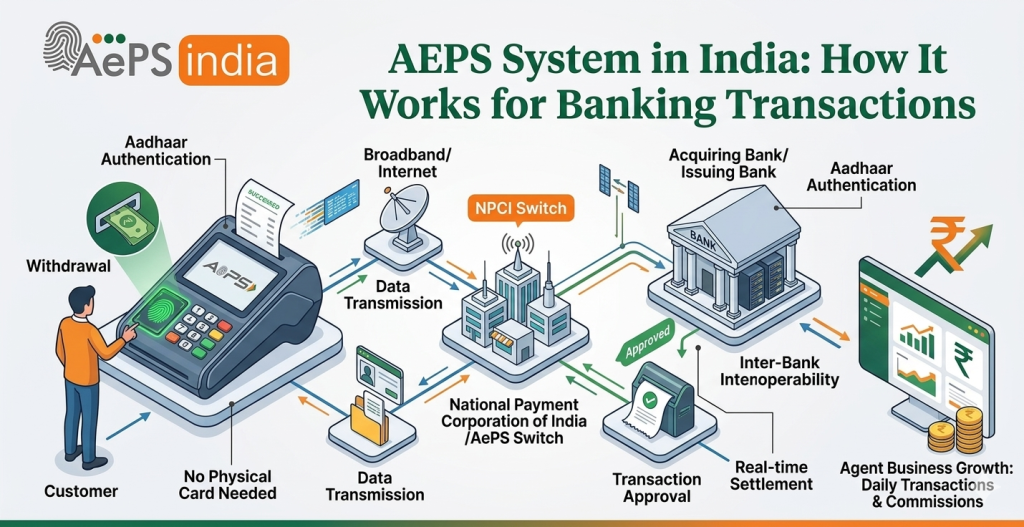
The AEPS system in India (Aadhaar Enabled Payment System) is one of the most important innovations in digital banking. It allows customers to perform basic banking transactions like cash withdrawal, balance enquiry and mini statement using only their Aadhaar number and fingerprint. This makes banking simple, fast, and accessible, especially for people in rural and remote areas.
Understanding how AEPS works for banking transactions is very important for retailers, agents and fintech businesses who want to offer digital banking services. The system uses biometric authentication, where a customer’s fingerprint is verified with their Aadhaar-linked bank account to complete transactions securely in real time.
The Aadhaar Enabled Payment System (AePS) is a bank-led model developed by NPCI that enables bank customers to perform basic financial transactions (cash withdrawal, balance enquiry, mini statement, Aadhaar-to-Aadhaar transfer) at Micro ATM or Business Correspondent outlets using their Aadhaar number and fingerprint/iris scan. It ensures secure, interoperable, and inclusive banking without physical cards.
A powerful AEPS system works by connecting banks with a secure network, where transactions are completed in real time using fingerprint authentication. This ensures fast, secure and reliable banking transactions, making it a trusted Aeps solution for millions of users.
The demand for AEPS cash withdrawal services is growing rapidly across India, as more people prefer quick and easy Aeps banking solutions without visiting bank branches. This creates a great opportunity for businesses to expand their Aeps services and increase their income.
Aeps india provides a reliable and secure AEPS system solution in India, designed to help businesses offer seamless Aeps banking services. With features like high transaction success rate, fast processing, secure Aeps API integration, and easy Aeps api setup, it enables retailers and agents to serve customers efficiently while earning Aeps commission on every transaction.
If you are planning to enter the digital banking sector, using a trusted AEPS system like Aeps india can help you build a strong, scalable, and profitable business in today’s competitive fintech market.
In this blog, you will learn everything about AEPS System, its features, benefits, and how it helps in smooth and secure banking transactions in 2026.
What is AEPS System in India?
The Aadhaar Enabled Payment System (AePS) is a bank-led model developed by the National Payments Corporation of India (NPCI) that allows customers to perform basic banking transactions using their Aadhaar data. By authenticating through fingerprint or iris scan on a micro ATM device or authorized correspondent, users can withdraw, deposit or transfer money without a debit card or PIN.

AEPS System Work
The Aadhaar Enabled Payment System (AEPS) is an NPCI-developed, bank-led model allowing users to perform secure banking transactions like cash withdrawals, deposits, and balance inquiries using their Aadhaar number and biometric authentication (fingerprint/iris) through a Business Correspondent (BC) or micro ATM devices. This best Aeps system enables interoperable banking, permitting customers to access their Aadhaar-linked accounts at any BC terminal without needing a bank branch, card or PIN.
Key Features of AEPS System Work
- Authentication & Security: Transactions require biometric verification, ensuring high security. The system verifies the user’s identity against Aadhaar records.
- Interoperability: Customers can use the banking services of any bank (that supports AePS) at any BC outlet, enabling access to funds regardless of the bank, as long as the account is linked to Aadhaar.
- Main Services:
- Cash Withdrawal: Users can withdraw money directly from their bank account at a merchant/BC location.
- Balance Enquiry: Provides real-time information about the available balance.
- Mini Statement: Generates a summary of the latest transactions.
- Aadhaar-to-Aadhaar Fund Transfer: Enables transfers between Aadhaar-linked accounts.
- Targeted Audience: Primarily Aeps design for rural, underbanked areas to provide doorstep banking, particularly benefitting beneficiaries of government schemes (like MGNREGA).
Types of AEPS Services
AEPS services allow bank customers to perform secure, cardless, and PIN-less transactions using Aadhaar authentication via business correspondents or micro ATM service. Key best Aeps services include cash withdrawal, deposit, balance enquiry, mini statements, and Aadhaar-to-Aadhaar fund transfers, primarily fostering financial inclusion.
Core AEPS Services
- Cash Withdrawal: Enables account holders to withdraw money directly from their Aadhaar-linked bank account without a debit card.
- Cash Deposit: Allows customers to deposit cash into their Aadhaar-linked account instantly through an agent.
- Balance Enquiry: Provides real-time access to check the current available balance in the linked bank account.
- Mini Statement: Generates a summary of the last few transactions conducted on the account.
- Aadhaar to Aadhaar Fund Transfer: Enables instant transfer of funds from one Aadhaar-linked account to another.
- Best Finger Detection (BFD): Identifies the best fingerprint among all ten digits for faster and more accurate authentication.
- Aadhaar Pay (Merchant Payment): Facilitates merchant transactions, allowing customers to make payments directly from their bank accounts without using POS machines, cards, or wallets.
Who Can Use AEPS System
Any resident of India with an Aadhaar-linked bank account can use the Aadhaar Enabled Payment System (AEPS) to perform basic banking transactions (cash withdrawal, balance enquiry, mini statement) via a Business Correspondent (BC) or micro-ATM. It is Aeps designed for all citizens, particularly in rural areas, requiring only biometrics (fingerprint/iris) and an Aadhaar number no debit card or PIN needed.
Key Requirements to Use AEPS:
- Linked Aadhaar & Bank Account: You must have an active bank account that is linked to your Aadhaar number.
- Biometric Authentication: Transactions require a fingerprint or iris scan, ensuring secure identification.
- Business Correspondent (BC): Services must be accessed via a Bank Mitra, micro ATM software services, or authorized agent (e.g., CSC, retailer).
Who Benefits Most?
- Rural Residents: Those without easy access to bank branches or ATMs, as agents bring banking services to their doorstep.
- Underprivileged Users: Individuals who may struggle with technology, PINs, or physical cards.
- Interoperable Access: Anyone can use any bank’s correspondent, making it highly flexible.

Why Use AEPS System
The Aadhaar-Enabled Payment System (AEPS) is a bank-led model launched by the NPCI that allows users to perform banking transactions, such as cash withdrawals, deposits and balance inquiries, using only their Aadhaar number and Aeps biometrics (fingerprint/iris) at a Micro ATM software solution. It eliminates the need for physical bank cards, PINs, or smartphones, making it a secure, convenient, and accessible way to conduct financial transactions.
Key reasons to use the AEPS system include:
- Financial Inclusion: AEPS connects individuals in remote areas, particularly those without easy access to bank branches or ATMs, to the mainstream banking system.
- Security and Safety: Transactions are protected by biometric authentication, significantly reducing the risk of fraud compared to card-based methods.
- No Card or PIN Needed: It allows users to make withdrawals and check balances simply by using their finger scan, eliminating the need to remember PINs or carry debit cards.
- Interoperability: Customers can access services at any banking correspondent’s micro ATM API, regardless of which bank holds their account.
- Direct Benefit Transfer (DBT): It facilitates the secure disbursement of government scheme benefits, such as pensions and scholarships, directly to beneficiaries.
- Easy Access: It provides a range of banking services including balance inquiry, cash withdrawal and fund transfers all in one place at local, authorized retail points.
The BEST Aeps system is highly secure, designed to be user-friendly, and supports the digital economy by bringing banking services closer to consumers.
Top Use cases of AEPS System
The Aadhaar Enabled Payment System (AEPS) is a crucial banking model in India, leveraging Aadhaar-based biometric authentication for secure, cardless, and PIN-less transactions. It promotes financial inclusion by turning local retail shops into bank-appointed service points (Micro ATM Machine), primarily facilitating Aeps cash withdrawal api service, Aeps cash deposit api service, Aeps balance inquiry API and Aeps mini statement API service.
Top Use Cases of AEPS System:
- Cash Withdrawal (Mini-ATM): Users can withdraw cash from their Aadhaar-linked bank accounts at local enabled micro-ATMs without needing a debit card or PIN.
- Cash Deposit: Customers can deposit cash directly into their accounts through agents in real-time, avoiding the need to visit a bank branch.
- Balance Inquiry & Mini Statement: Users can instantly check their bank account balance and review recent transaction histories, increasing trust in digital payments.
- Direct Benefit Transfer (DBT) Disbursement: Best AEPS is a critical channel for government beneficiaries to access pensions, subsidies (e.g., LPG), and wages (e.g., MGNREGA) locally.
- Aadhaar to Aadhaar Fund Transfer: Enables secure, instant money transfer software service between two different bank accounts that are both linked to Aadhaar.
- BHIM Aadhaar Pay (Merchant Payments): Enables merchants to accept digital payments from customers using their biometric authentication (fingerprint/iris).
- eKYC Services: Facilitates instant, paperless, and digital KYC for opening new bank accounts or subscribing to services, streamlining customer Aeps onboard.
These best Aeps service are particularly revolutionary in rural and underserved areas, allowing access to banking services at their doorstep.
Key Aspects of AEPS System
The Aadhaar Enabled Payment System (AEPS) is a bank-led model designed by NPCI for financial inclusion, allowing customers to perform, secure, cardless transactions such as cash withdrawals, deposits, and balance inquiries using their Aadhaar number and biometric authentication at low cost Micro ATM or via Banking Correspondents. It enables interoperable door-step banking.
Key Aspects of the AEPS System
- Biometric Security: Transactions require fingerprint or iris scanning, reducing fraud risk.
- Interoperability: Customers can use the Business Correspondent (BC) or agent of any bank to access their account, regardless of where they hold the account.
- No Physical Cards/PINs: Eliminates the need for debit cards, PINs, or smartphones, relying instead on Aadhaar verification.
- Essential Banking Services: Facilitates cash withdrawal, cash deposit, balance enquiry, mini-statements, and Aadhaar-to-Aadhaar fund transfers.
- Financial Inclusion: Highly crucial in rural and remote areas, bringing banking services to underserved populations.
- Core Requirements: Requires an Aadhaar-linked bank account (AEBA) and a biometric scanner.
- Transaction Limits: Typically, a maximum of ₹10,000 per transaction is permitted, with some banks having specific daily limits.
- Instant Transactions: Provides real-time processing of transactions, with a 12-digit number generated for tracking.
The top Aeps system serves as a digital “debit card” for rural areas and plays a vital role in Direct Benefit Transfers (DBT) for government subsidies.

Documents Required for AEPS Registration
AEPS registration requires personal Aeps KYC documents and technical hardware to act as a business correspondent (BC). Key documents include a self-attested Aadhaar card (linked to mobile), PAN card, active bank account details (passbook/cancelled cheque), passport-sized photo, and a STQC-certified Aeps biometric device (fingerprint/iris scanner).
Key Documents Checklist
- Aadhaar Card: Must be linked to a mobile number and the bank account used for settlements.
- PAN Card: Mandatory for identity verification.
- Bank Account Proof: Cancelled cheque or the first page of the passbook for settlement of funds.
- Mobile Number & Email: Active mobile number, preferably linked to Aadhaar.
- Passport-sized Photo: Recent photograph.
- Business Address Proof (Optional but Recommended): Electricity bill or rent agreement.
Hardware Requirements
- Biometric Scanner: UIDAI-certified and RD-service-compliant fingerprint or Aeps iris scanner (e.g., Mantra, Morpho).
- Device: Android smartphone or desktop computer with internet access.
Prerequisites for Registration
- Age: Minimum 18 years old.
- Bank Linking: Your bank account must be fully functional and mapped to your Aadhaar for transaction settlements.
- Authorized Service Provider: Registration should be done through an NPCI-approved Aeps india.
Role of AEPS System
The Aadhaar Enabled Payment System (AEPS), launched by the National Payments Corporation of India (NPCI), is a bank-led model enabling secure financial transactions using Aadhaar-based biometric authentication (fingerprint/iris) at buy Micro ATM machine and via Aeps india. It serves as a cornerstone for doorstep banking in rural and unbanked areas, requiring no physical card or PIN.
Key Roles and Functions of AEPS:
- Financial Inclusion: Extends banking services, such as cash withdrawals, deposits, balance inquiries, and mini-statements, to underserved populations, often through local shopkeepers acting as agents.
- Direct Benefit Transfer (DBT): Streamlines the secure delivery of government subsidies, pensions, and wages directly into accounts, bypassing middlemen.
- Secure Transactions: Utilizes biometric authentication to enhance security and prevent fraud.
- Interoperability: Facilitates transactions across different banks.
- Digital Payments: Enables merchants to accept payments through BHIM Aadhaar Pay.
Key Requirements & Limitations:
- Requirements: Requires Aadhaar-linked bank accounts.
- Limits: Typically limited to ₹10,000 per transaction, with some monthly restrictions.
- Challenges: Susceptible to biometric failures and reliance on internet connectivity.
- Risks: Vulnerable to sophisticated fraud like cloning, demanding strict compliance with safety guidelines.
Why AEPS System is Important for Digital India
The Aadhaar Enabled Payment System (AEPS) is critical to Digital India by enabling secure, interoperable, biometric-based banking for rural and underserved populations. It eliminates the need for cards or PINs, allowing instant cash withdrawals, deposits, and fund transfers through local agents, thereby driving financial inclusion, bolstering Direct Benefit Transfer (DBT) efficiency, and reducing reliance on cash.
Key Reasons AEPS is Important for Digital India:
- Financial Inclusion (The Last Mile): Top AEPS acts as a bridge for the unbanked and underbanked, bringing banking services to remote villages where bank branches are rare.
- Convenience and Accessibility: Customers only need their Aadhaar number and fingerprints/iris scan to perform transactions at a best Micro ATM or with a Business Correspondent (Bank Mitra), bypassing the need to travel to banks.
- Secure Transactions: By using unique biometric authentication, AEPS significantly reduces the risks associated with card fraud or forgotten PINs, ensuring safer transactions.
- Digital Empowerment for Rural Communities: It enables illiterate or semi-literate individuals to access banking through technology, transforming small local shops into “mini-banks”.
- Direct Benefit Transfer (DBT): It ensures seamless, corruption-free, and immediate disbursement of government benefits (e.g., NREGA, pension) directly to the beneficiaries’ Aadhaar-linked bank accounts.
- Interoperability: It allows users to connect with any bank’s services through a single, standardized platform, promoting a unified financial ecosystem.
- High Efficiency & Lower Cost: It offers low-cost banking to residents while reducing the need for physical infrastructure in remote areas.
AEPS turns simple, everyday locations into trusted banking touchpoints, making it a cornerstone of India’s cashless, digital economy.

Why AEPS System is Important in Banking System
The Aadhaar Enabled Payment System (AEPS) is crucial for driving financial inclusion in India, allowing users to conduct banking transactions Aeps cash withdrawal service, Aeps cash deposit service and Aeps balance inquiry service using only their Aadhaar number and biometrics (fingerprint/iris). It brings banking to remote areas via local agents, bypassing the need for physical branches, cards, or PINs, thus empowering rural, unbanked populations.
Key reasons for the importance of the AEPS system:
- Financial Inclusion & Accessibility: AEPS bridges the gap for rural populations with limited access to bank branches or ATMs by allowing local Micro ATM Machine and Business Correspondents (agents) to serve them.
- No Physical Cards or PINs Needed: It removes the dependency on physical debit/credit cards and remembering PINs, making it easier for users with low literacy to access their money securely.
- High-Level Security: Using biometric authentication (fingerprint/iris scan) reduces fraud risk, as transactions are tied directly to unique physical attributes.
- Direct Benefit Transfers (DBT): It facilitates the direct, secure, and transparent transfer of government subsidies, pensions, and welfare payments to beneficiaries’ Aadhaar-linked accounts, minimizing corruption.
- Interoperability: Customers of any bank can use their Aadhaar to transact at any AEPS-enabled agent point, ensuring a unified, seamless banking experience.
- Cost-Effective for Banks: It enables banks to expand their top Aeps service reach to remote areas without the high infrastructure costs of setting up traditional bank branches or ATMs.
Overall, AEPS turns local kirana shops or local agents into accessible banking service points, fostering a cashless and digitally enabled economy.
Why AEPS is Important for Rural and Semi-Urban Areas
Aadhaar Enabled Payment System (AEPS) is vital for rural/semi-urban areas because it bridges the financial inclusion gap by enabling secure, cardless, and PIN-less doorstep banking via biometric authentication. It empowers residents to perform transactions like cash withdrawals, deposits, and balance inquiries at local shops without traveling to distant bank branches.
Key reasons for its importance include:
- Deep Financial Inclusion: It reaches unbanked populations who lack debit cards, smartphones, or functional literacy, requiring only an Aadhaar number and fingerprint.
- Doorstep Banking Services: Local banking correspondents (agents) or village-level entrepreneurs provide services, solving the lack of bank branches or ATMs in remote areas.
- Secure & Reliable: Biometric authentication reduces risks of fraud compared to physical cards or signatures, ensuring secure transactions.
- Government Subsidy Access (DBT): It allows instant access to government welfare payments and Direct Benefit Transfers (DBT) directly into their accounts.
- Low-Cost Access: It eliminates travel costs to far-off city branches, making banking affordable.
With over 2.4 billion transactions in FY 2024, AEPS acts as a digital lifeline, making banking an accessible, daily reality for rural India.
Features AEPS System
The Aadhaar Enabled Payment System (AEPS) is a secure, bank-led model enabling financial transactions using Aadhaar authentication and biometrics (fingerprint/iris) at purchase micro ATM or via business correspondents. Key features include cardless/pinless transactions, high security, 24/7 accessibility for rural areas and interoperability across different banks.
Core Features of AEPS System
- Biometric Authentication: Transactions are secured by scanning the user’s fingerprint or iris, ensuring authorized access without a PIN or signature.
- Cardless & Pinless Transactions: Eliminates the need to carry debit/credit cards or remember PINs, reducing the risk of card fraud.
- Essential Banking Services: Facilitates cash withdrawals, cash deposits, balance inquiries, mini-statements, and Aadhaar-to-Aadhaar fund transfers.
- Financial Inclusion & Accessibility: Provides rural and unbanked populations with access to banking services via local business correspondents (BCs) or kirana shops.
- Interoperable Platform: A customer can use their Aadhaar-linked account to transact at any bank’s micro-ATM.
- High-Security Infrastructure: Uses UIDAI database verification, reducing the risk of fraud and ensuring safe transactions.
- Instant Transactions: Transactions are processed in real-time, providing immediate confirmation and fund transfers.
- Free Registration: Users can register for AEPS for free by visiting their bank branch or a correspondent.
- Real-time Transactions: Aeps india offers instant, real-time settlement of transactions.
- Daily Transaction Limits: To enhance security, there is a standard daily limit, with some banks capping transactions up to ₹50,000.
Benefits AEPS System
The Aadhaar Enabled Payment System (AePS) is a secure, biometric-based Aeps platform allowing instant, cardless banking withdrawals, deposits, and balance checks at local, remote agents. By using Aadhaar and fingerprints, it boosts financial inclusion, eliminating the need for bank branches, PINs, or smartphones particularly in rural India.
Key Benefits of the AePS System:
- High Security (Biometric Authentication): Transactions are authorized using unique fingerprints or iris scans, minimizing frauds associated with stolen cards or PINs.
- Financial Inclusion for Remote Areas: Brings banking to the doorstep of rural residents and those with limited access to traditional bank branches or ATMs.
- Convenience and Security: Eliminates the need for debit/credit cards or ATM PINs. Transactions are secured via Aadhaar-linked biometric authentication (fingerprint or iris scan).
- Interoperability: Customers can use their Aadhaar-linked account to transact at any bank’s micro-ATM or agent point, regardless of where they hold their account.
- Instant Transactions: Facilitates fast, real-time banking services and fund transfers.
- Cardless & Paperless Banking: No need to carry physical debit cards, paper slips, or remember PINs, making it highly convenient.
- Doorstep Banking: Reduces the need for traveling long distances to urban bank branches; banking services are brought to the local village level.
- Core Banking Services: Facilitates essential services like cash withdrawal, cash deposit, balance enquiry, and mini-statement generation.
- Direct Benefit Transfer (DBT): Assists the government in directly transferring subsidies and payments into beneficiaries’ accounts, reducing fraud and delays.
- Diverse Services: Aeps india offers multiple, essential services including cash withdrawal, balance check, mini statements, and Aadhaar-to-Aadhaar fund transfers.
- Easy Setup for Agents: Enables local shopkeepers to become banking points without massive infrastructure, helping them grow their business while serving the community.
- Simple & User-Friendly: Aeps system Design for ease of use, even for individuals with low digital literacy, by simply using fingerprint technology.
AePS acts as a “mini-bank,” empowering local shopkeepers to become business correspondents, further simplifying banking access for citizens.

AEPS API Integration for Businesses
AEPS API integration involves partnering with an NPCI-certified Aeps india, completing KYC, and implementing biometric authentication on your platform. Key steps include signing up, receiving Aeps API credentials (MID/Keys), installing STQC-certified Aeps L1 device RD services, developing Aeps software backend integration testing in a sandbox environment, and going live.
Steps for AEPS API Integration Process:
- Select a Certified Provider: Partner with an Aeps india that offers robust security, high uptime and comprehensive Aeps api documentation.
- Onboarding & KYC Compliance: Submit mandatory documents, including Aadhaar, PAN card, and bank account details for verification to register as a business correspondent.
- Acquire Hardware (Biometric Device): Purchase Aeps L1 biometric device (fingerprint or iris scanner) and register it with the Aeps india.
- Receive API Credentials: Upon approval, you will receive Aeps API keys, Aeps ID (MID), and documentation required for technical integration.
- Technical Integration & Backend Development:
- Frontend: Integrate the SDK to capture user Aadhaar, IIN (bank code), and encrypted biometric data.
- Backend: Develop Aeps API endpoints for transaction requests (e.g., cash withdrawal, balance inquiry) using JSON/XML to connect to the NPCI network.
- Sandbox Testing: Perform rigorous testing in a provided sandbox environment to ensure secure biometric data transmission and proper error handling.
- Go Live & Monitor: Move to the production environment to start Aeps api live transactions, ensuring continuous monitoring of security and reconciliation.
Key Requirements:
- Compliance: Adhere to the “One Operator, One Bank” policy for settlement.
- Data Security: Ensure no biometric data is stored, following RBI data localization guidelines.
- Device RD Service: Install the specific RD Aeps service app (e.g., Mantra).
AEPS Commission Structure and Earning Opportunities in AEPS
AEPS allows retailers to act as mini-banks, earning commissions of ₹2–₹17+ per transaction for cash withdrawals, deposits, and balance inquiries. Retailers earn Aeps high commissions on large withdrawals (up to ₹10,000) through Aeps platforms like Aeps india. Key income streams include transaction commissions, mini ATM services, and monthly performance bonuses.
AEPS Commission Structure 2026 (Typical Slab)
The Aeps commission is usually tiered based on the withdrawal amount, with higher amounts yielding better returns.
- ₹100 – ₹999: ₹2.00 per transaction
- ₹1,000 – ₹1,499: ₹3.00 per transaction
- ₹1,500 – ₹1,999: ₹4.50 per transaction
- ₹2,000 – ₹2,499: ₹5.50 per transaction
- ₹2,500 – ₹2,999: ₹5 – ₹7 per transaction
- ₹3,000 – ₹10,000: ₹10 – ₹15+ per transaction
- Balance Inquiry/Mini-statement: ₹2–₹3 per transaction
AEPS Commission Structure
Aeps Commissions are typically slab-based, rewarding higher transaction amounts.
| Transaction Amount (₹) | Approximate Commission (₹) |
|---|---|
| 100 – 499 | ₹0.50 – ₹1.00 |
| 500 – 999 | ₹1.00 – ₹3.00 |
| 1,000 – 1,499 | ₹2.00 – ₹5.00 |
| 1,500 – 1,999 | ₹3.00 – ₹7.00 |
| 2,000 – 2,499 | ₹5.00 – ₹9.00 |
| 2,500 – 2,999 | ₹7.00 – ₹11.00 |
| 3,000 – 3,499 | ₹8.00 – ₹13.00 |
| 3,500 – 7,999 | ₹10.00 – ₹14.00 |
| 8,000 – 10,000 | ₹12.00 – ₹15.00+ |
Earning Opportunities in AEPS
Retailers can maximize Aeps earnings by offering comprehensive services:
- Cash Withdrawal: Highest income source, particularly with large transaction volumes (e.g., ₹2,000 withdrawal can net ₹6).
- Balance Inquiry & Mini Statement: Smaller commissions (e.g., ₹0.50) but drive customer footfall.
- Micro ATM: Provides extra commission for card-based transactions.
- Aadhaar Pay: Enables high-value transactions above ₹10,000 (up to ₹50,000).
- Bill Payments & Recharges: Additional services like BBPS service (electricity, water, gas).
- Money Transfer (DMT): Domestic money transfer API offer additional service fees.
- Monthly Incentives: Aeps india offer bonuses for exceeding a specific number of transactions per month.
Requirements to Start
- KYC: Valid PAN and Aadhaar Card.
- Hardware: Smartphone/computer, internet, and a registered Aeps biometric scanner (e.g., Mantra MFS100).
- Registration: Aeps Registration fees range from free up to ₹3,000 for Aeps india.
Factors Affecting Earnings
- Transaction Volume: Higher traffic directly increases profits.
- Service Provider: Aeps india offer varying commission structures and incentive schemes.
- Settlement Type: Instant settlement (T+0) or next-day (T+1) affects cash flow management.
AEPS Transaction Charges
Aadhaar Enabled Payment System (AePS) transactions are generally free for customers, with no direct charges for cash withdrawals or balance inquiries at most bank ATMs or Business Correspondent (BC) points. However, banks may charge agents or customers for frequent transactions, with some banks applying fees (e.g., ₹20+GST) after 3-5 free monthly transactions.
Key AePS Charges and Limits Overview
- Customer Charges: Aeps india offer free AePS services to users, but some impose charges after a specific number of transactions (e.g., 3-5 free transactions/month).
- Charges per Transaction (Post-Free Limit): After free limits, charges can range from ₹15-20 + GST for cash withdrawals or deposits.
- Balance Enquiry/Mini Statement: Typically, 5 free transactions are allowed per month. Subsequent checks may cost around ₹5 + GST.
- Transaction Limits: Typically, the maximum withdrawal per transaction is ₹10,000, with varying daily limits often around ₹50,000.
- Setup Costs: Retailers often pay for Aeps ID activation (up to ₹1,250) or buy Aeps biometric devices (Aeps L1 scanner: ₹1,500–₹3,000).
- Agent Incentives: High volume Aeps agents processing 150-200+ transactions monthly can earn additional bonuses of ₹2,000+.
- Platform Variation: Aeps india offer slightly best Aeps commission structure, with some offering higher earnings than others.

How Retailers Earn Money from AEPS System
Retailers earn money through the Aadhaar Enabled Payment System (AEPS) by charging commissions on customer transactions, specifically earning ₹2–₹15+ per cash withdrawal. Acting as a “Mini ATM,” they utilize a smartphone and purchase Aeps biometric device to process cash withdrawals, balance inquiries, and mini-statements, receiving higher payouts for larger transactions.
How Retailers Earn via AEPS:
- Cash Withdrawal Commission: The primary income source, offering a tiered Aeps commission structure. Transactions between ₹3,000–₹10,000 can earn the highest payouts, often ₹12–₹15+ per transaction.
- Balance Enquiry & Mini-Statements: Retailers earn Aeps commissions, typically ₹1–₹5, for assisting customers with these services.
- Aadhaar Pay (Merchant Payments): Retailers can facilitate payments for goods using a customer’s Aadhaar, earning approximately 1% commission on these high-value transactions (up to ₹50,000).
- Increased Footfall & Cross-Selling: Providing banking services attracts more customers to the store, increasing sales of regular retail products.
Requirements to Start:
- Biometric Device: A finger/iris scanner (e.g., Morpho).
- Android Phone/PC: With an internet connection.
- AEPS Provider: Registration with a best AEPS service provider company like Aeps india for Aeps API integrate.
- KYC Verification: Simple digital Aeps onboarding.
Key Advantages:
- Instant Settlement (T+0): Daily earnings are often settled immediately or within 24 hours, keeping cash flowing.
- Low Cost: Minimal investment for high daily income potential (up to ₹3,000+ per day).
- Reduced Cash Management: Retailers can use cash from sales to fulfill withdrawal requests.
AEPS System Real-Time Transactions and High Success Rate
The Aadhaar Enabled Payment System (AEPS) offers secure, real-time banking transactions (cash withdrawal, balance inquiry, mini-statement) with a high success rate typically exceeding 98%–99.9% facilitated by instant 𝑇+0 settlement and biometric authentication. Best Aeps service provider like Aeps india ensure 99.9% uptime, serving rural and urban areas with 24/7 technical support and secure NPCI-compliant systems.
Key Features for High-Performance AEPS:
- Real-Time Processing: Transactions are processed within seconds, providing immediate cash access.
- High Success Rates: Top Aeps platform offer >98% success rates to minimize failures and build trust.
- Instant Settlement (T+0): Immediate wallet settlement ensures continuous working capital for agents.
- Enhanced Security: Adheres to NPCI/RBI guidelines using biometric (fingerprint/iris) authentication to prevent fraud.
- Maximum Earnings: High Aeps commission structures (up to ₹15–₹20 per transaction) for agents.
Key Benefits of High-Performance AEPS:
- Reduced Failures: High reliability Aeps systems ensure that biometric authentication is precise and transaction failure rates are minimal.
- All-India Coverage: High speed Aeps system work efficiently, even in low-connectivity rural areas.
- Diversified Income: Agents can earn through cash withdrawals, Mini-Statements and Aadhaar Pay API, which supports higher transaction volumes.
Devices Needed for AEPS System
An AePS setup requires a STQC-certified Aeps biometric scanner, a smartphone/PC, and stable internet. Key hardware includes Aeps fingerprint scanners (e.g., Mantra MFS100) or buy Aeps iris scanners, along with an AePS app/Aeps portal. A buy Micro ATM device is optional for printing receipts.
Essential Devices & Requirements for AePS:
- Biometric Fingerprint Scanner: Mandatory for customer authentication, must be STQC-certified and Registered Device (RD) compliant.
- Smartphone or Computer: Android phone (version 7.0+) or Windows PC/laptop (Windows 10+) with USB/Bluetooth connectivity.
- Stable Internet Connection: Reliable 4G or broadband for real-time transactions.
- AePS Application: Software from a Aeps india.
- Optional Hardware: Purchase Micro ATM device (all-in-one device with scanner/printer).
Commonly Used Certified Brands:
- Fingerprint Scanners: Mantra (MFS100).
- Iris Scanners: Mantra (MIS100).
Ensure the Aeps device is Registered Device (RD) service enabled, as non-certified sensors built into phones cannot be used for AEPS transactions.

White Label AEPS Software Solution for Businesses
White Label AEPS software is a pre-built, fully customizable digital Aeps banking platform that allows businesses to offer cash withdrawals, balance inquiries, and money transfers under their own brand logo and domain. It provides a rapid, cost effective Aeps launch without complex infrastructure Aeps software development, offering a secure, RBI-approved Aeps softare solution managed via a customized Aeps admin panel.
Key Features of White Label AEPS Solutions
- Custom Branding: Use your own brand name, domain, logo, and color schemes.
- Admin Panel: Control and manage an unlimited network of super distributors, distributors, and retail agents.
- Core Services: AEPS (cash withdrawal, balance check), DMT (Money Transfer), best BBPS service (bill payments), and best Recharge api service.
- Security: High-level, secure, and compliant with standard financial regulations.
- Real-time Management: Instant settlement, wallet management, and real-time transaction reporting.
Key Benefits for Businesses
- Low Cost & Quick Entry: Skip the high cost and time of building from scratch, entering the fintech market quickly.
- Revenue Generation: Earn commission on every transaction.
- Build Credibility: Launch a high-tech financial Highest commission Aeps platform under your own brand.
- Comprehensive Backend: Backend, security, and updates are handled by the Aeps india.
Best AEPS Provider in India for Retailers and Businesses
The best AEPS service provider in India such as Aeps India and Noble Web Studio offer high commissions up to ₹15–₹16 per transaction, 99.9% uptime, and instant (T+0) settlements. These High commission Aeps platform are highly secure, supporting biometric/face authentication for rural/urban banking.
Key Considerations for Selecting a Provider:
- Commission Rates: Look for Aeps india offering up to ₹15-₹16 on higher transactions.
- Settlement Speed: Instant (T+0) settlement enables better cash flow for retailers.
- Uptime/Success Rate: Aim for High volume Aeps platform with >98% transaction success rates for reliability.
- Support: 24/7 technical support is vital for managing, and preventing, transaction failures.
How to Choose Best AEPS System Provider in india
Aeps india one of the best AEPS system provider in India requires prioritizing high transaction success rates (>98%), instant settlement (T+0), strong security (NPCI/RBI certified), and 24/7 technical support. Look for competitive commissions (₹5–₹15 per transaction) and user friendly Aeps b2b apps, top options including Aeps india and Noble web studio.
Key Factors for Selecting an AEPS Provider
- Security & Regulatory Compliance: Ensure the Aeps india is certified by NPCI, RBI, and adheres to UIDAI guidelines for biometric (fingerprint/iris) authentication to ensure customer data protection.
- High Success Rates & Reliability: Look for 99.9% uptime and a >98% transaction success rate. Frequent downtime leads to failed transactions and loss of customer trust.
- Settlement Speed (Working Capital Management): Aeps India and Noble web studio offer instant or same-day (T+0 or T+1) settlements, allowing you to move cash from your wallet to your bank account immediately.
- Commission Structure: Look for a transparent and highest Aeps commission structure, often ranging from ₹5 to ₹15+ per transaction with no hidden fees.
- Customer Support: 24/7 technical support via phone or WhatsApp is essential for resolving failed transactions instantly.
- User-Friendly Platform: The best Aeps app or best Aeps portal should be easy to use, providing real-time tracking.
- Additional Services: Aeps india offer in addition to AEPS software service, Micro ATM software service, BBPS API service and DMT API services.

Why Choose Provider for AEPS System Solutions
Aeps india is a professional AEPS solution provider is crucial for reliable, secure, and compliant banking services that boost revenue, customer footfall, and operational efficiency. Aeps india offer high transaction success rates (>98%), 24/7 technical support and instant settlement, allowing retailers to act as mini-banks for rural, unbanked populations.
Why Choose a Dedicated AEPS Provider:
- Security and Compliance: Aeps india offer secure Aadhaar-based biometric (fingerprint/iris) authentication that complies with NPCI and RBI guidelines, reducing fraud risk.
- Reliability and Speed: Aeps india ensure a 99.9% system uptime and a 98%+ success rate for cash withdrawals, balance inquiries, and mini statements, which is critical for building customer trust.
- Instant Settlement (T+0): Enables immediate or same-day settlement of funds to the agent’s bank account, keeping working capital liquid.
- Revenue Generation: Agents and businesses earn competitive Aeps commission rates, often ranging from ₹7–₹20 per transaction.
- User-Friendly Technology: Aeps india provide intuitive mobile Aeps apps and web portals that simplify onboarding and operations for agents.
- Comprehensive Services: Beyond just cash withdrawals, providers often include Mini-statements, Aadhaar Pay API service, BBPS API service (bill payments), and Domestic Money Transfer API service (DMT).
- Enhanced Customer Traffic: By providing essential Aeps banking api services, especially in rural or underserved areas, local shops can increase customer loyalty and footfall.
- Easy Technical Integration: Access to user-friendly Aeps B2B apps, Aeps portals and robust Aeps API (Application Programming Interfaces) designed for easy setup and scaling.
- Support & Training: Aeps india provide 24/7 technical support to resolve issues instantly and assist with Aeps agent onboarding.
Partnering with a reliable AEPS provider provides access to secure technology, such as biometric fingerprint or iris scanners, making banking accessible without a physical bank branch.
Future Trends AEPS System in India
The Aadhaar Enabled Payment System (AEPS) is evolving from basic cash withdrawals into a comprehensive rural financial hub, featuring enhanced biometric security (liveness detection), near real-time transactions, and AI-driven fraud prevention. It will expand services to include micro-loans, insurance and BBPS deeply integrating with local retail networks.
Key Future Trends in AEPS System:
- Advanced Biometric Security: To combat fraud, the system is moving toward mandatory liveness detection and enhanced biometric standards, reducing false authentication attempts.
- Regulatory Tightening: Implementation of strict “one-agent-one-bank” linking and mandatory re-KYC for inactive agents to ensure accountability.
- Instant T+0 Settlement: Real-time settlement for agents, improving liquidity and efficiency.
- Mobile-First Design: Enhanced, user-friendly Aeps Android APP interfaces for agents in rural areas.
- Beyond Cash Withdrawals: Agents are becoming comprehensive Aeps india, offering insurance, micro-loans, and BBPS software service (bill payments) through integrated Aeps platform.
- Embedded Finance: Banking services are being deeply embedded into diverse, non-financial Aeps b2b apps for better rural reach.
- AI and Machine Learning (ML): AI/ML will be heavily utilized to analyze transactions in real-time, predicting user behavior and preventing fraudulent activities.
- Faster and Reliable Transactions: By 2026, infrastructure enhancements will focus on providing near real-time, 24/7 transaction settlements, reducing failures.
- Increased Reliance on Local Correspondents: The network of business correspondents and local retail stores will expand, acting as essential, trusted financial hubs in rural areas.
- Blockchain Integration: To ensure transparency and tamper-proof records, blockchain technology may be adopted for recording transactions, increasing user trust.
- Multi-Modal Biometrics: Moving beyond fingerprints to include iris and facial recognition for higher accuracy and faster authentication.
- Stricter Regulatory Compliance: The RBI is implementing stricter guidelines for operator onboarding, monitoring, and technical controls to enhance security.
- Face and Iris Authentication: Future authentication will likely move beyond fingerprints to include iris and facial recognition for higher security and accuracy.
These trends reflect a strategic shift toward making AEPS a secure, comprehensive, and accessible digital payment ecosystem tailored for India’s rural and semi-urban populations.

Conclusion
The AEPS system in India (Aadhaar Enabled Payment System) has become a powerful solution for delivering simple and secure banking services to every corner of the country. It allows customers to perform essential banking transactions like cash withdrawal, balance enquiry, and mini statement using just their Aadhaar number and fingerprint, without needing a debit card or visiting a bank branch.
The Aadhaar Enabled Payment System (AePS) is a bank-led model developed by the NPCI that allows users to perform basic banking transactions securely using their Aadhaar number and biometric authentication (fingerprint/iris scan). It enables interoperable, cardless, and PIN-less transactions through Business Correspondents (BCs) or Micro ATMs.
For retailers, agents, and fintech businesses, AEPS offers a great opportunity to provide AEPS banking services and earn commission on every transaction. With the increasing demand for AEPS cash withdrawal services in India, especially in rural and semi-urban areas, this system is helping expand financial inclusion and digital banking access.
Aeps india is an top AEPS service provider in India ensures secure biometric authentication, real-time transactions, and high success rate, making the entire process fast Aeps, safe, and user-friendly. This not only improves customer convenience but also increases trust in digital banking services.
Aeps india is the right AEPS service provider in India is important for long-term success. A strong Aeps platform ensures fewer transaction failures, quick settlement, and better performance, which directly impacts your business growth.
Aeps india provides a reliable and secure AEPS system solution in India with features like high transaction success rate, fast processing, secure biometric authentication, and easy integration. This helps businesses offer smooth services, build customer trust, and increase their daily earnings.
If you want to grow in the digital banking sector, using a trusted and scalable AEPS system like Aeps india is the best step toward higher income, better service, and long-term success in the fintech industry.
Frequently Asked Questions (FAQs) – AEPS System in India
The AEPS system in India (Aadhaar Enabled Payment System) is a digital banking service that allows users to perform cash withdrawal, balance enquiry, and mini statement using Aadhaar number and biometric authentication.
The AEPS system works through Aadhaar verification and fingerprint authentication. A customer provides their Aadhaar number, selects the bank, and completes the transaction using biometric verification.
Any bank customer with an Aadhaar-linked bank account can use AEPS banking services through authorized retailers or agents.
The AEPS banking services include:
Cash Withdrawal
Balance Enquiry
Mini Statement
Aadhaar-based transactions
To start AEPS business in India, you need:
Aadhaar card
PAN card
Bank account details
Mobile number
Yes, the AEPS system in India is highly secure because it uses biometric authentication and encrypted transactions, reducing the risk of fraud.
Key benefits include easy banking access, no need for debit card, real-time transactions, low cost, and availability in rural areas.
Retailers earn commission on every AEPS transaction such as cash withdrawal and balance enquiry, making it a profitable business model.
Yes, AEPS does not require internet banking. Transactions are completed using Aadhaar and biometric verification, making it accessible for everyone.
The AEPS system in India helps people in rural and remote areas access banking services without visiting banks, supporting financial inclusion.
Businesses and retailers can earn commission on every AEPS transaction, making it a profitable digital banking business in India.
Yes, a basic internet connection is required for real-time AEPS transactions, but it works even in low-connectivity areas.
Yes, businesses and retailers can earn commission on every AEPS transaction, making it a profitable opportunity in the digital banking and fintech sector.
No, the AEPS system does not require a debit card or PIN. Transactions are done using Aadhaar number and fingerprint authentication.
Aeps india offers secure Aeps platform, high success rate, easy integration, fast transactions, and reliable support for business growth.
The future of the AEPS system in India is very strong due to increasing demand for digital banking, financial inclusion, and Aadhaar-based services, making it a growing opportunity for both users and businesses.
Best AEPS API Provider in India: Features, Pricing, Integration & Benefits

Best AEPS B2B Software Provider for Your Business in 2026
Trusted AEPS Panel: Features, Benefits and Business Opportunities
About Author

