Why AEPS Software is Important for Financial Inclusion in India
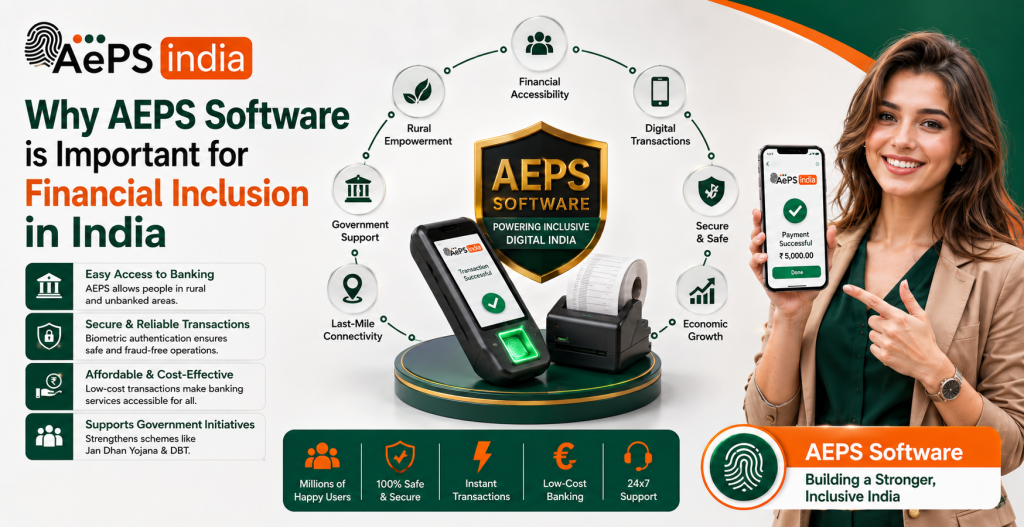
If you are searching why AEPS software is important for financial inclusion in India, you are looking at one of the most powerful tools transforming the country’s banking system. The AEPS (Aadhaar Enabled Payment System) has made it possible for people to access basic banking services like cash withdrawal, balance inquiry, and mini statement using just their Aadhaar number and fingerprint. This is especially helpful in rural and semi-urban areas where traditional banking facilities are limited.
With the help of advanced AEPS software solutions, retailers and agents can act as mini banking points, providing instant services to nearby customers. Features like real-time transactions, high success rate, multi-bank support, and secure biometric verification ensure a smooth and reliable user experience.
One of the biggest benefits of AEPS software for financial inclusion is that it promotes easy access to banking for unbanked and underbanked populations, helping them participate in the formal financial system. At the same time, it creates a profitable business opportunity for retailers through a commission-based earning model.
For businesses and retailers, using a reliable platform like Noble Web Studio makes it easy to start and manage AEPS services. It offers secure transactions, fast processing, and high success rates, ensuring a smooth experience for both retailers and customers.
NobleWebStudio provides a trusted and secure AEPS software solution, designed to support fast transactions, high success rates, and easy onboarding. It helps retailers and agents serve more customers while contributing to the goal of digital financial inclusion in India.
By choosing a trusted platform like NobleWebStudio AEPS software, businesses can offer secure and scalable services while contributing to the growth of a cashless and digitally empowered India.
In this complete guide, Noble Web Studio will explain everything in simple and easy language what AEPS software is, why it matters so deeply for India’s financial inclusion journey, how it is changing millions of lives, and why every retailer, agent and entrepreneur should be part of this powerful movement in 2026.
What is AEPS Software
AEPS (Aadhaar Enabled Payment System) software is a secure, NPCI-developed digital banking solution that allows customers to perform financial transactions cash withdrawal, balance inquiry, and mini statements—using only their Aadhaar number and fingerprint/iris scan at a retailer’s shop. It acts as a cardless, PIN-less “micro-ATM” for banking correspondents.

AEPS Software Work
AEPS (Aadhaar Enabled Payment System) software is a bank-led model enabling secure, cardless banking transactions cash withdrawal, balance enquiry, mini-statement, and fund transfers using Aadhaar authentication. Agents use a smartphone/computer, biometric device, and software to connect to the NPCI network, allowing local shops to function as mini-ATMs and earn commissions.
AEPS software is the most powerful tool India has today to make that dream a reality.
How AEPS Software Works
- Initialization: The retailer opens the AEPS portal/app, selects the service (e.g., Cash Withdrawal), and enters the customer’s Aadhaar number and bank name.
- Authentication: The customer places their finger on a STQC-certified biometric scanner.
- Verification & Processing: The software encrypts the data and sends it to UIDAI for identification. Once verified, the request goes through NPCI to the respective bank.
- Transaction Completion: Upon successful bank authorization, the transaction is completed instantly, cash is provided to the customer, and the agent receives an immediate commission.
AEPS Services Offered Through Software
AEPS (Aadhaar Enabled Payment System) software enables secure, biometric-based banking services, turning retail outlets into mini-banks. Key services include cash withdrawals, balance inquiries, mini-statements, cash deposits, Aadhaar-to-Aadhaar fund transfers, Aadhaar Pay for merchants, and e-KYC, mostly via Aadhaar authentication.
Core AEPS Services Offered Through Software
- Cash Withdrawal: Enables customers to withdraw money from their Aadhaar-linked bank account without a debit card.
- Balance Enquiry: Provides real-time, instant checking of account balances.
- Mini Statement: Generates a quick, digital, or printed summary of recent transaction history.
- Cash Deposit: Facilitates instant cash deposits into Aadhaar-linked accounts.
- Aadhaar to Aadhaar Fund Transfer: Enables secure, direct money transfers between two Aadhaar-linked accounts.
- Aadhaar Pay: Allows merchants to accept cashless payments directly from a customer’s account using biometrics.
- e-KYC: Facilitates electronic verification for banking services.
- Best Finger Detection (BFD): Identifies the best fingerprint for successful authentication.
Types of AEPS Software
AEPS (Aadhaar Enabled Payment System) software enables cardless banking via biometric authentication, primarily used for cash withdrawals, balance inquiries, and mini-statements. Key software types include White-Label Portals (pre-built, branded), Custom APIs (bank-integrated), and Mobile-first Apps tailored for rural and urban merchant transactions.
Key Types of AEPS Software Solutions:
- White-Label AEPS Portal: Pre-built, ready-to-use platforms customized with your brand name, logo, and domain, costing roughly ₹15,000–₹35,000.
- Custom AEPS API Integration: Specialized development tailored for large entities requiring direct integration with banks (e.g., ICICI, Yes Bank). These are highly scalable but cost over ₹1 lakh.
- Ready-made B2B/Admin Software: Off-the-shelf software, often costing ₹35,000–₹60,000, designed to manage a network of agents.
- AEPS Agent/Retailer App: Mobile applications used by agents to facilitate transactions using a smartphone and fingerprint scanner.
These software solutions often include added services like Mobile Recharge, BBPS, and Micro ATM integration.

Who Can Use AEPS Software
AEPS (Aadhaar Enabled Payment System) software can be used by authorized bank agents, Business Correspondents (BCs), shopkeepers, and fintech entrepreneurs to offer banking services. Key users also include rural residents, pensioners, and beneficiaries of government schemes (DBT) who need to access their Aadhaar-linked bank accounts via biometric authentication for cash withdrawals, balance inquiries, and mini statements.
Who Can Use AEPS Software as Agents (Service Providers)
- Retailers & Shop Owners: Kirana stores, mobile shops, pharmacies, and small retail shops can turn their businesses into “Mini ATMs”.
- Business Correspondents (BCs) & Agents: Authorized individuals acting on behalf of banks to provide services in rural or unbanked areas.
- Common Service Centers (CSC) & Cyber Cafes: Digital service centers offering digital payments to citizens.
- Fintech Entrepreneurs: Startups looking to integrate or white-label AEPS, UPI, and financial services.
Who Can Use AEPS Services as Customers (Users)
- Bank Account Holders: Any Indian resident with an Aadhaar-linked bank account (AEBA).
- Rural & Remote Area Residents: Individuals with limited access to traditional bank branches or ATMs.
- Government Scheme Beneficiaries: Recipients of DBT, such as MGNREGA wages or social security pensions.
- Individuals Without Cards/Smartphones: People who prefer to use, or only have access to, biometric authentication.
Key Requirements to Operate AEPS Software
- Mandatory Documents: PAN card, Aadhaar card, and bank account details (for BC/Agent registration).
- Hardware: An Android smartphone or PC and a STQC/UIDAI-certified fingerprint or iris scanner.
- Connectivity: A stable internet connection.
Why Use AEPS Software
Aadhaar Enabled Payment System (AEPS) software enables secure, cardless banking—cash withdrawals, balance inquiries, and mini-statements—using biometrics, facilitating financial inclusion in rural areas. It allows retail agents to offer doorstep banking, boosting income through commissions, while providing interoperable, 24/7 services across banks, reducing dependence on physical ATMs.
Key Reasons to Use AEPS Software:
- Financial Inclusion: Extends crucial banking services to rural and remote areas where bank branches are scarce.
- High Security: Transactions are authenticated via fingerprint or iris scan, reducing fraud risks compared to PIN-based cards.
- Convenience & Cardless Transactions: Users only need their Aadhaar number to conduct transactions, eliminating the need to carry cards or remember PINs.
- Business Opportunity for Retailers: Shopkeepers can earn high commissions on transactions while increasing customer footfall.
- Interoperability: Customers can use any AEPS-enabled device to access their bank account, regardless of the bank, increasing accessibility.
- Direct Benefit Transfer (DBT): Facilitates fast, secure, and direct transfer of government subsidies, pensions, and wages to beneficiaries.
- Lowered Infrastructure Cost: Reduces the need for costly, physical ATM installations in remote locations.
For businesses and fintech startups, adopting robust AEPS software is a key strategy for tapping into the rural digital economy and providing essential financial services.
Top Use Cases of AEPS Software
AEPS (Aadhaar Enabled Payment System) software enables cardless, biometric-based banking, acting as a “mini-bank” to drive financial inclusion. Key use cases include cash withdrawals, deposits, balance inquiries, mini-statements, Aadhaar-to-Aadhaar fund transfers, Direct Benefit Transfers (DBT) of government subsidies, and secure Aadhaar Pay merchant payments.
Core Use Cases of AEPS Software
- Cash Withdrawal (Micro-ATM): Provides immediate cash withdrawal services to customers at local retail shops without needing a debit card, PIN, or ATM, making it ideal for rural areas.
- Cash Deposit: Allows customers to deposit cash directly into their Aadhaar-linked bank accounts through local, authorized agents.
- Balance Inquiry & Mini-Statement: Enables instant access to view current account balances and review recent transactions using biometrics.
- Aadhaar-to-Aadhaar Fund Transfer: Facilitates secure, real-time money transfers between two different bank accounts linked to the same or different Aadhaar numbers.
- Direct Benefit Transfer (DBT) Access: Serves as a vital channel for villagers to withdraw government subsidies, scholarships, and pensions (e.g., MNREGA payments).
- Aadhaar Pay (Merchant Payments): Empowers small business owners to accept digital payments from customers through biometric authentication, eliminating the need for a PoS machine.
- eKYC (Electronic Know Your Customer): Facilitates instant, paperless identity verification for opening bank accounts or accessing financial services.
- Utility Bill Payments & Recharges: Enables agents to provide additional services such as mobile recharges and bill payments (electricity, DTH) through the same platform.
- Agent Banking/Banking Correspondent: Empowers local shop owners to operate as banking agents, offering banking services to the surrounding community.
Common Use Cases in Daily Life
- Small Retail Shops: Used by rural shopkeepers to provide banking services to customers.
- Direct Payment: Used in, for instance, a grocery store for accepting payments without requiring a POS terminal.
- Rural Banking: Essential for individuals to manage their money without traveling to a distant bank branch.

Key Aspects of AEPS Software
AEPS software enables secure, cardless banking by transforming retail outlets into mini-bank branches using Aadhaar authentication. Key aspects in 2026 include biometric (fingerprint/iris) verification, interoperability across banks, real-time transaction processing, instant T+0 settlements, high-security encryption, and comprehensive agent management panels.
Key Aspects of AEPS Software:
- Core Banking Services: Provides essential financial services, including cash withdrawal, balance inquiry, mini-statement, cash deposit, and Aadhaar-to-Aadhaar fund transfers.
- Advanced Security (2026 Standards): Features UIDAI-certified biometric authentication with liveness checks and secure Registered Device (RD) services to prevent fraud.
- Interoperability: Enables customers to access services with any bank account through any Bank Mitra (Business Correspondent), regardless of the bank, ensuring universal access.
- Instant Settlement (T+0): Features fast, real-time, or same-day (T+0 or T+1) settlement of funds to agents’ bank accounts, ensuring high liquidity.
- High Performance: Optimized with >98% success rates and fast 2-3 second processing times.
- Aadhaar Pay & High Limits: Supports Merchant Payments (Aadhaar Pay) with higher transaction limits (up to ₹50,000).
- Administrative Dashboard: Includes comprehensive management tools for tracking, report generation, and commission management for agents and administrators.
- Easy Integration: Offers seamless API integration for fintechs and financial institutions to add banking services to their existing platforms.
These systems are heavily focused on enhancing financial inclusion in rural areas by allowing individuals to conduct transactions without debit cards or PINs.
Why Retailers Should Use AEPS Software
Retailers should use AEPS software to transform their shops into mini-banking points, significantly increasing footfall and generating extra commission income (₹5-₹15 per transaction). It enables secure, biometric-based cash withdrawals and banking services, fostering customer trust and providing a low-cost, high-growth opportunity for rural and urban retailers alike.
Key Reasons for Retailers to Use AEPS Software:
- Extra Income Generation: Retailers earn commission on every transaction, including cash withdrawals, balance inquiries, and mini-statements.
- Increased Footfall: Providing essential banking services attracts more customers to the store, potentially boosting sales of regular goods.
- Reduced Cash Management Issues: Retailers can use cash from their daily sales to facilitate customer withdrawals, lowering the need to deposit cash in banks and minimizing security risks.
- Enhanced Customer Trust: Offering convenient, secure, and instant banking services (especially in rural areas) builds strong community trust and loyalty.
- Low Operational Costs: Setting up the system is easy, requiring only a smartphone/computer, an internet connection, and a STQC certified biometric scanner.
- Secure Transactions: As a government-regulated system (via NPCI and RBI), AEPS uses unique biometric authentication to minimize fraud risks and ensure high security.
- Turn-Key Financial Hub: Aeps platforms allow integration of other services like bill payments (BBPS), and recharges.
Key Considerations for Choosing Software:
- High Success Rate: Look for providers ensuring 99.9% uptime, such as those recommended in Aeps India’s 2026 Guide.
- Instant Settlement: Ensures you have immediate access to your funds.
- User-Friendly App: Ensure the software is easy for you and your customers to use.
Role of AEPS Software in Digital Banking
AEPS (Aadhaar Enabled Payment System) software acts as a crucial digital bridge in banking, enabling cardless, PIN-less, and secure transactions via biometric authentication. It empowers agents to turn local shops into mini-bank branches, allowing rural and urban users to withdraw cash, check balances, and transfer funds without visiting a bank.
Key Roles of AEPS Software in Digital Banking:
- Financial Inclusion (Rural Focus): Bridges the gap in remote areas by providing banking services through Business Correspondents (BCs) and Micro ATMs, removing the need for physical bank branches.
- Cardless & PIN-less Transactions: Uses Aadhaar number and biometric data (fingerprint or iris scan) for secure verification.
- Comprehensive Banking Services: Enables cash withdrawals, cash deposits, balance inquiries, mini-statements, and Aadhaar-to-Aadhaar fund transfers.
- Government Subsidy Access: Facilitates direct receipt of government benefits like social security pensions and MGNREGA payments.
- Agent-Based Ecosystem: Powers a, high-demand, low-investment business model where local retailers (agents) earn commissions by facilitating transactions.
- High Security: Reduces fraud risk through stringent biometric authentication.
AEPS software serves as a cornerstone of India’s digital financial inclusion, ensuring essential banking is accessible at any biometric-enabled touchpoint.

Role of Retailers and Agents in AEPS Ecosystem
Retailers and agents act as the crucial last-mile link in the Aadhaar Enabled Payment System (AEPS) ecosystem, converting local shops into “mini-banks” that facilitate secure, cardless, and PIN-less banking for underserved rural populations. By utilizing biometric authentication (fingerprints/iris), they enable cash withdrawals, deposits, and balance inquiries directly at the customer’s doorstep.
Key Roles of Retailers/Agents (Business Correspondents/BCs)
- Doorstep Banking Hubs: They operate as AePS Terminal Operators (ATOs), allowing customers to access bank accounts without visiting a distant branch or ATM.
- Biometric Authentication: Agents use STQC-certified biometric devices (fingerprint/iris scanners) to verify customer identities in real-time against UIDAI data.
- Cash Flow Management: Agents use cash received from daily retail sales to fulfill withdrawal requests, enabling cash recycling and reducing the need to transport cash to banks.
- Government Benefit Distribution: They play a critical role in facilitating Direct Benefit Transfer (DBT) withdrawals (e.g., pensions, NREGA wages) for beneficiaries.
- Digital Adoption: They act as agents of financial inclusion, building trust in digital payments for consumers who lack smartphones or debit cards.
Operational Aspects & Earning Model
- Commission Income: Agents earn commissions, often ranging from ₹7–₹15+ per transaction, with higher rewards for high-value withdrawals (₹3,000–₹10,000).
- Increased Footfall: By providing banking services, retailers increase their shop footfall by 15–20%, boosting their primary sales.
- Setup Requirements: A smartphone (Android), a STQC-certified fingerprint scanner, and a stable internet connection.
- 2026 Regulatory Compliance: Effective January 2026, agents are limited to linking with one acquiring bank (“One Operator, One Bank Rule”), must use L1-compliant biometric devices, and must undergo re-KYC if inactive for 3 months.
How AEPS Helps Rural and Unbanked Population
The Aadhaar-enabled Payment System (AePS) is a transformative, biometric-based,, and secure banking system that allows individuals in rural, unbanked areas to access essential financial services—such as cash withdrawals, deposits, and fund transfers—directly at their local doorstep using only their Aadhaar number and fingerprint.
How AEPS Helps Rural and Unbanked Populations:
- Bank at Your Doorstep: AEPS removes the need to travel long distances to crowded bank branches or ATMs, bringing banking to local kirana shops or banking correspondents.
- Direct Government Benefits (DBT): It facilitates seamless, direct, and secure transfers of government subsidies, pensions, and wages to the beneficiaries’ accounts, reducing fraud and middlemen.
- Cardless & PIN-less Security: Using biometric authentication (fingerprint) prevents the need for physical debit cards or PINs, making it highly secure for illiterate or low-literacy users.
- Boosts Financial Inclusion: It brings the unbanked and underbanked into the formal financial system, empowering them to manage money safely, start savings, and increase economic independence.
- Strengthens Local Economies: Local, small-scale entrepreneurs can function as Banking Correspondents (BCs), creating employment and enabling local economic growth in villages.
- Simple Technology: The process is straightforward, reducing the technological barrier for accessing digital services.
By bridging the urban-rural divide, AEPS empowers residents with convenient, safe, and secure banking services, enabling financial self-reliance.
The Financial Inclusion Problem in India Understanding the Challenge
To understand why AEPS software is so important, we must first understand how big India’s financial inclusion challenge truly is.
India is a country of 1.4 billion people. It is the world’s fifth largest economy. It has one of the fastest growing digital payment systems on the planet.
But look at the numbers more carefully:
- Over 400 million Indians still do not have meaningful access to formal banking services
- Over 65% of India’s population lives in rural areas where bank branches are scarce
- There are only 0.15 bank branches per 1,000 adults in rural India — compared to 0.57 in urban areas
- Millions of pensioners, farmers and daily wage workers receive government money in their accounts but cannot easily access it
- Hundreds of millions of Indians have never used a debit card or internet banking in their lives
These are not just numbers. These are real people — farmers, daily wage workers, elderly pensioners, tribal community members, migrant laborers and homemakers — who deserve the same financial access that urban India takes for granted.
AEPS software bridges this gap.
It does not ask people to learn new technology. It does not require a smartphone or a debit card. It works with the one thing every Indian already has their Aadhaar number and their fingerprint

How AEPS Software Improves Digital Payment Adoption in India
AEPS (Aadhaar Enabled Payment System) software has become a cornerstone of India’s digital payment revolution, driving adoption by enabling cardless, PIN-less, biometric banking for rural and underserved populations. By transforming local kirana stores into “mini-banks,” AEPS software provides 24/7 doorstep banking services, bridging the digital divide, boosting financial inclusion, and facilitating government disbursements (DBT).
How AEPS Software Drives Digital Payment Adoption
- Financial Inclusion & Doorstep Banking: AEPS software allows local agents (Business Correspondents) to offer essential banking services cash withdrawal, balance inquiry, and mini-statements directly to villagers. This eliminates the need for traveling long distances to distant ATMs or bank branches.
- Cardless & PIN-less Technology: Users only need their 12-digit Aadhaar number and biometric authentication (fingerprint or iris scan). This removes barriers for non-tech-savvy users, senior citizens, and those with limited literacy, encouraging them to trust and adopt digital methods.
- Empowering Local Retailers: Shop owners (kirana stores, pharmacies) turn their stores into banking service points, earning commissions on transactions while fostering community trust.
- Direct Benefit Transfer (DBT) Access: AEPS is a primary channel for distributing government subsidies, pensions, and wages directly into beneficiaries’ accounts, creating a seamless, transparent, and immediate digital experience.
- Interoperability: AEPS software ensures that a customer of one bank can transact at an agent’s outlet, regardless of which bank the agent represents, creating a universal financial ecosystem.
- Secure & Compliant Infrastructure: Modern AEPS solutions, mandated by NPCI and RBI for 2026, utilize STQC-certified L1 devices, end-to-end encryption, and liveness detection, which reduces fraud risks and boosts user confidence.
Why AEPS Software Demand is Increasing in India
The demand for AEPS software in India is surging in 2026 due to its crucial role in driving rural financial inclusion, offering high commissions for retailers (up to ₹15), and enabling secure, card-less cash withdrawals via biometric authentication. It bridges the rural banking gap, turning local shops into mini-banks with low-cost, high-uptime digital solutions.
Key Reasons for Growing Demand:
- Rural Financial Inclusion & Convenience: As a core pillar of India’s digital payment stack, AEPS brings essential banking cash withdrawals, balance inquiries, and mini-statements directly to underbanked areas.
- High Profitability for Retailers: Retailers and agents can earn significant income through commissions on each transaction, creating a lucrative business opportunity, with some offering up to ₹15 per transaction.
- Security & Reliability: Transactions are secured using Aadhaar-linked biometric authentication (fingerprint/iris), which minimizes fraud compared to PIN-based methods.
- Low Cost & High Scalability: Setting up an AEPS portal requires minimal investment, typically requiring only a smartphone/PC and a biometric scanner.
- Instant Settlement (T+0): Modern software providers offer instant settlement (T+0) of funds, which increases liquidity and encourages more businesses to adopt the system.
- Increasing Digital Adoption: With rural areas becoming more familiar with digital payments, demand for user-friendly systems like AEPS continues to rise, notes experts.
10 Powerful Reasons Why AEPS Software is Important for Rural and Semi-Urban Areas in India
Aadhaar Enabled Payment System (AePS) software is crucial for rural India, providing last-mile financial access, security, and convenience to unbanked populations. It transforms local shops into mini-banks, allowing cardless, biometric-authenticated cash withdrawals, balance inquiries, and Direct Benefit Transfers (DBT) without traveling to distant banks.
Here are 10 powerful reasons why AEPS software is important for rural and semi-urban areas in India:
- Financial Inclusion for Rural Areas: Connects the underserved/unbanked population to formal banking, allowing them to access services at nearby Kirana shops rather than traveling to cities.
- No Physical Bank Branches Required: Enables “doorstep banking” in remote villages without the need for physical infrastructure, reducing travel costs and time for rural residents.
- Biometric Security & Reduced Fraud: Uses Aadhaar-based fingerprint or iris authentication, which is far more secure than PIN-based systems and reduces fraud risks associated with lost ATM cards.
- Direct Benefit Transfer (DBT) Receipt: Ensures government subsidies, pensions, and NREGA payments reach beneficiaries directly, reducing corruption and middlemen.
- Cardless and PIN-less Banking: Allows users to perform transactions without a debit card or remembering a PIN, making it easy for illiterate or technologically hesitant individuals.
- Interoperability Across Banks: A customer can use any bank’s service at a single authorized Business Correspondent (BC) or agent outlet, providing immense flexibility.
- Empowering Local Retailers: Empowers small shopkeepers to act as banking agents, offering them a new revenue stream through commissions (up to ₹13-₹15 per transaction).
- Increased Footfall for Retailers: Acting as a mini-bank increases customer traffic (footfall) in local shops, which often leads to higher sales of other products.
- 24/7 Availability & Instant Services: Provides instant 24/7 access to cash withdrawals and banking services, even when physical bank branches are closed.
- Bridging the Digital Divide: Promotes digital literacy by encouraging the adoption of biometric technology for daily transactions and financial tasks.

How AEPS Software Supports Financial Inclusion
Aadhaar Enabled Payment System (AEPS) software drives financial inclusion by enabling secure, cardless, and PIN-less banking transactions (withdrawals, deposits, transfers) using only Aadhaar verification and biometrics. It brings last-mile banking to remote, unbanked areas via local agents/micro-ATMs and facilitates Direct Benefit Transfers (DBT) of government subsidies.
How AEPS Software Supports Financial Inclusion:
- Last-Mile Accessibility: AEPS eliminates the need for physical bank branches by turning local Kirana stores and Business Correspondents (BCs) into micro-ATMs, allowing rural residents to access banking services without traveling.
- Accessible for All Populations: Because it uses biometric authentication (fingerprint/iris), AEPS bypasses the need for literacy or technical skills required to manage debit cards and PINs, making it ideal for rural workers and senior citizens.
- Direct Benefit Transfers (DBT): It streamlines government initiatives like MGNREGA and PMJDY by allowing funds to be deposited directly into beneficiaries’ Aadhaar-linked bank accounts, reducing corruption and delays.
- Interoperable Banking: It allows customers to use the services of any bank through a single BC-operated device, promoting universal access.
- Reduced Financial Costs: It removes the need for expensive infrastructure, offering low-cost or free transactions that encourage rural populations to join the formal banking system.
- Empowering Local Agents: AEPS software enables small retailers to act as banking agents, offering services like cash withdrawal, balance inquiry, and mini-statements, which strengthens the local economy.
Features AEPS Software
AEPS (Aadhaar Enabled Payment System) software enables secure, cardless banking transactions—cash withdrawal, balance inquiry, and mini-statements—via biometric authentication (fingerprint/iris). Key features include 24/7 interoperability across banks, real-time transaction processing, high-security encryption, and instant, high-commission settlements for agents.
Key features of modern AEPS software include:
- Secure Biometric Authentication: Uses UIDAI-certified L1 devices (fingerprint/iris) for secure login, eliminating the need for physical debit cards or PINs.
- Core Banking Services: Provides instant access to cash withdrawals, deposits, balance inquiries, and mini-statements.
- Interoperability: Allows a customer of any bank to access services at any Business Correspondent (BC) or retailer outlet, irrespective of the bank they hold an account with.
- Instant/Same-Day Settlement (T+0): Ensures immediate transfer of funds to the agent’s bank account, enhancing liquidity.
- Aadhaar-to-Aadhaar Fund Transfer: Allows immediate money transfers between two Aadhaar-linked accounts.
- High Success Rates & Reliability: Offers over 98% success rates and 99.9% uptime, with fast 2-3 second processing for real-time transactions.
- Detailed Reporting & Dashboard: Provides a user-friendly interface for agents to track transactions, earnings, and generate reports in real-time.
- Real-time Reports & Security: Offers real-time transaction tracking and supports advanced security like liveness detection to prevent fraud.
- User-Friendly Interface: Easy-to-use apps/portals designed for retail agents with minimal technical knowledge.
- Wide Device Compatibility: Supports multiple registered biometric scanners for flexible hardware use.
- Compliance & Security: Adheres to NPCI and RBI regulations, including 2026 mandates for secure liveness checks.
Benefits AEPS Software
AEPS (Aadhaar Enabled Payment System) software offers secure, cardless, and PIN-less banking, allowing users to perform transactions using Aadhaar-linked biometrics. Key benefits include 24/7 accessibility, financial inclusion for rural areas, secure biometric authentication, interoperability across banks, and instant settlement for agents.
Key Benefits of AEPS Software
- Convenience and Accessibility: Customers can access banking services like cash withdrawals, balance inquiries, and mini-statements at local micro-ATMs or Kirana shops, reducing the need to travel to bank branches.
- High-Security Authentication: AEPS uses biometric verification (fingerprint or iris scan), ensuring only the account holder can access funds, which lowers fraud risks compared to traditional cards.
- Financial Inclusion: It bridges the gap for rural and unbanked populations, allowing them to access mainstream banking services easily.
- Cardless & PIN-less Transactions: Transactions require only the Aadhaar number and biometrics, making it ideal for individuals who struggle with technology, such as the elderly.
- Interoperability: Users can transact with any bank account at any authorized agent’s AEPS-enabled device, regardless of where their account is held.
- Direct Benefit Transfer (DBT): It streamlines the receipt of government subsidies, pensions, and MGNREGA wages directly into bank accounts.
- Additional Revenue for Agents: Retailers and small business owners can earn commissions (approx. ₹2–₹15+ per transaction) while increasing customer traffic.
- Benefits for Agents (Retailers): Shopkeepers can increase customer traffic and earn commissions on transactions (e.g., ₹12–₹20).
- Immediate Access: Provides 24/7, instantaneous cash withdrawals and balance inquiries, crucial for immediate liquidity.
AEPS software often enables additional services like Mini Statements, Micro-ATMs and boosting the utility for both users and service providers.

Aeps API Integration Process
AePS (Aadhaar Enabled Payment System) API integration enables businesses to process biometric banking transactions by connecting with NPCI-certified providers. The key steps include choosing a certified provider, completing KYC, integrating RD-compliant biometric devices, developing backend APIs using SDKs, sandbox testing, and going live to process cash withdrawals/balances.
Detailed Steps for AEPS API Integration
1. Choose an NPCI-Certified Provider
- Select a reputable AEPS API provider that offers high uptime, technical support, and comprehensive API documentation.
2. Registration and KYC Compliance
- Complete the onboarding process, which includes submitting business documents (PAN, Aadhaar, Bank Details) and signing the merchant agreement.
3. Acquire and Register Biometric Devices
- Obtain a UIDAI-certified, registered device (RD) service compliant fingerprint or iris scanner (e.g., Mantra, Morpho, Startek). Register the device with your service provider.
4. Receive API Credentials & Documentation
- Obtain API documentation, API keys, and Merchant ID (MID) to access the provider’s API endpoints.
5. Technical Development and Integration
- Frontend Integration: Create an interface to capture Aadhaar number, bank details, and scan biometric data using the RD service.
- Backend Integration: Implement API endpoints (using JSON/XML) for Cash Withdrawal, Balance Inquiry, and Mini Statement.
- Callback URL Setup: Configure a secure HTTPS POST URL to receive real-time transaction updates from the provider.
6. Sandbox Testing (Pre-Live)
- Test all transactions (success/failure scenarios) in a simulated environment using test API credentials to ensure compliance and security.
7. Going Live (Production)
- Once testing is successful, switch to live production credentials provided by your partner to start real-time transactions.
Key Technical Considerations
- Data Security: Aadhaar numbers must be encrypted according to NPCI and RBI regulations.
- Biometric Data: The RD service allows secure capture and encryption of biometric data, ensuring that sensitive data is encrypted before it leaves the terminal.
- Callback URL: Crucial for receiving real-time transaction status.
Requirements for AEPS Software Setup
Setting up Aadhaar Enabled Payment System (AEPS) software requires a STQC-certified biometric device, an Android smartphone or Windows PC, stable internet, and KYC documents (Aadhaar, PAN, bank account). It allows secure, instant, and Aadhaar-linked banking services (cash withdrawal, balance inquiry) for customers, requiring registration with an authorized NPCI-partnered service provider.
1. Essential Hardware Requirements
- Biometric Scanner: Mandatory STQC/UIDAI-certified fingerprint or iris scanner (e.g., Mantra, Morpho, SecuGen) with Registered Device (RD) service.
- Operating Device: Android smartphone (version 4.2+), or a Windows Laptop/Desktop (Windows 7 or higher).
- Connectivity: Stable internet connection (4G/5G or Wi-Fi).
- Optional: Printer for customer receipts, cash drawer, and CCTVs.
2. Documentation & KYC (Mandatory)
- Aadhaar Card: Must be linked with your mobile number for OTP-based e-KYC.
- PAN Card: Essential for financial transactions.
- Bank Account Details: Cancelled cheque, passbook, or statement for transaction settlements.
- Business Proof: Shop & Establishment Certificate, Udyam Registration, or GST Certificate.
- Personal Information: Passport-sized photographs, active email address, and mobile number.
3. Software & Technical Requirements
- AEPS Application/API: Integration with an authorized service provider (API/web portal/app).
- RD Service: Proper installation of Registered Device (RD) services for secure biometric capture.
- IP Whitelisting: For API-based setups, the server IP must be whitelisted with the bank/service provider.
4. Eligibility Requirements
- Age: Minimum 18 years old.
- Location: A physical shop or business entity.
- Authorization: The agent must be trained in the basic operation of the software and biometric devices.
AEPS Software Commission Structure and Earning Potential
AEPS (Aadhaar Enabled Payment System) software enables banking services via biometrics, offering agents commissions ranging from ₹2 to ₹15+ per transaction, often reaching ₹15,000–₹30,000+ in monthly income for high-volume users. Commissions are generally higher on larger, slab-based cash withdrawals (e.g., ₹3,000–₹10,000).
AEPS Commission Structure (2026 Typical Slabs)
Commissions are largely dependent on the transaction value, rewarding higher amounts with better payouts.
- ₹100 – ₹999: ~₹2.00 commission
- ₹1,000 – ₹1,499: ~₹3.00 commission
- ₹1,500 – ₹1,999: ~₹4.50 commission
- ₹2,000 – ₹2,499: ~₹5.50 commission
- ₹2,500 – ₹2,999: ₹5 – ₹7 commission
- ₹3,000 – ₹10,000: ₹13 – ₹15+ (Highest Slab)
- Aadhaar Pay: Up to 1% commission on high-value transactions up to ₹50,000.
- Balance Enquiry/Mini-Statement: ₹0.50 – ₹5 per transaction.
Earning Potential and Factors
- Monthly Income: Active agents can earn ₹10,000–₹30,000+ monthly, depending on transaction volume.
- High-Volume Agents: Often receive bonuses (e.g., up to ₹2,000 extra) for meeting targets.
- Settlement: High-commission platforms often offer instant (T+0) or same-day (T+1) settlement.
- Best Time to Earn: Rural or unbanked areas often provide higher transaction volumes.
Key Features of Top AEPS Software
- High Commission Rates: Some providers like Noble Web Studio offer ₹15–₹16 per transaction.
- 99.9% Uptime: Reliable, high-success-rate platforms ensure better customer trust.
- Instant Settlement: Immediate bank transfer (T+0) for cash flow management.

AEPS Software Cost Structure
AEPS (Aadhaar Enabled Payment System) software costs in India range from ₹20,000 to over ₹1 lakh for white-label solutions, with custom development reaching ₹4.5 lakh+. Key costs include a ₹12,000–₹35,000 one-time setup fee, annual maintenance (₹9,999–₹40,000), and optional API charges. Retailers earn ₹2–₹15 per transaction.
AEPS Software Cost Structure
- White-Label AEPS Portal: Pre-built, branded software typically costs between ₹15,000 and ₹1.2 lakhs.
- Custom AEPS Development: Fully customized, direct API integration with banks (e.g., ICICI, Yes Bank) can range from ₹1 lakh to ₹4.5 lakh+.
- One-Time Setup/Integration Fee: Initial setup for AEPS API services generally ranges from ₹12,000 to ₹35,000.
- Annual Maintenance Charges (AMC): Ongoing support and maintenance typically cost ₹9,999–₹40,000 annually.
- Agent/Retailer ID Registration: Usually free to around ₹3,000, although some offer it for as low as ₹99.
- Transaction Fees: Some API providers charge a percentage-based commission (0.5% – 1%) or a fixed fee per transaction.
- Hardware Costs: Biometric scanners (L1) cost ₹1,500 – ₹3,000 per unit, while Micro ATMs cost ₹10,000 – ₹15,000+.
Key Considerations
- Commission Structure: Retailers can earn commissions of ₹2–₹15+ per transaction, depending on the transaction value and the provider.
- Failed Transactions: Some, providers charge a small fee for failed authentication attempts, often around ₹0.50.
- Settlement: Many platforms offer Instant (T+0) or next-day (T+1) settlement options.
Importance of Biometric Authentication in AEPS System
Biometric authentication is the backbone of the Aadhaar Enabled Payment System (AEPS), offering, secure,, and cardless transactions by matching fingerprints or iris scans against Aadhaar data. It ensures high security against fraud, enables financial inclusion for unbanked populations, provides, authentication for, government, benefits (DBT),, and, eliminates, the, need, for PINs/cards.
Key Reasons for Importance:
- High Security & Fraud Reduction: Biometric data (fingerprint/iris) is unique to an individual and nearly impossible to replicate, offering superior security over PINs or signatures. It prevents identity theft and unauthorized access.
- Enabling Financial Inclusion: AEPS allows individuals in rural or underserved areas to access banking services through local agents, bridging the digital divide.
- Convenience & Accessibility: It enables cardless and PIN-less transactions, making banking accessible to those uncomfortable with, or lacking, traditional banking technology.
- Secure Government Transfers (DBT): It plays a critical role in direct benefit transfers for subsidies, pensions, and welfare payments, ensuring funds reach the rightful beneficiary.
- Liveness Detection: Modern biometric devices use “liveness detection,” which ensures the fingerprint is from a live person, preventing the use of fake or cloned biometric impressions.
- Instant Verification: The system matches biometric data against the UIDAI database in real-time for secure and efficient, service delivery.
How it Functions:
- Authentication Mechanism: A user provides their 12-digit Aadhaar number, selects the bank, and scans their finger/iris on a certified device.
- Encryption and Matching: The captured biometric data is encrypted and sent to the UIDAI database for verification.
- Security Principle: The system stores only a unique digital code (template) derived from the fingerprint, not the actual image, providing enhanced security.
Biometric authentication transforms banking by establishing a direct and secure link to a user’s bank account, ensuring that only the rightful owner can access their money.
Security and Biometric Authentication in AEPS Software
AEPS (Aadhaar Enabled Payment System) software ensures security through mandatory, real-time biometric authentication (fingerprint or iris) matched against UIDAI records, eliminating PINs or cards. Systems utilize STQC-certified Registered Devices (RD) with liveness detection to prevent spoofing. Data is encrypted, and no biometric images are stored by agents.
Key Security & Biometric Features in AEPS
- Biometric Verification: Replaces PINs and cards with unique finger or iris scans for authorization.
- Real-Time Authentication: Biometric data is instantly sent to UIDAI/NPCI to verify the user’s identity.
- Registered Devices (RD) Service: Only certified scanners are permitted to prevent the use of cloned biometrics.
- Liveness Detection: Technology ensures the fingerprint is from a live person, not a fake impression.
- End-to-End Encryption: Data is encrypted at the device level before transmission to prevent interception.
- No Data Storage Policy: AEPS software is prohibited from storing user biometric data, mitigating theft risk.
Recent Security Updates and Requirements
- Mandatory Two-Factor Authentication (2FA): As of 2026, 2FA is required for agents to log in to AEPS portals, typically involving a dual-biometric check (agent then customer).
- Aadhaar Locking: Users are advised to utilize the UIDAI website to lock their biometrics when not in use to prevent fraud.
- Suspension of Face Authentication: As of April 2026, reports indicate that face authentication has been suspended due to security concerns, limiting authentication to fingerprints and iris scans.
Components of Secure AEPS Software
- Biometric Device (Scanner): Captures high-quality, encrypted images.
- RD Service App: Ensures secure communication between the app and the scanner.
- Transaction API: Securely connects the agent’s application to the banking server.

Government Support for AEPS and Digital Banking Growth
The Indian government heavily supports the Aadhaar Enabled Payment System (AePS) and digital banking to drive financial inclusion, particularly in rural areas, through the Digital India mission. Supported by the NPCI and RBI, AePS enables banking services via biometrics at Business Correspondent outlets. This initiative reduces dependence on physical branches, facilitates Direct Benefit Transfers (DBT) for welfare schemes, and promotes a less-cash society.
Key Government Support and Mechanisms
- Aadhaar-Linked Infrastructure: The foundation of AePS, allowing secure, biometric-based transactions without smartphones or debit cards, specifically targeting rural accessibility.
- Direct Benefit Transfer (DBT): Government welfare schemes like MGNREGA and PM-KISAN use AePS for direct fund disbursement, reducing corruption.
- Micro-ATM Deployment: Incentives for establishing a network of Banking Correspondents (BCs) or agents who act as mini-banks, boosting local employment and accessibility.
- Regulatory Backing: The NPCI sets standard rules to ensure secure and smooth transactions across all participant banks, ensuring security.
- Promoting Fintech Growth: The government encourages fintech collaboration to enhance AI-driven security and improve user experience on AePS platforms.
Impact on Digital Banking
- Financial Inclusion: Reaches underbanked populations by eliminating the need for physical branches.
- Ease of Access: Provides services like cash withdrawal, balance inquiry, and fund transfers through biometric authentication.
- Security: Uses Aadhaar-linked biometrics for secure and legitimate transactions.
- Growth Figures: Digital transactions reached a high volume of 1,783 crore in July 2024, demonstrating rapid adoption.
Future efforts focus on upgrading AePS to support voice-based authentication and integration with UPI Lite for faster services.
How to Choose Best AEPS Software Provider in India
Noble web studio one of the best AEPS software provider requires prioritizing high security (NPCI compliance, L1-certified devices), 99.9%+ system uptime, high transaction success rates (>98%), and instant T+0 settlement speeds. Noble web studio offer competitive commissions (₹12-₹20), 24/7 technical support, and user-friendly interfaces, including additional services like micro-ATM and BBPS.
Key factors to consider include:
- Security & Compliance: Ensure the Noble web studio is authorized by the National Payments Corporation of India (NPCI) and complies with RBI/UIDAI guidelines, including 2FA and liveness detection for fraud prevention.
- Transaction Success & Reliability: Choose a platform offering 99.9% uptime and high success rates (above 98%) to ensure reliable service.
- Settlement Speed: Look for instant (T+0) or same-day (T+1) settlement options to keep your working capital liquid.
- Commission Structure: Noble web studio with high, transparent, and tiered commission structures, often offering ₹12–₹15+ per transaction over ₹3,000.
- Customer Support: 24/7 technical support is critical to resolve failed transactions instantly and maintain customer trust.
- Additional Services & Integration: Noble web studio offer additional services like micro-ATM and BBPS to maximize revenue.
- Usability: Choose a user-friendly app or portal designed for quick biometric (fingerprint/iris) transactions.
- Platform Usability: The app or portal should be intuitive and user-friendly for both Android and web platforms.
- White-label Options: If starting a new, look for Noble web studio offering customizable white-label solutions.
Why Choose Noble Web Studio for AEPS Software
Noble web studio one of the professional AEPS software provider is critical to ensure secure, high-speed transactions (>98% success rate) with 99.9% uptime, essential for building customer trust and minimizing fraud. Key advantages include earning high commissions (up to ₹15+ per transaction), instant (T+0) cash settlements, and reliable 24/7 technical support.
Key reasons to choose a reliable AEPS software provider include:
- Security & Compliance: Noble web studio ensure 100% adherence to RBI/NPCI guidelines and use advanced encryption with biometric authentication to prevent fraud.
- High Transaction Success Rate: Noble web studio offer near-perfect uptime (99.9%), minimizing failed transactions, which keeps customers satisfied and reduces service disruptions.
- Maximized Revenue & Commission: High-quality providers offer competitive commission structures, often allowing agents to earn up to ₹12–₹15 per transaction, with some offering up to ₹20.
- Easy Onboarding & User-Friendly Interface: Simple and fast onboarding processes with intuitive apps or dashboards.
- Stability: Choose a Noble web studio with a proven, stable API for seamless integration into your Aeps app or portal.
- Fast Transactions: 2-3 second processing for high customer throughput.
- Technology & Ease of Use: Look for intuitive interfaces that are easy for both agents and customers.
- Scalability: Select a Noble web studio whose software can scale with your business growth, from a single retail outlet to a large network.
- White Label Solutions: Enables businesses to launch their own branded fintech app with full support.
- Instant Settlement Systems: Noble web studio offers instant (𝑇+0) or same-day settlements, which is crucial for managing working capital and ensuring cash flow for agents.
- Comprehensive Services: Beyond just cash withdrawal, Noble web studio offer integrated services such as Mini ATM (Micro ATM), Bharat Bill Payment System (BBPS) allowing agents to act as a one-stop-shop.
- 24/7 Technical Support: Partnering with a Noble web studio ensures immediate resolution of technical issues via dedicated support teams.
Choosing the Noble web studio is a strategic partnership that ensures stability and growth for your business, rather than just purchasing Aeps software.
Future Trends AEPS Software in India
Future AEPS software is transitioning toward a hyper-secure, AI-driven, and multi-modal biometric framework, heavily mandated by RBI/UIDAI regulations effective 2026. Key trends include mandatory L1-certified devices, AI-driven liveness detection to prevent fraud, and real-time transaction monitoring. The system is evolving into a comprehensive financial hub, enabling instantaneous settlements, voice-based payments, and blockchain adoption.
Key Future Trends of AEPS Software (2026-2030)
- Hyper-Security and Mandatory L1 Compliance: As of January 1, 2026, AEPS software must support STQC-certified L1 biometric devices to prevent biometric cloning. This includes mandatory AI-driven liveness detection to differentiate between real and fake fingerprints.
- AI and Machine Learning (ML) Integration: AI will be used for behavioral analytics to detect fraudulent transactions in real-time, such as identifying unusual patterns in rural, high-volume transactions.
- Multi-modal Biometrics: Moving beyond finger-scanning, future systems will incorporate iris and facial recognition to improve accessibility for the elderly or manual workers, enhancing reliability.
- Instant Settlement (T+0): The industry is shifting to immediate (T+0) or same-day settlement of funds, ensuring better cash flow and liquidity for agents.
- API-First Design: Modern platforms use API-first architectures, allowing AEPS services to be easily embedded into mobile apps, web dashboards, and kiosks.
- Comprehensive Financial Hubs: AEPS portals are expanding beyond basic cash withdrawal/balance inquiry to offer BBPS (Bharat Bill Pay), micro-loans, insurance, and digital gold, turning retail outlets into rural financial centers.
- “One Operator, One Bank” Rule: Increased accountability is being enforced by restricting each operator to link with only one acquiring bank to curb fraudulent activities.
- Cloud-Native Mobile Apps: Development of highly responsive Android applications utilizing cloud technology for improved scalability and uptime.
- Blockchain for Data Security: Implementation of blockchain technology for creating immutable, transparent transaction records to boost system trust and security.
- Voice-Based Payments & Local Language Support: Development of voice-activated, regional language-compliant interfaces to improve access for rural, semi-literate users.
Technological Advancements in Development
- Edge Computing: Authentication pre-processing directly on the device to reduce latency and dependence on network connectivity.
- Phygital Model: Combining physical agent networks (local kirana stores) with robust, user-friendly digital dashboards and AI chatbots.
- Offline AEPS Transactions: Exploring offline transaction models to overcome connectivity issues in remote rural areas.

Conclusion
The AEPS software (Aadhaar Enabled Payment System) has become a powerful tool in driving financial inclusion in India. It helps bring basic banking services like cash withdrawal, balance enquiry, and mini statement to people who do not have easy access to banks or ATMs, especially in rural and remote areas.
By using AEPS software in India, customers can complete banking transactions using just their Aadhaar number and biometric authentication, making the process simple, fast, and accessible for everyone. This removes the need for debit cards, PINs, or long travel to bank branches, which is a major step toward inclusive growth.
For businesses and retailers, AEPS creates a strong opportunity to act as mini banking service providers. With features like real-time transactions, high success rate, multi-bank support, and secure processing, retailers can offer reliable services while earning commission on every transaction.
One of the biggest advantages of AEPS services in India is that it removes the need for debit cards and complex banking processes. People can simply use their Aadhaar number and fingerprint authentication to complete transactions quickly and safely. This makes banking accessible for everyone, including those who were previously unbanked.
Choosing a trusted solution like NobleWebStudio AEPS software ensures a secure, scalable, and easy-to-use platform that supports both business growth and customer satisfaction.
Noble Web Studio provides a reliable and secure AEPS software solution in India that supports fast transactions, high success rates, and easy operation. With features like biometric authentication, real-time processing, and user-friendly dashboard, it helps businesses deliver smooth and efficient services.
As India continues to move toward a digital economy, AEPS software will remain a key tool for expanding banking access and supporting financial growth. Choosing a trusted AEPS provider like Noble Web Studio can help you contribute to financial inclusion while building a profitable and scalable business in India.
About Author

